High Throughput Screening Essentials
Accelerating Discovery in Synthetic Biology and Beyond
Many researchers assume that high throughput screening requires massive budgets and industrial-scale infrastructure.
207 pages9 chaptersJun 2, 2026Synthetic Biology
About this book
In reality, HTS is a strategic approach to discovery that can be adapted to labs of any size. This book demystifies high throughput screening and shows you how to leverage it effectively in synthetic biology and biological research. You'll learn how to design assays that actually work, implement screening campaigns that generate reliable data, and interpret results with statistical confidence. Whether you're screening genetic libraries, optimizing metabolic pathways, or discovering novel biological functions, this guide provides practical frameworks and real-world examples. You'll understand the critical role of automation without becoming dependent on it, master data analysis techniques that separate signal from noise, and develop validation strategies that confirm your discoveries are genuine. By the end, you'll have a complete toolkit for accelerating your research through intelligent, systematic screening.
Table of contents
- IntroductionWhy High Throughput Screening Matters Today, What This Book Covers and How to Use It, Common Misconceptions About HTS, Your Path to Screening SuccessRead below
- Chapter 1: Fundamentals of High Throughput ScreeningWhat Is High Throughput Screening?, Evolution of HTS: From Manual to Automated, HTS Applications Across Biology and Synthetic Biology, The Complete HTS Workflow
- Chapter 2: Assay Design: The Foundation of SuccessCore Principles of Assay Design, Choosing the Right Assay Format, Optimizing Your Assay for Screening, Validating Assay Performance
- Chapter 3: Library Design and PreparationTypes of Screening Libraries, Constructing Diverse and Representative Libraries, Ensuring Library Quality and Complexity, Storage and Handling of Screening Libraries
- Chapter 4: Automation and InstrumentationUnderstanding Automation in HTS, Robotic Platforms and Liquid Handling Systems, Detection Technologies and Readers, Integrating Automation Into Your Workflow
- Chapter 5: Data Management and AnalysisCollecting and Organizing Screening Data, Ensuring Data Quality and Integrity, Statistical Methods for Hit Identification, Visualizing and Interpreting Results
- Chapter 6: Hit Identification and ValidationDefining and Identifying Hits, Recognizing and Eliminating False Positives, Secondary Screening and Confirmation, Characterizing Your Validated Hits
- Chapter 7: HTS in Synthetic BiologyHTS Applications in Synthetic Biology, Screening Genetic Libraries and Variants, Optimizing Metabolic Pathways Through Screening, Discovering Novel Phenotypes and Functions
- Chapter 8: Quality Control and TroubleshootingImplementing Quality Control Protocols, Common HTS Problems and Solutions, Ensuring Reproducibility Across Screens, Systematic Troubleshooting Approaches
- Chapter 9: Planning and Resource ManagementPlanning Your HTS Campaign, Cost-Benefit Analysis and Budget Planning, Managing Timelines and Milestones, Building and Coordinating Your HTS Team
- ConclusionKey Takeaways for Your HTS Journey, The Future of High Throughput Screening, Your Next Steps
- Glossary
- Further Reading and Resources
Introduction
Biological discovery has always been a numbers game. The more variants you test, the more pathways you explore, and the more conditions you evaluate, the better your chances of finding something genuinely useful. For most of scientific history, that reality was a frustrating constraint. Researchers could only test so many things by hand, and the pace of discovery was limited by the speed of human fingers, pipettes, and patience. High throughput screening changed that equation fundamentally, and its impact on biology, medicine, and synthetic biology has been nothing short of transformative.
High throughput screening (HTS) is a systematic approach to testing thousands, sometimes millions, of biological samples, compounds, or genetic variants in a compressed timeframe. What once took a team of scientists several years can now be accomplished in weeks. Drug discovery programs that previously required enormous resources have become more accessible. Synthetic biology projects that depend on finding the best genetic construct out of a vast combinatorial space now have a practical path forward. HTS is not a single technology or a single technique. It is a strategic framework that combines assay design, automation, data analysis, and validation into a coherent discovery engine.
This book was written for researchers and biotech professionals who already have a working knowledge of biology and want to move beyond basic lab techniques into the world of systematic, high-volume screening. You do not need a pharmaceutical company's budget or an industrial robotics suite to benefit from HTS principles. Many of the most powerful concepts in this field scale down remarkably well to academic labs and small biotech teams. What you do need is a clear understanding of how the pieces fit together, where the common failure points are, and how to make decisions that keep your screening campaign on track from start to finish.
Throughout these chapters, you will find practical frameworks, concrete examples, and actionable guidance drawn from real screening campaigns across drug discovery, metabolic engineering, and synthetic biology. The goal is not to give you a catalog of technologies to admire from a distance. The goal is to give you the knowledge and confidence to design and run screening campaigns that generate reliable, reproducible, and genuinely useful results. Whether you are just starting to think about your first HTS project or looking to sharpen a process that already exists in your lab, this book is built to meet you where you are.
Why High Throughput Screening Matters Today
The pace of biological research has accelerated dramatically over the past two decades, and HTS has been one of the primary engines driving that acceleration. In drug discovery alone, the ability to screen hundreds of thousands of compounds against a biological target in a matter of days has reshaped how pharmaceutical companies and academic labs approach early-stage research. Before HTS became widespread, identifying a promising drug candidate could take five to ten years of painstaking manual testing. Today, primary screens of 100,000 or more compounds can be completed in a matter of weeks.[1]
In synthetic biology, the stakes are equally high. Synthetic biology projects often involve designing genetic circuits, metabolic pathways, or protein variants where the number of possible combinations is astronomically large. Consider a simple example: if you are optimizing a five-enzyme metabolic pathway and each enzyme has 20 possible variants, you are looking at 3.2 million possible combinations. No team can test those by hand. HTS provides the only practical route to exploring that kind of combinatorial space in a reasonable timeframe, which is why it has become central to modern metabolic engineering and genetic circuit design.
Beyond speed, HTS matters because it reduces the role of bias in discovery. When researchers test candidates one at a time, they inevitably make choices about which ones to prioritize based on intuition, prior knowledge, or convenience. Those choices can be valuable, but they can also cause you to miss unexpected winners that fall outside your assumptions. A well-designed HTS campaign tests candidates systematically and objectively, giving every member of a library a fair chance to show what it can do. Some of the most important biological discoveries in recent years came from hits that no one predicted in advance.
The relevance of HTS has also grown because the tools supporting it have become more accessible. Liquid handling robots that once cost hundreds of thousands of dollars now have more affordable counterparts suitable for smaller labs. Open-source data analysis pipelines have reduced the software barrier. Miniaturized assay formats like 384-well and 1536-well plates have cut reagent costs dramatically. These trends mean that HTS is no longer the exclusive domain of large pharmaceutical companies. Academic labs, startup biotechs, and even well-equipped university core facilities can now run meaningful screening campaigns.
There is also a growing urgency to the work. Antibiotic resistance, metabolic disease, climate-driven agricultural challenges, and the demand for sustainable biomanufacturing all require faster biological solutions than traditional research timelines can deliver. HTS is one of the most powerful tools available for compressing those timelines without sacrificing scientific rigor. Understanding how to use it well is not just a career advantage. It is increasingly a practical necessity for researchers working on problems that matter at a societal scale.
Finally, HTS matters because it generates data at a scale that enables a different kind of scientific thinking. When you have results from thousands of experiments, you can start to see patterns that would be invisible in a smaller dataset. You can build predictive models, identify structure-activity relationships, and generate hypotheses that would never emerge from a handful of manual experiments. HTS is not just a faster way to do the same science. It is a gateway to a fundamentally richer understanding of biological systems.
What This Book Covers and How to Use It
This book is organized to take you through the complete HTS workflow from first principles to practical execution. Each chapter addresses a distinct phase of the screening process, and together they form a complete picture of what it takes to run a successful campaign. You can read the book straight through to build a comprehensive understanding, or you can jump to specific chapters that address your most immediate needs. Both approaches work, because each chapter is written to stand on its own while also connecting to the broader framework.
The early chapters establish the conceptual foundation. Chapter 1 covers the fundamentals of HTS, including its history, core concepts, and the range of applications it supports. Chapter 2 dives into assay design, which is arguably the most critical phase of any screening campaign. A well-designed assay is the difference between a screen that generates actionable data and one that produces noise. Chapter 3 addresses library design and preparation, covering how to build or source the collection of variants you will be testing and how to ensure that collection is diverse, representative, and high quality.
The middle chapters focus on execution and analysis. Chapter 4 covers automation and instrumentation, explaining how robotic platforms and detection technologies work and how to integrate them into your workflow without letting them become a bottleneck. Chapter 5 addresses data management and statistical analysis, which is where many screening campaigns stumble. Generating data is only half the challenge. Knowing how to clean it, analyze it, and interpret it correctly is equally important. Chapter 6 covers hit identification and validation, including the critical steps that separate genuine discoveries from artifacts.
The later chapters address specialized applications and practical management. Chapter 7 focuses specifically on HTS in synthetic biology, covering genetic library screening, metabolic pathway optimization, and phenotype discovery. Chapter 8 tackles quality control and troubleshooting, giving you the tools to diagnose and fix problems before they derail your campaign. Chapter 9 covers planning and resource management, including how to build a realistic budget, manage timelines, and coordinate a team effectively.
Throughout the book, you will find concrete examples drawn from real screening scenarios. These are not hypothetical illustrations. They are grounded in the kinds of challenges and decisions that researchers actually face. You will also find practical checklists, decision frameworks, and step-by-step guidance that you can apply directly to your own work. The goal is always to move from understanding to action as efficiently as possible.
A note on scope: this book focuses on biological and biochemical screening applications, with particular emphasis on synthetic biology. It does not cover clinical trial design, regulatory submissions, or the full drug development pipeline beyond early-stage discovery. If your work sits at the intersection of HTS and those downstream processes, this book will give you a strong foundation, but you will want to supplement it with resources specific to those domains.
One practical suggestion: as you read, keep your own research context in mind. The most useful thing you can do is map the concepts in each chapter onto a specific project you are working on or planning. HTS principles are most powerful when they are applied to a concrete problem, not studied in the abstract. If you do not have a current project in mind, think about a past experiment where you wished you could have tested more variants or gotten results faster. That is usually a good indicator of where HTS could add real value to your work.
Common Misconceptions About HTS
Before going further, it is worth addressing some of the most persistent misconceptions about high throughput screening. These misunderstandings cause researchers to either avoid HTS when it would genuinely help them, or to approach it with unrealistic expectations that lead to disappointment. Getting these out of the way early will help you engage with the rest of the book more productively.
Misconception 1: HTS requires a massive budget and industrial infrastructure. This is probably the most common barrier that keeps researchers from even considering HTS. It is true that large pharmaceutical companies run screens with million-compound libraries and fully automated robotic systems that cost millions of dollars. But that is one end of the spectrum, not the definition of the field. Many productive screening campaigns run in 96-well or 384-well plate formats with semi-automated liquid handling and standard plate readers. A focused screen of 5,000 to 20,000 variants can yield genuinely important discoveries and is well within reach of a well-organized academic lab or small biotech team.
Misconception 2: More compounds or variants always means better results. Bigger libraries are not automatically better. A poorly curated library of 500,000 compounds will generate more noise, more false positives, and more wasted follow-up work than a thoughtfully designed library of 10,000 compounds. Library quality, diversity, and relevance to your biological question matter far more than raw size. This is especially true in synthetic biology, where a focused library of rationally designed genetic variants often outperforms a random combinatorial library many times its size.
Misconception 3: Automation handles everything once it is set up. Automation is a powerful amplifier, but it amplifies both your successes and your mistakes. A liquid handling robot that dispenses the wrong volume consistently will ruin an entire screen before anyone notices. Automated systems require careful validation, regular maintenance, and ongoing quality control. They also require human expertise to program, troubleshoot, and interpret. Automation reduces manual labor and increases throughput, but it does not replace scientific judgment or eliminate the need for rigorous quality control.
Misconception 4: A hit from a primary screen is a discovery. Primary screen hits are hypotheses, not conclusions. In a typical HTS campaign, the false positive rate in primary screens can be substantial, sometimes exceeding 50% of apparent hits depending on the assay format and library composition.[2] Confirmation screens, counter-screens, and orthogonal assays are essential steps that transform a list of primary hits into a set of validated, actionable leads. Skipping or shortcutting these steps is one of the most common and costly mistakes in HTS practice.
Misconception 5: HTS is only relevant to drug discovery. HTS originated in pharmaceutical research, and that history shapes how many people think about it. But the same principles apply directly to enzyme engineering, biosensor development, metabolic pathway optimization, genetic circuit design, and directed evolution. Anywhere you need to evaluate a large number of biological variants against a defined criterion, HTS thinking applies. Synthetic biology in particular has become one of the most active and innovative areas of HTS application, and that is a major focus of this book.
Understanding what HTS actually is, rather than what it is assumed to be, opens up a much wider range of possibilities. The field is more flexible, more scalable, and more accessible than its reputation sometimes suggests. The chapters ahead will show you exactly how to take advantage of that flexibility in your own research context.
Your Path to Screening Success
Running a successful HTS campaign is not a linear process where you simply follow a recipe from start to finish. It is an iterative, decision-rich process where the choices you make early have significant consequences downstream. Understanding that dynamic from the beginning will help you approach each phase with the right mindset. The most successful screening campaigns are built on careful planning, honest assessment of what your assay can and cannot tell you, and a willingness to revisit earlier decisions when the data demands it.
The single most important decision in any HTS campaign is assay design. Everything else, including your choice of automation, your library composition, your data analysis approach, and your hit validation strategy, depends on having an assay that reliably measures what you actually care about. Researchers who rush through assay development to get to the "exciting" part of running the screen almost always pay for it later in the form of ambiguous results, high false positive rates, and expensive re-screening. Chapter 2 will give you the tools to get this right the first time.
The second most important factor is data quality. HTS generates large datasets, and large datasets can create an illusion of certainty that is not always warranted. A screen that produces 50,000 data points is only as good as the quality controls built into the process that generated those points. Statistical rigor is not optional in HTS. It is the mechanism by which you distinguish real signal from systematic noise, and it is the foundation on which every downstream decision rests. Chapter 5 covers this in depth, including specific statistical methods that are well-suited to HTS data.
Here is a practical framework for thinking about your HTS journey in phases:
- Define your question clearly. What biological activity, phenotype, or function are you trying to identify or optimize? The more precisely you can define this, the better your assay will be.
- Design and validate your assay. Build the measurement system that will answer your question, and confirm that it works reliably before you scale up.
- Build or source your library. Assemble the collection of variants you will test, with attention to diversity, quality, and relevance.
- Run your primary screen. Execute the screen with appropriate controls and quality checkpoints built in throughout.
- Analyze and filter your data. Apply statistical methods to identify candidates that genuinely stand out from the background.
- Validate your hits. Confirm that your top candidates are real, reproducible, and not artifacts of your assay format.
- Characterize and follow up. Understand what your validated hits are doing biologically and decide how to move forward.
Each of these phases has its own set of decisions, tools, and potential failure modes. This book addresses all of them. But it is worth noting that the phases are not always cleanly sequential. Assay optimization often continues into the early stages of screening. Library design decisions sometimes need to be revisited after initial data reveals unexpected patterns. Hit validation can generate new questions that send you back to the assay design phase. Flexibility and scientific judgment are as important as technical skill.
One of the most valuable things you can do as you work through this book is to build a habit of asking "what could go wrong here?" at each stage. HTS is a field where small errors compound quickly. A 2% pipetting error that would be negligible in a single experiment becomes a systematic bias when it is replicated across 10,000 wells. A control that works fine in a 96-well format may behave differently in a 384-well format due to edge effects or evaporation. Anticipating these issues before they occur is far more efficient than diagnosing them after the fact. Chapter 8 provides a systematic troubleshooting guide, but the mindset of proactive quality thinking should start here.
It is also worth being honest about what HTS cannot do. It cannot compensate for a poorly defined biological question. It cannot rescue a fundamentally flawed assay. It cannot guarantee that your library contains the answer you are looking for. What it can do is give you the best possible chance of finding that answer efficiently, systematically, and with a level of confidence that manual testing simply cannot match. Used well, HTS is one of the most powerful tools in modern biological research. This book is your guide to using it well.
The researchers who get the most out of HTS are not necessarily the ones with the biggest budgets or the most sophisticated equipment. They are the ones who think carefully about their biological question, design their assay with discipline, treat their data with statistical respect, and validate their findings with appropriate skepticism. Those are skills that can be learned, practiced, and refined. That is exactly what the chapters ahead are designed to help you do.
This is the end of the free sample. The full book has 9 chapters.
Want this book written for you?
Tell us your goals and background, and get your own version of this book, tailored by AI to you.


Benefits of AI-tailored books
- Read one book, not ten:
- all the Synthetic Biology knowledge you need, gathered into a single book.
- Save days of learning:
- tell us your goals, choose your topics, and the whole book is built around them.
- Learn effortlessly:
- Synthetic Biology book written for your specific background and expertise.
- Understand at a glance:
- includes charts, tables, timelines, checklists, decision trees, and more.
- Stay current:
- written the day you order it, not years ago.
- Trust what you read:
- every book is checked for accuracy, with real research when your subject needs it.
Create your unique book in 3 steps
- 1. Select your focus
Select the focus of your Synthetic Biology book and share your background
- 2. Personalize your book
Specify your goals and choose sub-topics to include
- 3. Get your tailored book
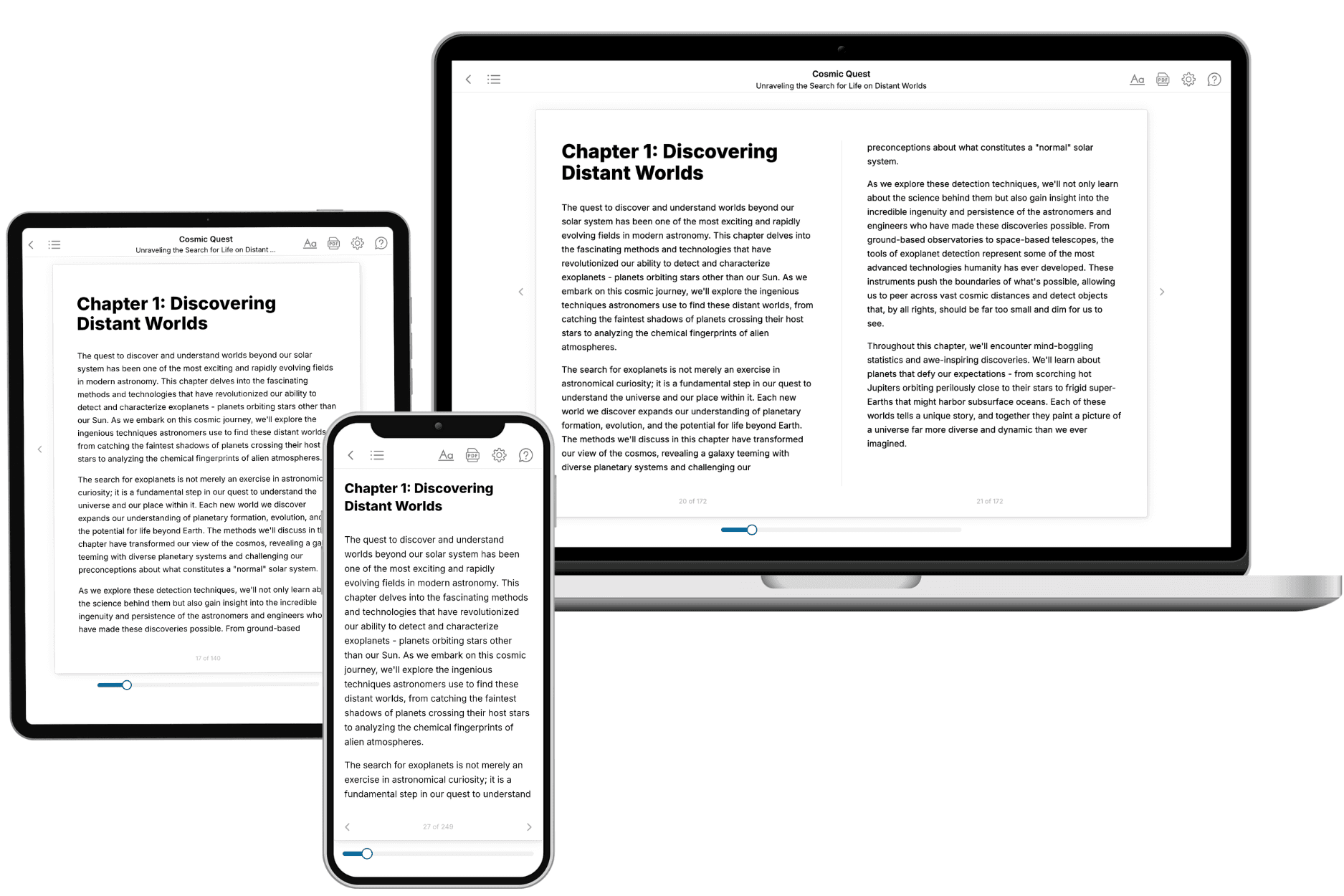
Your book is ready in 10 minutes. Read it online, download as EPUB or PDF, or send to Kindle.
Frequently asked questions
- What is TailoredRead?
TailoredRead creates complete, full-length nonfiction ebooks, written specifically for you. Tell us what you want to learn and why, and TailoredRead writes you a complete ebook on it, with charts, tables, and diagrams throughout. Read it online, on Kindle, or on any e-reader, or download it as a PDF or EPUB. Every book is written fresh the day you order it.
- How is the book tailored to me?
Before anything is written, you answer a few short questions about your goals, your background, and the topics you care about. Your book is then planned around your answers: written at your level, focused on your goals, and covering the topics you chose, instead of the one-size-fits-all book a store sells everyone.
- Will it read like generic AI content?
No. Your book isn't a chat transcript: it's planned chapter by chapter before a single word is written, told in a clear book voice, and explains ideas visually with charts, tables, and diagrams. After writing, every book goes through an editorial pass that polishes chapters so the book reads consistent from start to finish. Judge for yourself: browse thousands of sample books on our Explore Books page.
- How accurate is the content?
Our AI first checks whether your subject needs live research. Niche and fast-moving subjects are researched before writing, and the book plan and chapters are grounded in what it finds. After writing, every book goes through a quality pass that checks its facts and consistency, and researched books list their sources in a Notes section at the back.
- How long is the book?
You choose the length: Comprehensive (250-300 pages), Detailed (150-200 pages), Essential (70-100 pages), or Short (30-50 pages).
- Does the book include visuals?
Yes. Every book includes charts, tables, and diagrams: timelines, checklists, step-by-step guides, decision trees, comparison tables, matrices, and bar charts. A typical book includes dozens of these visual elements.
- Can I read it on Kindle? What formats can I download?
Yes. Every book can be read in our online reader or downloaded as a PDF or EPUB. The EPUB can be opened with Kindle, Apple Books, Kobo, and any e-reader. The Commercial and Author licenses also include an editable Word (DOCX) and Markdown download.
- How much does it cost?
About the price of a regular ebook. The exact price depends on your book's length and complexity, from $2 for the shortest books to $35 for the most comprehensive, and it's shown when you review your book, before you commit to anything. Each book is a one-time purchase, yours to keep, no subscription. Licenses that let you share, teach, or publish your book range from $35.99 to $49.99.
- Can I preview the book before purchasing?
Before you pay, you'll see what your book will cover: the title, a detailed description, the estimated length, and the complete chapter-by-chapter table of contents, so you know what you're getting before you decide. The full text itself is written after you purchase.
- How long does it take to create a book?
About 10 minutes. You can start reading the opening chapters while the rest is still being written.