Hopfield Networks Mastery
Understanding Associative Memory and Pattern Recognition in Neural Networks
Picture yourself confidently designing neural network systems that can remember, recognize, and reconstruct complex patterns with remarkable accuracy.
300 pages15 chaptersEnglishSep 14, 2025AI and Machine Learning
About this book
You'll understand the elegant mathematical principles behind associative memory and possess the practical skills to implement these powerful computational models in your own projects. This comprehensive guide takes you deep into the world of Hopfield Networks, revealing how these fascinating neural architectures store memories and retrieve information through energy minimization. You'll discover the mathematical foundations that make pattern completion possible, explore the delicate balance between storage capacity and retrieval accuracy, and learn to navigate the rich landscape of network dynamics. From the original discrete Hopfield model to modern continuous and quantum variations, you'll master both theoretical concepts and practical implementation techniques. Each chapter builds systematically on previous knowledge, ensuring you develop a solid understanding of energy functions, convergence properties, and optimization landscapes. Whether you're working on image recognition systems, developing optimization algorithms, or researching advanced neural architectures, this book provides the deep understanding and practical tools you need to harness the power of associative memory networks in your work.
Table of contents
- IntroductionNeural Networks and Memory, The Significance of Hopfield Networks, How This Book Is Structured, Prerequisites and BackgroundRead below
- Chapter 1: Foundations of Neural NetworksArtificial Neurons and Activation Functions, Network Architectures and Connectivity, Learning Paradigms in Neural Networks, Introduction to Recurrent Networks
- Chapter 2: The Origins of Hopfield NetworksHistorical Context and Motivation, The Original Hopfield Model, Biological Inspiration and Neural Basis, Early Applications and Discoveries
- Chapter 3: Mathematical FrameworkNetwork Structure and Weight Matrix, State Representation and Dynamics, The Energy Function, Stability and Equilibrium Analysis
- Chapter 4: Discrete Hopfield NetworksBinary Neurons and Threshold Functions, Synchronous and Asynchronous Update Rules, Convergence Properties and Guarantees, Basic Implementation Techniques
- Chapter 5: Energy Landscapes and DynamicsEnergy Minimization Principles, Local Minima and Attractors, Basins of Attraction, Spurious States and Their Impact
- Chapter 6: Pattern Storage MechanismsHebbian Learning Rule, Weight Matrix Calculation, Orthogonal and Correlated Patterns, Storage Algorithms and Techniques
- Chapter 7: Storage Capacity and LimitationsTheoretical Storage Capacity, Mathematical Analysis of Capacity Limits, Pattern Interference and Crosstalk, Strategies for Capacity Optimization
- Chapter 8: Pattern Retrieval and RecognitionThe Pattern Retrieval Process, Retrieval from Partial Cues, Noise Tolerance and Robustness, Pattern Completion Accuracy
- Chapter 9: Continuous Hopfield NetworksContinuous Neuron Models, Differential Equation Dynamics, Energy Functions in Continuous Networks, Analog Implementation Considerations
- Chapter 10: Optimization and Computational ApplicationsCombinatorial Optimization Problems, Constraint Satisfaction Networks, Mapping Problems to Network Structure, Performance Analysis and Benchmarking
- Chapter 11: Modern Variations and ExtensionsQuantum Hopfield Networks, Sparse Hopfield Networks, Hierarchical Hopfield Models, Hybrid Network Architectures
- Chapter 12: Implementation and ProgrammingProgramming Fundamentals, Efficient Data Structures, Algorithm Optimization Techniques, Debugging and Testing Strategies
- Chapter 13: Real-World ApplicationsImage Processing and Recognition, Data Reconstruction and Completion, Content-Addressable Memory Systems, Pattern Classification Applications
- Chapter 14: Performance Analysis and EvaluationPerformance Metrics and Measurement, Benchmarking Methods, Comparative Analysis with Other Methods, Scalability Assessment
- Chapter 15: Advanced Topics and Research FrontiersRecent Theoretical Advances, Neuromorphic Computing Applications, Connections to Deep Learning, Future Research Directions
- Conclusion
- Glossary
- Further Reading
Introduction
Neural networks have revolutionized artificial intelligence by mimicking the computational principles of biological brains, yet one of their most fascinating capabilities remains largely underexplored in mainstream applications: associative memory. Unlike traditional computer memory that requires precise addresses to retrieve information, associative memory allows systems to recall complete patterns from partial or noisy inputs, much like how you can remember an entire song from hearing just a few notes. This remarkable ability forms the foundation of Hopfield Networks, a class of recurrent neural networks that has profoundly influenced our understanding of memory, pattern recognition, and computational dynamics in artificial systems.
The journey into Hopfield Networks begins with a simple yet powerful observation: memories are not stored in isolation but exist as interconnected patterns that can trigger and reinforce each other. When John Hopfield introduced his groundbreaking model in 1982, he demonstrated how networks of simple artificial neurons could exhibit complex emergent behaviors, including the ability to store multiple patterns simultaneously and retrieve them reliably even when presented with incomplete or corrupted versions. This breakthrough bridged the gap between theoretical neuroscience and practical computation, offering insights into both how biological brains might store memories and how artificial systems could be designed to exhibit similar capabilities.
What makes Hopfield Networks particularly compelling is their elegant mathematical foundation, which connects concepts from physics, neuroscience, and computer science into a unified framework. The network's behavior can be understood through energy landscapes, where stored patterns correspond to stable states that the system naturally gravitates toward during operation. This physical analogy provides intuitive understanding while maintaining mathematical rigor, making Hopfield Networks an ideal entry point for understanding more complex neural architectures and their underlying principles.
Today, as artificial intelligence systems become increasingly sophisticated, the principles underlying Hopfield Networks continue to influence cutting-edge research in areas ranging from optimization algorithms to quantum computing. Modern variations extend the original discrete model to continuous dynamics, quantum mechanical systems, and hierarchical architectures that can handle increasingly complex pattern recognition tasks. Understanding these networks provides essential insights into the fundamental mechanisms of memory, learning, and pattern completion that underlie many contemporary AI applications.
Neural Networks and Memory
Traditional computing systems store information in discrete memory locations, each accessible through specific addresses that must be known precisely to retrieve the stored data. This approach, while highly efficient for many computational tasks, differs fundamentally from how biological systems appear to organize and access memories. In biological neural networks, memories seem to be distributed across interconnected networks of neurons, where the activation of one memory can trigger related memories through associative connections. This distributed storage mechanism provides remarkable robustness against damage and enables sophisticated pattern completion capabilities that traditional computing struggles to replicate efficiently.
The concept of associative memory represents a paradigm shift from address-based storage to content-based retrieval systems. In associative memory, the content itself serves as the key for retrieval, allowing systems to reconstruct complete patterns from partial inputs. Consider how you might remember a person's name when you see their face, or how hearing a familiar melody can trigger memories of specific events or emotions. These examples illustrate the power of associative connections, where one piece of information naturally leads to related information without requiring explicit addressing mechanisms.
Neural networks designed for associative memory must solve several challenging problems simultaneously:
- Pattern Storage: How to encode multiple patterns in the same network without interference
- Pattern Retrieval: How to reconstruct complete patterns from partial or noisy inputs
- Capacity Management: How to determine the maximum number of patterns that can be stored reliably
- Stability Assurance: How to ensure the network converges to stable states rather than oscillating indefinitely
The mathematical foundation for neural associative memory draws heavily from concepts in statistical physics and dynamical systems theory. Each possible state of the network can be assigned an energy value, creating an energy landscape where stored patterns correspond to local minima. During retrieval, the network naturally evolves toward these low-energy states, effectively "rolling downhill" in the energy landscape until it reaches a stable configuration. This physical analogy provides both intuitive understanding and rigorous mathematical tools for analyzing network behavior and predicting performance characteristics.
Biological inspiration for associative memory comes from observations of how neurons in the brain form and strengthen connections based on correlated activity. The famous principle neurons that fire together, wire together
captures the essence of Hebbian learning, where synaptic connections between neurons strengthen when they are active simultaneously. This learning rule provides a biologically plausible mechanism for storing patterns in neural networks, where each pattern corresponds to a specific configuration of neural activities that has been reinforced through repeated exposure or training.
Modern neuroscience research has revealed that biological associative memory involves complex interactions between multiple brain regions, with different areas specializing in different aspects of memory formation, storage, and retrieval. The hippocampus, for example, appears to play a crucial role in forming new associative memories, while the neocortex provides long-term storage for established patterns. These discoveries continue to inspire new architectures for artificial associative memory systems that can capture increasingly sophisticated aspects of biological memory processing.
The practical implications of associative memory extend far beyond academic interest, with applications in pattern recognition, data reconstruction, optimization, and content-addressable storage systems. Unlike traditional databases that require exact matches for queries, associative memory systems can handle approximate queries and return the most similar stored patterns. This capability proves invaluable in real-world scenarios where input data may be incomplete, noisy, or slightly different from stored templates, such as in image recognition systems that must identify objects under varying lighting conditions or viewing angles.
Understanding associative memory also provides insights into the fundamental nature of intelligence and cognition. The ability to recognize patterns, complete partial information, and make associations between related concepts forms the basis for higher-level cognitive functions including reasoning, creativity, and problem-solving. By studying how artificial systems can exhibit these capabilities, we gain deeper appreciation for the computational principles that might underlie biological intelligence and develop better tools for creating intelligent artificial systems.
The Significance of Hopfield Networks
John Hopfield's 1982 paper Neural networks and physical systems with emergent collective computational abilities
marked a watershed moment in neural network research, introducing a model that was both mathematically tractable and biologically inspired[1]. Unlike previous neural network models that were often difficult to analyze theoretically, Hopfield Networks provided a clear mathematical framework based on energy minimization principles borrowed from statistical physics. This breakthrough enabled researchers to make precise predictions about network behavior, calculate storage capacities, and understand the conditions under which the networks would converge to stable states.
The significance of Hopfield's contribution extends beyond the specific model he proposed to encompass a new way of thinking about computation in neural systems. By demonstrating how simple local interactions between artificial neurons could give rise to complex global behaviors like pattern storage and retrieval, Hopfield showed that emergent computation was not merely a biological curiosity but a principle that could be harnessed in artificial systems. This insight influenced subsequent research in areas ranging from artificial neural networks to swarm intelligence and distributed computing systems.
From a theoretical perspective, Hopfield Networks provided the first rigorous connection between neural computation and well-established principles from physics. The network's energy function, analogous to the Hamiltonian in physical systems, allowed researchers to apply powerful mathematical tools from statistical mechanics to understand neural dynamics. This connection revealed deep relationships between:
- Network states and physical configurations: Each pattern of neural activities corresponds to a point in a high-dimensional state space
- Learning and energy landscape shaping: Storing patterns creates valleys in the energy landscape where the system naturally settles
- Retrieval and energy minimization: Pattern completion occurs through gradient descent in the energy landscape
- Capacity limits and phase transitions: Storage capacity exhibits sharp transitions similar to phase changes in physical materials
The practical impact of Hopfield Networks became apparent as researchers began applying them to real-world problems. One of the most famous early applications was the traveling salesman problem, where Hopfield and Tank demonstrated how optimization problems could be mapped onto neural network dynamics[2]. While this particular application had mixed success, it established the principle that neural networks could serve as analog computers for solving complex optimization problems, inspiring decades of research into neural optimization algorithms.
Perhaps more importantly, Hopfield Networks served as a conceptual bridge between different fields of study. Computer scientists gained new perspectives on parallel processing and distributed computation, while physicists found new applications for statistical mechanics in understanding information processing systems. Neuroscientists obtained mathematical tools for modeling memory and learning, while engineers discovered new approaches to pattern recognition and signal processing. This interdisciplinary fertilization continues to generate new insights and applications across multiple domains.
The influence of Hopfield Networks on subsequent neural network research cannot be overstated. Many fundamental concepts that are now taken for granted in the field trace their origins to Hopfield's work:
These concepts continue to influence modern deep learning architectures, particularly in areas involving memory, attention, and recurrent processing.The energy-based approach to understanding neural dynamics, the use of recurrent connections for memory storage, the application of statistical physics to neural computation, and the recognition that simple local rules can produce complex global behaviors all stem from insights first articulated in the context of Hopfield Networks.
Modern variations of Hopfield Networks have found applications in cutting-edge research areas including quantum computing, neuromorphic hardware, and advanced optimization algorithms. Recent work has shown that Hopfield Networks can be extended to continuous variables, quantum mechanical systems, and hierarchical architectures that can handle much more complex pattern recognition tasks than the original discrete model. These extensions demonstrate the enduring relevance of Hopfield's original insights and their continued potential for addressing contemporary computational challenges.
The educational value of Hopfield Networks also deserves recognition. Their relative simplicity compared to modern deep learning architectures makes them ideal for understanding fundamental principles of neural computation without getting lost in implementation details. Students can implement basic Hopfield Networks with minimal code, experiment with different parameters, and observe emergent behaviors firsthand. This hands-on experience provides intuitive understanding of concepts like energy landscapes, convergence dynamics, and capacity limitations that apply broadly across neural network architectures.
How This Book Is Structured
This book follows a carefully designed progression that builds your understanding systematically from fundamental concepts to advanced applications and research frontiers. The structure reflects both the historical development of the field and the logical dependencies between different topics, ensuring that each chapter provides the necessary foundation for subsequent material. Whether you're approaching Hopfield Networks for the first time or seeking to deepen existing knowledge, this organization allows you to engage with the material at an appropriate level while maintaining clear sight of how individual concepts contribute to the broader understanding of associative memory systems.
The opening chapters establish essential foundations, beginning with a comprehensive review of neural network principles that provides context for understanding Hopfield Networks within the broader landscape of artificial intelligence. Chapter 1 covers artificial neurons, network architectures, and learning paradigms, while Chapter 2 explores the historical context and biological inspiration that led to Hopfield's breakthrough. These chapters ensure that readers from diverse backgrounds can engage with subsequent material on equal footing, regardless of their prior exposure to neural networks or neuroscience.
The mathematical core of the book spans Chapters 3 through 8, where you'll develop deep understanding of the theoretical principles that govern Hopfield Network behavior. This section progresses logically through:
- Mathematical Framework (Chapter 3): Network structure, state representation, and the fundamental energy function
- Discrete Hopfield Networks (Chapter 4): Binary neurons, update rules, and convergence properties
- Energy Landscapes (Chapter 5): Energy minimization, attractors, and spurious states
- Pattern Storage (Chapter 6): Hebbian learning and weight matrix calculation
- Capacity Limits (Chapter 7): Theoretical storage capacity and optimization strategies
- Pattern Retrieval (Chapter 8): Retrieval dynamics, noise tolerance, and completion accuracy
Chapters 9 through 11 expand your knowledge to encompass modern variations and extensions of the original Hopfield model. Chapter 9 introduces continuous Hopfield Networks with their differential equation dynamics and analog implementation considerations. Chapter 10 explores optimization applications, showing how Hopfield Networks can solve combinatorial problems and constraint satisfaction tasks. Chapter 11 surveys cutting-edge variations including quantum Hopfield Networks, sparse architectures, and hierarchical models that push the boundaries of what associative memory systems can accomplish.
The practical implementation section, comprising Chapters 12 and 13, bridges the gap between theoretical understanding and real-world application. Chapter 12 provides comprehensive guidance on programming Hopfield Networks, covering data structures, algorithm optimization, and debugging strategies with concrete code examples in multiple programming languages. Chapter 13 showcases real-world applications in image processing, data reconstruction, content-addressable memory, and pattern classification, complete with case studies and performance analysis.
The final chapters, 14 and 15, address performance evaluation and advanced research topics respectively. Chapter 14 covers metrics, benchmarking methods, and comparative analysis techniques that allow you to assess Hopfield Network performance objectively. Chapter 15 explores research frontiers including neuromorphic computing applications, connections to deep learning, and future research directions that may shape the field's evolution.
Throughout the book, several pedagogical features enhance learning and retention:
These features support different learning styles and allow you to engage with the material at multiple levels of depth.Each chapter begins with clear learning objectives and ends with summary points that reinforce key concepts. Mathematical derivations are presented step-by-step with intuitive explanations alongside formal proofs. Code examples progress from simple illustrations to complete implementations that you can run and modify. Exercises range from basic concept checks to challenging research-level problems that encourage deeper exploration.
The book's modular structure also supports flexible reading approaches. While the chapters are designed to build upon each other, experienced readers may choose to focus on specific topics of interest. Cross-references throughout the text help you navigate dependencies and find related material efficiently. Advanced readers might skip the foundational chapters and dive directly into modern variations or implementation details, while beginners can work through the material systematically to build comprehensive understanding.
Special attention has been paid to connecting theoretical concepts with practical applications throughout the book. Rather than treating theory and practice as separate domains, each theoretical concept is illustrated with concrete examples and potential applications. This approach helps you understand not just how Hopfield Networks work, but why they matter and how they can be applied to solve real problems in artificial intelligence and machine learning.
Prerequisites and Background
This book assumes you have intermediate-level knowledge in several key areas, though the specific depth required varies across different topics. The mathematical prerequisites include linear algebra at the level of matrix operations, eigenvalues, and vector spaces, as these concepts are fundamental to understanding network dynamics and stability analysis. You should be comfortable with calculus including partial derivatives and basic optimization theory, since energy functions and gradient descent play central roles in Hopfield Network analysis. Additionally, familiarity with probability theory and basic statistics will help you understand capacity analysis and performance evaluation methods discussed in later chapters.
From a computer science perspective, you should have solid programming experience in at least one high-level language such as Python, MATLAB, or similar environments commonly used for scientific computing. While the book provides code examples and implementation guidance, you'll benefit most from hands-on experimentation with the concepts presented. Basic knowledge of algorithms and data structures will help you understand efficiency considerations and implementation trade-offs. Familiarity with machine learning concepts such as training, testing, and cross-validation will provide useful context, though the book explains these concepts as they relate specifically to Hopfield Networks.
The neuroscience background required is minimal but helpful for understanding biological motivation and inspiration. Basic knowledge of how neurons communicate through synapses and the general principles of neural plasticity will enhance your appreciation of the biological foundations underlying Hopfield Networks. However, the book provides sufficient biological context to make the material accessible to readers without extensive neuroscience training. The focus remains on computational principles rather than detailed biological mechanisms.
Physics background, while not strictly required, can provide valuable intuition for understanding energy-based approaches to neural computation. Familiarity with concepts from statistical mechanics such as energy minimization, equilibrium states, and phase transitions will help you grasp the physical analogies that make Hopfield Networks mathematically tractable. However, the book introduces these concepts from first principles, making the material accessible to readers without formal physics training.
If you find gaps in your background knowledge, several strategies can help you prepare for or supplement your reading:
- Mathematical Review: Khan Academy, MIT OpenCourseWare, and similar platforms offer excellent refreshers on linear algebra and calculus
- Programming Practice: Implement simple neural network examples to build familiarity with matrix operations and iterative algorithms
- Machine Learning Basics: Andrew Ng's Machine Learning course provides excellent foundation in core concepts
- Physics Intuition: Popular science books on statistical mechanics can provide helpful intuitive understanding without mathematical complexity
For readers with strong backgrounds in modern deep learning but limited exposure to classical neural networks, some adjustment in perspective may be helpful. Hopfield Networks operate on different principles than feedforward architectures commonly used in contemporary applications. The emphasis on energy minimization, recurrent dynamics, and associative memory requires thinking about neural computation in terms of dynamical systems rather than function approximation. This shift in perspective, while initially challenging, provides valuable insights into alternative approaches to neural computation that complement modern techniques.
Conversely, readers with strong theoretical backgrounds but limited practical experience should pay particular attention to the implementation chapters and work through the provided code examples. Understanding how theoretical concepts translate into working systems requires hands-on experience that cannot be gained through reading alone. The book provides scaffolding for this practical work, but active engagement with implementation exercises is essential for developing comprehensive understanding.
The book also assumes familiarity with standard mathematical notation and conventions used in neural network literature. Vectors are typically denoted with bold lowercase letters, matrices with bold uppercase letters, and scalars with regular typeface. Summation notation, partial derivatives, and matrix operations appear frequently throughout the mathematical development. While the book defines specialized notation as it's introduced, comfort with standard mathematical conventions will facilitate smoother reading.
Finally, this book is designed for readers who want to go beyond superficial understanding to develop genuine expertise in Hopfield Networks. This requires willingness to engage with mathematical details, work through derivations, and implement concepts in code. While the presentation aims for clarity and accessibility, the material is inherently technical and requires active engagement rather than passive reading. The reward for this effort is deep understanding of fundamental principles that apply broadly across neural network architectures and provide foundation for advanced research and application development.
Notes
Introduction
This is the end of the free sample. The full book has 15 chapters.
Want this book written for you?
Tell us your goals and background, and get your own version of this book, tailored by AI to you.


Benefits of AI-tailored books
- Read one book, not ten:
- all the AI and Machine Learning knowledge you need, gathered into a single book.
- Save days of learning:
- tell us your goals, choose your topics, and the whole book is built around them.
- Learn effortlessly:
- AI and Machine Learning book written for your specific background and expertise.
- Understand at a glance:
- includes charts, tables, timelines, checklists, decision trees, and more.
- Stay current:
- written the day you order it, not years ago.
- Trust what you read:
- every book is checked for accuracy, with real research when your subject needs it.
Create your unique book in 3 steps
- 1. Select your focus
Select the focus of your AI and Machine Learning book and share your background
- 2. Personalize your book
Specify your goals and choose sub-topics to include
- 3. Get your tailored book
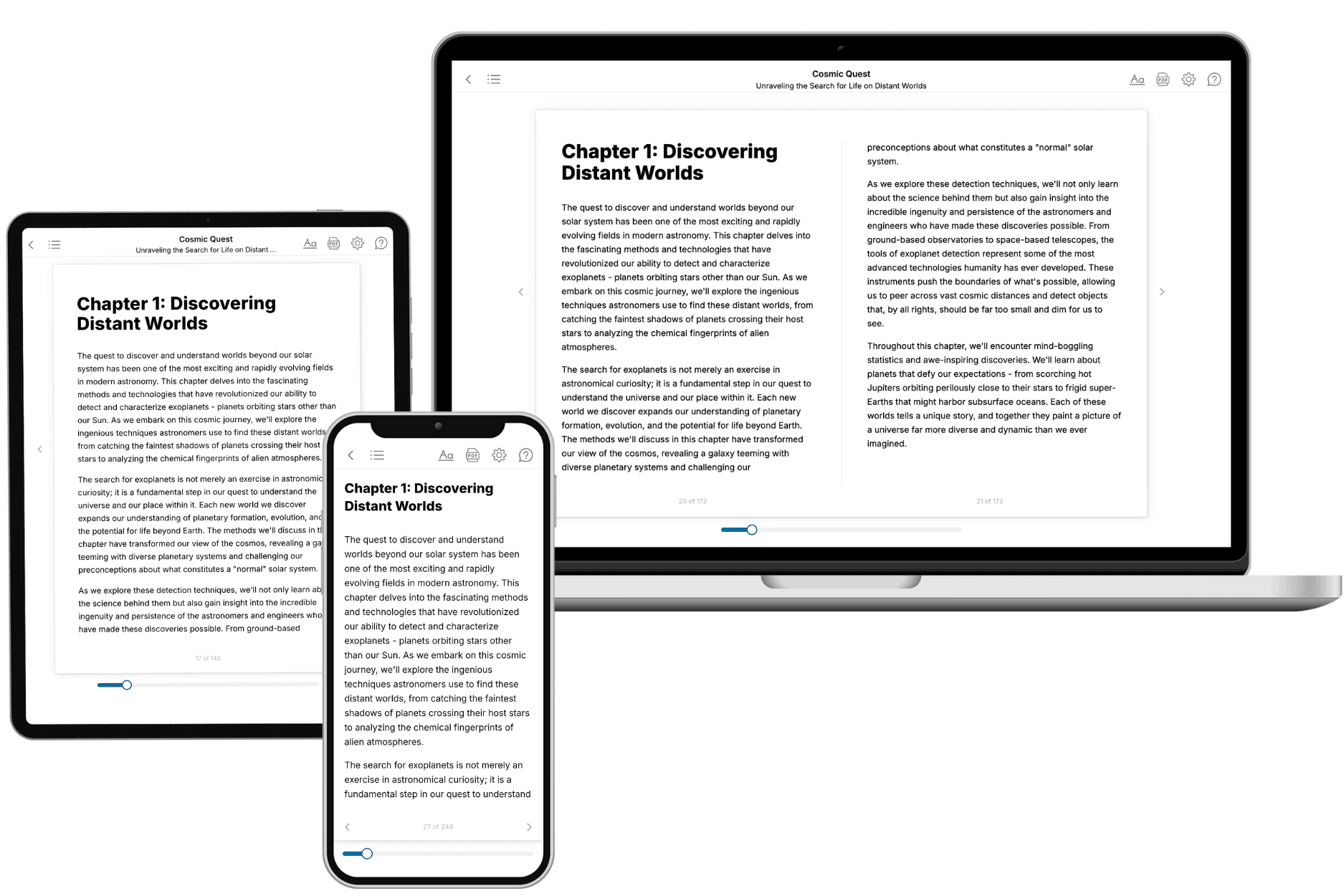
Your book is ready in 10 minutes. Read it online, download as EPUB or PDF, or send to Kindle.

Frequently asked questions
- What is TailoredRead?
TailoredRead creates complete, full-length nonfiction ebooks, written specifically for you. Tell us what you want to learn and why, and TailoredRead writes you a complete ebook on it, with charts, tables, and diagrams throughout. Read it online, on Kindle, or on any e-reader, or download it as a PDF or EPUB. Every book is written fresh the day you order it.
- How is the book tailored to me?
Before anything is written, you answer a few short questions about your goals, your background, and the topics you care about. Your book is then planned around your answers: written at your level, focused on your goals, and covering the topics you chose, instead of the one-size-fits-all book a store sells everyone.
- Will it read like generic AI content?
No. Your book isn't a chat transcript: it's planned chapter by chapter before a single word is written, told in a clear book voice, and explains ideas visually with charts, tables, and diagrams. After writing, every book goes through an editorial pass that polishes chapters so the book reads consistent from start to finish. Judge for yourself: browse thousands of sample books on our Explore Books page.
- How accurate is the content?
Our AI first checks whether your subject needs live research. Niche and fast-moving subjects are researched before writing, and the book plan and chapters are grounded in what it finds. After writing, every book goes through a quality pass that checks its facts and consistency, and researched books list their sources in a Notes section at the back.
- How long is the book?
You choose the length: Comprehensive (250-300 pages), Detailed (150-200 pages), Essential (70-100 pages), or Short (30-50 pages).
- Does the book include visuals?
Yes. Every book includes charts, tables, and diagrams: timelines, checklists, step-by-step guides, decision trees, comparison tables, matrices, and bar charts. A typical book includes dozens of these visual elements.
- Can I read it on Kindle? What formats can I download?
Yes. Every book can be read in our online reader or downloaded as a PDF or EPUB. The EPUB can be opened with Kindle, Apple Books, Kobo, and any e-reader. The Commercial and Author licenses also include an editable Word (DOCX) and Markdown download.
- How much does it cost?
About the price of a regular ebook. The exact price depends on your book's length and complexity, from $2 for the shortest books to $35 for the most comprehensive, and it's shown when you review your book, before you commit to anything. Each book is a one-time purchase, yours to keep, no subscription. Licenses that let you share, teach, or publish your book range from $35.99 to $49.99.
- Can I preview the book before purchasing?
Before you pay, you'll see what your book will cover: the title, a detailed description, the estimated length, and the complete chapter-by-chapter table of contents, so you know what you're getting before you decide. The full text itself is written after you purchase.
- How long does it take to create a book?
About 10 minutes. You can start reading the opening chapters while the rest is still being written.