Illuminating Pixels
A Practical Guide to Ray Tracing in Computer Graphics
Dive into the fascinating world of ray tracing with "Illuminating Pixels: A Practical Guide to Ray Tracing in Computer Graphics." This comprehensive guide takes you on a journey through the intricate realm of computer graphics, focusing on the powerful technique of ray tracing.
284 pages14 chaptersDec 6, 2024Computer Graphics
About this book
From the fundamentals of light behavior to advanced optimization strategies, this book covers everything you need to know to master ray tracing. You'll explore the mathematical foundations, learn how to implement basic and advanced algorithms, and discover techniques to create stunning, photorealistic images. Whether you're a game developer, a 3D artist, or a computer graphics enthusiast, this book will equip you with the knowledge and skills to bring your virtual worlds to life. With practical examples, clear explanations, and hands-on exercises, you'll be ray tracing like a pro in no time. Get ready to illuminate your understanding of computer graphics and take your projects to the next level!
Table of contents
- IntroductionWhat is Ray Tracing?, A Brief History of Ray Tracing, The Importance of Ray Tracing in Computer Graphics, Book Overview and How to Use This GuideRead below
- Chapter 1: Fundamentals of Computer GraphicsCoordinate Systems and Transformations, Vector and Matrix Operations, Color Theory and Representation, Basic Light Behavior and Optics
- Chapter 2: Ray Tracing BasicsThe Concept of a Ray, Camera Models and Ray Generation, Ray-Object Intersection, Basic Shading and Lighting
- Chapter 3: Scene RepresentationGeometric Primitives, Object Transformations, Scene Graph Structure, Material Properties and Textures
- Chapter 4: Ray Intersection TechniquesRay-Sphere Intersection, Ray-Plane and Ray-Triangle Intersection, Ray-Box Intersection, Numerical Methods for Complex Surfaces
- Chapter 5: Shading and Lighting ModelsThe Phong Reflection Model, Blinn-Phong and Other Local Illumination Models, Implementing Shadows, Ambient Occlusion
- Chapter 6: Reflection and RefractionPerfect Reflection, The Fresnel Effect, Refraction and Snell's Law, Total Internal Reflection
- Chapter 7: Acceleration StructuresBounding Volume Hierarchies (BVH), KD-Trees, Octrees and Spatial Partitioning, Grid-Based Acceleration
- Chapter 8: Monte Carlo Ray TracingIntroduction to Monte Carlo Methods, Path Tracing, Importance Sampling, Bidirectional Path Tracing
- Chapter 9: Advanced Lighting EffectsSoft Shadows and Area Lights, Caustics, Subsurface Scattering, Volumetric Lighting and Participating Media
- Chapter 10: Advanced Material ModelingMicrofacet Theory, BRDF Models, Measured Materials, Procedural Textures and Shaders
- Chapter 11: Optimization TechniquesParallel Processing on CPUs, GPU Acceleration, Ray Packets and SIMD, Adaptive Sampling and Reconstruction
- Chapter 12: Real-Time Ray TracingHybrid Rendering Techniques, Denoising Strategies, Exploiting Temporal Coherence, Hardware Acceleration for Ray Tracing
- Chapter 13: Ray Tracing in ProductionRay Tracing in Film and VFX, Integration with Game Engines, Architectural Visualization, Scientific Visualization and Simulation
- Chapter 14: Future Directions in Ray TracingMachine Learning and Ray Tracing, Cloud-Based Rendering, Quantum Computing and Ray Tracing, Emerging Technologies and Their Impact
- ConclusionRecap of Key Concepts, Continuing Your Ray Tracing Journey
- Glossary
- Further Reading
Introduction
Welcome to the captivating world of ray tracing in computer graphics. As you embark on this journey through "Illuminating Pixels: A Practical Guide to Ray Tracing in Computer Graphics," you're about to discover a technique that has revolutionized the way we create and perceive digital imagery. This introduction will lay the foundation for your exploration of ray tracing, providing you with a comprehensive overview of what ray tracing is, its historical context, its significance in the field of computer graphics, and how to make the most of this guide.
Ray tracing is not just a rendering technique; it's a gateway to creating stunningly realistic digital worlds. Whether you're a game developer striving for photorealistic environments, a 3D artist aiming to produce lifelike visualizations, or a computer graphics enthusiast eager to understand the magic behind your favorite animated films, ray tracing is a crucial skill to master. Throughout this book, you'll gain insights into the underlying principles, learn practical implementation techniques, and discover how to optimize your ray tracing algorithms for various applications.
As we delve into the intricacies of ray tracing, you'll find that this guide is designed to be both comprehensive and accessible. Each chapter builds upon the previous one, gradually introducing more advanced concepts while reinforcing fundamental principles. By the end of this journey, you'll have the knowledge and skills to implement sophisticated ray tracing techniques in your own projects, pushing the boundaries of what's possible in computer-generated imagery.
What is Ray Tracing?
At its core, ray tracing is a rendering technique that simulates the behavior of light to create highly realistic images. Unlike traditional rasterization methods, which project 3D objects onto a 2D plane, ray tracing works by tracing the path of light rays as they interact with virtual objects in a scene. This approach allows for the accurate simulation of complex lighting phenomena, resulting in images that can be virtually indistinguishable from photographs of real-world scenes.
The fundamental concept behind ray tracing is deceptively simple: for each pixel in the final image, we cast a ray from the virtual camera through that pixel and into the scene. As this ray travels through the virtual environment, it interacts with various objects, potentially reflecting, refracting, or being absorbed. By carefully calculating these interactions, we can determine the color and intensity of light that should be displayed for each pixel, effectively "painting" our image one ray at a time.
One of the key strengths of ray tracing is its ability to naturally handle a wide range of optical effects. Reflections, for instance, are simulated by following the path of a ray as it bounces off reflective surfaces. Refractions, such as those seen through glass or water, are modeled by calculating how light bends as it passes through different materials. Shadows are created by tracing rays from surfaces to light sources, checking for obstructions along the way. These effects, which can be challenging to achieve convincingly with other rendering techniques, emerge naturally from the ray tracing algorithm.
Ray tracing also excels at simulating global illumination, which accounts for the complex interplay of light as it bounces around a scene. This includes effects like color bleeding, where light reflected from one surface influences the appearance of nearby objects, and caustics, the intricate patterns of light formed when rays are focused by reflective or refractive surfaces. By accurately modeling these subtle lighting interactions, ray tracing can produce images with a depth and realism that is difficult to achieve through other means.
It's important to note that ray tracing is not a single, monolithic technique, but rather a family of related algorithms and approaches. At its simplest, a ray tracer might only consider direct lighting and perfect reflections. More sophisticated implementations might incorporate Monte Carlo methods to simulate diffuse inter-reflections, or use advanced acceleration structures to efficiently handle complex scenes with millions of objects. Throughout this book, we'll explore this spectrum of techniques, from the fundamental principles to cutting-edge advancements in the field.
While ray tracing offers unparalleled realism, it has traditionally been associated with high computational costs. Each ray must be traced through the scene, potentially spawning multiple secondary rays for reflections, refractions, and shadow calculations. For complex scenes with many light sources and objects, this can result in billions of ray-object intersection tests for a single image. As a result, ray tracing was long considered too slow for real-time applications, relegated primarily to offline rendering for films and high-end visual effects.
However, recent advancements in hardware and software have dramatically changed this landscape. The advent of powerful GPUs with dedicated ray tracing cores, coupled with sophisticated acceleration algorithms and denoising techniques, has brought real-time ray tracing within reach. This has led to a renaissance in computer graphics, with ray tracing features now appearing in consumer-grade graphics cards and being integrated into popular game engines.
As you progress through this book, you'll gain a deep understanding of how ray tracing works, from the mathematical foundations to practical implementation details. You'll learn how to build a basic ray tracer from scratch, optimize its performance, and extend it with advanced features. By the end, you'll be well-equipped to harness the power of ray tracing in your own projects, whether you're developing cutting-edge games, creating stunning visual effects, or pushing the boundaries of scientific visualization.
Ray tracing is more than just a rendering technique; it's a powerful tool for understanding and simulating the behavior of light in virtual environments. As we embark on this journey together, prepare to see the digital world in a new light, illuminated by the countless rays we'll trace through our virtual pixels.
A Brief History of Ray Tracing
The concept of ray tracing has its roots in the early days of computer graphics, evolving from fundamental principles of optics and mathematics. To truly appreciate the significance of ray tracing in modern computer graphics, it's essential to understand its historical context and the key milestones that have shaped its development. This journey through time will not only provide you with valuable insights into the origins of ray tracing but also help you grasp the rapid advancements that have made it a cornerstone of contemporary rendering techniques.
The foundations of ray tracing can be traced back to the 17th century, when René Descartes and Pierre de Fermat developed theories about the behavior of light rays. These early optical theories laid the groundwork for understanding how light interacts with surfaces, a crucial concept in ray tracing. However, it wasn't until the advent of computer graphics in the mid-20th century that these principles could be applied to create synthetic images.
The first significant step towards modern ray tracing came in 1968 when Arthur Appel introduced the concept of "ray casting" in his paper "Some Techniques for Shading Machine Renderings of Solids"[1]. Ray casting involved tracing a single ray from the eye through each pixel of an image plane into a 3D scene, determining the closest object intersection for each ray. This technique allowed for the creation of simple shaded images and was a precursor to full ray tracing.
The term "ray tracing" itself was coined by Turner Whitted in his seminal 1979 paper "An Improved Illumination Model for Shaded Display"[2]. Whitted extended the concept of ray casting by introducing recursive ray tracing, which allowed for the simulation of reflection, refraction, and shadows. This breakthrough enabled the creation of images with much greater realism, including effects like mirror reflections and transparent objects, which were challenging to achieve with other rendering techniques of the time.
Throughout the 1980s and early 1990s, researchers continued to refine and expand upon Whitted's work. Notable advancements included the introduction of distributed ray tracing by Robert Cook, Thomas Porter, and Loren Carpenter in 1984[3]. This technique used multiple rays per pixel to simulate effects like motion blur, depth of field, and soft shadows, further enhancing the realism of rendered images. In 1986, James Kajiya introduced the rendering equation[4], which provided a formal mathematical framework for global illumination, encompassing both ray tracing and radiosity methods.
The 1990s saw the emergence of Monte Carlo ray tracing techniques, which used statistical sampling to solve the rendering equation. Path tracing, introduced by James Kajiya in 1986, and bidirectional path tracing, developed independently by Eric Lafortune and Yves Willems in 1993[5], allowed for the simulation of complex light transport phenomena, including indirect illumination and caustics. These methods significantly improved the accuracy of rendered images but came at the cost of increased computation time.
Despite these advancements, ray tracing remained primarily in the realm of offline rendering for many years due to its computational intensity. It was widely used in film production and high-end visual effects, where render times of hours or even days per frame were acceptable. Meanwhile, real-time graphics for applications like video games relied on rasterization techniques, which could produce images much more quickly, albeit with limitations in terms of lighting accuracy and certain visual effects.
The turn of the millennium brought renewed interest in accelerating ray tracing for interactive and real-time applications. Researchers began developing sophisticated acceleration structures and algorithms to reduce the number of ray-object intersection tests required. Notable contributions included the development of efficient bounding volume hierarchies (BVHs) and improvements to kd-tree construction and traversal algorithms.
A significant milestone in the quest for real-time ray tracing came in 2010 when NVIDIA researchers demonstrated the first real-time ray tracing system running entirely on GPUs[6]. This proof of concept showed that with sufficient parallel processing power, ray tracing could potentially be used for interactive applications.
The last decade has seen an explosion of advancements in real-time ray tracing. In 2018, NVIDIA introduced the first consumer-grade graphics cards with dedicated hardware ray tracing acceleration, marking a turning point in the accessibility of ray tracing technology. This was quickly followed by similar offerings from AMD and the integration of ray tracing capabilities into game consoles like the PlayStation 5 and Xbox Series X.
Today, ray tracing stands at the forefront of computer graphics technology. It's being used in combination with traditional rasterization techniques to create hybrid rendering pipelines that offer the best of both worlds: the speed of rasterization for primary visibility and the accuracy of ray tracing for complex lighting effects. The gaming industry has embraced ray tracing for enhancing reflections, shadows, and global illumination in real-time environments. Meanwhile, offline renderers continue to push the boundaries of photorealism, using advanced ray tracing techniques to create stunning visual effects for films and television.
As we look to the future, the role of ray tracing in computer graphics is set to expand even further. Advancements in hardware acceleration, coupled with innovative software techniques like machine learning-based denoising and adaptive sampling, are continuously improving the performance and quality of ray-traced images. The integration of ray tracing with emerging technologies like virtual and augmented reality promises to create even more immersive and realistic digital experiences.
Understanding this rich history of ray tracing provides valuable context for the techniques and concepts you'll explore in the rest of this book. As you delve deeper into the world of ray tracing, remember that you're building upon decades of research and innovation. The algorithms and methods you'll learn have been refined and optimized over many years, and continue to evolve as technology advances. By mastering these techniques, you'll be well-equipped to contribute to the next chapter in the ongoing story of ray tracing in computer graphics.
The Importance of Ray Tracing in Computer Graphics
Ray tracing has emerged as a cornerstone technology in the field of computer graphics, revolutionizing the way we create and interact with digital imagery. Its importance extends far beyond mere visual appeal, influencing various industries and applications. In this section, we'll explore the multifaceted significance of ray tracing, examining its impact on realism, efficiency, and the future of digital content creation.
At the heart of ray tracing's importance is its unparalleled ability to produce photorealistic images. By simulating the physical behavior of light, ray tracing can accurately render complex lighting phenomena that are challenging or impossible to achieve with traditional rasterization techniques. This includes effects such as physically accurate reflections, refractions, shadows, and global illumination. The result is imagery that can be virtually indistinguishable from photographs, a capability that has profound implications for industries ranging from film and gaming to architecture and product design.
In the film and visual effects industry, ray tracing has become an indispensable tool for creating convincing digital environments and characters. Movies like "Avatar" and "The Jungle Book" have leveraged ray tracing to blend computer-generated elements seamlessly with live-action footage[7]. The ability to accurately simulate light interaction allows visual effects artists to create digital assets that respond realistically to the lighting conditions of a scene, enhancing the overall believability of the final product.
The gaming industry has also embraced ray tracing as a means to elevate the visual fidelity of interactive experiences. With the advent of real-time ray tracing capabilities in consumer hardware, game developers can now incorporate more realistic lighting, reflections, and shadows into their titles. This not only enhances the visual appeal of games but also opens up new possibilities for gameplay mechanics that rely on accurate light simulation, such as stealth games with realistic shadow rendering or puzzle games that utilize reflections and refractions.
Beyond entertainment, ray tracing plays a crucial role in industries where accurate visualization is essential. In architecture and interior design, ray tracing enables the creation of photorealistic renderings that allow clients to visualize spaces before they are built. This can significantly streamline the design process, reduce costly revisions, and help in making informed decisions about materials and lighting. Similarly, in product design and manufacturing, ray tracing is used to create lifelike product visualizations, allowing designers to evaluate the appearance of materials and finishes under various lighting conditions without the need for physical prototypes.
The automotive industry has particularly benefited from advancements in ray tracing technology. Car manufacturers use ray tracing for both design visualization and virtual prototyping. By creating highly accurate digital models of vehicles, complete with realistic materials and lighting, designers can evaluate and refine their designs more efficiently. This extends to the development of advanced driver assistance systems (ADAS) and autonomous vehicles, where ray tracing is used to simulate various lighting and weather conditions for testing and training purposes[8].
In scientific visualization and research, ray tracing provides a means to accurately represent complex phenomena. Fields such as astrophysics use ray tracing to visualize the behavior of light around black holes and other cosmic structures. Medical imaging benefits from ray tracing in the creation of detailed 3D visualizations of scan data, aiding in diagnosis and surgical planning. The ability to accurately simulate light transport also makes ray tracing valuable in fields like optics and lens design, where it can be used to model and optimize optical systems.
The importance of ray tracing extends to its role in driving technological innovation. The pursuit of faster and more efficient ray tracing algorithms has spurred advancements in computer hardware, particularly in the development of specialized GPU architectures. This has had a ripple effect across the computing industry, benefiting not just graphics applications but also fields like scientific computing and machine learning that can leverage similar parallel processing capabilities.
Moreover, ray tracing has become a catalyst for research in related areas of computer graphics. The quest for more realistic rendering has led to advancements in material modeling, with techniques like physically based rendering (PBR) becoming industry standards. The computational demands of ray tracing have also driven innovation in acceleration structures and sampling techniques, which have applications beyond rendering in areas like computational geometry and Monte Carlo simulations.
Looking to the future, the importance of ray tracing is only set to grow. As virtual and augmented reality technologies mature, the demand for highly realistic, real-time rendering will increase. Ray tracing is well-positioned to meet this demand, offering a path to creating immersive digital environments that respond realistically to user interactions. The integration of ray tracing with machine learning techniques also promises exciting possibilities, such as more efficient denoising of ray-traced images and the potential for AI-assisted lighting design in virtual environments.
In the realm of content creation, ray tracing is democratizing access to high-quality rendering. As real-time ray tracing becomes more accessible through consumer hardware and integration into popular game engines and 3D software, it empowers a broader range of creators to produce professional-quality visuals. This has the potential to transform industries like indie game development, architectural visualization, and digital art, allowing smaller teams and individual creators to compete with larger studios in terms of visual quality.
The importance of ray tracing in computer graphics cannot be overstated. It represents a fundamental shift in how we approach digital image synthesis, offering a physically based method that aligns closely with the natural behavior of light. As you delve deeper into the techniques and applications of ray tracing throughout this book, keep in mind the broader context of its significance. The skills and knowledge you gain will not only enable you to create stunning visuals but also position you at the forefront of a technology that is shaping the future of digital content creation and visualization across numerous industries.
Book Overview and How to Use This Guide
"Illuminating Pixels: A Practical Guide to Ray Tracing in Computer Graphics" is designed to be your comprehensive companion on the journey to mastering ray tracing. This section will provide you with an overview of the book's structure and content, as well as guidance on how to make the most of this resource based on your background and learning goals. Whether you're a student, a professional developer, or an enthusiast, this guide is structured to accommodate various levels of expertise and learning styles.
The book is organized into 14 chapters, each focusing on a specific aspect of ray tracing. We begin with the fundamentals and progressively move towards more advanced topics, ensuring a solid foundation before delving into complex techniques. Here's a brief overview of what you can expect from each chapter:
1. Fundamentals of Computer Graphics: This chapter lays the groundwork, covering essential concepts like coordinate systems, vector operations, and basic light behavior. Even if you have experience in computer graphics, this chapter serves as a valuable refresher and ensures everyone starts on the same page.
2. Ray Tracing Basics: Here, we introduce the core concepts of ray tracing, including ray generation, intersection testing, and basic shading. This chapter forms the backbone of your understanding of ray tracing algorithms.
3-4. Scene Representation and Ray Intersection Techniques: These chapters delve into how 3D scenes are represented in ray tracing systems and the mathematical techniques used for ray-object intersections. You'll learn how to efficiently test rays against various geometric primitives.
5-6. Shading, Lighting, Reflection, and Refraction: Building on the basics, these chapters explore more advanced lighting models and how to simulate complex material properties like reflection and refraction.
7. Acceleration Structures: As scenes become more complex, efficient rendering becomes crucial. This chapter introduces various acceleration structures that optimize ray tracing performance.
8-9. Monte Carlo Ray Tracing and Advanced Lighting Effects: Here, we venture into stochastic methods for simulating complex light transport, enabling effects like soft shadows and global illumination.
10. Advanced Material Modeling: This chapter covers sophisticated techniques for representing real-world materials, including microfacet theory and measured material data.
11-12. Optimization Techniques and Real-Time Ray Tracing: These chapters focus on strategies for improving ray tracing performance, including parallel processing, GPU acceleration, and techniques specific to real-time applications.
13. Ray Tracing in Production: This chapter provides insights into how ray tracing is used in various industries, from film VFX to architectural visualization.
14. Future Directions in Ray Tracing: We conclude by exploring emerging technologies and trends that are shaping the future of ray tracing.
To make the most of this guide, consider the following approaches based on your background and goals:
For Beginners: If you're new to computer graphics or ray tracing, it's recommended to work through the chapters sequentially. Pay special attention to the early chapters that build foundational knowledge. Don't hesitate to revisit earlier sections as you progress; concepts often become clearer with repeated exposure and practical application.
For Intermediate Users: If you have some experience with computer graphics but are new to ray tracing, you might skim the first chapter for review but focus more deeply starting from Chapter 2. As you progress, try implementing the concepts in code to reinforce your understanding.
For Advanced Users: If you're already familiar with ray tracing basics, you might use the early chapters as a quick review before diving into the more advanced topics from Chapter 7 onwards. Pay particular attention to the optimization techniques and cutting-edge methods in the later chapters.
Regardless of your level, here are some general tips for using this guide effectively:
- Hands-on Practice: Throughout the book, you'll find code snippets and pseudocode illustrating key concepts. Implement these in your preferred programming language to gain practical experience.
- Visualize: Ray tracing is inherently visual. Whenever possible, create visualizations of the concepts you're learning. This could be as simple as drawing ray paths on paper or as complex as rendering your own scenes.
- Incremental Learning: Build your ray tracer incrementally as you progress through the book. Start with a basic implementation and add features as you learn new techniques.
- Explore Further: Use the references and further reading suggestions at the end of each chapter to dive deeper into topics that interest you.
- Apply to Projects: Try to apply the concepts you learn to your own projects or areas of interest. This could involve integrating ray tracing into an existing application or creating a new project from scratch.
Remember, learning ray tracing is a journey. Don't be discouraged if some concepts seem challenging at first. With practice and persistence, you'll develop a deep understanding of this powerful rendering technique. As you progress through the book, you'll not only learn the technical aspects of ray tracing but also gain insights into its practical applications and future potential.
By the end of this guide, you'll have a comprehensive understanding of ray tracing, from its fundamental principles to advanced techniques used in professional applications. You'll be equipped with the knowledge to implement your own ray tracer, optimize its performance, and apply ray tracing concepts to a wide range of graphics applications.
Embrace the journey ahead, and get ready to illuminate your understanding of computer graphics through the fascinating world of ray tracing. Let's begin this exciting exploration into the art and science of creating stunning, realistic digital imagery!
Notes
Introduction
- 1. A. Appel, "Some techniques for shading machine renderings of solids," Proceedings of the Spring Joint Computer Conference, 1968
- 2. T. Whitted, "An improved illumination model for shaded display," Communications of the ACM, 1979
- 3. R. L. Cook and others, "Distributed ray tracing," ACM SIGGRAPH Computer Graphics, 1984
- 4. J. T. Kajiya, "The rendering equation," ACM SIGGRAPH Computer Graphics, 1986
- 5. E. P. Lafortune and Y. D. Willems, "Bi-directional path tracing," Proceedings of CompuGraphics, 1993
- 6. S. G. Parker and others, "OptiX: a general purpose ray tracing engine," ACM Transactions on Graphics (TOG), 2010
- 7. M. Seymour, The Jungle Book: Pushing Virtual Production, FX Guide, 2017
- 8. Nvidia, How Autonomous Vehicles Use Lidar and Ray Tracing to See the World, Nvidia Blog, 2019
This is the end of the free sample. The full book has 14 chapters.
Want this book written for you?
Tell us your goals and background, and get your own version of this book, tailored by AI to you.


Benefits of AI-tailored books
- Read one book, not ten:
- all the Computer Graphics knowledge you need, gathered into a single book.
- Save days of learning:
- tell us your goals, choose your topics, and the whole book is built around them.
- Learn effortlessly:
- Computer Graphics book written for your specific background and expertise.
- Understand at a glance:
- includes charts, tables, timelines, checklists, decision trees, and more.
- Stay current:
- written the day you order it, not years ago.
- Trust what you read:
- every book is checked for accuracy, with real research when your subject needs it.
Create your unique book in 3 steps
- 1. Select your focus
Select the focus of your Computer Graphics book and share your background
- 2. Personalize your book
Specify your goals and choose sub-topics to include
- 3. Get your tailored book
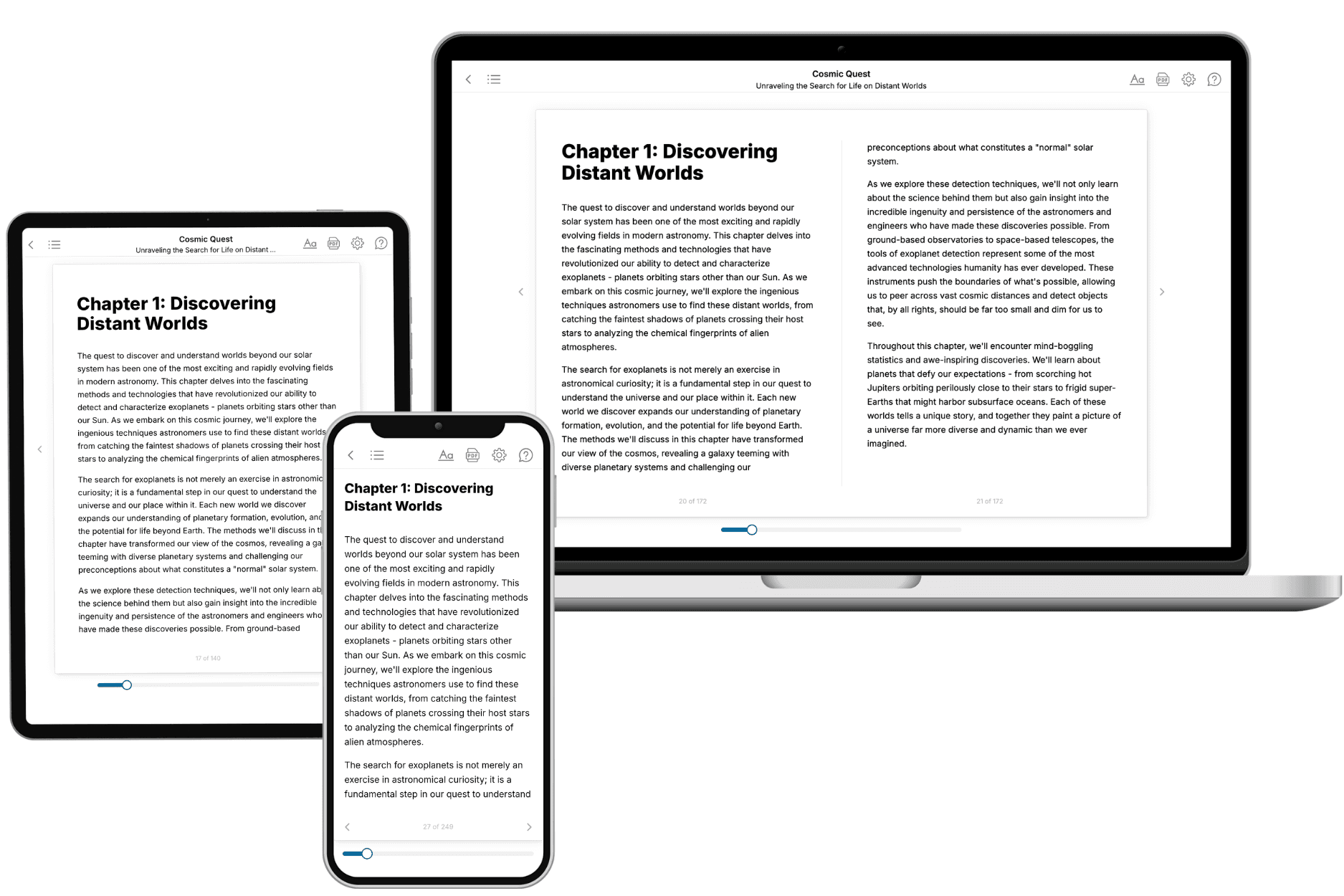
Your book is ready in 10 minutes. Read it online, download as EPUB or PDF, or send to Kindle.

Frequently asked questions
- What is TailoredRead?
TailoredRead creates complete, full-length nonfiction ebooks, written specifically for you. Tell us what you want to learn and why, and TailoredRead writes you a complete ebook on it, with charts, tables, and diagrams throughout. Read it online, on Kindle, or on any e-reader, or download it as a PDF or EPUB. Every book is written fresh the day you order it.
- How is the book tailored to me?
Before anything is written, you answer a few short questions about your goals, your background, and the topics you care about. Your book is then planned around your answers: written at your level, focused on your goals, and covering the topics you chose, instead of the one-size-fits-all book a store sells everyone.
- Will it read like generic AI content?
No. Your book isn't a chat transcript: it's planned chapter by chapter before a single word is written, told in a clear book voice, and explains ideas visually with charts, tables, and diagrams. After writing, every book goes through an editorial pass that polishes chapters so the book reads consistent from start to finish. Judge for yourself: browse thousands of sample books on our Explore Books page.
- How accurate is the content?
Our AI first checks whether your subject needs live research. Niche and fast-moving subjects are researched before writing, and the book plan and chapters are grounded in what it finds. After writing, every book goes through a quality pass that checks its facts and consistency, and researched books list their sources in a Notes section at the back.
- How long is the book?
You choose the length: Comprehensive (250-300 pages), Detailed (150-200 pages), Essential (70-100 pages), or Short (30-50 pages).
- Does the book include visuals?
Yes. Every book includes visual elements such as timelines, checklists, step-by-step guides, decision trees, comparison tables, and matrices, and many include bar charts. A typical book includes dozens of these visual elements.
- Can I read it on Kindle? What formats can I download?
Yes. Every book can be read in our online reader or downloaded as a PDF or EPUB. The EPUB can be opened with Kindle, Apple Books, Kobo, and any e-reader. The Commercial and Author licenses also include an editable Word (DOCX) and Markdown download.
- How much does it cost?
About the price of a regular ebook. The exact price depends on your book's length and complexity, from $2 for the shortest books to $35 for the most comprehensive, and it's shown when you review your book, before you commit to anything. Each book is a one-time purchase, yours to keep, no subscription. Licenses that let you share, teach, or publish your book range from $35.99 to $49.99.
- Can I preview the book before purchasing?
Before you pay, you'll see what your book will cover: the title, a detailed description, the estimated length, and the complete chapter-by-chapter table of contents, so you know what you're getting before you decide. The full text itself is written after you purchase.
- How long does it take to create a book?
About 10 minutes. You can start reading the opening chapters while the rest is still being written.