The Inca Empire
Masters of the Mountains—How a Civilization Built an Empire Without Written Language
Most people assume the Inca Empire was a primitive civilization that simply got lucky with gold and geography.
207 pages10 chaptersAug 24, 2026Incan History
About this book
In reality, the Inca built one of history's most sophisticated empires without a single written word, managing millions of people across some of Earth's most unforgiving terrain. This book reveals how the Inca achieved what seemed impossible: creating an administrative system so efficient it rivaled contemporary European kingdoms, constructing architectural marvels that still baffle engineers today, and organizing society through reciprocal obligations rather than coercion. You'll discover how the quipu—a knotted string recording system—enabled empire-wide record-keeping, how Pachacuti transformed a regional kingdom into a continental superpower in just decades, and why Spanish conquistadors succeeded not through superior tactics but by exploiting internal divisions. From the engineering secrets of Machu Picchu to the agricultural innovations that fed millions, this book explores the Inca on their own terms, showing how they created one of history's most remarkable civilizations.
Table of contents
- IntroductionWhy the Inca Matter Today, Separating Fact from Fiction, How to Use This BookRead below
- Chapter 1: The Foundations: Early Inca Origins and the Cusco ValleyMythological Origins and Historical Reality, The Settlement of Cusco and Early Expansion, Competing Powers in the Andean Region
- Chapter 2: The Rise of Pachacuti: Transformation of a KingdomPachacuti's Rise to Power, Military Strategy and Technological Advances, The Rapid Expansion of Empire
- Chapter 3: Governance Without Writing: The Quipu and Administrative SystemsUnderstanding the Quipu: Knotted String Records, The Bureaucratic Hierarchy and Decision-Making, Managing an Empire Through Oral Tradition and Quipu
- Chapter 4: Social Organization: The Ayllu and Mit'a SystemsThe Ayllu: Community, Kinship, and Reciprocity, The Mit'a Labor Obligation System, Class Structure and Social Mobility
- Chapter 5: Engineering Marvels: Architecture and InfrastructureMachu Picchu: The Citadel in the Clouds, The Qhapaq Ñan: The Great Road System, Building Methods and Architectural Innovation
- Chapter 6: Agriculture and Sustenance: Feeding an EmpireTerrace Farming and Land Management, Crop Domestication and Agricultural Innovation, Storage Systems and Food Security
- Chapter 7: Religion and Cosmology: The Inca WorldviewInti the Sun God and Divine Kingship, Sacred Geography and Huaca Sites, Rituals, Ceremonies, and Religious Practices
- Chapter 8: The Inca at Their Peak: 15th-Century DominanceThe Extent of Inca Territory and Population, Integrating Diverse Peoples into One Empire, The Inca in the Context of 15th-Century World History
- Chapter 9: Conflict and Conquest: The Spanish Arrival and FallInternal Conflict and Civil War, The Spanish Conquest and Pizarro's Campaign, Why the Empire Fell: Disease, Division, and Warfare
- Chapter 10: Legacy and Influence: The Inca in History and TodayInca Culture in Colonial and Modern Times, What Archaeology Reveals About Inca Civilization, Understanding the Inca in the Modern World
- ConclusionKey Takeaways: What the Inca Teach Us, Continuing Your Inca Journey
- Further Reading and Resources
Introduction
A stone wall at Sacsayhuaman fits together so precisely that a knife blade cannot slide between its blocks, yet the people who built it never used a single written blueprint. No architectural drawings, no measurement tables, no contracts survive because none were ever made. Everything that coordinated the labor, the stone-cutting, and the placement of tens of thousands of tons of rock lived in memory, in oral instruction, and in a system of knotted cords called quipu. That single fact should reset expectations for what follows in this book. The absence of alphabetic writing did not mean the absence of organization, precision, or record-keeping. It meant a different solution to the same problems every large society has to solve.
This book sets out to explain how Tawantinsuyu, the name the Inca gave their own empire, grew from a small kingdom in the Cusco Valley into a political structure stretching along nearly the entire length of the Andes. That expansion happened astonishingly fast, mostly within a single century, and it happened without the tools historians usually treat as prerequisites for empire: coined money, wheeled transport, and above all, writing. Later chapters trace this story in sequence, from the founding legends surrounding Manco Capac through the military transformation led by Pachacuti Inca Yupanqui, and on through the administrative, agricultural, religious, and engineering systems that held the empire together before its rapid collapse after contact with Spanish forces.
Before any of that detail arrives, it helps to address three things directly. First, why the Inca deserve sustained attention rather than a footnote in world history survey courses that spend most of their time on Europe and Asia. Second, why so many popular ideas about the Inca (that they were a "lost" civilization, or a primitive one, or purely a story of gold and human sacrifice) are wrong or badly incomplete. Third, how this book is organized so it can be read productively, whether cover to cover or chapter by chapter as a reference.
None of this requires prior expertise. The chapters ahead assume curiosity about how large human societies function, not a background in Andean archaeology. Technical terms appear as they become necessary, always explained in context, and always using the same names consistently so cross-referencing between chapters stays simple. The goal is not to romanticize the Inca as flawless or to treat them as a footnote to the Spanish conquest, but to explain them on their own terms, as a civilization that solved hard problems of geography, communication, and governance in ways still studied by engineers and administrators today.
Why the Inca Matter Today
By the early sixteenth century, Tawantinsuyu covered territory that included parts of modern Peru, Ecuador, Bolivia, Chile, Argentina, and Colombia, an area often estimated at close to 800,000 square miles. That land included coastal desert, high alpine plateau, and dense tropical forest edges, three environments that rarely coexist within a single political system anywhere in world history. Governing a population estimated by many scholars at somewhere between six and twelve million people across that range of terrain, without wheeled vehicles and without draft animals larger than the llama, is not a minor logistical footnote. It is one of the more remarkable state-building achievements of the pre-industrial world, and it deserves to be measured against the empires of Eurasia on its own merits rather than dismissed by comparison.
The comparison to contemporaries is instructive rather than decorative. While the Inca were consolidating the Andes under Pachacuti and his successors, the Ottoman Empire was expanding through the eastern Mediterranean, the Ming dynasty governed a vast bureaucratic China, and various European kingdoms were only beginning the maritime expansion that would eventually bring Spanish ships to Andean shores. Each of these societies solved the problem of governing distant populations differently. The Ottomans and Ming relied heavily on written bureaucracy and standing literate administrative classes. The Inca relied on a combination of standardized infrastructure, labor obligation, and an oral-plus-quipu recording system. Placing Tawantinsuyu in that global frame, a task taken up more fully in the chapter on the Inca at their territorial peak, corrects the tendency to treat the Americas as historically isolated or behind.
Modern engineering and administrative fields still reference Inca solutions because those solutions worked, and in some cases they have not been fully explained. The Qhapaq Ñan, the road network connecting the empire, ran an estimated 25,000 miles through terrain that includes some of the steepest gradients and highest elevations habitable by large populations anywhere on Earth. Sections of that road remain intact and usable five centuries later, a durability rate that modern infrastructure rarely matches. Structures built using ashlar masonry, the fitted stone technique visible at sites like Machu Picchu and Sacsayhuaman, have survived earthquakes that have destroyed more recent colonial and modern buildings nearby. Engineers studying seismic resistance still examine these joints for design principles applicable today.
Beyond the physical remains, the Inca offer a case study in an entirely different model of literacy and information management, one relevant well past the boundaries of Andean history. The quipu system, explored in depth in the chapter on governance without writing, demonstrates that recording numerical data, historical narrative, and administrative instruction does not require an alphabet. Cognitive scientists and information theorists have taken renewed interest in khipu (the more precise term for individual quipu devices) as an example of an alternative symbolic system that achieved many of the same functions writing does elsewhere. That reframing matters beyond academic curiosity. It challenges an assumption embedded in much of Western historical thought, namely that writing is a necessary threshold for civilization, statehood, or complex bureaucracy.
There is also a simpler, human reason the Inca matter now. Millions of people across Peru, Bolivia, Ecuador, and neighboring countries speak Quechua, the language the Inca state used to unify its territories, and many communities maintain agricultural and social practices that trace directly back to ayllu-based organization described in later chapters. This is not a civilization that vanished and left only ruins. It left a living linguistic and cultural inheritance carried by tens of millions of descendants. Understanding the Inca empire is, in a very direct sense, understanding a piece of the present, not only a chapter closed in the sixteenth century.
Finally, the Inca case offers a genuinely useful lens for thinking about how societies scale. Small kinship-based communities, organized around the ayllu unit, do not automatically know how to become a state governing millions of strangers across a continent. The mechanisms the Inca used to bridge that gap, particularly the labor obligation system known as mit'a and the practice of relocating populations called mitimae, are studied not because they were painless but because they reveal general principles about how reciprocity, obligation, and central coordination can substitute for coercive force alone. Those mechanisms receive full treatment in the chapters on social organization, but their relevance extends into modern discussions of state capacity and public works financing.
Separating Fact from Fiction
The phrase "lost civilization," frequently attached to the Inca in popular media, misrepresents what actually happened. Machu Picchu was never lost to the people who lived in the surrounding region, and Spanish colonial administrators knew a great deal about Inca governance because they inherited and, in modified form, continued using parts of it for decades after the conquest. What was lost, largely due to the destruction of quipu records by colonial authorities who associated them with idolatry, was direct access to a huge volume of primary Inca-authored information. The "rediscovery" of sites like Machu Picchu by American explorer Hiram Bingham in 1911 was a rediscovery for international academic audiences, not for local Quechua-speaking communities who had long known of its existence.[1]
Another persistent misconception treats the Inca as a single ethnic group ruling by simple military domination over passive subjects. In reality, Tawantinsuyu was a multiethnic empire built by incorporating, often through negotiation as much as conquest, dozens of distinct peoples who spoke different languages and maintained different local customs. The Inca state co-opted local elites, called curaca, who retained regional authority in exchange for loyalty and labor obligations owed to Cusco. Resistance and negotiation both shaped this process. The Chanka War, treated in the chapter on Pachacuti's rise, shows how the Inca state's formation involved genuine military threat and crisis, not smooth inevitable expansion.
The idea that the Inca practiced constant, large-scale human sacrifice on the scale sometimes depicted in sensationalized media also needs correction. Ritual sacrifice did occur, most notably through the capacocha ceremony involving selected children in moments of significant political or religious importance, and archaeological evidence including preserved remains found on high mountain summits confirms this practice existed.[2] But these events were rare, ritually specific, and tied to particular circumstances such as the death of a Sapa Inca or a major crisis, not routine practice comparable to depictions in some popular culture. Overemphasizing this element distorts a religious system, detailed in the chapter on Inca cosmology, that was built primarily around agricultural cycles, ancestor veneration, and sun worship centered on Inti.
A further misconception assumes the Inca economy resembled European feudalism, with private land ownership and market exchange as central features. Inca economics worked through reciprocity and redistribution instead. Labor, not goods or money, was the primary currency of obligation between subjects and the state, and the state in turn guaranteed food security through storage systems called qollqas and infrastructure such as terrace farming, known as andenes. There was no significant Inca marketplace system comparable to what existed in Mesoamerica among the Aztec, and no currency in the conventional sense. Applying European economic categories to Inca society tends to obscure rather than illuminate how it actually distributed resources, a topic covered thoroughly in the chapters on agriculture and social organization.
Perhaps the most consequential misconception concerns the Spanish conquest itself, often summarized as a triumph of superior European military technology over a technologically inferior society. Steel weapons, horses, and firearms mattered in specific tactical encounters, most famously the Battle of Cajamarca in 1532, but the conquest's success depended far more heavily on factors internal to the empire. A devastating civil war between rival claimants Huascar and Atahualpa had already fractured Inca unity before Francisco Pizarro's forces arrived. Epidemic disease, likely smallpox spreading ahead of direct European contact, had already killed the reigning Sapa Inca and thrown succession into crisis. The chapter on conflict and conquest unpacks this sequence in detail, because attributing the fall of Tawantinsuyu mainly to European superiority badly misreads what actually happened on the ground.
Even the framing of the Inca as a single continuous empire from its mythical founding onward deserves qualification. Inca oral tradition traces political origins back through a line of rulers organized into kinship groups called panaca, but the transformation from a modest regional chiefdom in the Cusco Valley into a continental empire happened primarily within the reigns of Pachacuti and his immediate successors in the fifteenth century, a span of roughly three generations. Earlier rulers, described in the founding myths involving Manco Capac and the deity Viracocha, governed a far smaller and more contested territory. Understanding this compressed timeline, covered fully in the chapters on Inca origins and Pachacuti's transformation, corrects the impression of a slow, ancient empire and replaces it with the more accurate picture of a remarkably rapid state-building achievement.
How to Use This Book
The ten core chapters follow a roughly chronological and thematic arc, beginning with origins and ending with collapse and legacy, but each chapter is written to stand reasonably well on its own. Someone specifically interested in architecture and engineering can move directly to the chapter covering Machu Picchu, the Qhapaq Ñan, and Inca construction techniques without needing to have absorbed every detail of the earlier chapters on governance. That said, reading in sequence produces the clearest picture, since concepts introduced early (the ayllu, the mit'a, the quipu, the role of the Sapa Inca) recur constantly in later chapters as load-bearing terms rather than isolated facts.
Each chapter is divided into three subchapters that move from a foundational explanation toward more specific mechanisms or consequences. In the chapter on governance, for example, the discussion begins with how the quipu physically worked, then moves into the bureaucratic hierarchy that used it, and finally into how oral tradition and quipu combined in practice to manage empire-wide record keeping. This structure repeats throughout the book. Readers looking for a fast overview of any topic can read just the first subchapter of a given chapter and get a workable foundation, while readers wanting depth can continue through all three.
A short list of recurring terms will appear repeatedly and is worth fixing in mind early:
- Sapa Inca: the supreme ruler, considered a descendant of Inti the sun god
- Ayllu: the basic kinship-based community unit underlying Inca social organization
- Mit'a: the rotational labor obligation owed by subjects to the state
- Quipu (plural khipu): knotted cord devices used for recording numerical and possibly narrative information
- Curaca: local or regional leaders incorporated into Inca administration
- Huaca: sacred sites or objects central to Inca religious geography
These terms are used consistently throughout the book rather than swapped for synonyms, a deliberate choice that makes it easier to track how each concept develops and connects across chapters. When a term first appears in a chapter, it receives a brief explanation even if it was already defined earlier, so no chapter demands that earlier material be memorized perfectly before proceeding.
Citations throughout the book point toward established archaeological and historical scholarship, including Spanish colonial-era chronicles written by figures such as Pedro Cieza de León and later Inca-descended chroniclers like Garcilaso de la Vega, alongside modern archaeological studies. These primary chronicles require some caution, since they were written after the conquest, often decades later, by authors with their own biases and political motivations. Where a claim rests on a chronicle account rather than physical archaeological evidence, that distinction is flagged so it remains clear what kind of evidence supports a given statement. This matters especially in chapters dealing with religious practice and succession politics, where colonial-era sources sometimes reflect Spanish assumptions as much as Inca reality.
Finally, treat the terrain covered here as a foundation for further exploration rather than a closed account. Andean archaeology remains an active field, with khipu decipherment efforts ongoing and new excavation sites still emerging, particularly around lesser-studied provincial centers outside Cusco itself.[3] The final chapter on legacy and modern relevance, along with the further reading section, points toward avenues for readers who want to go beyond this book's scope. What follows is meant to build a durable, accurate framework for understanding how Tawantinsuyu functioned, not a final word on a subject that continues to be rewritten as new evidence surfaces from the mountains, coastlines, and archives that still hold its remains.
This is the end of the free sample. The full book has 10 chapters.
Want this book written for you?
Tell us your goals and background, and get your own version of this book, tailored by AI to you.


Benefits of AI-tailored books
- Read one book, not ten:
- all the Incan History knowledge you need, gathered into a single book.
- Save days of learning:
- tell us your goals, choose your topics, and the whole book is built around them.
- Learn effortlessly:
- Incan History book written for your specific background and expertise.
- Understand at a glance:
- includes charts, tables, timelines, checklists, decision trees, and more.
- Stay current:
- written the day you order it, not years ago.
- Trust what you read:
- every book is checked for accuracy, with real research when your subject needs it.
Create your unique book in 3 steps
- 1. Select your focus
Select the focus of your Incan History book and share your background
- 2. Personalize your book
Specify your goals and choose sub-topics to include
- 3. Get your tailored book
Your book is ready in 10 minutes. Read it online, download as EPUB or PDF, or send to Kindle.

Frequently asked questions
- What is TailoredRead?
TailoredRead creates complete, full-length nonfiction ebooks, written specifically for you. Tell us what you want to learn and why, and TailoredRead writes you a complete ebook on it, with charts, tables, and diagrams throughout. Read it online, on Kindle, or on any e-reader, or download it as a PDF or EPUB. Every book is written fresh the day you order it.
- How is the book tailored to me?
Before anything is written, you answer a few short questions about your goals, your background, and the topics you care about. Your book is then planned around your answers: written at your level, focused on your goals, and covering the topics you chose, instead of the one-size-fits-all book a store sells everyone.
- Will it read like generic AI content?
No. Your book isn't a chat transcript: it's planned chapter by chapter before a single word is written, told in a clear book voice, and explains ideas visually with charts, tables, and diagrams. After writing, every book goes through an editorial pass that polishes chapters so the book reads consistent from start to finish. Judge for yourself: browse thousands of sample books on our Explore Books page.
- How accurate is the content?
Our AI first checks whether your subject needs live research. Niche and fast-moving subjects are researched before writing, and the book plan and chapters are grounded in what it finds. After writing, every book goes through a quality pass that checks its facts and consistency, and researched books list their sources in a Notes section at the back.
- How long is the book?
You choose the length: Comprehensive (250-300 pages), Detailed (150-200 pages), Essential (70-100 pages), or Short (30-50 pages).
- Does the book include visuals?
Yes. Every book includes visual elements such as timelines, checklists, step-by-step guides, decision trees, comparison tables, and matrices, and many include bar charts. A typical book includes dozens of these visual elements.
- Can I read it on Kindle? What formats can I download?
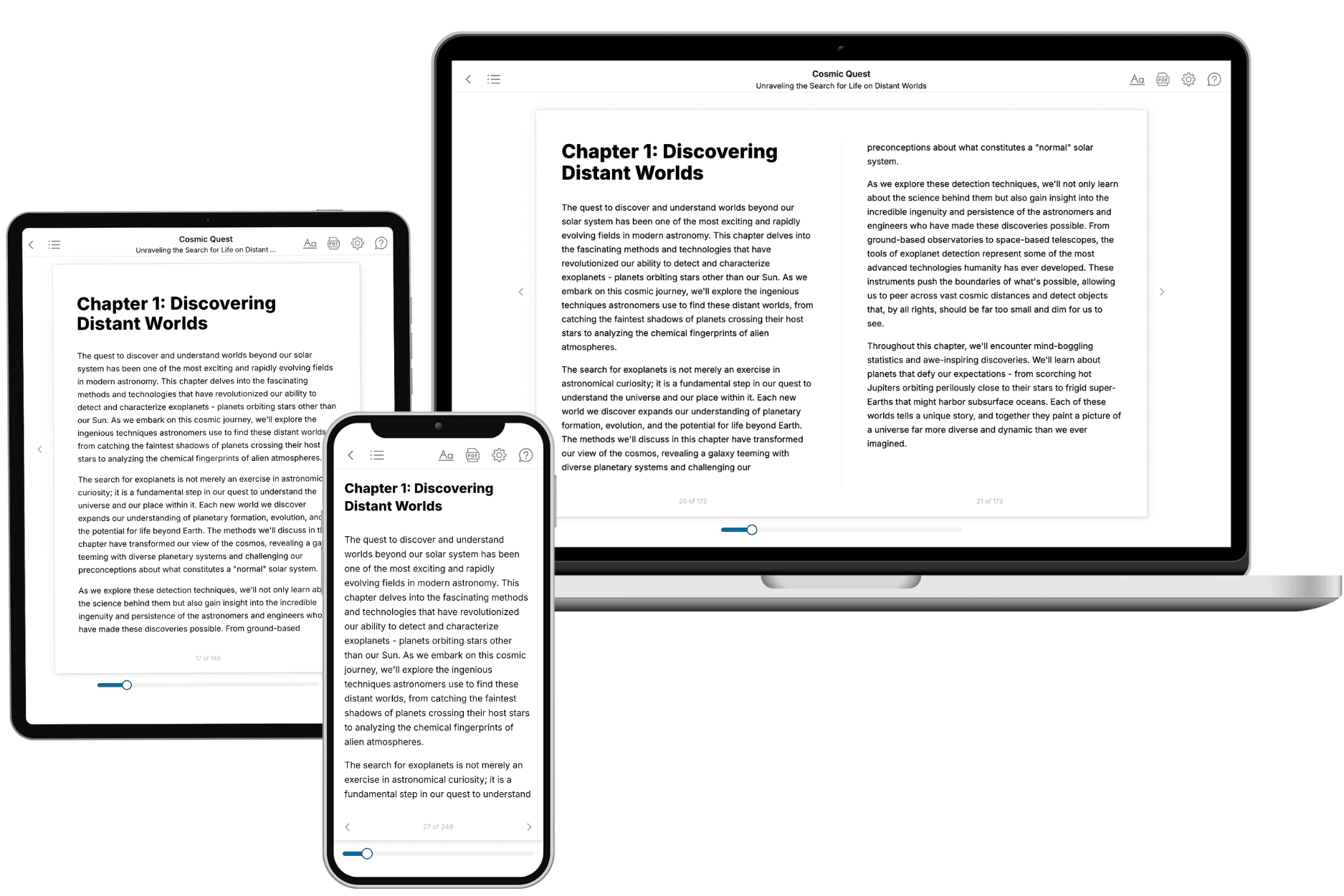
Yes. Every book can be read in our online reader or downloaded as a PDF or EPUB. The EPUB can be opened with Kindle, Apple Books, Kobo, and any e-reader. The Commercial and Author licenses also include an editable Word (DOCX) and Markdown download.
- How much does it cost?
About the price of a regular ebook. The exact price depends on your book's length and complexity, from $2 for the shortest books to $35 for the most comprehensive, and it's shown when you review your book, before you commit to anything. Each book is a one-time purchase, yours to keep, no subscription. Licenses that let you share, teach, or publish your book range from $35.99 to $49.99.
- Can I preview the book before purchasing?
Before you pay, you'll see what your book will cover: the title, a detailed description, the estimated length, and the complete chapter-by-chapter table of contents, so you know what you're getting before you decide. The full text itself is written after you purchase.
- How long does it take to create a book?
About 10 minutes. You can start reading the opening chapters while the rest is still being written.