The Index Advantage
Master Database Indexing to Build Faster, Scalable Backend Systems
Why do some databases handle millions of queries per second while others struggle with thousands?
191 pages9 chaptersAug 16, 2026Databases
About this book
The answer often comes down to one critical decision: how you index your data. This book reveals the indexing strategies that separate high-performing systems from bottlenecked ones. You'll learn how to analyze query patterns, choose the right index types, and design composite indexes that dramatically reduce query costs. Discover why adding more indexes can actually slow down your system, how to identify missing indexes before they become production problems, and how to maintain index health as your data grows. Whether you're optimizing a struggling application or architecting a new system from scratch, this practical guide provides the frameworks and techniques used by engineers at scale. Move beyond trial-and-error indexing and build databases that perform predictably under real-world load.
Table of contents
- IntroductionWhy Indexing Matters More Than You Think, Common Indexing Myths That Cost You Performance, How to Use This BookRead below
- Chapter 1: Fundamentals of Database IndexingWhat Is an Index and How Does It Work?, Index Data Structures: B-Trees, Hash Tables, and Beyond, The Cost of Indexing: Write Performance and Storage
- Chapter 2: Understanding Query Execution PlansReading and Interpreting Execution Plans, How the Query Optimizer Makes Decisions, Identifying Performance Bottlenecks in Your Queries
- Chapter 3: Index Types and When to Use ThemB-Tree Indexes: The Workhorse of Databases, Hash and Bitmap Indexes: Specialized Solutions, Full-Text and Specialized Indexes
- Chapter 4: Designing Single-Column IndexesChoosing Which Columns to Index, Cardinality and Selectivity: The Foundation of Index Design, Column Order and Index Effectiveness
- Chapter 5: Composite Indexes and Advanced TechniquesDesigning Composite Indexes for Multiple Columns, Covering Indexes: Eliminating Table Lookups, Partial and Filtered Indexes for Specific Workloads
- Chapter 6: Analyzing and Optimizing Query WorkloadsAnalyzing Your Actual Query Workload, Finding Missing Indexes Before They Hurt Performance, Identifying and Removing Unused Indexes
- Chapter 7: Index Maintenance and Performance MonitoringUnderstanding and Managing Index Fragmentation, Keeping Statistics Current for Accurate Query Plans, Monitoring Index Health in Production
- Chapter 8: Scaling Indexes as Your Data GrowsHow Indexing Strategies Change at Scale, Indexing in Partitioned and Sharded Systems, Index Design for Distributed Databases
- Chapter 9: Real-World Indexing Patterns and Anti-PatternsCommon Indexing Mistakes and How to Avoid Them, Case Studies: From Slow to Fast, Indexing Strategies for OLTP, OLAP, and Hybrid Workloads
- ConclusionCore Principles for Effective Indexing, Your Path Forward
- Appendix: Quick Reference GuideIndex Creation Syntax Across Databases, Index Optimization Checklist, Glossary of Indexing Terms
Introduction
A single missing index once turned a routine dashboard query into a ninety-second wait. The query itself was simple: pull the last thirty days of orders for a given customer. No joins to speak of, no subqueries, nothing exotic. Yet the database was scanning every row in a table of forty million orders, one by one, because nothing told it where to look. Adding one index on the customer and date columns brought that query down to under ten milliseconds. Nothing about the application code changed. Nothing about the hardware changed. Only the index changed.
This kind of story repeats itself constantly in backend engineering, across companies, industries, and database systems. Teams spend weeks optimizing application logic, adding caching layers, or upgrading server hardware, all while the real bottleneck sits quietly inside the database schema. An index is not a minor implementation detail left to database administrators. It is a design decision with direct consequences for latency, infrastructure cost, and how far a system can scale before it needs a rewrite.
This book treats indexing as a core engineering skill, not a checkbox to tick after a query gets slow. You will build a working mental model of how indexes function, how the query optimizer decides whether to use them, and how to design indexes that match the way your application actually queries data. The goal is not to memorize syntax for creating an index. The goal is to reason clearly about tradeoffs, so that every indexing decision is deliberate rather than accidental.
Before going further, it helps to set expectations for what this introduction covers. The next three sections explain why indexing deserves more attention than it typically gets, expose a handful of persistent myths that quietly damage production systems, and describe how to get the most out of the chapters that follow. None of this replaces the technical depth found later in the book. It sets the frame you will use to make sense of everything that comes after it.
Why Indexing Matters More Than You Think
Most performance problems in backend systems trace back to how data is read, not how it is processed. A web application can have perfectly efficient code, a well-structured API, and a clean architecture, and still buckle under load because every request triggers a Sequential Scan across a large table. The database has to check every row to find the ones that match a query's condition, because there is no structure pointing directly to the matching rows. As tables grow from thousands of rows to millions, this approach stops being a minor inefficiency and becomes the defining bottleneck of the entire system.
Consider a table storing user sessions with ten million rows, where an application frequently looks up sessions by user_id. Without an index on that column, the database reads all ten million rows on every lookup, even though it might only need to return three or four matching records. With an index in place, the database performs an Index Seek, jumping almost directly to the matching rows using a structure similar to a phone book sorted by last name. The difference in work is not incremental. It is the difference between reading an entire library and checking a card catalog.
This gap compounds under real production load. A query that takes 200 milliseconds without an index might feel tolerable in isolation. But at 500 requests per second, that query alone can consume more database connections and CPU time than the rest of the application combined, forcing teams to scale hardware vertically or horizontally just to keep up. Proper indexing often removes the need for that scaling entirely, because it addresses the actual cause of the slowdown instead of adding more capacity to work around it.
Indexing also changes the economics of running a backend system. Cloud database pricing is frequently tied to compute, memory, and I/O consumption, all of which rise sharply when queries scan far more data than necessary. A team running a moderately sized PostgreSQL or MySQL instance can often downgrade to a smaller, cheaper instance simply by adding the right indexes, because the database no longer needs to do brute-force work on every query. Infrastructure savings from indexing are frequently larger than savings from code-level optimizations, yet they receive a fraction of the attention.
The query optimizer decisions covered in the chapter on Execution Plan analysis depend entirely on what indexes exist. A well-designed Cost Model inside the database engine chooses between a Sequential Scan and an Index Scan based on estimated cost, but it can only choose an index path if a suitable index exists in the first place. No amount of query tuning, connection pooling, or caching can substitute for giving the optimizer a real option to work with. Indexing is the raw material the optimizer needs before it can do its job well.
There is a well documented academic foundation behind this idea. The concept of a cost-based optimizer choosing between access paths, including index-based and full-scan strategies, was formalized decades ago in research on relational database internals.[1] That research still shapes how modern systems like PostgreSQL, MySQL, and SQL Server decide whether to use an index today. Understanding that history is less important than internalizing its conclusion: the database will always try to pick the cheapest path available, and indexing determines which paths exist.
Indexing also matters because it is one of the few optimizations that requires no changes to application code. A backend engineer can improve a slow endpoint by adding an index directly in the database, without touching a single line of the service that calls it. This makes indexing uniquely low-risk compared to rewriting business logic, changing data models, or introducing new infrastructure like a caching layer. It is often the fastest path from a slow feature to a fast one, measured in hours rather than sprints.
None of this means indexing is free or automatically beneficial. Every index adds overhead to write operations and consumes storage, a tradeoff explored in depth in the chapter on the cost of indexing. The point here is narrower: indexing has an outsized effect on read performance relative to the effort required to implement it, and that effect is often invisible until someone looks for it. Treating index design as a first-class engineering concern, rather than an afterthought, is the single highest-leverage habit this book aims to build.
Throughout later chapters, you will see this leverage demonstrated repeatedly with concrete before-and-after comparisons: queries that drop from seconds to milliseconds, execution plans that shift from full scans to seeks, and workloads that scale to far larger data volumes without requiring bigger hardware. Keep the session-lookup example from earlier in mind as a baseline. Nearly every technique introduced later, from composite indexes to covering indexes, is a more refined version of that same basic idea: give the database a direct path to the data it needs.
Common Indexing Myths That Cost You Performance
Indexing sits in an unusual spot in software engineering: nearly everyone has heard of it, yet very few people apply it correctly under pressure. This gap creates fertile ground for myths, half-truths repeated so often that they get treated as settled fact. Some of these myths cause teams to under-index critical tables, leaving slow queries in production for months. Others cause the opposite mistake, piling on indexes until write performance collapses. Both failure modes trace back to the same root cause: reasoning about indexes from intuition instead of from how the database actually behaves.
The first and most damaging myth is the belief that more indexes always mean faster queries. This assumption feels reasonable on the surface, since an index does speed up the specific read it targets. But every index also has to be updated whenever a row is inserted, updated, or deleted, a cost known as Write Amplification. A table with fifteen indexes might serve read queries quickly, but every single insert now has to update fifteen separate structures, which can slow write-heavy workloads dramatically and bloat Storage Overhead well beyond what the actual data requires.
A second myth treats the primary key index as sufficient protection against slow queries. Many teams assume that because a table has a Primary Key, it is properly indexed. In practice, a primary key index only helps queries that filter or join on that specific column. A table of customer orders with a primary key on order_id gains nothing from that index when a query filters by customer_id and order_date instead. Every column or combination of columns used in filtering, joining, or sorting needs its own indexing consideration, independent of what the primary key already covers.
A third myth assumes that indexes can compensate for a poorly structured query or a flawed data model. This is only partially true, and the exceptions matter. An index cannot help a query that wraps an indexed column in a function, such as WHERE YEAR(order_date) = 2024, because the database can no longer match the raw column values against the index structure. Similarly, an index cannot fix a query built on an inefficient join strategy or an overly broad SELECT * pulling unnecessary columns. Indexing amplifies good query design. It does not replace it.
A fourth myth holds that once an index is created, it works correctly forever with no further attention. In reality, index performance degrades over time through Index Fragmentation and stale Statistics, both covered in depth later in this book. A database that relied on accurate statistics to choose a fast execution plan six months ago might silently switch to a slower plan today, simply because the data distribution shifted and nobody refreshed the statistics the optimizer depends on. Indexes require ongoing maintenance, not a one-time setup.
A fifth myth assumes that indexing decisions made early in a project will still be correct once the application scales. A table with ten thousand rows behaves very differently from the same table with five hundred million rows. An index that seemed unnecessary at low volume can become critical, and an indexing strategy that worked fine for a single-server database can break down entirely once the system moves to Partitioned Index or Distributed Index architectures. Indexing strategy is not a static decision made once at launch. It is a practice that has to evolve alongside the system.
A sixth myth treats all indexes as interchangeable, as if creating any index on a slow column will automatically solve a performance problem. In reality, a Hash Index behaves very differently from a B-Tree, and a Bitmap Index serves entirely different access patterns than a Full-Text Index. Applying the wrong index type to a query pattern can result in an index that technically exists but never gets used by the Query Optimizer, because the structure does not match how the query filters or sorts data. Index type selection matters as much as the decision to index at all.
These myths persist partly because indexing problems are often invisible until a system reaches a certain scale. A poorly indexed table with a thousand rows returns results quickly enough that nobody notices the missing index. The same schema, carried forward unchanged into production with millions of rows, becomes a serious liability almost overnight. This delayed feedback loop is exactly why indexing deserves proactive attention rather than reactive firefighting once users start complaining about slow page loads.
Recognizing these myths is the first step toward replacing guesswork with a repeatable process. Instead of assuming an index will help, or assuming a table already has enough of them, the disciplined approach is to examine actual Access Pattern data, measure Cardinality and Selectivity, and validate every indexing decision against a real Execution Plan. That discipline, built methodically across the chapters ahead, is what separates systems that perform predictably under load from systems that only seem fast until traffic grows.
How to Use This Book
This book is organized to move from foundational concepts toward increasingly advanced, production-focused techniques, and it works best when read in that order at least once. The early chapters build the mental models and vocabulary that later chapters rely on without re-explaining. If a later chapter references Selectivity or an Index-Only Scan, it assumes the concept was already introduced earlier rather than defining it again from scratch. Skipping ahead is possible for readers with strong existing knowledge, but the first pass through unfamiliar chapters should follow the sequence as written.
Each chapter is built around a specific, narrow question rather than a broad topic, which keeps the material practical instead of theoretical. The chapter on execution plans, for example, focuses specifically on reading and interpreting what a database engine reports, not on general query writing. The chapter on composite indexes focuses on multi-column index design, not on single-column basics already covered earlier. This structure means concepts get real depth instead of shallow overview, but it also means related ideas sometimes live in different chapters than expected. Cross-references point toward the relevant chapter whenever that happens.
Hands-on practice will get far more value out of this material than passive reading. Every major concept in this book, from reading an Execution Plan to designing a Covering Index, is something that can be tested directly against a real database. Setting up a local PostgreSQL, MySQL, or SQLite instance with a sample dataset, even a small one with a few hundred thousand rows, makes it possible to run the same queries shown in the book and observe the actual behavior of the Query Optimizer firsthand.
A practical setup checklist for following along includes:
- A database engine installed locally or accessible through a free-tier cloud instance (PostgreSQL and MySQL are the most common choices used throughout this book).
- A dataset large enough to reveal real performance differences, ideally at least a few hundred thousand rows in the primary tables being tested.
- Access to the database's execution plan tool, such as
EXPLAIN ANALYZEin PostgreSQL orEXPLAINin MySQL, since nearly every chapter references reading these outputs directly. - A way to measure query timing consistently, whether through the database client, a monitoring dashboard, or simple timestamp logging around queries.
This book deliberately avoids tying every example to a single database engine, because indexing concepts like Cardinality, Composite Index design, and Workload Analysis apply broadly across relational systems. Specific syntax differences between PostgreSQL, MySQL, SQL Server, and other engines are called out explicitly whenever they matter, particularly around index creation syntax and specialized index types like GIN Index or GiST Index, which are PostgreSQL-specific. The appendix at the end of the book collects syntax differences into a single quick-reference section for exactly this reason.
Readers coming from a specific background will find some chapters more immediately relevant than others, though skipping chapters entirely is not recommended on a first read. A backend engineer working primarily on a high-traffic e-commerce platform will find the chapters on OLTP Indexing Strategy and workload analysis especially applicable day to day. A data engineer working on reporting pipelines will get more immediate value from the chapters covering OLAP Indexing Strategy and specialized index types built for analytical queries. Both groups still benefit from the foundational chapters, since advanced techniques build directly on those basics.
Throughout the book, concrete numbers, code examples, and realistic scenarios replace abstract theory wherever possible. A claim like composite indexes can reduce query cost by orders of magnitude
is only useful when paired with an actual before-and-after example showing an execution plan changing from a full table scan to an index-only scan. Expect that pairing consistently: a concept, followed immediately by a concrete illustration of it in action, often including SQL statements that can be copied and run directly.
Finally, treat the checklists, frameworks, and troubleshooting guidance scattered throughout later chapters as working references, not one-time reading material. The index optimization checklist in the appendix, for instance, is designed to be revisited during actual production incidents or planned schema reviews, not just read once and forgotten. The real measure of whether this book worked is not how much of it gets remembered, but how differently indexing decisions get made the next time a query runs slower than it should.
Notes
Introduction
- 1. Patricia Selinger and others, "Access Path Selection in a Relational Database Management System," ACM SIGMOD, 1979
This is the end of the free sample. The full book has 9 chapters.
Want this book written for you?
Tell us your goals and background, and get your own version of this book, tailored by AI to you.


Benefits of AI-tailored books
- Read one book, not ten:
- all the Databases knowledge you need, gathered into a single book.
- Save days of learning:
- tell us your goals, choose your topics, and the whole book is built around them.
- Learn effortlessly:
- Databases book written for your specific background and expertise.
- Understand at a glance:
- includes charts, tables, timelines, checklists, decision trees, and more.
- Stay current:
- written the day you order it, not years ago.
- Trust what you read:
- every book is checked for accuracy, with real research when your subject needs it.
Create your unique book in 3 steps
- 1. Select your focus
Select the focus of your Databases book and share your background
- 2. Personalize your book
Specify your goals and choose sub-topics to include
- 3. Get your tailored book
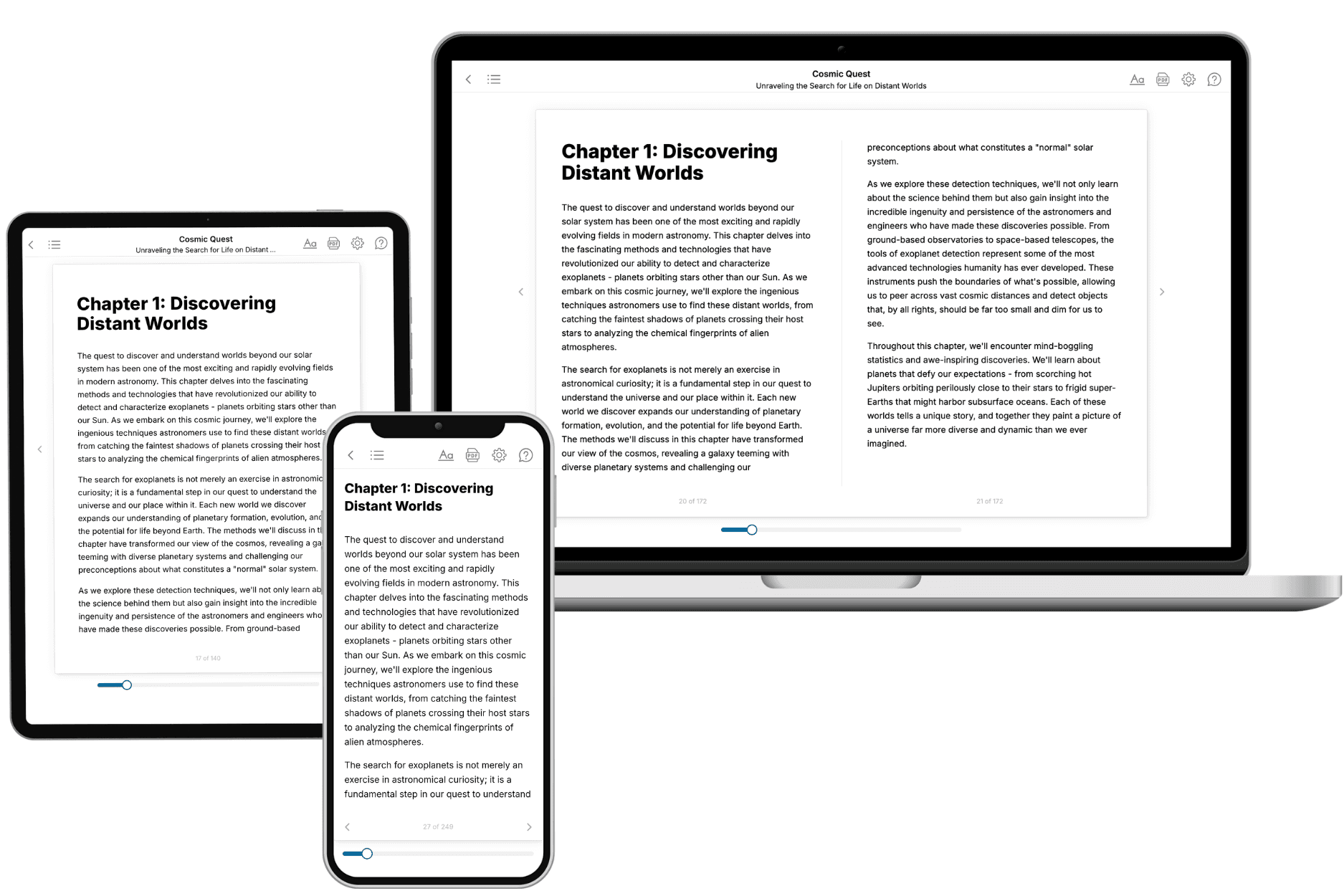
Your book is ready in 10 minutes. Read it online, download as EPUB or PDF, or send to Kindle.

Frequently asked questions
- What is TailoredRead?
TailoredRead creates complete, full-length nonfiction ebooks, written specifically for you. Tell us what you want to learn and why, and TailoredRead writes you a complete ebook on it, with charts, tables, and diagrams throughout. Read it online, on Kindle, or on any e-reader, or download it as a PDF or EPUB. Every book is written fresh the day you order it.
- How is the book tailored to me?
Before anything is written, you answer a few short questions about your goals, your background, and the topics you care about. Your book is then planned around your answers: written at your level, focused on your goals, and covering the topics you chose, instead of the one-size-fits-all book a store sells everyone.
- Will it read like generic AI content?
No. Your book isn't a chat transcript: it's planned chapter by chapter before a single word is written, told in a clear book voice, and explains ideas visually with charts, tables, and diagrams. After writing, every book goes through an editorial pass that polishes chapters so the book reads consistent from start to finish. Judge for yourself: browse thousands of sample books on our Explore Books page.
- How accurate is the content?
Our AI first checks whether your subject needs live research. Niche and fast-moving subjects are researched before writing, and the book plan and chapters are grounded in what it finds. After writing, every book goes through a quality pass that checks its facts and consistency, and researched books list their sources in a Notes section at the back.
- How long is the book?
You choose the length: Comprehensive (250-300 pages), Detailed (150-200 pages), Essential (70-100 pages), or Short (30-50 pages).
- Does the book include visuals?
Yes. Every book includes charts, tables, and diagrams: timelines, checklists, step-by-step guides, decision trees, comparison tables, matrices, and bar charts. A typical book includes dozens of these visual elements.
- Can I read it on Kindle? What formats can I download?
Yes. Every book can be read in our online reader or downloaded as a PDF or EPUB. The EPUB can be opened with Kindle, Apple Books, Kobo, and any e-reader. The Commercial and Author licenses also include an editable Word (DOCX) and Markdown download.
- How much does it cost?
About the price of a regular ebook. The exact price depends on your book's length and complexity, from $2 for the shortest books to $35 for the most comprehensive, and it's shown when you review your book, before you commit to anything. Each book is a one-time purchase, yours to keep, no subscription. Licenses that let you share, teach, or publish your book range from $35.99 to $49.99.
- Can I preview the book before purchasing?
Before you pay, you'll see what your book will cover: the title, a detailed description, the estimated length, and the complete chapter-by-chapter table of contents, so you know what you're getting before you decide. The full text itself is written after you purchase.
- How long does it take to create a book?
About 10 minutes. You can start reading the opening chapters while the rest is still being written.