Inductive Reasoning in Computer Science
Mastering Proof by Induction for Algorithmic Problem-Solving
Struggling to grasp the intricacies of proof by induction in computer science?
269 pages13 chaptersDec 21, 2024Computer Science and Algorithms
About this book
You're not alone. Many students and professionals find this fundamental concept challenging, yet it's crucial for advancing in the field. "Inductive Reasoning in Computer Science" is your comprehensive guide to mastering this powerful problem-solving technique. This book bridges the gap between abstract mathematical concepts and practical applications in computer science. You'll learn how to construct rigorous proofs, validate algorithm correctness, and analyze complex data structures using induction. Through clear explanations and diverse examples, you'll develop the skills to tackle advanced topics in algorithm design and analysis with confidence. Whether you're a student aiming to excel in your coursework or a professional looking to enhance your problem-solving toolkit, this book provides the insights and practice you need. By the end, you'll have transformed your approach to algorithmic challenges, equipped with a powerful technique that's essential for success in computer science.
Table of contents
- IntroductionThe Importance of Induction in Computer Science, Overview of the Book, How to Use This Book, Prerequisites and AssumptionsRead below
- Chapter 1: Foundations of Mathematical ReasoningBasic Logic and Set Theory, Overview of Proof Techniques, Introduction to Mathematical Induction, Historical Context of Induction
- Chapter 2: The Structure of Inductive ProofsEstablishing the Base Case, Formulating the Inductive Hypothesis, Proving the Inductive Step, Drawing Conclusions from Induction
- Chapter 3: Simple Induction in Computer ScienceProving Summation Formulas, Verifying Algorithm Correctness, Establishing Loop Invariants, Proving Correctness of Recursive Algorithms
- Chapter 4: Strong Induction and Its ApplicationsStrong Induction vs. Simple Induction, The Well-Ordering Principle, Analyzing Divide-and-Conquer Algorithms, Proving Correctness of Sorting Algorithms
- Chapter 5: Structural InductionInduction on Recursive Data Structures, Proving Properties of Trees, Inductive Proofs on Lists and Arrays, Applying Induction to Graph Algorithms
- Chapter 6: Induction and RecursionThinking Recursively, Proving Correctness of Recursive Functions, Tail Recursion and Optimization, Mutual Recursion and Induction
- Chapter 7: Induction in Algorithm AnalysisProving Time Complexity Bounds, Analyzing Space Complexity, Solving Recurrence Relations, Induction in Amortized Analysis
- Chapter 8: Advanced Induction TechniquesTelescoping Series and Induction, Double Induction, Induction with Invariants, Combining Induction and Contradiction
- Chapter 9: Common Pitfalls and How to Avoid ThemWeak Induction Hypotheses, Base Case Errors, Circular Reasoning in Proofs, Misidentifying the Induction Variable
- Chapter 10: Induction as a Design ToolUsing Induction for Algorithm Discovery, Designing Loop Invariants, Converting Recursive to Iterative Algorithms, Optimization Techniques Through Induction
- Chapter 11: Real-World Applications of Inductive ReasoningFormal Program Verification, Compiler Optimizations, Proving Properties of Distributed Systems, Security Proofs in Cryptography
- Chapter 12: Induction Beyond Computer ScienceConnections to Pure Mathematics, Applications in Physics and Engineering, Inductive Reasoning in Social Sciences, Philosophical and Logical Foundations
- Chapter 13: Future Directions and Open ProblemsAutomated Inductive Reasoning, Induction in Quantum Computing, Inductive Principles in Machine Learning, Open Challenges and Research Opportunities
- Conclusion
- Glossary
- Further Reading
Introduction
Welcome to "Inductive Reasoning in Computer Science: Mastering Proof by Induction for Algorithmic Problem-Solving." This book is designed to be your comprehensive guide to understanding and applying one of the most powerful and fundamental techniques in computer science: proof by induction. Whether you're a student looking to excel in your coursework or a professional aiming to enhance your problem-solving skills, this book will equip you with the knowledge and tools to tackle complex algorithmic challenges with confidence.
In the rapidly evolving field of computer science, the ability to reason about algorithms, data structures, and computational processes is paramount. Proof by induction stands at the forefront of these reasoning techniques, providing a robust framework for verifying the correctness of algorithms, analyzing their efficiency, and even guiding the design of new computational solutions. By mastering induction, you'll not only improve your ability to solve problems but also gain deeper insights into the fundamental principles that underpin computer science.
Throughout this book, we'll bridge the gap between abstract mathematical concepts and their practical applications in computer science. You'll learn how to construct rigorous proofs, validate algorithm correctness, and analyze complex data structures using induction. Through clear explanations, diverse examples, and challenging exercises, you'll develop the skills necessary to approach advanced topics in algorithm design and analysis with a solid foundation.
As we embark on this journey together, remember that mastering proof by induction is not just about learning a technique—it's about developing a way of thinking that will serve you throughout your career in computer science. Let's begin by exploring why induction is so crucial in our field and how this book will guide you towards mastery of this essential skill.
The Importance of Induction in Computer Science
Induction is more than just a mathematical proof technique; it's a fundamental pillar of computer science that permeates nearly every aspect of the field. From algorithm design and analysis to software verification and beyond, inductive reasoning plays a crucial role in how we understand and develop computational systems. To truly appreciate the significance of induction in computer science, let's delve into its various applications and the reasons why it's an indispensable tool for every computer scientist and software engineer.
At its core, induction provides a method for proving properties that hold for an infinite number of cases, which is particularly valuable in computer science where we often deal with algorithms and data structures that must work correctly for inputs of arbitrary size. This ability to reason about infinite sets with finite proofs is what makes induction so powerful. For instance, when you prove that a sorting algorithm correctly orders a list of n elements for any positive integer n, you're employing inductive reasoning, even if you're not explicitly using a formal inductive proof.
One of the primary applications of induction in computer science is in algorithm analysis. When determining the time or space complexity of an algorithm, we often need to prove that certain bounds hold for all input sizes. Induction allows us to establish these bounds by proving them for a base case (usually a small input size) and then showing that if the bound holds for some arbitrary input size, it must also hold for the next larger size. This technique is particularly useful for analyzing recursive algorithms, where the problem is broken down into smaller subproblems of the same type.
Consider the classic example of analyzing the time complexity of the Merge Sort algorithm. We can use induction to prove that Merge Sort has a time complexity of O(n log n) for all input sizes n. The proof would start with a base case for small n, then assume the O(n log n) bound holds for all arrays of size less than n, and finally show that it must also hold for arrays of size n. This inductive approach allows us to confidently state the algorithm's efficiency for all possible inputs, which is crucial for comparing algorithms and making informed design decisions.
Induction is also instrumental in proving the correctness of algorithms. When developing a new algorithm or implementing a complex system, it's essential to verify that it behaves correctly for all possible inputs. Inductive proofs allow us to establish invariants—properties that hold true at each step of an algorithm's execution. By proving these invariants inductively, we can guarantee that our algorithm produces the correct output for any valid input, which is a cornerstone of reliable software development.
For example, when implementing a binary search tree, we might use induction to prove that the binary search property (all nodes in the left subtree have keys less than the current node, and all nodes in the right subtree have keys greater than the current node) is maintained after every insertion or deletion operation. This inductive proof would consider the base case of an empty tree, then show that if the property holds for a tree of size n, it continues to hold after adding or removing a node, resulting in a tree of size n+1 or n-1.
In the realm of data structures, induction is particularly useful for reasoning about recursive structures such as linked lists, trees, and graphs. Many properties of these structures can be elegantly proven using structural induction, a variant of induction that follows the recursive definition of the data structure. For instance, proving that a function correctly traverses all nodes in a binary tree can be done by inducting on the structure of the tree, considering the base case of an empty tree and then showing that the property holds for larger trees composed of smaller subtrees.
Induction also plays a crucial role in formal verification of software systems. As software becomes increasingly complex and is deployed in critical systems where failures can have severe consequences, the need for rigorous proof of correctness becomes paramount. Formal methods often rely on inductive reasoning to prove that a system satisfies its specification for all possible execution paths and inputs. This application of induction extends beyond traditional algorithm analysis into the realm of ensuring the reliability and safety of large-scale software systems.
Furthermore, inductive thinking is fundamental to the design of recursive algorithms and the implementation of recursive functions. The process of breaking down a problem into smaller instances of the same problem until a base case is reached mirrors the structure of an inductive proof. This connection between induction and recursion helps in developing intuition for both concepts, making it easier to design efficient recursive solutions and prove their correctness.
In the field of programming language theory and compiler design, induction is used to prove properties of type systems, ensure the correctness of program transformations, and verify the soundness of static analysis techniques. These applications demonstrate how inductive reasoning extends beyond algorithm analysis to the very foundations of how we create and reason about programming languages.
As we move into an era dominated by machine learning and artificial intelligence, inductive reasoning continues to be relevant. Many machine learning algorithms, particularly those involving decision trees or recursive neural networks, implicitly use inductive principles. Understanding induction can provide insights into how these algorithms generalize from training data to make predictions on unseen inputs.
In conclusion, the importance of induction in computer science cannot be overstated. It provides a rigorous framework for reasoning about algorithms, data structures, and computational processes. By mastering inductive techniques, you'll be better equipped to design efficient algorithms, prove their correctness, analyze their performance, and understand the theoretical underpinnings of computer science. As you progress through this book, you'll see how induction serves as a powerful tool for tackling a wide range of problems in computer science, from the theoretical to the practical, and how it can enhance your ability to think critically about computational challenges.
Overview of the Book
"Inductive Reasoning in Computer Science" is structured to provide a comprehensive and progressive learning experience. The book is designed to take you from the foundational concepts of induction to advanced applications in various areas of computer science. Each chapter builds upon the knowledge gained in previous sections, allowing you to gradually develop a deep understanding of inductive reasoning and its practical applications in algorithmic problem-solving.
We begin with the Foundations of Mathematical Reasoning in Chapter 1, which lays the groundwork for the rest of the book. This chapter introduces basic logic and set theory, providing a refresher on the mathematical concepts that underpin inductive reasoning. It also offers an overview of various proof techniques, placing induction in the broader context of mathematical proofs. The chapter concludes with an introduction to mathematical induction and its historical context, giving you a sense of how this powerful technique has evolved and why it's so crucial in modern computer science.
Chapter 2 delves into The Structure of Inductive Proofs, breaking down the components of an inductive argument into its essential parts: the base case, the inductive hypothesis, and the inductive step. This chapter is crucial for understanding how to construct valid inductive proofs and how to recognize and avoid common pitfalls. By the end of this chapter, you'll have a solid grasp of the mechanics of inductive proofs and be ready to apply them to simple problems in computer science.
In Chapter 3, we explore Simple Induction in Computer Science, where you'll learn how to apply the principles of induction to prove summation formulas, verify algorithm correctness, establish loop invariants, and prove the correctness of recursive algorithms. This chapter bridges the gap between abstract mathematical concepts and practical applications in computer science, demonstrating how induction can be used to reason about fundamental algorithmic properties.
Chapter 4 introduces Strong Induction and Its Applications, expanding your toolkit with a more powerful form of induction. You'll learn how strong induction differs from simple induction and when to apply each technique. This chapter also covers the Well-Ordering Principle and its relationship to induction. Practical applications are explored through the analysis of divide-and-conquer algorithms and proofs of correctness for sorting algorithms, demonstrating the versatility of strong induction in tackling complex computational problems.
Structural Induction is the focus of Chapter 5, where we extend inductive reasoning to recursive data structures. This chapter is particularly important for computer scientists working with trees, lists, and graphs. You'll learn how to prove properties of these structures inductively, a skill that's invaluable when designing and analyzing algorithms that operate on complex data structures.
Chapter 6 explores the deep connection between Induction and Recursion. Here, you'll develop a recursive thinking mindset and learn how to prove the correctness of recursive functions. The chapter also covers advanced topics such as tail recursion optimization and mutual recursion, providing insights into how inductive reasoning can guide the design and analysis of efficient recursive algorithms.
In Chapter 7, we apply inductive techniques to Algorithm Analysis. This chapter shows how induction can be used to prove time and space complexity bounds, solve recurrence relations, and perform amortized analysis. These skills are essential for any computer scientist involved in algorithm design and optimization, as they provide rigorous methods for analyzing algorithm efficiency.
Chapter 8 introduces Advanced Induction Techniques, including telescoping series, double induction, and the combination of induction with other proof techniques such as invariants and contradiction. These advanced methods will equip you to tackle more complex proofs and analyses that arise in graduate-level computer science and research contexts.
To help you avoid common mistakes, Chapter 9 focuses on Common Pitfalls and How to Avoid Them. This practical chapter addresses issues such as weak induction hypotheses, base case errors, circular reasoning, and misidentification of induction variables. By learning to recognize and avoid these pitfalls, you'll be able to construct more robust and convincing inductive arguments.
Chapter 10 presents Induction as a Design Tool, showing how inductive thinking can guide algorithm discovery, loop invariant design, and the conversion of recursive algorithms to iterative ones. This chapter emphasizes the creative aspects of induction, demonstrating how it can be used not just for proof but also for the development of new algorithmic solutions.
In Chapter 11, we explore Real-World Applications of Inductive Reasoning, including formal program verification, compiler optimizations, distributed systems, and cryptography. This chapter bridges the gap between theory and practice, showing how the inductive techniques learned throughout the book are applied in industry and research settings.
Chapter 12 broadens the perspective by looking at Induction Beyond Computer Science. It explores connections to pure mathematics, applications in physics and engineering, inductive reasoning in social sciences, and the philosophical and logical foundations of induction. This interdisciplinary view helps to contextualize induction within the broader landscape of scientific and mathematical reasoning.
Finally, Chapter 13 looks at Future Directions and Open Problems in the field of inductive reasoning. It covers emerging areas such as automated inductive reasoning, induction in quantum computing, and the role of inductive principles in machine learning. This forward-looking chapter also highlights open challenges and research opportunities, inspiring you to consider how you might contribute to the advancement of the field.
Throughout the book, you'll find numerous examples, case studies, and exercises that reinforce the concepts presented. These practical elements are designed to help you develop intuition and gain hands-on experience in applying inductive reasoning to real-world problems in computer science. By working through these examples and exercises, you'll not only deepen your understanding of the material but also build confidence in your ability to use induction as a problem-solving tool.
The book concludes with a comprehensive glossary of terms, providing quick reference to key concepts, and a curated list of further reading materials for those who wish to explore specific topics in greater depth. These resources will support your continued learning and exploration of inductive reasoning in computer science beyond the scope of this book.
By the time you complete "Inductive Reasoning in Computer Science," you'll have developed a robust understanding of induction and its applications in computer science. You'll be equipped with the skills to approach complex algorithmic problems with confidence, prove the correctness and efficiency of your solutions, and contribute to the advancement of computer science through rigorous reasoning and analysis. Whether you're aiming to excel in your studies, enhance your professional capabilities, or pursue research in computer science, the knowledge and skills you gain from this book will serve as a strong foundation for your future endeavors in the field.
How to Use This Book
To get the most out of "Inductive Reasoning in Computer Science," it's important to approach the material with a strategic and engaged mindset. This book is designed to be both a comprehensive textbook and a practical guide, suitable for self-study or as a companion to formal coursework. Here are some recommendations on how to effectively use this book to master inductive reasoning and its applications in computer science.
First and foremost, it's crucial to read the chapters sequentially. The book is structured to build your knowledge progressively, with each chapter laying the foundation for the next. Concepts introduced in earlier chapters are often referenced and expanded upon in later sections. For instance, the basic structure of inductive proofs covered in Chapter 2 is fundamental to understanding the more advanced techniques presented in subsequent chapters. Skipping ahead or reading chapters out of order may lead to confusion or gaps in your understanding.
As you read, take an active approach to learning. Don't just passively consume the information; engage with it. One effective technique is to keep a notebook or digital document where you can jot down key concepts, write your own summaries of important ideas, and work through examples presented in the text. This active note-taking helps reinforce your learning and creates a valuable resource for future reference. For example, when studying the different forms of induction in Chapter 4, you might create a comparison table highlighting the key differences and use cases for simple induction versus strong induction.
Pay special attention to the examples provided throughout the book. These are carefully chosen to illustrate key concepts and demonstrate how inductive reasoning is applied to real computer science problems. Try to work through these examples on your own before reading the provided solutions. This practice will help you develop the problem-solving skills necessary to apply inductive reasoning independently. For instance, when encountering an example of proving the correctness of a recursive algorithm in Chapter 3, attempt to construct the proof yourself before reviewing the book's solution.
The exercises at the end of each chapter are an integral part of the learning process. Don't skip them! These exercises are designed to reinforce your understanding, challenge your thinking, and provide opportunities to apply what you've learned to new problems. Start with the easier exercises to build confidence, then progress to the more challenging ones. If you're struggling with a particular exercise, review the relevant sections of the chapter before attempting it again. Remember, the goal is not just to get the right answer, but to understand the reasoning process that leads to the solution.
Make use of the code examples provided in the book. Computer science is a practical field, and seeing inductive concepts applied in actual code can greatly enhance your understanding. Try implementing these examples in your preferred programming language, and experiment with modifying them to solve related problems. For instance, after studying the inductive proof for the correctness of a binary search algorithm, you might implement the algorithm and test it with various inputs to see the principles in action.
Don't hesitate to revisit earlier chapters or sections as you progress through the book. Inductive reasoning is a skill that develops with practice, and you may find that concepts that were initially challenging become clearer as you gain more experience. If you encounter a difficult concept in an advanced chapter, it can be helpful to review the foundational material that supports it. For example, if you're struggling with the analysis of a complex recursive algorithm in Chapter 7, you might benefit from revisiting the basics of recursive thinking in Chapter 6.
Take advantage of the "Further Reading" section at the end of the book. While this book provides a comprehensive treatment of inductive reasoning in computer science, the field is vast and constantly evolving. The suggested resources can help you explore specific topics in greater depth or stay updated with the latest developments in the field. Consider creating a reading list based on the areas that most interest you or that are most relevant to your studies or work.
If you're using this book as part of a course or study group, engage in discussions with your peers and instructors. Explaining concepts to others and hearing different perspectives can significantly enhance your understanding. Consider forming study groups to work through challenging exercises or discuss the implications of inductive reasoning in various areas of computer science.
For those using the book for self-study, consider setting a regular schedule for your reading and practice. Consistency is key when developing complex reasoning skills. You might aim to cover one chapter per week, allowing time for reading, working through examples, completing exercises, and reviewing difficult concepts. This structured approach can help you maintain steady progress and avoid feeling overwhelmed by the material.
As you work through the book, try to relate the concepts to your own experiences in computer science. If you're a student, think about how inductive reasoning might apply to projects or coursework you've encountered. If you're a professional, consider how these techniques could be used to improve or analyze the systems you work with. Making these connections will help solidify your understanding and make the material more relevant to your personal goals.
Don't be discouraged if you find some concepts challenging at first. Inductive reasoning, especially in its more advanced forms, can be complex and may require time to fully grasp. Persistence is key. If you're struggling with a particular topic, try approaching it from different angles: read explanations from multiple sources, work through additional examples, or seek out video tutorials that might present the information in a different way.
Finally, remember that mastering inductive reasoning is not just about memorizing proofs or techniques. The goal is to develop a way of thinking that allows you to approach problems systematically and rigorously. As you progress through the book, focus on understanding the underlying principles and reasoning patterns. With practice, you'll find that inductive thinking becomes more natural and intuitive, allowing you to apply these skills creatively to new and complex problems in computer science.
By following these guidelines and fully engaging with the material presented in "Inductive Reasoning in Computer Science," you'll be well on your way to mastering this essential skill. Whether your goal is to excel in academic pursuits, enhance your professional capabilities, or contribute to cutting-edge research in computer science, the knowledge and techniques you gain from this book will provide a solid foundation for your future endeavors in the field.
Prerequisites and Assumptions
"Inductive Reasoning in Computer Science" is designed to be accessible to a wide range of readers while still providing in-depth coverage of advanced topics. To make the most of this book, there are certain prerequisites and assumptions about your background knowledge. Understanding these will help you gauge your readiness for the material and identify any areas you may need to review before diving in.
First and foremost, this book assumes a solid foundation in basic mathematics. You should be comfortable with algebraic manipulation, including working with variables, equations, and inequalities. Familiarity with mathematical notation is essential, as proofs and examples throughout the book will use standard mathematical symbols and conventions. If you've completed high school algebra and perhaps a first-year college-level mathematics course, you should have the necessary background.
A basic understanding of set theory is also assumed. You should be familiar with concepts such as sets, subsets, unions, intersections, and basic set operations. These concepts are fundamental to many of the proofs and examples presented in the book. If you need a refresher, Chapter 1 provides a brief overview of essential set theory concepts, but prior exposure will be beneficial.
Some knowledge of basic logic is expected. You should be comfortable with logical operators (AND, OR, NOT), implications, and the concept of logical equivalence. Understanding truth tables and basic logical inference rules will be helpful, especially when constructing and analyzing proofs. Again, Chapter 1 offers a review of these concepts, but prior familiarity will allow you to progress more quickly through the material.
In terms of computer science knowledge, the book assumes that you have some programming experience. While no specific programming language is required, you should be familiar with fundamental programming concepts such as variables, loops, conditionals, functions, and recursion. Examples and exercises may include pseudocode or code snippets, so a general understanding of how to read and interpret algorithmic descriptions is necessary.
Familiarity with basic data structures such as arrays, linked lists, stacks, queues, and trees is assumed. You don't need to be an expert in implementing these structures, but you should understand their basic properties and operations. This knowledge is particularly important for chapters dealing with structural induction and algorithm analysis.
A general understanding of algorithm analysis and Big O notation is helpful. You should be familiar with the concept of time and space complexity and be able to interpret simple complexity expressions. While the book will cover advanced topics in algorithm analysis, having a basic foundation will make these discussions more accessible.
Some exposure to discrete mathematics is beneficial but not strictly necessary. Concepts from discrete math, such as sequences, series, and basic combinatorics, will appear in various proofs and examples. If you've taken a course in discrete mathematics, you'll find many of the examples and applications more intuitive. However, the book is designed to introduce these concepts as needed for readers without this background.
While not a strict prerequisite, some familiarity with proof techniques other than induction (such as direct proof, proof by contradiction, or proof by contrapositive) can be helpful. The book will introduce these techniques as needed, but prior exposure will allow you to focus more on the inductive aspects of proofs rather than on proof construction in general.
It's important to note that while calculus is not a prerequisite for this book, some examples or applications, particularly in later chapters, may touch on calculus concepts. However, these will be explained as needed and are not central to understanding the core principles of inductive reasoning in computer science.
For readers looking to use this book in conjunction with advanced computer science courses or research, some background in theoretical computer science, such as familiarity with formal languages, automata theory, or computational complexity, can be beneficial. However, these topics are not prerequisites for understanding the main content of the book.
If you find that your background in any of these areas is not as strong as you'd like, don't be discouraged. The book is designed to be self-contained, with important concepts introduced and explained as they are needed. Chapter 1, in particular, serves as a refresher for many of the foundational mathematical concepts. Additionally, the "Further Reading" section at the end of the book provides resources for strengthening your background in specific areas.
It's also worth noting that one of the most important prerequisites is not a specific body of knowledge, but rather a willingness to engage with abstract concepts and a persistence in working through challenging problems. Inductive reasoning often requires creative thinking and the ability to see patterns and relationships that may not be immediately obvious. Developing these skills is part of the learning process that this book aims to facilitate.
As you progress through the book, you may find that some sections challenge you more than others, depending on your background. This is normal and expected. The key is to approach the material with patience and persistence. If you encounter concepts that are unfamiliar or difficult, take the time to review the relevant background material, work through additional examples, and practice with the provided exercises.
Remember that learning inductive reasoning is a cumulative process. Each chapter builds on the concepts and techniques introduced in previous chapters. By working through the book sequentially and ensuring you have a solid grasp of each topic before moving on, you'll develop a comprehensive understanding of inductive reasoning and its applications in computer science, regardless of your starting point.
In conclusion, while a strong mathematical foundation and basic computer science knowledge will certainly be advantageous, the most crucial prerequisites for success with this book are curiosity, persistence, and a willingness to engage deeply with the material. With these qualities and the guidance provided throughout the book, you'll be well-equipped to master inductive reasoning and its powerful applications in computer science.
This is the end of the free sample. The full book has 13 chapters.
Want this book written for you?
Tell us your goals and background, and get your own version of this book, tailored by AI to you.


Benefits of AI-tailored books
- Read one book, not ten:
- all the Computer Science and Algorithms knowledge you need, gathered into a single book.
- Save days of learning:
- tell us your goals, choose your topics, and the whole book is built around them.
- Learn effortlessly:
- Computer Science and Algorithms book written for your specific background and expertise.
- Understand at a glance:
- includes charts, tables, timelines, checklists, decision trees, and more.
- Stay current:
- written the day you order it, not years ago.
- Trust what you read:
- every book is checked for accuracy, with real research when your subject needs it.
Create your unique book in 3 steps
- 1. Select your focus
Select the focus of your Computer Science and Algorithms book and share your background
- 2. Personalize your book
Specify your goals and choose sub-topics to include
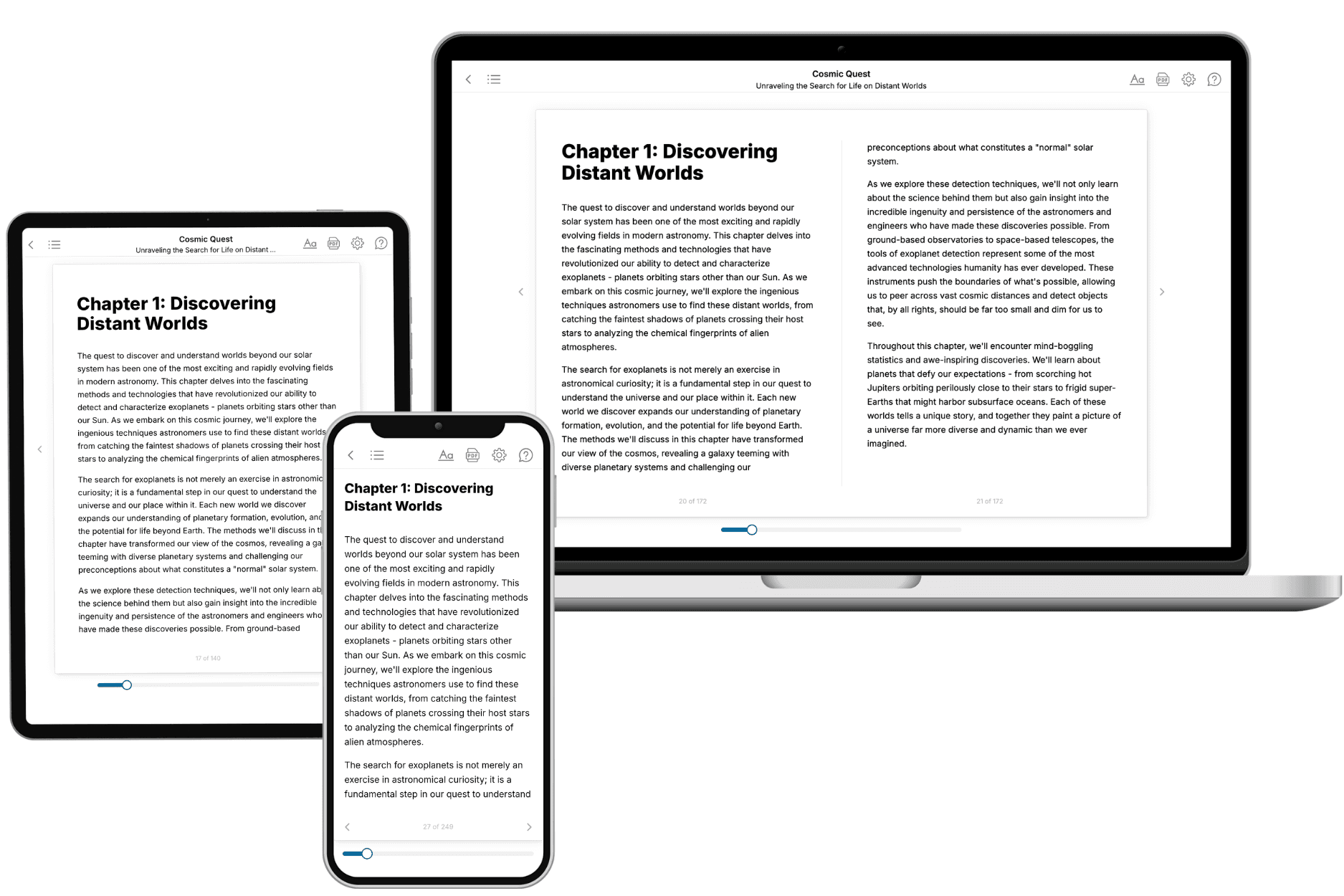
- 3. Get your tailored book
Your book is ready in 10 minutes. Read it online, download as EPUB or PDF, or send to Kindle.
Frequently asked questions
- What is TailoredRead?
TailoredRead creates complete, full-length nonfiction ebooks, written specifically for you. Tell us what you want to learn and why, and TailoredRead writes you a complete ebook on it, with charts, tables, and diagrams throughout. Read it online, on Kindle, or on any e-reader, or download it as a PDF or EPUB. Every book is written fresh the day you order it.
- How is the book tailored to me?
Before anything is written, you answer a few short questions about your goals, your background, and the topics you care about. Your book is then planned around your answers: written at your level, focused on your goals, and covering the topics you chose, instead of the one-size-fits-all book a store sells everyone.
- Will it read like generic AI content?
No. Your book isn't a chat transcript: it's planned chapter by chapter before a single word is written, told in a clear book voice, and explains ideas visually with charts, tables, and diagrams. After writing, every book goes through an editorial pass that polishes chapters so the book reads consistent from start to finish. Judge for yourself: browse thousands of sample books on our Explore Books page.
- How accurate is the content?
Our AI first checks whether your subject needs live research. Niche and fast-moving subjects are researched before writing, and the book plan and chapters are grounded in what it finds. After writing, every book goes through a quality pass that checks its facts and consistency, and researched books list their sources in a Notes section at the back.
- How long is the book?
You choose the length: Comprehensive (250-300 pages), Detailed (150-200 pages), Essential (70-100 pages), or Short (30-50 pages).
- Does the book include visuals?
Yes. Every book includes visual elements such as timelines, checklists, step-by-step guides, decision trees, comparison tables, and matrices, and many include bar charts. A typical book includes dozens of these visual elements.
- Can I read it on Kindle? What formats can I download?
Yes. Every book can be read in our online reader or downloaded as a PDF or EPUB. The EPUB can be opened with Kindle, Apple Books, Kobo, and any e-reader. The Commercial and Author licenses also include an editable Word (DOCX) and Markdown download.
- How much does it cost?
About the price of a regular ebook. The exact price depends on your book's length and complexity, from $2 for the shortest books to $35 for the most comprehensive, and it's shown when you review your book, before you commit to anything. Each book is a one-time purchase, yours to keep, no subscription. Licenses that let you share, teach, or publish your book range from $35.99 to $49.99.
- Can I preview the book before purchasing?
Before you pay, you'll see what your book will cover: the title, a detailed description, the estimated length, and the complete chapter-by-chapter table of contents, so you know what you're getting before you decide. The full text itself is written after you purchase.
- How long does it take to create a book?
About 10 minutes. You can start reading the opening chapters while the rest is still being written.