The Italian Wars Mastery Blueprint
Tactical Analysis, Political Dynamics, and Military Innovation in Renaissance Warfare
Imagine mastering the intricate military and political landscape of Renaissance Italy—understanding not just what happened on the battlefield, but why commanders made specific tactical decisions and how political alliances shaped military outcomes.
207 pages10 chaptersJun 15, 2026Military History
About this book
This comprehensive guide provides you with the analytical framework and detailed battle analysis necessary to understand the Italian Wars as a transformative period in military history. Through systematic examination of key campaigns including Fornovo, Cerignola, Garigliano, Marignano, Ravenna, Forlí, Bicocca, Agnadello, Pavia, and Ceresole, you'll develop expertise in Renaissance tactics, pike-and-shot formations, siege warfare, and the strategic positioning that determined territorial control. Detailed battle maps, casualty analysis, and commander strategy evaluations provide the empirical foundation for understanding how gunpowder innovation, mercenary army dynamics, and political-military coordination created the modern warfare paradigm. Whether you're conducting research, developing strategic frameworks, or seeking to understand how military innovation emerges from the intersection of technology, politics, and human leadership, this guide delivers the rigorous analysis and practical insights you need.
Table of contents
- IntroductionThe Italian Wars in Historical Context, The Military Revolution: From Medieval to Early Modern Warfare, Framework for Analysis and Strategic MasteryRead below
- Chapter 1: Italian Wars Chronology and Political FoundationsTimeline of Major Campaigns and Turning Points (1494-1559), Dynastic Powers and Their Strategic Objectives, Alliance Networks and Political Realignment
- Chapter 2: Renaissance Military Innovation and Tactical EvolutionGunpowder Artillery: Impact on Tactics and Fortifications, Pike and Shot Formations: Coordination and Effectiveness, Cavalry Charge Effectiveness and Tactical Integration
- Chapter 3: Condottieri Leadership and Mercenary Army DynamicsCondottieri Leadership Models and Command Structures, Mercenary Army Organization and Composition, Patronage Networks and Political-Military Coordination
- Chapter 4: Siege Warfare and Fortification StrategySiege Techniques and Supply Line Management, Fortification Design Evolution and Artillery Resistance, Case Study: The Siege of Forlí and Territorial Control
- Chapter 5: Early Campaigns and Tactical Foundations (1494-1503)Battle of Fornovo: Cavalry Dominance and Tactical Positioning, Battle of Cerignola: Pike and Shot Innovation in Action, Battle of Garigliano: Infantry Formation Tactics and River Warfare
- Chapter 6: Middle Period Campaigns and Strategic Consolidation (1504-1525)Battle of Agnadello: Territorial Control and Rapid Maneuver, Battle of Marignano: Pike Formations and Cavalry Coordination, Battle of Pavia: Gunpowder Dominance and Strategic Failure
- Chapter 7: Later Campaigns and Military Maturation (1526-1559)Battle of Ravenna: Artillery Effectiveness and Tactical Innovation, Battle of Bicocca: Defensive Positioning and Pike Effectiveness, Battle of Ceresole: Combined Arms Coordination and Terrain Utilization
- Chapter 8: Battle Analysis Framework and Outcome DeterminantsBattle Casualty Analysis and Troop Effectiveness Metrics, Battle Map Visualization and Tactical Movement Interpretation, Determining Factors in Battle Outcomes and Strategic Consequences
- Chapter 9: Strategic Positioning and Territorial Control PatternsTerrain Utilization and Geographic Advantage, Territorial Control Patterns and Strategic Geography, Supply Lines, Logistics, and Campaign Sustainability
- Chapter 10: Commander Strategy Evaluation and Decision AnalysisStrategic Decision-Making and Commander Competence, Tactical Adaptation and Response to Battlefield Conditions, Leadership Models and Organizational Effectiveness
- ConclusionSynthesis of Key Insights and Strategic Principles, Legacy of Italian Wars and Modern Military Implications
- Further Reading and Research Resources
Introduction
Between 1494 and 1559, the Italian peninsula became the proving ground for a new kind of warfare. Armies from France, Spain, the Holy Roman Empire, and a constellation of Italian states clashed across a landscape of fortified cities, mountain passes, and river valleys. What emerged from those sixty-five years was not simply a reshuffled map of European power. It was a fundamentally different way of organizing, equipping, and deploying military force. The Italian Wars did not just change who controlled Italy. They changed how wars were fought across the entire Western world.
For the military history researcher, this period offers something rare: a concentrated laboratory of tactical experimentation, political calculation, and institutional change. Within a single generation, commanders had to adapt to gunpowder artillery that could demolish medieval walls in days, pike-and-shot formations that made traditional cavalry charges catastrophically expensive, and siege operations that demanded engineering expertise as much as battlefield courage. The commanders who thrived were those who could integrate these new realities into coherent operational plans. Those who could not were often captured, killed, or simply outmaneuvered into irrelevance.
This book is designed for readers who already bring serious analytical tools to the study of military history. The goal is not to provide a narrative retelling of events that are well-documented elsewhere. Instead, the aim is to build a rigorous analytical framework around the Italian Wars, one that connects tactical decisions to strategic outcomes, links political dynamics to battlefield behavior, and traces the arc of military innovation from the first French invasion under Charles VIII to the final settlement at Cateau-Cambrésis. Each chapter is structured to support that kind of systematic, evidence-based analysis.
The chapters that follow move through the Italian Wars in both chronological and thematic dimensions. Chronological chapters examine specific battles and campaigns in detail, with attention to troop compositions, terrain, commander decisions, and measurable outcomes. Thematic chapters address the larger forces at work: the evolution of fortification design, the organizational logic of condottieri armies, the political economy of alliance networks, and the analytical methods that historians and strategists use to interpret battle outcomes. Together, these two tracks provide both the granular detail and the conceptual architecture needed for genuine mastery of the period.
The Italian Wars in Historical Context
The Italian Wars began with a single, dramatic act of dynastic ambition. In September 1494, King Charles VIII of France led an army of approximately 25,000 men across the Alps, claiming the Kingdom of Naples as his inheritance through a complex chain of dynastic succession. What made this invasion different from earlier French interventions in Italian politics was the scale of the force and, critically, the artillery train that accompanied it. Charles brought with him a mobile siege artillery park that could reduce fortifications that had previously been considered impregnable. The psychological and military shock of this capability reverberated across every Italian state almost immediately.[1]
Italy in 1494 was not a unified political entity. It was a mosaic of competing powers, each with its own military traditions, diplomatic networks, and territorial ambitions. The major players included the Kingdom of Naples in the south, the Papal States running through the center, the Republic of Florence, the Duchy of Milan in the north, and the Republic of Venice in the northeast. Smaller lordships, city-states, and ecclesiastical territories filled the gaps. This fragmentation meant that no single Italian power could resist a major foreign invasion alone, which is precisely why the Italian Wars became a contest between external powers using Italian territory as their arena.
The involvement of Spain transformed the conflict from a French dynastic adventure into a prolonged struggle for European hegemony. Ferdinand of Aragon, ruling through his viceroy in Sicily, had both the legal claim and the strategic motivation to contest French dominance in Naples. The Spanish response produced some of the most tactically significant engagements of the entire period, including the Battle of Cerignola in 1503, which is widely regarded as the first battle in European history decided primarily by gunpowder firearms.[2] The commander responsible, Gonzalo de Córdoba, became the template for the new kind of professional military leader that the Italian Wars demanded.
The Holy Roman Empire entered the conflict through the ambitions of Maximilian I and later Charles V, whose inheritance combined the Spanish crown with the Habsburg territories in central Europe. This created a strategic encirclement of France that shaped every major campaign after 1519. The Italian Wars were, from this point forward, inseparable from the broader contest between the Valois dynasty of France and the Habsburg dynasty of Spain and the Empire. Italy was the primary theater, but the stakes were continental. Understanding this geopolitical frame is essential for interpreting why specific battles were fought where they were, and why commanders accepted tactical risks that might otherwise seem irrational.
The Italian states themselves were not passive victims of foreign ambition. Venice, Milan, Florence, and the Papacy each pursued active diplomatic and military strategies, forming and dissolving alliances with remarkable speed when their interests shifted. The League of Venice in 1495, the League of Cambrai in 1508, and the Holy League of 1511 each represented a fundamental realignment of the political landscape, and each had direct consequences for military operations in the field. A commander who understood the political calendar, who knew when an ally might switch sides or when a new coalition was forming, held a significant operational advantage over one who focused only on the immediate tactical situation.
The wars concluded with the Peace of Cateau-Cambrésis in 1559, which confirmed Spanish dominance over most of the Italian peninsula. France retained only a few minor territorial gains after sixty-five years of intermittent warfare. The human and economic costs had been enormous. But the military legacy was transformative. The organizational structures, tactical doctrines, and fortification designs that emerged from the Italian Wars became the foundation of European military practice for the next century and a half. That legacy is the central subject of this book.
One important note on sources and methodology: the Italian Wars are documented through a rich but uneven body of primary and secondary sources. Chronicles, diplomatic dispatches, military treatises, and administrative records survive in varying quality and completeness. Casualty figures in particular must be treated with caution, as contemporary accounts frequently exaggerated losses on both sides for political effect. Where specific numbers are cited in this book, they represent the best current scholarly consensus, with appropriate acknowledgment of uncertainty where it exists.
The Military Revolution: From Medieval to Early Modern Warfare
The concept of a Military Revolution in early modern Europe was first systematically articulated by historian Michael Roberts in a 1955 lecture, and has been debated, refined, and contested ever since.[3] Roberts argued that a cluster of tactical, organizational, and strategic innovations between roughly 1560 and 1660 fundamentally transformed European warfare. Later historians, including Geoffrey Parker, pushed the origins of this transformation back into the Italian Wars period, arguing that the changes visible at Cerignola, Ravenna, and Pavia were not precursors to the Military Revolution but its actual beginning.[4] This book takes Parker's position as its working framework.
The most visible driver of change was gunpowder artillery. By the time Charles VIII crossed the Alps in 1494, French artillery had already undergone significant technical development. The key innovation was the replacement of stone cannonballs with iron shot, combined with improvements in bronze casting that allowed for lighter, more mobile gun carriages. The result was an artillery train that could travel with an army at a reasonable pace and still deliver devastating firepower against masonry walls. The traditional high-walled medieval castle, designed to resist escalade and battering rams, was suddenly vulnerable in ways its builders had never anticipated.
The response to this artillery threat drove one of the most consequential engineering developments of the Renaissance: the trace italienne, or Italian-style fortification. This system replaced tall, thin walls with low, thick earthwork bastions designed to absorb artillery fire and provide flanking coverage for defenders. The transition was expensive, slow, and uneven across different regions and political entities. But it fundamentally changed the calculus of siege warfare, making fortified positions far more resistant to artillery bombardment and dramatically increasing the time, resources, and manpower required to reduce a defended city. The implications for campaign planning and strategic geography were profound.
Infantry tactics underwent an equally dramatic transformation. The dominant infantry formation of the late medieval period in much of Europe was the mounted knight, supported by infantry archers and crossbowmen. The Swiss cantons had already demonstrated, at battles like Grandson (1476) and Murten (1476), that disciplined pike formations could defeat armored cavalry at a fraction of the cost. The Italian Wars spread this lesson across the entire European military system. Swiss mercenaries became the most sought-after infantry in Europe, and their tactical methods were studied, copied, and eventually surpassed by the Spanish tercio system that emerged from the campaigns of Gonzalo de Córdoba.
The pike-and-shot formation that became standard during the Italian Wars combined the shock power of massed pikes with the firepower of arquebusiers and, later, musketeers. This combination required a level of drill, coordination, and tactical discipline that was qualitatively different from anything that had come before. It also required a different kind of military organization. Armies built around feudal obligation, where nobles brought their retinues to the field for a limited campaign season, could not sustain the training and cohesion that pike-and-shot tactics demanded. The Italian Wars accelerated the shift toward paid, professional armies organized around permanent units with consistent training and command structures.
Cavalry did not disappear from the battlefield, but its role changed fundamentally. The heavily armored knight charging in close formation, the defining image of medieval warfare, became increasingly obsolete against disciplined pike squares and firearms. Cavalry adapted by shifting toward lighter, more mobile roles: reconnaissance, pursuit of broken infantry, flank protection, and harassment of supply lines. The gendarmes, the heavy cavalry that formed the elite of French armies, remained tactically significant throughout the Italian Wars, but their effectiveness depended increasingly on coordination with infantry and artillery rather than independent shock action.
Logistics and supply chain management emerged as critical determinants of campaign success in ways that medieval warfare had not fully required. Larger armies, longer campaigns, and the need to maintain siege operations for weeks or months at a time placed enormous demands on supply systems. Armies that could not feed themselves were forced to forage, which alienated local populations, spread disease, and degraded unit cohesion. The commanders who consistently succeeded in the Italian Wars, figures like Gonzalo de Córdoba and later the Marquis of Pescara, were those who understood that winning battles was only part of the problem. Keeping an army in the field, fed, paid, and capable of sustained operations, was equally essential.
Key transformation summary: The Italian Wars compressed what might otherwise have been a century of gradual military evolution into a single generation of intense, competitive innovation. Artillery, fortification, infantry tactics, cavalry roles, and logistics all underwent fundamental change between 1494 and 1559, driven by the pressure of continuous, high-stakes conflict between sophisticated military powers.
Intelligence gathering and operational security also became more systematic during this period. Commanders employed scouts, spies, and local informants to track enemy movements, assess fortification strengths, and anticipate alliance shifts. The diplomatic networks that sustained political alliances also served as intelligence channels. A commander like Cesare Borgia, operating in central Italy in the early 1500s, demonstrated how the integration of political intelligence with military planning could produce rapid, decisive results against opponents who were reacting rather than anticipating. Machiavelli, who observed Borgia's campaigns directly, drew on these observations in both The Prince and The Art of War.
Framework for Analysis and Strategic Mastery
This book is organized around a multi-level analytical framework that operates simultaneously at the tactical, operational, and strategic levels of war. These three levels are not simply different scales of the same analysis. They represent qualitatively different kinds of decision-making, with different time horizons, different information requirements, and different criteria for success. Understanding how decisions at each level interacted with and constrained decisions at the others is essential for grasping why specific campaigns unfolded as they did.
At the tactical level, the analysis focuses on individual battles and engagements: troop dispositions, terrain utilization, the timing and sequencing of attacks, the role of artillery and cavalry, and the immediate decisions that determined who held the field at the end of the day. Each battle chapter provides a structured breakdown of these elements, using the following analytical categories:
- Order of battle: Troop numbers, composition, and quality on each side
- Terrain assessment: Geographic features and how each commander used or failed to use them
- Artillery deployment: Positioning, effectiveness, and integration with infantry and cavalry
- Formation tactics: Pike-and-shot coordination, cavalry roles, and reserve management
- Command decisions: Key choices made before and during the engagement, with assessment of alternatives
- Outcome metrics: Casualties, prisoners, territorial consequences, and strategic follow-through
At the operational level, the analysis examines campaigns as sequences of connected actions: how armies moved through the landscape, how commanders chose their objectives, how supply lines were established and threatened, and how the outcome of one engagement shaped the options available in the next. The operational level is where the interaction between military action and political constraint is most visible. A commander might win a battle but find himself unable to exploit the victory because his political masters had already opened negotiations, or because a key ally had switched sides, or because his army had consumed its supplies and could not advance further.
At the strategic level, the analysis connects military operations to the dynastic ambitions, political alliances, and territorial objectives that gave the wars their overall shape. This is where the decisions of kings, popes, and diplomats intersect with the decisions of generals. The strategic level analysis in this book draws heavily on the documentary record of diplomatic correspondence, treaty negotiations, and political chronicles, treating these sources as evidence of the decision-making environment within which military commanders operated.
The analytical framework also incorporates a systematic approach to counterfactual reasoning. For each major battle and campaign, the analysis considers not only what happened but what plausibly could have happened under different conditions. This is not speculation for its own sake. Counterfactual analysis is a rigorous tool for identifying which factors were truly decisive and which were contingent. If a battle outcome would have been the same regardless of a particular decision, that decision was not a critical variable. If a small change in one factor would have produced a dramatically different outcome, that factor deserves close analytical attention. This approach helps distinguish between the genuinely important and the merely dramatic.
A note on the use of quantitative data in this book: wherever reliable figures exist for troop strengths, casualty counts, artillery inventories, and campaign durations, they are used as analytical inputs rather than simply as narrative color. The goal is to build arguments that are grounded in measurable evidence. However, as noted earlier, the quality of quantitative data from this period varies considerably. The analytical approach throughout is to use the best available figures while being explicit about their limitations and the range of uncertainty they carry.
The ten main chapters of this book are organized as follows. Chapters 1 through 4 establish the foundational context: the political and chronological framework of the wars, the nature of military innovation during the period, the organizational dynamics of condottieri armies, and the principles of siege warfare and fortification design. These chapters provide the conceptual vocabulary and analytical tools that the subsequent battle analyses depend on.
Chapters 5 through 7 provide detailed analysis of ten major battles, organized chronologically into three periods:
- Early campaigns (1494–1503): Fornovo, Cerignola, and Garigliano, covering the initial shock of French invasion and the Spanish tactical response
- Middle period (1504–1525): Agnadello, Marignano, and Pavia, covering the consolidation of pike-and-shot tactics and the emergence of Habsburg dominance
- Later campaigns (1526–1559): Ravenna, Bicocca, and Ceresole, covering the maturation of combined-arms warfare and the final resolution of the conflict
Chapters 8 through 10 synthesize the battle analyses into broader frameworks for understanding outcome determinants, strategic geography, and commander decision-making. These chapters are designed to be useful not only as summaries of the Italian Wars but as transferable analytical tools for the study of other military periods and conflicts.
Throughout the book, specific analytical tools are introduced and applied consistently. These include battle map interpretation guidelines, casualty analysis methodologies, commander competence evaluation rubrics, and supply chain assessment frameworks. Each tool is introduced in context, applied to the relevant case material, and then referenced in subsequent chapters where it applies. The goal is to build a cumulative analytical capability, so that by the final chapter, the reader has not just learned about the Italian Wars but has developed a systematic method for analyzing any complex military-political conflict.
How to use this book most effectively: The chapters are designed to be read in sequence, since later analytical chapters build on concepts introduced earlier. However, each battle chapter is also structured to stand alone as a reference document. Researchers focusing on a specific engagement can read that chapter independently and use the cross-references to locate relevant contextual material in the foundational chapters.
The Italian Wars reward serious analytical attention precisely because they are complex. Simple narratives of heroic commanders and decisive battles miss the deeper patterns: the way political constraints shaped operational choices, the way tactical innovation spread through competitive pressure, the way logistics and supply determined what was strategically possible. This book is built on the conviction that understanding those deeper patterns is both intellectually rewarding and practically valuable. The military problems that commanders faced in Renaissance Italy, how to integrate new technology into existing organizations, how to maintain cohesion under political pressure, how to translate tactical success into durable strategic advantage, are not problems that belong only to the sixteenth century. They are enduring challenges of organized conflict, and the Italian Wars offer some of the richest case material available for studying them.
Notes
Introduction
- 1. Mallett, Michael, and Christine Shaw. The Italian Wars 1494-1559: War, State and Society in Early Modern Europe. Pearson, 2012, pp. 14-18.
- 2. Oman, Charles. A History of the Art of War in the Sixteenth Century. Methuen, 1937, p. 63.
- 3. Roberts, Michael. 'The Military Revolution, 1560-1660.' A lecture delivered to the Queen's University of Belfast, 1955. Reprinted in Rogers, Clifford J, ed. The Military Revolution Debate. Westview Press, 1995
- 4. Parker, Geoffrey. The Military Revolution: Military Innovation and the Rise of the West, 1500-1800. Cambridge University Press, 1988, pp. 6-10.
This is the end of the free sample. The full book has 10 chapters.
Want this book written for you?
Tell us your goals and background, and get your own version of this book, tailored by AI to you.


Benefits of AI-tailored books
- Read one book, not ten:
- all the Military History knowledge you need, gathered into a single book.
- Save days of learning:
- tell us your goals, choose your topics, and the whole book is built around them.
- Learn effortlessly:
- Military History book written for your specific background and expertise.
- Understand at a glance:
- includes charts, tables, timelines, checklists, decision trees, and more.
- Stay current:
- written the day you order it, not years ago.
- Trust what you read:
- every book is checked for accuracy, with real research when your subject needs it.
Create your unique book in 3 steps
- 1. Select your focus
Select the focus of your Military History book and share your background
- 2. Personalize your book
Specify your goals and choose sub-topics to include
- 3. Get your tailored book
Your book is ready in 10 minutes. Read it online, download as EPUB or PDF, or send to Kindle.


Frequently asked questions
- What is TailoredRead?
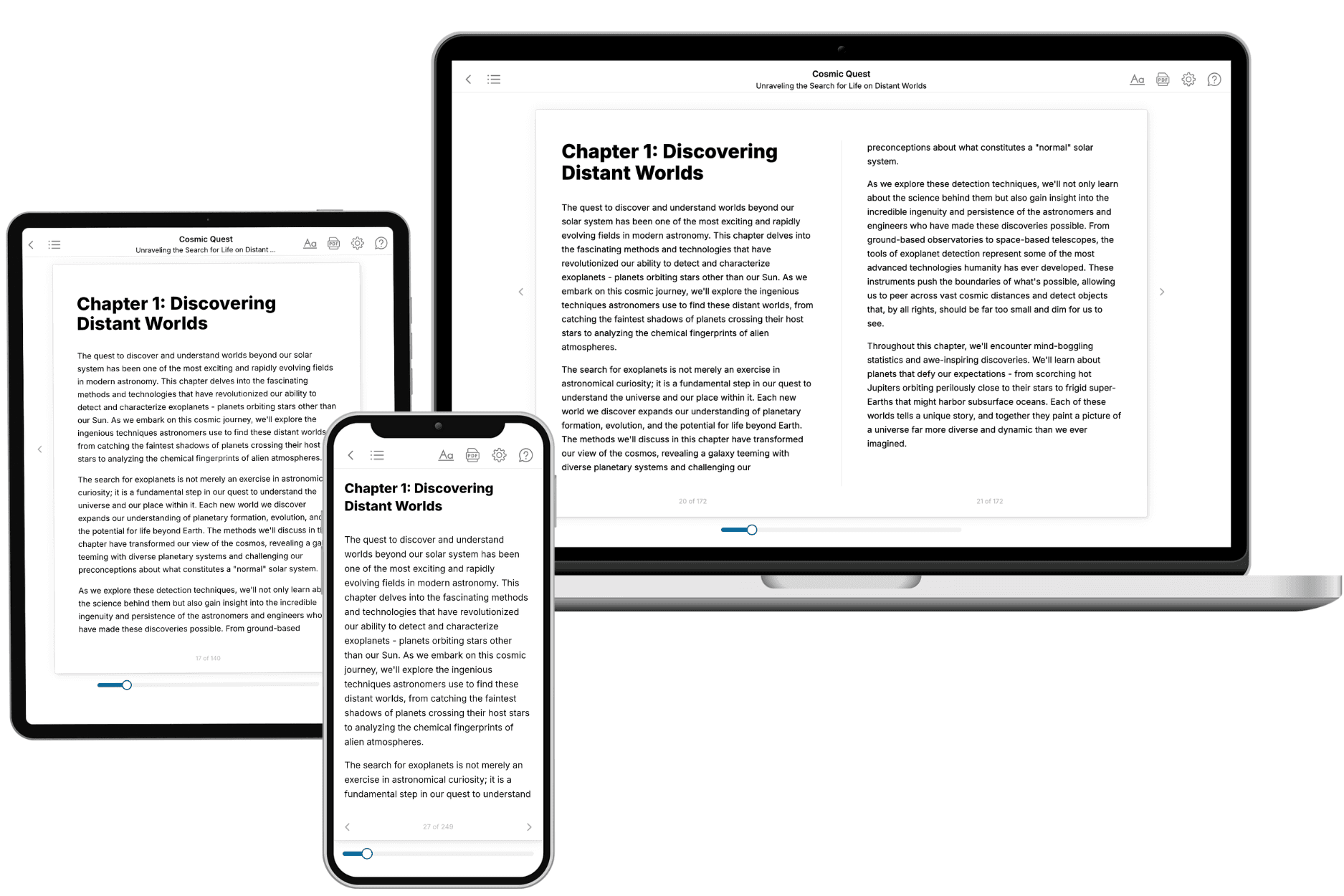
TailoredRead creates complete, full-length nonfiction ebooks, written specifically for you. Tell us what you want to learn and why, and TailoredRead writes you a complete ebook on it, with charts, tables, and diagrams throughout. Read it online, on Kindle, or on any e-reader, or download it as a PDF or EPUB. Every book is written fresh the day you order it.
- How is the book tailored to me?
Before anything is written, you answer a few short questions about your goals, your background, and the topics you care about. Your book is then planned around your answers: written at your level, focused on your goals, and covering the topics you chose, instead of the one-size-fits-all book a store sells everyone.
- Will it read like generic AI content?
No. Your book isn't a chat transcript: it's planned chapter by chapter before a single word is written, told in a clear book voice, and explains ideas visually with charts, tables, and diagrams. After writing, every book goes through an editorial pass that polishes chapters so the book reads consistent from start to finish. Judge for yourself: browse thousands of sample books on our Explore Books page.
- How accurate is the content?
Our AI first checks whether your subject needs live research. Niche and fast-moving subjects are researched before writing, and the book plan and chapters are grounded in what it finds. After writing, every book goes through a quality pass that checks its facts and consistency, and researched books list their sources in a Notes section at the back.
- How long is the book?
You choose the length: Comprehensive (250-300 pages), Detailed (150-200 pages), Essential (70-100 pages), or Short (30-50 pages).
- Does the book include visuals?
Yes. Every book includes charts, tables, and diagrams: timelines, checklists, step-by-step guides, decision trees, comparison tables, matrices, and bar charts. A typical book includes dozens of these visual elements.
- Can I read it on Kindle? What formats can I download?
Yes. Every book can be read in our online reader or downloaded as a PDF or EPUB. The EPUB can be opened with Kindle, Apple Books, Kobo, and any e-reader. The Commercial and Author licenses also include an editable Word (DOCX) and Markdown download.
- How much does it cost?
About the price of a regular ebook. The exact price depends on your book's length and complexity, from $2 for the shortest books to $35 for the most comprehensive, and it's shown when you review your book, before you commit to anything. Each book is a one-time purchase, yours to keep, no subscription. Licenses that let you share, teach, or publish your book range from $35.99 to $49.99.
- Can I preview the book before purchasing?
Before you pay, you'll see what your book will cover: the title, a detailed description, the estimated length, and the complete chapter-by-chapter table of contents, so you know what you're getting before you decide. The full text itself is written after you purchase.
- How long does it take to create a book?
About 10 minutes. You can start reading the opening chapters while the rest is still being written.