Jonkershoek Nature Reserve
Your Complete Guide to Cape Town's Hidden Mountain Sanctuary
Most visitors to Cape Town miss one of the region's most spectacular natural treasures—Jonkershoek Nature Reserve.
207 pages10 chaptersMay 14, 2026Travel and Outdoors
About this book
While Table Mountain dominates the skyline, this sprawling sanctuary in the Stellenbosch Mountains offers equally stunning landscapes with far fewer crowds. This guide reveals everything you need to know to experience Jonkershoek like a seasoned explorer. From selecting the perfect trail for your fitness level to understanding the unique fynbos ecosystem and spotting endemic wildlife, you'll discover how to maximize every moment in this protected wilderness. Learn the best times to visit, essential safety practices, and insider tips that transform a casual hike into an unforgettable adventure. Whether you're seeking challenging mountain trails, peaceful nature walks, or educational experiences about Cape Town's natural heritage, Jonkershoek delivers. This comprehensive guide combines practical logistics with rich context about the reserve's geology, biodiversity, and conservation importance, ensuring you're prepared and inspired for your visit.
Table of contents
- IntroductionWhy Jonkershoek Matters, What to Expect from This Guide, How to Use This BookRead below
- Chapter 1: Getting Started: Planning Your VisitLocation and How to Get There, Entry Fees and Operating Hours, Best Times to Visit by Season, What to Bring and Prepare
- Chapter 2: Understanding the ReserveHistory and Conservation Efforts, Geography and Geological Formation, Different Zones and Facilities
- Chapter 3: Biodiversity: Flora and FaunaThe Fynbos Ecosystem Explained, Endemic Plants and Wildflowers, Wildlife: What You Might See, Bird Watching Opportunities
- Chapter 4: Choosing Your TrailUnderstanding Difficulty Ratings, Easy Trails for Casual Walkers, Moderate Trails for Regular Hikers, Challenging Trails for Experienced Hikers
- Chapter 5: Popular Trails in DetailFirst Waterfall Trail, Second Waterfall Trail, Brandy Pool and Waterfall, Jonkershoek Peak Trail
- Chapter 6: Safety and PreparationWeather Hazards and Seasonal Risks, Fire Safety and Restrictions, Wildlife Safety and Encounters, Emergency Protocols and First Aid
- Chapter 7: Hiking Essentials and GearProper Footwear and Clothing, Hydration and Nutrition Planning, Navigation Tools and Maps, Photography Tips for Capturing Memories
- Chapter 8: Responsible Tourism and ConservationLeave No Trace Principles, Trail Etiquette and Respect, Your Role in Conservation
- Chapter 9: Visitor Facilities and ServicesPicnic Areas and Rest Spots, Guided Tours and Local Guides, Nearby Amenities and Services
- Chapter 10: Sample Itineraries and Trip PlanningHalf-Day and Full-Day Trip Options, Multi-Day Adventure Planning, Family-Friendly Visit Ideas, Integrating Jonkershoek into Your Cape Town Itinerary
- ConclusionThe Lasting Impact of Your Visit, Planning Your Return
- Appendix: Quick ReferenceContact Information and Resources, Glossary of Terms, Further Reading and Resources
Introduction
There is a place tucked into the mountains east of Stellenbosch where the air smells of wild herbs, rivers run cold and clear over ancient granite, and the trails wind through one of the most biologically rich ecosystems on the planet. Most visitors to Cape Town never find it. They spend their days on Table Mountain, along the Garden Route, or at the Cape of Good Hope, and they leave without ever knowing that Jonkershoek Nature Reserve was waiting for them just thirty minutes from the city center. That is a significant miss, and this guide exists to make sure it does not happen to you.
Jonkershoek sits within the Stellenbosch Mountains, part of the larger Cape Fold Belt that defines the dramatic landscape of the Western Cape. The reserve covers roughly 10,000 hectares of protected wilderness, sheltering an extraordinary concentration of fynbos vegetation, endemic wildlife, and mountain terrain that ranges from gentle valley walks to serious summit climbs.[1] It is a place where serious hikers and casual nature lovers can both find exactly what they are looking for, often on the same morning.
What makes Jonkershoek genuinely special is not just its beauty, though that is considerable. It is the combination of accessibility, ecological significance, and relative quiet that sets it apart. On a busy Saturday at Table Mountain, you might share the trail with hundreds of other visitors. At Jonkershoek on the same day, you might walk for an hour and encounter only a handful of people. That kind of solitude, so close to a major international city, is increasingly rare and genuinely worth seeking out. This guide will show you how to find it, how to prepare for it, and how to make the most of every hour you spend there.
Why Jonkershoek Matters
To understand why Jonkershoek deserves your attention, it helps to understand the broader ecological context it sits within. The reserve forms part of the Cape Floristic Region, one of only six recognized floral kingdoms on Earth and the smallest of them all.[2] Despite covering less than 0.5% of Africa's land area, this region contains nearly 20% of the continent's entire plant diversity. Jonkershoek protects a significant portion of that diversity within its boundaries, making it far more than a pretty hiking destination. It is an active conservation zone with global ecological importance.
The fynbos biome that dominates Jonkershoek is found nowhere else on Earth in its full form. This ancient shrubland ecosystem has evolved over millions of years in response to the Western Cape's specific combination of nutrient-poor soils, a Mediterranean climate, and periodic fire cycles. The result is a plant community of staggering variety. More than 1,400 plant species have been recorded within the reserve and its immediate surroundings, with a significant proportion classified as endemic, meaning they grow here and nowhere else on the planet.[3] Walking through Jonkershoek is, in a very real sense, walking through a living museum of evolutionary history.
Beyond its plant life, the reserve provides critical habitat for a range of animal species, including the Cape leopard, various antelope species, and an impressive diversity of birds. The Jonkershoek River system, which runs through the valley floor, supports freshwater ecosystems that are increasingly threatened across the Western Cape. The reserve's protected status helps maintain the water quality and flow that downstream communities and agricultural areas depend on. Conservation here is not abstract. It has direct, measurable consequences for the region's water security and biodiversity.
From a cultural and historical perspective, Jonkershoek also carries significant weight. The valley has been inhabited and used by humans for thousands of years, from the indigenous Khoikhoi and San peoples to Dutch and later British settlers who recognized the valley's agricultural and forestry potential. The name "Jonkershoek" itself derives from the Dutch word for "young gentleman's corner," a reference to early colonial land grants in the area. Understanding this layered history adds depth to any visit and connects the landscape to the broader story of the Western Cape.
The reserve also plays a practical role in Cape Town's water supply. The Jonkershoek Valley feeds into the Eerste River system, which historically contributed to the region's water catchment network. CapeNature, the conservation authority that manages the reserve, actively monitors and protects these water resources as part of its broader mandate.[4] When you visit Jonkershoek and follow responsible tourism practices, you are directly supporting the protection of infrastructure that matters to millions of people in the greater Cape Town area.
For travelers who care about experiencing destinations with genuine substance, Jonkershoek offers something that many popular tourist sites cannot: a place where natural beauty, ecological significance, cultural history, and practical conservation all converge in one accessible location. It rewards curiosity. The more you know about what you are looking at, the more remarkable it becomes. This guide is designed to give you that knowledge before you arrive, so that every step on the trail carries meaning.
Jonkershoek is not a backup plan for when Table Mountain is cloudy. It is a destination in its own right, one that offers a fundamentally different and arguably more intimate experience of the Cape's natural world.
The reserve's relative obscurity among international visitors is, in some ways, a gift. It means the trails are quieter, the wildlife is less disturbed, and the experience feels more authentic. But it also means that fewer visitors arrive prepared. They underestimate the terrain, misread the weather, or miss the ecological highlights entirely because they did not know what to look for. This guide addresses all of that directly, giving you the preparation and context to visit with confidence.
What to Expect from This Guide
This guide is built around a single goal: giving you everything you need to have a safe, meaningful, and genuinely enjoyable experience at Jonkershoek Nature Reserve. It is not a collection of vague travel tips or generic hiking advice. Every chapter addresses a specific aspect of visiting the reserve, with practical detail that you can act on directly. Whether you are planning your first visit or returning for a deeper exploration, the information here is designed to be immediately useful.
The guide covers the full arc of a visit, from initial planning through to responsible departure. You will find detailed information on how to get to the reserve, what entry fees to expect, and which seasons offer the best conditions for different types of activities. There is a dedicated chapter on the reserve's ecology and biodiversity, written to be accessible rather than academic, so you can recognize and appreciate what you encounter on the trail without needing a botany degree. The trail chapters go beyond simple descriptions to include practical details like elevation gain, estimated hiking times, key landmarks, and specific challenges to prepare for.
Safety is treated as a serious topic throughout this guide, not an afterthought. The Western Cape's mountain environment can change quickly, and Jonkershoek is no exception. Weather hazards, fire risks, wildlife encounters, and navigation challenges all receive dedicated attention. The goal is not to make the reserve sound dangerous, because it is not, when approached with appropriate preparation. The goal is to make sure you have the knowledge to handle whatever conditions you encounter, so that nothing catches you off guard.
The guide also addresses responsible tourism in practical terms. Jonkershoek's ecological value depends on visitors treating it with care. The chapters on conservation and trail etiquette are not lectures. They are straightforward explanations of why certain practices matter and exactly what you should and should not do. Following these guidelines protects the reserve and also tends to improve your own experience, since a well-preserved natural environment is simply more rewarding to spend time in.
Throughout the guide, you will find specific examples, real trail scenarios, and concrete recommendations rather than generalities. When a trail is described as challenging, that description comes with specific details about what makes it challenging and what preparation is required. When a season is recommended for wildflower viewing, the guide explains which species bloom when and where to find them. This level of specificity is what separates a genuinely useful guide from one that simply restates information you could find on any travel website.
The guide also includes sample itineraries for different types of visitors, from families with young children to experienced hikers looking for a full-day challenge. These itineraries are not rigid schedules. They are starting points that you can adapt based on your own fitness level, interests, and available time. The appendix at the back of the guide provides quick-reference information including contact details, a glossary of key terms, and recommendations for further reading if you want to go deeper on any particular topic.
One thing this guide does not do is oversell. Jonkershoek is a remarkable place, but it also has limitations. Some trails are closed seasonally due to fire risk or maintenance. The reserve does not have extensive on-site facilities, and certain amenities that visitors might expect are simply not available. Where limitations exist, this guide acknowledges them honestly and offers practical alternatives. The aim is to set accurate expectations so that your visit matches what you were hoping for.
How to Use This Book
This guide is organized to support two different reading approaches. You can read it cover to cover before your visit to build a comprehensive picture of the reserve, or you can navigate directly to the chapters most relevant to your immediate needs. Both approaches work, and the structure is designed to make either one easy. The table of contents is detailed enough to help you find specific information quickly, and each chapter is written to stand on its own without requiring you to have read everything that came before it.
If you are in the early planning stages of your trip, the best starting point is Chapter 1, which covers location, access, entry fees, and seasonal timing. This chapter gives you the foundational logistics you need before anything else makes sense. From there, Chapter 2 provides an overview of the reserve's history, geography, and layout, which will help you orient yourself when you arrive. Reading these two chapters together takes less than an hour and will significantly improve the quality of your planning.
For visitors who are primarily interested in the hiking trails, Chapters 4 and 5 are the core of the guide. Chapter 4 explains how to match trails to your fitness level and experience, while Chapter 5 provides detailed descriptions of the most popular routes. These chapters work best when read alongside Chapter 6 on safety and Chapter 7 on gear, since trail selection and preparation are closely connected. A trail that is perfectly appropriate for a well-equipped, experienced hiker can be genuinely risky for someone who arrives underprepared.
The biodiversity chapter (Chapter 3) is worth reading regardless of your primary interest in the reserve. Even if you are visiting primarily for the hiking, understanding what you are walking through transforms the experience. Knowing that the protea bush beside the trail is a species found only in this specific mountain range, or that the bird calling overhead is a Cape sugarbird feeding on fynbos nectar, adds a layer of engagement that makes the hike more memorable. This chapter is written to be enjoyable rather than technical, so it reads more like a nature story than a field guide.
If you are visiting with children or planning a family trip, Chapter 10's family-friendly itinerary section is a practical starting point. It identifies the trails and activities best suited to younger visitors and offers specific suggestions for keeping the experience engaging for different age groups. The responsible tourism chapter (Chapter 8) is also particularly relevant for family visits, since teaching children about conservation practices in a real-world setting is one of the most valuable things a visit to Jonkershoek can offer.
For visitors who are integrating Jonkershoek into a broader Cape Town itinerary, the final section of Chapter 10 addresses exactly that. It covers how to combine a Jonkershoek visit with other Western Cape destinations, how to manage travel time from different parts of Cape Town, and how to structure a day that includes both the reserve and other regional highlights. The Stellenbosch wine region, for example, is immediately adjacent to Jonkershoek, making a combined visit both logical and rewarding.
Throughout the guide, key terms are highlighted in bold when they are first introduced, and a full glossary is available in the appendix for quick reference. Footnotes are used to credit sources and point toward additional reading for those who want to explore specific topics further. The guide draws on information from CapeNature, academic research on the Cape Floristic Region, and established hiking resources for the Western Cape, all of which are cited where relevant.
A practical note on timing: conditions at Jonkershoek change with the seasons, and some of the specific details in this guide, particularly around entry fees, operating hours, and trail availability, are subject to change. Before your visit, it is always worth checking the current information directly with CapeNature, either through their official website or by calling the reserve directly. Contact details are provided in the appendix. The guide gives you the framework and context to make good decisions; the reserve's management team can give you the most current operational details.
Finally, consider this guide a starting point rather than a complete picture. Jonkershoek rewards repeated visits, and every season reveals something different. The guide covers the reserve comprehensively, but the experience of actually being there, of hearing the wind move through the fynbos and watching the light change on the mountain peaks, is something no book can fully capture. The goal here is simply to make sure you arrive ready to receive everything the reserve has to offer. What you do with that experience is entirely your own.
The best way to use this guide is to read enough to feel genuinely prepared, then put it in your pack and go. The mountain will do the rest.
Here is a quick reference for how to navigate the guide based on your situation:
- First-time visitor, general interest: Start with Chapters 1 and 2, then read Chapter 3 for ecological context before selecting a trail in Chapters 4 and 5.
- Experienced hiker seeking a challenge: Go directly to Chapter 4 for difficulty ratings, then Chapter 5 for detailed trail descriptions, and review Chapter 6 for safety specifics.
- Family with children: Begin with Chapter 10's family itinerary section, then cross-reference with Chapter 4's easy trail options and Chapter 8 on responsible tourism.
- Nature and wildlife enthusiast: Chapter 3 is your primary resource, supplemented by Chapter 5 for trail recommendations that maximize wildlife and plant viewing opportunities.
- Short on time, planning a half-day visit: Read Chapter 10's half-day itinerary options first, then use Chapter 5 to understand the specific trail you select.
- Integrating into a Cape Town trip: Start with Chapter 1 for logistics, then jump to Chapter 10's integration section for itinerary planning advice.
However you choose to use this guide, the underlying intention is the same: to make your time at Jonkershoek as rich, safe, and rewarding as possible. The reserve has been protecting and nurturing one of the world's most extraordinary ecosystems for decades. It deserves visitors who arrive ready to appreciate it fully. This guide is here to help you do exactly that.
Notes
Introduction
- 1. CapeNature, Jonkershoek Nature Reserve: Official Reserve Information, CapeNature Western Cape, 2023
- 2. N. Myers and others, "Biodiversity hotspots for conservation priorities," Nature, 2000
- 3. P. Goldblatt and J. Manning, Cape Plants: A Conspectus of the Cape Flora of South Africa, Strelitzia 9. National Botanical Institute, Pretoria, 2000
- 4. CapeNature, Annual Report 2021/2022, Western Cape Government, 2022
This is the end of the free sample. The full book has 10 chapters.
Want this book written for you?
Tell us your goals and background, and get your own version of this book, tailored by AI to you.


Benefits of AI-tailored books
- Read one book, not ten:
- all the Travel and Outdoors knowledge you need, gathered into a single book.
- Save days of learning:
- tell us your goals, choose your topics, and the whole book is built around them.
- Learn effortlessly:
- Travel and Outdoors book written for your specific background and expertise.
- Understand at a glance:
- includes charts, tables, timelines, checklists, decision trees, and more.
- Stay current:
- written the day you order it, not years ago.
- Trust what you read:
- every book is checked for accuracy, with real research when your subject needs it.
Create your unique book in 3 steps
- 1. Select your focus
Select the focus of your Travel and Outdoors book and share your background
- 2. Personalize your book
Specify your goals and choose sub-topics to include
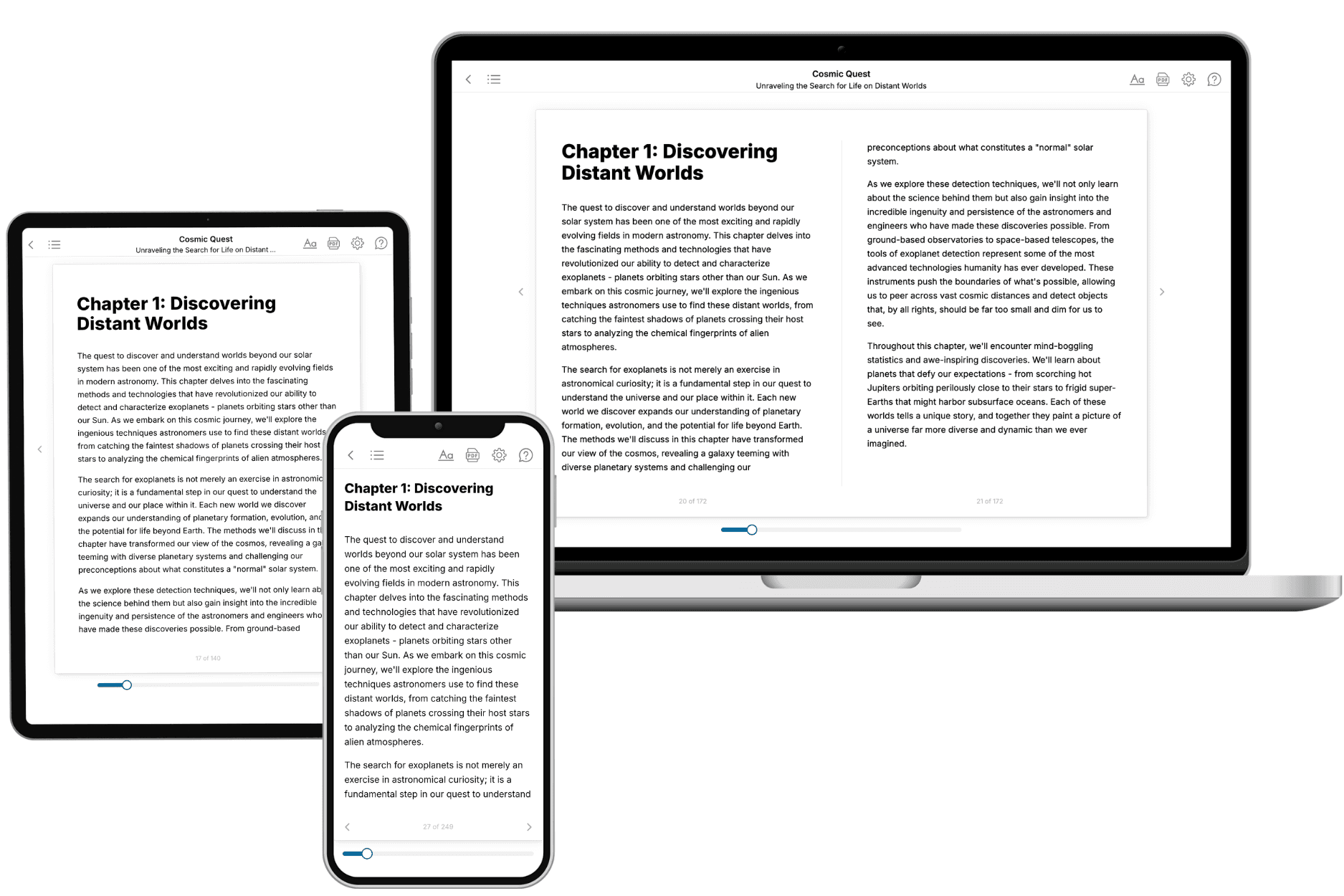
- 3. Get your tailored book
Your book is ready in 10 minutes. Read it online, download as EPUB or PDF, or send to Kindle.
Frequently asked questions
- What is TailoredRead?
TailoredRead creates complete, full-length nonfiction ebooks, written specifically for you. Tell us what you want to learn and why, and TailoredRead writes you a complete ebook on it, with charts, tables, and diagrams throughout. Read it online, on Kindle, or on any e-reader, or download it as a PDF or EPUB. Every book is written fresh the day you order it.
- How is the book tailored to me?
Before anything is written, you answer a few short questions about your goals, your background, and the topics you care about. Your book is then planned around your answers: written at your level, focused on your goals, and covering the topics you chose, instead of the one-size-fits-all book a store sells everyone.
- Will it read like generic AI content?
No. Your book isn't a chat transcript: it's planned chapter by chapter before a single word is written, told in a clear book voice, and explains ideas visually with charts, tables, and diagrams. After writing, every book goes through an editorial pass that polishes chapters so the book reads consistent from start to finish. Judge for yourself: browse thousands of sample books on our Explore Books page.
- How accurate is the content?
Our AI first checks whether your subject needs live research. Niche and fast-moving subjects are researched before writing, and the book plan and chapters are grounded in what it finds. After writing, every book goes through a quality pass that checks its facts and consistency, and researched books list their sources in a Notes section at the back.
- How long is the book?
You choose the length: Comprehensive (250-300 pages), Detailed (150-200 pages), Essential (70-100 pages), or Short (30-50 pages).
- Does the book include visuals?
Yes. Every book includes charts, tables, and diagrams: timelines, checklists, step-by-step guides, decision trees, comparison tables, matrices, and bar charts. A typical book includes dozens of these visual elements.
- Can I read it on Kindle? What formats can I download?
Yes. Every book can be read in our online reader or downloaded as a PDF or EPUB. The EPUB can be opened with Kindle, Apple Books, Kobo, and any e-reader. The Commercial and Author licenses also include an editable Word (DOCX) and Markdown download.
- How much does it cost?
About the price of a regular ebook. The exact price depends on your book's length and complexity, from $2 for the shortest books to $35 for the most comprehensive, and it's shown when you review your book, before you commit to anything. Each book is a one-time purchase, yours to keep, no subscription. Licenses that let you share, teach, or publish your book range from $35.99 to $49.99.
- Can I preview the book before purchasing?
Before you pay, you'll see what your book will cover: the title, a detailed description, the estimated length, and the complete chapter-by-chapter table of contents, so you know what you're getting before you decide. The full text itself is written after you purchase.
- How long does it take to create a book?
About 10 minutes. You can start reading the opening chapters while the rest is still being written.