The Kennedy Conservation Legacy
How Environmental Advocacy and Political Action Shape Biodiversity Protection
Many people care deeply about protecting nature but feel uncertain about how political action and environmental advocacy actually drive real conservation results.
191 pages9 chaptersMay 6, 2026Environmentalism
About this book
The challenge is understanding the complex relationship between scientific evidence, policy-making, and the influential voices that shape environmental protection efforts. This book explores how biodiversity conservation works in practice, examining the role of political engagement, regulatory frameworks, and advocacy in protecting our planet's ecosystems. You'll discover how environmental leaders navigate the intersection of science and politics, the mechanisms through which policy changes protect species and habitats, and why public awareness matters as much as scientific research. Whether you're interested in understanding environmental policy, exploring conservation strategies, or learning how individual advocacy contributes to larger environmental movements, this book provides practical insights into the real-world dynamics of protecting biodiversity in an increasingly complex political landscape.
Table of contents
- IntroductionWhy Biodiversity Conservation Matters Today, The Intersection of Politics and Environmental Protection, What You'll Learn in This BookRead below
- Chapter 1: Understanding Biodiversity and Its ValueWhat Is Biodiversity and Why Does It Matter?, The Economic and Health Benefits of Healthy Ecosystems, The Current Crisis: Understanding Biodiversity Loss
- Chapter 2: The Science Behind ConservationCore Ecological Principles That Guide Conservation, How Scientists Identify and Protect Endangered Species, Habitat Restoration and Ecosystem Recovery Strategies
- Chapter 3: Environmental Advocacy and Public AwarenessThe Role of Environmental Advocates in Conservation, Building Public Support for Conservation Initiatives, Effective Communication and Media Strategies
- Chapter 4: Policy and Regulatory FrameworksKey Environmental Laws and Their Impact, How Regulations Protect Species and Habitats, Navigating Political Opposition and Policy Challenges
- Chapter 5: Corporate Interests and Environmental ConflictHow Industrial Practices Threaten Biodiversity, Holding Corporations Accountable for Environmental Damage, Promoting Sustainable Business Practices
- Chapter 6: Chemical Exposure and Environmental HealthPesticides, Herbicides, and Their Effects on Wildlife, Regulating Harmful Chemicals to Protect Ecosystems, Linking Environmental Toxins to Human and Animal Health
- Chapter 7: Legal Tools for ConservationThe Endangered Species Act and Similar Protections, Using Legal Action to Protect Ecosystems, International Treaties and Global Conservation Efforts
- Chapter 8: Environmental Justice and Community ImpactUnderstanding Environmental Justice Principles, How Pollution and Habitat Loss Affect Vulnerable Communities, Empowering Communities in Conservation Decisions
- Chapter 9: Building Effective Conservation MovementsCreating Coalitions Across Different Groups, Grassroots Organizing and Community Engagement, Translating Advocacy into Political Influence
- ConclusionKey Takeaways for Conservation Action, Your Role in Protecting Biodiversity
- Further Reading and Resources
Introduction
Something remarkable happens when a person with political influence decides to make the natural world their cause. The conversation shifts. Funding moves. Laws get written. Species that were quietly disappearing from the landscape suddenly have defenders in rooms where decisions are made. This is not a coincidence, and it is not magic. It is the result of a specific kind of work: the work of connecting scientific knowledge to political will, and political will to real action on the ground. That connection is what this book is about.
Biodiversity conservation has never been purely a scientific endeavor. From the earliest national park designations to the landmark environmental legislation of the twentieth century, protecting nature has always required people willing to fight for it in public life. Scientists can document the collapse of a fish population or map the shrinking range of a migratory bird, but turning that documentation into protected habitat requires something more. It requires advocates, organizers, lawyers, and yes, politicians who are willing to put their credibility on the line for ecosystems that cannot speak for themselves.
The Kennedy family name has long been associated with public service and progressive causes in American life. In recent decades, environmental advocacy has become one of the most visible expressions of that tradition. Understanding how figures like Robert F. Kennedy Jr. have shaped environmental discourse, challenged corporate polluters, and pushed for stronger regulatory protections offers a window into how conservation actually works in practice. It is a story that involves courtrooms, community meetings, scientific research, and the messy, complicated world of American politics. This book uses that story as a lens for exploring the broader dynamics of biodiversity protection in the modern era.
This is not a book that requires a science degree to understand. It is written for people who care about the natural world and want to understand how the systems that protect it actually function. You will find practical explanations of ecological principles, honest assessments of where policy has succeeded and where it has fallen short, and clear guidance on how advocacy and political engagement translate into conservation outcomes. The goal is to leave you with a richer understanding of what it takes to protect biodiversity, and a clearer sense of what role you might play in that effort.
Why Biodiversity Conservation Matters Today
The scale of what is happening to the natural world right now is genuinely difficult to absorb. Scientists estimate that the current rate of species extinction is between 100 and 1,000 times higher than the natural background rate that existed before human industrial activity began.[1] That is not a projection about the future. It is a description of what is happening right now, in forests, wetlands, coral reefs, and grasslands across every continent. The term scientists use for this moment is the sixth mass extinction, and unlike the five that came before it, this one has a known cause: human activity.
Biodiversity refers to the variety of life on Earth, from the genetic differences within a single species to the diversity of ecosystems across a landscape. It is not simply a count of how many species exist. It is a measure of the complexity and resilience of living systems. When biodiversity declines, ecosystems become fragile. They lose their ability to recover from disturbances like drought, disease, or flood. The services they provide, including clean water, pollination, carbon storage, and soil fertility, begin to degrade. These are not abstract concerns. They are the foundations of food security, public health, and economic stability for billions of people.
Consider what happens when a single keystone species disappears from an ecosystem. When wolves were removed from Yellowstone National Park in the early twentieth century, elk populations exploded and overgrazed riverbanks. Without vegetation holding the soil, rivers eroded and widened. Water temperatures rose, harming fish populations. When wolves were reintroduced in 1995, the entire system began to recover, including the rivers themselves, in a process ecologists call a trophic cascade.[2] This example illustrates why biodiversity is not just about saving individual species. It is about maintaining the web of relationships that keeps ecosystems functioning.
The threats driving biodiversity loss are well documented. Habitat destruction remains the leading cause, as forests are cleared for agriculture, wetlands are drained for development, and grasslands are converted to monoculture crops. Pollution, including chemical runoff from farms and industrial sites, degrades water and soil quality across vast areas. Climate change is shifting the ranges of species faster than many can adapt. Invasive species, introduced deliberately or accidentally, outcompete native wildlife. And overexploitation, through overfishing, poaching, and unsustainable harvesting, removes species from ecosystems faster than they can reproduce.
What makes this moment particularly urgent is the speed of change. Ecosystems that took thousands of years to develop can be fundamentally altered within a single human generation. The Amazon rainforest, which contains roughly ten percent of all species on Earth, has lost about seventeen percent of its original cover in the last fifty years.[3] Coral reefs, which support approximately twenty-five percent of all marine species, have declined by fifty percent globally since the 1950s. These losses are not reversible on any timescale that matters to living people or their children.
Understanding why biodiversity conservation matters is the essential first step. But understanding alone does not protect a single acre of habitat or prevent a single species from going extinct. That requires action, and action requires understanding how the systems of protection actually work. It requires knowing which laws apply, which agencies enforce them, which political pressures shape their implementation, and which advocacy strategies have proven most effective. That is the knowledge this book is designed to provide.
There is also a deeply personal dimension to this issue that often gets lost in the policy discussion. People have a fundamental relationship with the natural world that shapes their physical and psychological well-being. Research consistently shows that access to natural environments reduces stress, improves mental health, and supports physical activity.[4] When biodiversity declines, it is not only ecosystems that suffer. It is the quality of human life itself. Conservation is, at its core, an act of self-preservation as much as it is an act of stewardship.
The Intersection of Politics and Environmental Protection
Science can tell us what is happening to the natural world. It can identify which species are at risk, which habitats are degrading, and which human activities are driving those changes. But science alone cannot stop a pipeline from being built through a wetland, prevent a chemical company from discharging pollutants into a river, or compel a government agency to enforce its own regulations. For those outcomes, you need politics. You need people who understand how power works and are willing to use it in service of conservation goals.
The relationship between environmental protection and political action in the United States has a long and complicated history. The conservation movement of the late nineteenth century, led by figures like John Muir and Gifford Pinchot, succeeded in establishing the national park system and the national forests largely through direct access to political power. Theodore Roosevelt, who shared their values and held the highest office in the land, used executive authority to protect more than 230 million acres of public land during his presidency.[5] That achievement was inseparable from the political moment that made it possible.
The modern environmental movement of the 1960s and 1970s followed a similar pattern. Rachel Carson's Silent Spring, published in 1962, documented the devastating effects of pesticides on wildlife and human health. The book created public outrage, but outrage alone did not ban DDT. It took years of advocacy, litigation, and political pressure before the Environmental Protection Agency was established in 1970 and DDT was finally banned in 1972. The science was necessary, but it was the political mobilization that turned scientific findings into regulatory action.
This pattern repeats throughout the history of environmental protection. The Clean Water Act, the Clean Air Act, the Endangered Species Act, and dozens of other landmark laws were not inevitable products of scientific consensus. They were hard-won political achievements, shaped by advocacy organizations, sympathetic legislators, public pressure campaigns, and in many cases, strategic litigation. Understanding this history is essential for anyone who wants to understand how conservation works today.
The political landscape for environmental protection has grown significantly more complex in recent decades. Corporate lobbying has become more sophisticated and better funded. Regulatory agencies face persistent pressure to weaken enforcement. Climate change has become a deeply polarized political issue, making it harder to build the broad coalitions that produced the environmental legislation of the 1970s. At the same time, the scientific evidence for the urgency of conservation action has never been stronger, and public concern about environmental issues remains high across demographic groups.
Navigating this landscape requires a specific set of skills and strategies. Effective environmental advocates need to understand not just the science of conservation but also the mechanics of policy-making, the dynamics of media coverage, the legal tools available for protecting ecosystems, and the ways that corporate interests shape regulatory outcomes. They need to know how to build coalitions, communicate with diverse audiences, and sustain long-term campaigns in the face of well-funded opposition. These are learnable skills, and this book will walk through each of them in detail.
The most effective conservation outcomes in American history have come from combining rigorous scientific evidence with strategic political engagement. Neither alone is sufficient. Together, they can be transformative.
The role of influential figures in this process deserves particular attention. When someone with name recognition, legal expertise, and political connections takes up an environmental cause, the dynamics shift in measurable ways. Media coverage increases. Funding flows more easily. Political leaders who might otherwise ignore an issue are forced to respond. This is not a criticism of grassroots organizing, which remains the foundation of any durable movement. It is simply an acknowledgment that influence, when directed toward conservation goals, can accelerate outcomes that would otherwise take decades to achieve.
Robert F. Kennedy Jr.'s work with the Waterkeeper Alliance offers a concrete example of this dynamic. Founded in 1999, the organization grew out of the Hudson Riverkeeper program, which had been fighting industrial pollution on the Hudson River since the 1960s. Kennedy's involvement brought legal expertise, public visibility, and political connections that helped the organization expand to more than 300 waterkeeper programs in over 40 countries.[6] The science of water quality monitoring was already there. The legal frameworks existed. What Kennedy added was the ability to translate those tools into sustained, high-profile advocacy that produced real regulatory outcomes.
What You'll Learn in This Book
This book is organized to take you from foundational concepts to practical strategies, building your understanding layer by layer. Each chapter addresses a distinct dimension of biodiversity conservation, from the science that defines the problem to the legal, political, and community-based tools available for addressing it. The goal is not to overwhelm you with information but to give you a coherent framework for understanding how conservation actually works in the real world.
The first two chapters establish the scientific foundation. You will learn what biodiversity actually means, why it matters economically and ecologically, and what the current state of biodiversity loss looks like in concrete terms. You will also explore the core ecological principles that guide conservation science, including how scientists identify endangered species, assess habitat quality, and design restoration strategies. This foundation is essential for understanding why the policy and advocacy work described in later chapters matters so much.
Chapters Three through Five shift the focus to the human systems that shape conservation outcomes. You will explore how environmental advocates build public support, communicate effectively with diverse audiences, and use media strategically to advance conservation goals. You will examine the key environmental laws and regulatory frameworks that protect species and habitats, and you will look honestly at the political challenges that make enforcement difficult. You will also dig into the conflict between corporate interests and environmental protection, including specific examples of how industrial practices threaten biodiversity and how accountability campaigns have produced results.
Chapters Six and Seven address two of the most powerful and often underappreciated tools in the conservation toolkit. The chapter on chemical exposure examines how pesticides, herbicides, and industrial toxins affect wildlife and human health, and what regulatory frameworks exist to address these threats. The chapter on legal tools explores how litigation, the Endangered Species Act, and international treaties have been used to protect ecosystems in ways that political processes alone could not achieve. These chapters are particularly relevant for understanding the kind of advocacy work that has defined the Kennedy environmental legacy.
The final two chapters before the conclusion focus on the human dimensions of conservation. Chapter Eight examines environmental justice, exploring how pollution and habitat loss disproportionately affect vulnerable communities and how conservation movements can and should address those inequities. Chapter Nine brings everything together by looking at how effective conservation movements are built, from coalition-building and grassroots organizing to translating advocacy into lasting political influence. Here is a summary of what each chapter covers:
- Chapter 1: The science and value of biodiversity, including ecosystem services and the current extinction crisis
- Chapter 2: Ecological principles, species protection methods, and habitat restoration strategies
- Chapter 3: Environmental advocacy, public communication, and media strategy
- Chapter 4: Environmental laws, regulatory enforcement, and political challenges
- Chapter 5: Industrial threats to biodiversity and corporate accountability
- Chapter 6: Chemical pollution, pesticide regulation, and environmental health connections
- Chapter 7: Legal tools including the Endangered Species Act, litigation, and international agreements
- Chapter 8: Environmental justice and community empowerment in conservation
- Chapter 9: Building conservation movements and translating advocacy into political influence
Throughout the book, you will find concrete examples drawn from real conservation campaigns, regulatory battles, and advocacy efforts. These examples are not included simply to make the material more interesting, though they do accomplish that. They are included because the most important lessons in conservation come from studying what has actually worked and what has not. Abstract principles are useful, but specific cases teach you how to think about the messy, complicated situations you will encounter in real advocacy work.
You will also find practical frameworks and actionable guidance throughout. Understanding why biodiversity matters is important, but this book is designed to go further. It aims to give you the tools to do something with that understanding, whether that means engaging more effectively with local conservation issues, supporting advocacy organizations more strategically, or simply becoming a more informed participant in the public conversations that shape environmental policy.
One thing this book does not do is pretend that conservation is simple or that the right answers are always obvious. The intersection of science, politics, economics, and community values is genuinely complex. There are real trade-offs involved in conservation decisions, and reasonable people sometimes disagree about the best path forward. This book will not resolve all of those disagreements, but it will give you the conceptual tools to engage with them more thoughtfully and more effectively.
The natural world is worth fighting for. The science is clear about what is at stake, and the history of environmental advocacy is full of examples that demonstrate what determined, well-informed people can accomplish. The chapters that follow are designed to help you understand that history, learn from it, and apply its lessons to the conservation challenges of the present moment. The work is urgent, the tools are available, and the need for informed, engaged advocates has never been greater.
Notes
Introduction
- 1. G. Ceballos and others, "Biological annihilation via the ongoing sixth mass extinction signaled by vertebrate population losses and declines," PNASE6089-E6096, 2017
- 2. W. J. Ripple and R. L. Beschta, "Trophic cascades in Yellowstone," Biological Conservation, 2012
- 3. Amazon Environmental Research Institute, Deforestation in the Amazon: Causes, Dynamics and Alternatives, IPAM Amazônia, 2021
- 4. G. N. Bratman and others, "Nature and mental health," Science Advanceseaax0903, 2019
- 5. National Park Service, Theodore Roosevelt and Conservation, U.S. Department of the Interior, 2020
- 6. Waterkeeper Alliance, About Waterkeeper Alliance. waterkeeper.org, 2023
This is the end of the free sample. The full book has 9 chapters.
Want this book written for you?
Tell us your goals and background, and get your own version of this book, tailored by AI to you.


Benefits of AI-tailored books
- Read one book, not ten:
- all the Environmentalism knowledge you need, gathered into a single book.
- Save days of learning:
- tell us your goals, choose your topics, and the whole book is built around them.
- Learn effortlessly:
- Environmentalism book written for your specific background and expertise.
- Understand at a glance:
- includes charts, tables, timelines, checklists, decision trees, and more.
- Stay current:
- written the day you order it, not years ago.
- Trust what you read:
- every book is checked for accuracy, with real research when your subject needs it.
Create your unique book in 3 steps
- 1. Select your focus
Select the focus of your Environmentalism book and share your background
- 2. Personalize your book
Specify your goals and choose sub-topics to include
- 3. Get your tailored book
Your book is ready in 10 minutes. Read it online, download as EPUB or PDF, or send to Kindle.

Frequently asked questions
- What is TailoredRead?
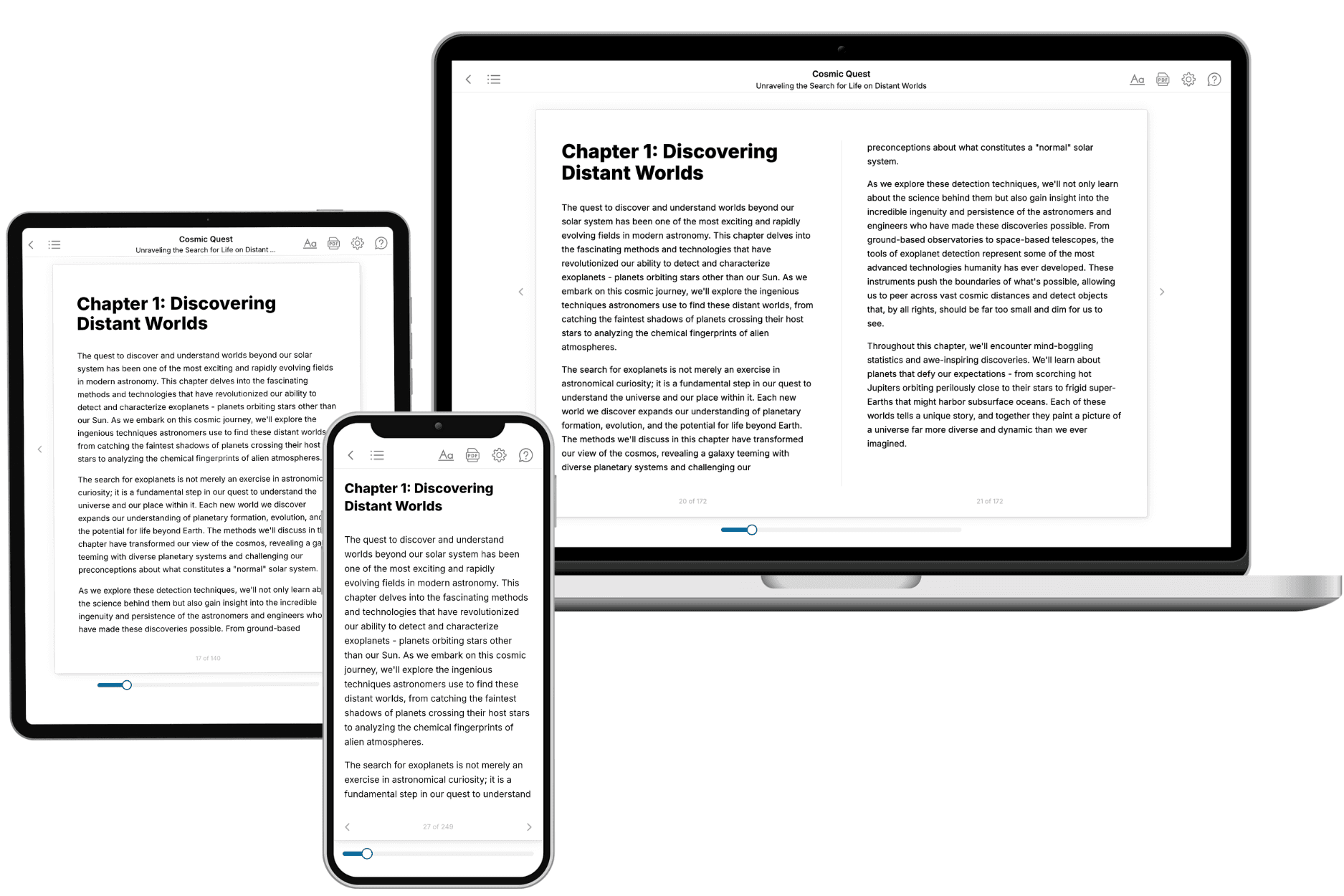
TailoredRead creates complete, full-length nonfiction ebooks, written specifically for you. Tell us what you want to learn and why, and TailoredRead writes you a complete ebook on it, with charts, tables, and diagrams throughout. Read it online, on Kindle, or on any e-reader, or download it as a PDF or EPUB. Every book is written fresh the day you order it.
- How is the book tailored to me?
Before anything is written, you answer a few short questions about your goals, your background, and the topics you care about. Your book is then planned around your answers: written at your level, focused on your goals, and covering the topics you chose, instead of the one-size-fits-all book a store sells everyone.
- Will it read like generic AI content?
No. Your book isn't a chat transcript: it's planned chapter by chapter before a single word is written, told in a clear book voice, and explains ideas visually with charts, tables, and diagrams. After writing, every book goes through an editorial pass that polishes chapters so the book reads consistent from start to finish. Judge for yourself: browse thousands of sample books on our Explore Books page.
- How accurate is the content?
Our AI first checks whether your subject needs live research. Niche and fast-moving subjects are researched before writing, and the book plan and chapters are grounded in what it finds. After writing, every book goes through a quality pass that checks its facts and consistency, and researched books list their sources in a Notes section at the back.
- How long is the book?
You choose the length: Comprehensive (250-300 pages), Detailed (150-200 pages), Essential (70-100 pages), or Short (30-50 pages).
- Does the book include visuals?
Yes. Every book includes charts, tables, and diagrams: timelines, checklists, step-by-step guides, decision trees, comparison tables, matrices, and bar charts. A typical book includes dozens of these visual elements.
- Can I read it on Kindle? What formats can I download?
Yes. Every book can be read in our online reader or downloaded as a PDF or EPUB. The EPUB can be opened with Kindle, Apple Books, Kobo, and any e-reader. The Commercial and Author licenses also include an editable Word (DOCX) and Markdown download.
- How much does it cost?
About the price of a regular ebook. The exact price depends on your book's length and complexity, from $2 for the shortest books to $35 for the most comprehensive, and it's shown when you review your book, before you commit to anything. Each book is a one-time purchase, yours to keep, no subscription. Licenses that let you share, teach, or publish your book range from $35.99 to $49.99.
- Can I preview the book before purchasing?
Before you pay, you'll see what your book will cover: the title, a detailed description, the estimated length, and the complete chapter-by-chapter table of contents, so you know what you're getting before you decide. The full text itself is written after you purchase.
- How long does it take to create a book?
About 10 minutes. You can start reading the opening chapters while the rest is still being written.