The Khmer Alphabet Mastery Guide
From Ancient Script to Modern Fluency: A Complete System for Learning Khmer Writing
Many learners approach the Khmer alphabet as an intimidating collection of unfamiliar symbols with no apparent logic.
238 pages10 chaptersNov 20, 2025Learning Khmer
About this book
This misconception leads to frustration and slow progress. In reality, the Khmer script is a beautifully organized system that becomes intuitive once you understand its underlying structure. This guide demystifies the Khmer alphabet by breaking it into manageable components and revealing the patterns that govern how it works. You'll discover why certain characters are shaped the way they are, how vowels and consonants interact, and how tone marks transform meaning. Through clear explanations, practical exercises, and authentic examples, you'll progress from recognizing individual characters to confidently reading and writing Khmer text. Whether you're learning Cambodian for cultural connection, professional purposes, or linguistic curiosity, this book provides the systematic foundation you need to move beyond memorization into genuine fluency with Cambodia's elegant writing system.
Table of contents
- IntroductionWhy Learn the Khmer Alphabet?, How to Use This Book, What You'll Accomplish, Overview of Khmer Script StructureRead below
- Chapter 1: The History and Evolution of Khmer ScriptAncient Origins: From Brahmi to Khmer, Development Through the Centuries, Modern Khmer Script Today, Cultural and Linguistic Significance
- Chapter 2: Consonants: The Foundation of Khmer WritingUnderstanding the 33 Consonants, First and Second Series Consonants, Shape Patterns and Mnemonic Devices, Writing and Recognizing Consonants
- Chapter 3: Vowels and Diacritical Marks: The ModifiersThe Khmer Vowel System Explained, Dependent Vowels and Their Placement, Diacritical Marks and Their Functions, Combining Consonants and Vowels
- Chapter 4: Tone Marks and Pronunciation RulesUnderstanding Khmer Tones, The Four Tone Marks and Their Meanings, Pronunciation Rules and Exceptions, Practicing Tones with Real Words
- Chapter 5: Ligatures and Special CharactersWhat Are Ligatures and Why They Matter, Common Consonant Clusters and Ligatures, Special Characters and Symbols, Recognizing and Writing Ligatures
- Chapter 6: Building Words: From Characters to VocabularyKhmer Syllable Structure and Patterns, How Khmer Words Are Formed, Common Word Patterns and Prefixes, Building Your Vocabulary Through Script Recognition
- Chapter 7: Reading Authentic Khmer TextsStrategies for Reading Unfamiliar Text, Using Context and Frequency to Decode Meaning, Working with Authentic Khmer Materials, Guided Reading Exercises
- Chapter 8: Writing Khmer: Technique and PracticeProper Writing Technique and Stroke Order, Spacing, Alignment, and Formatting, Common Writing Mistakes and How to Avoid Them, Progressive Writing Exercises
- Chapter 9: Comparing Khmer to Other ScriptsKhmer and Thai: Similarities and Differences, Khmer and Lao: Related but Distinct, Why Khmer Differs from Latin-Based Scripts, Using Comparative Knowledge to Accelerate Learning
- Chapter 10: Digital Khmer: Typing and TechnologyKhmer Keyboard Layouts and Input Methods, Digital Tools for Learning and Practice, Understanding Unicode and Khmer Encoding, Practicing with Digital Resources
- ConclusionYour Path to Khmer Mastery, Continuing Your Learning Journey
- Glossary of Khmer Linguistic Terms
- Further Learning Resources
- Appendix: Quick Reference Charts
Introduction
The Khmer alphabet stands as one of Southeast Asia's most elegant and sophisticated writing systems, yet it remains one of the least understood by language learners outside Cambodia. With its graceful curves, intricate diacritical marks, and complex vowel system, Khmer script can appear intimidating at first glance. Many learners who successfully navigate basic spoken Khmer find themselves hesitant to tackle the written language, assuming it requires years of dedicated study to achieve even basic literacy. This assumption, while understandable, is fundamentally incorrect. The Khmer alphabet follows logical, consistent patterns that become intuitive once you understand the underlying structure.
This book exists to bridge the gap between your current knowledge of Khmer and true literacy in the language. If you've reached an intermediate level in spoken Khmer, you already possess the phonetic awareness and vocabulary foundation necessary to master the script. What you need now is a systematic approach that reveals the organizational principles governing how Khmer is written. Unlike learning resources that treat the alphabet as a collection of isolated symbols to memorize, this guide shows you how consonants, vowels, and tone marks interact as an integrated system. You'll discover that Khmer script isn't arbitrary—it's a carefully designed representation of the language's phonetic structure.
Throughout this book, you'll move beyond simple character recognition to develop genuine reading and writing fluency. Each chapter builds on the previous one, introducing concepts in a sequence that mirrors how the script naturally works. You'll learn not just what each character looks like, but why it functions the way it does within the broader system. By connecting script learning to authentic vocabulary and cultural context, you'll develop the kind of deep understanding that leads to lasting retention. Whether your goal is to read Cambodian literature, communicate more effectively with Khmer speakers, or simply appreciate the beauty of this ancient writing system, this guide provides the comprehensive foundation you need.
Why Learn the Khmer Alphabet?
Learning to read and write Khmer transforms your relationship with the language in ways that spoken fluency alone cannot achieve. When you rely exclusively on romanized transcriptions or phonetic approximations, you're experiencing Khmer through a filter that distorts its essential character. The Khmer script captures phonetic distinctions that simply don't exist in the Latin alphabet, including vowel lengths, consonant series, and tonal qualities that fundamentally change word meanings. Without literacy in the native script, you'll inevitably develop pronunciation habits based on English phonetics rather than authentic Khmer sounds. These fossilized errors become increasingly difficult to correct as time passes.
Literacy in Khmer script opens access to an entire world of cultural resources that remain invisible to non-readers. Cambodia's rich literary tradition, from ancient inscriptions at Angkor Wat to contemporary novels and poetry, becomes directly accessible when you can read the original text. Street signs, restaurant menus, government documents, and social media posts all take on new meaning when you're no longer dependent on translations or transliterations. This independence accelerates your language learning exponentially because you can engage with authentic materials designed for native speakers rather than simplified content created for learners. The vocabulary and grammatical structures you encounter in written Khmer reflect how the language actually functions in real-world contexts.
Professional and personal opportunities expand dramatically when you achieve Khmer literacy. If you work with Cambodian communities, conduct research related to Cambodia, or maintain personal relationships with Khmer speakers, the ability to read and write demonstrates a level of commitment and respect that spoken language alone cannot convey. Many Cambodians express genuine appreciation when foreigners make the effort to learn their script, viewing it as evidence of serious cultural engagement rather than casual interest. From a practical standpoint, literacy enables you to navigate Cambodia independently, handle administrative tasks, and communicate through written channels without constant assistance. These capabilities transform you from a perpetual outsider requiring translation to someone who can participate more fully in Cambodian society.
The cognitive benefits of learning a new writing system extend beyond language acquisition itself. Research in neurolinguistics demonstrates that learning non-Latin scripts activates different neural pathways and enhances overall cognitive flexibility[1]. The Khmer alphabet, with its unique combination of consonant series, dependent vowels, and diacritical marks, challenges your brain to process visual information in entirely new ways. This mental exercise strengthens pattern recognition abilities, improves visual-spatial processing, and enhances your capacity to learn additional writing systems in the future. Many learners report that mastering Khmer script makes subsequently learning Thai, Lao, or other related scripts significantly easier because they've developed the cognitive frameworks for understanding abugida writing systems.
Perhaps most importantly, learning the Khmer alphabet deepens your understanding of how the language itself works. The script isn't merely a transcription system—it's a sophisticated representation of Khmer phonology that reveals relationships between sounds, meanings, and grammatical structures. When you understand why certain vowels appear above consonants while others appear below, or how consonant series affect vowel pronunciation, you're gaining insights into the language's fundamental architecture. These insights clarify pronunciation patterns that seem arbitrary when you only hear them, explain spelling conventions that appear random in romanization, and reveal etymological connections between related words. The alphabet becomes a tool for linguistic analysis that accelerates your overall language learning.
The aesthetic dimension of Khmer script deserves recognition as well. The flowing curves and balanced proportions of Khmer characters represent centuries of calligraphic refinement, creating a visual beauty that enhances the reading experience. Many learners find that the artistic quality of the script motivates continued practice and study. Writing Khmer by hand becomes a meditative practice that connects you to Cambodia's artistic traditions. Whether you're copying passages from classical literature or composing your own sentences, the physical act of forming these elegant characters creates a tangible connection to the culture that produced them. This aesthetic appreciation adds an emotional dimension to language learning that purely functional approaches often lack.
How to Use This Book
This book is designed as a progressive learning system rather than a reference manual to be consulted randomly. Each chapter builds directly on concepts introduced in previous chapters, creating a cumulative understanding of how Khmer script functions as an integrated whole. You'll achieve the best results by working through the chapters sequentially, even if you're tempted to skip ahead to topics that seem more immediately relevant. The foundational concepts presented early in the book—particularly the consonant series system and vowel placement rules—are essential for understanding everything that follows. Attempting to learn ligatures or tone marks without this foundation is like trying to construct a building's upper floors before completing the ground level.
The structure of each chapter follows a consistent pattern designed to optimize learning and retention. You'll begin with clear explanations of the underlying principles governing each aspect of the script, followed by specific examples that illustrate how these principles work in practice. Visual aids, including character charts and annotated examples, provide reference points you can return to as needed. Practice exercises appear throughout each chapter rather than only at the end, allowing you to immediately apply new concepts while they're fresh in your mind. This interleaved approach—alternating between explanation and practice—has been shown to produce better long-term retention than massed practice sessions[2].
Your approach to practice exercises should emphasize quality over speed. When you encounter writing exercises, take time to form each character carefully, paying attention to stroke order and proportions. Rushing through exercises to complete them quickly defeats the purpose—you're training your hand and eye to recognize and reproduce specific shapes, which requires deliberate, mindful practice. For reading exercises, resist the temptation to immediately look up unfamiliar words. Instead, try to decode them using the principles you've learned, even if the process feels slow and uncertain at first. This struggle is where actual learning occurs. The discomfort of not knowing immediately gives way to the satisfaction of successfully decoding text through your own analytical efforts.
The book includes several types of supplementary materials designed to support different learning styles and needs:
- Quick reference charts in the appendix provide at-a-glance access to character forms, vowel combinations, and tone marks without requiring you to search through explanatory text
- Glossary entries define linguistic terms used throughout the book, ensuring you understand the technical vocabulary necessary for discussing script features
- Authentic text examples demonstrate how concepts appear in real-world Khmer writing, bridging the gap between isolated practice and actual reading
- Common mistake warnings highlight errors that frequently trip up learners, helping you avoid developing bad habits that require correction later
- Cultural context notes explain the historical and social significance of certain script features, enriching your understanding beyond purely technical knowledge
Establish a consistent study routine rather than attempting marathon learning sessions. Research on skill acquisition consistently shows that distributed practice—shorter sessions spread over time—produces better results than massed practice of equal total duration[3]. Aim for daily practice sessions of thirty to forty-five minutes rather than occasional multi-hour blocks. This schedule allows your brain to consolidate learning between sessions while maintaining momentum. During each session, review material from previous chapters before tackling new content. This spaced repetition reinforces earlier learning and helps you recognize connections between different aspects of the script system.
Supplement the structured content in this book with exposure to authentic Khmer text in your daily environment. Even before you can read fluently, looking at Khmer script regularly trains your visual system to recognize character shapes and common patterns. Follow Khmer social media accounts, watch Cambodian videos with Khmer subtitles, or simply observe Khmer text in photographs of Cambodian street scenes. This passive exposure complements your active study by familiarizing you with how the script appears in natural contexts. You'll begin noticing characters you've studied appearing in real-world settings, creating satisfying moments of recognition that reinforce your learning and maintain motivation.
Keep a dedicated notebook for handwriting practice separate from this book. The physical act of writing Khmer characters by hand engages motor memory in ways that typing or passive reading cannot replicate. Your practice notebook becomes a personal record of your progress, allowing you to look back and see how your character formation improves over time. Don't worry about achieving perfect calligraphy immediately—focus instead on consistency and accuracy. As you practice, you'll naturally develop a personal writing style while maintaining the essential features that make each character recognizable. This handwriting practice is particularly important for internalizing the spatial relationships between consonants, vowels, and diacritical marks.
What You'll Accomplish
By the time you complete this book, you'll possess a comprehensive understanding of the Khmer writing system that enables confident reading and writing across diverse contexts. You'll recognize all thirty-three consonants instantly, understanding not just their shapes but their phonetic values and how they function within the consonant series system. This recognition will be automatic rather than requiring conscious effort—you'll see a character and immediately know its sound, just as you do with Latin letters. Your vowel knowledge will extend beyond simple identification to understanding how dependent vowels interact with different consonant series to produce varying pronunciations. This systematic understanding eliminates the confusion that plagues learners who try to memorize vowel sounds in isolation.
Your reading ability will progress from decoding individual characters to processing complete words and sentences with increasing fluency. You'll develop strategies for handling unfamiliar vocabulary, using context clues and your knowledge of word formation patterns to make educated guesses about meaning. When you encounter authentic Khmer texts—whether signs, social media posts, or published materials—you'll be able to extract meaning even when you don't know every word. This functional literacy represents a crucial threshold: you'll no longer be entirely dependent on translations or romanizations, though you may still consult them for efficiency or to verify understanding. The psychological shift from complete dependence to selective consultation marks a significant milestone in your language journey.
Your writing skills will enable you to compose clear, readable Khmer text by hand and through digital input methods. You'll understand proper character formation, spacing conventions, and the placement of diacritical marks and tone indicators. More importantly, you'll know how to spell Khmer words correctly by applying the systematic rules governing the relationship between pronunciation and orthography. This capability allows you to communicate in writing with Khmer speakers, take notes in Khmer during conversations or lectures, and create written materials for your own study purposes. Your writing may not achieve the elegance of a trained calligrapher, but it will be legible and correctly formed—the essential foundation for all written communication.
The analytical skills you develop through this book will serve you well beyond the specific content covered in each chapter. You'll understand how to approach unfamiliar script features systematically, breaking them down into component parts and analyzing how those parts interact. This analytical framework applies to learning additional aspects of Khmer that extend beyond this book's scope, such as specialized vocabulary, formal registers, or classical script variations. When you encounter exceptions to the rules you've learned, you'll have the conceptual tools to understand why those exceptions exist and how they fit into the broader system. This meta-cognitive awareness—understanding how you learn and how the system works—accelerates all future language learning.
Your cultural competence will deepen significantly through the process of mastering Khmer script. You'll understand references to script-related concepts that appear in Cambodian culture, from traditional blessings written in ornate calligraphy to contemporary wordplay that depends on visual puns. You'll appreciate the historical depth of Khmer literacy, recognizing connections between modern script and ancient inscriptions. This cultural knowledge enriches your interactions with Khmer speakers and your understanding of Cambodian society. When Cambodians see you reading or writing their script, the conversations that follow often reveal cultural insights that would never emerge in interactions conducted entirely in English or through romanized Khmer.
Perhaps most significantly, you'll gain confidence in your ability to master complex writing systems. The Khmer alphabet presents genuine challenges—it's not a simple substitution cipher for sounds you already know. Successfully navigating these challenges proves to yourself that you can learn sophisticated linguistic systems through systematic effort. This confidence transfers to other learning domains, whether you subsequently tackle additional Southeast Asian scripts, pursue advanced Khmer language skills, or apply the same disciplined approach to entirely different subjects. The sense of accomplishment that comes from achieving Khmer literacy provides motivation that sustains continued language learning long after you complete this book.
Specific competencies you'll develop include:
- Instant recognition of all consonants and their phonetic values in both first and second series contexts
- Accurate pronunciation of vowel combinations based on consonant series and diacritical marks
- Correct interpretation of tone marks and their effects on word meaning
- Recognition and reading of common ligatures and consonant clusters
- Understanding of syllable structure and word formation patterns
- Ability to decode unfamiliar words using systematic phonetic analysis
- Proper handwriting technique with correct stroke order and character proportions
- Competent use of Khmer keyboard layouts for digital text input
- Awareness of common spelling patterns and orthographic conventions
- Strategies for continued independent learning beyond this book's scope
Overview of Khmer Script Structure
The Khmer writing system belongs to the abugida family of scripts, a category that includes Thai, Lao, Burmese, and the various scripts of India. Understanding what makes an abugida different from alphabets like Latin or syllabaries like Japanese kana is essential for approaching Khmer script with the right conceptual framework. In an abugida, consonants carry an inherent vowel sound (in Khmer's case, typically the vowel sound "o" as in "go"), and additional vowel symbols modify or replace this inherent vowel. This fundamental principle means that a single consonant character represents a complete syllable, not just a consonant sound. Additional vowel markers transform that syllable by changing its vowel component while maintaining the consonant.
The Khmer alphabet consists of thirty-three consonants, each representing a specific consonant sound. These consonants divide into two series—first series and second series—based on historical phonetic characteristics that still affect how vowels are pronounced when combined with them. This series system is perhaps the most challenging concept for learners accustomed to Latin-based scripts, where letters have fixed sounds regardless of context. In Khmer, the same vowel symbol produces different sounds depending on whether it combines with a first-series or second-series consonant. For example, the vowel symbol that produces an "a" sound (as in "father") with first-series consonants produces an "ea" sound (as in "yeah") with second-series consonants. This systematic variation isn't arbitrary—it reflects historical sound changes in the Khmer language that the script preserves.
Vowels in Khmer are represented by dependent symbols that attach to consonants in various positions: above, below, before, after, or in combinations surrounding the consonant. Unlike the linear left-to-right arrangement of Latin script, Khmer vowels occupy two-dimensional space around their associated consonants. This spatial arrangement can initially confuse learners, but it follows consistent rules. Each vowel has a specific position relative to the consonant it modifies, and these positions never vary. Once you internalize these spatial patterns, reading becomes fluid because the visual arrangement itself conveys phonetic information. The three-dimensional quality of Khmer text—with marks above, below, and around base consonants—creates the script's distinctive appearance.
Diacritical marks and tone indicators add another layer of information to the basic consonant-vowel combinations. These marks serve various functions:
- Tone marks indicate specific tonal patterns that distinguish otherwise identical words
- The silent marker (called bantoc) indicates that a consonant is not pronounced, typically appearing in consonant clusters
- The vowel killer (called toandakhiat) removes the inherent vowel from a consonant, creating a pure consonant sound
- The register shifter (called triisap) changes a second-series consonant to first-series pronunciation or vice versa
- The reduplication mark indicates that a syllable should be repeated
Consonant clusters and ligatures represent another distinctive feature of Khmer script. When multiple consonants appear in sequence within a single syllable, they often combine into ligature forms where the second consonant appears in a reduced form below or beside the first. These ligatures maintain readability while representing complex consonant combinations efficiently. Some ligatures are transparent—you can clearly see both component consonants in modified forms. Others are more opaque, having evolved into distinct shapes that require specific learning. The most common ligatures appear frequently enough that you'll quickly recognize them through repeated exposure, while rarer combinations may require conscious analysis even for advanced readers.
Word boundaries in Khmer text are not marked by spaces in the way English uses spaces between words. Instead, spaces in Khmer text indicate phrase or clause boundaries, similar to how commas and periods function in English. This convention means that what appears to an English speaker as a single "word" (a space-delimited unit) might actually be an entire phrase containing multiple Khmer words. Learning to identify actual word boundaries requires understanding Khmer grammar and word formation patterns. Initially, this lack of clear word separation can make reading challenging, but it becomes natural as your familiarity with common word patterns increases. Many learners find that this feature actually helps them think in Khmer phrases rather than translating word-by-word from English.
The overall structure of a Khmer syllable follows a predictable pattern that, once understood, makes reading systematic rather than arbitrary. A complete syllable may include:
- An optional initial consonant cluster (main consonant plus subscript consonant)
- The main consonant (which carries the inherent vowel unless modified)
- A vowel symbol (which may appear before, after, above, below, or surrounding the consonant)
- Optional diacritical marks (tone marks, register shifters, etc.)
- An optional final consonant (which may be marked as silent or pronounced)
The relationship between Khmer script and Khmer pronunciation is more regular than English spelling, though not perfectly phonetic. Once you understand the rules governing consonant series, vowel pronunciation, and tone marks, you can pronounce most Khmer words correctly from their written form. Exceptions exist, particularly in words borrowed from Pali or Sanskrit that retain historical spellings no longer reflecting modern pronunciation. However, these exceptions are far less common than in English, where irregular spellings pervade even basic vocabulary. This relative regularity means that investing effort in understanding the systematic rules pays substantial dividends—you're learning principles that apply broadly rather than memorizing countless special cases.
Understanding this structural overview before diving into specific characters provides the conceptual framework necessary for making sense of the details. Each subsequent chapter explores one component of this system in depth, but keeping the overall structure in mind helps you understand how each piece fits into the whole. The Khmer script isn't a random collection of symbols—it's an elegant system where each component serves a specific function in representing the sounds of the Khmer language. Approaching it with this systematic understanding transforms what might seem like an overwhelming memorization task into a logical learning progression where each new concept builds naturally on what you've already mastered.
Notes
Introduction
- 1. C. A. Perfetti and L. H. Tan, "Write to read," Trends in Cognitive Sciences, 2013
- 2. D. Rohrer and K. Taylor, "The shuffling of mathematics problems improves learning," Instructional Science, 2007
- 3. N. J. Cepeda and others, "Distributed practice in verbal recall tasks," Psychological Bulletin, 2006
This is the end of the free sample. The full book has 10 chapters.
Want this book written for you?
Tell us your goals and background, and get your own version of this book, tailored by AI to you.


Benefits of AI-tailored books
- Read one book, not ten:
- all the Learning Khmer knowledge you need, gathered into a single book.
- Save days of learning:
- tell us your goals, choose your topics, and the whole book is built around them.
- Learn effortlessly:
- Learning Khmer book written for your specific background and expertise.
- Understand at a glance:
- includes charts, tables, timelines, checklists, decision trees, and more.
- Stay current:
- written the day you order it, not years ago.
- Trust what you read:
- every book is checked for accuracy, with real research when your subject needs it.
Create your unique book in 3 steps
- 1. Select your focus
Select the focus of your Learning Khmer book and share your background
- 2. Personalize your book
Specify your goals and choose sub-topics to include
- 3. Get your tailored book
Your book is ready in 10 minutes. Read it online, download as EPUB or PDF, or send to Kindle.

Frequently asked questions
- What is TailoredRead?
TailoredRead creates complete, full-length nonfiction ebooks, written specifically for you. Tell us what you want to learn and why, and TailoredRead writes you a complete ebook on it, with charts, tables, and diagrams throughout. Read it online, on Kindle, or on any e-reader, or download it as a PDF or EPUB. Every book is written fresh the day you order it.
- How is the book tailored to me?
Before anything is written, you answer a few short questions about your goals, your background, and the topics you care about. Your book is then planned around your answers: written at your level, focused on your goals, and covering the topics you chose, instead of the one-size-fits-all book a store sells everyone.
- Will it read like generic AI content?
No. Your book isn't a chat transcript: it's planned chapter by chapter before a single word is written, told in a clear book voice, and explains ideas visually with charts, tables, and diagrams. After writing, every book goes through an editorial pass that polishes chapters so the book reads consistent from start to finish. Judge for yourself: browse thousands of sample books on our Explore Books page.
- How accurate is the content?
Our AI first checks whether your subject needs live research. Niche and fast-moving subjects are researched before writing, and the book plan and chapters are grounded in what it finds. After writing, every book goes through a quality pass that checks its facts and consistency, and researched books list their sources in a Notes section at the back.
- How long is the book?
You choose the length: Comprehensive (250-300 pages), Detailed (150-200 pages), Essential (70-100 pages), or Short (30-50 pages).
- Does the book include visuals?
Yes. Every book includes charts, tables, and diagrams: timelines, checklists, step-by-step guides, decision trees, comparison tables, matrices, and bar charts. A typical book includes dozens of these visual elements.
- Can I read it on Kindle? What formats can I download?
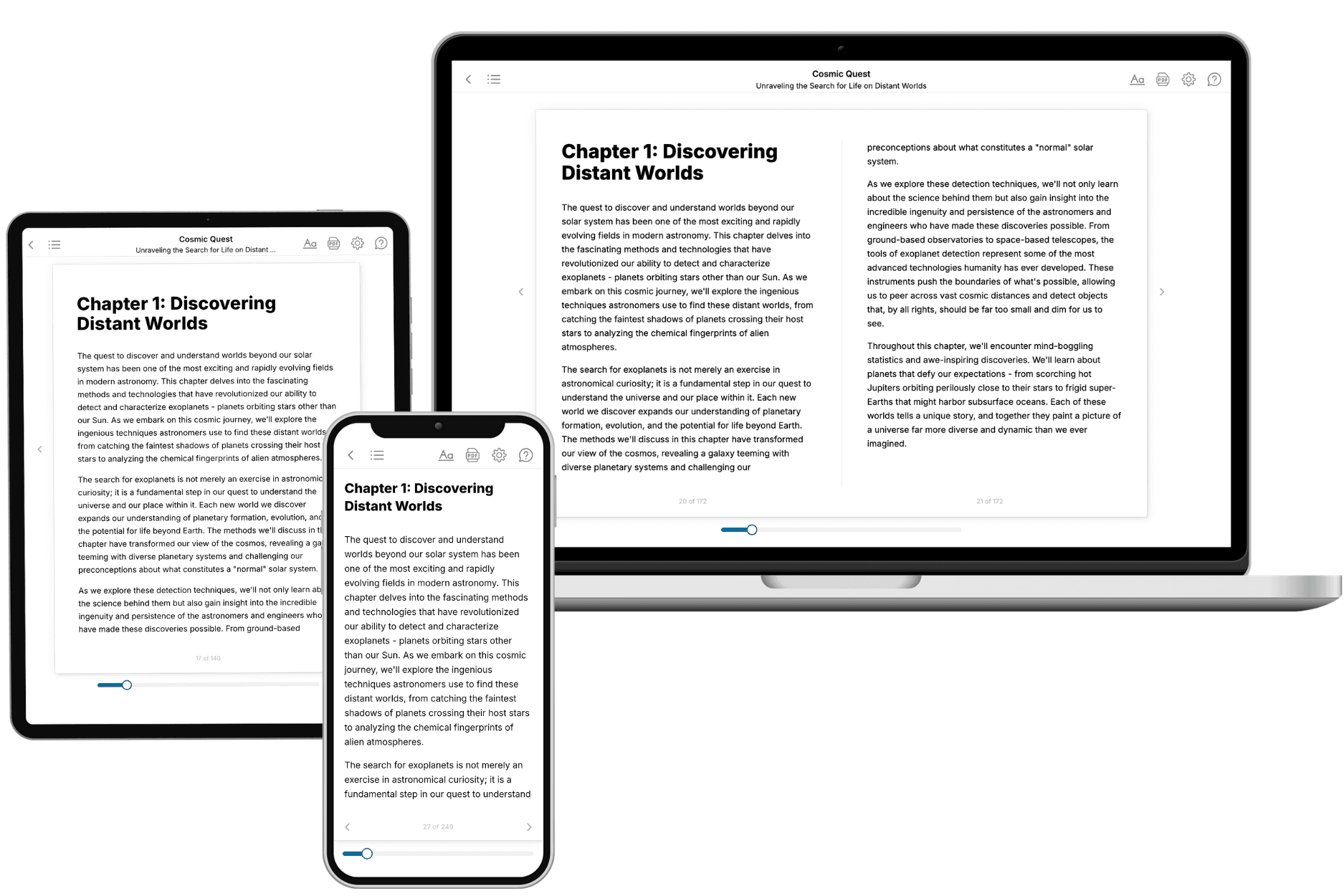
Yes. Every book can be read in our online reader or downloaded as a PDF or EPUB. The EPUB can be opened with Kindle, Apple Books, Kobo, and any e-reader. The Commercial and Author licenses also include an editable Word (DOCX) and Markdown download.
- How much does it cost?
About the price of a regular ebook. The exact price depends on your book's length and complexity, from $2 for the shortest books to $35 for the most comprehensive, and it's shown when you review your book, before you commit to anything. Each book is a one-time purchase, yours to keep, no subscription. Licenses that let you share, teach, or publish your book range from $35.99 to $49.99.
- Can I preview the book before purchasing?
Before you pay, you'll see what your book will cover: the title, a detailed description, the estimated length, and the complete chapter-by-chapter table of contents, so you know what you're getting before you decide. The full text itself is written after you purchase.
- How long does it take to create a book?
About 10 minutes. You can start reading the opening chapters while the rest is still being written.