Layered Light
Mastering Multiple Exposures in Alternative Photography
Most photographers believe multi-exposure photography is either a gimmick for creating surreal effects or an advanced technique reserved for digital experts.
207 pages9 chaptersAug 9, 2026Photography
About this book
The truth is far more nuanced and accessible. Multi-exposure photography is a powerful creative language that allows you to layer meaning, emotion, and visual complexity into a single frame—whether you're working with film, digital cameras, or alternative printing processes. This guide bridges the gap between traditional and contemporary approaches, showing you how to harness multiple exposures across different mediums. You'll discover how to plan compositions that work across layers, master exposure calculations for film and digital, explore the unique aesthetics of alternative processes, and develop a personal visual voice through intentional multi-exposure work. Whether you're drawn to the unpredictability of film or the precision of digital, this book provides the technical foundation and creative inspiration to transform your photography.
Table of contents
- IntroductionWhat is Multi-Exposure Photography?, Why Multi-Exposure Matters in Modern Photography, How to Use This BookRead below
- Chapter 1: Foundations of Light and ExposureThe Exposure Triangle and Multi-Exposure Considerations, Metering Strategies for Layered Images, How Light Behaves Across Multiple Exposures
- Chapter 2: Composition and PlanningVisualizing Your Layers Before Shooting, Sketching and Conceptual Development, Managing Spatial Relationships in Multi-Exposure Work, Choosing Subjects That Work Well Together
- Chapter 3: Film-Based Multi-Exposure TechniquesIn-Camera Multi-Exposure on Film, Calculating Exposures for Film Layering, Choosing Film Stocks for Multi-Exposure Work, Understanding Film Aesthetics and Grain in Layered Images
- Chapter 4: Digital Multi-Exposure MethodsIn-Camera Multi-Exposure Features, Layering and Blending in Post-Processing, Mastering Blending Modes and Opacity Control, Building an Efficient Digital Multi-Exposure Workflow
- Chapter 5: Color Theory and HarmonyHow Colors Interact in Layered Images, Creating Visual Cohesion Through Color, Color Grading Strategies for Multi-Exposure Work
- Chapter 6: Alternative Photography ProcessesIntroduction to Alternative Printing Methods, Cyanotype and Multi-Exposure Negatives, Gum Bichromate for Complex Layered Prints, Photogravure, Platinum, and Other Processes
- Chapter 7: Negative Preparation and PrintingPreparing Multi-Exposure Negatives for Alternative Printing, Managing Density and Contrast in Negatives, Contact Printing Techniques for Alternative Processes
- Chapter 8: Troubleshooting and Problem-SolvingCommon Multi-Exposure Mistakes and How to Avoid Them, Diagnosing and Fixing Exposure Issues, Solving Composition and Alignment Problems, Troubleshooting Alternative Process Results
- Chapter 9: Developing Your Personal VisionFinding Your Unique Multi-Exposure Voice, Building Conceptual Frameworks for Series Work, Structured Experimentation and Practice
- ConclusionMoving Forward With Multi-Exposure Photography
- Glossary
- Further Reading and Resources
Introduction
Two negatives, one frame. That simple act of layering light onto a single piece of film or sensor has produced some of the most haunting, emotionally resonant images in photographic history. A portrait where a face dissolves into a forest canopy. A cityscape that bleeds into a storm cloud. A hand holding what appears to be a galaxy. These images do not happen by accident. They are the result of deliberate thinking, careful exposure calculation, and a clear understanding of how light accumulates when you ask a camera to record more than one moment at a time.
Multi-exposure photography sits at a fascinating crossroads. On one side, you have the raw, unpredictable world of film, where decisions are permanent and the results reveal themselves only after development. On the other, you have the precise, iterative world of digital capture and post-processing, where layers can be adjusted, blended, and refined until the image matches your vision exactly. And beyond both of those, there is a third territory that most photographers never explore: alternative printing processes like Cyanotype, Gum Bichromate, and Platinum-Palladium Printing, where a multi-exposure negative becomes the starting point for a handmade object that carries its own texture, chemistry, and character.
This book covers all three territories. It is built for photographers who already understand the basics of exposure and composition and are ready to push further. You do not need to be an expert in darkroom chemistry or a Photoshop power user to get value from these pages. What you do need is curiosity, a willingness to plan carefully, and an appetite for images that carry more than a single moment inside them. The chapters ahead move from foundational principles through to advanced creative practice, giving you both the technical tools and the conceptual frameworks to make multi-exposure work that is genuinely yours.
What is Multi-Exposure Photography?
At its most basic level, multi-exposure photography is the practice of recording two or more distinct images onto the same frame. The camera's sensor or film receives light from separate scenes, subjects, or moments, and those layers of light combine into a single final image. The result is something that neither exposure could produce alone. Depending on how the exposures are balanced and composed, the layers can blend seamlessly, create ghostly transparencies, or produce bold graphic overlaps where shapes from different scenes collide.
The technique is older than most people assume. Photographers were experimenting with multiple exposures on glass plates and early film stocks in the nineteenth century, long before digital tools made the process forgiving or reversible.[1] Early portrait photographers used double exposures to create spirit photographs, placing a translucent figure beside a living subject to suggest the presence of a ghost. These images were often deliberate fictions, but they demonstrated something real: that layering exposures could produce emotional and psychological effects that a single photograph simply could not.
Today, the definition has expanded considerably. Multi-exposure work includes:
- In-camera film multi-exposure, where the film advance is disabled between shots so that two or more frames are recorded on the same piece of film
- Digital in-camera multi-exposure, where modern cameras combine frames electronically before writing a single file to the memory card
- Post-Processing Layering, where separate images are combined in software using Blending Modes and Opacity Control to achieve the final composite
- Alternative process printing, where a multi-exposure negative is used as the source image for handmade prints in processes like Cyanotype or Gum Bichromate
Each of these approaches produces a different kind of image with a different aesthetic character. Film-based multi-exposure tends to produce results with organic imprecision, where the layers interact in ways that are difficult to predict and impossible to undo. Digital methods offer control and repeatability. Alternative processes add a material dimension, where the surface of the print, the chemistry of the coating, and the texture of the paper all become part of the image itself. Understanding these differences is the first step toward choosing the right approach for the image you want to make.
One important distinction worth establishing early: multi-exposure photography is not the same as photo manipulation or compositing in the broader sense. When you combine two exposures in-camera on film, you are working with a physical, optical process governed by the physics of light. When you layer images in post-processing, you are working with mathematical operations that simulate how light behaves. Both are legitimate creative tools, but they produce different results and require different thinking. This book treats them as related but distinct disciplines, each with its own logic and its own rewards.
The most common misconception about multi-exposure work is that it is primarily about creating surreal or dreamlike effects. While those effects are certainly possible and often beautiful, they represent only one corner of what the technique can do. Multi-exposure photography can also be used to compress time, showing the arc of movement across a single frame. It can be used to create conceptual juxtapositions, placing two subjects in dialogue with each other. It can be used to build texture and depth into an otherwise flat image. The technique is a creative language, and like any language, its range is far wider than its most obvious expressions.
A multi-exposure image is not two photographs added together. It is a third photograph that neither of the originals could have been on its own. That distinction matters, because it changes how you plan, shoot, and evaluate your work.
Understanding what multi-exposure photography actually is, in technical and conceptual terms, sets the foundation for everything that follows. The chapters on the Exposure Triangle and Multi-Exposure Metering will build on this foundation with precise technical detail. But the conceptual point is worth holding onto from the start: you are not combining images. You are creating a new one.
Why Multi-Exposure Matters in Modern Photography
Photography has never been more accessible. Cameras are embedded in every smartphone, and editing software has made it possible for anyone to produce technically competent images with minimal effort. In that environment, the question of what makes a photograph distinctive has become more urgent, not less. Multi-exposure photography offers one compelling answer: images that carry genuine visual complexity, where the meaning and the form are inseparable from the process that created them.
There is a growing appetite for photographs that feel handmade, considered, and irreducible to a single click. This is part of what has driven the resurgence of film photography over the past decade, and it is also part of what has made alternative printing processes increasingly visible in galleries and art fairs.[2] Multi-exposure work sits squarely in this current. Whether you are shooting on film or building layers in post-processing, the technique demands intentionality. You cannot make a good multi-exposure image by accident, and that intentionality tends to show in the final result.
From a purely visual standpoint, multi-exposure images do things that single exposures cannot. Consider what happens when you layer a portrait against a landscape. The face does not simply appear in front of the trees or the sky. Instead, the two subjects interpenetrate. The texture of bark might appear within the shadow of a cheekbone. The gradient of a sky might bleed through the highlights of a forehead. These interactions create visual relationships that feel organic rather than constructed, even when they are the result of careful planning. That quality of organic complexity is difficult to achieve through any other means.
Multi-exposure photography also matters because it forces a different relationship with time. A single photograph captures a moment. A multi-exposure image captures a relationship between moments. That relationship can be temporal, showing the same subject at different points in time. It can be spatial, showing subjects from different locations as if they occupy the same space. It can be conceptual, placing two ideas in visual dialogue. In each case, the image carries more information and more ambiguity than a single frame could hold, and that ambiguity is often where the most interesting meaning lives.
For photographers working with Alternative Printing Processes, multi-exposure adds another dimension entirely. A Cyanotype print made from a multi-exposure negative is not just a photograph. It is an object with its own material presence, where the blue tones of the cyanotype chemistry interact with the layered complexity of the negative to produce something that exists at the intersection of photography, printmaking, and painting. The same is true of Gum Bichromate prints, where multiple layers of pigmented gum can be registered over a multi-exposure negative to build up color and texture across several printing sessions. These processes reward the kind of careful, layered thinking that multi-exposure photography demands.
There is also a practical argument for developing multi-exposure skills. The discipline of planning and executing a multi-exposure image sharpens your understanding of light, composition, and visual hierarchy in ways that straightforward single-exposure work does not. When you have to think about how two subjects will interact within a single frame, you are forced to consider negative space, tonal relationships, and compositional balance with unusual precision. Photographers who work seriously with multi-exposure techniques consistently report that it improves their single-exposure work as well, because it trains a more analytical and anticipatory way of seeing.
The technique also opens doors to collaboration and conceptual depth that can be harder to access through conventional photography. A series of multi-exposure portraits that layer each subject against a landscape from their childhood, for example, carries a conceptual weight that a straightforward portrait series cannot match. The layering is not decorative. It is structural to the meaning of the work. That kind of conceptual integration, where form and content reinforce each other, is what separates memorable photography from technically competent photography.
Finally, multi-exposure photography matters because it is genuinely fun. There is a particular pleasure in the unpredictability of film-based multi-exposure work, where you commit to a combination of subjects and exposures and then wait to see what the chemistry produces. There is a different but equally real pleasure in the precision of digital layering, where you can experiment with Blending Modes and Opacity Control until the image clicks into place. And there is a deep satisfaction in pulling a finished Platinum-Palladium print from a tray and seeing how the multi-exposure negative has translated into a rich, archival object. These pleasures are worth pursuing for their own sake, independent of any larger artistic ambition.
How to Use This Book
The chapters in this book are arranged to build on each other, but they are also designed to be useful as standalone references. If you are new to multi-exposure work in any form, reading from the beginning will give you the strongest foundation. If you already have experience with one approach, such as digital layering, and want to expand into film or alternative processes, you can move directly to the relevant chapters without losing the thread.
Here is a brief map of what each section covers and how they connect:
- The chapter on Foundations of Light and Exposure covers the Exposure Triangle, Multi-Exposure Metering, and Light Accumulation. These concepts underpin everything else in the book. Even if you feel confident about exposure basics, the multi-exposure-specific material in that chapter is worth reading carefully.
- The chapter on Composition and Planning introduces Pre-Visualization, Layer Sketching, Spatial Relationship Management, and Subject Compatibility. These are the creative planning tools that separate intentional multi-exposure work from random layering.
- The chapter on Film-Based Multi-Exposure Techniques covers In-Camera Film Multi-Exposure, exposure calculation for film, Film Stock Selection, and Grain Aesthetics. This chapter is for anyone working with analog cameras or interested in the unique qualities that film brings to layered images.
- The chapter on Digital Multi-Exposure Methods covers Digital In-Camera Multi-Exposure, Post-Processing Layering, Blending Modes, Opacity Control, and workflow efficiency. This chapter is relevant whether you shoot with a mirrorless camera, a DSLR, or a smartphone.
- The chapter on Color Theory and Harmony addresses Color Interaction in Layers, Visual Color Cohesion, and Color Grading for Multi-Exposure work. Color is one of the most common sources of failure in multi-exposure images, and this chapter gives you the tools to manage it deliberately.
- The chapters on Alternative Photography Processes and Negative Preparation and Printing cover Cyanotype, Gum Bichromate, Photogravure, Platinum-Palladium Printing, Negative Preparation, Density Management, and Contact Printing. These chapters are for photographers who want to take their multi-exposure negatives into the darkroom and produce handmade prints.
- The chapter on Troubleshooting and Problem-Solving uses a problem-first framework to address Multi-Exposure Error Diagnosis, Alignment Problem-Solving, and process-specific failures. Return to this chapter whenever something goes wrong.
- The final chapter on Developing Your Personal Vision addresses Personal Photographic Voice, Series Conceptual Framework, and Structured Experimentation. This is where the technical skills developed throughout the book connect to the larger question of what you want to say with your work.
A few practical notes on how to get the most from the material. First, the technical chapters include specific calculations and formulas, particularly around exposure compensation for film-based multi-exposure work. Do not skip these sections even if math is not your strong suit. The calculations are straightforward, and understanding them will save you significant frustration in the field. Second, the chapters on alternative processes assume no prior darkroom experience. If you have worked in a darkroom before, some of the foundational material will be familiar, but the multi-exposure-specific content will be new.
Third, and most importantly: treat the exercises and examples in each chapter as starting points, not endpoints. Multi-exposure photography rewards experimentation, and the best way to develop your skills is to shoot, evaluate, adjust, and shoot again. The Structured Experimentation framework in the final chapter gives you a systematic way to do this, but the habit of deliberate practice should begin from your very first multi-exposure attempt. Keep notes on your exposures, your subject choices, and your intentions. Those notes will become invaluable as you develop your own approach.
The book also uses a consistent set of canonical terms throughout. When you see Pre-Visualization, it refers specifically to the practice of mentally constructing the final layered image before making the first exposure. When you see Layer Sketching, it refers to the physical or digital sketching process used to plan how subjects will overlap and interact. When you see Blending Modes, it refers to the mathematical operations in post-processing software that determine how pixel values from different layers combine. These terms are defined in detail in their respective chapters and collected in the glossary at the back of the book. Using consistent terminology makes it easier to cross-reference concepts and to communicate with other photographers about your work.
One thing this book does not do is tell you what kind of multi-exposure photography to make. The technical frameworks and creative tools here are deliberately medium-agnostic and style-agnostic. Whether you are drawn to the quiet, contemplative quality of Platinum-Palladium prints or the bold graphic energy of high-contrast digital composites, the underlying principles are the same. The goal is to give you enough technical fluency and conceptual vocabulary that your own creative instincts can take over. The most interesting multi-exposure work always reflects a specific sensibility, a particular way of seeing the world and choosing to layer it. That sensibility is yours to develop.
A note on equipment: this book does not require any specific camera, software, or darkroom setup. The film-based chapters are relevant to any camera that allows manual control of the film advance, from vintage rangefinders to modern medium-format systems. The digital chapters cover principles that apply across major camera brands and editing platforms. The alternative process chapters require some specialized chemistry and materials, but these are widely available and relatively affordable. Specific equipment recommendations appear within each chapter where they are most relevant, rather than in a single consolidated list, because the right tools depend entirely on the approach you are taking.
The images you are capable of making are more complex and more resonant than a single frame can hold. The chapters ahead are the technical and creative infrastructure to prove that to yourself, one layer at a time.
This is the end of the free sample. The full book has 9 chapters.
Want this book written for you?
Tell us your goals and background, and get your own version of this book, tailored by AI to you.


Benefits of AI-tailored books
- Read one book, not ten:
- all the Photography knowledge you need, gathered into a single book.
- Save days of learning:
- tell us your goals, choose your topics, and the whole book is built around them.
- Learn effortlessly:
- Photography book written for your specific background and expertise.
- Understand at a glance:
- includes charts, tables, timelines, checklists, decision trees, and more.
- Stay current:
- written the day you order it, not years ago.
- Trust what you read:
- every book is checked for accuracy, with real research when your subject needs it.
Create your unique book in 3 steps
- 1. Select your focus
Select the focus of your Photography book and share your background
- 2. Personalize your book
Specify your goals and choose sub-topics to include
- 3. Get your tailored book
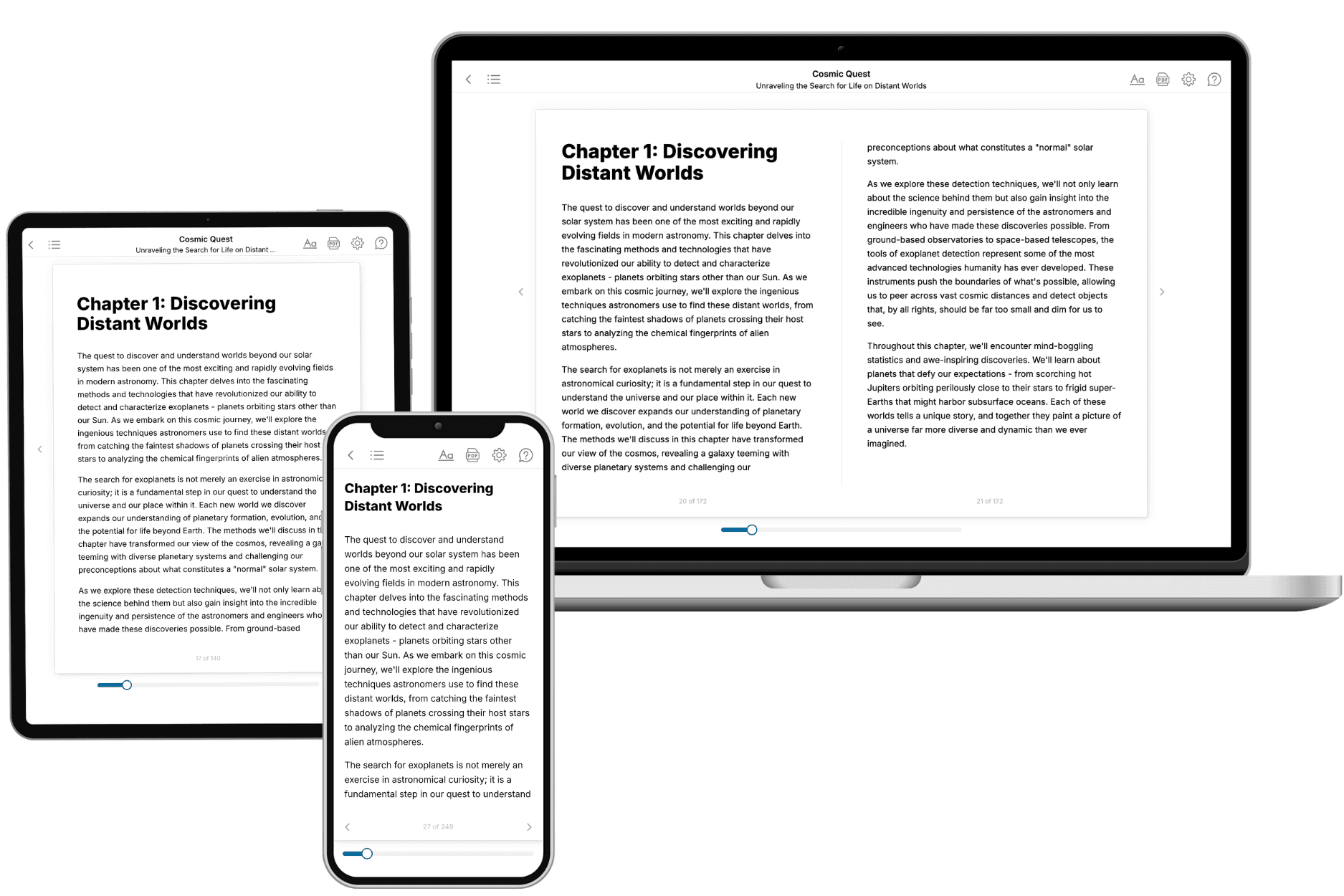
Your book is ready in 10 minutes. Read it online, download as EPUB or PDF, or send to Kindle.
Frequently asked questions
- What is TailoredRead?
TailoredRead creates complete, full-length nonfiction ebooks, written specifically for you. Tell us what you want to learn and why, and TailoredRead writes you a complete ebook on it, with charts, tables, and diagrams throughout. Read it online, on Kindle, or on any e-reader, or download it as a PDF or EPUB. Every book is written fresh the day you order it.
- How is the book tailored to me?
Before anything is written, you answer a few short questions about your goals, your background, and the topics you care about. Your book is then planned around your answers: written at your level, focused on your goals, and covering the topics you chose, instead of the one-size-fits-all book a store sells everyone.
- Will it read like generic AI content?
No. Your book isn't a chat transcript: it's planned chapter by chapter before a single word is written, told in a clear book voice, and explains ideas visually with charts, tables, and diagrams. After writing, every book goes through an editorial pass that polishes chapters so the book reads consistent from start to finish. Judge for yourself: browse thousands of sample books on our Explore Books page.
- How accurate is the content?
Our AI first checks whether your subject needs live research. Niche and fast-moving subjects are researched before writing, and the book plan and chapters are grounded in what it finds. After writing, every book goes through a quality pass that checks its facts and consistency, and researched books list their sources in a Notes section at the back.
- How long is the book?
You choose the length: Comprehensive (250-300 pages), Detailed (150-200 pages), Essential (70-100 pages), or Short (30-50 pages).
- Does the book include visuals?
Yes. Every book includes charts, tables, and diagrams: timelines, checklists, step-by-step guides, decision trees, comparison tables, matrices, and bar charts. A typical book includes dozens of these visual elements.
- Can I read it on Kindle? What formats can I download?
Yes. Every book can be read in our online reader or downloaded as a PDF or EPUB. The EPUB can be opened with Kindle, Apple Books, Kobo, and any e-reader. The Commercial and Author licenses also include an editable Word (DOCX) and Markdown download.
- How much does it cost?
About the price of a regular ebook. The exact price depends on your book's length and complexity, from $2 for the shortest books to $35 for the most comprehensive, and it's shown when you review your book, before you commit to anything. Each book is a one-time purchase, yours to keep, no subscription. Licenses that let you share, teach, or publish your book range from $35.99 to $49.99.
- Can I preview the book before purchasing?
Before you pay, you'll see what your book will cover: the title, a detailed description, the estimated length, and the complete chapter-by-chapter table of contents, so you know what you're getting before you decide. The full text itself is written after you purchase.
- How long does it take to create a book?
About 10 minutes. You can start reading the opening chapters while the rest is still being written.