Lean Manufacturing Revolution 2025
Navigating Breakthrough Innovations in Yacht Building
Many yacht builders believe that traditional lean manufacturing principles are sufficient for modern production challenges.
269 pages13 chaptersAug 14, 2025Manufacturing ManagementCreated by German
About this book
However, the rapidly evolving landscape of technology and sustainability demands a revolutionary approach. This book dives deep into the cutting-edge world of lean manufacturing for the yacht building industry, offering a comprehensive exploration of innovations that will reshape the field by 2025. You'll discover how to harness the power of digital twins, IoT, and AI-driven systems to optimize your shipyard operations. Learn to integrate 3D-printed parts seamlessly into your production line, and understand how nano-materials are revolutionizing hull design. This guide doesn't just present theories; it provides practical strategies for implementing these advanced concepts in your unique yacht building environment. By the end of this book, you'll be equipped with the knowledge to not only adapt to the future of lean manufacturing but to lead the revolution in your industry.
Table of contents
- IntroductionThe Evolution of Lean in Yacht Building, The 2025 Lean Manufacturing Landscape, Navigating This BookRead below
- Chapter 1: Digital Integration in Lean Yacht ManufacturingIoT Applications in Modern Shipyards, Digital Twin Technology for Yacht Production, AI-Driven Lean Manufacturing Systems, Leveraging Data Analytics for Process Optimization
- Chapter 2: Advanced Materials and Production Techniques3D-Printed Yacht Components: Opportunities and Challenges, Nano-Material Applications in Hull Design, Smart Composites for Yacht Construction, Sustainable Materials in Lean Yacht Building
- Chapter 3: Modular and Adaptive Yacht DesignPrinciples of Modular Yacht Design, Balancing Customization and Lean Production, Adaptive Systems in Yacht Manufacturing, Bionic Design Concepts for Yachts
- Chapter 4: Next-Generation Quality ManagementAugmented Reality in Quality Control, Predictive Maintenance in Yacht Production, Automated Inspection Technologies, Data-Driven Quality Assurance Strategies
- Chapter 5: Sustainable Lean Practices in Yacht BuildingEco-Friendly Production Processes, Energy Efficiency in Shipyards, Advanced Waste Reduction Techniques, Sustainable Lifecycle Management for Yachts
- Chapter 6: Smart and Efficient Propulsion SystemsElectric and Hybrid Propulsion Technologies, AI-Optimized Engine Performance, Alternative Fuels in Yacht Propulsion, Lean Manufacturing for Propulsion Systems
- Chapter 7: Smart Yacht EcosystemsOnboard IoT Integration, Autonomous Systems in Yacht Operation, Advanced Connectivity Solutions, Manufacturing Smart Ecosystems Efficiently
- Chapter 8: Agile Yacht Production StrategiesApplying Agile Principles to Yacht Manufacturing, Flexible Assembly Line Concepts, Rapid Prototyping in Yacht Design, Integrating Lean and Agile Methodologies
- Chapter 9: Data-Driven Lean ManufacturingBig Data in Yacht Production, Predictive Analytics for Process Optimization, Real-Time Production Monitoring Systems, Data Visualization for Lean Decision Making
- Chapter 10: Customizing Lean for Luxury Yacht ProductionBalancing Luxury and Lean Principles, Mass Customization Techniques, Value Stream Mapping for Custom Yachts, Lean Management of Luxury Materials
- Chapter 11: Next-Generation Shipyard OptimizationAdvanced Shipyard Layout Optimization, Integrating Automation in Shipyards, Smart Energy Management in Production Facilities, Lean Logistics for Yacht Building
- Chapter 12: Future Trends and InnovationsEmerging Technologies in Yacht Manufacturing, Industry 5.0 and Its Impact on Yacht Building, The Circular Economy in Yacht Production, Future Skills for Lean Yacht Builders
- Chapter 13: Implementation Strategies and Change ManagementNavigating Lean Transformation in Yacht Building, Engaging Employees in Lean Initiatives, Measuring Success in Lean Implementation, Fostering a Culture of Continuous Improvement
- ConclusionThe Future of Lean in Yacht Manufacturing, Key Takeaways for Lean Success
- Glossary
- Further Reading
Introduction
The yacht building industry stands at the cusp of a revolutionary transformation, driven by the convergence of advanced technologies, sustainable practices, and innovative lean manufacturing principles. As a senior technical engineer in yacht building with a naval engineering background, you are uniquely positioned to lead this change. The traditional approaches to lean manufacturing that have served the industry well for decades are no longer sufficient to meet the challenges and opportunities that lie ahead. This book is your comprehensive guide to navigating the cutting-edge innovations that will reshape yacht building by 2025 and beyond.
In the pages that follow, you will embark on a journey through the future of lean manufacturing in yacht building. You'll discover how digital technologies are becoming integral to next-generation production processes, how sustainable practices are reshaping the industry's approach to materials and energy use, and how data analytics and artificial intelligence are revolutionizing quality control and process efficiency. The concepts and strategies presented here are not mere theoretical constructs; they are practical, actionable insights that you can apply to your unique yacht building environment.
As we delve into topics such as modular design, advanced materials, smart propulsion systems, and agile production strategies, you'll gain a comprehensive understanding of how these innovations can be integrated into your existing operations. This book is designed to challenge your current perspectives, inspire new ways of thinking, and provide you with the tools to lead the lean manufacturing revolution in yacht building.
The yacht building industry of 2025 will be characterized by unprecedented levels of customization, efficiency, and sustainability. By embracing the principles and technologies outlined in this book, you'll be well-equipped to meet the evolving demands of discerning yacht owners while optimizing your production processes for maximum efficiency and minimal waste. Let's begin this exciting journey into the future of lean manufacturing in yacht building.
The Evolution of Lean in Yacht Building
The concept of lean manufacturing has been a cornerstone of efficient production across industries for decades, and the yacht building sector is no exception. Originating from the Toyota Production System in the mid-20th century, lean principles have continuously evolved to meet the changing demands of various manufacturing environments. In the context of yacht building, this evolution has been particularly significant, given the unique challenges and opportunities presented by the luxury marine industry.
Traditionally, yacht building has been characterized by its emphasis on craftsmanship, customization, and attention to detail. These attributes, while essential to the industry's reputation for quality, have often been at odds with the core tenets of lean manufacturing, which prioritize efficiency, waste reduction, and standardization. The challenge for yacht builders has been to find a balance between maintaining the artisanal aspects of their craft while incorporating lean principles to improve productivity and reduce costs.
The early adoption of lean in yacht building focused primarily on inventory management and workflow optimization. Shipyards began implementing just-in-time (JIT) inventory systems to reduce storage costs and minimize waste. Value stream mapping became a valuable tool for identifying inefficiencies in the production process, from design to delivery. These initial steps laid the groundwork for more comprehensive lean implementations, but they were often limited by the highly customized nature of yacht production.
As the industry progressed, lean principles were adapted to accommodate the unique requirements of yacht building. The concept of "mass customization" emerged as a way to reconcile the need for personalization with the efficiencies of standardized production. This approach involved creating modular designs and flexible production systems that could accommodate a wide range of customer preferences without sacrificing efficiency. Advanced CAD/CAM systems played a crucial role in this evolution, enabling precise customization while maintaining lean production principles.
The integration of digital technologies marked another significant milestone in the evolution of lean in yacht building. Computer-aided design (CAD) and computer-aided manufacturing (CAM) systems allowed for more precise planning and execution of complex yacht designs. These technologies not only improved accuracy but also facilitated better communication between design teams, engineers, and production staff, reducing errors and rework – key objectives of lean manufacturing.
In recent years, the concept of Industry 4.0 has begun to reshape lean practices in yacht building. The introduction of Internet of Things (IoT) devices, big data analytics, and artificial intelligence has opened up new possibilities for optimizing production processes. Shipyards are now able to collect and analyze vast amounts of data in real-time, enabling more informed decision-making and predictive maintenance. These technologies have also paved the way for the development of digital twins – virtual replicas of physical yachts and production processes that can be used for simulation and optimization.
Sustainability has also become an increasingly important factor in the evolution of lean yacht building. As environmental concerns have grown, shipyards have had to adapt their lean practices to incorporate eco-friendly materials and energy-efficient production methods. This has led to innovations in waste reduction, recycling, and the use of renewable energy sources in shipyards. The lean principle of eliminating waste has taken on new significance in this context, extending beyond operational efficiency to encompass environmental responsibility.
The global nature of the yacht building industry has also influenced the evolution of lean practices. With supply chains spanning multiple countries and continents, shipyards have had to develop more sophisticated logistics and coordination systems. Lean principles have been applied to these global networks, optimizing the flow of materials and information across borders and time zones. This has resulted in more resilient and adaptable production systems capable of responding to global market fluctuations and supply chain disruptions.
As we approach 2025, the evolution of lean in yacht building is accelerating at an unprecedented pace. The convergence of advanced materials, smart technologies, and data-driven decision-making is creating new opportunities for efficiency and innovation. Concepts such as agile manufacturing, which emphasizes flexibility and rapid response to changing customer demands, are being integrated with traditional lean principles to create hybrid approaches tailored to the unique needs of yacht building.
The future of lean in yacht building will likely see an even greater emphasis on customization and personalization, enabled by advanced technologies and flexible production systems. 3D printing, for example, is poised to revolutionize the production of complex, customized components, allowing for unprecedented levels of design freedom while maintaining lean efficiency. Similarly, augmented reality (AR) and virtual reality (VR) technologies are expected to play a significant role in design visualization, quality control, and worker training, further enhancing the lean capabilities of shipyards.
In conclusion, the evolution of lean in yacht building has been a journey of continuous adaptation and innovation. From its origins in automotive manufacturing to its current state as a sophisticated, technology-driven approach to yacht production, lean principles have consistently proven their value in improving efficiency, quality, and customer satisfaction. As you navigate the chapters that follow, keep in mind this rich history of evolution and adaptation. The future of lean in yacht building will be shaped by those who can successfully integrate cutting-edge technologies and sustainable practices with the timeless principles of waste reduction and value creation.
The 2025 Lean Manufacturing Landscape
As we look ahead to 2025, the landscape of lean manufacturing in yacht building is set to undergo a profound transformation. This evolution is driven by a convergence of technological advancements, changing consumer expectations, and an increasing focus on sustainability. Understanding this future landscape is crucial for yacht builders who aim to stay competitive and innovative in an rapidly changing industry.
One of the most significant shifts in the 2025 lean manufacturing landscape will be the full integration of digital technologies into every aspect of yacht production. The concept of the "smart shipyard" will move from experimental implementations to industry standard. Internet of Things (IoT) sensors will be ubiquitous, collecting real-time data on everything from material usage to equipment performance. This constant stream of information will feed into advanced analytics systems, powered by artificial intelligence and machine learning algorithms. These systems will provide unprecedented insights into production processes, enabling real-time optimization and predictive maintenance[1].
Digital twin technology will play a central role in the 2025 lean manufacturing landscape. Every yacht in production will have a digital counterpart, a highly detailed virtual model that evolves in real-time as the physical yacht is built. This digital twin will serve multiple purposes: it will allow for advanced simulations to optimize design and production processes, facilitate remote collaboration between global teams, and provide a platform for virtual reality (VR) walkthroughs for clients. The ability to test and refine designs in a virtual environment before physical construction begins will significantly reduce waste and rework, aligning perfectly with lean principles.
Additive manufacturing, or 3D printing, will reach new levels of sophistication by 2025, revolutionizing the production of complex, customized components. Large-scale 3D printing will enable the creation of entire hull sections or superstructure elements, dramatically reducing production time and material waste. This technology will be particularly transformative for the creation of molds and tooling, allowing for rapid prototyping and iteration. The flexibility offered by additive manufacturing will enable a new level of mass customization, where each yacht can be uniquely tailored to client specifications without sacrificing the efficiencies of lean production[2].
Sustainability will be a defining feature of the 2025 lean manufacturing landscape in yacht building. Environmental considerations will be integrated into every aspect of production, from material selection to energy usage. Advanced recycling technologies will enable the reuse of a higher percentage of materials, creating a more circular economy within shipyards. Energy management systems, powered by AI, will optimize power consumption across the production facility, balancing the use of renewable energy sources with traditional power supplies. The lean principle of waste reduction will extend beyond operational efficiency to encompass environmental impact, with shipyards striving for carbon-neutral production processes.
The workforce in the 2025 lean manufacturing landscape will be highly skilled and technologically adept. Augmented reality (AR) systems will be commonplace, providing workers with real-time information and guidance as they perform complex tasks. This technology will not only improve efficiency and reduce errors but also serve as a powerful training tool for new employees. Collaborative robots, or cobots, will work alongside human workers, taking on repetitive or physically demanding tasks while allowing human craftsmen to focus on high-value, skilled work. This human-robot collaboration will represent a new frontier in lean manufacturing, optimizing the strengths of both human creativity and machine precision.
Supply chain management in 2025 will be characterized by unprecedented visibility and flexibility. Blockchain technology will provide a secure, transparent record of every component's journey from supplier to shipyard, ensuring authenticity and traceability. AI-powered demand forecasting systems will enable more accurate inventory management, reducing waste and storage costs. The concept of the "digital supply network" will replace traditional linear supply chains, allowing for more dynamic and responsive sourcing strategies. This increased agility will be crucial in navigating the global uncertainties and disruptions that are likely to continue into the mid-2020s.
Quality control in the 2025 lean manufacturing landscape will be proactive rather than reactive. Advanced sensor systems and machine vision technology will continuously monitor production processes, detecting deviations or potential issues before they become problems. This real-time quality assurance will be complemented by predictive analytics, which will identify patterns and trends that could lead to quality issues in the future. The result will be a dramatic reduction in defects and rework, aligning perfectly with lean principles of continuous improvement and waste reduction.
The concept of modular design will reach new heights by 2025, enabling unprecedented levels of customization while maintaining the efficiencies of standardized production. Advanced parametric design tools will allow for the rapid configuration of yacht designs based on a set of standardized modules. These modules will be designed for easy assembly and disassembly, facilitating not only efficient production but also easier maintenance and upgrades throughout the yacht's lifecycle. This approach will represent a perfect synthesis of lean manufacturing principles and the bespoke nature of luxury yacht building.
Data-driven decision making will be at the heart of lean manufacturing in 2025. Every aspect of the production process will generate data, which will be collected, analyzed, and acted upon in real-time. Advanced visualization tools will make this data accessible and understandable to workers at all levels, fostering a culture of continuous improvement. Machine learning algorithms will constantly analyze this data, identifying patterns and opportunities for optimization that might be invisible to human observers. This data-centric approach will enable a new level of agility in production planning and execution, allowing shipyards to respond quickly to changing market conditions or client requirements.
The client experience will also be transformed in the 2025 lean manufacturing landscape. Virtual and augmented reality technologies will allow clients to be more deeply involved in the design and production process, experiencing their yacht in immersive virtual environments long before it hits the water. This increased client engagement will not only enhance satisfaction but also reduce the likelihood of late-stage design changes, which can be costly and disruptive to lean production flows.
As we approach 2025, the boundaries between different phases of yacht production – design, engineering, manufacturing, and testing – will become increasingly blurred. The concept of concurrent engineering will be taken to new heights, with all aspects of yacht development happening simultaneously and in close coordination. This integrated approach will significantly reduce time-to-market while ensuring that design decisions are always made with manufacturability and efficiency in mind.
In conclusion, the 2025 lean manufacturing landscape in yacht building will be characterized by unprecedented levels of digitalization, sustainability, flexibility, and integration. It will require a new mindset from yacht builders, one that embraces continuous learning and adaptation. The shipyards that thrive in this new landscape will be those that can successfully balance the artisanal craft of yacht building with the cutting-edge technologies and data-driven approaches of modern lean manufacturing. As you navigate the chapters that follow, keep this vision of the future in mind. The strategies and technologies discussed will be your toolkit for success in the dynamic and exciting world of yacht building in 2025 and beyond.
Navigating This Book
As you embark on this journey through the future of lean manufacturing in yacht building, it's essential to understand how this book is structured and how to best utilize the wealth of information it contains. This guide is designed to be both comprehensive and practical, providing you with the knowledge and tools you need to revolutionize your approach to yacht production. Here's an overview of what you can expect from each chapter and how to navigate the book effectively.
The book is organized into thirteen main chapters, each focusing on a critical aspect of lean manufacturing in the context of yacht building. These chapters are designed to build upon each other, creating a comprehensive understanding of the subject matter. However, they are also written to stand alone, allowing you to focus on specific areas of interest or immediate relevance to your work. Each chapter begins with an overview of the topic and ends with key takeaways and practical implementation strategies.
Chapter 1, "Digital Integration in Lean Yacht Manufacturing," sets the foundation for understanding how digital technologies are reshaping the industry. You'll explore the applications of IoT in modern shipyards, the potential of digital twin technology, and how AI-driven systems are optimizing lean manufacturing processes. This chapter is crucial for understanding the technological landscape that will define yacht building in 2025 and beyond.
In Chapter 2, "Advanced Materials and Production Techniques," you'll delve into the cutting-edge materials and methods that are revolutionizing yacht construction. From 3D-printed components to nano-materials in hull design, this chapter will give you insights into how these innovations can be integrated into lean production processes. Pay particular attention to the section on sustainable materials, as this will be a critical factor in future yacht building practices.
Chapter 3, "Modular and Adaptive Yacht Design," introduces concepts that will allow you to balance customization with lean production principles. The ideas presented here, such as modular design principles and adaptive systems, will be crucial for meeting the increasing demand for personalized yachts while maintaining efficiency. This chapter includes practical examples and case studies that illustrate how these concepts can be applied in real-world scenarios.
As you progress through the book, you'll encounter chapters dedicated to specific aspects of lean manufacturing, such as quality management, sustainable practices, and smart propulsion systems. Each of these chapters is designed to provide a deep dive into its respective topic, offering both theoretical knowledge and practical implementation strategies. Pay close attention to the "Key Considerations" sections within each chapter, as these highlight critical points that should inform your decision-making process.
Throughout the book, you'll find numerous case studies, real-world examples, and data visualizations. These are not mere illustrations but valuable sources of information that demonstrate how the concepts discussed are being applied in the industry. Take the time to analyze these examples, as they often provide insights into potential challenges and solutions that you may encounter in your own work.
The book also includes several "Future Perspective" sections, which explore emerging trends and technologies that are likely to shape the industry beyond 2025. While these may not be immediately applicable, they are crucial for long-term strategic planning and for fostering a mindset of continuous innovation.
As you read, you'll notice that certain themes recur across different chapters. This is intentional, as concepts like data analytics, sustainability, and customization are integral to multiple aspects of lean manufacturing in yacht building. These recurring themes help to reinforce the interconnected nature of modern production processes and encourage a holistic approach to implementing lean principles.
One of the unique features of this book is its emphasis on practical implementation. Each chapter includes a section on "Implementation Strategies," which provides step-by-step guidance on how to apply the concepts discussed in your own shipyard. These sections are particularly valuable for translating theoretical knowledge into actionable plans. They often include checklists, decision matrices, and suggested timelines to help you navigate the implementation process.
The book also addresses the human element of lean manufacturing. Chapter 13, "Implementation Strategies and Change Management," is dedicated to the challenges of leading organizational change and fostering a culture of continuous improvement. This chapter is crucial for senior technical engineers who are responsible for driving innovation and efficiency in their organizations.
Throughout the book, you'll find references to additional resources, including academic papers, industry reports, and online tools. These are provided to allow you to delve deeper into specific topics that are of particular interest or relevance to your work. The "Further Reading" section at the end of the book is an excellent starting point for continued learning and research.
As you navigate through this book, it's important to approach the material with an open and critical mind. The yacht building industry is unique, and while the principles and technologies discussed here have broad applicability, they may need to be adapted to your specific context. Use this book as a guide and a source of inspiration, but always consider how the ideas presented can be tailored to your particular shipyard, market, and production processes.
Finally, remember that this book is not just a one-time read but a resource to be revisited as you implement lean manufacturing principles in your yacht building operations. Different sections may become more relevant as you progress in your lean journey, and you may find new insights each time you return to the material. Keep this book close at hand as a reference guide and a source of inspiration as you lead the revolution in lean yacht manufacturing.
By thoroughly engaging with the content of this book, analyzing the case studies, and thoughtfully considering how to apply the principles and technologies discussed, you will be well-equipped to navigate the exciting future of lean manufacturing in yacht building. The journey ahead is challenging but filled with opportunity. Let's begin this exploration of the cutting-edge world of lean yacht production, and prepare to lead your organization into a new era of efficiency, innovation, and success.
This is the end of the free sample. The full book has 13 chapters.
Want this book written for you?
Tell us your goals and background, and get your own version of this book, tailored by AI to you.


Benefits of AI-tailored books
- Read one book, not ten:
- all the Manufacturing Management knowledge you need, gathered into a single book.
- Save days of learning:
- tell us your goals, choose your topics, and the whole book is built around them.
- Learn effortlessly:
- Manufacturing Management book written for your specific background and expertise.
- Understand at a glance:
- includes charts, tables, timelines, checklists, decision trees, and more.
- Stay current:
- written the day you order it, not years ago.
- Trust what you read:
- every book is checked for accuracy, with real research when your subject needs it.
Create your unique book in 3 steps
- 1. Select your focus
Select the focus of your Manufacturing Management book and share your background
- 2. Personalize your book
Specify your goals and choose sub-topics to include
- 3. Get your tailored book
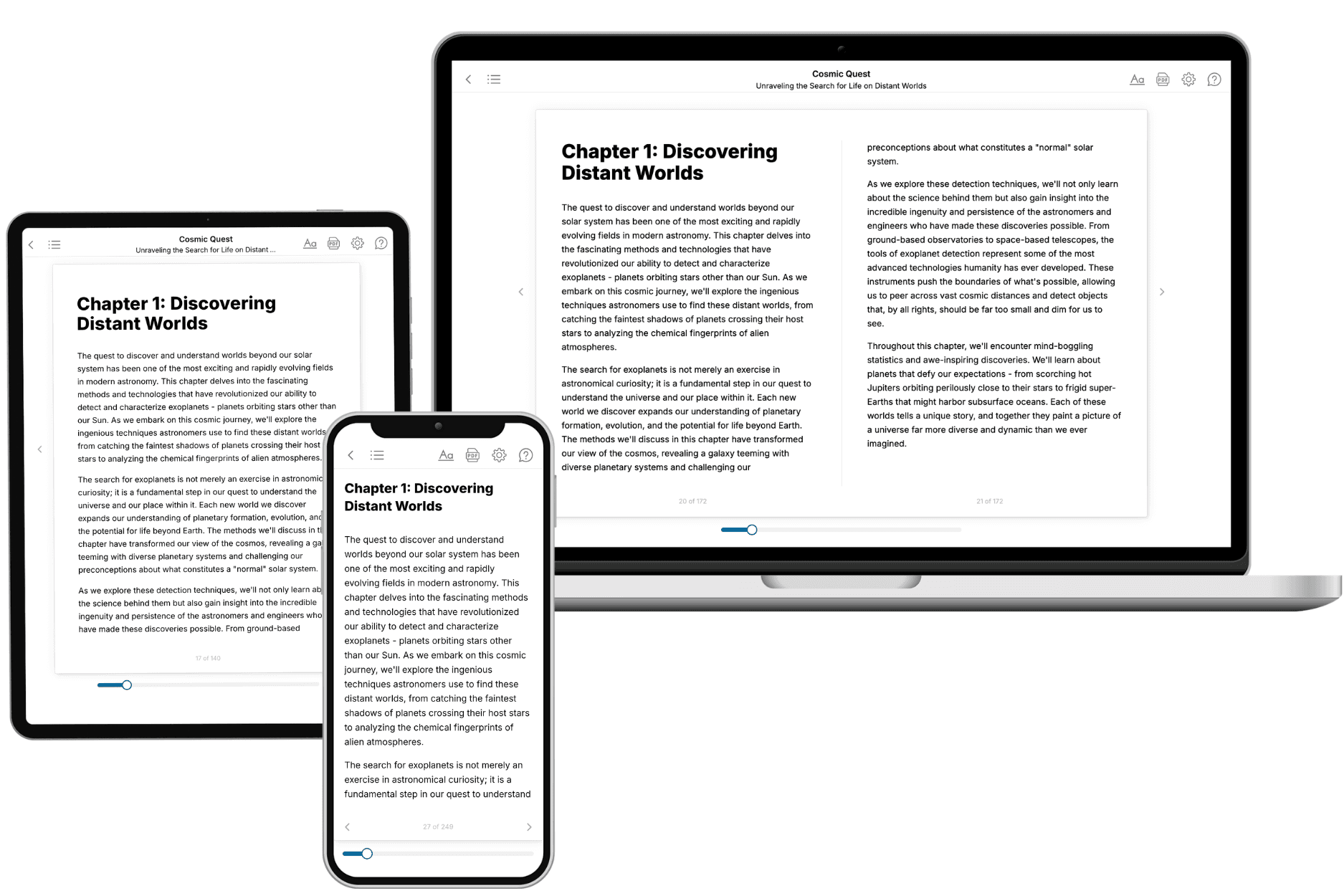
Your book is ready in 10 minutes. Read it online, download as EPUB or PDF, or send to Kindle.

Frequently asked questions
- What is TailoredRead?
TailoredRead creates complete, full-length nonfiction ebooks, written specifically for you. Tell us what you want to learn and why, and TailoredRead writes you a complete ebook on it, with charts, tables, and diagrams throughout. Read it online, on Kindle, or on any e-reader, or download it as a PDF or EPUB. Every book is written fresh the day you order it.
- How is the book tailored to me?
Before anything is written, you answer a few short questions about your goals, your background, and the topics you care about. Your book is then planned around your answers: written at your level, focused on your goals, and covering the topics you chose, instead of the one-size-fits-all book a store sells everyone.
- Will it read like generic AI content?
No. Your book isn't a chat transcript: it's planned chapter by chapter before a single word is written, told in a clear book voice, and explains ideas visually with charts, tables, and diagrams. After writing, every book goes through an editorial pass that polishes chapters so the book reads consistent from start to finish. Judge for yourself: browse thousands of sample books on our Explore Books page.
- How accurate is the content?
Our AI first checks whether your subject needs live research. Niche and fast-moving subjects are researched before writing, and the book plan and chapters are grounded in what it finds. After writing, every book goes through a quality pass that checks its facts and consistency, and researched books list their sources in a Notes section at the back.
- How long is the book?
You choose the length: Comprehensive (250-300 pages), Detailed (150-200 pages), Essential (70-100 pages), or Short (30-50 pages).
- Does the book include visuals?
Yes. Every book includes charts, tables, and diagrams: timelines, checklists, step-by-step guides, decision trees, comparison tables, matrices, and bar charts. A typical book includes dozens of these visual elements.
- Can I read it on Kindle? What formats can I download?
Yes. Every book can be read in our online reader or downloaded as a PDF or EPUB. The EPUB can be opened with Kindle, Apple Books, Kobo, and any e-reader. The Commercial and Author licenses also include an editable Word (DOCX) and Markdown download.
- How much does it cost?
About the price of a regular ebook. The exact price depends on your book's length and complexity, from $2 for the shortest books to $35 for the most comprehensive, and it's shown when you review your book, before you commit to anything. Each book is a one-time purchase, yours to keep, no subscription. Licenses that let you share, teach, or publish your book range from $35.99 to $49.99.
- Can I preview the book before purchasing?
Before you pay, you'll see what your book will cover: the title, a detailed description, the estimated length, and the complete chapter-by-chapter table of contents, so you know what you're getting before you decide. The full text itself is written after you purchase.
- How long does it take to create a book?
About 10 minutes. You can start reading the opening chapters while the rest is still being written.