Likelihood Estimation
Master Probability, Algorithms, and Real-World Decision Making
Most people think probability is about predicting the future, but likelihood estimation is about something more fundamental: finding the best explanation for what you've already observed.
207 pages11 chaptersDec 13, 2025Statistics
About this book
Whether you're building machine learning models, analyzing experimental data, or making algorithmic decisions, likelihood estimation is the mathematical engine behind the scenes. This book cuts through the complexity to show you how likelihood estimation actually works—from foundational concepts to practical implementation. You'll discover why Maximum Likelihood Estimation has become the gold standard in statistics and machine learning, how to navigate the computational challenges of real-world problems, and when to use approximation techniques instead of exact solutions. Written for those with intermediate probability knowledge, this guide combines clear explanations with concrete examples, helping you move from understanding the theory to confidently applying these powerful techniques in your own work.
Table of contents
- IntroductionWhy Likelihood Estimation Matters in Modern Computing, What You'll Learn in This Book, How to Use This Book EffectivelyRead below
- Chapter 1: Foundations of Probability and LikelihoodProbability Fundamentals: A Quick Review, The Critical Difference Between Likelihood and Probability, Understanding Probability Distributions
- Chapter 2: Introduction to Likelihood FunctionsDefining the Likelihood Function, Key Properties and Characteristics of Likelihood, Practical Examples Across Different Domains
- Chapter 3: Maximum Likelihood Estimation PrinciplesThe Core Concept of Maximum Likelihood Estimation, Mathematical Foundation and Derivation, Why MLE is the Gold Standard
- Chapter 4: Analytical Solutions and Closed-Form EstimatorsWhen Closed-Form Solutions Exist, MLE for Common Probability Distributions, Techniques for Deriving Maximum Likelihood Estimators
- Chapter 5: Numerical Optimization MethodsOverview of Numerical Optimization Approaches, Gradient Descent and Its Variants, Advanced Optimization Techniques and Algorithms
- Chapter 6: Likelihood Estimation in Machine LearningHow Machine Learning Uses Likelihood Estimation, Likelihood in Classification and Regression Models, Likelihood Estimation in Deep Learning
- Chapter 7: Bayesian Approaches and Posterior InferenceBayesian Framework and Prior Beliefs, Computing Posterior Distributions, Comparing MLE and Bayesian Approaches
- Chapter 8: Approximation Techniques and Computational EfficiencyWhen and Why to Use Approximations, Sampling-Based Approximation Techniques, Variational Inference and Mean-Field Approximations
- Chapter 9: Practical Implementation and ChallengesPractical Considerations for Implementation, Handling Numerical Stability and Overflow Issues, Debugging and Validating Your Estimators
- Chapter 10: Model Selection, Evaluation, and BiasChoosing Between Competing Models, Understanding Bias, Variance, and Overfitting, Metrics for Evaluating Likelihood Estimators
- Chapter 11: Real-World Applications and Case StudiesLikelihood Estimation in Natural Language Processing, Applications in Computer Vision and Image Analysis, Statistical Inference and Hypothesis Testing
- ConclusionKey Takeaways and Core Principles, Your Next Steps in Mastering Likelihood Estimation
Introduction
Every day, algorithms make decisions that affect your life in profound ways. When your email client filters spam, when a recommendation system suggests your next purchase, when a medical diagnostic tool evaluates test results, or when a self-driving car interprets sensor data, likelihood estimation is working behind the scenes. These systems don't just calculate probabilities—they solve a more fundamental problem: given the data they've observed, what's the most plausible explanation? This is the essence of likelihood estimation, and it's one of the most powerful tools in modern computing and data science.
Most introductions to probability focus on forward reasoning: if you know the parameters of a system, what outcomes should you expect? Likelihood estimation flips this question around. You observe outcomes and need to infer the parameters that most likely produced them. This inverse problem appears everywhere in computational work. When you train a machine learning model, you're finding parameters that maximize the likelihood of your training data. When you fit a statistical model to experimental results, you're estimating parameters that make your observations most probable. When you build a probabilistic algorithm, you're often computing likelihoods to make optimal decisions under uncertainty.
This book bridges the gap between theoretical understanding and practical implementation of likelihood estimation. You already have foundational knowledge of probability and computer science, which means you're ready to go deeper. You'll learn not just what likelihood estimation is, but how to implement it effectively, when different approaches work best, and how to navigate the computational and conceptual challenges that arise in real-world applications. By the end of this book, you'll understand the mathematical principles that power modern statistical inference and machine learning, and you'll have the practical skills to apply these techniques confidently in your own work.
Why Likelihood Estimation Matters in Modern Computing
Likelihood estimation has become indispensable in modern computing because it provides a principled, mathematically rigorous framework for learning from data. Unlike ad-hoc approaches that rely on intuition or heuristics, likelihood-based methods offer guarantees about their behavior and performance. Maximum Likelihood Estimation (MLE), in particular, has desirable statistical properties: under reasonable conditions, MLE estimators are consistent (they converge to the true parameter values as you collect more data), asymptotically efficient (they achieve the lowest possible variance among consistent estimators), and asymptotically normal (their sampling distribution approaches a normal distribution)[1]. These properties make MLE a reliable foundation for building systems that need to make accurate inferences from data.
The ubiquity of likelihood estimation in machine learning cannot be overstated. When you train a logistic regression classifier, you're maximizing the likelihood of the observed class labels given the features. When you fit a neural network, the loss function you minimize is typically the negative log-likelihood of your training data. When you build a generative model like a Gaussian Mixture Model or a Hidden Markov Model, you're using likelihood-based algorithms like Expectation-Maximization to find parameters that best explain your observations. Understanding likelihood estimation means understanding the mathematical foundation beneath these widely-used techniques.
Consider a concrete example from natural language processing. When a language model predicts the next word in a sentence, it's computing probabilities based on parameters learned through likelihood estimation. During training, the model sees millions of text examples and adjusts its parameters to maximize the likelihood of the observed word sequences. At inference time, it uses these learned parameters to compute the probability of different possible next words. This same pattern—learning parameters from data via likelihood maximization, then using those parameters to make predictions—appears across countless applications in computer vision, speech recognition, bioinformatics, and beyond.
Likelihood estimation also provides a unifying framework for understanding diverse statistical and machine learning methods. Many techniques that initially seem unrelated turn out to be special cases of likelihood-based inference. Linear regression with Gaussian errors is equivalent to maximum likelihood estimation under a normal distribution. Support Vector Machines can be interpreted through a likelihood framework. Even some Bayesian methods, which incorporate prior beliefs, rely on likelihood functions as a core component. This unifying perspective helps you see connections between different methods and choose the right tool for each problem.
The computational challenges of likelihood estimation have driven significant algorithmic innovation. Many real-world problems involve likelihood functions that are too complex to optimize analytically. This has led to the development of sophisticated numerical optimization algorithms, from gradient descent variants used in deep learning to Markov Chain Monte Carlo methods for Bayesian inference. Understanding these computational techniques is essential for implementing likelihood estimation effectively, especially when working with large datasets or complex models where computational efficiency becomes critical.
Beyond technical applications, likelihood estimation shapes how we think about uncertainty and decision-making. It provides a formal language for quantifying how well different explanations fit observed data. When you compare competing models using likelihood-based criteria like the Akaike Information Criterion or Bayesian Information Criterion, you're making principled trade-offs between model complexity and goodness of fit. This framework helps you avoid both underfitting (models too simple to capture important patterns) and overfitting (models that memorize noise instead of learning generalizable patterns). These concepts are crucial for building systems that perform well on new, unseen data.
The practical impact of likelihood estimation extends to critical decision-making domains. In medical diagnosis, likelihood-based methods help interpret test results and estimate disease probabilities. In finance, they inform risk assessment and portfolio optimization. In climate science, they enable parameter estimation in complex physical models. In each domain, the ability to find the most likely explanation for observed data—while properly accounting for uncertainty—can have significant real-world consequences. Mastering likelihood estimation means gaining tools that are both theoretically sound and practically powerful.
What You'll Learn in This Book
This book is structured to take you from foundational concepts to advanced applications in a logical progression. You'll start by solidifying your understanding of the relationship between probability and likelihood—a distinction that confuses many practitioners but is essential for clear thinking about inference. You'll learn why likelihood is a function of parameters given fixed data, while probability is a function of data given fixed parameters. This conceptual clarity will serve as the foundation for everything that follows, helping you avoid common misconceptions that can lead to errors in implementation and interpretation.
The early chapters focus on building your intuition and mathematical understanding of likelihood functions. You'll see how to construct likelihood functions for different types of data and probability distributions. You'll learn to recognize when closed-form solutions exist and how to derive maximum likelihood estimators analytically. These chapters include worked examples across diverse domains:
- Estimating the bias of a coin from a sequence of flips (Bernoulli distribution)
- Inferring the mean and variance of a population from sample measurements (Normal distribution)
- Determining the rate parameter of events occurring over time (Exponential distribution)
- Estimating parameters of discrete count data (Poisson distribution)
The middle chapters transition to computational methods for likelihood estimation. You'll learn when and why numerical optimization becomes necessary—typically when likelihood functions are too complex for analytical solutions or when working with high-dimensional parameter spaces. You'll explore gradient-based optimization methods, understanding how algorithms like gradient descent, stochastic gradient descent, and Newton's method navigate the parameter space to find likelihood maxima. You'll also learn about the trade-offs between different optimization approaches: gradient descent is simple and widely applicable but can be slow to converge, while second-order methods like Newton's method converge faster but require computing expensive Hessian matrices.
A significant portion of the book examines likelihood estimation in the context of machine learning. You'll see how training neural networks is fundamentally a likelihood maximization problem, where the choice of loss function corresponds to assumptions about the data-generating distribution. For classification tasks, cross-entropy loss emerges naturally from maximizing the likelihood under a categorical distribution. For regression tasks, mean squared error corresponds to maximum likelihood under Gaussian noise assumptions. Understanding these connections helps you make informed choices about loss functions and interpret what your models are actually learning.
The book also covers Bayesian approaches, which extend likelihood-based inference by incorporating prior beliefs about parameters. You'll learn how Bayes' theorem combines likelihood functions with prior distributions to produce posterior distributions that represent updated beliefs after observing data. You'll explore the philosophical and practical differences between frequentist maximum likelihood estimation and Bayesian inference, understanding when each approach is more appropriate. This includes examining scenarios where Bayesian methods excel:
- When you have genuine prior information that should inform your estimates
- When you need full posterior distributions rather than point estimates
- When you want to quantify uncertainty in a principled way
- When you're working with small datasets where regularization through priors helps prevent overfitting
Later chapters address the computational challenges that arise in complex, real-world applications. You'll learn about approximation techniques that make likelihood estimation tractable when exact computation is infeasible. This includes sampling-based methods like Markov Chain Monte Carlo (MCMC), which generate samples from posterior distributions when you can't compute them analytically. You'll also explore variational inference, which frames posterior inference as an optimization problem, trading some accuracy for significant computational speedups. These techniques are essential for working with modern probabilistic models like Bayesian neural networks or complex hierarchical models.
The book emphasizes practical implementation throughout. You'll learn about numerical stability issues that can derail likelihood computations, such as underflow when multiplying many small probabilities. You'll discover why practitioners typically work with log-likelihoods instead of raw likelihoods, and how to implement this correctly. You'll explore debugging strategies for when your likelihood optimization doesn't converge or produces unexpected results. You'll also learn about model selection criteria that help you choose between competing models, understanding the bias-variance tradeoff and how to evaluate whether your estimators are performing well on new data.
The final chapters showcase real-world applications across multiple domains. In natural language processing, you'll see how likelihood estimation powers language models, machine translation systems, and text classification. In computer vision, you'll explore how likelihood-based methods enable object detection, image segmentation, and generative models. In statistical inference, you'll learn how likelihood ratio tests provide a principled framework for hypothesis testing. Each application chapter includes concrete examples with specific implementation details, helping you understand not just the theory but how to apply these techniques to solve actual problems in your own work.
How to Use This Book Effectively
This book is designed for intermediate learners who already have foundational knowledge of probability theory and basic programming skills. You should be comfortable with concepts like probability distributions, expected values, and conditional probability. You should also have some experience with programming, ideally in a language commonly used for scientific computing like Python, R, or Julia. If you need to refresh these prerequisites, consider reviewing introductory probability textbooks or online courses before diving into this material. The book assumes you understand what a probability density function is, how to compute basic probabilities, and how to implement simple algorithms, but it doesn't assume prior exposure to likelihood estimation or advanced statistical inference.
The chapters are structured to build on each other progressively, so reading sequentially is recommended for your first pass through the material. Early chapters establish conceptual foundations and mathematical frameworks that later chapters assume you understand. However, the book is also designed to serve as a reference. If you're already familiar with basic likelihood concepts and want to learn about specific topics like numerical optimization or Bayesian inference, you can jump to those chapters directly. Each chapter includes cross-references to related material elsewhere in the book, helping you navigate to prerequisite concepts if needed.
To get the most from this book, engage actively with the material rather than reading passively. When you encounter a mathematical derivation, work through it yourself with pencil and paper. When you see an example, try to implement it in code before looking at the provided solution. When a concept seems abstract, create your own examples to test your understanding. Active engagement transforms theoretical knowledge into practical skills. Consider keeping a notebook where you work through derivations, implement algorithms, and document your own examples and insights. This practice will deepen your understanding and create a valuable reference for future work.
The book includes numerous examples and case studies, but you'll learn most effectively by applying these techniques to your own problems. As you progress through the chapters, think about how likelihood estimation relates to projects you're working on or problems you want to solve. Try implementing the methods on your own datasets. Experiment with different approaches and compare their performance. This hands-on practice is essential for developing intuition about when different techniques work well and what challenges arise in practice. The gap between understanding a method in theory and implementing it successfully in practice is significant, and bridging that gap requires experimentation and iteration.
Pay special attention to the sections on common pitfalls and debugging strategies. Likelihood estimation involves subtle issues that can lead to incorrect results if you're not careful. Understanding what can go wrong—and how to diagnose and fix problems—is just as important as understanding the basic methods. When you encounter difficulties in your own work, refer back to these sections for troubleshooting guidance. The book highlights specific warning signs to watch for:
- Optimization algorithms that fail to converge or converge to poor solutions
- Numerical underflow or overflow in likelihood computations
- Estimators that produce unreasonable parameter values
- Models that perform well on training data but poorly on test data
- Likelihood functions with multiple local maxima that trap optimization algorithms
The mathematical content in this book strikes a balance between rigor and accessibility. Derivations are included when they provide insight into why methods work and how to apply them correctly. However, the focus is always on understanding and application rather than mathematical formalism for its own sake. If you find a particular derivation challenging, don't let it block your progress. Read through it to get the main ideas, then move forward. You can always return to work through the details more carefully later. The goal is to build practical competence in likelihood estimation, not to prove every theorem from first principles.
Consider forming a study group or finding a learning partner if possible. Discussing concepts with others helps clarify your thinking and exposes you to different perspectives. Explaining likelihood estimation to someone else is one of the best ways to solidify your own understanding. If you're working through this book as part of a course, take advantage of opportunities to discuss the material with classmates and instructors. If you're learning independently, consider joining online communities focused on statistics, machine learning, or data science where you can ask questions and share insights.
Finally, remember that mastering likelihood estimation is a journey, not a destination. The field continues to evolve, with new methods and applications emerging regularly. This book provides a solid foundation, but staying current requires ongoing learning. After completing this book, you'll be well-equipped to read research papers, understand advanced techniques, and continue developing your expertise. The references and footnotes throughout the book point to additional resources for deeper exploration of specific topics. Use this book as a launching point for continued growth in your understanding of likelihood estimation and its applications in modern computing and data science.
Notes
Introduction
- 1. G. Casella and R. L. Berger, Statistical Inference (2nd ed.), Duxbury Press, 2002
This is the end of the free sample. The full book has 11 chapters.
Want this book written for you?
Tell us your goals and background, and get your own version of this book, tailored by AI to you.


Benefits of AI-tailored books
- Read one book, not ten:
- all the Statistics knowledge you need, gathered into a single book.
- Save days of learning:
- tell us your goals, choose your topics, and the whole book is built around them.
- Learn effortlessly:
- Statistics book written for your specific background and expertise.
- Understand at a glance:
- includes charts, tables, timelines, checklists, decision trees, and more.
- Stay current:
- written the day you order it, not years ago.
- Trust what you read:
- every book is checked for accuracy, with real research when your subject needs it.
Create your unique book in 3 steps
- 1. Select your focus
Select the focus of your Statistics book and share your background
- 2. Personalize your book
Specify your goals and choose sub-topics to include
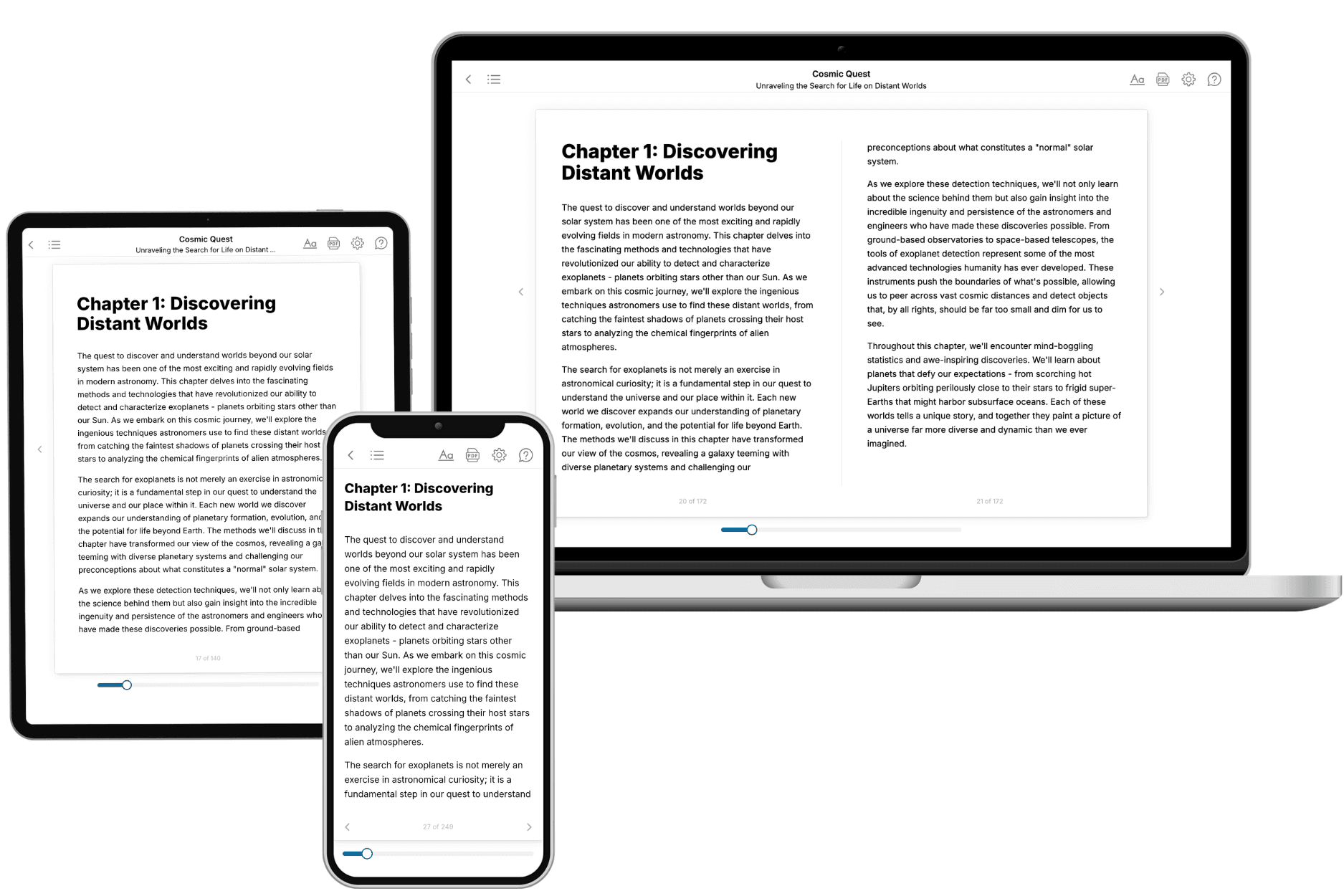
- 3. Get your tailored book
Your book is ready in 10 minutes. Read it online, download as EPUB or PDF, or send to Kindle.
Frequently asked questions
- What is TailoredRead?
TailoredRead creates complete, full-length nonfiction ebooks, written specifically for you. Tell us what you want to learn and why, and TailoredRead writes you a complete ebook on it, with charts, tables, and diagrams throughout. Read it online, on Kindle, or on any e-reader, or download it as a PDF or EPUB. Every book is written fresh the day you order it.
- How is the book tailored to me?
Before anything is written, you answer a few short questions about your goals, your background, and the topics you care about. Your book is then planned around your answers: written at your level, focused on your goals, and covering the topics you chose, instead of the one-size-fits-all book a store sells everyone.
- Will it read like generic AI content?
No. Your book isn't a chat transcript: it's planned chapter by chapter before a single word is written, told in a clear book voice, and explains ideas visually with charts, tables, and diagrams. After writing, every book goes through an editorial pass that polishes chapters so the book reads consistent from start to finish. Judge for yourself: browse thousands of sample books on our Explore Books page.
- How accurate is the content?
Our AI first checks whether your subject needs live research. Niche and fast-moving subjects are researched before writing, and the book plan and chapters are grounded in what it finds. After writing, every book goes through a quality pass that checks its facts and consistency, and researched books list their sources in a Notes section at the back.
- How long is the book?
You choose the length: Comprehensive (250-300 pages), Detailed (150-200 pages), Essential (70-100 pages), or Short (30-50 pages).
- Does the book include visuals?
Yes. Every book includes charts, tables, and diagrams: timelines, checklists, step-by-step guides, decision trees, comparison tables, matrices, and bar charts. A typical book includes dozens of these visual elements.
- Can I read it on Kindle? What formats can I download?
Yes. Every book can be read in our online reader or downloaded as a PDF or EPUB. The EPUB can be opened with Kindle, Apple Books, Kobo, and any e-reader. The Commercial and Author licenses also include an editable Word (DOCX) and Markdown download.
- How much does it cost?
About the price of a regular ebook. The exact price depends on your book's length and complexity, from $2 for the shortest books to $35 for the most comprehensive, and it's shown when you review your book, before you commit to anything. Each book is a one-time purchase, yours to keep, no subscription. Licenses that let you share, teach, or publish your book range from $35.99 to $49.99.
- Can I preview the book before purchasing?
Before you pay, you'll see what your book will cover: the title, a detailed description, the estimated length, and the complete chapter-by-chapter table of contents, so you know what you're getting before you decide. The full text itself is written after you purchase.
- How long does it take to create a book?
About 10 minutes. You can start reading the opening chapters while the rest is still being written.