The Limited Third Person Perspective
Master the Art of Intimate Storytelling Through Restricted Narrative Vision
What if the most powerful storytelling technique isn't about showing everything, but about showing only what your protagonist can see, know, and feel?
222 pages10 chaptersApr 24, 2026Creative Writing
About this book
Limited third person perspective is the narrative engine behind bestselling novels across every genre—yet many writers struggle to maintain it consistently or leverage its full potential. This guide reveals how to harness restricted narrative vision to create stories that feel intimate, suspenseful, and utterly compelling. You'll discover the psychological mechanics that make readers feel like they're living inside your character's mind, learn to distinguish limited third person from omniscient narration, and master the technical skills that separate amateur writing from professional prose. Through practical examples, common pitfalls, and actionable techniques, you'll develop the precision needed to maintain perspective consistency, create natural suspense through information gaps, and craft narratives that keep readers emotionally invested from first page to last.
Table of contents
- IntroductionWhy Perspective Matters in Modern Fiction, What You'll Learn in This Book, How to Use This GuideRead below
- Chapter 1: Understanding Limited Third PersonDefinition and Basics, Limited Third Person vs. Omniscient Narration, Why Writers Choose Limited Third Person
- Chapter 2: The Psychology of Restricted PerspectiveCreating Reader Immersion Through Perspective, Building Emotional Connection with Your Protagonist, Leveraging Knowledge Gaps for Suspense
- Chapter 3: Technical Foundations of Point of ViewPronouns, Voice, and Narrative Distance, Internal Monologue and Thought Attribution, Sensory Details and Perception Filtering
- Chapter 4: Maintaining Perspective ConsistencyCommon Point of View Violations, Avoiding Head-Hopping and Perspective Shifts, Eliminating Authorial Intrusion
- Chapter 5: Dialogue and Limited PerspectiveDialogue Tags and Attribution, Subtext and Character Misunderstanding, Revealing Information Through Conversation
- Chapter 6: Creating Suspense Through Information ControlStrategic Information Revelation, Building Mystery Through Limited Knowledge, Managing Reader Expectations and Surprises
- Chapter 7: Genre-Specific ApplicationsRomance: Maximizing Emotional Intimacy, Thrillers: Exploiting Information Gaps, Literary Fiction: Psychological Depth and Complexity
- Chapter 8: Transitions and Scene StructureManaging Scene Breaks and Perspective, Chapter Transitions While Maintaining POV, Handling Time Jumps and Perspective Continuity
- Chapter 9: Advanced Techniques and VariationsMultiple POV Characters in Limited Third, Unreliable Narrators and Perspective Manipulation, Strategic Perspective Shifts Between Chapters
- Chapter 10: Editing and Refining Your PerspectiveSelf-Editing Checklist for POV Consistency, Identifying and Fixing Perspective Problems, Using Beta Reader Feedback to Strengthen Perspective
- ConclusionYour Mastery Journey Begins, Final Thoughts on Perspective and Craft
- Glossary of Narrative Terms
- Further Reading and Resources
Introduction
Every story you've ever loved was filtered through a lens. Someone decided what you would see, what you would know, and what would remain hidden from you until exactly the right moment. That decision, made before a single scene was written, shaped everything: the tension you felt, the characters you cared about, the surprises that caught you off guard. Point of view is not a technical formality. It is the architecture of your reader's entire experience, and choosing it wisely is one of the most consequential decisions a writer makes.
Limited third person perspective is the dominant narrative mode in contemporary fiction. Walk into any bookstore and pull novels from the shelves at random. Chances are, the majority of them use some form of it. From literary fiction to commercial thrillers, from romance to young adult fantasy, writers return to this technique again and again because it solves a fundamental storytelling problem: how do you make readers feel genuinely close to a character while still maintaining the flexibility and readability of third person prose? Limited third person is the answer most professional writers have settled on, and for good reason.
Yet despite its prevalence, many writers struggle with it. They understand the basic concept but find themselves drifting into omniscient narration without realizing it. They accidentally reveal information their viewpoint character couldn't possibly know. They let their own authorial voice bleed into scenes where only the character's perspective should exist. These are not small errors. They are the kinds of problems that pull readers out of a story, erode trust in the narrative, and ultimately make the difference between a manuscript that feels polished and one that feels amateurish. This guide exists to close that gap.
What follows is a comprehensive, practical exploration of limited third person perspective. The goal is not to give you abstract theory to admire from a distance. The goal is to give you tools you can use immediately, techniques you can apply to your current project, and a clear framework for diagnosing and fixing perspective problems in your own writing. Whether you're drafting a new novel or revising an existing manuscript, the chapters ahead will help you work with greater precision, confidence, and intentionality.
Why Perspective Matters in Modern Fiction
Perspective is not just about grammar or pronoun choice. It is about the fundamental contract between writer and reader. When you establish a point of view, you are making a promise: the reader will experience this story through a specific consciousness, with specific limitations and specific access to information. Breaking that promise, even subtly, creates a sense of unease that readers often can't name but always feel. They describe it as the story feeling "off" or the writing feeling "distant." What they're actually sensing is a broken contract.
Consider two versions of the same scene. In the first, a woman named Clara walks into a room and notices a man in the corner looking nervous. She wonders what's bothering him. In the second version, Clara walks into the room, and the narration tells us that the man in the corner is nervous because he's hiding a secret from his employer. The first version keeps us inside Clara's limited awareness. The second version steps outside it entirely. Both versions describe the same moment, but they create completely different reading experiences. The first builds curiosity and tension. The second deflates it.
Modern readers, shaped by decades of psychologically intimate fiction and first-person narration in film and television, have developed a strong appetite for interiority. They want to feel like they're inside a character's head, not watching from a comfortable distance. Limited third person satisfies that appetite while giving writers structural advantages that pure first person cannot offer. It allows for a slightly more flexible narrative voice, easier scene transitions, and a subtle authorial presence that can shape tone without dominating it.
Research into reader engagement consistently shows that psychological closeness to a protagonist is one of the strongest predictors of reader satisfaction and emotional investment.[1] When readers feel like they are genuinely inhabiting a character's perspective, they process the story differently. They become more emotionally reactive to what happens to that character. They feel suspense more acutely because they share the character's ignorance. They feel relief more deeply because they've been waiting alongside the character for resolution. Perspective is the mechanism that creates this psychological closeness.
The stakes are especially high in contemporary publishing. Agents and editors read manuscripts with a trained eye for perspective consistency, and POV violations are among the most commonly cited reasons for rejection at the query stage. This is not arbitrary gatekeeping. It reflects a genuine understanding of what makes fiction work at a craft level. A writer who has mastered perspective control signals to industry professionals that they understand the mechanics of storytelling at a deep level, not just the surface level of plot and character.
Beyond publication, perspective mastery matters for your readers. A story told with consistent, disciplined limited third person perspective creates an immersive experience that keeps readers turning pages. It generates the kind of emotional investment that leads to word-of-mouth recommendations, loyal readership, and the deeply satisfying sense that your story has genuinely affected someone. That is, ultimately, why most writers write. Perspective is the technical foundation that makes that emotional impact possible.
Point of view is not a stylistic preference. It is the structural decision that determines everything else about how your story is experienced. Get it right, and readers will feel like they're living inside your narrative. Get it wrong, and they'll feel like they're watching it through glass.
It's also worth noting that perspective choices carry thematic weight. A story told through a single, limited consciousness makes an implicit argument about the nature of knowledge and experience: that we are all trapped inside our own perceptions, that understanding is always partial, that other people remain fundamentally mysterious to us. These are not just technical constraints. They are philosophical positions that can deepen the meaning of your narrative if you use them deliberately and thoughtfully.
What You'll Learn in This Book
This guide is organized to take you from foundational understanding through advanced application. It begins with the basics and builds systematically toward more complex techniques, but it is designed so that you can also dip into specific chapters when you need targeted help with a particular problem. Each chapter addresses a distinct aspect of limited third person perspective, and each one includes concrete examples, practical exercises, and specific guidance you can apply immediately.
The early chapters establish the conceptual foundation. You'll learn exactly what limited third person perspective is, how it differs from omniscient narration, and why writers across genres consistently choose it. You'll explore the psychological mechanics that make it so effective at creating reader immersion and emotional investment. These chapters are not just theoretical background. They give you the vocabulary and conceptual framework you need to make deliberate, informed decisions about your own writing.
The middle chapters get technical. You'll work through the specific craft elements that make limited third person function at a sentence level:
- How pronoun choice and narrative distance interact to create different reading experiences
- How to write internal monologue that feels natural and character-specific rather than mechanical
- How to filter sensory details through your viewpoint character's perception rather than presenting them as objective facts
- How to handle dialogue so that it reveals information without stepping outside your character's awareness
- How to identify and eliminate the most common POV violations that undermine narrative consistency
The later chapters address more advanced concerns. You'll learn how different genres leverage limited third person in distinct ways, with specific techniques for romance, thrillers, and literary fiction. You'll explore how to manage scene breaks and chapter transitions while maintaining perspective integrity. You'll tackle the more complex challenges of multiple POV characters, unreliable narrators, and strategic perspective shifts between chapters. These are the techniques that separate competent writers from genuinely skilled ones.
The final chapter focuses on revision. Even writers who understand limited third person in theory often find perspective problems in their drafts that they didn't notice while writing. You'll get a practical self-editing checklist, specific strategies for identifying and fixing perspective violations, and guidance on how to use beta reader feedback to strengthen your POV consistency. Revision is where craft is truly built, and this chapter gives you the tools to approach it systematically.
Throughout the book, you'll find examples drawn from the kinds of scenarios writers actually encounter. Some examples show what effective limited third person looks like in practice. Others show common mistakes and explain exactly why they don't work and how to fix them. The goal is always to make the abstract concrete, to show you not just what the principle is but what it looks like on the page.
By the time you finish this guide, you should be able to:
- Identify the difference between limited third person and omniscient narration in any text, including your own
- Write scenes that consistently maintain a single character's perspective without accidental violations
- Use your viewpoint character's knowledge gaps deliberately to create suspense and reader engagement
- Craft internal monologue, sensory details, and dialogue that all reinforce the limited perspective
- Manage complex structural challenges like multiple POV characters and time jumps without losing perspective coherence
- Edit your own work for POV consistency with a trained, systematic eye
These are not abstract goals. They are specific, measurable skills that will make your writing noticeably stronger. Writers who have worked through the techniques in this guide consistently report that their manuscripts feel more focused, their characters feel more vivid, and their stories feel more emotionally compelling. That is the practical payoff of mastering perspective.
How to Use This Guide
This book is designed for writers who already have some experience with fiction. You don't need to be an expert, but you should be familiar with basic storytelling concepts like scene structure, character development, and dialogue. If you've written at least one complete draft of a short story or novel, you have enough experience to get full value from what follows. The techniques here will make the most sense when you can connect them to your own writing challenges and experiences.
The most effective way to use this guide is to read it alongside an active writing project. Each chapter introduces concepts and techniques that you can immediately apply to whatever you're currently working on. Don't just read passively. After each chapter, take a few pages of your current manuscript and look at them through the lens of what you've just learned. Ask yourself whether your perspective is consistent, whether your character's knowledge is being respected, whether your sensory details are filtered through the right consciousness. Active application is how abstract concepts become internalized skills.
If you're working on a specific problem rather than reading cover to cover, here's a quick reference for where to find what you need:
- Struggling to understand the basic concept: Start with Chapter 1
- Readers say your story feels distant or hard to connect with: Focus on Chapter 2
- Getting feedback about "head-hopping" or POV violations: Go directly to Chapter 4
- Unsure how to handle dialogue without breaking perspective: Chapter 5 is your starting point
- Writing a thriller and struggling to build suspense: Chapters 6 and 7 address this directly
- Managing multiple POV characters: Chapter 9 covers this in depth
- Revising a completed draft for perspective consistency: Chapter 10 is designed for exactly this
The examples throughout this book are constructed to illustrate specific points clearly. When you see a "before" example showing a perspective problem, resist the urge to simply note that it's wrong and move on. Instead, try to articulate exactly why it doesn't work before reading the explanation. This active engagement with the examples will sharpen your editorial instincts far more effectively than passive reading. The same applies to the "after" examples: don't just accept that they're better. Ask yourself what specific changes were made and why those changes solve the problem.
Some writers find it helpful to keep a dedicated notebook while working through a craft guide like this one. If that approach appeals to you, consider using it to track three things: perspective problems you notice in your own writing, techniques from each chapter that feel immediately applicable to your current project, and questions that arise as you read. The questions are especially valuable. They often point toward the specific areas where your understanding is still developing, and they give you a focused agenda for re-reading or further study.
It's also worth being honest with yourself about the learning curve involved. Mastering limited third person perspective is not something that happens after reading a single chapter or even a single book. It is a skill that develops through repeated practice, attentive revision, and the gradual internalization of principles that initially feel effortful and mechanical. Most writers go through a phase where maintaining perspective consistency feels like a constant conscious effort. That phase passes. With enough practice, perspective awareness becomes automatic, and you'll start catching violations in your drafts almost instinctively.
Don't be discouraged if you find perspective problems in your existing work as you read through this guide. Finding problems is not a sign of failure. It is a sign that your skills are developing. Every writer who has ever mastered a craft technique went through a period of seeing their own work more clearly and finding it wanting. That clarity is the first step toward improvement. The writers who struggle most are not the ones who find problems in their work. They are the ones who can't see the problems at all.
Finally, remember that the goal of all this technical work is not technical perfection for its own sake. The goal is to serve your story and your readers. Limited third person perspective is a tool, and like any tool, its value lies entirely in how effectively it helps you accomplish what you're trying to accomplish. Keep your story's emotional core at the center of every technical decision you make. The techniques in this guide are means to an end, and that end is a narrative that genuinely moves, engages, and stays with your readers long after they've turned the last page.
The best technical craft work is invisible. When limited third person perspective is done well, readers don't think about point of view at all. They simply feel like they're inside the story. That invisibility is the goal, and it is entirely achievable with deliberate, informed practice.
The chapters ahead will give you everything you need to reach that level of craft. The work is yours to do, but the path is clear. Start where you are, apply what you learn, and trust the process. Perspective mastery is not a gift that some writers have and others don't. It is a skill, and skills can be learned. Let's begin.
Notes
Introduction
- 1. R. A. Mar and K. Oatley, "The function of fiction is the abstraction and simulation of social experience," Perspectives on Psychological Science, 2008
This is the end of the free sample. The full book has 10 chapters.
Want this book written for you?
Tell us your goals and background, and get your own version of this book, tailored by AI to you.


Benefits of AI-tailored books
- Read one book, not ten:
- all the Creative Writing knowledge you need, gathered into a single book.
- Save days of learning:
- tell us your goals, choose your topics, and the whole book is built around them.
- Learn effortlessly:
- Creative Writing book written for your specific background and expertise.
- Understand at a glance:
- includes charts, tables, timelines, checklists, decision trees, and more.
- Stay current:
- written the day you order it, not years ago.
- Trust what you read:
- every book is checked for accuracy, with real research when your subject needs it.
Create your unique book in 3 steps
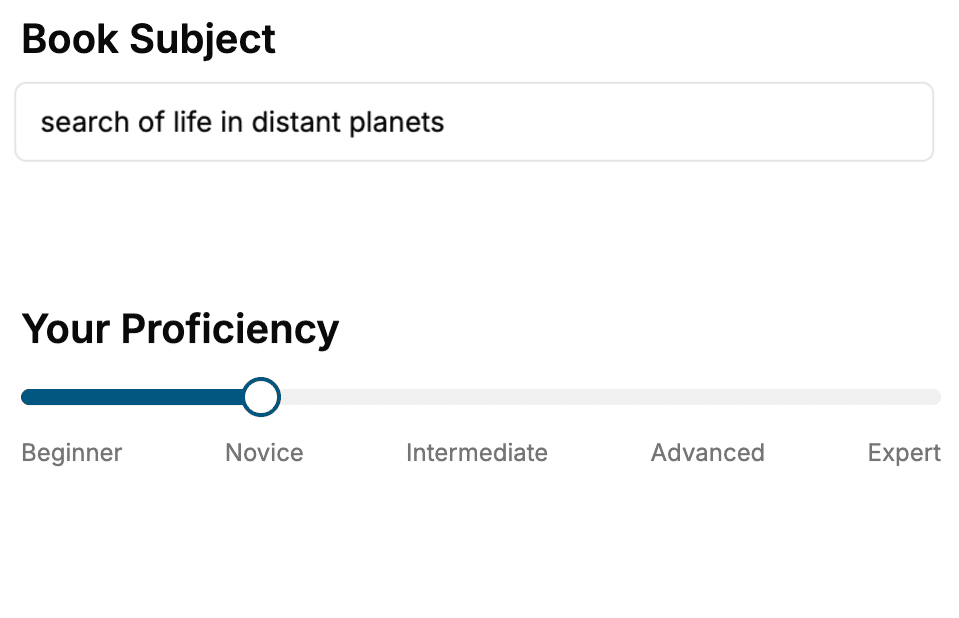
- 1. Select your focus
Select the focus of your Creative Writing book and share your background
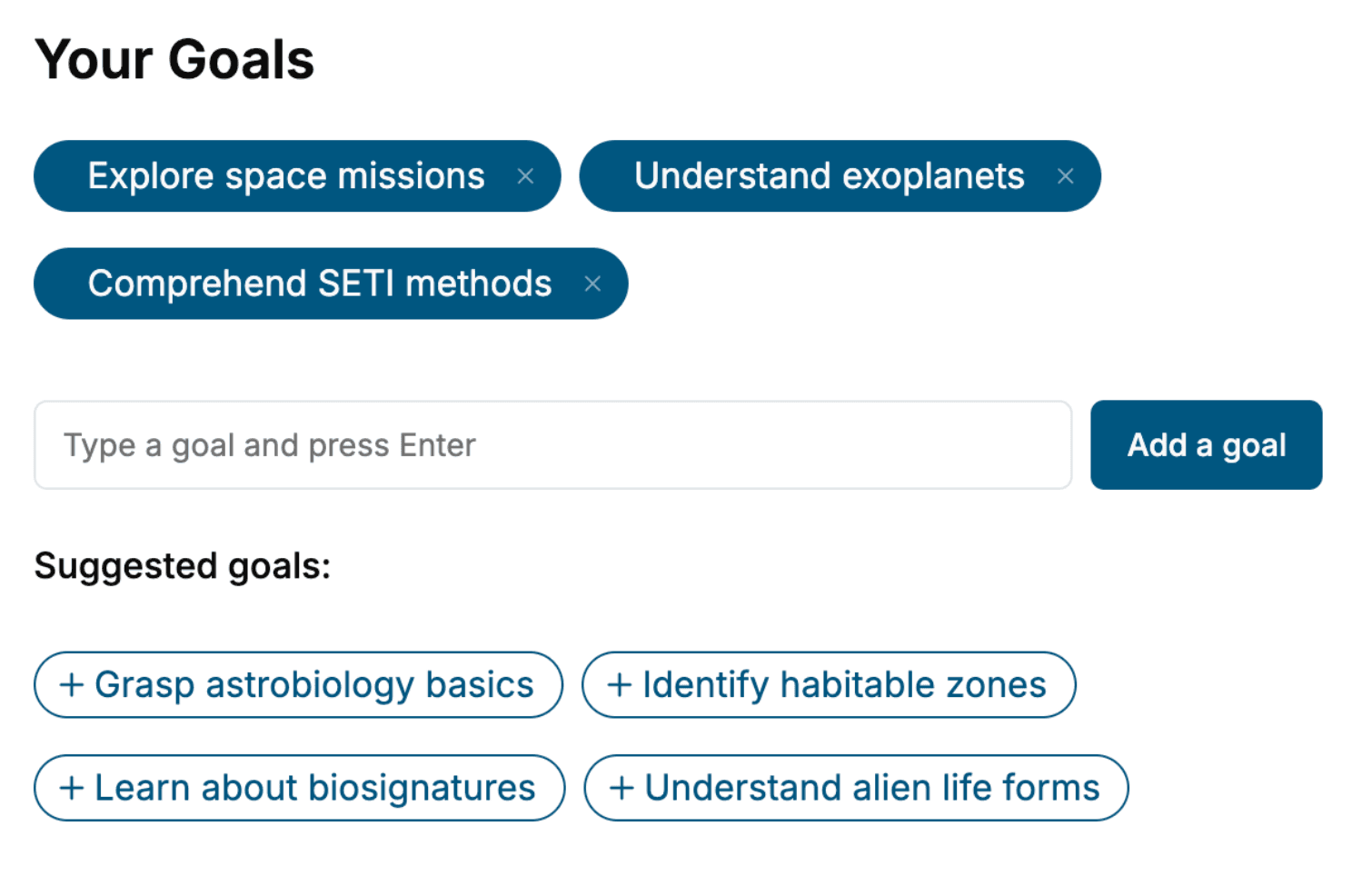
- 2. Personalize your book
Specify your goals and choose sub-topics to include
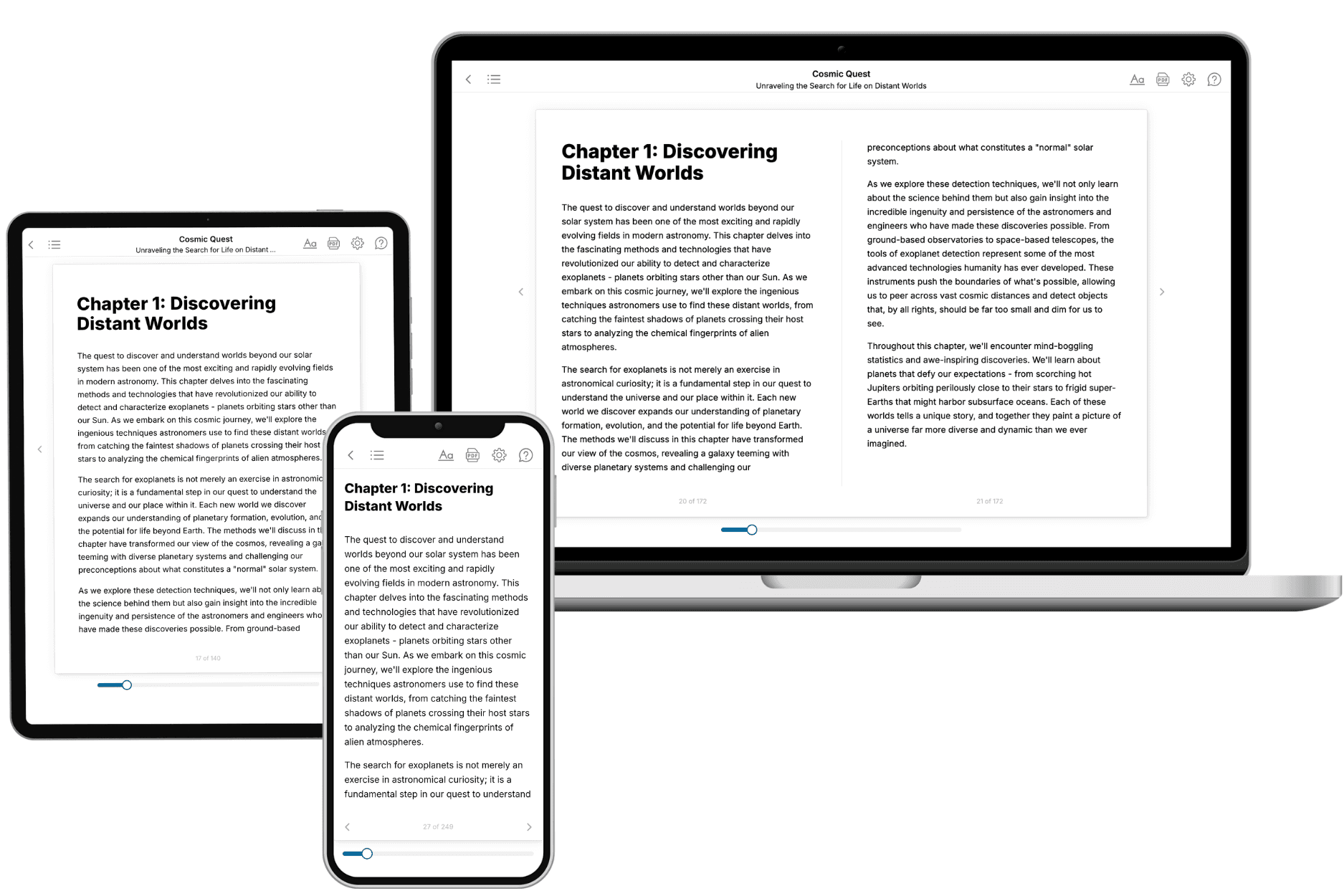
- 3. Get your tailored book
Your book is ready in 10 minutes. Read it online, download as EPUB or PDF, or send to Kindle.
Frequently asked questions
- What is TailoredRead?
TailoredRead creates complete, full-length nonfiction ebooks, written specifically for you. Tell us what you want to learn and why, and TailoredRead writes you a complete ebook on it, with charts, tables, and diagrams throughout. Read it online, on Kindle, or on any e-reader, or download it as a PDF or EPUB. Every book is written fresh the day you order it.
- How is the book tailored to me?
Before anything is written, you answer a few short questions about your goals, your background, and the topics you care about. Your book is then planned around your answers: written at your level, focused on your goals, and covering the topics you chose, instead of the one-size-fits-all book a store sells everyone.
- Will it read like generic AI content?
No. Your book isn't a chat transcript: it's planned chapter by chapter before a single word is written, told in a clear book voice, and explains ideas visually with charts, tables, and diagrams. After writing, every book goes through an editorial pass that polishes chapters so the book reads consistent from start to finish. Judge for yourself: browse thousands of sample books on our Explore Books page.
- How accurate is the content?
Our AI first checks whether your subject needs live research. Niche and fast-moving subjects are researched before writing, and the book plan and chapters are grounded in what it finds. After writing, every book goes through a quality pass that checks its facts and consistency, and researched books list their sources in a Notes section at the back.
- How long is the book?
You choose the length: Comprehensive (250-300 pages), Detailed (150-200 pages), Essential (70-100 pages), or Short (30-50 pages).
- Does the book include visuals?
Yes. Every book includes visual elements such as timelines, checklists, step-by-step guides, decision trees, comparison tables, and matrices, and many include bar charts. A typical book includes dozens of these visual elements.
- Can I read it on Kindle? What formats can I download?
Yes. Every book can be read in our online reader or downloaded as a PDF or EPUB. The EPUB can be opened with Kindle, Apple Books, Kobo, and any e-reader. The Commercial and Author licenses also include an editable Word (DOCX) and Markdown download.
- How much does it cost?
About the price of a regular ebook. The exact price depends on your book's length and complexity, from $2 for the shortest books to $35 for the most comprehensive, and it's shown when you review your book, before you commit to anything. Each book is a one-time purchase, yours to keep, no subscription. Licenses that let you share, teach, or publish your book range from $35.99 to $49.99.
- Can I preview the book before purchasing?
Before you pay, you'll see what your book will cover: the title, a detailed description, the estimated length, and the complete chapter-by-chapter table of contents, so you know what you're getting before you decide. The full text itself is written after you purchase.
- How long does it take to create a book?
About 10 minutes. You can start reading the opening chapters while the rest is still being written.