Linear Discriminant Analysis for Binary Classification
Master the Fundamentals of LDA and Build Powerful Classification Models
Imagine confidently building classification models that not only predict accurately but also reveal exactly why those predictions are made.
222 pages10 chaptersEnglishDec 25, 2025Machine Learning
About this book
Linear Discriminant Analysis offers this rare combination of power and interpretability, yet many practitioners overlook it in favor of more complex algorithms. This book bridges that gap by taking you from foundational concepts to practical mastery of LDA for binary classification. You'll discover how LDA leverages mathematical elegance to find optimal decision boundaries between classes, and learn when it outperforms other methods. Through clear explanations of the underlying mathematics, hands-on implementation guidance, and real-world examples, you'll understand how to preprocess data effectively, validate assumptions, and troubleshoot common challenges. Whether you're building fraud detection systems, medical diagnostic tools, or customer segmentation models, this guide equips you with the knowledge to apply LDA strategically. You'll learn not just how to implement LDA, but when to use it, how to interpret results, and how to integrate it into your broader machine learning workflow.
Table of contents
- IntroductionWhy Linear Discriminant Analysis Matters in Modern Machine Learning, How This Book Is Organized and What You'll Learn, Prerequisites and How to Get the Most from This GuideRead below
- Chapter 1: Classification Fundamentals and the Role of LDAUnderstanding Binary Classification Problems, Overview of Common Classification Algorithms, Where Linear Discriminant Analysis Fits in the ML Landscape
- Chapter 2: Mathematical Foundations of Linear Discriminant AnalysisProbability Theory and Bayes' Theorem Essentials, The Multivariate Normal Distribution and Class Assumptions, Deriving Discriminant Functions and Decision Boundaries, Critical Assumptions: Normality, Homogeneity of Variance, and Independence
- Chapter 3: The LDA Algorithm: Step-by-Step MechanicsComputing Class Means and Pooled Covariance Matrices, Calculating Discriminant Coefficients and Thresholds, Making Predictions: From Raw Data to Class Assignments, Understanding Probability Outputs and Confidence Scores
- Chapter 4: Data Preparation and Preprocessing for LDAData Cleaning and Handling Missing Values, Feature Standardization and Scaling Techniques, Detecting and Addressing Multicollinearity, Strategies for Handling Class Imbalance
- Chapter 5: Feature Selection and Dimensionality ReductionFeature Selection Methods and Their Impact on LDA, Using LDA for Dimensionality Reduction in Binary Classification, Interpreting LDA Components and Feature Importance
- Chapter 6: Validating LDA Assumptions and Model DiagnosticsTesting for Multivariate Normality, Testing for Homogeneity of Variance (Levene's Test), Creating and Interpreting Diagnostic Plots, What to Do When Assumptions Are Violated
- Chapter 7: Model Evaluation and Performance MetricsConfusion Matrix, Accuracy, Precision, Recall, and F1-Score, ROC Curves and AUC: Understanding Classification Trade-offs, Cross-Validation Strategies for Robust Performance Estimation, Optimizing Classification Thresholds for Your Use Case
- Chapter 8: Practical Implementation and Hands-On ExamplesImplementing LDA with Python, R, and Popular Libraries, Case Study: Building a Fraud Detection Model, Case Study: Medical Diagnosis and Risk Prediction, Troubleshooting Common Implementation Issues
- Chapter 9: Comparing LDA with Other Classification AlgorithmsLDA vs. Logistic Regression: Similarities and Differences, LDA vs. Decision Trees and Random Forests, LDA vs. Support Vector Machines and Neural Networks, Choosing the Right Algorithm for Your Problem
- Chapter 10: Advanced Topics and ExtensionsQuadratic Discriminant Analysis (QDA) and When to Use It, Regularized LDA for High-Dimensional Data, Combining LDA with Ensemble Methods
- ConclusionKey Takeaways and Your Path Forward, Next Steps in Your Machine Learning Journey
- Glossary of Key Terms
- Further Reading and Resources
Introduction
Machine learning has transformed how we solve classification problems, from detecting fraudulent transactions to diagnosing diseases. Yet amid the excitement surrounding deep learning and ensemble methods, a powerful and elegant algorithm often gets overlooked: Linear Discriminant Analysis. While newer practitioners rush toward complex neural networks, experienced data scientists recognize that LDA offers something increasingly rare in modern machine learning—a perfect balance of predictive power, mathematical interpretability, and computational efficiency. This book exists to help you master LDA for binary classification, understanding not just how to implement it, but when to choose it and why it works.
Linear Discriminant Analysis stands apart from many classification algorithms because it provides clear insights into the decision-making process. When you build an LDA model, you don't just get predictions—you get interpretable coefficients that reveal exactly which features drive classification decisions and by how much. In an era where explainable AI has become critical for regulatory compliance, stakeholder trust, and ethical deployment, LDA's transparency becomes a significant advantage. You can trace every prediction back to its mathematical foundations, explaining to non-technical stakeholders precisely why the model classified a particular instance as positive or negative.
This guide takes you beyond surface-level tutorials and cookbook implementations. You'll develop a deep understanding of the mathematical principles underlying LDA, learn how to validate critical assumptions, and discover practical strategies for preprocessing data and optimizing performance. Whether you're working with medical diagnostic data, financial risk assessment, customer churn prediction, or any other binary classification problem, you'll gain the knowledge to apply LDA effectively and confidently. The journey ahead combines rigorous theory with hands-on practice, ensuring you can both understand the algorithm conceptually and implement it successfully in real-world scenarios.
Why Linear Discriminant Analysis Matters in Modern Machine Learning
The machine learning landscape has evolved dramatically over the past decade, with new algorithms and frameworks emerging at a rapid pace. In this environment, you might wonder why you should invest time learning an algorithm developed in the 1930s by statistician Ronald Fisher. The answer lies in understanding that newer doesn't always mean better—the right algorithm depends entirely on your problem characteristics, data properties, and deployment constraints. LDA continues to thrive in modern applications because it addresses several critical needs that many contemporary algorithms struggle to meet simultaneously.
First, LDA excels when interpretability matters as much as accuracy. Consider a medical diagnostic system that predicts whether a patient has a particular disease. Doctors need to understand why the model made its prediction, which features contributed most strongly, and how confident the system is in its assessment. LDA provides this transparency naturally through its discriminant coefficients and probability outputs. Each coefficient tells you exactly how much a one-unit change in a feature shifts the discriminant score toward one class or another. This interpretability isn't an add-on feature—it's built into the algorithm's mathematical structure.
Second, LDA performs remarkably well with small to medium-sized datasets, a common scenario in many real-world applications. While deep learning models typically require thousands or millions of training examples to achieve good performance, LDA can build effective classifiers with just hundreds of observations. This efficiency stems from LDA's parametric nature—it estimates relatively few parameters (class means and a shared covariance matrix) compared to the vast parameter spaces of neural networks. When you're working with limited data, perhaps in a specialized medical domain or a niche business application, LDA often outperforms more complex alternatives that suffer from overfitting.
Third, LDA offers computational efficiency that matters in production environments. Training an LDA model involves computing class statistics and solving linear equations—operations that execute quickly even on modest hardware. Once trained, making predictions requires only simple matrix multiplications and comparisons, enabling real-time classification with minimal latency. This efficiency becomes crucial when you need to deploy models on edge devices, process high-volume streams of data, or minimize cloud computing costs. A well-tuned LDA model can handle thousands of predictions per second on a single CPU core.
Fourth, LDA provides inherent dimensionality reduction capabilities that serve dual purposes. When you have high-dimensional data with many features, LDA can project your data onto a lower-dimensional space that maximizes class separation. This projection not only reduces computational requirements but also helps visualize decision boundaries and understand feature relationships. Unlike generic dimensionality reduction techniques like PCA that ignore class labels, LDA's projections are specifically optimized for classification, often yielding better results when the goal is separating classes rather than merely capturing variance.
Fifth, LDA handles multicollinearity more gracefully than some alternatives like logistic regression. When features are correlated—a common situation in real-world data—LDA's use of a pooled covariance matrix helps stabilize estimates and produce reliable predictions. While severe multicollinearity still requires attention, LDA's mathematical framework naturally accounts for feature correlations in a way that makes the algorithm more robust. This property proves particularly valuable in domains like genomics, finance, and sensor data analysis where features often exhibit complex correlation structures.
Finally, LDA serves as an excellent baseline and benchmark for more complex models. Before investing time and computational resources in sophisticated ensemble methods or neural networks, building an LDA model helps you understand your data's fundamental structure and establish a performance baseline. If LDA achieves 95% accuracy on your problem, you know that more complex models need to exceed this threshold to justify their additional complexity. Conversely, if LDA performs poorly, this signals that your data may violate key assumptions, prompting you to investigate data quality issues or consider non-linear alternatives. This diagnostic value alone makes LDA worth understanding, even if you ultimately deploy a different algorithm.
The practical applications where LDA continues to excel span numerous industries and domains:
- Medical diagnostics: Classifying patients as healthy or diseased based on biomarkers, lab results, and clinical measurements where interpretability is legally and ethically required
- Financial services: Credit risk assessment, fraud detection, and loan default prediction where regulatory requirements demand explainable decisions
- Quality control: Manufacturing defect detection where understanding which measurements indicate defects helps improve production processes
- Marketing analytics: Customer churn prediction and response modeling where insights into customer behavior drivers inform strategic decisions
- Biometrics: Face recognition and authentication systems where computational efficiency enables real-time processing
- Environmental science: Species classification and habitat suitability modeling where limited sample sizes are common
Understanding LDA also deepens your broader machine learning knowledge. The algorithm connects fundamental concepts from linear algebra, probability theory, and statistical inference in ways that illuminate how classification works at a deeper level. When you grasp how LDA derives decision boundaries from class distributions, you develop intuition that transfers to understanding other algorithms. The relationship between LDA and logistic regression, for instance, reveals important insights about generative versus discriminative modeling approaches. Similarly, comparing LDA with its non-linear cousin, Quadratic Discriminant Analysis, teaches you about the bias-variance tradeoff in a concrete, tangible way.
How This Book Is Organized and What You'll Learn
This book follows a carefully structured progression that builds your understanding from foundational concepts to advanced applications. Each chapter addresses specific aspects of LDA while connecting to the broader narrative of mastering binary classification. The organization reflects how you would approach a real-world classification project—starting with problem understanding, moving through mathematical foundations and implementation, and culminating in evaluation and comparison with alternative approaches. You can read the book sequentially for comprehensive learning or jump to specific chapters when you need targeted information for a particular challenge.
Chapter 1: Classification Fundamentals and the Role of LDA establishes the context for everything that follows. You'll explore what binary classification problems look like in practice, review the landscape of available algorithms, and understand where LDA fits within this ecosystem. This chapter answers the crucial question of when you should consider LDA versus other approaches, helping you make informed algorithm selection decisions before investing time in implementation. You'll see concrete examples of classification problems and learn to recognize data characteristics that favor LDA.
Chapter 2: Mathematical Foundations of Linear Discriminant Analysis dives into the theory underlying LDA. Rather than presenting dry mathematical proofs, this chapter builds intuition by connecting probability theory, Bayes' theorem, and multivariate statistics to the practical goal of separating classes. You'll understand how LDA derives discriminant functions from assumptions about data distributions, why these assumptions matter, and what happens when they're violated. The mathematical content is presented with visual aids and concrete examples that make abstract concepts tangible, ensuring you develop genuine understanding rather than just memorizing formulas.
Chapter 3: The LDA Algorithm: Step-by-Step Mechanics walks through the computational process of building and using an LDA classifier. You'll learn exactly how to compute class means, pooled covariance matrices, and discriminant coefficients. This chapter demystifies the algorithm by breaking it into discrete, understandable steps, showing you what happens at each stage and why. You'll see how raw data transforms into predictions, how probability scores are calculated, and how decision thresholds determine final classifications. By the end of this chapter, you could implement LDA from scratch if needed.
Chapter 4: Data Preparation and Preprocessing for LDA addresses the critical but often overlooked work that precedes model building. LDA's performance depends heavily on proper data preparation, and this chapter provides comprehensive guidance on cleaning data, handling missing values, standardizing features, and addressing multicollinearity. You'll learn specific techniques for detecting and resolving common data quality issues, with particular attention to how these issues affect LDA differently than other algorithms. The chapter also covers strategies for handling class imbalance, a frequent challenge in real-world classification problems.
Chapter 5: Feature Selection and Dimensionality Reduction explores how to identify the most informative features for your classification task and leverage LDA's dimensionality reduction capabilities. You'll learn various feature selection methods, understand their trade-offs, and discover how to use LDA itself as a dimensionality reduction technique. This chapter shows you how to interpret LDA components to understand which features drive classification decisions, enabling you to build more parsimonious models and communicate insights to stakeholders effectively.
Chapter 6: Validating LDA Assumptions and Model Diagnostics equips you with tools to verify whether your data meets LDA's requirements. You'll learn how to test for multivariate normality, homogeneity of variance, and independence using both statistical tests and visual diagnostics. Importantly, this chapter doesn't just identify assumption violations—it provides practical strategies for addressing them, including data transformations, alternative algorithms, and robust variants of LDA. You'll develop the judgment to decide when assumption violations are minor enough to ignore and when they require intervention.
Chapter 7: Model Evaluation and Performance Metrics teaches you how to assess LDA model quality rigorously. Beyond basic accuracy, you'll master the full suite of classification metrics including precision, recall, F1-score, ROC curves, and AUC. This chapter emphasizes choosing metrics that align with your specific business objectives—for instance, prioritizing recall in medical screening applications or precision in fraud detection. You'll learn cross-validation strategies that provide honest performance estimates and techniques for optimizing classification thresholds to match your use case requirements.
Chapter 8: Practical Implementation and Hands-On Examples brings everything together through detailed case studies. You'll see complete implementations using Python and R, working through real-world scenarios like fraud detection and medical diagnosis. These examples demonstrate the entire workflow from raw data to deployed model, including all the messy details that tutorials often omit. You'll encounter common implementation challenges and learn how to troubleshoot them, building the practical skills needed to apply LDA successfully in your own projects.
Chapter 9: Comparing LDA with Other Classification Algorithms provides the comparative analysis you need to make informed algorithm choices. You'll understand the similarities and differences between LDA and logistic regression, decision trees, random forests, support vector machines, and neural networks. Rather than declaring one algorithm superior, this chapter helps you recognize which algorithm best matches your specific problem characteristics, data properties, and deployment constraints. You'll develop a decision framework for algorithm selection that serves you across diverse classification challenges.
Chapter 10: Advanced Topics and Extensions explores sophisticated variations and extensions of LDA. You'll learn about Quadratic Discriminant Analysis for handling non-linear decision boundaries, regularized LDA for high-dimensional data, and techniques for combining LDA with ensemble methods. This chapter prepares you to tackle challenging scenarios where basic LDA needs enhancement, while maintaining the algorithm's core advantages of interpretability and efficiency.
The book concludes with a Conclusion that synthesizes key takeaways and charts your path forward, a Glossary defining technical terms for quick reference, and a Further Reading section pointing you toward additional resources for continued learning. Throughout the book, you'll find:
- Concrete examples with specific numbers and scenarios rather than abstract descriptions
- Code snippets and implementation guidance using popular libraries
- Visual diagrams illustrating mathematical concepts and decision boundaries
- Practical tips and warnings based on real-world experience
- Exercises and thought questions to deepen your understanding
- References to research papers and additional resources for deeper exploration
Prerequisites and How to Get the Most from This Guide
This book assumes you have intermediate knowledge of machine learning and statistics. You should be comfortable with fundamental concepts like training and test sets, overfitting and underfitting, and basic evaluation metrics. You don't need to be an expert, but you should have built at least a few classification models using algorithms like logistic regression or decision trees. If terms like "confusion matrix," "cross-validation," and "feature engineering" are completely unfamiliar, consider reviewing introductory machine learning resources before diving into this book. That said, the book does review key concepts when necessary, so don't let minor gaps in knowledge deter you.
On the mathematical side, you'll benefit from familiarity with linear algebra, probability, and statistics. Specifically, you should understand:
- Linear algebra: Vectors, matrices, matrix multiplication, matrix inversion, and eigenvalues at a conceptual level
- Probability: Probability distributions, conditional probability, Bayes' theorem, and expected values
- Statistics: Mean, variance, covariance, correlation, normal distribution, and hypothesis testing basics
- Calculus: Basic derivatives and optimization concepts (helpful but not strictly required)
For programming, you should have working knowledge of either Python or R, the two dominant languages for machine learning. The code examples use popular libraries like scikit-learn for Python and the MASS package for R, so familiarity with these ecosystems helps. You don't need to be an expert programmer—the code focuses on clarity rather than advanced techniques. If you can load data, manipulate arrays or data frames, and call library functions, you have sufficient programming skills. The book includes enough context around code examples that you can follow along even if you're stronger in one language than the other.
To maximize your learning, consider adopting these practices as you work through the book:
- Run the code examples: Don't just read the implementations—type them out, run them, and experiment with modifications. Change parameters, try different datasets, and observe how results change. This hands-on practice cements understanding far better than passive reading.
- Work through the mathematics: When you encounter equations, take time to understand what each term represents and why the equation makes sense. Grab paper and pencil to work through derivations yourself. This active engagement transforms abstract formulas into intuitive concepts.
- Apply concepts to your own data: Throughout the book, think about how each concept applies to classification problems you've encountered. Try implementing LDA on your own datasets, even if they're not perfectly suited to the algorithm. The experience of adapting techniques to your specific context accelerates learning.
- Compare with other algorithms: When you learn a new LDA technique, implement the same task using logistic regression or another familiar algorithm. Comparing results deepens your understanding of each algorithm's strengths and weaknesses.
- Engage with the exercises: The book includes thought questions and practical exercises. Resist the temptation to skip them—they're designed to challenge your understanding and reveal gaps in knowledge before they become problems in real applications.
- Build a reference notebook: Create a personal reference with key formulas, code snippets, and decision guidelines. This resource becomes invaluable when you need to implement LDA in future projects.
The book is designed to support different learning styles and use cases. If you're a theory-oriented learner who wants deep understanding before implementation, read Chapters 1-3 carefully before moving to practical chapters. If you prefer learning by doing, you might start with Chapter 8's case studies, then circle back to earlier chapters when you need to understand specific concepts more deeply. If you're facing a specific challenge—say, dealing with assumption violations—you can jump directly to Chapter 6. The cross-references throughout the book help you navigate between related topics regardless of your reading path.
You'll encounter several types of content formatted to support different learning needs:
- Conceptual explanations build intuition about why LDA works and when to use it
- Mathematical derivations show how algorithms emerge from first principles
- Code examples demonstrate practical implementation in Python and R
- Case studies illustrate complete workflows from problem definition to model deployment
- Comparison tables help you choose between alternative approaches
- Diagnostic checklists guide you through troubleshooting common issues
- Visual diagrams clarify complex concepts and decision boundaries
Common pitfalls to avoid as you learn LDA include rushing through the mathematical foundations without building genuine understanding, applying LDA without validating assumptions, focusing solely on accuracy without considering other metrics, and treating LDA as either a universal solution or an obsolete algorithm. The truth lies between extremes—LDA is a powerful tool for specific situations, and your job is to recognize those situations and apply the algorithm effectively. This book helps you develop that judgment through both theoretical understanding and practical experience.
Finally, remember that mastering LDA is not an end in itself but a means to solving real-world classification problems more effectively. The ultimate measure of success isn't how well you can recite formulas or implement algorithms, but whether you can build models that deliver value in production environments. Keep this practical goal in mind as you work through the material. When you encounter challenging concepts, ask yourself how understanding them helps you build better classifiers. When you learn new techniques, consider how they apply to problems you care about. This pragmatic mindset ensures your learning translates into tangible skills that advance your career and enable you to tackle increasingly sophisticated machine learning challenges.
This is the end of the free sample. The full book has 10 chapters.
Want this book written for you?
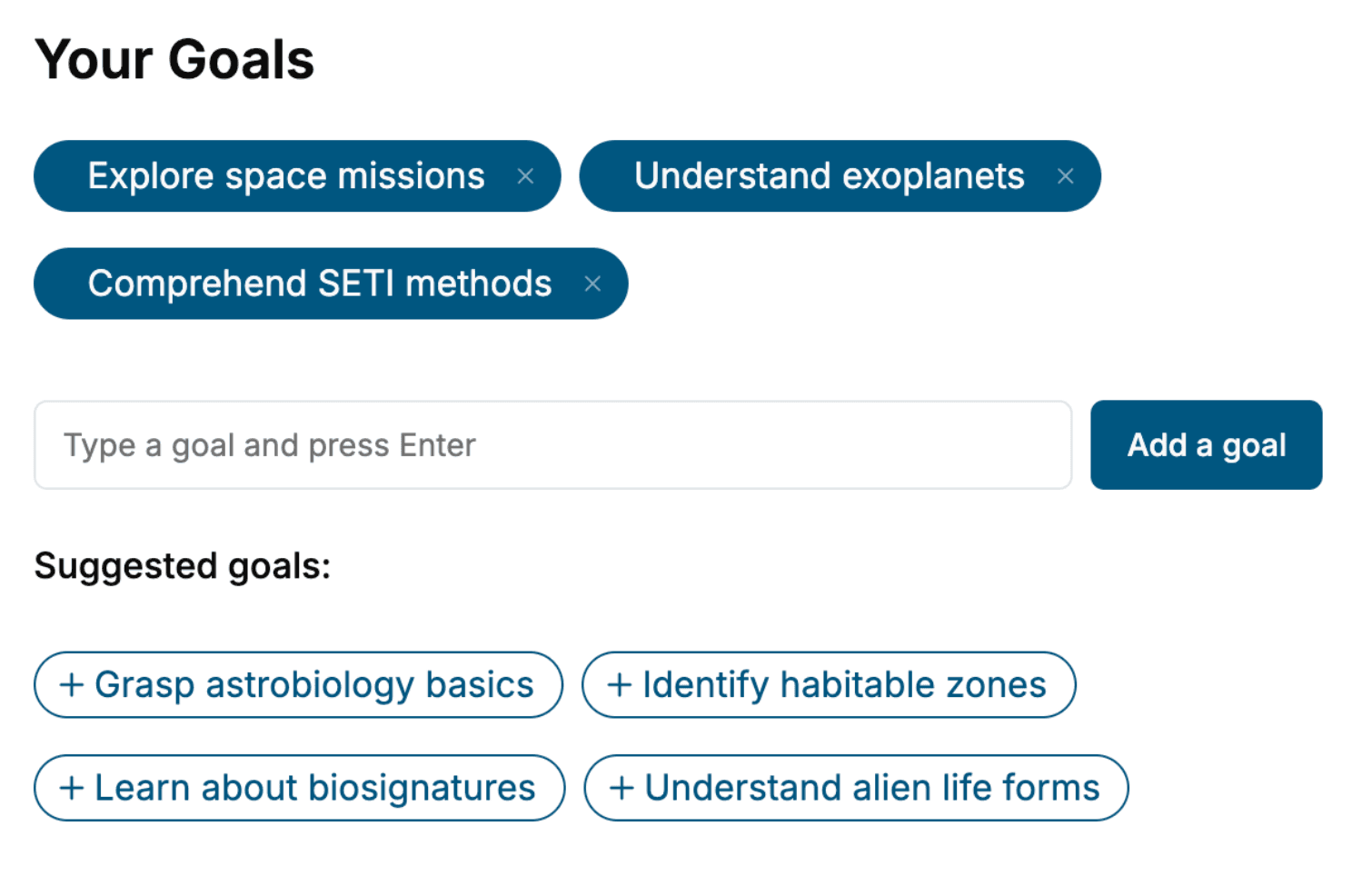
Tell us your goals and background, and get your own version of this book, tailored by AI to you.


Benefits of AI-tailored books
- Read one book, not ten:
- all the Machine Learning knowledge you need, gathered into a single book.
- Save days of learning:
- tell us your goals, choose your topics, and the whole book is built around them.
- Learn effortlessly:
- Machine Learning book written for your specific background and expertise.
- Understand at a glance:
- includes charts, tables, timelines, checklists, decision trees, and more.
- Stay current:
- written the day you order it, not years ago.
- Trust what you read:
- every book is checked for accuracy, with real research when your subject needs it.
Create your unique book in 3 steps
- 1. Select your focus
Select the focus of your Machine Learning book and share your background
- 2. Personalize your book
Specify your goals and choose sub-topics to include
- 3. Get your tailored book
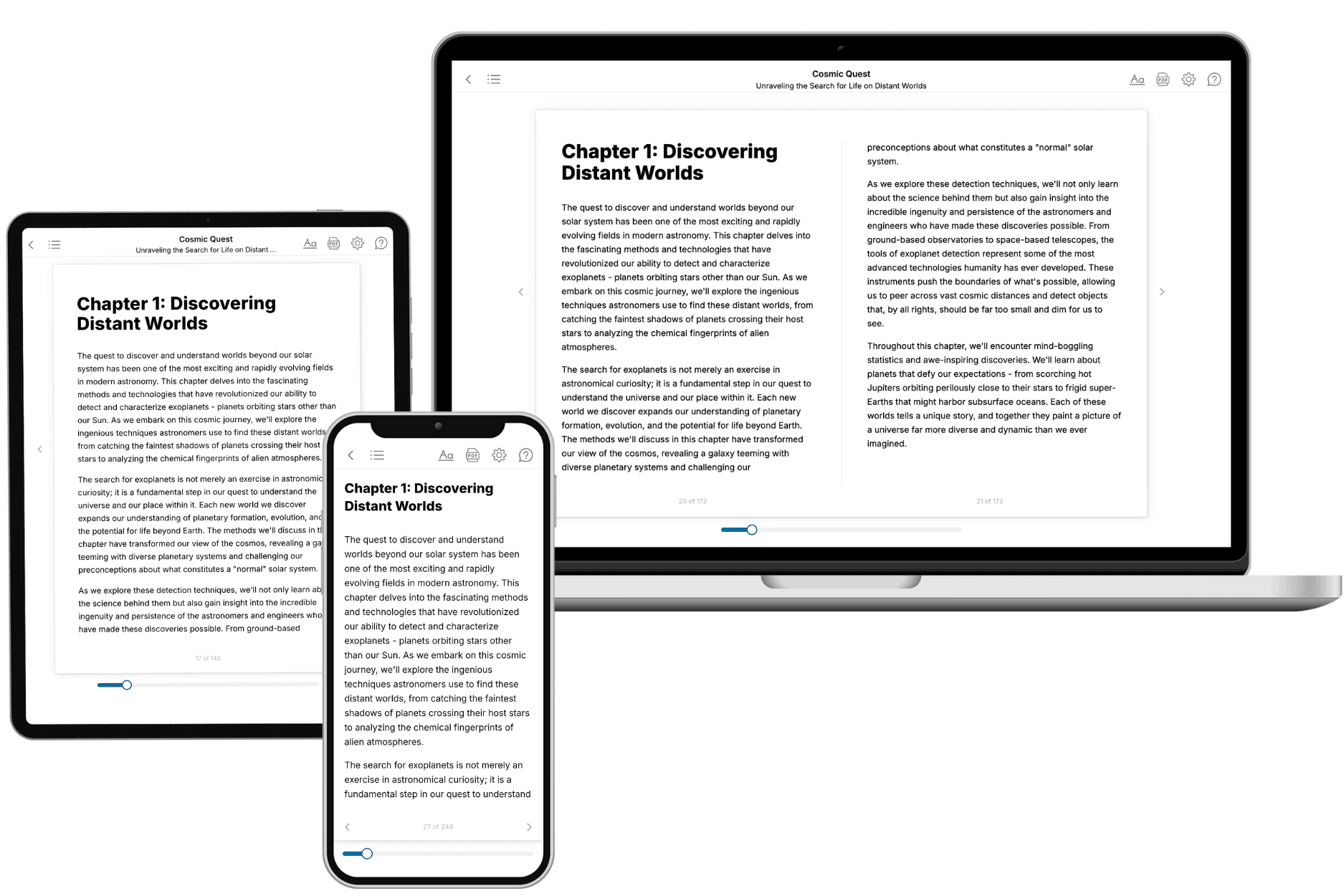
Your book is ready in 10 minutes. Read it online, download as EPUB or PDF, or send to Kindle.

Frequently asked questions
- What is TailoredRead?
TailoredRead creates complete, full-length nonfiction ebooks, written specifically for you. Tell us what you want to learn and why, and TailoredRead writes you a complete ebook on it, with charts, tables, and diagrams throughout. Read it online, on Kindle, or on any e-reader, or download it as a PDF or EPUB. Every book is written fresh the day you order it.
- How is the book tailored to me?
Before anything is written, you answer a few short questions about your goals, your background, and the topics you care about. Your book is then planned around your answers: written at your level, focused on your goals, and covering the topics you chose, instead of the one-size-fits-all book a store sells everyone.
- Will it read like generic AI content?
No. Your book isn't a chat transcript: it's planned chapter by chapter before a single word is written, told in a clear book voice, and explains ideas visually with charts, tables, and diagrams. After writing, every book goes through an editorial pass that polishes chapters so the book reads consistent from start to finish. Judge for yourself: browse thousands of sample books on our Explore Books page.
- How accurate is the content?
Our AI first checks whether your subject needs live research. Niche and fast-moving subjects are researched before writing, and the book plan and chapters are grounded in what it finds. After writing, every book goes through a quality pass that checks its facts and consistency, and researched books list their sources in a Notes section at the back.
- How long is the book?
You choose the length: Comprehensive (250-300 pages), Detailed (150-200 pages), Essential (70-100 pages), or Short (30-50 pages).
- Does the book include visuals?
Yes. Every book includes charts, tables, and diagrams: timelines, checklists, step-by-step guides, decision trees, comparison tables, matrices, and bar charts. A typical book includes dozens of these visual elements.
- Can I read it on Kindle? What formats can I download?
Yes. Every book can be read in our online reader or downloaded as a PDF or EPUB. The EPUB can be opened with Kindle, Apple Books, Kobo, and any e-reader. The Commercial and Author licenses also include an editable Word (DOCX) and Markdown download.
- How much does it cost?
About the price of a regular ebook. The exact price depends on your book's length and complexity, from $2 for the shortest books to $35 for the most comprehensive, and it's shown when you review your book, before you commit to anything. Each book is a one-time purchase, yours to keep, no subscription. Licenses that let you share, teach, or publish your book range from $35.99 to $49.99.
- Can I preview the book before purchasing?
Before you pay, you'll see what your book will cover: the title, a detailed description, the estimated length, and the complete chapter-by-chapter table of contents, so you know what you're getting before you decide. The full text itself is written after you purchase.
- How long does it take to create a book?
About 10 minutes. You can start reading the opening chapters while the rest is still being written.