Linear Equations Mastery
A Practical Guide to Solving Systems and Building Algebraic Confidence
Master the essential skill of solving systems of linear equations and apply it confidently to real-world problems.
191 pages9 chaptersMar 26, 2026Algebra
About this book
This practical guide takes you from foundational concepts through advanced techniques, building your algebraic confidence step by step. You'll learn three primary solution methods—substitution, elimination, and graphing—and discover when each approach works best. Through clear explanations, worked examples, and strategic practice problems, you'll develop the pattern recognition and intuition that separates struggling students from confident problem-solvers. Explore how systems of equations model real situations in business, science, and engineering. Understand the geometric meaning behind your solutions and why some systems have one answer, no solution, or infinitely many. Whether you're preparing for advanced mathematics, tackling homework challenges, or simply wanting to strengthen your algebra skills, this book provides the clarity and practical tools you need to succeed.
Table of contents
- IntroductionWhy Systems of Equations Matter, What You'll Learn in This Book, How to Use This Guide for Maximum Learning, Building Your Foundation: What You Need to KnowRead below
- Chapter 1: Understanding Systems of Linear EquationsWhat Is a System of Linear Equations?, Components and Mathematical Notation, Types of Solutions: One, None, or Infinite, Visualizing Systems Geometrically
- Chapter 2: The Substitution MethodSubstitution Method Fundamentals, Step-by-Step Process and Worked Examples, When Substitution Works Best, Avoiding Common Mistakes
- Chapter 3: The Elimination MethodElimination Method Principles, Multiplying Equations and Adding Strategically, Worked Examples and Problem Patterns, Why Elimination Is Often the Fastest Method
- Chapter 4: The Graphing MethodGraphing Linear Equations Efficiently, Finding Intersection Points as Solutions, Parallel Lines and Coincident Lines, Using Technology for Graphing and Verification
- Chapter 5: Systems with Three VariablesIntroduction to Three-Variable Systems, Solving Three-Variable Systems Systematically, Geometric Interpretation in Three Dimensions, Real-World Applications with Three Variables
- Chapter 6: Real-World Applications and ModelingBusiness and Economics Problems, Science and Physics Applications, Mixture Problems and Rate Problems, Translating Word Problems into Systems
- Chapter 7: Special Cases and TroubleshootingIdentifying Inconsistent Systems, Understanding Dependent Systems, Recognizing Patterns That Signal Special Cases, Debugging and Verifying Your Solutions
- Chapter 8: Matrices and Advanced TechniquesIntroduction to Matrix Representation, Row Operations and Gaussian Elimination, When to Use Matrix Methods, Using Calculators and Software for Matrices
- Chapter 9: Practice, Mastery, and Problem-Solving StrategiesDeliberate Practice for Skill Development, Strategic Approaches to Unfamiliar Problems, Building Mathematical Intuition and Pattern Recognition, Preparing for Exams and Assessments
- ConclusionYour Progress and Next Steps, Continuing Your Mathematical Growth
- Appendix: Quick Reference and Additional ResourcesFormula and Method Reference Guide, Glossary of Key Terms, Additional Practice Problems with Solutions
Introduction
There is a moment that almost every algebra student knows well. You are staring at two equations, each with two unknowns, and the question seems simple enough on the surface: find the values that make both equations true at the same time. But then the variables start to blur together, the arithmetic gets tangled, and what looked like a manageable problem starts to feel like a puzzle with missing pieces. That moment of confusion is not a sign that you lack ability. It is simply a sign that you have not yet built the right mental framework for this type of problem.
Systems of linear equations are one of the most important topics in algebra, and for good reason. They appear in nearly every quantitative field you can name. Engineers use them to analyze forces in structures. Economists use them to model supply and demand. Chemists use them to balance reactions. Business analysts use them to find break-even points and optimize resources. Even everyday decisions, like figuring out which phone plan saves you more money over a year, can be modeled as a system of equations. Learning to solve these systems is not just an academic exercise. It is a genuinely useful skill that pays dividends across many areas of life and work.
This book was designed with one goal in mind: to take you from uncertainty to confidence. Whether you are working through a challenging algebra course, preparing for a standardized test, or simply trying to fill in gaps in your mathematical foundation, the material here is organized to build your understanding step by step. Each concept is explained clearly, each method is demonstrated with worked examples, and each chapter connects the math to real situations so you can see why any of this matters. By the time you finish, solving a system of equations will feel less like guesswork and more like a reliable, repeatable skill you can trust.
Before diving into the first chapter, this introduction will give you a clear picture of what lies ahead. You will see why systems of equations deserve serious attention, what specific skills and methods this book covers, how to get the most out of the material as you work through it, and what foundational knowledge will help you hit the ground running. Think of this section as your orientation guide, a brief but important stop before the real journey begins.
Why Systems of Equations Matter
It is worth pausing to ask a genuine question: why do systems of linear equations deserve an entire book? The honest answer is that they sit at the intersection of abstract algebra and practical problem-solving in a way that few other topics do. A single linear equation describes a relationship between variables. A system of equations describes multiple relationships simultaneously, and finding the point where all those relationships hold true at once is exactly the kind of problem that the real world constantly throws at us.
Consider a straightforward business scenario. A small company sells two products. Product A earns $15 in profit per unit, and Product B earns $22 per unit. The company has a production capacity of 200 units total and needs to hit a profit target of $3,600. How many of each product should they make? This is not a single-equation problem. It requires two equations working together, one for total units and one for total profit. Solving the system gives you the exact production mix that satisfies both constraints at once. That is the power of a system of equations: it handles complexity that a single equation simply cannot.
The applications extend far beyond business. In physics, systems of equations describe the motion of objects under multiple forces. In chemistry, they are used to balance chemical equations and calculate concentrations in mixture problems. In computer graphics, they help determine where lines and surfaces intersect in three-dimensional space. In nutrition science, dietitians use them to design meal plans that meet multiple nutritional targets simultaneously. The list goes on across virtually every technical and scientific discipline.[1]
Beyond specific applications, mastering systems of equations builds a broader mathematical habit of mind. When you work through these problems regularly, you develop the ability to translate a messy real-world situation into clean mathematical language, manipulate that language systematically, and interpret the result in context. These are transferable skills. They make you better at logical reasoning, better at spotting structure in complex situations, and better prepared for more advanced mathematics like linear algebra, calculus, and statistics.
There is also a confidence dimension worth acknowledging. Many students arrive at systems of equations having already developed some anxiety about algebra. They have hit walls before, and they expect to hit another one here. But systems of equations, approached with the right methods and enough practice, are genuinely learnable. The techniques are logical and consistent. The patterns become recognizable with repetition. And the satisfaction of solving a system correctly, especially one that seemed intimidating at first, is a real confidence builder that carries forward into harder topics.
Finally, systems of equations are a gateway topic. Mastering them opens the door to matrix algebra, linear programming, differential equations, and a wide range of quantitative methods used in data science and engineering. The time you invest here is not just about passing a test or finishing a homework set. It is an investment in your long-term mathematical capability. Every hour spent building genuine understanding of systems pays back many times over as you move into more advanced work.
What You'll Learn in This Book
This book covers the full landscape of systems of linear equations at the intermediate algebra level, moving from core concepts through multiple solution methods and into real-world applications and advanced techniques. The progression is deliberate. Each chapter builds on what came before, so by the time you reach the more complex material, you will have the foundation to handle it without feeling lost.
The journey begins with a solid conceptual foundation. Chapter 1 establishes what a system of linear equations actually is, how to read and write one using proper mathematical notation, and what the three possible types of solutions look like. You will also explore the geometric meaning of a system, understanding that two linear equations in two variables represent two lines on a graph, and that the solution is the point where those lines meet. This geometric perspective is not just a visual aid. It gives you an intuitive check on your algebraic work throughout the rest of the book.
From there, the book walks you through three primary solution methods in dedicated chapters:
- Substitution (Chapter 2): Solving one equation for a variable and plugging that expression into the other equation. This method is especially clean when one variable is already isolated or easy to isolate.
- Elimination (Chapter 3): Adding or subtracting equations strategically to cancel out one variable. This method shines when coefficients are already aligned or can be made to align with simple multiplication.
- Graphing (Chapter 4): Plotting both equations and identifying the intersection point visually. This method builds geometric intuition and works well for quick estimates and verification.
Each method chapter includes a clear explanation of the underlying logic, a step-by-step process you can follow, multiple worked examples at increasing difficulty levels, and guidance on when that particular method is the best choice. You will also find a dedicated section in each chapter on common mistakes, because knowing what can go wrong is just as valuable as knowing what to do right.
Chapter 5 extends the core methods to systems with three variables, which introduces a new layer of complexity but follows the same logical principles. Chapter 6 is devoted entirely to real-world applications, covering business and economics problems, science and physics scenarios, mixture problems, and rate problems. This chapter also teaches you how to translate a word problem into a system of equations, which is often the hardest step for students and deserves focused attention.
Chapter 7 addresses special cases: systems that have no solution (inconsistent systems) and systems that have infinitely many solutions (dependent systems). You will learn to recognize these situations early, understand what they mean geometrically, and avoid the confusion that often arises when a problem does not behave as expected. Chapter 8 introduces matrix methods, including Gaussian elimination, which provides a powerful and systematic approach to solving larger systems and prepares you for linear algebra. Chapter 9 closes the main content with strategies for deliberate practice, building mathematical intuition, and preparing effectively for exams.
By the end of this book, you will be able to:
- Identify and classify systems of linear equations by their solution type
- Solve systems using substitution, elimination, and graphing with confidence
- Choose the most efficient method for a given problem structure
- Solve systems with three variables using systematic elimination
- Translate real-world word problems into solvable systems
- Recognize and correctly handle inconsistent and dependent systems
- Use basic matrix methods to organize and solve systems
- Verify solutions and debug errors in your own work
How to Use This Guide for Maximum Learning
A math book is not like a novel. You cannot read it passively and expect the material to stick. The concepts here require active engagement: working through examples with pencil and paper, pausing to try problems before reading the solutions, and returning to sections that feel unclear rather than pushing past them. The way you interact with this material matters as much as the material itself.
The most effective approach is to read each section with a notebook open beside you. When a worked example appears, try to solve it yourself before reading the solution. This is not about getting it right on the first attempt. It is about activating your thinking so that when you do read the solution, you are comparing it to your own reasoning rather than just absorbing it passively. Research on learning consistently shows that this kind of active retrieval practice leads to much stronger retention than passive reading alone.[2]
Here is a practical workflow to use for each chapter:
- Read the concept explanation once through without stopping to take notes. Get the big picture first.
- Re-read with your notebook, writing down key definitions, formulas, and the step-by-step process in your own words.
- Attempt the worked examples yourself before reading the provided solutions.
- Compare your work to the solution and identify any steps where your reasoning differed.
- Try the practice problems at the end of each chapter independently, without looking back at the examples.
- Check your answers and, for any wrong answers, trace back through your work to find exactly where the error occurred.
Do not skip the sections on common mistakes. These sections exist because the same errors appear again and again across students at every level. Reading about a mistake before you make it is far more efficient than discovering it on a test. Pay particular attention to sign errors, which are the single most common source of wrong answers in systems of equations problems. A small arithmetic slip in step two can cascade into a completely wrong final answer, so developing careful habits early saves a lot of frustration later.
The chapters are designed to be read in order, especially for the first pass through the book. The substitution method in Chapter 2 builds directly on the conceptual foundation in Chapter 1. The elimination method in Chapter 3 is easier to understand if you have already worked through substitution. The three-variable systems in Chapter 5 assume you are comfortable with two-variable systems. Jumping ahead is tempting when you feel confident, but the connections between chapters are real and worth respecting.
That said, once you have read the book through once, it works well as a reference. If you are stuck on a specific type of problem, you can go directly to the relevant chapter or section. The appendix at the back includes a formula and method reference guide, a glossary of key terms, and additional practice problems with solutions, all designed to support quick lookups and extra practice without requiring you to re-read entire chapters.
Finally, be patient with yourself. Learning mathematics is not a linear process. There will be moments when a concept clicks immediately and moments when it takes three or four attempts before it makes sense. Both experiences are completely normal. The students who succeed are not the ones who never struggle. They are the ones who keep working through the struggle rather than stopping when it gets hard. Every problem you work through, even the ones you get wrong, is building the neural pathways that make the next problem easier.
Building Your Foundation: What You Need to Know
This book is written for intermediate algebra students, which means it assumes you have some prior experience with basic algebra. You do not need to be an expert, but there are a few foundational skills that will make your experience with this material significantly smoother. If any of the topics below feel shaky, it is worth spending a little time reviewing them before diving into Chapter 1. A solid foundation makes everything that follows easier and faster to learn.
The most important prerequisite is comfort with solving single-variable linear equations. You should be able to solve something like 3x + 7 = 22 without hesitation, and you should understand the logic behind each step: isolating the variable by performing the same operation on both sides of the equation. If this feels uncertain, practice a dozen or so single-variable equations until the process feels automatic. Systems of equations require you to do this kind of solving repeatedly, often as a sub-step within a larger process.
You also need to be comfortable with basic operations on algebraic expressions. This includes:
- Combining like terms (for example, simplifying
3x + 5x - 2to8x - 2) - Distributing multiplication over addition (for example, expanding
2(x + 4)to2x + 8) - Working with negative signs carefully, especially when distributing a negative (for example,
-(x - 3)becomes-x + 3, not-x - 3) - Moving terms across the equals sign by adding or subtracting on both sides
Familiarity with the coordinate plane is helpful, particularly for Chapter 4 on graphing. You should know how to plot points using (x, y) coordinates, understand what the x-axis and y-axis represent, and have a basic sense of what a straight line looks like on a graph. You do not need to be an expert at graphing, but knowing that the equation y = 2x + 1 represents a line with a slope of 2 and a y-intercept of 1 will give you a head start.
It also helps to understand slope-intercept form (y = mx + b) and standard form (ax + by = c) for linear equations. These are the two most common ways that equations appear in systems problems, and being able to move between them fluidly will save you time. For example, if you need to graph an equation that is given in standard form, you will want to rearrange it into slope-intercept form first. If you need to use the elimination method, standard form is often more convenient to work with directly.
Here is a quick self-check. Try solving these problems before moving on. If you can handle all of them comfortably, you are ready to start Chapter 1:
- Solve for
x:4x - 9 = 3 - Simplify:
5y + 3 - 2y + 7 - Expand:
-3(2x - 5) - Rewrite
2x + 3y = 12in slope-intercept form - Plot the point
(3, -2)on a coordinate plane and identify which quadrant it falls in
The answers are x = 3, 3y + 10, -6x + 15, y = (-2/3)x + 4, and the fourth quadrant, respectively. If any of these gave you trouble, that is useful information. It tells you exactly where to focus your review before starting the main content. There is no shame in going back to basics. In fact, taking the time to shore up your foundation now is one of the smartest things you can do to accelerate your progress through the rest of the book.
One final note on mindset: mathematics rewards persistence more than raw talent. The students who master systems of equations are not necessarily the ones who found it easy from the start. They are the ones who worked through confusion methodically, asked good questions, and kept practicing even when progress felt slow. Approach this material with curiosity rather than anxiety, and treat every mistake as information rather than failure. With that attitude and the tools in this book, you have everything you need to succeed.
This is the end of the free sample. The full book has 9 chapters.
Want this book written for you?
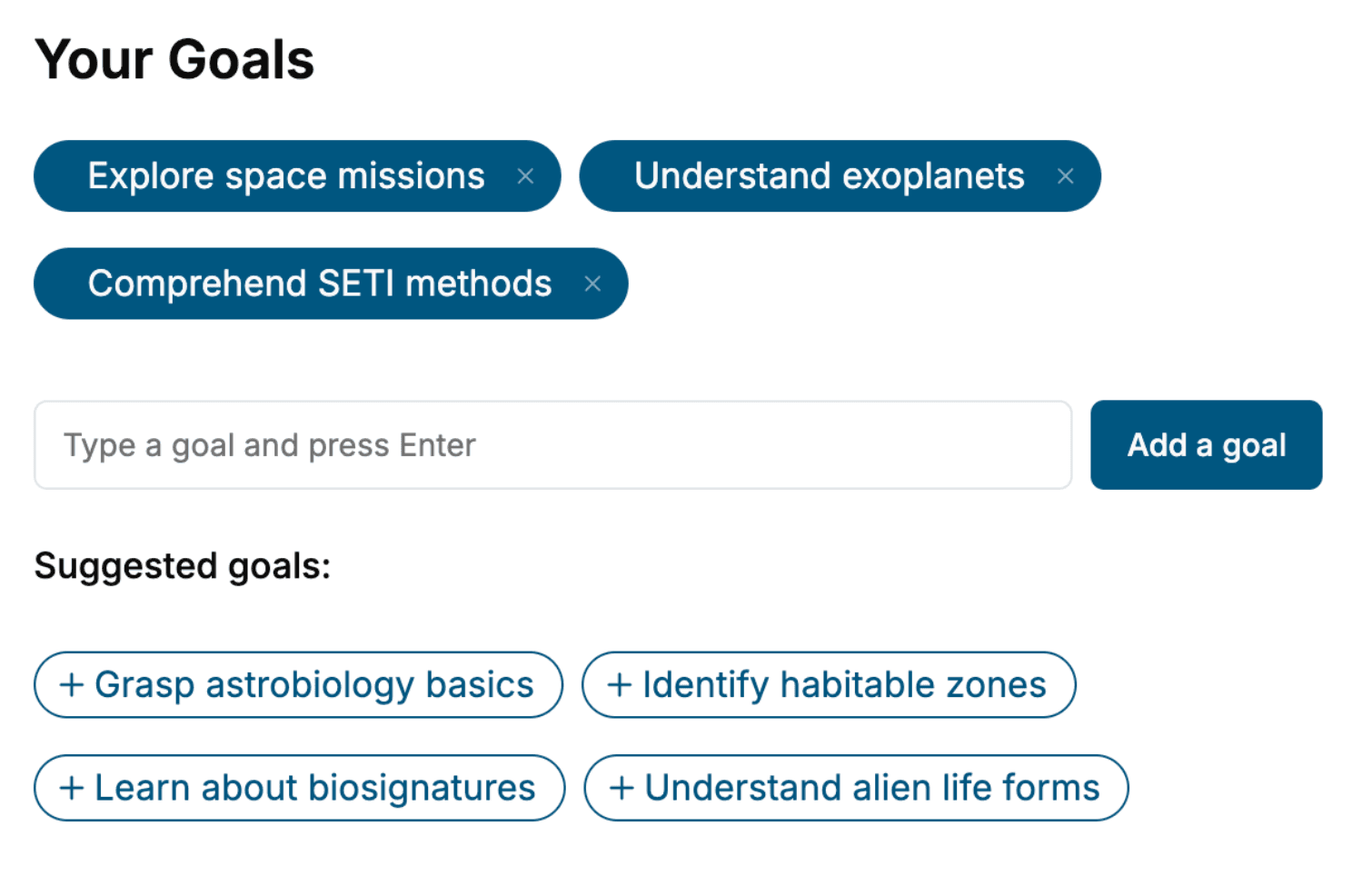
Tell us your goals and background, and get your own version of this book, tailored by AI to you.


Benefits of AI-tailored books
- Read one book, not ten:
- all the Algebra knowledge you need, gathered into a single book.
- Save days of learning:
- tell us your goals, choose your topics, and the whole book is built around them.
- Learn effortlessly:
- Algebra book written for your specific background and expertise.
- Understand at a glance:
- includes charts, tables, timelines, checklists, decision trees, and more.
- Stay current:
- written the day you order it, not years ago.
- Trust what you read:
- every book is checked for accuracy, with real research when your subject needs it.
Create your unique book in 3 steps
- 1. Select your focus
Select the focus of your Algebra book and share your background
- 2. Personalize your book
Specify your goals and choose sub-topics to include
- 3. Get your tailored book
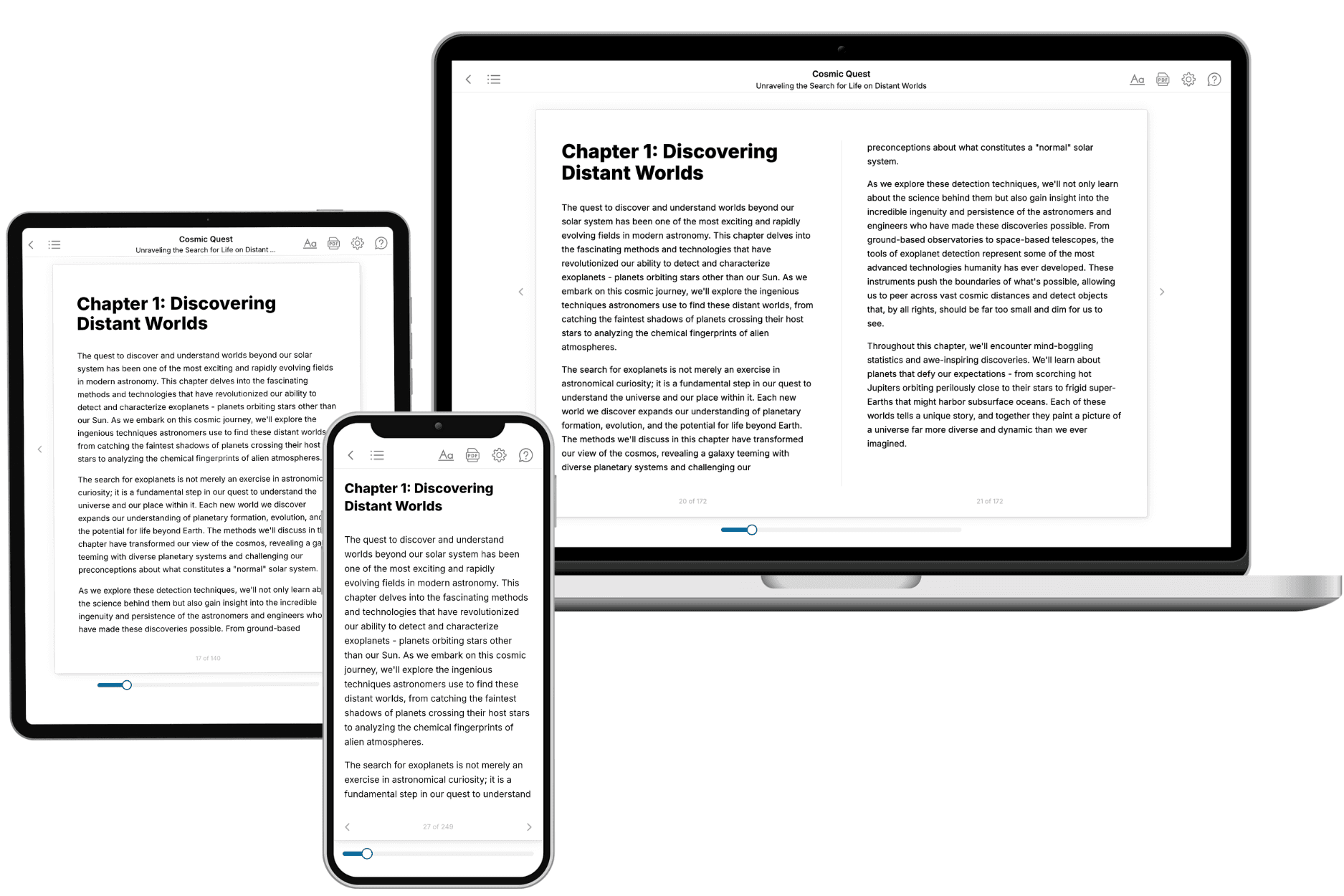
Your book is ready in 10 minutes. Read it online, download as EPUB or PDF, or send to Kindle.

Frequently asked questions
- What is TailoredRead?
TailoredRead creates complete, full-length nonfiction ebooks, written specifically for you. Tell us what you want to learn and why, and TailoredRead writes you a complete ebook on it, with charts, tables, and diagrams throughout. Read it online, on Kindle, or on any e-reader, or download it as a PDF or EPUB. Every book is written fresh the day you order it.
- How is the book tailored to me?
Before anything is written, you answer a few short questions about your goals, your background, and the topics you care about. Your book is then planned around your answers: written at your level, focused on your goals, and covering the topics you chose, instead of the one-size-fits-all book a store sells everyone.
- Will it read like generic AI content?
No. Your book isn't a chat transcript: it's planned chapter by chapter before a single word is written, told in a clear book voice, and explains ideas visually with charts, tables, and diagrams. After writing, every book goes through an editorial pass that polishes chapters so the book reads consistent from start to finish. Judge for yourself: browse thousands of sample books on our Explore Books page.
- How accurate is the content?
Our AI first checks whether your subject needs live research. Niche and fast-moving subjects are researched before writing, and the book plan and chapters are grounded in what it finds. After writing, every book goes through a quality pass that checks its facts and consistency, and researched books list their sources in a Notes section at the back.
- How long is the book?
You choose the length: Comprehensive (250-300 pages), Detailed (150-200 pages), Essential (70-100 pages), or Short (30-50 pages).
- Does the book include visuals?
Yes. Every book includes charts, tables, and diagrams: timelines, checklists, step-by-step guides, decision trees, comparison tables, matrices, and bar charts. A typical book includes dozens of these visual elements.
- Can I read it on Kindle? What formats can I download?
Yes. Every book can be read in our online reader or downloaded as a PDF or EPUB. The EPUB can be opened with Kindle, Apple Books, Kobo, and any e-reader. The Commercial and Author licenses also include an editable Word (DOCX) and Markdown download.
- How much does it cost?
About the price of a regular ebook. The exact price depends on your book's length and complexity, from $2 for the shortest books to $35 for the most comprehensive, and it's shown when you review your book, before you commit to anything. Each book is a one-time purchase, yours to keep, no subscription. Licenses that let you share, teach, or publish your book range from $35.99 to $49.99.
- Can I preview the book before purchasing?
Before you pay, you'll see what your book will cover: the title, a detailed description, the estimated length, and the complete chapter-by-chapter table of contents, so you know what you're getting before you decide. The full text itself is written after you purchase.
- How long does it take to create a book?
About 10 minutes. You can start reading the opening chapters while the rest is still being written.