About this book
Across ten focused chapters, you will learn how historians divide the past into eras, why those divisions are debated, and how to use them to organize what you know. You will move from the deep prehistory of foraging societies through the spread of agriculture, the growth of states and empires, and the interregional networks that linked distant peoples. Along the way you will build a working timeline of key civilizations, learn to compare regions side by side, and examine the causes of empire formation, decline, and collapse with a careful, evidence-based eye. The course also teaches you how to explain global history to non-experts: how to choose a central question, select a few vivid examples, and tell a connected story that respects complexity. Each chapter builds on the last, so by the end you will have a clear mental map of the past and the confidence to share it with colleagues, clients, and friends.
Table of contents
- IntroductionWhy the Global Past Matters Today, How This Course Is Organized, Using the Timeline Throughout the CourseRead below
- Module 1: Defining World HistoryWhat World History Covers and Excludes, Global History Versus World History, Comparative and Connected Approaches
- Module 2: How Historians Divide the PastWhy Historians Name and Bound Eras, Debated Turning Points and Their Limits, Building Periods for Your Own Purpose
- Module 3: Prehistory and the Human JourneyHomo Sapiens and the Earliest Evidence, Diverse Foraging Lifeways Across the Globe, Early Migration and Settlement Patterns, Placing Prehistory on Your Timeline
- Module 4: The Emergence of AgricultureAgriculture Arising in Several Regions, How Farming Reshaped Settlement and Society, Agricultural Societies and Their Tensions
- Module 5: Early States and CivilizationsThe Formation of the Earliest States, Cities, Writing, and Administration, Comparing Early Civilizations Side by Side
- Module 6: Trade, Exchange, and Cultural NetworksOverland and Maritime Trade Routes, The Silk Roads as a Modern Label, Exchange of Goods, Technologies, and Ideas
- Module 7: How Empires RoseConquest, Administration, and Imperial Formation, Legitimacy, Religion, and Imperial Power, Comparing Empires Across Regions and Eras
- Module 8: Decline, Crisis, and Societal CollapseInteracting Causes of Decline, Environment, Climate, and Disease Pressures, Debating Collapse and Its Evidence
- Module 9: Industrialization and the Modern WorldIndustrialization and Its Global Reach, Population Growth and Its Recent Slowing, Connections in the Modern Global Economy
- Module 10: Explaining Global History to Non-ExpertsChoosing a Central Question for Your Story, Selecting Vivid and Accurate Examples, Presenting Your Timeline Clearly to Others, Practicing and Reviewing Your Explanation
- ConclusionBringing the Frameworks Together, Next Steps for Continued Study
- Glossary
Introduction
Picture a consultant asked to open a client workshop with "a five-minute tour of world history." That request sounds simple until the clock starts, because the past has no natural starting line and no single correct shape. Does the tour begin with the first humans, the first cities, or the first ships that linked continents? Every choice cuts out other choices, and every cut reflects a judgment about what matters most. This course exists to make those judgments deliberate instead of accidental, giving a structured way to divide, compare, and explain the long human story.
The chapters ahead move in a deliberate sequence, from the deep past of foraging bands through farming, states, empires, and the industrial world that produced today's interconnected economy. Each step builds a layer of the framework rather than a stand-alone fact pile. By the time the course reaches its final chapters, the aim is not just knowledge retention but communication skill, because a framework that cannot be explained to a colleague or client has limited practical value for a working consultant.
Three habits of mind recur throughout the book. First, treat any division of time, any named era,
as a tool built for a purpose rather than a fact discovered in the ground. Second, hold multiple regions in view at once instead of following one civilization's story to the exclusion of others happening at the same time. Third, expect complexity in explaining big outcomes such as the rise of a state or the collapse of an empire, since single-cause stories rarely survive scrutiny. These three habits turn scattered facts into something closer to a working mental map.
This introduction sets up that map before the detailed chapters begin. It explains why the global past is useful material for someone in a consulting or advisory role, lays out how the ten core chapters connect to one another, and introduces the timeline device used throughout the book to keep overlapping chronologies visible. None of this introduction asks for memorization of specific dates or figures. It is an orientation, meant to make the chapters that follow easier to absorb and easier to apply.
- Understand why a broad view of the human past has practical value beyond academic interest.
- See how the ten core chapters build on one another in a logical sequence.
- Learn how to use a running timeline as a tool for comparison across regions and eras.
Module Outcomes: by the end of this module, you will be able to:
- Explain in your own words why a working knowledge of world history is useful in professional and everyday conversation.
- Describe the overall arc of the course and identify which chapter covers a given topic.
- Start and maintain a personal timeline that will be built on in later chapters.
- Distinguish between a timeline as a factual record and periodization as an interpretive tool.
When to use this module: return to this introduction whenever a later chapter feels disconnected from the whole, or before explaining the course's framework to someone else for the first time. It is also the right place to start if you feel unsure about why any of this matters for a consulting or advisory career, since the first lesson addresses that question directly.
Why the Global Past Matters Today
- Explain at least two concrete professional situations where a world history framework adds value.
- Identify the difference between knowing isolated facts and holding a connected framework.
- Describe why comparing regions, rather than focusing on one, produces sounder judgment.
A consultant advising a client entering a new regional market rarely needs a lecture on ancient trade. What that consultant needs is a habit of asking how societies in that region organized power, handled outside contact, and responded to shocks in the past, because those patterns often echo in present institutions. A grounding in world history supplies exactly that kind of pattern recognition. It is less about trivia and more about building intuition for how large human systems behave under pressure, how they absorb new ideas, and how they sometimes break down.
Consider a simple contrast. Someone who only knows isolated facts might say a given empire fell because of invasion.
Someone working from a connected framework will instead ask what weakened that empire's institutions, economy, and legitimacy before any invasion arrived, since invasions rarely topple healthy, well-governed states. The second kind of thinking transfers to other domains entirely. A company does not usually collapse because of one competitor's product launch. It collapses because internal weaknesses, from strained finances to poor morale, left it unable to absorb an external shock. The historical habit of looking for interacting causes becomes a transferable analytical skill.
Comparing regions side by side, rather than following one civilization in isolation, sharpens this skill further. If you only study one empire's rise and fall, you risk treating its specific causes as universal laws. If you place two or three empires from different eras and continents next to each other, as later chapters on empire formation and societal collapse will do, you start noticing which causes repeat across very different settings and which were local accidents. That distinction, between a repeating pattern and a one-off event, is exactly the kind of judgment a consultant is paid to exercise when reading a client's situation.
There is also a communication payoff. Clients, colleagues, and friends often want context for current events, from shifts in global trade to debates about which regions are rising or declining in influence. Someone who can sketch a clear, non-partisan historical backdrop in a few sentences earns credibility that a purely technical specialist may lack. This course builds toward that skill directly in its final chapter, but the foundation starts here, with the recognition that historical fluency is a communication asset, not a decorative one.
None of this requires becoming a specialist historian. The reader profile for this course assumes limited prior background in the subject, and that is by design. The chapters ahead introduce concepts gradually, defining technical terms such as periodization and state formation the first time they appear, and returning to them with fresh examples in later chapters. The goal is working fluency, the kind that lets you follow a conversation about empires or collapse, ask a sharp question, and offer a grounded opinion, not the kind that requires footnoted precision on every date.
It helps to think of this course as building a mental filing cabinet. Right now the drawers are mostly empty, or filled with loose, unlabeled facts picked up from school, documentaries, or news coverage. The chapters ahead will label the drawers, in rough chronological and thematic order, and start filling them with examples you can retrieve later. A useful filing cabinet does not need every drawer stuffed full. It needs clear labels and a few strong examples per drawer, so that when a new fact or question comes along, you know exactly where it belongs and what it connects to.
One more practical reason to build this framework now: global business and policy conversations increasingly reference history directly, whether in discussions of trade networks, regional rivalries, or demographic shifts. A consultant who can place a current debate about population trends, for instance, against the backdrop of the broader demographic transition covered later in this course brings more value to the conversation than one who treats every current event as historically unprecedented. Few things are entirely unprecedented. Most have rhymes in the deeper past, even if the details differ.
- Review the last three news stories you read involving another country or region.
- For each one, write one sentence guessing what historical pattern (trade, empire, collapse, migration) might be relevant, even without specific knowledge yet.
- Keep these three sentences and revisit them after finishing the course to see how your answers change.
Key Takeaways:
- World history builds transferable pattern recognition, useful well beyond academic settings.
- Comparing regions and eras side by side prevents mistaking a local cause for a universal law.
- Historical fluency is a communication asset that builds credibility with clients and colleagues.
- This course aims for working fluency, not specialist precision, matching the reader's starting point.
- Thinking of the course as a labeled filing cabinet helps organize scattered facts into a usable structure.
How This Course Is Organized
- Describe the overall sequence of the ten core chapters and the logic behind their order.
- Identify which chapter to revisit for a specific topic, such as empire formation or collapse.
- Explain how later chapters depend on concepts introduced earlier.
The ten core chapters that follow this introduction move in roughly chronological order, but the real organizing logic is conceptual, not just calendar-based. The course opens by defining world history itself and explaining how it differs from national history or regional specialist history, since without that definition, later comparisons across regions would lack a shared frame. It then turns immediately to periodization, the practice of naming and bounding eras, because every later chapter will use period labels, and those labels need to be understood as tools rather than natural facts before they are put to use.
With definitions and periodization in place, the course turns to substance, starting with the deep human past. That chapter covers the long span of foraging lifeways and early migration, well before agriculture or cities existed, and it introduces the practice of placing prehistoric developments on a timeline alongside much shorter, better documented later eras. This ordering matters: it prevents the common error of treating recorded history as the whole of human history, when in fact it represents a relatively short stretch of a much longer story.
From there, the course follows the familiar arc of the agricultural revolution, which did not happen once in one place but arose independently in multiple regions, each with its own timeline and consequences. The chapter on early states and civilizations follows directly, since farming surplus and settled populations were preconditions for the administrative structures, cities, and writing systems that mark the earliest states. Rather than presenting one civilization as the template others followed, that chapter compares several side by side, consistent with the comparative habit introduced in this first lesson.
The middle of the course shifts from internal development to connection. A chapter on trade, exchange, and cultural networks, including the routes popularly known as the Silk Roads, shows how societies that developed somewhat independently still exchanged goods, technologies, and ideas across vast distances. This sets up the chapter on how empires rose, since empires typically grew by absorbing or dominating the networks and territories that earlier trade and state formation had already connected. Conquest and administration, not isolated genius, built the large political structures the course calls empires.
Growth stories need their counterpart, so the course turns next to decline, crisis, and societal collapse. This chapter deliberately resists single-cause explanations, walking instead through interacting pressures such as environmental stress, disease, economic strain, and political fragmentation. It also surveys the scholarly debate over how useful the word collapse
really is, since some societies that appear to vanish from the historical record simply transformed or dispersed rather than disappearing outright. That nuance matters for anyone tempted to draw a simple lesson from a single famous example.
The course then jumps forward to the modern transformations of industrialization and the accompanying shift in global population growth, sometimes called the demographic transition, before closing with a practical chapter on explaining global history to non-experts. That final chapter is where the analytical habits built across the previous nine chapters turn into a communication skill: choosing a central question, picking a few vivid and accurate examples, and presenting a timeline clearly to an audience that has not read this course. A short conclusion and glossary round out the book, synthesizing the frameworks and offering a reference point for terms introduced along the way.
Each chapter assumes familiarity with terms and ideas from the ones before it, so working through the course roughly in order will make the later material easier to follow. That said, the structure is also built for selective use. A reader preparing specifically to discuss the causes of empire decline with a client, for instance, could jump directly to the chapter on decline and collapse, though a quick glance at the empire-formation chapter immediately before it would supply useful context on how the same empire had grown in the first place.
The decision tree below offers a quick way to find the right chapter when a specific question comes up mid-project, without rereading the whole book from the start.
Finding the Right Chapter Fast
- What question are you facing?
- How to name or bound a time period Go to the periodization chapter
- How farming or early societies began Go to the prehistory or agriculture chapters
- How states, trade, or empires expanded Go to the states, trade, or empire chapters
- Why a society weakened or ended Go to the decline and collapse chapter
- How to present this to an audience Go to the final chapter on explaining history
- Skim the ten chapter titles in the table of contents and write one sentence predicting what each will cover, before reading further.
- Pick one current event involving another region of the world and guess which chapter would best inform a discussion of it.
- Identify one topic from the outline you already feel confident about, and one you feel least confident about, to track your progress later.
Key Takeaways:
- The ten core chapters follow a conceptual arc: definitions, deep past, agriculture, states, networks, empires, collapse, modern transformations, and communication.
- Periodization and definitions come early because later chapters depend on those shared terms.
- The course supports both full sequential reading and selective lookup for a specific question.
- Growth chapters (states, trade, empires) and decline chapters (collapse) are deliberately paired to avoid one-sided narratives.
- The decision tree above offers a fast way to locate the right chapter during real project work.
Using the Timeline Throughout the Course
- Explain the difference between a factual timeline and an interpretive periodization scheme.
- Start a personal timeline using a simple, consistent format.
- Describe why overlapping entries across regions matter more than a single straight chronological line.
A timeline and a periodization scheme look similar but do different jobs, and confusing them causes real problems later in the course. A timeline is closer to a factual record: this development happened, roughly in this stretch of time, in this place. A periodization scheme sits on top of that record and groups stretches of time into named eras based on an argument about what mattered most, whether that argument centers on technology, politics, or something else. The timeline is the raw material; periodization is one way of organizing it, among several possible ways, as the next chapter will show in detail.
Throughout this course, you are encouraged to build and maintain a personal timeline rather than relying only on the one implied by the chapter order. A simple, workable format uses four columns: a rough time range, a region or society, a brief description of the development, and a one-line note on why it matters or what it connects to. This format resists the temptation to memorize exact dates, which specialists debate anyway, and instead emphasizes relative sequence and connection, which is exactly what a non-specialist audience usually wants from a historical explanation.
The table below sketches an example of this format using placeholder entries, showing the kind of structure to build out as the course proceeds rather than a finished product to copy exactly.
| Rough Period | Region or Society | Development | Why It Matters |
|---|---|---|---|
| Deep past | Multiple continents | Foraging lifeways and early migration | Shows diversity of early human adaptation |
| Later prehistory | Several separate regions | Independent emergence of agriculture | Challenges single-origin stories of civilization |
| Early recorded history | Multiple river valleys | Formation of early states and cities | Marks the start of administration and writing |
| Later recorded history | Connected regions across continents | Expansion of trade networks and empires | Shows growth through connection, not isolation |
Notice that the sample table avoids packing in specific numeric dates, since this introduction is not the place to assert checkable figures that belong to later, more specialized chapters. What the table demonstrates instead is the habit of keeping multiple regions in the same row structure, so that a glance down the Region or Society
column shows variety rather than a single thread. That variety is the entire point of a genuinely global timeline, as opposed to a timeline that quietly follows one region's story and treats everything else as a footnote.
One common mistake when building a first timeline is making it too linear, as if history were a single relay race where one region passes a baton to the next. A better mental image is several parallel lanes on a track, each representing a different region or society, moving forward together, sometimes crossing into each other's lanes through trade, migration, or conquest. The chapters on trade networks and empire formation will give concrete content for those crossing points. For now, the discipline worth building is simply resisting the single-lane habit from the start.
A second common mistake is overloading the timeline with too many entries too early, which makes it unreadable and discouraging to maintain. A better approach adds only entries connected to a clear question or a specific chapter's content, keeping the running total manageable. Four to eight entries after finishing the early chapters on prehistory and agriculture is a reasonable target, with more added gradually as later chapters on states, trade, and empires introduce new material worth tracking.
The steps below offer a straightforward way to start this personal timeline right now, before moving into the first numbered chapter.
Starting Your Personal Timeline
- Choose a format - Set up a simple table or spreadsheet with four columns: rough period, region or society, development, and why it matters.
- Add a placeholder row - Write one entry you already know something about, even loosely, to get past a blank page.
- Leave room for regions you don't know yet - Add a few empty rows labeled only by region, as a reminder to fill them in as later chapters cover that area.
- Review after each chapter - At the end of each numbered chapter, add one or two new rows drawn from that chapter's content.
- Look across rows, not just down them - Periodically scan for entries that fall in roughly the same period across different regions, to practice the comparative habit.
Keep the timeline visible, whether on paper, a spreadsheet, or a notes app, since it functions as the connective tissue of this entire course. Chapters on agriculture, states, trade, empires, and collapse will each suggest new rows to add, and by the time the course reaches its closing chapters on explaining history to others, that personal timeline becomes raw material for the stories and examples you choose to tell. A timeline built gradually, chapter by chapter, tends to stick far better than one assembled all at once from a reference book after the fact.
The callout below captures the core distinction worth carrying forward into every later chapter.
- Set up your personal timeline table using the four-column format described above.
- Add one entry you are already confident about, from any region or period.
- Leave three blank rows labeled only with a region you know little about, to fill in as the course proceeds.
- Write one sentence explaining, in your own words, the difference between a timeline and a periodization scheme.
Key Takeaways:
- A timeline records developments across regions in parallel, while periodization interprets and groups those developments into named eras.
- A workable personal timeline format uses period, region, development, and significance as its four core fields.
- Picture a global timeline as parallel lanes across regions rather than a single relay race.
- Keep early timeline entries manageable in number, adding more gradually as the course proceeds.
- Reviewing the timeline after each chapter builds material that later chapters on explaining history will draw on directly.
This is the end of the free sample. The full book has 10 chapters.
Want this book written for you?
Tell us your goals and background, and get your own version of this book, tailored by AI to you.


Benefits of AI-tailored books
- Read one book, not ten:
- all the knowledge you need, gathered into a single book.
- Save days of learning:
- tell us your goals, choose your topics, and the whole book is built around them.
- Learn effortlessly:
- a book written for your specific background and expertise.
- Understand at a glance:
- includes charts, tables, timelines, checklists, decision trees, and more.
- Stay current:
- written the day you order it, not years ago.
- Trust what you read:
- every book is checked for accuracy, with real research when your subject needs it.

Create your unique book in 3 steps
- 1. Pick a subject
Select what you want to learn and share your background
- 2. Personalize your book
Specify your goals and choose sub-topics to include
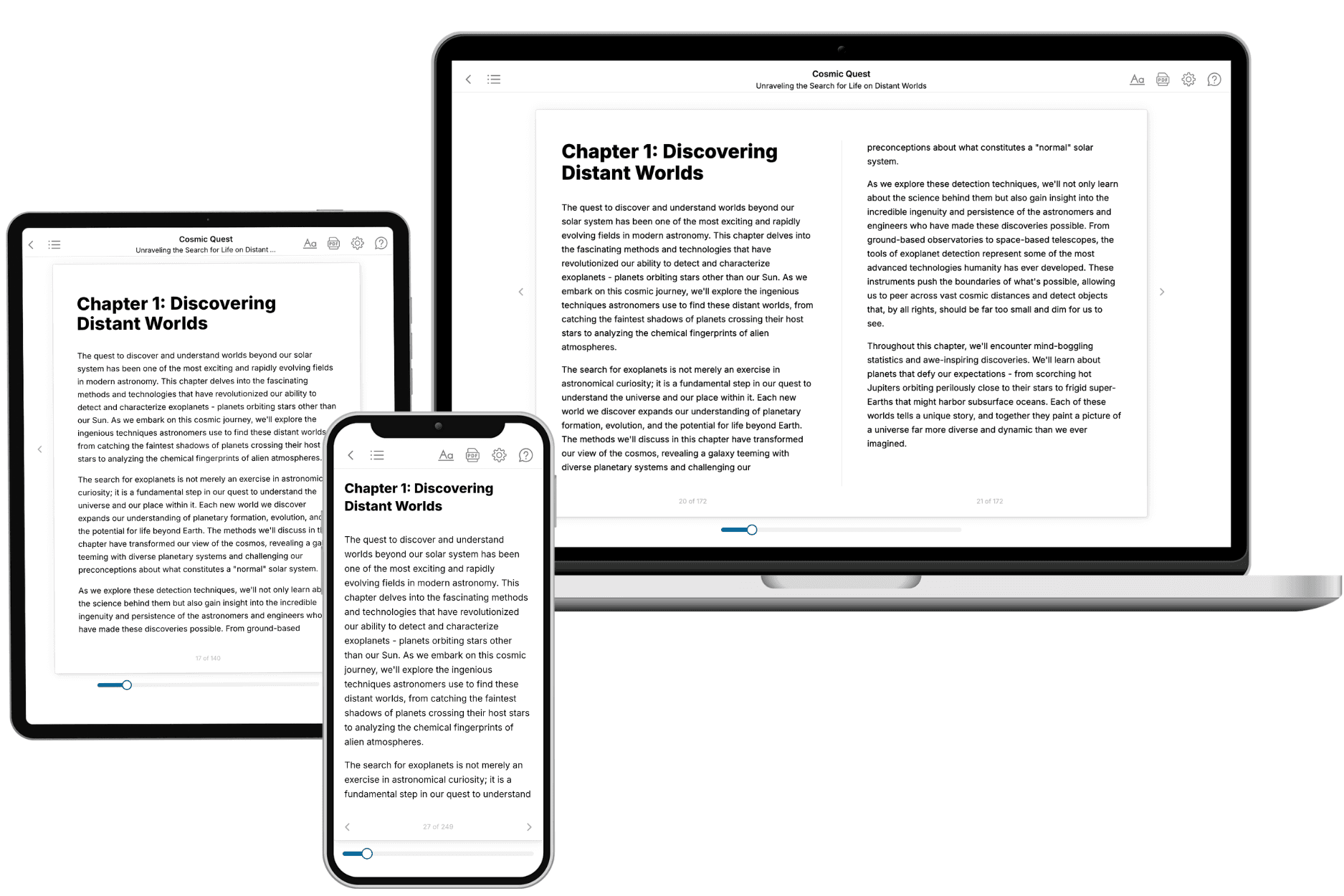
- 3. Get your tailored book
Your book is ready in 10 minutes. Read it online, download as EPUB or PDF, or send to Kindle.
Frequently asked questions
- What is TailoredRead?
TailoredRead creates complete, full-length nonfiction ebooks, written specifically for you. Tell us what you want to learn and why, and TailoredRead writes you a complete ebook on it, with charts, tables, and diagrams throughout. Read it online, on Kindle, or on any e-reader, or download it as a PDF or EPUB. Every book is written fresh the day you order it.
- How is the book tailored to me?
Before anything is written, you answer a few short questions about your goals, your background, and the topics you care about. Your book is then planned around your answers: written at your level, focused on your goals, and covering the topics you chose, instead of the one-size-fits-all book a store sells everyone.
- Will it read like generic AI content?
No. Your book isn't a chat transcript: it's planned chapter by chapter before a single word is written, told in a clear book voice, and explains ideas visually with charts, tables, and diagrams. After writing, every book goes through an editorial pass that polishes chapters so the book reads consistent from start to finish. Judge for yourself: browse thousands of sample books on our Explore Books page.
- How accurate is the content?
Our AI first checks whether your subject needs live research. Niche and fast-moving subjects are researched before writing, and the book plan and chapters are grounded in what it finds. After writing, every book goes through a quality pass that checks its facts and consistency, and researched books list their sources in a Notes section at the back.
- How long is the book?
You choose the length: Comprehensive (250-300 pages), Detailed (150-200 pages), Essential (70-100 pages), or Short (30-50 pages).
- Does the book include visuals?
Yes. Every book includes visual elements such as timelines, checklists, step-by-step guides, decision trees, comparison tables, and matrices, and many include bar charts. A typical book includes dozens of these visual elements.
- Can I read it on Kindle? What formats can I download?
Yes. Every book can be read in our online reader or downloaded as a PDF or EPUB. The EPUB can be opened with Kindle, Apple Books, Kobo, and any e-reader. The Commercial and Author licenses also include an editable Word (DOCX) and Markdown download.
- How much does it cost?
About the price of a regular ebook. The exact price depends on your book's length and complexity, from $5 for the shortest books to $35 for the most comprehensive, and it's shown when you review your book, before you commit to anything. Each book is a one-time purchase, yours to keep, no subscription. Licenses that let you share, teach, or publish your book range from $35.99 to $49.99.
- Can I preview the book before purchasing?
Before you pay, you'll see what your book will cover: the title, a detailed description, the estimated length, and the complete chapter-by-chapter table of contents, so you know what you're getting before you decide. The full text itself is written after you purchase.
- How long does it take to create a book?
10 minutes. You can start reading the opening chapters while the rest is still being written.