The Louisiana Purchase
How America's Greatest Land Deal Shaped a Nation
Discover how a single transaction in 1803 transformed America from a fledgling nation into a continental power.
191 pages10 chaptersApr 25, 2026United States History
About this book
The Louisiana Purchase stands as one of history's most consequential real estate deals, doubling the nation's size and opening the western frontier to American settlement and expansion. This book examines the political intrigue, diplomatic negotiations, and strategic calculations that led President Thomas Jefferson to acquire 828,000 square miles from France for just $15 million. You'll explore the complex motivations behind the purchase, the constitutional questions it raised, and the profound consequences that rippled through American society for generations. From the immediate impact on Native American populations to the sectional tensions over slavery's expansion, the Louisiana Purchase set in motion forces that would shape American politics, economics, and geography for centuries. Whether you're a history student, educator, or curious reader, this comprehensive exploration reveals how one bold decision fundamentally altered the nation's destiny and established the foundation for American continental dominance.
Table of contents
- IntroductionWhy This Moment Matters, What You'll Learn in This Book, Setting the Stage: America in 1803Read below
- Chapter 1: The World Before the PurchaseAmerica's Colonial Legacy and Early Boundaries, European Powers and North American Ambitions, The Mississippi River: America's Vital Artery
- Chapter 2: France's American EmpireFrench Colonial Ambitions in North America, The Louisiana Territory: Vast and Underdeveloped, The Haitian Revolution and French Setbacks
- Chapter 3: Jefferson's Vision and ConcernsJefferson's Dream of Western Expansion, The New Orleans Crisis and Trade Threats, Diplomatic Strategy and Initial Negotiations
- Chapter 4: The Negotiation and DealMonroe and Livingston: America's Negotiators, Napoleon's Changing Calculations, The Final Agreement and Price
- Chapter 5: Constitutional Questions and Political DebateExecutive Power and Constitutional Authority, Federalist Opposition and Concerns, Senate Ratification and Approval
- Chapter 6: Exploring the Unknown TerritoryThe Lewis and Clark Expedition, Scientific Discovery and Geographic Knowledge, Encounters with Native American Nations
- Chapter 7: Westward Expansion and SettlementEarly Settlement Patterns and Migration, Organizing New Territories into States, Economic Development and Resource Extraction
- Chapter 8: Impact on Native American PeoplesDisplacement and Forced Removal, Cultural and Social Consequences, Native Resistance and Adaptation Strategies
- Chapter 9: Slavery and Sectional TensionsSlavery's Expansion into New Territories, The Missouri Compromise and Political Crisis, Growing Sectional Divide and Future Conflict
- Chapter 10: Economic and Strategic ConsequencesTrade, Commerce, and Economic Growth, Geopolitical Power and International Standing, Natural Resources and Long-term Wealth
- ConclusionThe Enduring Legacy of the Louisiana Purchase, Why This Deal Still Matters Today
Introduction
On April 30, 1803, two American diplomats sitting in a Paris office agreed to a transaction that would permanently alter the shape of a nation. Robert Livingston and James Monroe, acting on behalf of President Thomas Jefferson, signed documents transferring roughly 828,000 square miles of North American territory from France to the United States for approximately $15 million. The deal was completed in a matter of days, yet its consequences stretched across centuries. No single act of diplomacy in American history has done more to define the country's physical boundaries, economic potential, and political character than the Louisiana Purchase.
What makes this story so compelling is how unlikely it almost was. Jefferson had sent his negotiators to Paris with a narrow mission: secure the port of New Orleans and, if possible, the Floridas. Instead, they came home with an empire. Napoleon Bonaparte, facing military disaster in the Caribbean and the looming threat of renewed war with Britain, offered the entire Louisiana Territory in a move that stunned even the Americans who accepted it. The deal was improvised, legally ambiguous, and constitutionally untested. Yet it worked, and the United States was never the same afterward.
This book tells that story in full. It traces the events that made the purchase necessary, the negotiations that made it possible, and the consequences that made it historic. Along the way, it examines the people who shaped this moment: Jefferson the visionary, Napoleon the pragmatist, the Native nations whose homelands were traded without their knowledge, and the thousands of settlers who poured westward in the decades that followed. Understanding the Louisiana Purchase means understanding not just a single transaction, but the entire arc of American ambition and its costs.
The story is not a simple triumph. The same purchase that opened the continent to American settlement also accelerated the forced removal of Indigenous peoples, intensified the political crisis over slavery's expansion, and raised fundamental questions about the limits of executive power that remain relevant today. Holding both the achievement and its consequences in view is essential to understanding what the Louisiana Purchase actually meant, and what it continues to mean for the nation it helped create.
Why This Moment Matters
It is difficult to overstate how different the United States would look today without the Louisiana Purchase. In 1803, the young republic occupied a narrow strip of territory along the Atlantic seaboard, hemmed in by European colonial powers on nearly every side. Spain controlled Florida and vast stretches of the Southwest. Britain held Canada to the north. France, under Napoleon, had just reacquired the Louisiana Territory from Spain and was positioning itself to build a powerful empire in the Western Hemisphere. The United States was a regional player, not a continental one.
The purchase changed that calculation overnight. By doubling the nation's size in a single transaction, Jefferson transformed the United States from a coastal republic into a potential continental power. The territory that changed hands in 1803 would eventually become all or part of fifteen modern states, including Louisiana, Missouri, Arkansas, Iowa, North Dakota, South Dakota, Nebraska, Kansas, Minnesota, Oklahoma, Colorado, Wyoming, Montana, and portions of New Mexico and Texas.[1] The sheer scale of that transformation is hard to absorb even now.
Beyond geography, the purchase mattered because of what the land contained. The Mississippi River and its tributaries formed the backbone of an agricultural economy that would feed a growing nation and generate enormous export wealth. The Great Plains held some of the most fertile soil on earth. The Rocky Mountains and the lands beyond them offered pathways to the Pacific. None of this was fully understood in 1803, but the potential was there, waiting to be discovered and exploited. The purchase was, in economic terms, one of the greatest bargains in recorded history.
The moment also matters because of the questions it forced Americans to confront. Could the president acquire foreign territory without explicit constitutional authority? Could Congress admit new states carved from that territory? Would those new states be free or slave? These were not abstract debates. They were live political crises that shaped the next six decades of American history, culminating in the Civil War. The Louisiana Purchase did not cause that war, but it created the conditions that made the conflict over slavery's expansion unavoidable.
There is also a human dimension to this story that deserves attention from the very beginning. The Louisiana Territory was not empty land. It was home to dozens of Native American nations, each with its own political structures, economies, and relationships to the land. When France sold the territory to the United States, it transferred sovereignty over people who had never consented to be governed by either power. The consequences for those nations were devastating and long-lasting. Any honest account of the Louisiana Purchase must reckon with that reality alongside the diplomatic triumph.
Finally, this moment matters because it established a template for American expansion that would be repeated again and again throughout the nineteenth century. The logic of the Louisiana Purchase, that the United States had both the right and the destiny to expand across the continent, became the foundation of Manifest Destiny. Understanding where that idea came from, and what it cost, is essential to understanding American history as a whole.
"The acquisition of Louisiana is, in my estimation, one of the most important events that has occurred since the establishment of our independence." — Robert Livingston, American Minister to France, 1803
Livingston's words, written in the immediate aftermath of the deal, capture the sense of historic magnitude that participants felt even at the time. They understood they had done something extraordinary. What they could not fully see were all the ways that extraordinary act would ripple forward through time, shaping a nation in ways both glorious and deeply troubling.
What You'll Learn in This Book
This book is organized to take you through the Louisiana Purchase story in a logical, chronological sequence, while also pausing to examine the deeper themes and consequences that give the story its lasting significance. Each chapter builds on the last, so that by the end you will have a comprehensive picture of not just what happened, but why it happened and what it meant.
The early chapters establish the world as it existed before the purchase. You will learn about the colonial history of the Louisiana Territory, the competing ambitions of European powers in North America, and the critical importance of the Mississippi River to American commerce. Understanding this background is essential because the purchase did not emerge from nowhere. It was the product of decades of geopolitical tension and economic pressure that made control of the river a matter of national survival for the young United States.
The middle chapters focus on the negotiations themselves. You will follow the story of how Napoleon came to offer the entire territory, how American diplomats responded to an offer they had not expected, and how the final agreement was structured. This section also examines the fierce political debate that erupted back in the United States, where Federalist opponents questioned whether Jefferson had the constitutional authority to make such a purchase at all. The debate over executive power raised in 1803 echoes in American political life to this day.
The later chapters turn to consequences. Here is a summary of the major themes covered:
- Exploration and discovery: The Lewis and Clark Expedition, launched in 1804, was Jefferson's effort to understand what he had bought. Their journey produced the first systematic geographic and scientific survey of the western interior.
- Settlement and economic development: How American settlers moved into the new territories, organized them into states, and built an agricultural and commercial economy that transformed the nation's wealth.
- Impact on Native peoples: The displacement, forced removal, and cultural disruption experienced by the dozens of Indigenous nations whose homelands were included in the purchase.
- Slavery and sectional conflict: How the question of whether slavery would be permitted in new states carved from the Louisiana Territory drove a wedge between North and South, producing crises like the Missouri Compromise of 1820 and ultimately contributing to the Civil War.
- Geopolitical consequences: How the purchase transformed the United States from a regional power into a continental one, reshaping its relationships with European nations and establishing the foundation for American global influence.
Throughout the book, the goal is to present this history with both accuracy and honesty. The Louisiana Purchase was a remarkable achievement of diplomacy and strategic vision. It was also an act that had profound and often painful consequences for people who had no voice in the transaction. Both of these things are true, and both deserve serious attention.
You do not need to be a professional historian to follow this story. The book is written for readers who have a genuine interest in American history and want to understand one of its most pivotal moments in depth. Some familiarity with the broad outlines of early American history will be helpful, but the book provides enough context that you can follow the narrative even if your knowledge of the period is limited.
By the time you finish, you will have a clear understanding of how a single diplomatic transaction in 1803 set the United States on a path toward continental dominance, and why the choices made in that moment continue to shape American life, politics, and geography more than two centuries later. That is a story worth knowing well.
Setting the Stage: America in 1803
To understand why the Louisiana Purchase was so consequential, you need to understand just how precarious the United States felt in 1803. The nation was only twenty years removed from the end of the Revolutionary War and barely fifteen years into its experiment with the Constitution. The federal government was new, its authority was contested, and its finances were fragile. The country had a population of roughly 5.3 million people, most of them clustered along the Atlantic coast east of the Appalachian Mountains.[2]
The political landscape was sharply divided. Thomas Jefferson had won the presidency in 1800 in what he called the "Revolution of 1800," defeating the Federalists led by John Adams and Alexander Hamilton. Jefferson's Democratic-Republican Party believed in limited federal government, agrarian values, and the expansion of the republic across the continent. The Federalists, concentrated in New England, favored strong central government, commercial interests, and closer ties with Britain. These two factions viewed each other with deep suspicion, and the Louisiana Purchase would become a flashpoint in their ongoing conflict.
Economically, the United States in 1803 was heavily dependent on agriculture. The vast majority of Americans were farmers, and their ability to get crops to market depended critically on river transportation. The Mississippi River and its tributaries were the highways of the interior. Farmers in Kentucky, Tennessee, and the Ohio Valley floated their goods downstream to New Orleans, where they were loaded onto oceangoing ships for export to Europe and the Caribbean. Control of New Orleans was therefore not just a strategic concern. It was an economic lifeline for hundreds of thousands of American families.
The international situation was equally tense. Europe in 1803 was in the grip of the Napoleonic Wars, a series of conflicts that would reshape the continent over the next decade. Britain and France were the dominant powers, and both had interests in North America that sometimes aligned with and sometimes threatened American ambitions. Spain, weakened by decades of conflict, still controlled Florida and had recently transferred the Louisiana Territory back to France under the secret Treaty of San Ildefonso in 1800. When Americans learned of that transfer in 1801, alarm spread quickly through the Jefferson administration.
The prospect of a powerful, aggressive France controlling the mouth of the Mississippi River was deeply unsettling. Spain had been a weak and generally accommodating neighbor. France under Napoleon was neither. Jefferson understood that a French Louisiana would fundamentally alter the balance of power in North America and could threaten American commerce and security in ways that Spain never had. This fear drove the diplomatic initiative that ultimately produced the purchase.
It is also worth noting what Americans in 1803 did not know about the territory they were about to acquire. The Louisiana Territory was, from an American perspective, largely unmapped and unknown. Explorers and traders had ventured into parts of it, but systematic geographic knowledge was sparse. Americans knew the Mississippi River and its lower reaches. They knew little about the Great Plains, the Rocky Mountains, or the lands beyond. The territory was, in the language of the time, a wilderness, though of course it was home to millions of Indigenous people who knew it intimately.
This combination of factors, political division at home, economic dependence on the Mississippi, fear of French power, and ignorance of the western interior, created the conditions that made the Louisiana Purchase both necessary and possible. Jefferson did not set out to buy an empire. He set out to solve a specific problem: securing American access to the Mississippi River and the port of New Orleans. What he got was far more than he bargained for, in every sense of the phrase.
Understanding this context helps explain why the purchase felt so momentous to those who lived through it. They were not simply buying land. They were resolving a crisis, seizing an opportunity, and making a bet on the future of their young nation. Whether that bet paid off, and at what cost, is the story this book tells.
The chapters that follow will take you through that story step by step, from the colonial origins of the Louisiana Territory to the long-term consequences of its acquisition. Along the way, you will encounter remarkable individuals, dramatic turning points, and complex moral questions that do not have easy answers. That is what makes this history so rich, and so worth exploring in depth.
This is the end of the free sample. The full book has 10 chapters.
Want this book written for you?
Tell us your goals and background, and get your own version of this book, tailored by AI to you.


Benefits of AI-tailored books
- Read one book, not ten:
- all the United States History knowledge you need, gathered into a single book.
- Save days of learning:
- tell us your goals, choose your topics, and the whole book is built around them.
- Learn effortlessly:
- United States History book written for your specific background and expertise.
- Understand at a glance:
- includes charts, tables, timelines, checklists, decision trees, and more.
- Stay current:
- written the day you order it, not years ago.
- Trust what you read:
- every book is checked for accuracy, with real research when your subject needs it.
Create your unique book in 3 steps
- 1. Select your focus
Select the focus of your United States History book and share your background
- 2. Personalize your book
Specify your goals and choose sub-topics to include
- 3. Get your tailored book
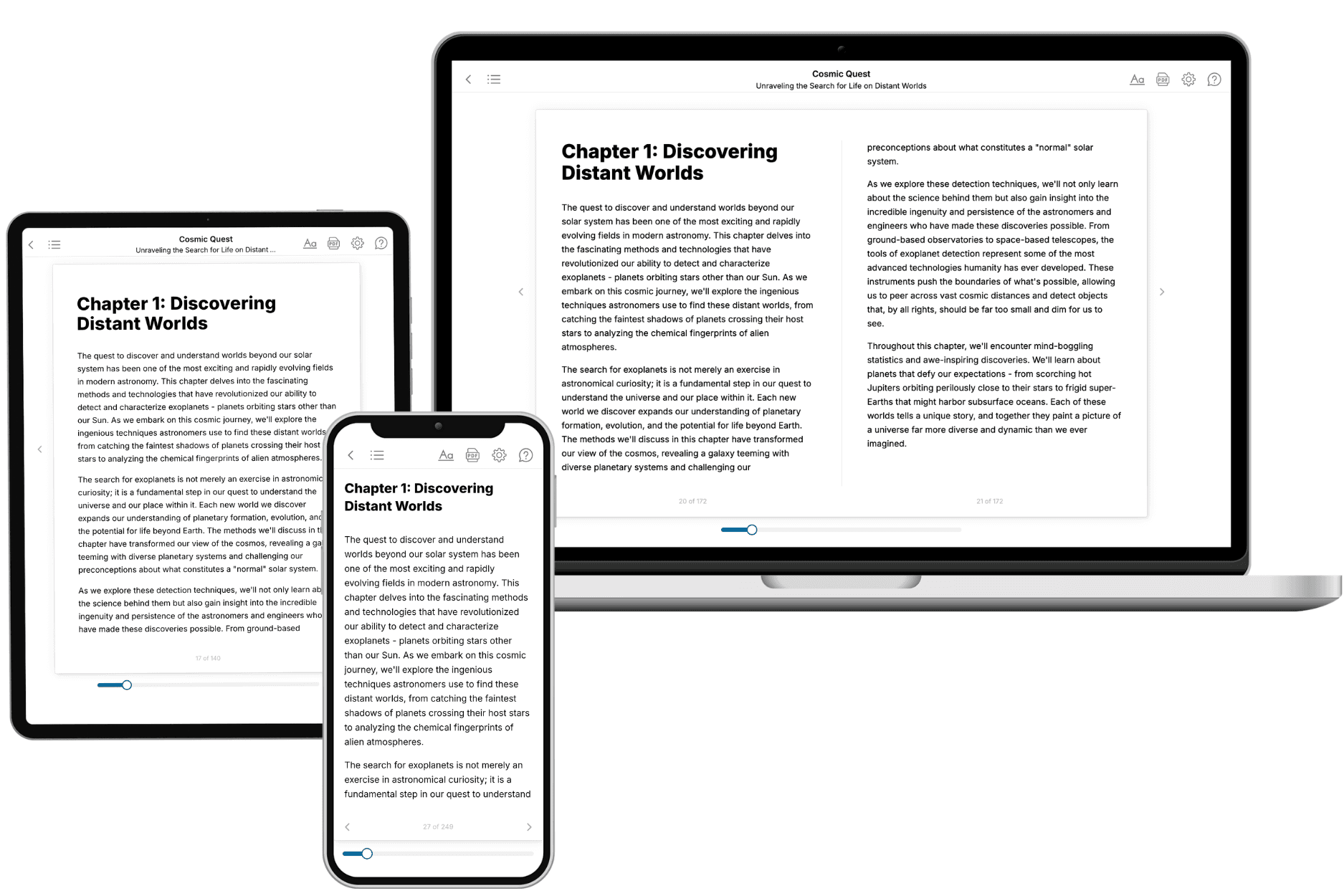
Your book is ready in 10 minutes. Read it online, download as EPUB or PDF, or send to Kindle.

Frequently asked questions
- What is TailoredRead?
TailoredRead creates complete, full-length nonfiction ebooks, written specifically for you. Tell us what you want to learn and why, and TailoredRead writes you a complete ebook on it, with charts, tables, and diagrams throughout. Read it online, on Kindle, or on any e-reader, or download it as a PDF or EPUB. Every book is written fresh the day you order it.
- How is the book tailored to me?
Before anything is written, you answer a few short questions about your goals, your background, and the topics you care about. Your book is then planned around your answers: written at your level, focused on your goals, and covering the topics you chose, instead of the one-size-fits-all book a store sells everyone.
- Will it read like generic AI content?
No. Your book isn't a chat transcript: it's planned chapter by chapter before a single word is written, told in a clear book voice, and explains ideas visually with charts, tables, and diagrams. After writing, every book goes through an editorial pass that polishes chapters so the book reads consistent from start to finish. Judge for yourself: browse thousands of sample books on our Explore Books page.
- How accurate is the content?
Our AI first checks whether your subject needs live research. Niche and fast-moving subjects are researched before writing, and the book plan and chapters are grounded in what it finds. After writing, every book goes through a quality pass that checks its facts and consistency, and researched books list their sources in a Notes section at the back.
- How long is the book?
You choose the length: Comprehensive (250-300 pages), Detailed (150-200 pages), Essential (70-100 pages), or Short (30-50 pages).
- Does the book include visuals?
Yes. Every book includes visual elements such as timelines, checklists, step-by-step guides, decision trees, comparison tables, and matrices, and many include bar charts. A typical book includes dozens of these visual elements.
- Can I read it on Kindle? What formats can I download?
Yes. Every book can be read in our online reader or downloaded as a PDF or EPUB. The EPUB can be opened with Kindle, Apple Books, Kobo, and any e-reader. The Commercial and Author licenses also include an editable Word (DOCX) and Markdown download.
- How much does it cost?
About the price of a regular ebook. The exact price depends on your book's length and complexity, from $2 for the shortest books to $35 for the most comprehensive, and it's shown when you review your book, before you commit to anything. Each book is a one-time purchase, yours to keep, no subscription. Licenses that let you share, teach, or publish your book range from $35.99 to $49.99.
- Can I preview the book before purchasing?
Before you pay, you'll see what your book will cover: the title, a detailed description, the estimated length, and the complete chapter-by-chapter table of contents, so you know what you're getting before you decide. The full text itself is written after you purchase.
- How long does it take to create a book?
About 10 minutes. You can start reading the opening chapters while the rest is still being written.