Master German Prepositions
The Complete Guide to Using In, On, At, and Beyond with Confidence
Many German learners plateau at the intermediate level because they struggle with prepositions—those small words that seem to have endless exceptions and confusing rules.
191 pages9 chaptersJan 10, 2026Learning German
About this book
You memorize the rules, but then encounter sentences that don't follow them. The frustration is real, and it's not your fault. German prepositions are genuinely complex, but they're not impossible. This book breaks down the system into manageable, logical patterns that actually make sense. You'll discover why certain prepositions take specific cases, how two-way prepositions work, and how to recognize idiomatic uses that go beyond textbook definitions. Through clear explanations, practical examples, and strategic exercises, you'll move from confusion to confidence. Whether you're preparing for exams, planning to live in Germany, or simply want to speak more naturally, this guide provides the tools you need to master prepositions once and for all.
Table of contents
- IntroductionWhy Prepositions Matter in German, Common Struggles and How This Book Helps, How to Use This Book Effectively, What You'll Learn and AccomplishRead below
- Chapter 1: The Foundation: German Cases and PrepositionsUnderstanding the Four German Cases, How Prepositions Determine Case, Practicing Case Agreement with Prepositions
- Chapter 2: Dative Prepositions: Location and RelationshipsIntroduction to Dative Prepositions, Aus, Von, Bei, and Related Prepositions, Mit, Nach, Seit, and Temporal Uses, Practical Exercises and Real-World Contexts
- Chapter 3: Accusative Prepositions: Movement and DirectionIntroduction to Accusative Prepositions, Durch, Gegen, Um, and Direction Prepositions, Bis, Ohne, Für, and Purpose Prepositions, Practical Exercises and Real-World Contexts
- Chapter 4: Two-Way Prepositions: The Location-Movement DistinctionUnderstanding the Location-Movement Rule, An, Auf, In: The Most Common Two-Way Prepositions, Über, Unter, Vor, Hinter, and Other Two-Way Prepositions, Mastering the Dative-Accusative Switch
- Chapter 5: Genitive Prepositions: Possession and Advanced StructuresIntroduction to Genitive Prepositions, Wegen, Trotz, Während, and Common Genitive Prepositions, Genitive Prepositions in Formal and Written German, Practical Exercises and Contextual Usage
- Chapter 6: Prepositions with Multiple Meanings and Idiomatic UsesWhy Prepositions Have Multiple Meanings, From Spatial to Temporal to Abstract Meanings, Common Idiomatic Expressions with Prepositions, Using Context to Determine Meaning
- Chapter 7: Prepositions in Phrases and Verb CombinationsBuilding and Understanding Prepositional Phrases, Verbs That Require Specific Prepositions, Phrasal Constructions and Fixed Expressions, Exercises with Phrases and Verb Combinations
- Chapter 8: Regional Variations and Colloquial UsageHow German Prepositions Vary Across Regions, Austrian and Swiss German Variations, Colloquial and Spoken German Patterns
- Chapter 9: Mastering Prepositions Through Practice and ApplicationEffective Learning Strategies for Prepositions, Learning from Reading and Listening Materials, Applying Prepositions in Speaking and Writing, Common Mistakes and How to Avoid Them
- ConclusionYour Preposition Mastery Journey, Next Steps and Continued Learning
- Appendix: Quick Reference GuideComplete Preposition Chart by Case, Common Verbs and Their Prepositions, Idiomatic Expressions Reference
Introduction
German prepositions are the small words that hold sentences together, yet they cause more frustration for intermediate learners than almost any other aspect of the language. You've mastered basic vocabulary and verb conjugations. You understand sentence structure and can hold conversations about everyday topics. But then you encounter a sentence like Ich warte auf dich
instead of Ich warte für dich
, and suddenly the rules you thought you knew seem arbitrary and confusing. The truth is that German prepositions follow logical patterns, but these patterns are rarely explained in a way that makes intuitive sense. This book exists to change that. It will show you the underlying system that governs how prepositions work, why they take specific cases, and how to use them naturally in real-world contexts.
The challenge with German prepositions isn't that they're inherently difficult—it's that they operate on principles that don't exist in English. English speakers say on the table
and on Monday
using the same preposition for both physical location and time. German uses auf dem Tisch
but am Montag
, requiring different prepositions and different cases. This isn't random. German prepositions encode information about spatial relationships, movement, time, and abstract concepts in ways that English handles through word order or context. Once you understand these encoding patterns, prepositions stop being a memorization nightmare and start making logical sense. You'll see why in takes the dative when describing location but the accusative when describing movement toward a destination.
This introduction will prepare you for the journey ahead by explaining why prepositions matter so much in German communication, what specific struggles you'll overcome, how to use this book most effectively, and what concrete skills you'll develop. By the end of this book, you won't just know preposition rules—you'll understand the system well enough to make educated guesses about prepositions you've never encountered before. You'll recognize patterns in authentic German texts and conversations. Most importantly, you'll speak and write with the confidence that comes from genuine understanding rather than rote memorization. The path to preposition mastery isn't about memorizing hundreds of exceptions. It's about understanding the core principles that make German prepositions predictable and learnable.
Why Prepositions Matter in German
Prepositions are fundamental to German communication because they do far more work than their English counterparts. In English, you might say I'm going to the store
or I'm at the store
, and the prepositions to and at provide some information about location and movement. In German, these same concepts require not only the correct preposition but also the correct case for the article and noun that follow. The sentence Ich gehe in den Laden
uses the accusative case because you're moving into the store, while Ich bin im Laden
uses the dative case because you're already in the store. This case distinction carries meaning that affects how native speakers understand your sentence. Using the wrong case doesn't just sound incorrect—it can actually communicate the wrong information or create confusion about what you mean.
The importance of prepositions extends beyond basic spatial relationships into every area of German expression. Temporal relationships rely heavily on prepositions: vor drei Tagen
(three days ago), in einer Woche
(in a week), seit dem Morgen
(since morning). Abstract relationships and idiomatic expressions are built on prepositional foundations: Angst vor etwas haben
(to be afraid of something), sich freuen auf etwas
(to look forward to something), denken an jemanden
(to think of someone). These verb-preposition combinations are not interchangeable. You cannot substitute one preposition for another without changing the meaning or creating nonsense. A German speaker who hears Ich freue mich über dich
understands something different from Ich freue mich auf dich
—the first means you're happy about someone, while the second means you're looking forward to seeing them.
Prepositions also serve as markers of education level and language sophistication in German. Native speakers immediately notice when non-native speakers use prepositions incorrectly, and these errors can undermine otherwise fluent speech. Consider the difference between saying Ich interessiere mich für Kunst
(correct) versus Ich interessiere mich über Kunst
(incorrect). The wrong preposition doesn't just sound foreign—it marks you as someone still learning the language. Conversely, using prepositions correctly and naturally signals advanced proficiency. This is particularly important in professional contexts, academic writing, and formal communication where precision matters. German business correspondence, academic papers, and official documents all rely on precise prepositional usage to convey exact meanings and relationships between ideas.
The case system that prepositions govern affects every noun, article, and adjective in a prepositional phrase. When you say mit meinem besten Freund
(with my best friend), the dative case required by mit changes the form of the possessive pronoun meinem, the adjective besten, and potentially the noun itself if it's a weak masculine noun. This cascading effect means that prepositional errors often create multiple grammatical mistakes in a single phrase. Understanding prepositions isn't just about learning which little word to use—it's about mastering a system that affects the structure of entire phrases and clauses. This is why intermediate learners who neglect prepositions often plateau, unable to progress to advanced fluency despite expanding their vocabulary and learning more complex grammar structures.
Prepositions also reveal cultural and conceptual differences in how German speakers organize spatial and temporal reality. German distinguishes between in (inside a three-dimensional space) and an (at or on a surface or boundary) in ways that English often doesn't. You go an die Universität
(to the university, emphasizing it as an institution or location) but in die Bibliothek
(into the library, emphasizing entering the building). These distinctions reflect how German speakers conceptualize spaces and relationships. Learning prepositions means learning to think about spatial relationships, time, and abstract concepts the way German speakers do. This cognitive shift is one of the most important steps in moving from translating in your head to actually thinking in German.
Finally, prepositions matter because they appear in virtually every German sentence you'll speak, write, read, or hear. Research on language frequency shows that prepositions are among the most common words in any language, and German is no exception. The prepositions in, zu, von, mit, and auf appear in the top 50 most frequently used German words[1]. You cannot avoid them, and you cannot communicate effectively without them. Every conversation about where you've been, where you're going, what you're doing, and how you feel involves multiple prepositions. Mastering them isn't optional if you want to achieve genuine fluency—it's absolutely essential.
Understanding why prepositions matter provides motivation for the detailed work ahead. These small words carry enormous weight in German communication. They affect grammar, meaning, clarity, and how others perceive your language ability. The effort you invest in mastering them will pay dividends in every aspect of your German skills, from casual conversation to professional communication. The good news is that prepositions, despite their reputation, follow learnable patterns. Once you understand these patterns, you'll find that prepositions become one of the most satisfying aspects of German to master because they unlock so much expressive power and precision.
Common Struggles and How This Book Helps
The most common struggle intermediate learners face with German prepositions is the overwhelming sense that there are too many exceptions to remember. You learn that mit takes the dative case, then encounter in which sometimes takes dative and sometimes accusative. You memorize that für means for
, then read a sentence where for
is translated as seit or zu instead. The apparent inconsistency creates frustration and the feeling that you'll never master this aspect of German. This book addresses this struggle by revealing the underlying logic. Two-way prepositions aren't arbitrary—they follow a clear location-versus-movement rule. Prepositions that seem to have multiple meanings actually extend from core spatial concepts to temporal and abstract uses through predictable metaphorical patterns. Once you see these patterns, the exceptions become far fewer and more manageable.
Another major struggle involves the case system itself. Many learners understand cases in theory but struggle to apply them quickly in conversation. You know that mit requires dative, but in the moment of speaking, you can't remember whether the dative form of der Mann
is dem Mann or den Mann. This book helps by providing extensive practice with prepositions in context, not just isolated grammar drills. You'll work with complete sentences and realistic scenarios that build automatic recognition of case forms. The exercises progress from simple identification to active production, helping you internalize the patterns so they become automatic. By the time you finish this book, you won't need to consciously think mit takes dative, so I need dem
—you'll simply know that mit dem Mann
sounds right.
Verb-preposition combinations present another significant challenge. German has hundreds of verbs that require specific prepositions, and these combinations often don't match English patterns. You might logically think to wait for someone
translates as warten für jemanden, but the correct form is warten auf jemanden. These combinations must be learned individually, but this book provides strategies for learning them efficiently. You'll discover that many verb-preposition pairs follow semantic patterns—verbs of emotion often use über for the cause of the emotion, while verbs of anticipation use auf. Understanding these patterns reduces the memorization burden and helps you make educated guesses about combinations you haven't explicitly learned.
Many learners also struggle with the abstract and idiomatic uses of prepositions. You learn that über means over
or above
, then encounter it meaning about
in ein Buch über Geschichte
(a book about history). The book Thinking German Translation notes that prepositional meaning extension from concrete to abstract is one of the most challenging aspects of translation[2]. This book addresses this struggle by systematically showing how spatial prepositions extend to temporal and abstract meanings. You'll learn that über meaning about
comes from the spatial sense of spanning over
a topic. These conceptual connections make the multiple meanings memorable and logical rather than arbitrary.
The location-movement distinction with two-way prepositions causes particular confusion. Learners understand the rule in principle: use dative for location (where?
) and accusative for movement (where to?
). But applying this rule requires understanding what counts as movement. Is Ich hänge das Bild an die Wand
(I'm hanging the picture on the wall) movement because you're moving the picture, or location because the picture ends up on the wall? This book clarifies these distinctions with extensive examples and visual explanations. You'll learn to ask the right questions: Is the subject or object changing location? Is the focus on the destination or the current position? These diagnostic questions help you apply the rule correctly even in ambiguous situations.
Regional variations and colloquial usage create additional confusion, especially for learners who study standard German but then encounter different usage in Austria, Switzerland, or various regions of Germany. You might learn that in with accusative indicates movement, then hear Austrians say Ich gehe in die Kirche
but also Ich gehe auf die Universität
where standard German would use zu. This book acknowledges these variations without overwhelming you. The focus remains on standard German that will be understood everywhere, but you'll also learn about common regional differences so you're not confused when you encounter them. This approach builds flexibility and cultural awareness without undermining the core patterns you're learning.
Finally, many learners struggle with the sheer volume of information about prepositions. Traditional grammar books present long lists of prepositions with their cases, meanings, and exceptions, expecting you to memorize everything at once. This approach leads to cognitive overload and poor retention. This book takes a different approach by building your knowledge systematically. You'll start with the foundation—understanding how cases work with prepositions—then progress through dative prepositions, accusative prepositions, two-way prepositions, and finally genitive prepositions and advanced uses. Each chapter builds on previous knowledge, and frequent practice exercises reinforce what you've learned before introducing new material. This structured progression prevents overwhelm and ensures solid mastery at each level before moving forward.
How to Use This Book Effectively
This book is designed for systematic progression, and you'll get the best results by working through it in order rather than jumping to specific topics. Each chapter builds on concepts introduced in previous chapters, and the exercises assume you've mastered earlier material. Start with Chapter 1 even if you think you already understand the case system—it establishes the specific framework this book uses and introduces terminology that appears throughout. The foundation chapter ensures everyone starts from the same baseline, regardless of how you learned German previously. If you're confident about your case knowledge, you can move through Chapter 1 quickly, but don't skip it entirely. The investment of time will pay off when later chapters reference these foundational concepts.
Approach each chapter in three passes for maximum retention and skill development:
- First pass: Read through the entire chapter without stopping to do exercises. Focus on understanding the concepts, patterns, and explanations. Take notes on anything that surprises you or contradicts what you previously believed.
- Second pass: Reread the chapter more slowly, this time completing all exercises and examples. Check your answers and review any mistakes carefully to understand why the correct answer is correct.
- Third pass: Return to the chapter after a few days and complete the exercises again without looking at your previous answers. This spaced repetition solidifies your learning and reveals what you've truly internalized versus what you only temporarily understood.
The exercises in this book are designed for active engagement, not passive reading. When you encounter an exercise, resist the temptation to just read through it and think yes, I understand this.
Actually write out your answers, speak them aloud, or type them—the physical act of production strengthens neural pathways and reveals gaps in your knowledge that passive reading conceals. Many exercises ask you to create your own sentences using specific prepositions or patterns. Take these seriously. Creating original sentences forces you to actively apply rules rather than just recognizing correct usage, and this active application is what builds fluency. Keep a dedicated notebook for your exercises so you can review your work and track your progress over time.
Pay special attention to the example sentences throughout the book. These aren't just illustrations—they're models for the kind of German you should be producing. When you see an example sentence, try these strategies:
- Read it aloud multiple times to develop a feel for natural German rhythm and word order
- Identify the preposition, its case, and how the case affects the following words
- Create parallel sentences by substituting different nouns, verbs, or adjectives while maintaining the same prepositional structure
- Translate the sentence to English, then translate your English back to German without looking at the original to see if you can reproduce the structure
Use the appendices as ongoing reference tools, not just end-of-book summaries. The quick reference charts are designed for frequent consultation as you work through the chapters and as you encounter German in your daily study. Consider printing out the preposition charts and keeping them visible in your study space, or creating digital flashcards based on the verb-preposition lists. The appendices distill the book's content into quick-lookup formats that support your learning without requiring you to reread entire chapters. Return to them regularly, and you'll find that information that seemed overwhelming at first becomes familiar and accessible through repeated exposure.
Supplement this book with authentic German materials from the beginning. While working through the chapters, actively look for the prepositions you're studying in German texts, videos, podcasts, and conversations. When you're learning about dative prepositions, pay special attention to how mit, nach, and bei appear in real contexts. Keep a running list of interesting or unusual prepositional phrases you encounter. This connection between the book's systematic instruction and real-world usage accelerates your learning and helps you see that the patterns you're studying aren't just textbook abstractions—they're the actual structures native speakers use constantly. The book provides the framework; authentic materials provide the evidence that the framework works.
Set realistic pacing goals based on your available study time and learning style. Each chapter contains substantial content and multiple exercises, so plan to spend at least a week on each major chapter. If you're studying intensively, you might complete a chapter in three to four focused study sessions. If you're studying more casually, you might spread a chapter over two weeks, working through one or two subsections per study session. The key is consistency rather than speed. Regular engagement with the material—even just 20 to 30 minutes daily—produces better results than occasional marathon study sessions. Create a study schedule that you can realistically maintain, and track your progress through the book to maintain motivation.
Finally, use this book as part of a comprehensive German learning program, not as your only resource. Prepositions are crucial, but they're one component of German fluency. Continue practicing speaking, listening, reading, and writing while working through this book. Apply what you learn about prepositions immediately in your other German activities. If you're taking a class or working with a tutor, share what you're learning from this book and ask for feedback on your prepositional usage. If you're self-studying, find language exchange partners or online communities where you can practice using prepositions in conversation. The combination of systematic study from this book and active practice in real communication contexts creates the optimal environment for mastering German prepositions.
What You'll Learn and Accomplish
By the end of this book, you will have mastered the complete system of German prepositions across all four cases. You'll understand not just which prepositions take which cases, but why the system works the way it does. This deep understanding means you'll be able to make educated guesses about prepositions you haven't explicitly studied, recognize patterns in new contexts, and self-correct when you make mistakes. You'll know the core meanings of all major German prepositions and how these meanings extend from spatial to temporal to abstract uses. This knowledge transforms prepositions from a memorization challenge into a logical, learnable system that makes sense and stays with you.
You will achieve confident, automatic use of two-way prepositions—the aspect of German prepositions that causes the most confusion for intermediate learners. The location-movement distinction will become intuitive rather than something you have to consciously think about. When you want to say I'm putting the book on the table
, you'll automatically produce Ich lege das Buch auf den Tisch
with the accusative case, and when you want to say The book is on the table
, you'll naturally say Das Buch liegt auf dem Tisch
with the dative case. This automaticity comes from understanding the underlying principle and practicing it extensively in varied contexts. You'll develop an intuitive feel for whether a sentence describes location or movement, and this intuition will guide your case selection.
Your vocabulary will expand significantly through learning verb-preposition combinations and idiomatic expressions. You'll master common combinations like:
- sich freuen auf (to look forward to), sich freuen über (to be happy about)
- denken an (to think of), nachdenken über (to think about/reflect on)
- warten auf (to wait for), hoffen auf (to hope for)
- sich interessieren für (to be interested in), sich kümmern um (to take care of)
You will develop the ability to understand and use prepositions in all their contexts—spatial, temporal, and abstract. You'll know when to use in versus an versus auf for different types of locations. You'll understand temporal prepositions like vor (ago), seit (since), in (in/within), and für (for a duration), and you'll be able to express complex time relationships accurately. You'll grasp abstract uses like aus for reasons or causes (aus Angst
- out of fear), durch for means or agency (durch harte Arbeit
- through hard work), and trotz for concession (trotz des Regens
- despite the rain). This comprehensive understanding allows you to express nuanced ideas and relationships that intermediate learners often struggle to communicate.
Your reading comprehension will improve dramatically as prepositional phrases that once slowed you down become instantly clear. You'll be able to parse complex sentences with multiple prepositional phrases without getting lost. Consider a sentence like: Wegen des schlechten Wetters blieb er trotz seiner Pläne zu Hause, anstatt mit seinen Freunden ins Kino zu gehen.
(Because of the bad weather, he stayed home despite his plans, instead of going to the movies with his friends.) After working through this book, you'll immediately recognize the genitive prepositions wegen and trotz, the dative preposition mit, and the accusative preposition ins (in + das), and you'll understand how each prepositional phrase relates to the main clause. This fluent reading ability opens up authentic German literature, news, and professional texts.
You will gain cultural and regional awareness about how German prepositions vary across German-speaking countries and regions. You'll understand that Austrians and Swiss Germans sometimes use prepositions differently than Germans, and you'll know the most common variations. This awareness prevents confusion when you encounter regional usage and demonstrates cultural sensitivity. You'll know, for example, that Austrians often say Ich bin auf der Universität
where Germans say Ich bin an der Universität
, and that Swiss Germans might use ab where Germans use von in certain contexts. This knowledge doesn't mean you need to adopt regional variations, but it helps you understand and communicate with German speakers from all regions.
Most importantly, you will develop the confidence to use German prepositions in real-time conversation without hesitation or self-doubt. The fear of making prepositional mistakes often causes intermediate learners to simplify their speech, avoiding complex sentences or sophisticated expressions. After mastering the content in this book, you'll speak more freely and naturally because you'll trust your prepositional knowledge. You'll make fewer errors, and when you do make mistakes, you'll often catch and correct them yourself. This confidence transforms your German from careful, hesitant speech to fluent, natural expression. You'll sound more like a proficient speaker and less like someone translating from English in their head, and this shift will be noticeable both to you and to the native speakers you communicate with.
The skills and knowledge you gain from this book will serve as a foundation for continued advancement in German. Prepositions connect to virtually every other aspect of the language—cases, verb usage, sentence structure, and idiomatic expression. By mastering prepositions, you remove a major obstacle to fluency and create a solid platform for learning more advanced grammar, expanding your vocabulary, and refining your style. The investment you make in working through this book thoroughly will pay dividends throughout your German learning journey, making everything else you study easier and more accessible. You're not just learning prepositions—you're building the structural knowledge that supports genuine, lasting fluency in German.
This is the end of the free sample. The full book has 9 chapters.
Want this book written for you?
Tell us your goals and background, and get your own version of this book, tailored by AI to you.


Benefits of AI-tailored books
- Read one book, not ten:
- all the Learning German knowledge you need, gathered into a single book.
- Save days of learning:
- tell us your goals, choose your topics, and the whole book is built around them.
- Learn effortlessly:
- Learning German book written for your specific background and expertise.
- Understand at a glance:
- includes charts, tables, timelines, checklists, decision trees, and more.
- Stay current:
- written the day you order it, not years ago.
- Trust what you read:
- every book is checked for accuracy, with real research when your subject needs it.
Create your unique book in 3 steps
- 1. Select your focus
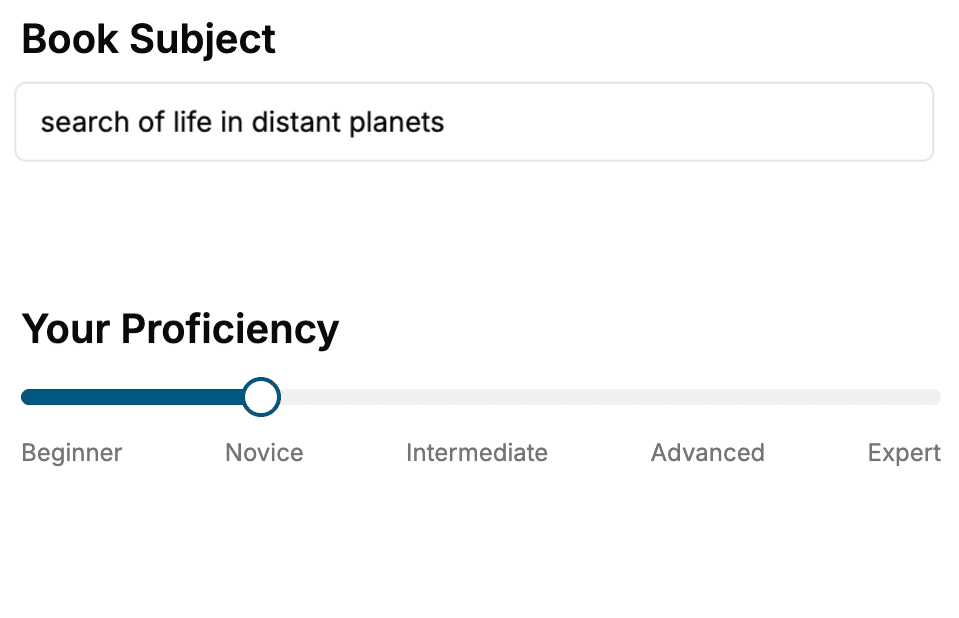
Select the focus of your Learning German book and share your background
- 2. Personalize your book
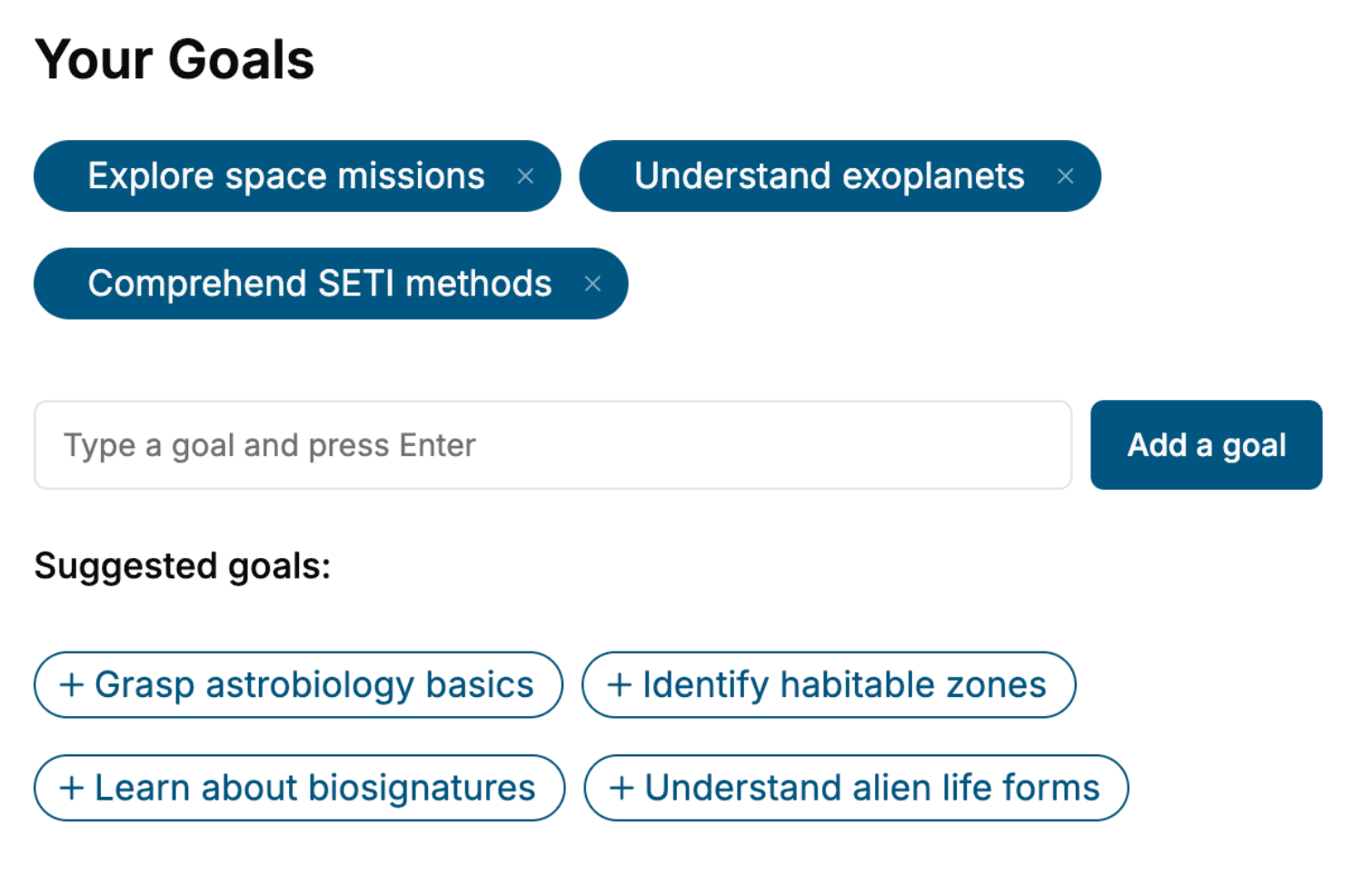
Specify your goals and choose sub-topics to include
- 3. Get your tailored book
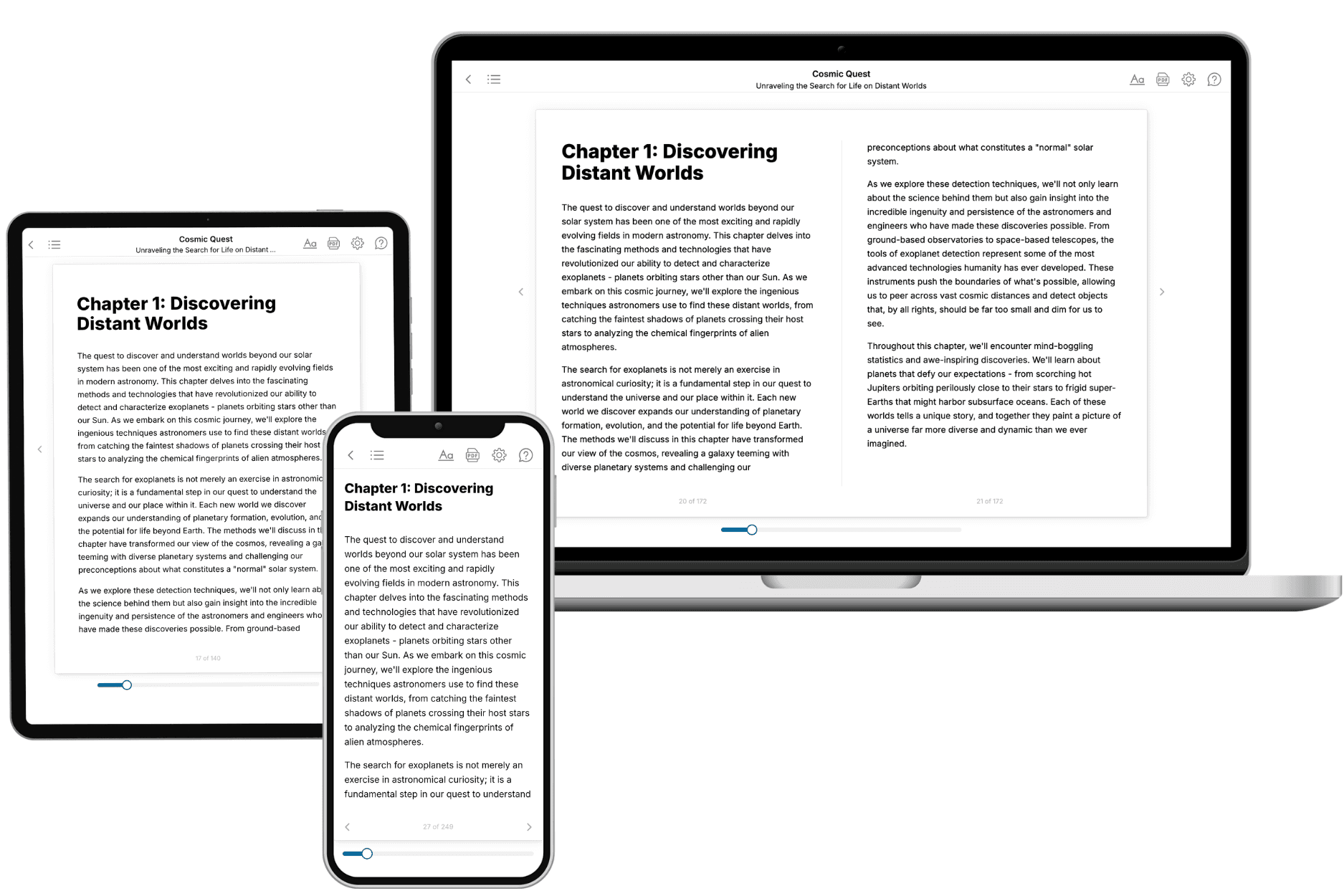
Your book is ready in 10 minutes. Read it online, download as EPUB or PDF, or send to Kindle.
Frequently asked questions
- What is TailoredRead?
TailoredRead creates complete, full-length nonfiction ebooks, written specifically for you. Tell us what you want to learn and why, and TailoredRead writes you a complete ebook on it, with charts, tables, and diagrams throughout. Read it online, on Kindle, or on any e-reader, or download it as a PDF or EPUB. Every book is written fresh the day you order it.
- How is the book tailored to me?
Before anything is written, you answer a few short questions about your goals, your background, and the topics you care about. Your book is then planned around your answers: written at your level, focused on your goals, and covering the topics you chose, instead of the one-size-fits-all book a store sells everyone.
- Will it read like generic AI content?
No. Your book isn't a chat transcript: it's planned chapter by chapter before a single word is written, told in a clear book voice, and explains ideas visually with charts, tables, and diagrams. After writing, every book goes through an editorial pass that polishes chapters so the book reads consistent from start to finish. Judge for yourself: browse thousands of sample books on our Explore Books page.
- How accurate is the content?
Our AI first checks whether your subject needs live research. Niche and fast-moving subjects are researched before writing, and the book plan and chapters are grounded in what it finds. After writing, every book goes through a quality pass that checks its facts and consistency, and researched books list their sources in a Notes section at the back.
- How long is the book?
You choose the length: Comprehensive (250-300 pages), Detailed (150-200 pages), Essential (70-100 pages), or Short (30-50 pages).
- Does the book include visuals?
Yes. Every book includes visual elements such as timelines, checklists, step-by-step guides, decision trees, comparison tables, and matrices, and many include bar charts. A typical book includes dozens of these visual elements.
- Can I read it on Kindle? What formats can I download?
Yes. Every book can be read in our online reader or downloaded as a PDF or EPUB. The EPUB can be opened with Kindle, Apple Books, Kobo, and any e-reader. The Commercial and Author licenses also include an editable Word (DOCX) and Markdown download.
- How much does it cost?
About the price of a regular ebook. The exact price depends on your book's length and complexity, from $2 for the shortest books to $35 for the most comprehensive, and it's shown when you review your book, before you commit to anything. Each book is a one-time purchase, yours to keep, no subscription. Licenses that let you share, teach, or publish your book range from $35.99 to $49.99.
- Can I preview the book before purchasing?
Before you pay, you'll see what your book will cover: the title, a detailed description, the estimated length, and the complete chapter-by-chapter table of contents, so you know what you're getting before you decide. The full text itself is written after you purchase.
- How long does it take to create a book?
About 10 minutes. You can start reading the opening chapters while the rest is still being written.