Master LLM Fine-Tuning
A Frontend Developer's Complete Guide to Training, Deploying, and Building Agents with Large Language Models
Picture yourself confidently building and deploying your own fine-tuned language models, creating intelligent agents that solve real-world problems, and transitioning from frontend development into the cutting-edge world of AI engineering.
346 pages20 chaptersOct 15, 2025AI and Machine LearningCreated by 全
About this book
This comprehensive guide transforms complex machine learning concepts into accessible, practical knowledge specifically designed for developers with frontend experience. You'll discover how to harness your existing programming skills while mastering the fundamentals of transformer architecture, attention mechanisms, and dataset preprocessing. Through hands-on examples and clear explanations, you'll learn to fine-tune open-source LLMs from scratch, understanding not just the how but the why behind each technique. The book covers everything from parameter-efficient fine-tuning methods to full model retraining, ensuring you can choose the right approach for your specific use case. Beyond training models, you'll master the art of deployment through robust serving APIs and learn to architect intelligent agents that can interact with external systems. Each chapter builds upon the previous one, creating a cohesive learning experience that takes you from LLM novice to confident practitioner. You'll gain the skills to evaluate model performance, optimize for different deployment scenarios, and troubleshoot common issues that arise in production environments. This isn't just another technical manual - it's your roadmap to becoming proficient in one of the most exciting areas of modern software development. By the end, you'll have the knowledge and confidence to build, deploy, and maintain your own LLM-powered applications and agent systems.
Table of contents
- IntroductionThe AI Revolution and Your Role in It, From Frontend Development to AI Engineering, How This Book Will Transform Your Skills, What You Need to Get StartedRead below
- Chapter 1: Understanding Large Language ModelsWhat Are Large Language Models, Core Capabilities and Limitations, The Open Source LLM Landscape, Choosing the Right Base Model
- Chapter 2: Transformer Architecture Deep DiveTransformer Architecture Fundamentals, Encoder-Decoder vs Decoder-Only Models, Understanding Layer Components, Model Parameters and Their Roles
- Chapter 3: Mastering Attention MechanismsThe Theory Behind Attention, Self-Attention in Practice, Multi-Head Attention Explained, Positional Encoding and Context
- Chapter 4: Setting Up Your Development EnvironmentHardware Requirements and Options, Essential Software and Libraries, Cloud Platform Setup and Configuration, Local Development Best Practices
- Chapter 5: Dataset Fundamentals for Fine-TuningUnderstanding Different Data Types, Assessing and Ensuring Data Quality, Finding and Evaluating Data Sources, Data Ethics and Responsible Collection
- Chapter 6: Advanced Dataset PreprocessingData Cleaning and Normalization, Tokenization Strategies and Implementation, Formatting Data for Training, Creating Effective Train-Validation Splits
- Chapter 7: Fine-Tuning FundamentalsCore Fine-Tuning Concepts, Transfer Learning Principles, Defining Training Objectives, Choosing Evaluation Metrics
- Chapter 8: Parameter-Efficient Fine-Tuning TechniquesLoRA: Low-Rank Adaptation, Prefix Tuning and Prompt Tuning, Adapter Layers and Their Applications, Comparing Parameter-Efficient Methods
- Chapter 9: Full Model Fine-TuningWhen to Use Full Fine-Tuning, Gradient Computation and Backpropagation, Memory Optimization Techniques, Distributed Training Strategies
- Chapter 10: The Training ProcessHyperparameter Selection and Tuning, Learning Rate Schedules and Optimization, Monitoring Training Progress, Early Stopping and Regularization
- Chapter 11: Model Evaluation and ValidationEvaluation Frameworks and Benchmarks, Performance Metrics and Interpretation, Human Evaluation Techniques, Detecting and Mitigating Bias
- Chapter 12: Model Optimization for DeploymentQuantization and Compression, Model Pruning Methods, Knowledge Distillation, Inference Speed Optimization
- Chapter 13: Deployment InfrastructureDeployment Architecture Options, Containerization with Docker, Kubernetes and Container Orchestration, Auto-scaling and Load Balancing
- Chapter 14: Building Model Serving APIsRESTful API Design Principles, FastAPI Implementation, Authentication and Security, Rate Limiting and Resource Management
- Chapter 15: Production Deployment ConsiderationsMonitoring and Logging Systems, Error Handling and Recovery, Model Version Management, Performance Monitoring and Alerting
- Chapter 16: Agent Architecture FundamentalsUnderstanding AI Agents, Types of AI Agents, Agent Decision-Making Processes, Environment Interaction Patterns
- Chapter 17: Agent Design PatternsReactive Agent Patterns, Planning and Goal-Oriented Agents, Multi-Agent System Design, Hybrid Agent Architectures
- Chapter 18: Tool Integration and External APIsImplementing Tool Calling, External API Integration, Data Retrieval and Processing, Tool Chaining and Workflows
- Chapter 19: Implementing Your First AgentChoosing an Agent Framework, Building a Basic Agent, Implementing Memory Systems, Testing and Debugging Agents
- Chapter 20: Advanced Agent FeaturesLearning and Adaptation, Context Management Strategies, Error Recovery and Fallback, Agent Performance Optimization
- ConclusionYour Learning Journey Recap, Next Steps and Continued Learning
Introduction
The world of artificial intelligence is experiencing an unprecedented transformation, and you're standing at the perfect moment to become part of this revolution. Large language models have evolved from experimental research projects into powerful tools that are reshaping how we interact with technology, process information, and solve complex problems. What makes this moment particularly exciting is that the barriers to entry have never been lower for developers who want to harness these capabilities. The combination of open-source models, accessible cloud computing resources, and mature development frameworks means that individual developers can now build and deploy AI systems that would have required entire research teams just a few years ago.
Your background as a frontend developer positions you uniquely well for this transition into AI engineering. The skills you've developed in creating user interfaces, managing state, handling asynchronous operations, and building scalable applications translate remarkably well to the world of machine learning. The attention to detail required for responsive design mirrors the precision needed for dataset preprocessing. Your experience with API integration becomes invaluable when building agent systems that interact with external tools. The debugging skills you've honed while troubleshooting JavaScript applications will serve you well when diagnosing training issues or optimizing model performance.
This book bridges the gap between your existing expertise and the specialized knowledge needed to master large language model fine-tuning and agent development. Rather than starting from scratch, you'll build upon familiar concepts while gradually introducing the mathematical foundations, architectural principles, and practical techniques that define modern AI engineering. You'll discover how transformer architectures work at a fundamental level, learn to preprocess datasets with the same rigor you apply to data validation in web applications, and develop the skills to deploy models with the same reliability standards you maintain for production web services.
The journey ahead involves more than just learning new technologies—it's about developing a new way of thinking about problems and solutions. You'll learn to approach challenges through the lens of data quality, model capabilities, and system architecture. You'll develop intuition for when to use parameter-efficient fine-tuning versus full model retraining, how to design agent architectures that balance autonomy with reliability, and how to evaluate model performance beyond simple accuracy metrics. These skills will enable you to build AI systems that not only work but work well in production environments.
The AI Revolution and Your Role in It
The current AI revolution represents a fundamental shift in how we approach software development and problem-solving. Unlike previous technological waves that primarily automated existing processes, large language models introduce genuine reasoning capabilities that can adapt to novel situations and generate creative solutions. This transformation is happening across industries, from healthcare systems that can analyze medical literature to financial platforms that can explain complex regulations in plain language. The key difference from earlier AI winters is that today's models demonstrate consistent, reliable performance across diverse tasks while being accessible enough for individual developers to customize and deploy.
What makes this revolution particularly significant for developers is the democratization of AI capabilities. Open-source models like Llama, Mistral, and CodeLlama provide performance that rivals proprietary alternatives while offering complete control over customization and deployment. This shift means that small teams and individual developers can now build sophisticated AI applications without depending on external APIs or accepting the limitations of black-box systems. You can fine-tune models on your specific data, optimize them for your particular use cases, and deploy them in environments that meet your security and performance requirements.
The economic implications of this accessibility are profound. Companies are actively seeking developers who can bridge the gap between traditional software engineering and AI capabilities. The demand for professionals who can fine-tune models, build agent systems, and deploy AI applications reliably far exceeds the current supply. This creates an exceptional opportunity for frontend developers who are willing to expand their skill set. Your existing understanding of user experience, system architecture, and production deployment provides a strong foundation for building AI applications that users actually want to use and that businesses can rely on.
The technical landscape is evolving rapidly, with new model architectures, training techniques, and deployment strategies emerging regularly. However, the fundamental principles remain consistent: quality data leads to quality models, proper evaluation prevents overfitting, and robust deployment practices ensure reliable performance. By mastering these fundamentals while staying current with emerging techniques, you position yourself to adapt to future developments rather than being left behind by them. The skills you'll develop through fine-tuning and agent development will remain relevant even as specific tools and frameworks evolve.
Your role in this revolution extends beyond simply implementing existing techniques. As someone who understands both user needs and technical constraints, you're positioned to identify novel applications and develop innovative solutions. The combination of domain expertise, technical skills, and user-focused thinking enables you to build AI systems that solve real problems rather than just demonstrating technical capabilities. This perspective is increasingly valuable as the field matures from proof-of-concept demonstrations to production applications that deliver measurable business value.
The timing of your entry into AI development is particularly advantageous. The foundational technologies have stabilized enough to enable reliable development practices, while the field remains young enough that individual contributors can make significant impacts. The next few years will likely see the establishment of best practices, standardization of development workflows, and maturation of deployment infrastructure. By developing expertise now, you'll be positioned to influence these emerging standards rather than simply following them.
The intersection of AI capabilities and traditional software development creates opportunities that didn't exist even two years ago. Applications can now understand natural language instructions, generate code, analyze complex documents, and interact with external systems in ways that feel genuinely intelligent. These capabilities enable entirely new categories of software that blur the lines between tools and assistants. As a developer who understands both the technical implementation and the user experience implications, you're uniquely positioned to build applications that leverage these capabilities effectively.
The global nature of the AI revolution means that the skills you develop will be valuable regardless of your geographic location or industry focus. Whether you're interested in building consumer applications, enterprise tools, or specialized domain solutions, the fundamental techniques of model fine-tuning and agent development apply universally. The open-source nature of the ecosystem ensures that you're not locked into any particular vendor's platform or constrained by regional availability of services. This universality provides both career flexibility and the opportunity to work on problems that genuinely interest you.
From Frontend Development to AI Engineering
The transition from frontend development to AI engineering involves leveraging your existing skills while developing new areas of expertise. Your experience with component-based architectures translates directly to understanding how transformer models compose attention layers, feed-forward networks, and normalization components into coherent systems. The state management patterns you've mastered in React or Vue applications provide excellent intuition for understanding how language models maintain context across token sequences. Your familiarity with asynchronous programming and promise handling prepares you well for managing the complex data pipelines and distributed training processes that define modern AI development.
The debugging skills you've developed as a frontend developer are particularly valuable in AI engineering. Just as you've learned to trace through component render cycles and identify performance bottlenecks in web applications, you'll apply similar analytical thinking to diagnose training instabilities, identify data quality issues, and optimize inference performance. The systematic approach you use to isolate and fix frontend bugs—forming hypotheses, testing changes incrementally, and validating results—applies directly to troubleshooting model training and deployment issues. Your experience with browser developer tools and performance profiling provides excellent preparation for using similar tools in the AI development ecosystem.
Your understanding of API design and integration becomes crucial when building agent systems that interact with external tools and services. The REST API patterns you've implemented in frontend applications provide a solid foundation for designing model serving endpoints that are both performant and maintainable. Your experience with authentication, rate limiting, and error handling in web applications translates directly to building production-ready AI services. The attention to user experience that defines good frontend development becomes essential when designing agent interactions that feel natural and reliable.
The version control and deployment practices you've mastered in frontend development extend naturally to AI engineering, though with some important additions. Your familiarity with Git workflows, continuous integration, and deployment pipelines provides the foundation for managing model versions, dataset changes, and experiment tracking. However, AI development introduces additional complexity around data versioning, model artifact management, and reproducible training environments. The systematic approach you've developed for managing frontend dependencies and build processes will help you navigate these additional requirements effectively.
Your experience with performance optimization in frontend applications provides excellent preparation for the similar challenges in AI development. Just as you've learned to optimize bundle sizes, minimize render cycles, and manage memory usage in web applications, you'll apply comparable techniques to optimize model size, reduce inference latency, and manage GPU memory efficiently. The trade-offs between functionality and performance that you navigate in frontend development mirror the decisions you'll make between model capability and computational efficiency in AI applications.
The collaborative aspects of frontend development—working with designers, product managers, and backend engineers—prepare you well for the interdisciplinary nature of AI projects. Building effective AI applications requires collaboration with domain experts, data scientists, and infrastructure engineers. Your experience translating between technical constraints and user requirements becomes valuable when working with stakeholders who may not have deep technical backgrounds but have crucial insights into problem domains and user needs.
The rapid pace of change in frontend technologies has prepared you for the similarly dynamic nature of the AI field. Your experience adapting to new frameworks, learning emerging patterns, and evaluating competing approaches will serve you well in an ecosystem where new model architectures, training techniques, and deployment strategies emerge regularly. The learning strategies you've developed for staying current with frontend technologies—following key researchers, experimenting with new tools, and building practice projects—apply directly to AI development.
Your understanding of user interface design principles becomes particularly valuable when building AI applications that non-technical users will interact with. The principles of progressive disclosure, clear feedback, and error recovery that guide good frontend design are essential when creating interfaces for AI systems. Your experience designing forms, handling validation, and managing user state provides excellent preparation for building interfaces that allow users to interact effectively with AI capabilities while understanding the system's limitations and capabilities.
The testing methodologies you've developed in frontend development extend to AI engineering with some important adaptations. Your experience with unit testing, integration testing, and end-to-end testing provides the foundation for developing comprehensive evaluation strategies for AI systems. However, AI testing introduces additional challenges around data distribution shifts, model robustness, and evaluation metric selection. The systematic approach you've developed for testing frontend applications will help you develop effective strategies for validating AI system performance and reliability.
How This Book Will Transform Your Skills
This book follows a carefully designed progression that builds from fundamental concepts to advanced implementation techniques. The early chapters establish the theoretical foundation you need to understand how large language models work at a deep level. You'll explore transformer architecture, attention mechanisms, and the mathematical principles that enable these models to process and generate human-like text. Rather than treating these as abstract concepts, you'll see how each component contributes to the model's overall capabilities and how understanding these mechanisms enables more effective fine-tuning decisions.
The middle sections focus on practical implementation, starting with environment setup and progressing through dataset preparation, training techniques, and model evaluation. Each chapter includes hands-on examples that you can run and modify to deepen your understanding. You'll work with real datasets, implement actual training loops, and deploy functional models. The examples are designed to be educational while remaining practical enough to serve as starting points for your own projects. By the end of these sections, you'll have experience with both parameter-efficient fine-tuning methods and full model retraining approaches.
The deployment and serving sections bridge the gap between trained models and production applications. You'll learn to optimize models for inference, design robust serving APIs, and implement monitoring and logging systems that ensure reliable operation. These chapters draw heavily on your existing web development experience while introducing the specific considerations that apply to AI systems. You'll understand how to handle the unique challenges of serving large models, managing computational resources, and maintaining performance under varying load conditions.
The final sections on agent development represent the culmination of your learning journey. You'll discover how to combine fine-tuned models with external tools, design agent architectures that balance autonomy with reliability, and implement systems that can reason about complex multi-step tasks. These chapters show how the foundational knowledge from earlier sections enables sophisticated applications that go far beyond simple text generation. You'll build agents that can interact with APIs, process documents, and execute complex workflows while maintaining appropriate oversight and error handling.
Throughout the book, you'll encounter detailed code examples that demonstrate key concepts in action. These examples are written in Python using popular libraries like PyTorch, Transformers, and FastAPI, but the principles apply regardless of your specific technology choices. Each code sample includes explanatory comments and is accompanied by discussion of alternative approaches and potential modifications. You'll also find troubleshooting sections that address common issues and their solutions, drawing on the debugging skills you've developed as a frontend developer.
The book emphasizes practical considerations that are often overlooked in academic treatments of these topics. You'll learn about data quality assessment, computational resource planning, and production deployment strategies that ensure your AI applications work reliably in real-world environments. These practical insights come from experience building and maintaining AI systems in production, and they'll help you avoid common pitfalls that can derail AI projects.
Each chapter includes exercises and projects that reinforce the concepts and techniques covered in the text. These range from simple implementation exercises that verify your understanding to more complex projects that require combining multiple techniques. The projects are designed to build a portfolio of work that demonstrates your capabilities to potential employers or clients. You'll also find suggestions for extending the projects in directions that align with your specific interests or career goals.
The book's structure allows for multiple reading approaches depending on your background and goals. If you're primarily interested in fine-tuning techniques, you can focus on the middle sections while using the early chapters as reference material. If agent development is your main interest, you can move more quickly through the foundational material to reach the later sections. However, the integrated approach means that concepts introduced early in the book become increasingly important as you progress to more advanced topics.
By the end of your journey through this book, you'll have developed a comprehensive skill set that spans from low-level model architecture understanding to high-level system design. You'll be able to evaluate different approaches to AI problems, implement solutions that meet specific requirements, and deploy systems that operate reliably in production environments. More importantly, you'll have developed the intuition and problem-solving approaches that enable continued learning as the field evolves.
What You Need to Get Started
Your existing frontend development experience provides most of the foundational skills needed for this journey. You should be comfortable with JavaScript or TypeScript, familiar with modern development tools like Git and package managers, and have experience building and deploying web applications. While the examples in this book use Python, your programming experience will transfer readily—the concepts and patterns are more important than the specific syntax. If you haven't worked with Python before, you'll find that your existing programming knowledge makes the transition straightforward, and the book includes guidance on Python-specific patterns and idioms as they arise.
Mathematical prerequisites are kept to the minimum necessary for understanding key concepts. You should be comfortable with basic algebra and have some familiarity with concepts like functions, variables, and basic statistics. The book introduces more advanced mathematical concepts like linear algebra and calculus as needed, with intuitive explanations that connect to practical applications. Your experience with algorithms and data structures from frontend development provides sufficient background for understanding the computational aspects of machine learning. The focus remains on practical implementation rather than theoretical derivations.
Hardware requirements vary depending on your learning approach and budget. For initial learning and experimentation, a modern laptop with at least 16GB of RAM will suffice for working with smaller models and datasets. However, serious fine-tuning work benefits significantly from GPU acceleration. The book covers both local development with consumer GPUs and cloud-based approaches using platforms like Google Colab, AWS, and Hugging Face Spaces. You'll learn to evaluate the trade-offs between different hardware options and choose approaches that fit your budget and performance requirements.
Cloud platform familiarity, while helpful, is not required to start. The book includes detailed setup instructions for the major cloud providers and explains the key concepts you need to understand for effective cloud-based development. Your experience with deployment platforms like Netlify or Vercel provides good preparation for understanding cloud services, though AI development introduces additional considerations around GPU instances, storage requirements, and cost management. You'll learn to navigate these platforms effectively while avoiding common cost pitfalls.
Software prerequisites include a code editor or IDE that you're comfortable with, though the book includes recommendations for Python-specific tools that can enhance your development experience. You'll need to install Python and several key libraries, but the book provides detailed installation instructions and troubleshooting guidance. Your experience managing dependencies in frontend projects prepares you well for working with Python virtual environments and package management. The book also covers containerization with Docker, which provides a reliable way to manage complex dependencies and ensure reproducible development environments.
Time commitment expectations should be realistic given the complexity of the material. Plan to spend several hours per week over several months to work through the book thoroughly and complete the exercises. The learning curve is steeper initially as you absorb new concepts and terminology, but your existing development experience will accelerate your progress significantly. The book is designed to accommodate different pacing preferences, with clear chapter boundaries that allow you to take breaks and consolidate your learning before moving to new topics.
Access to datasets and models is facilitated through the Hugging Face ecosystem, which provides free access to thousands of pre-trained models and datasets. You'll learn to navigate this ecosystem effectively and understand how to evaluate and select appropriate resources for your projects. The book includes guidance on dataset licensing, model usage rights, and ethical considerations that ensure your projects comply with appropriate guidelines. You'll also learn to create and share your own datasets and models within this ecosystem.
Community resources play a crucial role in successful AI development, and the book includes guidance on engaging with the broader AI development community. You'll learn about key forums, Discord servers, and social media accounts that provide ongoing learning opportunities and troubleshooting support. Your experience participating in frontend development communities provides good preparation for engaging effectively with AI development communities, though you'll discover some differences in culture and communication patterns.
Financial considerations vary significantly depending on your approach to learning and development. The book covers cost-effective strategies for experimentation and learning, including free tier usage of cloud platforms and efficient resource management techniques. You'll learn to estimate costs for different types of projects and make informed decisions about when to invest in more powerful hardware or cloud resources. The goal is to enable effective learning and development without requiring significant upfront investment, while providing guidance for scaling up as your projects become more ambitious.
This is the end of the free sample. The full book has 20 chapters.
Want this book written for you?
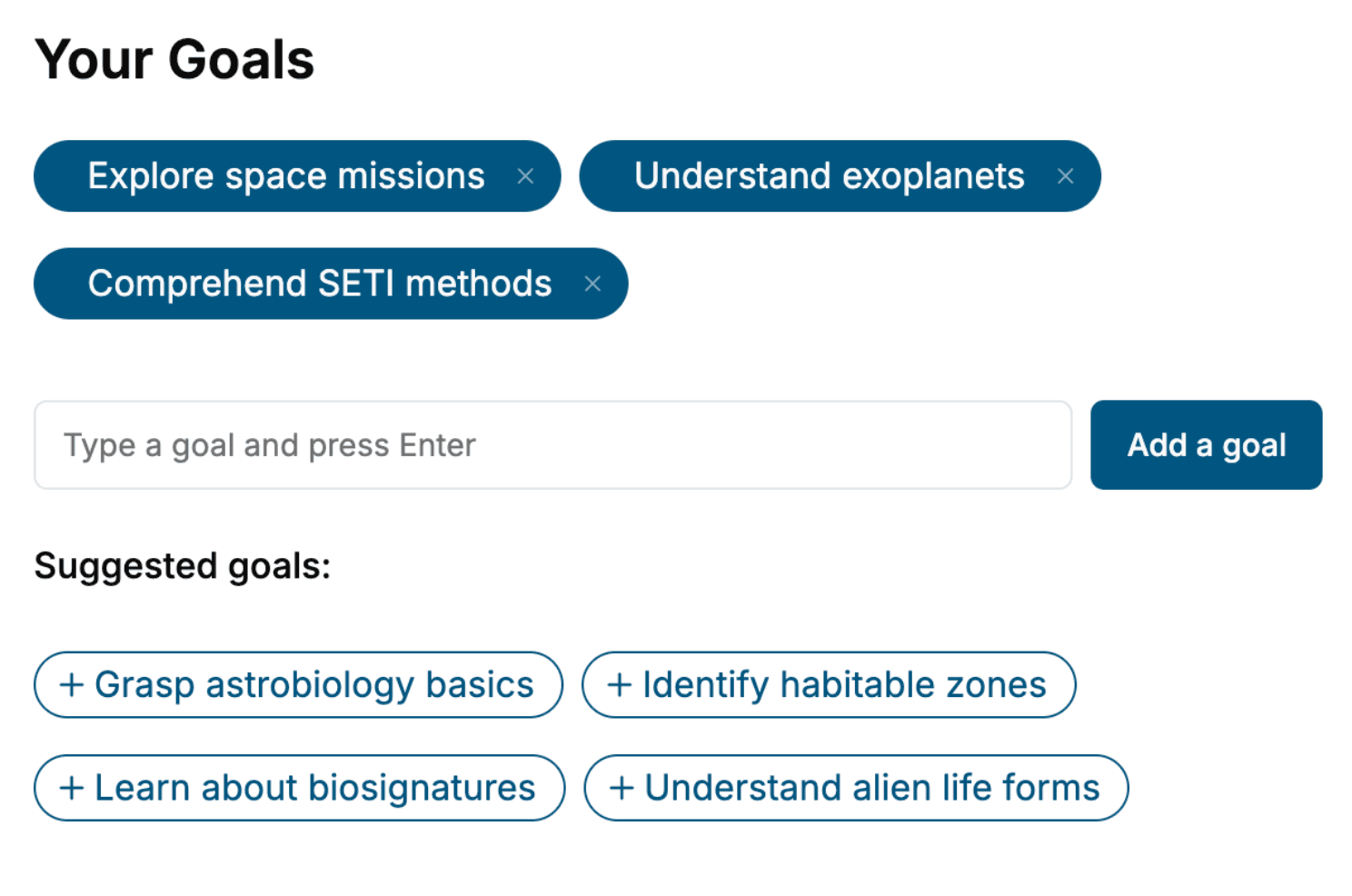
Tell us your goals and background, and get your own version of this book, tailored by AI to you.


Benefits of AI-tailored books
- Read one book, not ten:
- all the AI and Machine Learning knowledge you need, gathered into a single book.
- Save days of learning:
- tell us your goals, choose your topics, and the whole book is built around them.
- Learn effortlessly:
- AI and Machine Learning book written for your specific background and expertise.
- Understand at a glance:
- includes charts, tables, timelines, checklists, decision trees, and more.
- Stay current:
- written the day you order it, not years ago.
- Trust what you read:
- every book is checked for accuracy, with real research when your subject needs it.
Create your unique book in 3 steps
- 1. Select your focus
Select the focus of your AI and Machine Learning book and share your background
- 2. Personalize your book
Specify your goals and choose sub-topics to include
- 3. Get your tailored book
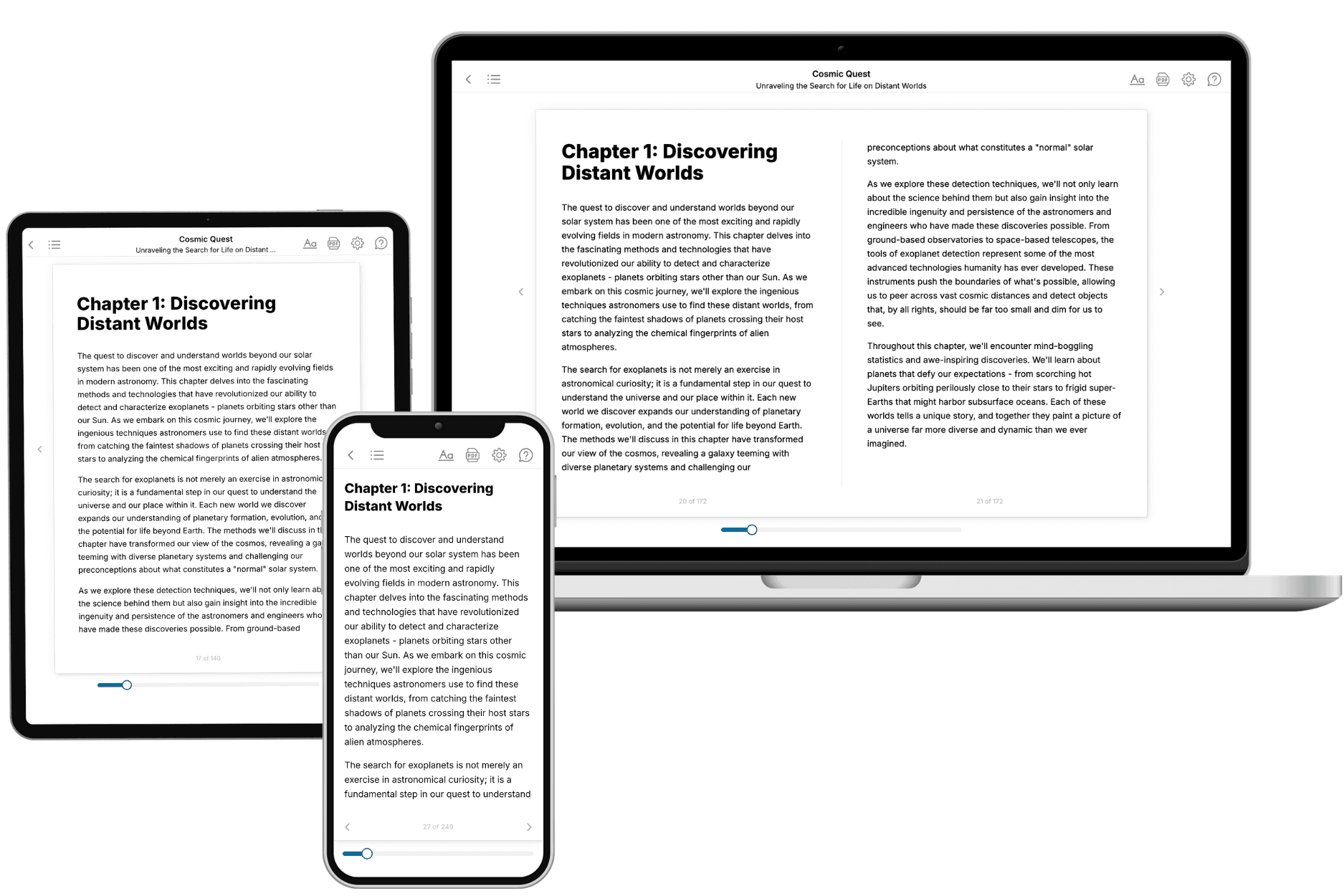
Your book is ready in 10 minutes. Read it online, download as EPUB or PDF, or send to Kindle.

Frequently asked questions
- What is TailoredRead?
TailoredRead creates complete, full-length nonfiction ebooks, written specifically for you. Tell us what you want to learn and why, and TailoredRead writes you a complete ebook on it, with charts, tables, and diagrams throughout. Read it online, on Kindle, or on any e-reader, or download it as a PDF or EPUB. Every book is written fresh the day you order it.
- How is the book tailored to me?
Before anything is written, you answer a few short questions about your goals, your background, and the topics you care about. Your book is then planned around your answers: written at your level, focused on your goals, and covering the topics you chose, instead of the one-size-fits-all book a store sells everyone.
- Will it read like generic AI content?
No. Your book isn't a chat transcript: it's planned chapter by chapter before a single word is written, told in a clear book voice, and explains ideas visually with charts, tables, and diagrams. After writing, every book goes through an editorial pass that polishes chapters so the book reads consistent from start to finish. Judge for yourself: browse thousands of sample books on our Explore Books page.
- How accurate is the content?
Our AI first checks whether your subject needs live research. Niche and fast-moving subjects are researched before writing, and the book plan and chapters are grounded in what it finds. After writing, every book goes through a quality pass that checks its facts and consistency, and researched books list their sources in a Notes section at the back.
- How long is the book?
You choose the length: Comprehensive (250-300 pages), Detailed (150-200 pages), Essential (70-100 pages), or Short (30-50 pages).
- Does the book include visuals?
Yes. Every book includes charts, tables, and diagrams: timelines, checklists, step-by-step guides, decision trees, comparison tables, matrices, and bar charts. A typical book includes dozens of these visual elements.
- Can I read it on Kindle? What formats can I download?
Yes. Every book can be read in our online reader or downloaded as a PDF or EPUB. The EPUB can be opened with Kindle, Apple Books, Kobo, and any e-reader. The Commercial and Author licenses also include an editable Word (DOCX) and Markdown download.
- How much does it cost?
About the price of a regular ebook. The exact price depends on your book's length and complexity, from $2 for the shortest books to $35 for the most comprehensive, and it's shown when you review your book, before you commit to anything. Each book is a one-time purchase, yours to keep, no subscription. Licenses that let you share, teach, or publish your book range from $35.99 to $49.99.
- Can I preview the book before purchasing?
Before you pay, you'll see what your book will cover: the title, a detailed description, the estimated length, and the complete chapter-by-chapter table of contents, so you know what you're getting before you decide. The full text itself is written after you purchase.
- How long does it take to create a book?
About 10 minutes. You can start reading the opening chapters while the rest is still being written.