Mastering Boundary Value Problems
A Practical Guide to Solving Differential Equations
Solve complex differential equations with confidence.
269 pages13 chaptersMar 1, 2025Mathematics
About this book
Mastering Boundary Value Problems equips you with the tools and techniques to tackle a wide range of mathematical challenges. This comprehensive guide takes you on a step-by-step journey through the intricacies of boundary value problems, from basic concepts to advanced applications. You'll develop a deep understanding of the underlying principles, learn to identify different types of boundary conditions, and master various solution methods. Through carefully crafted examples and exercises, you'll hone your problem-solving skills and gain the confidence to approach even the most daunting differential equations. Whether you're a student looking to excel in your mathematics courses or a professional seeking to enhance your analytical capabilities, this book provides the knowledge and practice you need. By the end, you'll have a robust toolkit for solving boundary value problems, enabling you to tackle real-world applications in physics, engineering, and beyond.
Table of contents
- IntroductionThe Importance of Boundary Value Problems, Overview of the Book, Prerequisites and Notation, How to Use This BookRead below
- Chapter 1: Foundations of Boundary Value ProblemsReview of Ordinary Differential Equations, Definition and Classification of Boundary Value Problems, Types of Boundary Conditions, Well-Posed Problems
- Chapter 2: Linear Boundary Value ProblemsHomogeneous Linear BVPs, Nonhomogeneous Linear BVPs, Principle of Superposition, Existence and Uniqueness of Solutions
- Chapter 3: Separation of VariablesConcept of Separation of Variables, Separation of Variables for ODEs, Separation of Variables for PDEs, Examples and Applications
- Chapter 4: Fourier Series and Boundary Value ProblemsIntroduction to Fourier Series, Convergence of Fourier Series, Fourier Series Solutions to BVPs, Examples and Applications
- Chapter 5: Sturm-Liouville TheoryThe Sturm-Liouville Problem, Eigenvalues and Eigenfunctions, Orthogonality of Eigenfunctions, Sturm-Liouville Expansions
- Chapter 6: Green's FunctionsConcept of Green's Functions, Construction of Green's Functions, Applications to BVPs, Examples and Exercises
- Chapter 7: Finite Difference MethodsIntroduction to Finite Differences, Finite Difference Approximations, Applying Finite Differences to BVPs, Stability and Convergence
- Chapter 8: Finite Element MethodsIntroduction to Finite Elements, Weak Formulation of BVPs, Discretization and Element Types, Assembly and Solution
- Chapter 9: The Shooting MethodConcept of the Shooting Method, Linear Shooting Method, Nonlinear Shooting Method, Examples and Applications
- Chapter 10: Eigenvalue ProblemsIntroduction to Eigenvalue Problems, Regular Sturm-Liouville Problems, Singular Sturm-Liouville Problems, Applications in Physics and Engineering
- Chapter 11: Nonlinear Boundary Value ProblemsIntroduction to Nonlinear BVPs, Linearization Techniques, Iteration Methods, Examples and Case Studies
- Chapter 12: Advanced Topics in Boundary Value ProblemsMulti-dimensional BVPs, Spectral Methods, Variational Methods, Asymptotic Methods
- Chapter 13: Applications of Boundary Value ProblemsHeat Conduction Problems, Wave Propagation, Quantum Mechanics, Fluid Dynamics, Elasticity Theory
- ConclusionSummary of Key Concepts, Future Directions in BVP Research
- AppendixMathematical Preliminaries, Numerical Software for BVPs
- Glossary
Introduction
Welcome to "Mastering Boundary Value Problems: A Practical Guide to Solving Differential Equations." This comprehensive guide is designed to take you on a journey through the fascinating world of boundary value problems (BVPs) in differential equations. Whether you're a mathematics student looking to deepen your understanding or a professional seeking to enhance your problem-solving skills, this book will equip you with the knowledge and techniques necessary to tackle a wide range of mathematical challenges with confidence.
Boundary value problems are a fundamental concept in the study of differential equations, with far-reaching applications in physics, engineering, and various other scientific disciplines. These problems arise when we seek solutions to differential equations that satisfy specific conditions at the boundaries of a domain. Understanding and solving BVPs is crucial for modeling and analyzing numerous real-world phenomena, from heat conduction and wave propagation to quantum mechanics and fluid dynamics.
Throughout this book, you will develop a deep understanding of the underlying principles of boundary value problems, learn to identify different types of boundary conditions, and master various solution methods. By working through carefully crafted examples and exercises, you will hone your problem-solving skills and gain the confidence to approach even the most daunting differential equations. The knowledge and practice you gain from this book will provide you with a robust toolkit for solving boundary value problems, enabling you to tackle real-world applications with ease and precision.
The Importance of Boundary Value Problems
Boundary value problems play a pivotal role in the mathematical modeling of physical phenomena and engineering systems. Unlike initial value problems, which specify conditions at a single point (usually the starting point), boundary value problems involve conditions imposed at two or more points of the domain. This characteristic makes BVPs particularly suited for describing systems where the behavior at the boundaries significantly influences the overall solution.
The importance of boundary value problems extends far beyond the realm of pure mathematics. In physics, BVPs are essential for describing phenomena such as heat conduction, where the temperature distribution in a material is governed by the heat equation subject to specific boundary conditions. In engineering, BVPs arise in structural analysis, where the deflection of a beam under load must satisfy certain conditions at its supports. Even in fields like economics and biology, boundary value problems find applications in modeling complex systems with constrained behaviors.
One of the key reasons for the significance of BVPs is their ability to capture the essence of many physical laws and principles. For instance, the wave equation, which describes the propagation of waves in various media, is typically formulated as a boundary value problem. The solution to this problem not only provides insights into the behavior of waves but also forms the basis for understanding phenomena ranging from sound propagation to electromagnetic radiation.
Moreover, the study of boundary value problems has led to the development of powerful mathematical techniques that have applications beyond their original context. The method of separation of variables, Fourier series expansions, and Green's functions are just a few examples of techniques that originated from the analysis of BVPs but have found widespread use in various branches of mathematics and physics.
In the field of numerical analysis, boundary value problems have spurred the development of sophisticated computational methods. Finite difference and finite element methods, which are indispensable tools in modern scientific computing, were largely motivated by the need to solve complex BVPs that lack analytical solutions. These numerical techniques have revolutionized our ability to model and simulate real-world systems, from predicting weather patterns to designing advanced materials.
The theoretical study of boundary value problems has also contributed significantly to the advancement of mathematical analysis. Concepts such as well-posedness, which ensures that a mathematical problem has a unique solution that depends continuously on the input data, have their roots in the analysis of BVPs. The Sturm-Liouville theory, which provides a framework for analyzing eigenvalue problems in BVPs, has far-reaching implications in functional analysis and spectral theory.
Furthermore, boundary value problems serve as a bridge between pure and applied mathematics. They provide a concrete context for abstract mathematical concepts, allowing students and researchers to see the practical implications of theoretical results. This connection between theory and application makes the study of BVPs an excellent vehicle for developing mathematical intuition and problem-solving skills.
As you progress through this book, you will come to appreciate the elegance and power of boundary value problems in modeling and solving real-world problems. The techniques you learn will not only enhance your mathematical abilities but also provide you with valuable insights into the underlying principles that govern many natural phenomena. Whether your interest lies in theoretical mathematics, applied sciences, or engineering, a solid understanding of boundary value problems will prove to be an invaluable asset in your academic and professional journey.
Overview of the Book
"Mastering Boundary Value Problems" is structured to provide a comprehensive and systematic approach to understanding and solving boundary value problems. The book is designed to take you from the foundational concepts to advanced techniques, ensuring a thorough grasp of the subject matter. Each chapter builds upon the knowledge gained in previous sections, creating a cohesive learning experience that reinforces key concepts and gradually introduces more complex ideas.
The journey begins with a solid foundation in Chapter 1, where we review the essential concepts of ordinary differential equations and introduce the definition and classification of boundary value problems. This chapter sets the stage for the rest of the book by establishing the fundamental principles and terminology that will be used throughout. You'll learn about the different types of boundary conditions and the concept of well-posed problems, which is crucial for understanding when a BVP has a meaningful and unique solution.
Chapter 2 delves into linear boundary value problems, covering both homogeneous and nonhomogeneous cases. This chapter introduces the principle of superposition and explores the conditions for the existence and uniqueness of solutions. These concepts form the backbone of many solution techniques and will be revisited frequently as you progress through the book.
In Chapter 3, we explore the powerful method of separation of variables. This technique is particularly useful for solving certain types of partial differential equations subject to boundary conditions. You'll learn how to apply this method to both ordinary and partial differential equations, and work through numerous examples to solidify your understanding.
Chapter 4 introduces Fourier series and their applications to boundary value problems. This chapter bridges the gap between the theoretical aspects of Fourier analysis and its practical use in solving BVPs. You'll gain insights into the convergence properties of Fourier series and learn how to represent solutions to boundary value problems using these expansions.
The book then progresses to more advanced topics. Chapter 5 covers Sturm-Liouville theory, a fundamental framework for analyzing eigenvalue problems in BVPs. This theory not only provides a deeper understanding of the structure of solutions but also has important applications in quantum mechanics and other areas of physics.
Chapter 6 introduces Green's functions, a powerful technique for solving inhomogeneous boundary value problems. You'll learn how to construct Green's functions and apply them to a variety of BVPs, appreciating their elegance and efficiency in obtaining solutions.
Chapters 7 and 8 focus on numerical methods, specifically finite difference and finite element methods. These chapters provide you with practical tools for solving complex BVPs that may not have analytical solutions. You'll learn how to discretize continuous problems, set up systems of equations, and analyze the stability and convergence of numerical solutions.
Chapter 9 introduces the shooting method, a technique that transforms boundary value problems into initial value problems. This method is particularly useful for certain types of BVPs and provides an alternative approach when other methods may be difficult to apply.
In Chapter 10, we delve deeper into eigenvalue problems, exploring both regular and singular Sturm-Liouville problems. This chapter emphasizes the physical interpretations and applications of eigenvalue problems in various fields of science and engineering.
Chapter 11 tackles nonlinear boundary value problems, introducing linearization techniques and iteration methods. This chapter prepares you to handle more complex real-world problems that often involve nonlinear differential equations.
The book concludes with two chapters that broaden your horizons. Chapter 12 covers advanced topics such as multi-dimensional BVPs, spectral methods, variational methods, and asymptotic techniques. Chapter 13 showcases the applications of boundary value problems in various fields, including heat conduction, wave propagation, quantum mechanics, fluid dynamics, and elasticity theory.
Throughout the book, you'll find numerous examples, exercises, and case studies that illustrate the concepts and techniques presented. These practical components are designed to enhance your problem-solving skills and deepen your understanding of the material. By the end of the book, you'll have a comprehensive toolkit for approaching and solving a wide range of boundary value problems, preparing you for advanced studies or real-world applications in your field of interest.
Prerequisites and Notation
To make the most of this book, it is assumed that you have a solid foundation in calculus and a basic understanding of ordinary differential equations. Familiarity with linear algebra concepts, such as matrices and eigenvalues, will also be beneficial, especially in later chapters. While the book is designed to be self-contained, with key concepts reviewed as needed, a prior course in differential equations will significantly enhance your learning experience.
The notation used throughout the book follows standard mathematical conventions. Ordinary derivatives are denoted by prime symbols (e.g., y' for dy/dx), while partial derivatives are indicated using the ∂ symbol (e.g., ∂u/∂t). Vector quantities are represented in bold typeface, and matrices are typically denoted by capital letters. Special functions, such as Bessel functions or Legendre polynomials, are introduced and defined as they appear in the text.
For boundary value problems, we typically use the following notation:
- x, y, z: Independent variables, often representing spatial coordinates
- t: Time variable in time-dependent problems
- u(x), y(x): Unknown functions to be determined
- a, b: Endpoints of the interval for one-dimensional problems
- L: Differential operator (e.g., L = d²/dx² + k²)
- λ: Eigenvalue in Sturm-Liouville problems
- φ(x): Eigenfunction corresponding to an eigenvalue
- G(x,ξ): Green's function
When discussing numerical methods, we use the following additional notation:
- h: Step size in finite difference methods
- xi: Discrete points in the domain
- ui: Approximate solution at point xi
- N: Number of discretization points or elements
Throughout the book, important theorems, definitions, and results are clearly highlighted and numbered for easy reference. Proofs of key theorems are provided where they contribute to understanding, but some more advanced proofs may be omitted or left as exercises to maintain focus on practical problem-solving skills.
Each chapter concludes with a set of exercises ranging from straightforward applications of the concepts to more challenging problems that extend the ideas presented. Working through these exercises is crucial for solidifying your understanding and developing the problem-solving skills necessary to master boundary value problems.
While the book primarily focuses on analytical methods, computational tools are introduced where appropriate. Basic familiarity with a scientific programming language (such as MATLAB, Python, or Julia) can be helpful for implementing numerical methods and visualizing solutions, especially in later chapters. However, the core concepts and techniques can be understood and applied without extensive programming knowledge.
As you progress through the book, you'll find that certain mathematical techniques and concepts are revisited and expanded upon. This spiral approach to learning allows for a deeper understanding of the material as you encounter familiar ideas in new contexts and with increasing complexity. Don't be discouraged if some concepts seem challenging at first; with practice and persistence, you'll develop a robust understanding of boundary value problems and their applications.
How to Use This Book
"Mastering Boundary Value Problems" is designed to be a comprehensive resource that can be used in various ways depending on your needs and background. Whether you're a student taking a course on differential equations, a researcher looking to refresh your knowledge, or a professional seeking to apply these concepts in your work, this book offers a flexible approach to learning and reference.
For students following a structured course, it's recommended to work through the chapters sequentially, as each builds upon the concepts introduced in previous sections. Pay close attention to the examples provided, as they illustrate the application of theoretical concepts to practical problems. After studying each section, attempt the exercises at the end of the chapter to reinforce your understanding. Don't hesitate to revisit earlier chapters if you encounter difficulties, as the spiral nature of the book means that concepts are often revisited and expanded upon.
If you're using this book for self-study, you may want to start by assessing your current knowledge. Review the table of contents and identify areas where you feel confident and those where you need more focus. You can then create a personalized study plan, allocating more time to challenging topics. As you work through the material, make use of the cross-references provided to connect related concepts across different chapters.
For researchers and professionals looking to apply boundary value problems to specific fields, you may find it useful to focus on the chapters most relevant to your area of interest. The applications chapter (Chapter 13) can serve as a starting point to identify which techniques are most applicable to your work. From there, you can delve into the relevant theoretical chapters to gain a deeper understanding of the methods.
Regardless of your approach, active engagement with the material is key to mastering boundary value problems. Here are some strategies to maximize your learning:
- Take notes and summarize key concepts in your own words. This process helps reinforce your understanding and creates a personalized reference for future review.
- Work through all example problems without looking at the solutions first. Then compare your approach with the one provided in the book.
- Attempt a variety of exercises, not just those that seem familiar. Challenging yourself with diverse problem types will enhance your problem-solving skills.
- Form study groups or find a study partner to discuss concepts and work through problems together. Explaining ideas to others is an excellent way to solidify your own understanding.
- Use visualization tools or software to graph solutions and explore how changing parameters affects the behavior of solutions.
- Connect the mathematical concepts to real-world applications in your field of interest. This connection enhances motivation and deepens understanding.
The book includes numerous footnotes and references to additional resources. While not essential for understanding the core material, these can provide valuable context and point you towards further reading on specific topics. If you're particularly interested in a subject, don't hesitate to explore these additional resources.
As you progress through the book, you'll notice that certain fundamental concepts, such as the principle of superposition or the construction of Green's functions, recur in different contexts. Pay special attention to these recurring themes, as they often represent powerful tools that can be applied across various types of boundary value problems.
Remember that mastering boundary value problems is a gradual process that requires patience and practice. Don't be discouraged if you don't grasp every concept immediately. Often, understanding deepens over time as you encounter ideas in different contexts and apply them to various problems. Regularly review earlier material as you progress, and you'll likely find that concepts that once seemed challenging become clearer in light of your growing knowledge.
Finally, consider keeping a "problem journal" where you record interesting problems, your approaches to solving them, and any insights you gain along the way. This journal can become a valuable personal resource, helping you track your progress and serving as a reference for problem-solving strategies.
By actively engaging with the material, practicing consistently, and connecting the concepts to real-world applications, you'll develop a deep and lasting understanding of boundary value problems. This knowledge will serve you well in your academic pursuits, research endeavors, or professional career, providing you with powerful tools to analyze and solve a wide range of mathematical and physical problems.
This is the end of the free sample. The full book has 13 chapters.
Want this book written for you?
Tell us your goals and background, and get your own version of this book, tailored by AI to you.


Benefits of AI-tailored books
- Read one book, not ten:
- all the Mathematics knowledge you need, gathered into a single book.
- Save days of learning:
- tell us your goals, choose your topics, and the whole book is built around them.
- Learn effortlessly:
- Mathematics book written for your specific background and expertise.
- Understand at a glance:
- includes charts, tables, timelines, checklists, decision trees, and more.
- Stay current:
- written the day you order it, not years ago.
- Trust what you read:
- every book is checked for accuracy, with real research when your subject needs it.
Create your unique book in 3 steps
- 1. Select your focus
Select the focus of your Mathematics book and share your background
- 2. Personalize your book
Specify your goals and choose sub-topics to include
- 3. Get your tailored book
Your book is ready in 10 minutes. Read it online, download as EPUB or PDF, or send to Kindle.


Frequently asked questions
- What is TailoredRead?
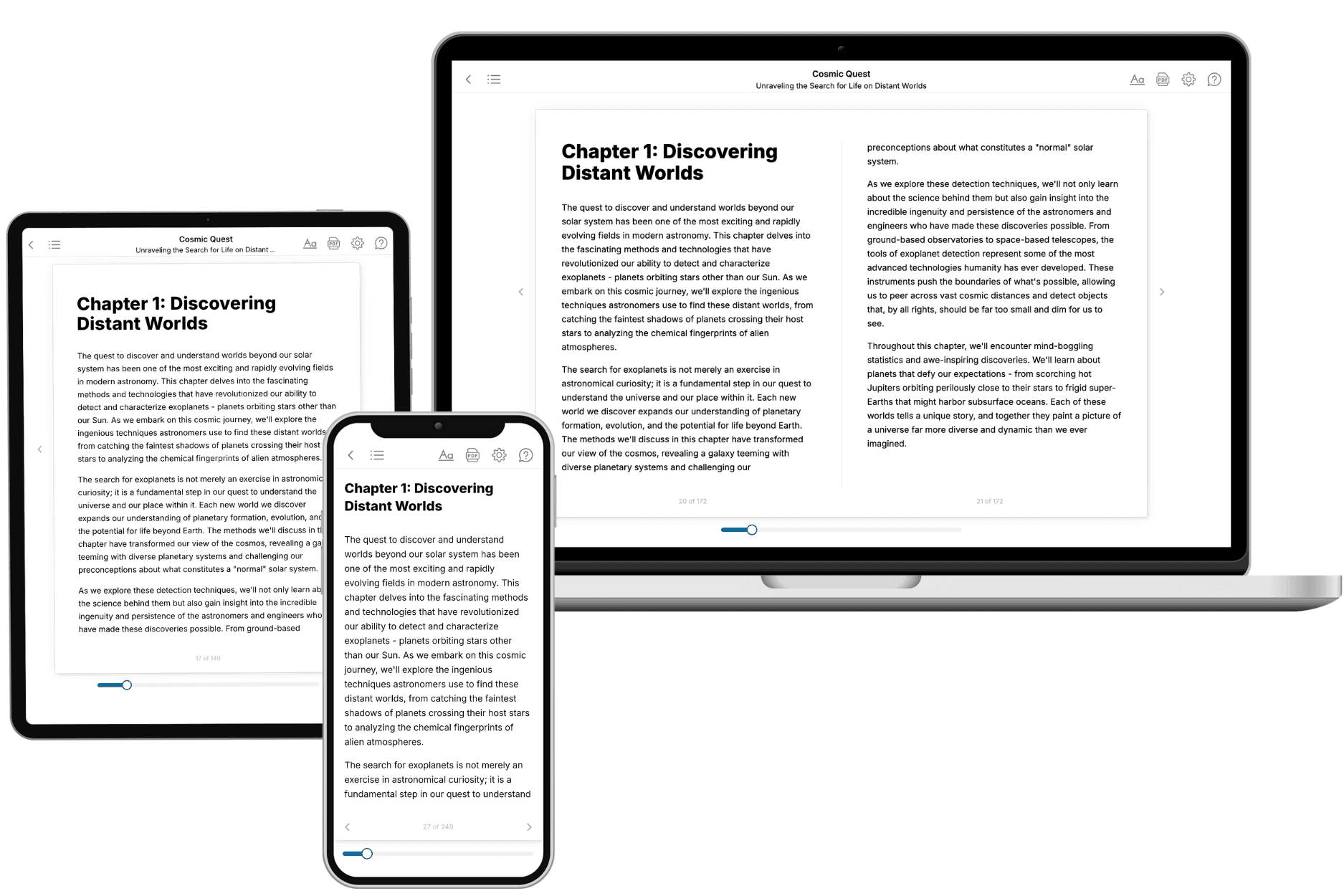
TailoredRead creates complete, full-length nonfiction ebooks, written specifically for you. Tell us what you want to learn and why, and TailoredRead writes you a complete ebook on it, with charts, tables, and diagrams throughout. Read it online, on Kindle, or on any e-reader, or download it as a PDF or EPUB. Every book is written fresh the day you order it.
- How is the book tailored to me?
Before anything is written, you answer a few short questions about your goals, your background, and the topics you care about. Your book is then planned around your answers: written at your level, focused on your goals, and covering the topics you chose, instead of the one-size-fits-all book a store sells everyone.
- Will it read like generic AI content?
No. Your book isn't a chat transcript: it's planned chapter by chapter before a single word is written, told in a clear book voice, and explains ideas visually with charts, tables, and diagrams. After writing, every book goes through an editorial pass that polishes chapters so the book reads consistent from start to finish. Judge for yourself: browse thousands of sample books on our Explore Books page.
- How accurate is the content?
Our AI first checks whether your subject needs live research. Niche and fast-moving subjects are researched before writing, and the book plan and chapters are grounded in what it finds. After writing, every book goes through a quality pass that checks its facts and consistency, and researched books list their sources in a Notes section at the back.
- How long is the book?
You choose the length: Comprehensive (250-300 pages), Detailed (150-200 pages), Essential (70-100 pages), or Short (30-50 pages).
- Does the book include visuals?
Yes. Every book includes charts, tables, and diagrams: timelines, checklists, step-by-step guides, decision trees, comparison tables, matrices, and bar charts. A typical book includes dozens of these visual elements.
- Can I read it on Kindle? What formats can I download?
Yes. Every book can be read in our online reader or downloaded as a PDF or EPUB. The EPUB can be opened with Kindle, Apple Books, Kobo, and any e-reader. The Commercial and Author licenses also include an editable Word (DOCX) and Markdown download.
- How much does it cost?
About the price of a regular ebook. The exact price depends on your book's length and complexity, from $2 for the shortest books to $35 for the most comprehensive, and it's shown when you review your book, before you commit to anything. Each book is a one-time purchase, yours to keep, no subscription. Licenses that let you share, teach, or publish your book range from $35.99 to $49.99.
- Can I preview the book before purchasing?
Before you pay, you'll see what your book will cover: the title, a detailed description, the estimated length, and the complete chapter-by-chapter table of contents, so you know what you're getting before you decide. The full text itself is written after you purchase.
- How long does it take to create a book?
About 10 minutes. You can start reading the opening chapters while the rest is still being written.