Mastering the Calculus of Variations
A Practical Guide to Advanced Mathematical Optimization
Elevate your mathematical prowess with "Mastering the Calculus of Variations." This comprehensive guide takes you on an intellectual journey through the fascinating world of mathematical optimization.
253 pages12 chaptersJan 28, 2025Mathematics
About this book
You'll delve into the core principles and applications of this powerful mathematical tool, gaining insights that will reshape your approach to problem-solving. From the foundations of variational principles to advanced techniques in optimization theory, this book equips you with the knowledge and skills to tackle complex mathematical challenges. You'll explore real-world applications, unravel historical developments, and gain a deeper appreciation for the elegance of mathematical theory. Whether you're a student looking to excel in your studies or a professional seeking to enhance your analytical toolkit, "Mastering the Calculus of Variations" offers a clear, engaging, and authoritative guide to this essential field. Prepare to see the world of mathematics in a new light and unlock a powerful set of tools for solving optimization problems across various disciplines.
Table of contents
- IntroductionWhat is the Calculus of Variations?, Historical Context and Significance, Overview of the Book, Why Study the Calculus of Variations?Read below
- Chapter 1: Foundations of Variational PrinciplesIntroduction to Optimization Problems, Basic Concepts of Functional Analysis, Formulating Variational Problems, Extrema and Stationary Points
- Chapter 2: The Euler-Lagrange EquationDerivation of the Euler-Lagrange Equation, Interpretation and Significance, Applications in Physics and Mechanics, Solved Examples and Exercises
- Chapter 3: Constrained Variational ProblemsIsoperimetric Problems, Method of Lagrange Multipliers, Holonomic and Non-holonomic Constraints, Examples of Constrained Problems
- Chapter 4: Variational Problems with Multiple VariablesFormulation of Multivariable Problems, Partial Derivatives and Total Derivatives, Multivariable Euler-Lagrange Equations, Solved Examples and Applications
- Chapter 5: Hamilton's Principle and Lagrangian MechanicsThe Principle of Least Action, Lagrangian Formulation of Mechanics, Conservation Laws and Noether's Theorem, Introduction to Hamilton-Jacobi Theory
- Chapter 6: Direct Methods in the Calculus of VariationsThe Ritz Method, The Kantorovich Method, Introduction to Finite Element Methods, Applications and Examples
- Chapter 7: The Second Variation and Sufficient ConditionsTheory of the Second Variation, The Legendre Condition, The Jacobi Condition, The Weierstrass Condition
- Chapter 8: Introduction to Optimal Control TheoryFormulation of Optimal Control Problems, Pontryagin's Maximum Principle, Dynamic Programming and the Hamilton-Jacobi-Bellman Equation, Applications in Engineering and Economics
- Chapter 9: Numerical Methods in Variational ProblemsDiscretization Techniques, Gradient and Steepest Descent Methods, Newton and Quasi-Newton Methods, Numerical Examples and Case Studies
- Chapter 10: Advanced Topics in Functional AnalysisBanach and Hilbert Spaces, Weak and Strong Convergence, Compact Operators and Spectral Theory, Introduction to Distributions
- Chapter 11: The Calculus of Variations and Partial Differential EquationsVariational Formulation of PDEs, Weak Solutions and Sobolev Spaces, Eigenvalue Problems and Variational Principles, Applications in Mathematical Physics
- Chapter 12: Modern Developments and ApplicationsShape Optimization, Applications in Image Processing, Variational Methods in Machine Learning, Variational Principles in Quantum Mechanics, Future Directions and Open Problems
- Conclusion
- Appendix: Mathematical PrerequisitesReview of Multivariable Calculus, Essential Linear Algebra, Basics of Ordinary Differential Equations
- Glossary of Terms
Introduction
Welcome to the fascinating world of the Calculus of Variations, a powerful mathematical discipline that has shaped our understanding of optimization and natural phenomena for centuries. As you embark on this journey through "Mastering the Calculus of Variations," you are about to unlock a realm of mathematical beauty and practical significance that extends far beyond the confines of pure mathematics. This introduction will serve as your gateway, providing you with a comprehensive overview of what lies ahead and why this subject is worthy of your dedicated study.
The Calculus of Variations stands at the intersection of several mathematical fields, including analysis, differential equations, and optimization theory. Its principles underlie many fundamental laws of nature and have wide-ranging applications in physics, engineering, economics, and computer science. As you progress through this book, you will discover how this powerful tool can be used to solve complex optimization problems, understand natural phenomena, and develop innovative solutions in various fields.
Whether you are a student seeking to deepen your mathematical understanding or a professional looking to expand your analytical toolkit, this book is designed to guide you through the intricacies of variational calculus with clarity and precision. By the time you reach the conclusion, you will have gained not only a solid theoretical foundation but also practical skills in applying variational methods to real-world problems.
In this introduction, we will begin by defining the Calculus of Variations and exploring its historical context. We will then provide an overview of the book's structure and content, highlighting key concepts and techniques you will encounter. Finally, we will discuss the compelling reasons why studying the Calculus of Variations is not only intellectually rewarding but also practically valuable in today's world of advanced technology and complex systems.
Prepare to challenge your mathematical intuition, expand your problem-solving capabilities, and gain insights into the elegant principles that govern optimization in nature and human-made systems. The journey ahead promises to be both intellectually stimulating and practically enriching. Let's begin our exploration of the Calculus of Variations.
What is the Calculus of Variations?
The Calculus of Variations is a branch of mathematical analysis that deals with finding optimal solutions to problems involving the minimization or maximization of functionals. Unlike classical calculus, which focuses on finding extrema of functions, the Calculus of Variations extends this concept to functionals—functions of functions. This subtle yet profound difference opens up a vast landscape of mathematical possibilities and applications.
At its core, the Calculus of Variations is concerned with finding functions that optimize certain quantities. For example, you might seek the shape of a curve that minimizes the time for an object to slide from one point to another under the influence of gravity (the famous brachistochrone problem), or the optimal path for a rocket to reach its destination while minimizing fuel consumption. These problems, while diverse in nature, share a common thread: they involve finding an optimal function rather than just an optimal value.
The fundamental object of study in the Calculus of Variations is the functional. A functional can be thought of as a function that takes another function as its input and returns a real number as its output. Mathematically, we often express this as an integral of the form:
Here, J[y] represents the functional, y(x) is the function we're seeking to optimize, and F is some given function that depends on x, y(x), and its derivative y'(x). The challenge is to find the function y(x) that makes J[y] either a minimum or a maximum.J[y] = ∫ab F(x, y(x), y'(x)) dx
The power of the Calculus of Variations lies in its ability to transform complex optimization problems into more manageable differential equations. The cornerstone of this transformation is the Euler-Lagrange equation, which provides necessary conditions for a function to be an extremal (a potential optimum) of a given functional. This equation, which you will explore in depth later in this book, serves as the foundation for solving a wide array of variational problems.
One of the most striking aspects of the Calculus of Variations is its universality. The principles developed in this field apply not only to mathematical abstractions but also to real-world phenomena across various disciplines. In physics, for instance, the principle of least action—a fundamental variational principle—underlies much of classical and modern physics, from classical mechanics to quantum field theory. In engineering, variational methods are used to optimize structural designs, control systems, and signal processing algorithms. Even in economics, variational techniques find applications in optimal control problems and dynamic optimization.
As you delve deeper into the Calculus of Variations, you will encounter a rich tapestry of concepts and techniques. You'll learn about direct methods for solving variational problems, explore the connections between variational principles and partial differential equations, and discover how numerical methods can be applied to tackle complex problems that defy analytical solutions. You'll also see how the field extends to more advanced topics such as optimal control theory and shape optimization.
It's important to note that while the Calculus of Variations shares some similarities with other branches of mathematics, it has its own unique character. Unlike ordinary calculus, which deals with finite-dimensional spaces, the Calculus of Variations often operates in infinite-dimensional function spaces. This shift brings both challenges and opportunities, requiring new mathematical tools and ways of thinking.
As you progress through this book, you'll find that the Calculus of Variations is not just a collection of techniques, but a way of approaching problems. It encourages you to think in terms of optimality and to seek elegant, general solutions to complex problems. This mindset is invaluable not only in mathematics but in any field where optimization and efficiency are paramount.
In essence, the Calculus of Variations is a powerful framework for understanding and solving optimization problems in their most general form. It provides a bridge between pure mathematics and applied sciences, offering insights into the fundamental principles that govern natural phenomena and human-designed systems alike. As you embark on your journey through this fascinating field, prepare to expand your mathematical horizons and gain a new perspective on the world of optimization.
Historical Context and Significance
The Calculus of Variations has a rich and fascinating history that spans several centuries, intertwining with the development of physics, mathematics, and engineering. Understanding this historical context not only provides valuable insights into the evolution of mathematical thought but also illuminates the profound impact that variational principles have had on our understanding of the natural world.
The roots of the Calculus of Variations can be traced back to ancient Greece, where mathematicians and philosophers grappled with optimization problems. One of the earliest examples is the isoperimetric problem, which asks what shape encloses the maximum area for a given perimeter. While the ancient Greeks intuitively understood that the circle was the solution, a rigorous proof eluded them for centuries[1].
The modern era of the Calculus of Variations began in the 17th century with the work of Pierre de Fermat. In 1662, Fermat formulated his principle of least time, which states that light travels between two points along the path that requires the least time. This principle, while seemingly simple, had profound implications for the development of optics and laid the groundwork for variational thinking in physics.
The true birth of the Calculus of Variations as a distinct mathematical discipline is often attributed to the Bernoulli brothers, Jakob and Johann, in the late 17th century. In 1696, Johann Bernoulli posed the famous brachistochrone problem: find the curve along which a bead will slide from one point to another in the least time, assuming only the force of gravity. This problem captured the imagination of mathematicians across Europe, including luminaries such as Isaac Newton and Gottfried Wilhelm Leibniz.
The solutions to the brachistochrone problem, particularly those provided by Jakob Bernoulli and Leibniz, laid the foundation for the systematic study of variational problems. However, it was Leonhard Euler who made the next significant leap. In his seminal work "Methodus inveniendi lineas curvas maximi minimive proprietate gaudentes" (1744), Euler developed a general method for solving variational problems, introducing what we now call the Euler-Lagrange equation[2].
Joseph-Louis Lagrange further refined and extended Euler's work in the late 18th century. Lagrange's contributions included the development of the method of variations, which provided a more systematic approach to deriving the Euler-Lagrange equation. He also extended the theory to problems with constraints, laying the groundwork for what would later become the method of Lagrange multipliers.
The 19th century saw a flourishing of the Calculus of Variations, with contributions from mathematicians such as Carl Gustav Jacob Jacobi, Karl Weierstrass, and David Hilbert. Jacobi developed the theory of the second variation, providing sufficient conditions for a solution to be a true minimum. Weierstrass introduced the concept of the "strong" extremum and developed what is now known as the Weierstrass excess function. Hilbert's work on direct methods in the Calculus of Variations laid the foundation for modern functional analysis.
Parallel to these mathematical developments, the Calculus of Variations found increasing applications in physics. William Rowan Hamilton's reformulation of classical mechanics in terms of variational principles in the 1830s was particularly significant. Hamilton's principle of least action provided a unifying framework for mechanics and opened new avenues for the application of variational methods in physics.
The 20th century witnessed a further expansion of the Calculus of Variations into new domains. The development of optimal control theory by Lev Pontryagin and Richard Bellman in the 1950s extended variational methods to a broader class of optimization problems. In mathematics, the work of Ennio De Giorgi, John Nash, and Jürgen Moser on regularity theory for elliptic partial differential equations showcased the deep connections between variational problems and PDEs.
The advent of computers and numerical methods in the latter half of the 20th century opened up new possibilities for applying variational techniques to complex real-world problems. Finite element methods, which have their roots in variational principles, have become indispensable tools in engineering and scientific computing.
Today, the Calculus of Variations continues to be an active area of research with applications spanning an ever-widening range of fields. From shape optimization in engineering to variational methods in machine learning and image processing, the principles developed over centuries continue to find new and exciting applications.
The historical significance of the Calculus of Variations extends beyond its mathematical content. It represents a shift in how mathematicians and scientists approach problems, emphasizing global optimization and the search for general principles. This perspective has profoundly influenced our understanding of nature, from the behavior of light to the fundamental laws of physics.
As you delve deeper into the Calculus of Variations, keep in mind that you are engaging with a rich intellectual tradition that has shaped our understanding of the world. The problems and methods you will encounter are not just abstract mathematical exercises, but part of a long-standing quest to uncover the fundamental principles that govern our universe.
Overview of the Book
"Mastering the Calculus of Variations" is designed to provide you with a comprehensive and accessible exploration of this powerful mathematical discipline. The book is structured to guide you from the foundational concepts to advanced applications, ensuring a thorough understanding of both the theoretical underpinnings and practical implementations of variational methods. As you progress through the chapters, you will build a robust toolkit for tackling a wide range of optimization problems and gain insights into the deep connections between the Calculus of Variations and other areas of mathematics and physics.
The book begins with this introduction, which sets the stage by defining the Calculus of Variations, exploring its historical context, and outlining the journey ahead. Following this, the main body of the book is divided into twelve chapters, each focusing on a key aspect of variational calculus. Let's take a closer look at what each chapter has to offer:
Chapter 1, "Foundations of Variational Principles," lays the groundwork for your study. You'll be introduced to the concept of optimization problems in a functional setting and learn the basic ideas of functional analysis that underpin variational methods. This chapter will help you formulate variational problems and understand the notion of extrema in function spaces.
Chapter 2 delves into "The Euler-Lagrange Equation," the cornerstone of variational calculus. You'll learn how to derive this fundamental equation, understand its significance, and see how it applies to problems in physics and mechanics. Through solved examples and exercises, you'll gain proficiency in using the Euler-Lagrange equation to solve a variety of variational problems.
In Chapter 3, "Constrained Variational Problems," you'll explore how to handle optimization problems with additional constraints. You'll study isoperimetric problems, learn the method of Lagrange multipliers, and understand the difference between holonomic and non-holonomic constraints. This chapter will equip you with tools to tackle more complex, real-world optimization scenarios.
Chapter 4 extends your knowledge to "Variational Problems with Multiple Variables." You'll learn how to formulate and solve problems involving functions of several variables, mastering the use of partial derivatives and total derivatives in the variational context. This chapter bridges the gap between single-variable and multi-variable calculus in the variational setting.
Chapter 5, "Hamilton's Principle and Lagrangian Mechanics," connects variational calculus to classical mechanics. You'll explore the principle of least action, understand the Lagrangian formulation of mechanics, and be introduced to conservation laws and Noether's theorem. This chapter showcases the profound link between variational principles and fundamental laws of physics.
In Chapter 6, "Direct Methods in the Calculus of Variations," you'll learn alternative approaches to solving variational problems. You'll study the Ritz method, the Kantorovich method, and get an introduction to finite element methods. These techniques are particularly valuable when dealing with problems that don't have closed-form solutions.
Chapter 7 covers "The Second Variation and Sufficient Conditions." Here, you'll delve deeper into the theory of extrema, learning about the Legendre condition, the Jacobi condition, and the Weierstrass condition. This chapter provides you with tools to determine whether a solution is truly a minimum or maximum, not just a stationary point.
Chapter 8 introduces you to "Optimal Control Theory," an extension of variational calculus with wide-ranging applications. You'll learn about Pontryagin's Maximum Principle and the Hamilton-Jacobi-Bellman equation, seeing how these principles apply to problems in engineering and economics.
Chapter 9, "Numerical Methods in Variational Problems," bridges theory and practice. You'll explore discretization techniques, gradient methods, and Newton-type methods for solving variational problems numerically. This chapter is crucial for applying variational methods to complex, real-world problems that defy analytical solutions.
In Chapter 10, "Advanced Topics in Functional Analysis," you'll deepen your mathematical foundation. You'll study Banach and Hilbert spaces, weak and strong convergence, and get an introduction to distributions. This chapter provides the theoretical backdrop for understanding modern developments in variational calculus.
Chapter 11 explores "The Calculus of Variations and Partial Differential Equations." You'll learn about the variational formulation of PDEs, weak solutions, and eigenvalue problems. This chapter illuminates the deep connections between variational principles and the theory of partial differential equations.
The final chapter, "Modern Developments and Applications," brings you to the cutting edge of the field. You'll explore shape optimization, applications in image processing and machine learning, and variational principles in quantum mechanics. The chapter concludes with a discussion of future directions and open problems, inspiring you to continue your exploration beyond this book.
Throughout the book, you'll find a wealth of examples, exercises, and real-world applications to reinforce your understanding. Each chapter builds on the previous ones, gradually increasing in complexity while maintaining a clear, accessible approach. By the end of the book, you'll have a comprehensive understanding of the Calculus of Variations and be well-equipped to apply these powerful techniques to a wide range of problems.
The book also includes an appendix covering mathematical prerequisites, ensuring that you have the necessary background in multivariable calculus, linear algebra, and ordinary differential equations. A glossary of terms is provided to help you navigate the terminology specific to variational calculus.
As you progress through "Mastering the Calculus of Variations," remember that each concept and technique you learn is a building block in your mathematical toolkit. Take the time to work through the examples and exercises, and don't hesitate to revisit earlier chapters as needed. The journey through this fascinating field promises to be challenging but immensely rewarding, opening up new ways of thinking about optimization and the fundamental principles that govern our world.
Why Study the Calculus of Variations?
As you embark on your journey through the Calculus of Variations, you might wonder about the practical value and intellectual rewards of studying this advanced mathematical discipline. The reasons for delving into this field are numerous and compelling, spanning from pure mathematical beauty to wide-ranging real-world applications. Let's explore why the study of the Calculus of Variations is not only intellectually stimulating but also practically valuable in today's world of advanced technology and complex systems.
First and foremost, the Calculus of Variations provides a powerful framework for understanding and solving optimization problems. In an era where efficiency and optimization are paramount across various fields, from engineering to economics, the ability to formulate and solve complex optimization problems is an invaluable skill. By mastering variational techniques, you'll be equipped to tackle a wide range of problems that involve finding the best possible solution among many alternatives.
The applications of variational methods are vast and diverse. In physics, variational principles underlie many fundamental laws of nature. Hamilton's principle of least action, for instance, provides a unifying framework for classical mechanics, electromagnetism, and even aspects of quantum mechanics. By studying the Calculus of Variations, you gain deep insights into the fundamental principles that govern the physical world[3].
In engineering, variational methods play a crucial role in structural optimization, control theory, and signal processing. For example, in aerospace engineering, variational techniques are used to design optimal trajectories for spacecraft, minimizing fuel consumption while satisfying mission constraints. In civil engineering, the same principles are applied to optimize the design of structures, balancing factors such as strength, weight, and cost.
The field of computer science and artificial intelligence has also embraced variational methods. Machine learning algorithms, particularly those involving neural networks, often rely on optimization techniques rooted in variational calculus. By understanding these principles, you'll be better equipped to develop and improve algorithms for data analysis, pattern recognition, and decision-making systems.
In the realm of image and signal processing, variational methods have proven to be powerful tools. Techniques for image denoising, segmentation, and reconstruction often involve solving variational problems. By studying the Calculus of Variations, you'll gain insights into how these algorithms work and how to develop new ones for emerging challenges in digital media processing.
Economics and finance also benefit from variational techniques. Optimal control theory, an extension of the Calculus of Variations, finds applications in portfolio optimization, resource allocation, and economic policy modeling. Understanding these methods can provide you with valuable tools for analyzing and solving complex economic problems.
Beyond its practical applications, studying the Calculus of Variations offers significant intellectual benefits. It enhances your mathematical reasoning and problem-solving skills, encouraging you to think in terms of global optimization rather than local analysis. This shift in perspective can be transformative, influencing how you approach problems in mathematics and beyond.
The Calculus of Variations also serves as a bridge between different areas of mathematics. It connects deeply with differential equations, functional analysis, and geometry. By studying variational methods, you'll gain a more unified view of mathematics, seeing how different branches interrelate and support each other. This interdisciplinary nature of variational calculus can be particularly valuable if you plan to pursue advanced studies in mathematics or related fields.
Moreover, the historical significance of the Calculus of Variations provides a fascinating lens through which to view the development of mathematical and scientific thought. From the brachistochrone problem that captivated 17th-century mathematicians to modern applications in quantum field theory, studying this field connects you to a rich intellectual tradition spanning centuries.
For those interested in research, the Calculus of Variations remains an active area with many open problems and new applications emerging. As technology advances and new challenges arise in science and engineering, variational methods continue to find novel applications. By mastering this field, you position yourself at the forefront of mathematical research and its applications.
Studying the Calculus of Variations also cultivates important skills that are valuable across various professions. It enhances your ability to formulate complex problems mathematically, a skill that is crucial in many scientific and technical fields. It improves your analytical thinking, teaching you to break down complex systems into manageable components. The iterative nature of solving variational problems also fosters persistence and creativity in problem-solving.
Furthermore, the Calculus of Variations exemplifies the beauty and elegance of mathematics. The way in which complex physical phenomena can be described by simple variational principles, or how intricate optimization problems can be solved through elegant mathematical formulations, showcases the aesthetic aspect of mathematics. This beauty can be a source of inspiration and wonder, enriching your appreciation of the mathematical sciences.
In conclusion, studying the Calculus of Variations offers a unique combination of theoretical depth and practical applicability. It equips you with powerful tools for solving optimization problems, provides insights into fundamental principles of nature, and enhances your mathematical reasoning skills. Whether your interests lie in pure mathematics, physics, engineering, economics, or computer science, the knowledge and skills you gain from studying variational calculus will be invaluable. As you progress through this book, keep in mind that you are not just learning a set of mathematical techniques, but gaining a new perspective on how to understand and optimize the world around you.
Notes
Introduction
- 1. H. H. Goldstine, A History of the Calculus of Variations from the 17th through the 19th Century, Springer-Verlag, 1980
- 2. C. G. Fraser, "Isoperimetric Problems in the Variational Calculus of Euler and Lagrange," Historia Mathematica, 1992
- 3. C. Lanczos, The Variational Principles of Mechanics, Dover Publications, 1986
This is the end of the free sample. The full book has 12 chapters.
Want this book written for you?
Tell us your goals and background, and get your own version of this book, tailored by AI to you.


Benefits of AI-tailored books
- Read one book, not ten:
- all the Mathematics knowledge you need, gathered into a single book.
- Save days of learning:
- tell us your goals, choose your topics, and the whole book is built around them.
- Learn effortlessly:
- Mathematics book written for your specific background and expertise.
- Understand at a glance:
- includes charts, tables, timelines, checklists, decision trees, and more.
- Stay current:
- written the day you order it, not years ago.
- Trust what you read:
- every book is checked for accuracy, with real research when your subject needs it.
Create your unique book in 3 steps
- 1. Select your focus
Select the focus of your Mathematics book and share your background
- 2. Personalize your book
Specify your goals and choose sub-topics to include
- 3. Get your tailored book
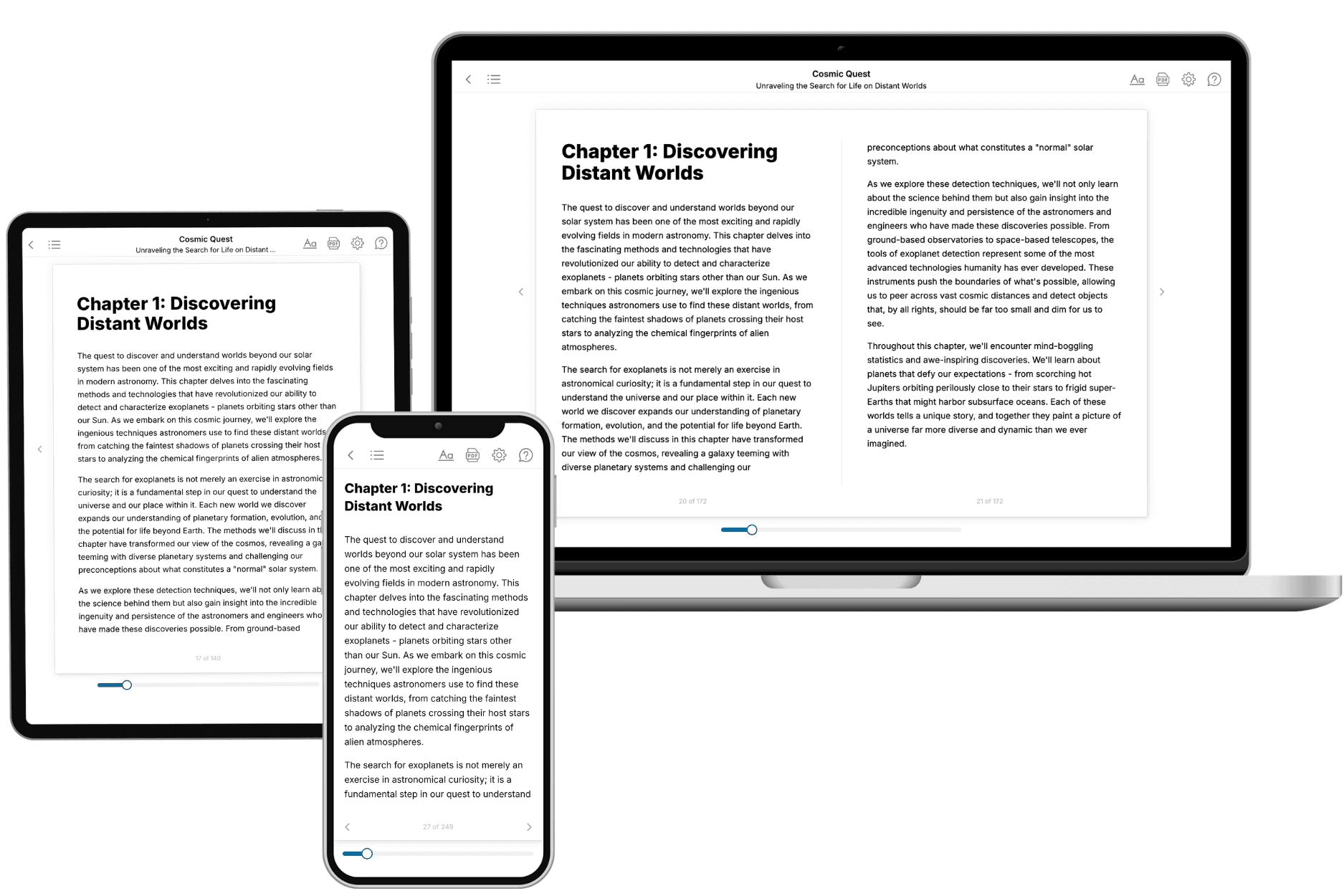
Your book is ready in 10 minutes. Read it online, download as EPUB or PDF, or send to Kindle.
Frequently asked questions
- What is TailoredRead?
TailoredRead creates complete, full-length nonfiction ebooks, written specifically for you. Tell us what you want to learn and why, and TailoredRead writes you a complete ebook on it, with charts, tables, and diagrams throughout. Read it online, on Kindle, or on any e-reader, or download it as a PDF or EPUB. Every book is written fresh the day you order it.
- How is the book tailored to me?
Before anything is written, you answer a few short questions about your goals, your background, and the topics you care about. Your book is then planned around your answers: written at your level, focused on your goals, and covering the topics you chose, instead of the one-size-fits-all book a store sells everyone.
- Will it read like generic AI content?
No. Your book isn't a chat transcript: it's planned chapter by chapter before a single word is written, told in a clear book voice, and explains ideas visually with charts, tables, and diagrams. After writing, every book goes through an editorial pass that polishes chapters so the book reads consistent from start to finish. Judge for yourself: browse thousands of sample books on our Explore Books page.
- How accurate is the content?
Our AI first checks whether your subject needs live research. Niche and fast-moving subjects are researched before writing, and the book plan and chapters are grounded in what it finds. After writing, every book goes through a quality pass that checks its facts and consistency, and researched books list their sources in a Notes section at the back.
- How long is the book?
You choose the length: Comprehensive (250-300 pages), Detailed (150-200 pages), Essential (70-100 pages), or Short (30-50 pages).
- Does the book include visuals?
Yes. Every book includes charts, tables, and diagrams: timelines, checklists, step-by-step guides, decision trees, comparison tables, matrices, and bar charts. A typical book includes dozens of these visual elements.
- Can I read it on Kindle? What formats can I download?
Yes. Every book can be read in our online reader or downloaded as a PDF or EPUB. The EPUB can be opened with Kindle, Apple Books, Kobo, and any e-reader. The Commercial and Author licenses also include an editable Word (DOCX) and Markdown download.
- How much does it cost?
About the price of a regular ebook. The exact price depends on your book's length and complexity, from $2 for the shortest books to $35 for the most comprehensive, and it's shown when you review your book, before you commit to anything. Each book is a one-time purchase, yours to keep, no subscription. Licenses that let you share, teach, or publish your book range from $35.99 to $49.99.
- Can I preview the book before purchasing?
Before you pay, you'll see what your book will cover: the title, a detailed description, the estimated length, and the complete chapter-by-chapter table of contents, so you know what you're getting before you decide. The full text itself is written after you purchase.
- How long does it take to create a book?
About 10 minutes. You can start reading the opening chapters while the rest is still being written.