Mastering Colored Pencil Artistry
Advanced Techniques for Lifelike Portraits, Landscapes, and Beyond
You've been honing your colored pencil skills for years, but something's still missing from your artwork.
269 pages13 chaptersEnglishJan 14, 2025Drawing
About this book
That elusive spark of life, the depth that makes a drawing leap off the page, seems just out of reach. "Mastering Colored Pencil Artistry" is your guide to bridging that final gap. This comprehensive manual delves deep into the nuances of colored pencil techniques, focusing on the areas where even experienced artists often struggle. You'll discover how to capture the soul of your subject, whether it's the mischievous glint in a dog's eye, the play of light across a sweeping landscape, or the subtle emotions in a human face. From mastering the art of layering to creating textures that seem touchable, this book will push your skills to new heights. You'll learn how to manipulate color temperature to add depth to your landscapes, and how to use complementary colors to make your subjects pop. The book also covers advanced shading techniques, helping you to create dramatic light and shadow effects that bring your drawings to life. Packed with practical exercises and insider tips, this guide is your roadmap to creating art that doesn't just represent life, but breathes it. Get ready to unlock the full potential of your colored pencils and create drawings that truly captivate.
Table of contents
- IntroductionOverview of the Book, Materials and Tools, Colored Pencil Basics Recap, Beginning Your Advanced JourneyRead below
- Chapter 1: Advanced Color TheoryThe Advanced Color Wheel, Color Harmony and Schemes, Color Psychology in Art, Advanced Color Mixing Techniques
- Chapter 2: Mastering Layering TechniquesLayering Basics Revisited, Gradual Color Build-up, Layering for Texture, Special Effects Through Layering
- Chapter 3: Advanced Blending MethodsDry Blending Techniques, Solvent Blending Mastery, The Art of Burnishing, Unconventional Blending Tools
- Chapter 4: Texture Rendering TechniquesCreating Realistic Fur Textures, Rendering Skin Textures, Textures in Nature: Bark, Leaves, and Rocks, Fabric and Material Textures
- Chapter 5: Mastering Light and ShadowUnderstanding Light Sources, Types of Shadows, Reflected Light and Color, Creating Dramatic Lighting Effects
- Chapter 6: Working with Color TemperatureWarm vs. Cool Colors, Using Temperature to Set Mood, Creating Depth with Temperature, Depicting Seasons Through Temperature
- Chapter 7: Advanced Portrait TechniquesMastering Facial Proportions, Achieving Natural Skin Tones, Rendering Detailed Facial Features, Advanced Hair Drawing Techniques
- Chapter 8: Mastering Eye DetailsUnderstanding Eye Anatomy, Capturing Eye Expressions, Rendering Realistic Eye Reflections, Drawing Animal Eyes
- Chapter 9: Creating Expressive Pet PortraitsPet Anatomy Essentials, Rendering Fur Patterns and Markings, Capturing Pet Expressions, Composition in Pet Portraits
- Chapter 10: Advanced Landscape ElementsSkies and Clouds, Water and Reflections, Trees and Foliage, Rocks and Varied Terrain
- Chapter 11: Landscape Composition and PerspectivePrinciples of Landscape Composition, Linear Perspective in Landscapes, Atmospheric Perspective Techniques, Creating Effective Focal Points
- Chapter 12: Specialized Colored Pencil TechniquesSgraffito and Embossing, Combining Colored Pencils with Other Media, Working on Colored and Textured Papers, Resist Techniques and Special Effects
- Chapter 13: Mastering Small DetailsTools for Precision Work, Creating Micro-Textures, Techniques for Ultra-Fine Lines, Balancing Detail in Composition
- ConclusionIntegrating Your New Skills, Developing Your Artistic Voice
- Glossary
- Further Resources
Introduction
Welcome to "Mastering Colored Pencil Artistry: Advanced Techniques for Lifelike Portraits, Landscapes, and Beyond." This comprehensive guide is designed to elevate your colored pencil drawing skills to new heights, focusing on advanced techniques that will breathe life into your artwork. As an experienced dog trainer with a strong foundation in art, you're about to embark on a journey that will refine your skills, particularly in the areas of pet portraits, landscapes, and human figures. This introduction will set the stage for your artistic adventure, providing an overview of what lies ahead and equipping you with the knowledge and tools you'll need to succeed.
Throughout this book, you'll discover how to capture the essence of your subjects with unprecedented realism and depth. From the mischievous glint in a dog's eye to the subtle play of light across a sweeping landscape, you'll learn to infuse your drawings with the spark of life that transforms a good piece into an extraordinary work of art. The techniques and insights shared in these pages are the result of years of artistic practice, research, and the collective wisdom of master colored pencil artists from around the world.
As we delve into the intricacies of advanced colored pencil artistry, remember that this is a journey of growth and discovery. Each chapter builds upon the last, introducing new concepts and techniques that will challenge you to push beyond your current limits. Embrace this challenge with an open mind and a willingness to experiment. The path to mastery is paved with practice, patience, and a touch of daring creativity.
Before we begin our exploration of advanced techniques, let's take a moment to set the stage for success. In the following sections, we'll provide an overview of the book's contents, discuss the materials and tools you'll need, recap some colored pencil basics, and prepare you for the advanced journey ahead. By the time you finish this introduction, you'll be fully equipped and inspired to take your colored pencil artistry to the next level.
Overview of the Book
"Mastering Colored Pencil Artistry" is structured to guide you through a comprehensive exploration of advanced colored pencil techniques. Each chapter is designed to build upon your existing skills, introducing new concepts and methods that will expand your artistic repertoire. The book is divided into thirteen main chapters, each focusing on a specific aspect of colored pencil artistry, followed by a conclusion that will help you integrate your new skills and develop your unique artistic voice.
We begin with a deep dive into advanced color theory, exploring the nuances of color relationships and their application in creating vibrant, harmonious artwork. This foundation in color will serve you throughout your artistic journey, informing every stroke of your pencil. From there, we move into mastering layering techniques, a cornerstone of colored pencil artistry that allows you to create depth, richness, and subtle variations in tone and hue.
The subsequent chapters delve into advanced blending methods, texture rendering techniques, and the mastery of light and shadow. These skills are crucial for creating the lifelike qualities that distinguish exceptional colored pencil art. You'll learn how to manipulate color temperature to add depth to your landscapes and bring warmth or coolness to your subjects, enhancing the overall mood and atmosphere of your drawings.
As we progress, we'll focus on specific subjects that are often challenging for artists: portraits, eyes, and pet drawings. These chapters will provide you with the specialized techniques needed to capture the soul of your subjects, whether human or animal. You'll discover how to render realistic skin tones, create expressive eyes that seem to look back at the viewer, and depict fur with such texture that it almost begs to be touched.
Landscape artists will find dedicated chapters on advanced landscape elements and composition. Here, you'll learn how to create breathtaking skies, realistic water reflections, and varied terrain that transports the viewer into your drawn world. The principles of perspective and composition covered in these sections will help you create balanced, engaging landscapes that draw the eye and tell a story.
For those looking to push the boundaries of traditional colored pencil techniques, we've included a chapter on specialized methods. This section covers innovative approaches like sgraffito, embossing, and combining colored pencils with other media. These techniques will add new dimensions to your work and open up exciting possibilities for artistic expression.
The book concludes with a chapter on mastering small details, an often-overlooked aspect of colored pencil art that can elevate a good drawing to greatness. You'll learn about precision tools and techniques for creating micro-textures and ultra-fine lines, as well as how to balance intricate details within the overall composition of your piece.
Throughout the book, you'll find practical exercises, insider tips, and examples from master artists that illustrate the concepts being discussed. These resources are designed to help you immediately apply what you're learning to your own work. Remember, the key to mastering these techniques is practice and experimentation. Don't be afraid to try new approaches and push your boundaries as you work through the book.
By the time you reach the conclusion, you'll have a comprehensive toolkit of advanced colored pencil techniques at your disposal. The final sections will guide you in integrating these new skills into your artistic practice and help you begin to develop your unique artistic voice. With dedication and practice, the techniques you learn in this book will enable you to create colored pencil artwork that truly captivates, bringing your artistic vision to life with unprecedented realism and depth.
Materials and Tools
Before embarking on your journey to master advanced colored pencil techniques, it's essential to ensure you have the right materials and tools at your disposal. While the quality of your art ultimately depends on your skills and creativity, having the proper equipment can significantly enhance your ability to achieve the desired effects. This section will guide you through the essential materials needed for advanced colored pencil artistry, as well as some optional tools that can expand your creative possibilities.
First and foremost, the quality of your colored pencils is paramount. For advanced techniques, it's recommended to invest in professional-grade colored pencils. These pencils offer superior pigmentation, blendability, and lightfastness compared to student-grade alternatives. Some highly regarded brands among professional artists include Faber-Castell Polychromos, Caran d'Ache Luminance, and Prismacolor Premier. Each brand has its unique characteristics, so you might want to experiment with different types to find the ones that best suit your style and preferences. It's also beneficial to have a wide range of colors at your disposal, ideally 72 or more, to give you the flexibility to create subtle color variations and achieve precise color matching[1].
The paper you choose is equally important as your pencils. For advanced colored pencil work, you'll want a high-quality, acid-free paper with enough tooth to hold multiple layers of pigment. Hot-pressed watercolor paper, such as Arches or Fabriano Artistico, is an excellent choice for detailed work. For more textured effects, consider using cold-pressed watercolor paper or specialized colored pencil papers like Stonehenge or Strathmore 400 Series. The weight of the paper should be at least 140 lb (300 gsm) to withstand multiple layers and blending techniques without buckling or tearing.
Sharpeners are crucial tools for maintaining the precise points needed for detailed work. A high-quality manual sharpener or an electric sharpener designed for colored pencils will help you achieve and maintain the sharp points necessary for fine details. Some artists prefer to use a craft knife for sharpening, as it allows for more control over the pencil's point shape.
Erasers are another essential tool in your kit. While colored pencil is generally difficult to erase completely, having a variety of erasers can help you make corrections and create special effects. A kneaded eraser is versatile for lifting color and creating highlights. A vinyl eraser can be useful for more precise erasing, while a battery-operated eraser can be invaluable for creating fine highlights and textures.
For blending, you'll want to have a selection of tools at your disposal. Colorless blender pencils can help smooth transitions between colors without adding pigment. Tortillons and blending stumps are useful for smudging and softening edges. Some artists also use odorless mineral spirits with a brush or cotton swab for solvent blending, which can create smooth, painterly effects.
Additional tools that can enhance your colored pencil work include:
- A ruler and templates for creating precise shapes and lines
- Drafting tape or artist's tape for masking areas of your drawing
- A light box for transferring sketches or working on translucent papers
- A magnifying glass for working on intricate details
- Workable fixative spray to protect finished layers as you continue to build your drawing
- Texture plates or rubbing plates for creating interesting background textures
- Colored pencil extenders to help you use your pencils down to the last bit
When it comes to storage and organization, consider investing in a good quality pencil case or storage box to keep your pencils protected and easily accessible. Color charts can be invaluable for quickly identifying the pencils you need, especially when working with a large set. Some artists create their own color charts on the same paper they typically use for their artwork to get an accurate representation of how the colors will appear in their drawings.
Remember, while having high-quality materials can certainly enhance your work, they are not a substitute for skill and practice. The most important tool you have is your own dedication to improving your craft. As you work through the techniques in this book, you may find that you prefer certain materials or tools over others. Don't be afraid to experiment and find what works best for you.
Lastly, consider your workspace. Good lighting is crucial for accurate color perception and detail work. Natural daylight is ideal, but if that's not always available, consider investing in a daylight-balanced lamp. A comfortable, ergonomic setup will allow you to work for longer periods without strain, which is particularly important when working on detailed pieces that require extended concentration.
With these materials and tools at your disposal, you'll be well-equipped to tackle the advanced techniques covered in the following chapters. As you progress, you may discover additional tools or materials that enhance your particular style or preferred subjects. The world of colored pencil artistry is rich with possibilities, and part of the joy of this medium is discovering new ways to use these versatile tools to bring your artistic vision to life.
Colored Pencil Basics Recap
Before delving into advanced techniques, it's beneficial to revisit the fundamental principles of colored pencil artistry. This recap will ensure you have a solid foundation upon which to build your advanced skills. Even if you're an experienced artist, reviewing these basics can help reinforce good habits and remind you of techniques you may not have used recently.
At its core, colored pencil art relies on layering pigments to create depth, richness, and complexity of color. Unlike paint, which can be mixed on a palette, colored pencils blend optically – the eye perceives the combination of layered colors as a new hue. This principle is crucial to understand as it forms the basis for many of the advanced techniques we'll explore later in the book.
One of the most fundamental techniques in colored pencil art is building up color gradually. This involves applying light layers of color, slowly increasing the pressure and intensity as you work. This approach allows for greater control over your color mixing and helps prevent the waxy bloom that can occur when too much pigment is applied too quickly. It's often helpful to start with lighter colors and progressively add darker tones, as it's easier to darken a light area than to lighten a dark one[2].
Understanding the pressure you apply with your pencil is another crucial basic skill. Light pressure allows you to create soft, ethereal effects and is useful for initial layers and distant objects in landscapes. Medium pressure is typically used for building up color and creating mid-tones. Heavy pressure is reserved for the darkest areas, final details, and burnishing – a technique where you apply firm pressure to blend and smooth previous layers.
The direction of your pencil strokes can significantly impact the texture and feel of your drawing. For smooth, even coverage, use consistent, parallel strokes. Circular strokes can create a more organic, blended look. Crosshatching – layering strokes in different directions – can add depth and texture to your work. When depicting specific textures like fur or grass, your stroke direction should follow the natural growth or movement of the subject.
Color theory is a fundamental aspect of any art form, and it's particularly important in colored pencil work where colors are built up through layering. Understanding the color wheel, including primary, secondary, and tertiary colors, is essential. Complementary colors (those opposite each other on the color wheel) can be used to create vibrant contrasts or to neutralize each other when mixed. Analogous colors (those adjacent on the color wheel) can create harmonious, natural-looking transitions.
Blending is a key technique in colored pencil art. While we'll explore more advanced blending methods later, it's important to remember the basic approaches. Layering colors on top of each other and burnishing with a light-colored or colorless pencil are common blending techniques. Some artists also use solvents or blending tools like tortillons to create smooth transitions between colors.
Creating texture is another fundamental skill in colored pencil art. Different textures can be achieved through varying your pencil pressure, stroke direction, and the type of paper you use. For example, using the side of your pencil lead can create broad, soft areas of color, while using the point with varying pressure can create fine details and sharp contrasts.
Understanding how to create the illusion of light and shadow is crucial for giving your drawings depth and dimensionality. This involves identifying the light source in your composition and consistently applying highlights, mid-tones, and shadows accordingly. Remember that shadows aren't simply darker versions of the local color – they often incorporate cool tones like blues and purples.
Observation is perhaps the most important skill for any artist. Training your eye to see subtle variations in color, tone, and texture will greatly enhance your ability to recreate these elements in your drawings. Practice looking at objects and scenes analytically, breaking them down into their component shapes, colors, and values.
Lastly, don't underestimate the importance of your initial sketch. A well-planned underdrawing can guide your color application and help ensure proper proportions and composition. Some artists prefer to create detailed sketches, while others opt for loose guidelines. Experiment to find what works best for you and your subject matter.
As we move into more advanced techniques, these fundamental skills will serve as the building blocks for creating increasingly complex and nuanced artwork. Remember, even as you learn new methods, these basics remain at the core of colored pencil artistry. Regularly practicing these foundational techniques will continue to improve your overall skill and control with the medium.
In the next section, we'll discuss how to approach the transition from these basics to more advanced techniques, setting the stage for the detailed explorations that follow in subsequent chapters. Keep in mind that mastery is an ongoing process – even the most accomplished artists continue to refine and build upon these fundamental skills throughout their careers.
Beginning Your Advanced Journey
As you stand at the threshold of your advanced journey in colored pencil artistry, it's important to approach this new phase with the right mindset and expectations. The transition from intermediate to advanced techniques is not always a linear process; it involves expanding your skills, challenging your assumptions, and often, relearning familiar concepts from a new perspective. This section will prepare you for the road ahead, offering guidance on how to approach your learning and practice as you delve into the more complex aspects of colored pencil art.
First and foremost, embrace a growth mindset. The techniques you'll be learning in this book may challenge you, and that's entirely normal and expected. Remember that every master artist was once a beginner, and then an intermediate, before reaching advanced levels. Your willingness to experiment, make mistakes, and learn from them is crucial to your growth as an artist. View each drawing not just as a finished piece, but as a learning experience that contributes to your overall development.
As you begin to explore advanced techniques, you may find that your progress seems to slow down compared to when you were learning the basics. This is a common experience known as the "plateau effect" in skill acquisition. Don't be discouraged by this; it's a sign that you're pushing into new territory and challenging yourself. Progress at advanced levels often comes in smaller increments but can lead to significant breakthroughs in your artistic expression[3].
One effective approach to advancing your skills is to focus on one technique or concept at a time. While it might be tempting to try everything at once, mastering advanced techniques often requires focused practice. Consider dedicating a series of drawings or a set period of time to exploring a single technique, such as advanced color layering or texture rendering. This focused approach allows you to dive deep into each method, understanding its nuances and potential applications.
As you work through the book, create a practice routine that works for you. Consistency is key in developing advanced skills. Set aside regular time for your art, even if it's just for short periods each day. These consistent practice sessions are often more beneficial than occasional long sessions. Consider keeping a sketchbook specifically for experimenting with new techniques – this can be a low-pressure way to explore and refine your skills without the expectation of creating a finished piece.
Don't hesitate to revisit earlier chapters or basic techniques as you progress. Advanced artistry often involves applying fundamental skills in new and complex ways. You might find that as you learn more advanced concepts, your understanding and application of basic techniques also evolve. This cyclical learning process is a natural part of artistic growth.
As you begin to master advanced techniques, start thinking about how you can combine them to develop your unique style. Advanced artistry isn't just about technical skill; it's about finding your artistic voice and using techniques creatively to express your vision. Pay attention to which methods resonate with you and consider how you can adapt and combine them in innovative ways.
Remember that reference materials are invaluable tools, even for advanced artists. As you work on more complex subjects and techniques, good reference photos or life studies become even more crucial. They help you observe and understand the subtle details that make your subjects come to life. Consider building a reference library of high-quality images or, better yet, practice sketching from life whenever possible.
Engage with the artistic community as you advance your skills. Join online forums, local art groups, or workshops where you can share your work, get feedback, and learn from other artists. Exposure to different perspectives and techniques can be incredibly enriching and can help you overcome challenges you might face. Don't be afraid to share your struggles as well as your successes – often, the most valuable learning comes from working through difficulties.
As you progress, start setting specific goals for your artwork. These could be technical goals, like mastering a particular texture technique, or broader artistic goals, like developing a cohesive body of work on a theme that interests you. Having clear objectives can help guide your practice and give you a sense of progress and achievement.
Finally, be patient with yourself and enjoy the journey. Advanced techniques take time to master, and each artist progresses at their own pace. Celebrate your improvements, no matter how small they might seem. Every stroke of your pencil is a step forward in your artistic journey. Remember why you started this journey – your love for art and the joy of creation. Let that passion fuel your practice and guide you through the challenges and triumphs ahead.
As we move forward into the detailed chapters of this book, approach each new technique with curiosity and enthusiasm. Be prepared to step out of your comfort zone, to try methods that might feel unfamiliar or challenging at first. With persistence, practice, and the guidance provided in the following chapters, you'll find yourself creating artwork that surpasses your current expectations, bringing new depth and life to your colored pencil creations.
The advanced journey you're about to embark on is not just about learning new techniques; it's about evolving as an artist, finding your unique voice, and pushing the boundaries of what you thought possible with colored pencils. Embrace this journey with an open mind and a willingness to explore, and you'll find that the world of advanced colored pencil artistry is filled with endless possibilities for creative expression.
Notes
Introduction
- 1. Smith, Janet. 'The Colored Pencil Artist's Handbook.' Quarto Publishing Group, 2018
- 2. Gildow, Janie, and Barbara Benedetti Newton. 'Colored Pencil Solution Book.' North Light Books, 2006
- 3. Ericsson, "Anders," and Robert Pool. 'Peak: Secrets from the New Science of Expertise.' Houghton Mifflin Harcourt, 2016
This is the end of the free sample. The full book has 13 chapters.
Want this book written for you?
Tell us your goals and background, and get your own version of this book, tailored by AI to you.


Benefits of AI-tailored books
- Read one book, not ten:
- all the Drawing knowledge you need, gathered into a single book.
- Save days of learning:
- tell us your goals, choose your topics, and the whole book is built around them.
- Learn effortlessly:
- Drawing book written for your specific background and expertise.
- Understand at a glance:
- includes charts, tables, timelines, checklists, decision trees, and more.
- Stay current:
- written the day you order it, not years ago.
- Trust what you read:
- every book is checked for accuracy, with real research when your subject needs it.
Create your unique book in 3 steps
- 1. Select your focus
Select the focus of your Drawing book and share your background
- 2. Personalize your book
Specify your goals and choose sub-topics to include
- 3. Get your tailored book
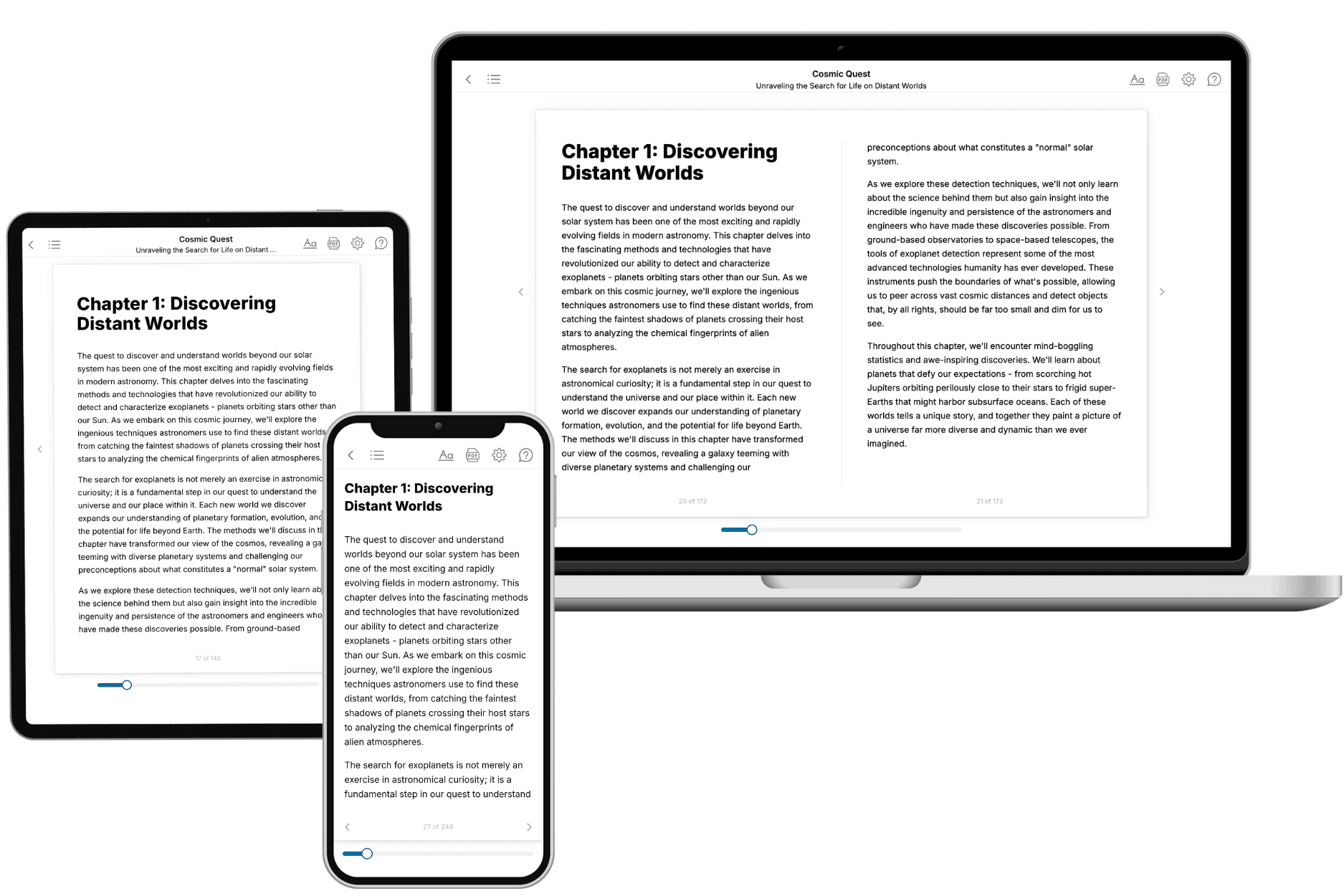
Your book is ready in 10 minutes. Read it online, download as EPUB or PDF, or send to Kindle.
Frequently asked questions
- What is TailoredRead?
TailoredRead creates complete, full-length nonfiction ebooks, written specifically for you. Tell us what you want to learn and why, and TailoredRead writes you a complete ebook on it, with charts, tables, and diagrams throughout. Read it online, on Kindle, or on any e-reader, or download it as a PDF or EPUB. Every book is written fresh the day you order it.
- How is the book tailored to me?
Before anything is written, you answer a few short questions about your goals, your background, and the topics you care about. Your book is then planned around your answers: written at your level, focused on your goals, and covering the topics you chose, instead of the one-size-fits-all book a store sells everyone.
- Will it read like generic AI content?
No. Your book isn't a chat transcript: it's planned chapter by chapter before a single word is written, told in a clear book voice, and explains ideas visually with charts, tables, and diagrams. After writing, every book goes through an editorial pass that polishes chapters so the book reads consistent from start to finish. Judge for yourself: browse thousands of sample books on our Explore Books page.
- How accurate is the content?
Our AI first checks whether your subject needs live research. Niche and fast-moving subjects are researched before writing, and the book plan and chapters are grounded in what it finds. After writing, every book goes through a quality pass that checks its facts and consistency, and researched books list their sources in a Notes section at the back.
- How long is the book?
You choose the length: Comprehensive (250-300 pages), Detailed (150-200 pages), Essential (70-100 pages), or Short (30-50 pages).
- Does the book include visuals?
Yes. Every book includes charts, tables, and diagrams: timelines, checklists, step-by-step guides, decision trees, comparison tables, matrices, and bar charts. A typical book includes dozens of these visual elements.
- Can I read it on Kindle? What formats can I download?
Yes. Every book can be read in our online reader or downloaded as a PDF or EPUB. The EPUB can be opened with Kindle, Apple Books, Kobo, and any e-reader. The Commercial and Author licenses also include an editable Word (DOCX) and Markdown download.
- How much does it cost?
About the price of a regular ebook. The exact price depends on your book's length and complexity, from $2 for the shortest books to $35 for the most comprehensive, and it's shown when you review your book, before you commit to anything. Each book is a one-time purchase, yours to keep, no subscription. Licenses that let you share, teach, or publish your book range from $35.99 to $49.99.
- Can I preview the book before purchasing?
Before you pay, you'll see what your book will cover: the title, a detailed description, the estimated length, and the complete chapter-by-chapter table of contents, so you know what you're getting before you decide. The full text itself is written after you purchase.
- How long does it take to create a book?
About 10 minutes. You can start reading the opening chapters while the rest is still being written.