Mastering Data Structures and Algorithms in C++
Build Efficient, Scalable Software with Proven Techniques and Real-World Applications
Master the essential data structures and algorithms that separate competent developers from exceptional ones.
222 pages11 chaptersMay 8, 2026C#
About this book
This comprehensive guide takes you beyond basic C++ syntax to show you how to design and implement solutions that scale. You'll learn why choosing the right data structure matters, how to analyze algorithm performance using Big O notation, and when to apply specific techniques to real-world problems. Through clear explanations, practical code examples, and hands-on exercises, you'll build a deep understanding of arrays, linked lists, stacks, queues, trees, graphs, and advanced techniques like dynamic programming. Whether you're preparing for technical interviews, optimizing existing code, or tackling complex software challenges, this book provides the knowledge and confidence to make informed decisions about data structure selection and algorithm design. By the end, you'll have the tools to write faster, more reliable, and more maintainable C++ code.
Table of contents
- IntroductionWhy Data Structures and Algorithms Matter, How to Use This Book, What You Need to Know, Your Journey AheadRead below
- Chapter 1: Foundations: Complexity Analysis and Big O NotationWhy We Analyze Algorithm Performance, Understanding Big O Notation, Time Complexity vs. Space Complexity, Analyzing Real Code Examples
- Chapter 2: Arrays and Vectors: The Foundation of Data StorageUnderstanding Arrays and Memory Layout, Vectors: Dynamic Arrays in C++, Common Operations and Their Costs, Practical Patterns and Techniques
- Chapter 3: Linked Lists: Flexible Data OrganizationSingly and Doubly Linked Lists, Insertion, Deletion, and Traversal, When to Choose Linked Lists Over Arrays, Implementing Linked Lists in C++
- Chapter 4: Stacks and Queues: Managing Order and PriorityStacks: Last-In-First-Out Behavior, Queues: First-In-First-Out Behavior, Real-World Stack Applications, Real-World Queue Applications
- Chapter 5: Sorting Algorithms: Organizing Data EfficientlySorting Fundamentals and Stability, Simple Sorts: Bubble, Selection, and Insertion, Efficient Sorts: Merge Sort, Quick Sort, and Heap Sort, Choosing the Right Sorting Algorithm
- Chapter 6: Searching Algorithms: Finding What You NeedLinear Search and When It's Appropriate, Binary Search: Divide and Conquer, Optimizing Search Performance, Advanced Search Patterns and Variations
- Chapter 7: Hash Tables and Hash Maps: Fast LookupsHash Functions and Collision Resolution, Implementing Hash Tables in C++, Using unordered_map and unordered_set, Practical Applications and Performance Considerations
- Chapter 8: Trees: Hierarchical Data OrganizationTree Fundamentals and Terminology, Binary Trees and Tree Traversal, Binary Search Trees: Searching, Inserting, and Deleting, Balanced Trees: AVL and Red-Black Trees
- Chapter 9: Graphs: Modeling Complex RelationshipsGraph Representations and Terminology, Depth-First and Breadth-First Search, Shortest Path Algorithms: Dijkstra and Bellman-Ford, Real-World Graph Problems and Solutions
- Chapter 10: Dynamic Programming: Solving Complex ProblemsDynamic Programming Principles and Memoization, Classic Problems: Fibonacci, Knapsack, and Longest Subsequence, Optimizing Space and Time in Dynamic Programming, Recognizing and Solving DP Patterns
- Chapter 11: Advanced Techniques: Greedy Algorithms and BacktrackingGreedy Algorithms and When They Work, Backtracking: Exploring All Possibilities, Combining Techniques for Complex Problems
- Conclusion: Putting It All TogetherKey Learnings and Takeaways, Your Next Steps in Mastery
- Appendix: Quick Reference and ResourcesBig O Complexity Cheat Sheet, Common Code Templates and Snippets, Further Reading and Learning Resources
Introduction
There is a moment that almost every developer experiences at some point in their career. You write code that works perfectly on small test inputs, you ship it with confidence, and then production data arrives. Suddenly, a function that ran in milliseconds now takes minutes. Users complain. Systems slow to a crawl. You stare at the code and wonder what went wrong. The logic is correct. The syntax is fine. But something fundamental is broken, and that something is almost always a poor choice of data structure or algorithm.
This book exists to make sure that moment either never happens to you, or that when it does, you have the tools to diagnose and fix it quickly. Data structures and algorithms are not abstract academic concepts reserved for computer science classrooms. They are the practical machinery underneath every piece of software that performs well at scale. Understanding them deeply is what separates developers who write code that works from developers who write code that scales.
C++ is one of the best languages in which to study these topics. It gives you direct control over memory, exposes the cost of operations in ways that higher-level languages hide, and provides a rich standard library that implements many classic data structures. Working through these concepts in C++ builds intuition that transfers to any language you use. When you understand why a std::vector resizes the way it does, or why a hash map lookup is O(1) on average, you carry that knowledge everywhere.
This introduction sets the stage for everything that follows. It explains why this material matters in practical terms, how to get the most out of the chapters ahead, what background knowledge you should bring, and what the overall journey looks like from start to finish. Take a few minutes to read it carefully. The context it provides will make every subsequent chapter easier to absorb and apply.
Why Data Structures and Algorithms Matter
Consider two developers given the same task: find whether a specific user ID exists in a list of one million records. The first developer writes a simple loop that checks each record one by one. The second developer stores the records in a hash set and checks membership directly. Both solutions produce the correct answer. But the first might take hundreds of milliseconds on modern hardware, while the second completes in microseconds. That difference, multiplied across thousands of requests per second, is the difference between a system that works and one that collapses under load.
This is not a contrived example. Scenarios like this appear constantly in real software development. A recommendation engine that scans a full dataset on every request. A routing algorithm that recalculates paths from scratch instead of caching intermediate results. A text editor that rebuilds an entire document structure on every keystroke. In each case, the underlying logic is correct, but the choice of data structure or algorithm makes the solution impractical. Fixing these problems requires knowing what better options exist and when to apply them.
The impact extends beyond raw performance. Choosing the right data structure also affects code clarity and maintainability. A well-chosen structure makes the intent of your code obvious. When you use a stack to track function call history, or a priority queue to manage task scheduling, the data structure itself communicates what the code is doing. This reduces the cognitive load on anyone reading or maintaining the code later, including your future self.
Technical interviews at most software companies place heavy emphasis on data structures and algorithms for exactly this reason. Companies like Google, Amazon, Microsoft, and Meta use algorithm problems to assess whether candidates can think about performance, trade-offs, and problem decomposition. Knowing these topics well does not just make you a better developer in your daily work. It also opens doors to roles and teams that demand rigorous engineering thinking.
There is also a deeper benefit that is harder to quantify but just as real. Studying algorithms trains a particular kind of problem-solving mindset. You learn to ask: what is the structure of this problem? What operations do I need to perform most often? What are the constraints on time and memory? These questions apply far beyond algorithm problems. They are the questions that good engineers ask before writing any significant piece of code. Developing this habit of thinking before coding is one of the most valuable things this material can give you.
Finally, the C++ standard library is built on these foundations. Understanding how std::map differs from std::unordered_map, or why std::deque exists alongside std::vector, requires knowing the underlying data structures. Without that knowledge, you are guessing at which tool to use. With it, you make informed decisions that directly improve the quality of your code.
A concrete example of impact: In 2012, a well-documented performance issue in a popular web framework was traced to an O(n²) algorithm in a string parsing routine. Under normal load, it was invisible. Under heavy load with large inputs, it caused request timeouts across the entire platform. The fix was a single algorithmic change that reduced the complexity to O(n). Understanding Big O notation and algorithm analysis is what makes these problems visible before they reach production.
The bottom line is straightforward. Data structures and algorithms are not optional knowledge for serious software developers. They are foundational. Every hour you invest in understanding them pays dividends across your entire career, in every codebase you touch, and in every system you help build.
How to Use This Book
This book is designed to be read sequentially, at least on the first pass. Each chapter builds on concepts introduced in earlier ones. Complexity analysis from Chapter 1 is referenced throughout every subsequent chapter. Array and linked list concepts from Chapters 2 and 3 underpin the tree and graph implementations in Chapters 8 and 9. Jumping ahead without that foundation can make later material harder to follow than it needs to be.
That said, once you have read through the book once, it works well as a reference. Each chapter is self-contained enough that you can return to, say, the sorting chapter when you need to choose between algorithms for a specific use case, or revisit the dynamic programming chapter when you encounter a problem that feels like it might benefit from that approach. The structure is designed to support both linear learning and targeted lookup.
The code examples throughout the book are written in modern C++ (C++17 and later where relevant). Every example is meant to be compiled and run. Do not just read the code. Type it out, compile it, run it, and then modify it. Change the input sizes. Break it intentionally and see what happens. Add print statements to observe behavior at each step. Active engagement with code is far more effective than passive reading when it comes to building genuine understanding.
Here is a suggested approach for working through each chapter:
- Read the chapter once without stopping to code, just to get the big picture.
- Go back and implement each code example from scratch, without copying and pasting.
- Test edge cases on your implementations: empty inputs, single elements, very large inputs, duplicate values.
- Try the exercises at the end of each chapter before looking at solutions or hints.
- Revisit the complexity analysis for each structure or algorithm and make sure you can derive it yourself, not just recite it.
The exercises at the end of each chapter range from straightforward implementation tasks to more open-ended design problems. Do not skip them. The gap between understanding an explanation and being able to apply the concept independently is wider than it feels when you are reading. The exercises are where that gap gets closed. If you find an exercise difficult, that is useful information. It tells you exactly where to focus more attention.
You will also find comparison tables, complexity summaries, and decision frameworks throughout the book. These are designed to be practical tools, not just visual decoration. When you face a real problem and need to choose between a vector and a linked list, or between Dijkstra's algorithm and Bellman-Ford, these summaries give you a quick reference point. Over time, the decisions will become intuitive, but having a reference while you are building that intuition is genuinely useful.
If you are using this book to prepare for technical interviews, pay particular attention to the sections on complexity analysis, sorting, searching, trees, and dynamic programming. These topics appear most frequently in interview settings. Work through the classic problems in each chapter multiple times until you can solve them fluently. Speed and clarity under pressure come from repetition, not from reading more explanations.
If your primary goal is to improve the performance of existing code, focus first on Chapters 1 through 7. These cover the data structures and analysis tools that address the most common performance bottlenecks in everyday software. The later chapters on trees, graphs, and dynamic programming are more specialized, but they become relevant quickly as the complexity of the systems you work on grows.
What You Need to Know
This book is written for intermediate C++ developers. That means it assumes you already have a working foundation in the language and in programming generally. You do not need to be an expert, but there are specific areas where solid familiarity will make the material much easier to follow. This section is honest about what those areas are, so you can assess your readiness and fill any gaps before diving in.
On the C++ side, you should be comfortable with the following:
- Basic syntax and control flow: loops, conditionals, functions, and basic I/O.
- Pointers and references: understanding what a pointer is, how to dereference it, and the difference between passing by value and by reference.
- Classes and structs: defining custom types, constructors, and member functions.
- Templates: a basic understanding of function and class templates, since many data structure implementations use them.
- The standard library basics: familiarity with
std::vector,std::string, and basic I/O streams. - Memory management: understanding stack vs. heap allocation, and basic use of
newanddelete(or smart pointers).
If any of those areas feel shaky, it is worth spending a few hours reviewing them before starting Chapter 1. The data structure implementations in this book rely heavily on pointers and dynamic memory allocation. If those concepts are unclear, the code examples will be confusing in ways that have nothing to do with the data structures themselves. A solid C++ primer or reference like A Tour of C++ by Bjarne Stroustrup can fill gaps quickly.[1]
On the mathematics side, the requirements are modest. You need to be comfortable with:
- Basic algebra: manipulating simple equations and understanding variables.
- Logarithms: knowing what log base 2 means and roughly how logarithmic growth behaves compared to linear growth.
- Basic set theory concepts: understanding what a set is and what membership means (relevant for hash tables and graph theory).
You do not need calculus, advanced discrete mathematics, or formal proof techniques to benefit from this book. The complexity analysis in Chapter 1 introduces the mathematical tools you need in an accessible, practical way. If you can follow the reasoning that doubling the input size doubles the work for an O(n) algorithm but quadruples it for an O(n²) algorithm, you have enough mathematical intuition to work through everything here.
On the general programming side, you should have experience writing programs of at least moderate complexity. If you have built a command-line application, implemented a simple game, or worked on any project with more than a few hundred lines of code, you have the right level of experience. The goal is not to teach you how to program. It is to teach you how to program well, with a focus on efficiency and design.
One thing you do not need is prior exposure to data structures or algorithms as a formal subject. This book starts from the beginning with each topic. If you have seen some of this material before in a course or another book, you will move through the early sections quickly and find the later chapters more challenging and rewarding. If this is your first serious encounter with the subject, the pace is designed to bring you along without overwhelming you.
A development environment where you can compile and run C++ code is essential. Any modern compiler (GCC, Clang, or MSVC) with C++17 support will work. If you do not have a setup already, a simple option is to install GCC via your system's package manager and use a text editor or lightweight IDE. More fully featured options like Visual Studio Code with the C++ extension, CLion, or Visual Studio Community Edition all work well and provide helpful debugging tools that will be useful as you work through the exercises.
Your Journey Ahead
The book is organized as a progression from foundational concepts to increasingly sophisticated techniques. Each layer builds on the one before it. Here is a clear picture of what each part of the journey covers and why it is sequenced the way it is.
Chapter 1: Complexity Analysis and Big O Notation. This is the analytical foundation for everything else. Before you can evaluate whether one data structure or algorithm is better than another, you need a way to measure and compare them. Big O notation provides that universal language. This chapter teaches you to analyze code and express its performance characteristics in a way that is independent of hardware, compiler, or input specifics. Every subsequent chapter uses this vocabulary.
Chapters 2 and 3: Arrays, Vectors, and Linked Lists. These are the most fundamental data structures in computing. Arrays and vectors are the default choice for sequential data storage, and understanding their memory layout explains why certain operations are fast and others are slow. Linked lists introduce the concept of dynamic, pointer-based structures and set the stage for trees and graphs later. Together, these two chapters establish the building blocks that more complex structures are built from.
Chapter 4: Stacks and Queues. These structures are defined by their access patterns rather than their underlying storage. A stack enforces last-in-first-out order; a queue enforces first-in-first-out order. Both appear constantly in real software, from function call management to task scheduling to breadth-first graph traversal. Understanding them deeply makes later chapters on trees and graphs much more intuitive.
Chapters 5 and 6: Sorting and Searching. Sorting and searching are among the most studied problems in computer science, and for good reason. They appear in virtually every non-trivial application. These chapters cover the full spectrum from simple O(n²) sorts to efficient O(n log n) algorithms, and from linear search to binary search and its variations. You will learn not just how each algorithm works, but when to use each one and why.
Chapter 7: Hash Tables and Hash Maps. Hash-based structures provide average O(1) lookup, insertion, and deletion, making them one of the most powerful tools in a developer's toolkit. This chapter explains how hash functions work, how collisions are handled, and how to use C++'s std::unordered_map and std::unordered_set effectively. It also covers the performance pitfalls that can turn O(1) average into O(n) worst case.
Chapter 8: Trees. Trees are hierarchical structures that enable efficient searching, insertion, and deletion in ways that flat structures cannot match. This chapter covers binary trees, binary search trees, tree traversal algorithms, and balanced tree variants like AVL and Red-Black trees. Trees are also the foundation for heaps, which power priority queues and heap sort.
Chapter 9: Graphs. Graphs are the most general data structure covered in this book, capable of modeling almost any relationship between entities. This chapter covers graph representations, depth-first and breadth-first traversal, and shortest-path algorithms including Dijkstra's and Bellman-Ford. Real-world applications range from navigation systems to social network analysis to dependency resolution in build systems.
Chapter 10: Dynamic Programming. Dynamic programming is a technique for solving problems that have overlapping subproblems and optimal substructure. It transforms problems that would take exponential time with naive recursion into polynomial-time solutions. This chapter works through classic problems like the Fibonacci sequence, the 0/1 knapsack problem, and the longest common subsequence, building the pattern recognition skills needed to apply dynamic programming to new problems.
Chapter 11: Greedy Algorithms and Backtracking. The final technique chapter covers two complementary approaches. Greedy algorithms make locally optimal choices at each step and work well for a specific class of problems. Backtracking systematically explores all possibilities and is the right tool when you need to find all solutions or when no greedy strategy exists. Together, these techniques round out a comprehensive toolkit for algorithm design.
The book closes with a conclusion that ties the key themes together and points toward next steps for continued learning. The appendix provides a Big O complexity cheat sheet, common code templates, and a curated list of resources for going deeper on any topic covered here.
By the time you finish this book, you will have implemented core data structures from scratch, analyzed the performance of real code, and solved a wide range of algorithmic problems. More importantly, you will have developed the habit of thinking about performance and design before writing code. That habit, more than any specific algorithm or data structure, is what will make you a consistently better developer. The journey ahead is challenging in the best possible way. Let's get started.
Notes
Introduction
- 1. Bjarne Stroustrup, A Tour of C++, 3rd Edition, Addison-Wesley Professional, 2022
This is the end of the free sample. The full book has 11 chapters.
Want this book written for you?
Tell us your goals and background, and get your own version of this book, tailored by AI to you.


Benefits of AI-tailored books
- Read one book, not ten:
- all the C# knowledge you need, gathered into a single book.
- Save days of learning:
- tell us your goals, choose your topics, and the whole book is built around them.
- Learn effortlessly:
- C# book written for your specific background and expertise.
- Understand at a glance:
- includes charts, tables, timelines, checklists, decision trees, and more.
- Stay current:
- written the day you order it, not years ago.
- Trust what you read:
- every book is checked for accuracy, with real research when your subject needs it.
Create your unique book in 3 steps
- 1. Select your focus
Select the focus of your C# book and share your background
- 2. Personalize your book
Specify your goals and choose sub-topics to include
- 3. Get your tailored book
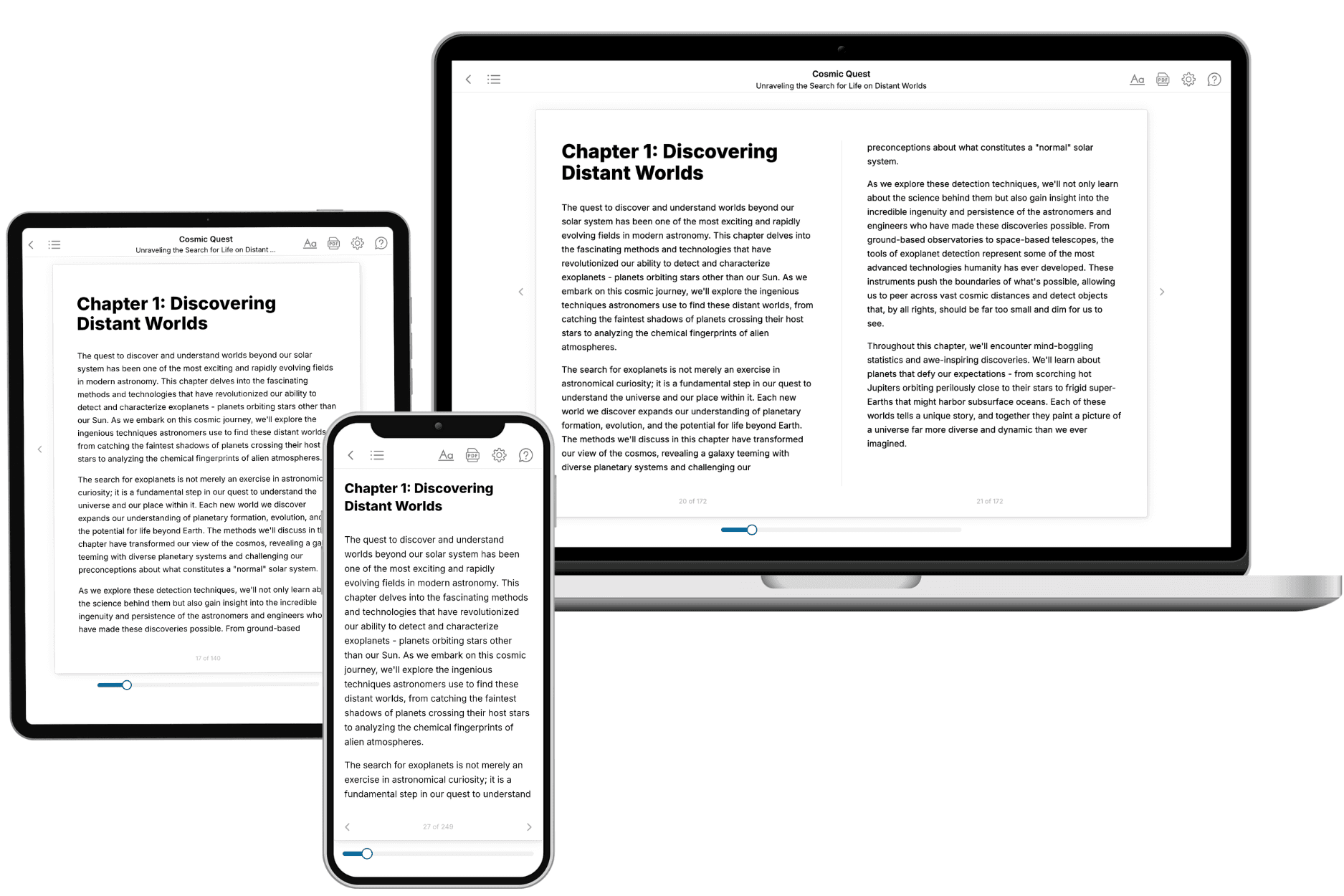
Your book is ready in 10 minutes. Read it online, download as EPUB or PDF, or send to Kindle.
Frequently asked questions
- What is TailoredRead?
TailoredRead creates complete, full-length nonfiction ebooks, written specifically for you. Tell us what you want to learn and why, and TailoredRead writes you a complete ebook on it, with charts, tables, and diagrams throughout. Read it online, on Kindle, or on any e-reader, or download it as a PDF or EPUB. Every book is written fresh the day you order it.
- How is the book tailored to me?
Before anything is written, you answer a few short questions about your goals, your background, and the topics you care about. Your book is then planned around your answers: written at your level, focused on your goals, and covering the topics you chose, instead of the one-size-fits-all book a store sells everyone.
- Will it read like generic AI content?
No. Your book isn't a chat transcript: it's planned chapter by chapter before a single word is written, told in a clear book voice, and explains ideas visually with charts, tables, and diagrams. After writing, every book goes through an editorial pass that polishes chapters so the book reads consistent from start to finish. Judge for yourself: browse thousands of sample books on our Explore Books page.
- How accurate is the content?
Our AI first checks whether your subject needs live research. Niche and fast-moving subjects are researched before writing, and the book plan and chapters are grounded in what it finds. After writing, every book goes through a quality pass that checks its facts and consistency, and researched books list their sources in a Notes section at the back.
- How long is the book?
You choose the length: Comprehensive (250-300 pages), Detailed (150-200 pages), Essential (70-100 pages), or Short (30-50 pages).
- Does the book include visuals?
Yes. Every book includes charts, tables, and diagrams: timelines, checklists, step-by-step guides, decision trees, comparison tables, matrices, and bar charts. A typical book includes dozens of these visual elements.
- Can I read it on Kindle? What formats can I download?
Yes. Every book can be read in our online reader or downloaded as a PDF or EPUB. The EPUB can be opened with Kindle, Apple Books, Kobo, and any e-reader. The Commercial and Author licenses also include an editable Word (DOCX) and Markdown download.
- How much does it cost?
About the price of a regular ebook. The exact price depends on your book's length and complexity, from $2 for the shortest books to $35 for the most comprehensive, and it's shown when you review your book, before you commit to anything. Each book is a one-time purchase, yours to keep, no subscription. Licenses that let you share, teach, or publish your book range from $35.99 to $49.99.
- Can I preview the book before purchasing?
Before you pay, you'll see what your book will cover: the title, a detailed description, the estimated length, and the complete chapter-by-chapter table of contents, so you know what you're getting before you decide. The full text itself is written after you purchase.
- How long does it take to create a book?
About 10 minutes. You can start reading the opening chapters while the rest is still being written.