Mastering Data Structures in JavaScript
Build Efficient Applications with Modern ECMAScript Patterns
You'll gain the practical knowledge to select and implement the right data structures for any JavaScript challenge.
176 pages8 chaptersAug 1, 2026JavaScript
About this book
This guide moves beyond surface-level understanding to show you how data structures actually work, why they matter for performance, and when to use each one. You'll explore JavaScript's native structures—Arrays, Objects, Maps, and Sets—then progress to implementing custom structures like linked lists, stacks, queues, trees, and graphs. Each concept is grounded in real-world scenarios where you'll see exactly how these structures solve actual problems developers face. By understanding the trade-offs between different approaches and learning to analyze complexity, you'll write code that's not just functional, but efficient and maintainable. Whether you're preparing for technical interviews, optimizing existing applications, or building systems that need to scale, this book equips you with the foundational knowledge that separates competent developers from those who truly understand how to build robust software.
Table of contents
- IntroductionWhy Data Structures Matter in JavaScript, How to Use This Book, What You'll Learn and AccomplishRead below
- Chapter 1: Fundamentals: Understanding Data Structures and ComplexityWhat Are Data Structures and Why Do They Exist?, Time Complexity: Measuring Performance, Space Complexity: Memory Considerations, Big O Notation: A Practical Framework
- Chapter 2: Arrays and Objects: JavaScript's Core StructuresArrays: Structure, Methods, and Performance, Objects: Key-Value Storage and Lookup, Choosing Between Arrays and Objects
- Chapter 3: Modern Collections: Maps, Sets, and Their VariantsMaps: Beyond Object Key-Value Pairs, Sets: Storing Unique Values Efficiently, WeakMap and WeakSet: Memory-Conscious Collections, Real-World Applications of Modern Collections
- Chapter 4: Linear Structures: Stacks, Queues, and Linked ListsStacks: Last-In-First-Out Problem Solving, Queues: First-In-First-Out Processing, Linked Lists: Dynamic Memory and Efficient Insertion, When to Use Linear Structures in Real Applications
- Chapter 5: Tree Structures: Hierarchical OrganizationBinary Trees: Foundation and Traversal, Binary Search Trees: Efficient Searching and Sorting, Balanced Trees: Maintaining Performance, Tree Structures in Real-World Scenarios
- Chapter 6: Graph Structures: Modeling Complex RelationshipsGraph Fundamentals: Nodes, Edges, and Representations, Graph Traversal: Depth-First and Breadth-First Search, Essential Graph Algorithms and Pathfinding, Graphs in Real Applications: Networks and Relationships
- Chapter 7: Advanced Patterns: Combining and Optimizing StructuresComposite Data Structures: Building Complex Solutions, Caching and Memoization Patterns, Performance Optimization Techniques
- Chapter 8: Practical Projects: Solving Real ProblemsProject 1: Building a Browser History Manager, Project 2: Creating a Task Scheduler with Priority Queues, Project 3: Modeling a Social Network with Graphs
- Conclusion: Becoming a Data Structure ExpertKey Takeaways and Next Steps, Continuing Your Learning Journey
- Appendix: Quick Reference and ResourcesTime and Space Complexity Cheatsheet, Common Implementation Templates, Further Learning Resources
Introduction
A JavaScript application that works is not the same as one that works well. The difference often comes down to a single decision made early in development: which data structure holds the information. Pick the wrong one, and a feature that should respond in milliseconds starts lagging under real load. Pick the right one, and the same logic runs cleanly at ten times the scale without a single line of optimization code added later. That gap is not magic. It is the direct result of understanding how data is organized, accessed, and modified under the hood.
Most JavaScript developers learn arrays and objects early, use them for everything, and move on. That approach works fine for small scripts and simple pages. But as applications grow, as datasets get larger, and as user expectations rise, the cracks appear. A search that scans every item in a list when it could jump directly to the answer. A deduplication routine that runs in nested loops when a Set would do it in a single pass. A relationship graph modeled in deeply nested objects when an Adjacency List would make traversal straightforward. These are not edge cases. They are everyday problems that intermediate developers run into constantly.
This book is built around a practical premise: understanding data structures is not an academic exercise reserved for computer science graduates. It is a working skill that makes you a more effective JavaScript developer right now. The structures covered here, from native collections like Map and Set to custom implementations like Linked Lists, Binary Search Trees, and Graphs, are tools with specific jobs. Knowing which tool fits which job, and why, is what separates code that merely functions from code that performs.
The chapters ahead move from foundational concepts to increasingly complex structures, always grounded in real scenarios. Along the way, you will build intuition for Time Complexity and Space Complexity, learn to read and apply Big O Notation, and implement structures that solve problems you have likely already encountered in your own projects. By the final chapter, you will have completed three full projects that demonstrate how these structures combine in production-quality JavaScript code.
Why Data Structures Matter in JavaScript
JavaScript is a flexible language. It lets you store almost anything in almost any shape, which is both its strength and its trap. Because the language rarely forces you to think about structure, it is easy to reach for whatever feels convenient in the moment. An array here, a nested object there, a few Array.prototype.find() calls scattered through the codebase. The application works, tests pass, and the problem feels solved. Then traffic doubles, the dataset grows from a few hundred records to a few hundred thousand, and suddenly the application is slow in ways that are hard to diagnose.
The root cause is almost always the same: a data structure that was chosen for convenience rather than fit. Consider a common scenario. You are building a feature that checks whether a user has already seen a notification. If you store seen notification IDs in an array and use Array.prototype.includes() to check each one, the check scans the entire array every time. With 10 items, that is instant. With 100,000 items, that check runs 100,000 comparisons in the worst case, every single time it is called. Swap the array for a Set, and the same check becomes a single constant-time lookup regardless of how many IDs are stored.[1]
This is not a contrived example. It reflects a pattern that appears across real codebases: autocomplete features that search unsorted arrays instead of using a Trie, task schedulers that sort arrays on every insertion instead of using a Priority Queue, and navigation systems that rebuild relationship maps from scratch instead of maintaining a Graph. Each of these choices has a measurable cost, and each has a better alternative once you know what to reach for.
JavaScript's runtime environment adds another layer of importance. Browser applications run on hardware that ranges from high-end laptops to low-powered mobile devices. Node.js services handle concurrent requests where memory efficiency directly affects how many users a single server can support. In both contexts, the data structures you choose affect not just speed but memory consumption, garbage collection pressure, and overall system stability. These are not theoretical concerns. They are the kinds of issues that show up in production monitoring dashboards and user complaints.
Modern ECMAScript has expanded the toolkit significantly. Map, Set, WeakMap, and WeakSet were added to the language precisely because plain objects and arrays were not sufficient for all use cases. Map preserves insertion order, accepts any value as a key, and provides reliable size tracking. WeakMap holds references that do not prevent garbage collection, making it ideal for associating metadata with DOM nodes or class instances without causing memory leaks. These are not obscure features. They are practical solutions to problems that developers were previously solving with workarounds.
Beyond the built-in structures, custom implementations open up an entirely different class of solutions. A Linked List makes insertions and deletions at arbitrary positions far cheaper than an array. A Binary Search Tree keeps data sorted while supporting fast search, insertion, and deletion. A Graph models relationships between entities in a way that no flat structure can replicate efficiently. Learning to implement and use these structures in JavaScript gives you access to solutions that the language's standard library simply does not provide out of the box.
The payoff extends beyond performance. Code that uses the right data structure is also easier to read and reason about. When a function receives a Map instead of a plain object, the intent is clearer: this is a collection of key-value pairs where the keys might not be strings, and where order matters. When a module exports a Stack, the calling code knows immediately that items are processed in last-in-first-out order. Structure communicates intent, and intent makes code maintainable. That matters as much to the developer who inherits your code six months from now as it does to the runtime executing it today.
The right data structure does not just make code faster. It makes the problem easier to think about, easier to implement correctly, and easier for others to understand when they read it later.
Technical interviews at software companies consistently test data structure knowledge because it is a reliable signal of engineering depth. Knowing how to reverse a string or write a loop is table stakes. Knowing when to use a Queue versus a Stack, how to traverse a Binary Tree, or how to find the shortest path in a Graph using Breadth-First Search demonstrates that a developer can think systematically about problems. This book prepares you for those conversations, but more importantly, it prepares you for the real work that follows them.
How to Use This Book
This book is structured as a progressive journey. Each chapter builds on the concepts introduced before it, so reading in order gives you the clearest path from foundational understanding to advanced application. That said, if you already have a solid grasp of Big O Notation and JavaScript's native structures, you can move directly to the chapters on custom implementations without losing the thread. Each chapter opens with enough context to orient you before diving into new material.
The first chapter establishes the vocabulary and mental models you will use throughout the rest of the book. Time Complexity, Space Complexity, and Big O Notation are not just theoretical concepts here. They are practical lenses for evaluating every structure and algorithm you encounter. If these terms are new to you, spend extra time with that chapter. If they are familiar, treat it as a calibration exercise to make sure you and the book are using the same language.
Chapters two and three cover JavaScript's built-in structures in depth. Arrays and plain objects get a thorough treatment, including their internal mechanics and the performance trade-offs that most tutorials skip over. The chapter on modern collections then introduces Map, Set, WeakMap, and WeakSet with concrete comparisons to show exactly when each one outperforms its simpler alternatives. These chapters are worth reading carefully even if you use these structures daily, because the performance details are often surprising.
Chapters four through six move into custom data structures. Each chapter follows a consistent pattern:
- Explain the structure's core concept and the problem it solves.
- Walk through a JavaScript implementation step by step.
- Analyze the time and space complexity of each operation.
- Show a real-world scenario where the structure is the right choice.
- Compare it to alternatives so you understand the trade-offs.
The code examples throughout the book are written in modern JavaScript, using ES6+ syntax including classes, arrow functions, destructuring, and the spread operator. No external libraries or frameworks are required. Every example runs in a standard Node.js environment or directly in a browser console. Where a concept benefits from seeing the code evolve incrementally, the examples build on each other within the chapter. Where a complete implementation is more useful, the full code is presented together so you can run it immediately.
Chapter seven shifts from individual structures to patterns for combining them. Memoization, LRU Cache design, and Composite Data Structure strategies are covered here. These patterns appear constantly in production code, and understanding them requires the foundation built in the earlier chapters. Chapter eight then applies everything to three complete projects: a browser history manager, a task scheduler using a Priority Queue, and a social network model built on a Graph. These projects are not toy examples. They are simplified but realistic implementations of features that appear in real applications.
To get the most out of this book, write the code yourself rather than just reading it. Copy the examples into your editor, run them, modify them, and break them intentionally to see what happens. When a chapter introduces a new structure, try implementing it from scratch before reading the provided implementation. The gap between what you think you understand and what you can actually build is where the real learning happens. The exercises and variations suggested throughout the chapters are designed to close that gap.
If you encounter a concept that feels unclear, the best approach is to look at the complexity analysis first. Understanding why a structure behaves the way it does in terms of time and memory usually makes the implementation details click into place. The appendix at the back of the book includes a complexity cheatsheet and implementation templates that serve as quick references once you have worked through the main content.
One practical note on environment setup: all examples assume you have Node.js installed (version 14 or later covers all the ES6+ features used here). A simple text editor and a terminal are sufficient. No build tools, transpilers, or bundlers are needed. The focus is on the structures and algorithms themselves, not on tooling configuration. If you want to follow along in a browser, the browser console in any modern browser works equally well for the standalone examples.
What You'll Learn and Accomplish
By the time you finish this book, you will have a working knowledge of more than a dozen distinct data structures and the judgment to choose between them in real situations. That judgment is the most valuable outcome. Memorizing the definition of a Binary Search Tree is straightforward. Knowing when a Binary Search Tree is the right choice over a sorted array, and when it is not, requires a deeper understanding that only comes from seeing both options analyzed side by side with concrete examples.
Here is a concrete picture of what you will be able to do after working through each major section:
- After the fundamentals chapter: Read and write Big O Notation for any function you encounter, identify whether a performance problem is a time or space issue, and compare two solutions analytically before writing a single line of code.
- After the arrays and objects chapter: Explain why certain array operations are fast and others are slow, use plain objects correctly for key-value storage, and recognize when an object's limitations are causing problems in your code.
- After the modern collections chapter: Replace inappropriate object and array usage with Map and Set where they fit better, use WeakMap to associate data with objects without causing memory leaks, and deduplicate data efficiently using Set operations.
- After the linear structures chapter: Implement a Stack to manage undo/redo history, build a Queue for processing tasks in order, and use a Linked List for scenarios where frequent mid-list insertions make arrays impractical.
- After the tree structures chapter: Build a Binary Search Tree that supports fast search and sorted traversal, understand why Balanced Trees matter for worst-case performance, and apply Tree Traversal strategies to solve hierarchical data problems.
- After the graph structures chapter: Model relationships between entities using an Adjacency List, traverse a Graph using both Depth-First Search and Breadth-First Search, and find shortest paths using Dijkstra's Algorithm.
- After the advanced patterns chapter: Apply Memoization to eliminate redundant computation, implement an LRU Cache using a combination of a Map and a Linked List, and design Composite Data Structures that combine simpler structures for complex requirements.
The three projects in the final chapter bring these skills together in a way that isolated exercises cannot. The browser history manager uses a Stack to handle back and forward navigation, with a Map for fast URL metadata lookup. The task scheduler combines a Priority Queue with time-based ordering to process jobs in the correct sequence. The social network model uses a Graph with Breadth-First Search to find connections between users and suggest new ones. Each project is small enough to complete in a single session but complex enough to require genuine structural thinking.
Beyond the specific structures, you will develop a general problem-solving habit that carries into every future project. Before writing code, you will ask: what operations does this feature need to perform most often? What is the acceptable trade-off between memory and speed? Does the order of items matter? Are there duplicates to handle? Does the data have relationships that a flat structure cannot represent? These questions, applied consistently, lead to better architectural decisions from the start rather than expensive refactors later.
Technical interview preparation is a natural side effect of this material, though it is not the primary goal. The structures and algorithms covered here appear regularly in interviews at companies of all sizes because they test genuine engineering reasoning. Working through the implementations and complexity analyses in this book gives you the depth to answer those questions confidently and, more importantly, to explain your reasoning clearly. Interviewers are not just checking whether you know the answer. They are watching how you think through a problem.
The knowledge in this book also compounds over time. Once you understand how a Binary Search Tree maintains sorted order through its insertion logic, understanding a Balanced Tree variant like an AVL tree becomes a matter of learning one additional constraint. Once you understand Depth-First Search on a tree, applying it to a Graph requires only a small conceptual extension. The structures build on each other, and each new one you learn makes the next one easier to grasp. That compounding effect is why developers who invest time in this material tend to find that their overall problem-solving speed increases, not just their knowledge of specific structures.
One realistic expectation to set: some of these concepts will feel uncomfortable the first time through. A Trie is not intuitive until you have seen it solve an autocomplete problem. Dijkstra's Algorithm requires holding several moving pieces in mind simultaneously. The LRU Cache implementation involves coordinating two separate structures in a way that feels complex until the design clicks. This discomfort is normal and temporary. The examples and step-by-step walkthroughs are designed to move you through that discomfort as efficiently as possible, and the projects at the end give you a chance to consolidate everything into working code that you built yourself.
What you will not find here is a comprehensive survey of every data structure that exists in computer science. This book covers the structures that matter most for practical JavaScript development, explained with enough depth to use them confidently. A Trie is included because it solves autocomplete and prefix-search problems that appear in real applications. A red-black tree is not included because its implementation complexity exceeds its practical value for most JavaScript developers, and the concept of Balanced Trees is covered at a level that gives you the understanding you need without the implementation overhead. Every inclusion and exclusion was made with the working JavaScript developer in mind.
The goal is not to turn you into a computer science theorist. The goal is to make you a more capable, more confident JavaScript developer who reaches for the right tool because you understand what each tool actually does. That understanding starts in the next chapter, where the vocabulary and analytical framework for everything that follows gets established from the ground up.
Notes
Introduction
- 1. Kyle Simpson, "You Don't Know JS," O'Reilly Media, 2015
This is the end of the free sample. The full book has 8 chapters.
Want this book written for you?
Tell us your goals and background, and get your own version of this book, tailored by AI to you.


Benefits of AI-tailored books
- Read one book, not ten:
- all the JavaScript knowledge you need, gathered into a single book.
- Save days of learning:
- tell us your goals, choose your topics, and the whole book is built around them.
- Learn effortlessly:
- JavaScript book written for your specific background and expertise.
- Understand at a glance:
- includes charts, tables, timelines, checklists, decision trees, and more.
- Stay current:
- written the day you order it, not years ago.
- Trust what you read:
- every book is checked for accuracy, with real research when your subject needs it.
Create your unique book in 3 steps
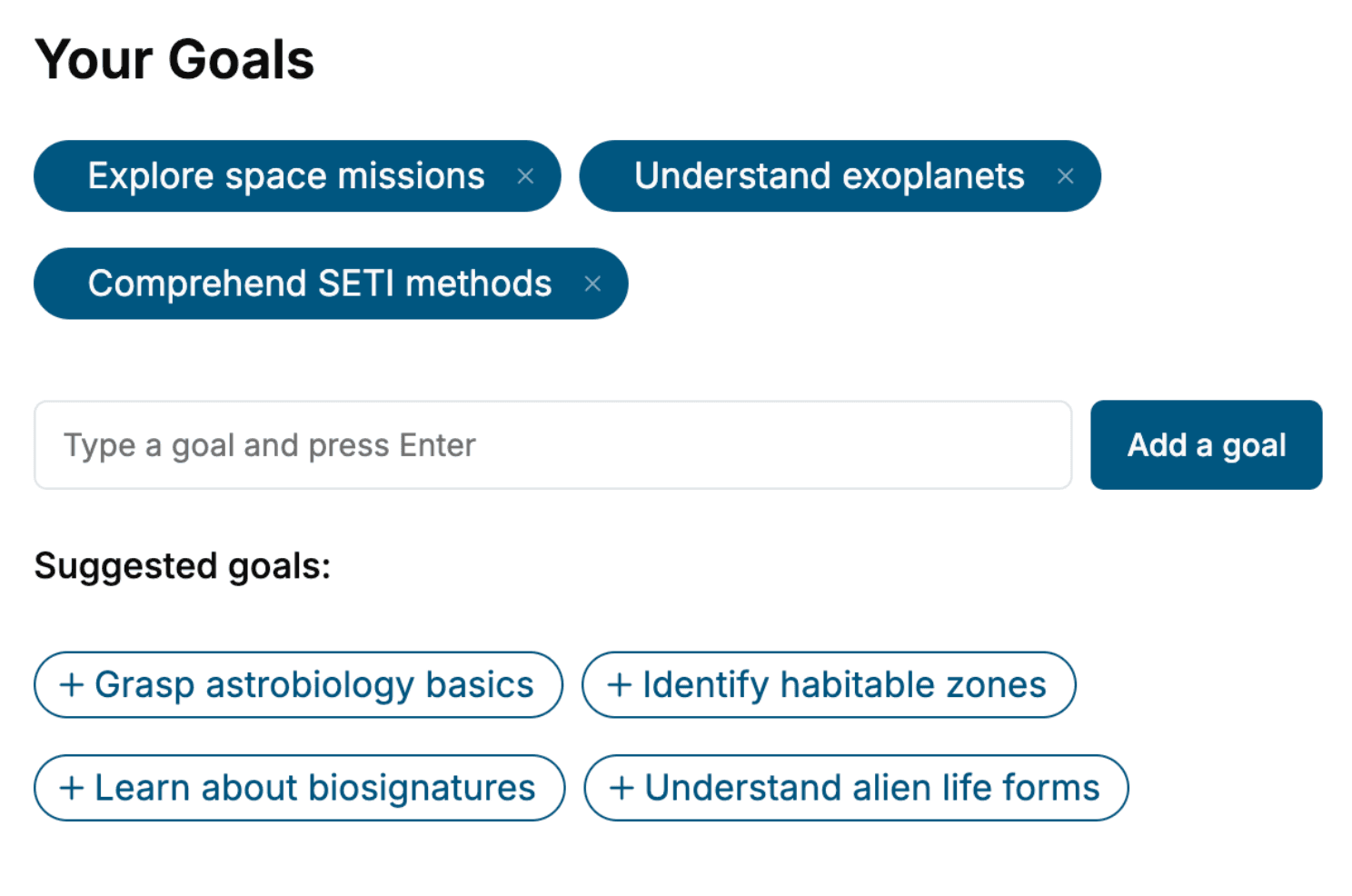
- 1. Select your focus
Select the focus of your JavaScript book and share your background
- 2. Personalize your book
Specify your goals and choose sub-topics to include
- 3. Get your tailored book
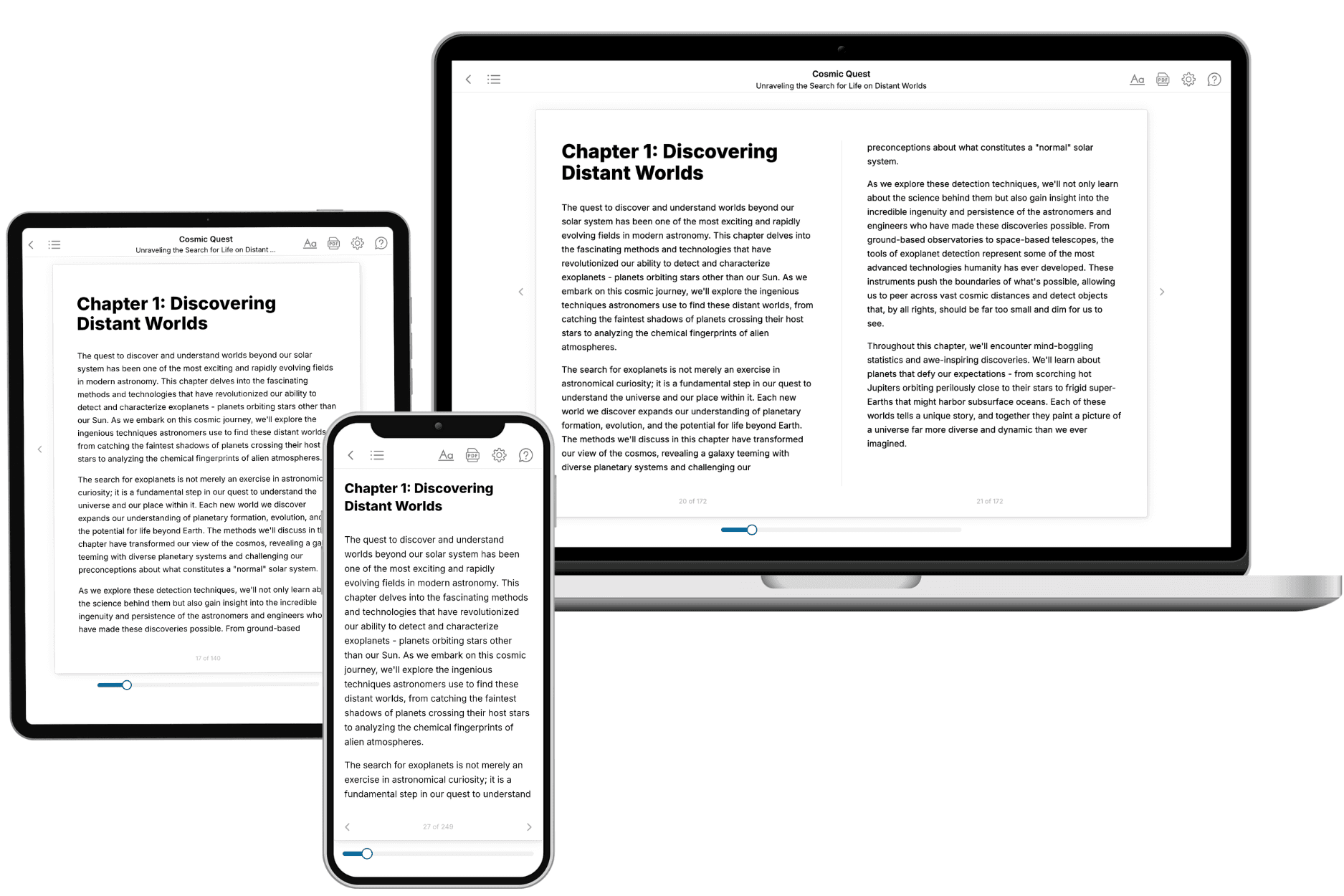
Your book is ready in 10 minutes. Read it online, download as EPUB or PDF, or send to Kindle.

Frequently asked questions
- What is TailoredRead?
TailoredRead creates complete, full-length nonfiction ebooks, written specifically for you. Tell us what you want to learn and why, and TailoredRead writes you a complete ebook on it, with charts, tables, and diagrams throughout. Read it online, on Kindle, or on any e-reader, or download it as a PDF or EPUB. Every book is written fresh the day you order it.
- How is the book tailored to me?
Before anything is written, you answer a few short questions about your goals, your background, and the topics you care about. Your book is then planned around your answers: written at your level, focused on your goals, and covering the topics you chose, instead of the one-size-fits-all book a store sells everyone.
- Will it read like generic AI content?
No. Your book isn't a chat transcript: it's planned chapter by chapter before a single word is written, told in a clear book voice, and explains ideas visually with charts, tables, and diagrams. After writing, every book goes through an editorial pass that polishes chapters so the book reads consistent from start to finish. Judge for yourself: browse thousands of sample books on our Explore Books page.
- How accurate is the content?
Our AI first checks whether your subject needs live research. Niche and fast-moving subjects are researched before writing, and the book plan and chapters are grounded in what it finds. After writing, every book goes through a quality pass that checks its facts and consistency, and researched books list their sources in a Notes section at the back.
- How long is the book?
You choose the length: Comprehensive (250-300 pages), Detailed (150-200 pages), Essential (70-100 pages), or Short (30-50 pages).
- Does the book include visuals?
Yes. Every book includes charts, tables, and diagrams: timelines, checklists, step-by-step guides, decision trees, comparison tables, matrices, and bar charts. A typical book includes dozens of these visual elements.
- Can I read it on Kindle? What formats can I download?
Yes. Every book can be read in our online reader or downloaded as a PDF or EPUB. The EPUB can be opened with Kindle, Apple Books, Kobo, and any e-reader. The Commercial and Author licenses also include an editable Word (DOCX) and Markdown download.
- How much does it cost?
About the price of a regular ebook. The exact price depends on your book's length and complexity, from $2 for the shortest books to $35 for the most comprehensive, and it's shown when you review your book, before you commit to anything. Each book is a one-time purchase, yours to keep, no subscription. Licenses that let you share, teach, or publish your book range from $35.99 to $49.99.
- Can I preview the book before purchasing?
Before you pay, you'll see what your book will cover: the title, a detailed description, the estimated length, and the complete chapter-by-chapter table of contents, so you know what you're getting before you decide. The full text itself is written after you purchase.
- How long does it take to create a book?
About 10 minutes. You can start reading the opening chapters while the rest is still being written.