Mastering Dynamic Programming
A Practical Guide to Optimizing Operations Research Problems
Optimize complex decision-making processes and solve intricate operations research problems with ease.
253 pages13 chaptersJun 7, 2025Algorithm Analysis
About this book
"Mastering Dynamic Programming" equips you with the tools to tackle multistage optimization challenges across various domains. Dive into the world of dynamic programming algorithms and discover how to break down complex problems into manageable subproblems. You'll learn to identify optimal substructures, implement efficient solutions, and apply these techniques to real-world scenarios in operations research. From understanding the fundamental principles to mastering advanced techniques, this book guides you through the intricacies of dynamic programming. Packed with practical examples, step-by-step explanations, and hands-on exercises, you'll develop the skills to design and implement powerful algorithms that drive operational efficiency and strategic decision-making.
Table of contents
- IntroductionWhat is Dynamic Programming?, The Importance of Dynamic Programming in Operations Research, Book Overview and How to Use It, Prerequisites and Assumed KnowledgeRead below
- Chapter 1: Foundations of Dynamic ProgrammingOptimal Substructure, Overlapping Subproblems, Memoization Technique, Tabulation Technique
- Chapter 2: Basic Dynamic Programming ProblemsFibonacci Sequence, Longest Increasing Subsequence, Coin Change Problem, 0/1 Knapsack Problem
- Chapter 3: Advanced Dynamic Programming ProblemsMatrix Chain Multiplication, Longest Common Subsequence, Edit Distance, Optimal Binary Search Tree
- Chapter 4: Dynamic Programming in Graph AlgorithmsShortest Path Problems, Traveling Salesman Problem, Floyd-Warshall Algorithm, Bellman-Ford Algorithm
- Chapter 5: Dynamic Programming in String AlgorithmsLongest Palindromic Subsequence, Regular Expression Matching, Wildcard Pattern Matching, String Interleaving
- Chapter 6: Optimization Techniques in Dynamic ProgrammingSpace Optimization, Time Optimization, Bitmasking in Dynamic Programming, Divide and Conquer DP
- Chapter 7: Multidimensional Dynamic Programming2D Dynamic Programming, 3D Dynamic Programming, State Compression Techniques, Real-world Examples of Multidimensional DP
- Chapter 8: Probabilistic Dynamic ProgrammingMarkov Decision Processes, Stochastic Dynamic Programming, Expectimax Algorithm, Applications in Risk Analysis and Decision Making
- Chapter 9: Dynamic Programming in Operations Research ApplicationsInventory Management, Production Planning and Scheduling, Resource Allocation Problems, Portfolio Optimization
- Chapter 10: Dynamic Programming in Machine LearningHidden Markov Models, Reinforcement Learning, Sequence Alignment in Bioinformatics, Speech Recognition Algorithms
- Chapter 11: Advanced Dynamic Programming TechniquesConvex Hull Trick, Knuth's Optimization, Divide and Conquer Optimization, Monotone Queue Optimization
- Chapter 12: Parallel Dynamic ProgrammingParallel DP Algorithms, GPU Acceleration for DP, Distributed Dynamic Programming, Performance Analysis and Optimization
- Chapter 13: Hybrid Approaches with Dynamic ProgrammingCombining DP with Greedy Algorithms, DP with Heuristics, DP in Metaheuristic Frameworks, Integrating DP with Constraint Programming
- ConclusionFuture Trends in Dynamic Programming, Challenges and Open Problems
- AppendixTime and Space Complexity Analysis, Implementation Tips and Best Practices
Introduction
Welcome to "Mastering Dynamic Programming: A Practical Guide to Optimizing Operations Research Problems." This book is designed to be your comprehensive guide to understanding, implementing, and mastering dynamic programming algorithms in the context of operations research. Whether you're a mid-level professional seeking to enhance your problem-solving skills or a graduate student aiming to deepen your knowledge of advanced algorithmic techniques, this book will equip you with the tools and insights needed to tackle complex optimization challenges across various domains.
Dynamic programming is a powerful algorithmic paradigm that has revolutionized the way we approach and solve multistage decision problems. By breaking down complex problems into simpler subproblems and systematically building solutions, dynamic programming enables us to find optimal solutions to a wide range of computational challenges. In the realm of operations research, where efficiency and optimality are paramount, mastering dynamic programming can significantly enhance your ability to design and implement effective solutions for real-world problems.
Throughout this book, you'll embark on a journey that will take you from the fundamental principles of dynamic programming to advanced techniques and real-world applications. You'll learn how to identify problems suitable for dynamic programming, develop efficient algorithms, and implement them in practical scenarios. By the end of this book, you'll have gained a deep understanding of dynamic programming and its applications in operations research, enabling you to approach complex problems with confidence and creativity.
What is Dynamic Programming?
Dynamic programming is a method for solving complex problems by breaking them down into simpler subproblems. It is a powerful technique that combines the efficiency of recursion with the optimization of storing intermediate results. The term "dynamic programming" was coined by Richard Bellman in the 1950s, and since then, it has become an essential tool in computer science, mathematics, and operations research[1].
At its core, dynamic programming is based on the principle of optimal substructure, which states that an optimal solution to a problem can be constructed from optimal solutions of its subproblems. This principle allows us to solve problems by recursively breaking them down into smaller, more manageable pieces, solving these subproblems, and then combining the results to obtain the solution to the original problem.
One of the key features of dynamic programming is its ability to avoid redundant computations by storing the results of subproblems. This technique, known as memoization, significantly improves the efficiency of algorithms by eliminating the need to recalculate previously solved subproblems. In many cases, this can transform exponential-time algorithms into polynomial-time solutions, making previously intractable problems solvable within reasonable time constraints.
Dynamic programming algorithms typically follow a specific pattern:
- Identify the structure of an optimal solution
- Recursively define the value of an optimal solution
- Compute the value of an optimal solution in a bottom-up fashion
- Construct an optimal solution from the computed information
This systematic approach allows us to solve a wide range of problems efficiently, from classic computer science challenges like the Fibonacci sequence and the knapsack problem to complex real-world applications in operations research, such as resource allocation, production planning, and portfolio optimization.
Dynamic programming is particularly powerful in situations where a problem exhibits overlapping subproblems and optimal substructure. Overlapping subproblems occur when a recursive algorithm revisits the same subproblems multiple times. By storing the solutions to these subproblems, dynamic programming algorithms can avoid redundant computations and significantly improve efficiency. Optimal substructure, on the other hand, means that the optimal solution to a problem can be constructed from optimal solutions of its subproblems, allowing us to build complex solutions from simpler ones.
It's important to note that dynamic programming is not a specific algorithm, but rather a general approach to problem-solving. Each problem requires careful analysis to determine if and how dynamic programming can be applied. This often involves identifying the appropriate state representation, defining the recurrence relation that connects subproblems, and determining the base cases that serve as the foundation for building more complex solutions.
Throughout this book, you'll encounter numerous examples that illustrate the versatility and power of dynamic programming. From classic problems that serve as building blocks for understanding the technique to advanced applications in operations research, you'll gain a comprehensive understanding of how to apply dynamic programming to a wide range of challenges. By mastering this technique, you'll be equipped with a powerful tool for optimizing complex decision-making processes and solving intricate problems across various domains.
The Importance of Dynamic Programming in Operations Research
Operations Research (OR) is a discipline that applies advanced analytical methods to help make better decisions. It encompasses a wide range of problem-solving techniques, including mathematical modeling, statistical analysis, and optimization algorithms. Within this field, dynamic programming stands out as a particularly powerful and versatile tool, playing a crucial role in solving complex, multistage decision problems that are common in many real-world scenarios.
The importance of dynamic programming in operations research cannot be overstated. It provides a systematic approach to solving problems that involve making a sequence of interrelated decisions over time. This characteristic makes it invaluable in numerous OR applications, including resource allocation, inventory management, production planning, and financial portfolio optimization. By breaking down these complex problems into more manageable subproblems, dynamic programming allows practitioners to find optimal solutions that would be difficult or impossible to determine using other methods[2].
One of the key strengths of dynamic programming in OR is its ability to handle uncertainty and variability in decision-making processes. Many real-world problems involve elements of uncertainty, such as fluctuating demand, variable costs, or unpredictable events. Dynamic programming provides a framework for incorporating these uncertainties into the decision-making process, allowing for more robust and adaptable solutions. This is particularly evident in stochastic dynamic programming, which explicitly models probabilistic elements and enables decision-makers to optimize outcomes under various scenarios.
Another significant advantage of dynamic programming in OR is its computational efficiency. While many optimization problems in operations research are NP-hard, meaning they become computationally intractable as the problem size increases, dynamic programming often provides a way to solve these problems in polynomial time. This efficiency is achieved through the systematic storage and reuse of intermediate results, avoiding redundant calculations and dramatically reducing the overall computational complexity. As a result, dynamic programming enables the solution of large-scale problems that would be impractical to solve using brute-force methods or other optimization techniques.
Dynamic programming also plays a crucial role in bridging the gap between theory and practice in operations research. While many theoretical models in OR provide valuable insights, they often make simplifying assumptions that limit their applicability to real-world scenarios. Dynamic programming, with its flexible problem-solving approach, allows practitioners to incorporate more realistic constraints and objectives into their models. This adaptability makes dynamic programming an essential tool for translating theoretical concepts into practical solutions that can be implemented in complex, real-world environments.
In the context of decision support systems, dynamic programming algorithms form the backbone of many advanced planning and optimization tools used in industry. These systems help organizations make informed decisions in areas such as supply chain management, production scheduling, and strategic planning. By leveraging the power of dynamic programming, these tools can quickly analyze vast amounts of data, consider multiple scenarios, and provide optimal or near-optimal solutions to complex business problems.
Furthermore, dynamic programming serves as a unifying framework for many other optimization techniques in operations research. It shares connections with linear programming, integer programming, and network flow algorithms, often providing alternative solution methods or complementing these approaches. This interconnectedness makes dynamic programming a fundamental concept that enhances overall problem-solving capabilities in OR.
As the complexity of business and organizational challenges continues to grow, the importance of dynamic programming in operations research is likely to increase. Emerging areas such as big data analytics, artificial intelligence, and machine learning are creating new opportunities for applying dynamic programming techniques to even larger and more complex problem domains. The ability to efficiently solve multistage decision problems will remain a critical skill for operations researchers and decision-makers in various industries.
In summary, dynamic programming is a cornerstone of modern operations research, providing a powerful and flexible approach to solving complex optimization problems. Its ability to handle uncertainty, computational efficiency, and adaptability to real-world constraints make it an indispensable tool for decision-makers and analysts across various domains. By mastering dynamic programming, you'll be equipped with a versatile problem-solving technique that will enhance your ability to tackle the most challenging problems in operations research and beyond.
Book Overview and How to Use It
"Mastering Dynamic Programming" is designed to provide you with a comprehensive understanding of dynamic programming algorithms, their applications in operations research, and practical implementation techniques. This book is structured to guide you through a logical progression of concepts, starting from the fundamental principles and gradually advancing to more complex topics and real-world applications.
The book is divided into several key sections, each focusing on different aspects of dynamic programming:
- Foundations of Dynamic Programming: This section introduces the core concepts of dynamic programming, including optimal substructure, overlapping subproblems, and the techniques of memoization and tabulation. These foundational principles will form the basis for your understanding of more advanced topics.
- Basic and Advanced Dynamic Programming Problems: Here, you'll explore a range of classic dynamic programming problems, from simple examples like the Fibonacci sequence to more complex challenges such as the knapsack problem and matrix chain multiplication. These problems will help you develop your problem-solving skills and intuition for applying dynamic programming techniques.
- Dynamic Programming in Specific Domains: Several chapters are dedicated to the application of dynamic programming in various areas, including graph algorithms, string algorithms, and operations research problems. These sections will demonstrate the versatility of dynamic programming across different problem domains.
- Optimization Techniques and Advanced Concepts: As you progress, you'll learn about optimization techniques specific to dynamic programming, multidimensional dynamic programming, and probabilistic approaches. These advanced topics will enhance your ability to tackle more complex real-world problems.
- Applications and Integration: The final sections of the book focus on practical applications of dynamic programming in operations research, machine learning, and other fields. You'll also explore hybrid approaches that combine dynamic programming with other algorithmic techniques.
To get the most out of this book, it's recommended that you follow these guidelines:
- Progressive Learning: Work through the chapters in order, as each builds upon the concepts introduced in previous sections. This structured approach will help you develop a solid understanding of dynamic programming principles before tackling more advanced topics.
- Hands-on Practice: Implement the algorithms and solve the problems presented in each chapter. Practical experience is crucial for internalizing the concepts and developing your problem-solving skills.
- Code Examples: Pay close attention to the code examples provided throughout the book. These examples are designed to illustrate key concepts and provide templates for your own implementations.
- Case Studies: Analyze the real-world case studies and applications presented in the book. These will help you understand how dynamic programming is applied in practical scenarios and inspire you to identify potential applications in your own work.
- Exercises and Problems: Attempt the exercises and additional problems at the end of each chapter. These will reinforce your learning and challenge you to apply the concepts in new ways.
- Review and Reflection: After each chapter, take time to review the key points and reflect on how the concepts can be applied to problems you've encountered or might encounter in your professional or academic work.
The book is designed to be accessible to readers with varying levels of experience with dynamic programming. If you're new to the topic, you may want to spend more time on the foundational chapters and basic problems before moving on to more advanced concepts. If you have some experience with dynamic programming, you can use the early chapters as a refresher and focus more on the advanced topics and applications.
Throughout the book, you'll find numerous examples, illustrations, and code snippets to help clarify complex concepts. These are designed to bridge the gap between theory and practice, showing you not just what dynamic programming is, but how to apply it effectively to solve real-world problems.
Remember that mastering dynamic programming is an iterative process. Don't be discouraged if some concepts seem challenging at first. With practice and persistence, you'll develop the intuition and skills needed to tackle even the most complex dynamic programming problems. As you progress through the book, you'll find yourself increasingly able to recognize opportunities for applying dynamic programming techniques in various scenarios.
By the end of this book, you should have a deep understanding of dynamic programming algorithms, their implementation, and their applications in operations research and beyond. You'll be equipped with the knowledge and skills to approach complex optimization problems with confidence, leveraging the power of dynamic programming to find efficient and effective solutions.
Prerequisites and Assumed Knowledge
While "Mastering Dynamic Programming" is designed to be accessible to a wide range of readers, having a solid foundation in certain areas will greatly enhance your learning experience and ability to grasp the concepts presented. This section outlines the prerequisites and assumed knowledge for getting the most out of this book.
Mathematical Background:
- Algebra and Calculus: A good understanding of algebraic concepts and basic calculus is essential. You should be comfortable with mathematical notation, functions, and basic differentiation and integration.
- Discrete Mathematics: Familiarity with concepts such as sets, relations, functions, and graph theory will be helpful, especially when dealing with graph-based dynamic programming problems.
- Probability Theory: Basic knowledge of probability concepts is necessary, particularly for chapters dealing with stochastic dynamic programming and probabilistic applications.
- Linear Algebra: While not strictly necessary for all chapters, a basic understanding of matrices and vector operations will be beneficial, especially for advanced topics.
Computer Science and Programming:
- Algorithm Basics: You should have a good grasp of fundamental algorithmic concepts such as time and space complexity analysis, big O notation, and basic data structures (arrays, linked lists, stacks, queues, trees, and graphs).
- Programming Skills: Proficiency in at least one programming language is essential. The code examples in this book will primarily use Python, but the concepts can be applied to any language. Familiarity with object-oriented programming concepts is also helpful.
- Recursion: A solid understanding of recursive algorithms is crucial, as many dynamic programming problems are first approached using recursive solutions before being optimized.
Operations Research Concepts:
- Optimization Basics: Familiarity with basic optimization concepts, such as objective functions, constraints, and the notion of optimal solutions, will be helpful.
- Linear Programming: While not a strict prerequisite, knowledge of linear programming concepts can provide useful context for some dynamic programming applications.
If you find that you're lacking in any of these areas, don't be discouraged. The book includes brief reviews of key concepts where necessary, and many topics are explained from first principles. However, you may find it beneficial to supplement your reading with additional resources in areas where you feel less confident.
For readers with a strong background in algorithms and mathematics, this book will provide a deep dive into dynamic programming techniques and their applications. You'll find advanced topics and optimization techniques that will challenge you and expand your problem-solving toolkit.
For those with less experience, the book is structured to gradually build your understanding. The early chapters focus on foundational concepts and provide numerous examples to help you develop intuition for dynamic programming approaches. As you progress, you'll find that the skills you develop in earlier chapters will prepare you for more advanced topics.
Regardless of your starting point, the key to success with this book is practice and persistence. Dynamic programming is a powerful technique, but it often requires a shift in thinking compared to other algorithmic approaches. The more problems you solve and algorithms you implement, the more natural dynamic programming will become.
Throughout the book, you'll find suggestions for additional resources and exercises to help reinforce your learning. Don't hesitate to explore these supplementary materials, especially in areas where you feel you need additional practice or explanation.
Remember that learning dynamic programming is a journey. Each problem you solve and concept you master builds upon the last, gradually expanding your capabilities. By the end of this book, regardless of your starting point, you'll have developed a strong foundation in dynamic programming and its applications in operations research, equipping you with valuable skills for tackling complex optimization problems in your professional or academic pursuits.
This is the end of the free sample. The full book has 13 chapters.
Want this book written for you?
Tell us your goals and background, and get your own version of this book, tailored by AI to you.


Benefits of AI-tailored books
- Read one book, not ten:
- all the Algorithm Analysis knowledge you need, gathered into a single book.
- Save days of learning:
- tell us your goals, choose your topics, and the whole book is built around them.
- Learn effortlessly:
- Algorithm Analysis book written for your specific background and expertise.
- Understand at a glance:
- includes charts, tables, timelines, checklists, decision trees, and more.
- Stay current:
- written the day you order it, not years ago.
- Trust what you read:
- every book is checked for accuracy, with real research when your subject needs it.
Create your unique book in 3 steps
- 1. Select your focus
Select the focus of your Algorithm Analysis book and share your background
- 2. Personalize your book
Specify your goals and choose sub-topics to include
- 3. Get your tailored book
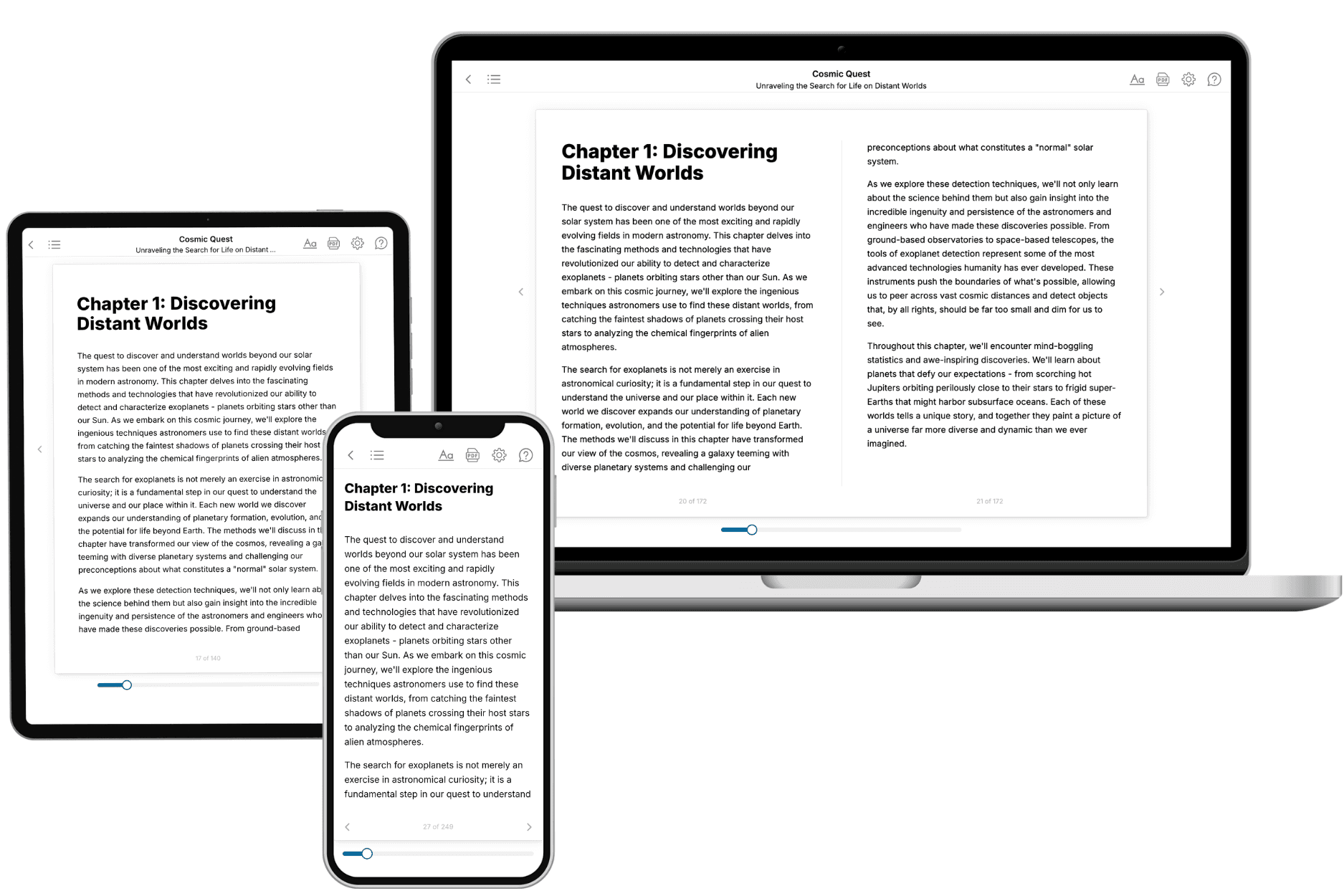
Your book is ready in 10 minutes. Read it online, download as EPUB or PDF, or send to Kindle.

Frequently asked questions
- What is TailoredRead?
TailoredRead creates complete, full-length nonfiction ebooks, written specifically for you. Tell us what you want to learn and why, and TailoredRead writes you a complete ebook on it, with charts, tables, and diagrams throughout. Read it online, on Kindle, or on any e-reader, or download it as a PDF or EPUB. Every book is written fresh the day you order it.
- How is the book tailored to me?
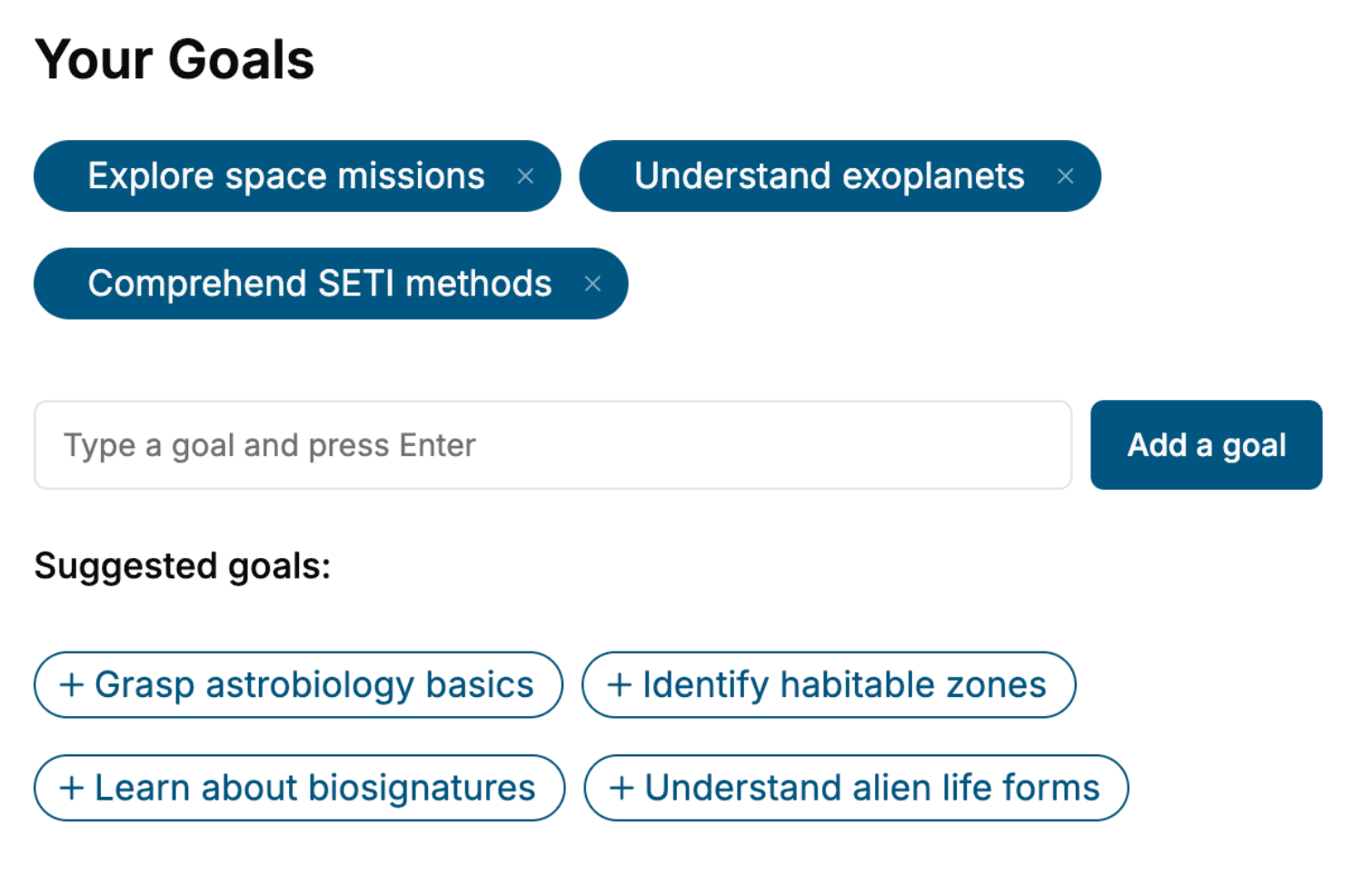
Before anything is written, you answer a few short questions about your goals, your background, and the topics you care about. Your book is then planned around your answers: written at your level, focused on your goals, and covering the topics you chose, instead of the one-size-fits-all book a store sells everyone.
- Will it read like generic AI content?
No. Your book isn't a chat transcript: it's planned chapter by chapter before a single word is written, told in a clear book voice, and explains ideas visually with charts, tables, and diagrams. After writing, every book goes through an editorial pass that polishes chapters so the book reads consistent from start to finish. Judge for yourself: browse thousands of sample books on our Explore Books page.
- How accurate is the content?
Our AI first checks whether your subject needs live research. Niche and fast-moving subjects are researched before writing, and the book plan and chapters are grounded in what it finds. After writing, every book goes through a quality pass that checks its facts and consistency, and researched books list their sources in a Notes section at the back.
- How long is the book?
You choose the length: Comprehensive (250-300 pages), Detailed (150-200 pages), Essential (70-100 pages), or Short (30-50 pages).
- Does the book include visuals?
Yes. Every book includes visual elements such as timelines, checklists, step-by-step guides, decision trees, comparison tables, and matrices, and many include bar charts. A typical book includes dozens of these visual elements.
- Can I read it on Kindle? What formats can I download?
Yes. Every book can be read in our online reader or downloaded as a PDF or EPUB. The EPUB can be opened with Kindle, Apple Books, Kobo, and any e-reader. The Commercial and Author licenses also include an editable Word (DOCX) and Markdown download.
- How much does it cost?
About the price of a regular ebook. The exact price depends on your book's length and complexity, from $2 for the shortest books to $35 for the most comprehensive, and it's shown when you review your book, before you commit to anything. Each book is a one-time purchase, yours to keep, no subscription. Licenses that let you share, teach, or publish your book range from $35.99 to $49.99.
- Can I preview the book before purchasing?
Before you pay, you'll see what your book will cover: the title, a detailed description, the estimated length, and the complete chapter-by-chapter table of contents, so you know what you're getting before you decide. The full text itself is written after you purchase.
- How long does it take to create a book?
About 10 minutes. You can start reading the opening chapters while the rest is still being written.