Mastering French Time
A Complete Guide to Telling Time, Dates, and Temporal Expressions in French
Imagine confidently discussing your schedule, making appointments, and planning events entirely in French without hesitation or confusion.
191 pages8 chaptersNov 29, 2025Learning French
About this book
You'll no longer stumble over whether to say "deux heures" or "quatorze heures," or wonder how to properly express when something happened. This comprehensive guide breaks down every aspect of French time expressions into clear, manageable lessons that build on each other. You'll master the 24-hour clock system, navigate the French calendar with ease, understand temporal prepositions that often confuse learners, and learn the cultural nuances behind how French speakers discuss time. Through practical examples, common mistakes to avoid, and real-world scenarios, you'll develop the confidence to handle any time-related conversation. Whether you're scheduling a business meeting, discussing your daily routine, or planning a vacation, you'll communicate with the precision and naturalness of a native speaker. This book transforms your relationship with French time from a source of anxiety into a source of confidence.
Table of contents
- IntroductionWhy Mastering French Time Matters, How to Use This Book, What You'll Learn and AccomplishRead below
- Chapter 1: The Fundamentals of French Time-TellingUnderstanding the 24-Hour Clock System, The Essential 'Il est...' Structure, Singular and Plural Rules for Hours
- Chapter 2: Telling Time with PrecisionAdding Minutes and Seconds, Quarter Hours and Half Hours, Common Time Phrases and Expressions
- Chapter 3: Days, Months, and SeasonsDays of the Week and Capitalization Rules, Months and Seasons with Proper Grammar, Ordinal Numbers for Dates
- Chapter 4: Mastering French DatesThe French Date Format: Day-Month-Year, Writing and Speaking Dates Correctly, Special Dates and Holidays
- Chapter 5: Temporal Prepositions and ConnectorsUsing 'À' for Specific Times, Using 'En' for Months and Seasons, Other Essential Temporal Prepositions
- Chapter 6: Duration, Frequency, and Recurring TimeExpressing Duration with 'Pendant' and 'Depuis', Expressing Frequency and Repetition, Future Time Expressions with 'Dans' and 'Il y a'
- Chapter 7: Cultural Nuances and Idiomatic ExpressionsCommon French Time Idioms, Cultural Attitudes Toward Time in French-Speaking Regions, Common Mistakes English Speakers Make
- Chapter 8: Real-World Applications and ScenariosScheduling Appointments and Meetings, Discussing Work Hours and Daily Routines, Planning Travel and Events
- ConclusionYour Progress and Next Steps, Continued Practice and Mastery
- Glossary of French Time Terms
- Further Reading and Resources
Introduction
Picture yourself in a bustling Parisian café, trying to arrange a meeting with a French colleague. You confidently say Je suis disponible à deux heures
, only to arrive at 2 PM while your colleague waited at 14:00—two in the afternoon according to the 24-hour clock they expected. Or imagine booking a train ticket for le 5/3
thinking it means May 3rd, when it actually refers to March 5th in the French day-month-year format. These aren't just minor inconveniences; they're missed opportunities, confused plans, and moments that shake your confidence in speaking French. Time expressions form the backbone of daily communication, yet they're often glossed over in traditional language courses that focus primarily on grammar rules and vocabulary lists.
The challenge with French time expressions goes far beyond memorizing numbers and clock positions. French uses temporal structures that don't map neatly onto English patterns, requiring you to think differently about how time works. The language distinguishes between pendant (during a completed period), depuis (since a point continuing to now), and pour (for a planned duration) in ways that English collapses into the single word "for." French speakers naturally switch between 12-hour and 24-hour formats depending on context, use à and en with different temporal nouns following rules that seem arbitrary at first, and employ idiomatic expressions like de bonne heure that don't translate literally. Without systematic guidance, you're left guessing, making errors that mark you as a non-native speaker, and missing the cultural nuances that native speakers take for granted.
This book exists to transform your relationship with French time from a source of anxiety into a foundation of confidence. You'll move beyond basic survival phrases to genuine mastery, understanding not just what to say but why French structures time the way it does. Through clear explanations, abundant examples, and practical scenarios drawn from real-world situations, you'll develop the intuition that native speakers possess. Whether you're scheduling business meetings, discussing your daily routine, planning vacations, or simply chatting about when something happened, you'll communicate with precision and naturalness. The goal isn't just competence—it's the kind of fluency that lets you stop translating in your head and start thinking directly in French temporal patterns.
Why Mastering French Time Matters
Time expressions appear in virtually every conversation you'll have in French, making them among the most frequently used language structures you'll encounter. Consider a typical day: you discuss when you woke up, schedule lunch plans, mention how long you've been studying French, talk about upcoming weekend activities, and reference past events. Each of these requires precise temporal language. Unlike vocabulary about specialized topics that you might use occasionally, time expressions are unavoidable. Research in second language acquisition shows that high-frequency structures like temporal expressions create a disproportionate impact on perceived fluency—native speakers notice errors in these fundamental areas far more than mistakes in advanced vocabulary[1]. When you stumble over telling time or expressing duration, it signals to listeners that your French proficiency may be limited, even if your vocabulary and grammar are otherwise strong.
The practical consequences of time-related confusion extend beyond embarrassment into real-world problems that affect your daily life. Missing appointments because you confused matin and après-midi, arriving a month early for an event because you misread a French date, or failing to understand train schedules because you're unfamiliar with 24-hour time—these aren't hypothetical scenarios. They happen regularly to intermediate learners who haven't systematically studied temporal expressions. In professional contexts, the stakes rise even higher. Business meetings, project deadlines, and work schedules demand precision. Telling a client you'll deliver results dans deux semaines (in two weeks) when you meant depuis deux semaines (for the past two weeks) creates serious misunderstandings. The ability to discuss time accurately isn't a luxury; it's a necessity for anyone using French in practical situations.
Beyond practical utility, mastering French time expressions opens doors to cultural understanding that enriches your entire language experience. French-speaking cultures have distinct attitudes toward punctuality, scheduling, and time management that differ from Anglophone norms. The concept of l'heure (the hour) carries different weight in Paris versus Montreal versus Dakar, with varying expectations about what constitutes being on time
for social versus professional engagements. Idiomatic expressions reveal cultural values: métro, boulot, dodo (metro, work, sleep) captures the rhythm of urban French life, while prendre son temps (to take one's time) reflects attitudes about rushing. When you understand these temporal patterns and expressions, you're not just learning vocabulary—you're gaining insight into how French speakers conceptualize and organize their lives around time.
The cognitive benefits of mastering temporal expressions extend to your overall French proficiency in surprising ways. Time structures force you to work with verb tenses in context, connecting past, present, and future in meaningful ways. When you learn to use depuis with the present tense to describe ongoing actions (J'habite ici depuis trois ans—I've been living here for three years), you're simultaneously reinforcing present tense conjugations and understanding aspectual differences between French and English. Temporal prepositions require you to master noun genders and articles, since you must know whether to say au printemps (in spring) or en été (in summer). These interconnections mean that studying time expressions strengthens multiple aspects of your French simultaneously, creating a multiplier effect on your learning.
For intermediate learners specifically, time expressions represent a crucial bridge between basic communication and advanced fluency. You've likely already learned to tell basic time and recognize days of the week, but you may struggle with nuanced temporal concepts that native speakers use effortlessly. The difference between pendant, depuis, pour, and dans probably still causes hesitation. You might avoid certain time-related conversations because you're unsure of the correct structures. This book targets exactly this gap—the space between beginner survival phrases and the sophisticated temporal language that characterizes truly fluent speakers. By systematically addressing these intermediate and advanced concepts, you'll eliminate a major barrier that prevents many learners from progressing to higher proficiency levels.
The confidence that comes from time mastery transforms your entire French-speaking experience in ways that extend far beyond the specific structures you learn. When you know you can accurately discuss schedules, dates, and timing, you stop avoiding these topics and start engaging more naturally in conversations. You volunteer to coordinate plans rather than passively following others' arrangements. You participate in discussions about past events and future plans without the anxiety of making temporal errors. This psychological shift—from defensive avoidance to confident engagement—accelerates your overall language development. You practice more, make fewer errors, and receive more positive feedback, creating a virtuous cycle that propels your French forward across all skill areas.
Finally, mastering French time expressions provides a template for approaching other complex language areas systematically. The methodology you'll use in this book—understanding underlying patterns, learning through abundant examples, practicing with real-world scenarios, and recognizing common pitfalls—applies equally well to other challenging aspects of French. Once you've successfully navigated the intricacies of temporal language, you'll have both the confidence and the learning strategies to tackle other advanced topics. The skills you develop here—pattern recognition, contextual understanding, and practical application—become transferable tools for continued language growth. In this sense, mastering time expressions isn't just about time; it's about developing the learning approach that will serve you throughout your French journey.
How to Use This Book
This book follows a carefully structured progression that builds from foundational concepts to advanced applications, with each chapter preparing you for the next. The early chapters establish the core mechanics of French time-telling—the 24-hour clock system, the essential Il est structure, and basic time expressions. Middle chapters expand into dates, temporal prepositions, and duration concepts that require more nuanced understanding. Later chapters address cultural idioms, common mistakes, and real-world scenarios that integrate everything you've learned. This isn't arbitrary sequencing; it reflects how temporal concepts naturally build on each other. You need to understand basic time-telling before tackling complex duration expressions, just as you need to master date formats before discussing scheduling in professional contexts. While you can certainly jump to specific chapters that address immediate needs, working through the book sequentially will give you the most comprehensive and lasting mastery.
Each chapter follows a consistent internal structure designed to maximize learning and retention through multiple reinforcement methods:
- Clear explanations that break down complex concepts into understandable components, showing you not just what to say but why French structures work the way they do
- Abundant examples with both French and English, demonstrating each concept in multiple contexts so you see how structures function in different situations
- Practical applications that connect abstract rules to real-world usage, helping you understand when and how to apply what you're learning
- Common mistakes sections that highlight errors English speakers typically make, helping you avoid pitfalls before they become ingrained habits
- Cultural notes that provide context about how French speakers actually use temporal expressions in different regions and situations
The examples throughout this book deserve special attention because they're your primary tool for internalizing French temporal patterns. Each example appears in French first, followed by an English translation, allowing you to attempt understanding before checking your comprehension. Don't just read these examples passively—engage with them actively. Cover the English translation and try to understand the French on your own. Say the French phrases aloud to develop muscle memory for pronunciation and rhythm. Notice the specific words used and how they combine to create meaning. When you encounter an example that confuses you, spend extra time with it rather than rushing forward. These examples aren't decorative; they're carefully chosen to illustrate specific points and common usage patterns. The more deeply you engage with them, the more naturally French temporal expressions will come to you in actual conversations.
Active practice should accompany your reading at every stage, transforming passive knowledge into active skill. After completing each section, close the book and try to recall the main concepts without looking. Create your own example sentences using the structures you've just learned, drawing from your actual life and schedule. Speak these sentences aloud, even if you're alone—the physical act of producing French sounds reinforces learning in ways that silent reading cannot. If you have access to French speakers, native or fellow learners, practice the expressions in real conversations. If not, talk to yourself in French about your schedule, plans, and past activities. This might feel awkward initially, but self-directed practice is remarkably effective for developing fluency. The goal is to move temporal expressions from your passive recognition vocabulary into your active production vocabulary, where they're available instantly when you need them.
The book includes numerous practical scenarios and dialogues that simulate real-world situations where you'll use French time expressions. These scenarios aren't just examples—they're practice opportunities. When you encounter a dialogue about scheduling an appointment or discussing work hours, don't just read it. Role-play it. Take one character's part and speak their lines aloud, imagining yourself in that situation. Then switch roles and practice the other side of the conversation. Modify the scenarios to reflect your actual life: change the times, dates, and activities to match your real schedule and interests. This personalization makes the language more memorable and immediately useful. Consider writing out your own dialogues based on the templates provided, creating scenarios you're likely to encounter in your specific French-speaking contexts, whether that's business meetings, social gatherings, travel situations, or academic settings.
Pay particular attention to the sections on common mistakes, as these represent the most frequent errors that intermediate learners make with French time expressions. These aren't random errors—they're systematic mistakes that arise from interference between English and French temporal structures. When you see a mistake highlighted, don't just note it and move on. Understand why it's wrong and what the correct form should be. Create a personal list of mistakes you're prone to making, based on both the book's examples and your own experience. Review this list regularly, especially before situations where you'll need to use French time expressions. Over time, you'll internalize the correct forms and the mistakes will disappear from your speech. This proactive approach to error correction is far more effective than hoping mistakes will naturally resolve themselves through exposure alone.
The glossary at the end of the book serves as both a reference tool and a study resource that you should consult frequently. It contains all the essential temporal vocabulary and expressions covered throughout the chapters, organized for easy lookup. When you're unsure about a specific term or expression, check the glossary before searching elsewhere—it's tailored specifically to the content and approach of this book. Consider using the glossary as a self-testing tool: cover the definitions and see if you can recall the meanings and usage of terms, or cover the French terms and try to recall them from the English descriptions. This active engagement with the glossary transforms it from a passive reference into an active learning tool. As you progress through the book, periodically review earlier glossary entries to ensure you're retaining what you've learned and not just accumulating new information while forgetting old material.
Finally, approach this book with patience and realistic expectations about the learning process. Mastering French time expressions isn't something you'll accomplish in a single reading or even a week of study. These structures need time to settle into your linguistic intuition through repeated exposure, practice, and real-world use. You'll likely need to revisit chapters multiple times, each reading revealing nuances you missed initially. Some concepts will click immediately while others require more time and practice. This is completely normal and expected. The goal isn't to memorize every rule and example perfectly but to develop a working understanding that improves gradually through consistent engagement. Trust the process, practice regularly, and be patient with yourself as these temporal patterns become increasingly natural and automatic in your French communication.
What You'll Learn and Accomplish
By the time you complete this book, you'll have comprehensive mastery of French time-telling in both formal and informal contexts. You'll confidently navigate the 24-hour clock system that dominates French public life—train schedules, business hours, official appointments—while also handling the 12-hour conversational format used in casual settings. You'll understand exactly when to say quatorze heures versus deux heures de l'après-midi, and you'll recognize which format native speakers expect in different situations. This dual competency eliminates the confusion that plagues many learners who learn one system but not the other, or who can't judge which system fits the context. You'll be able to read French schedules, timetables, and calendars without mental translation, processing times directly in French rather than converting them to English equivalents in your head.
Your command of French dates will become second nature, allowing you to write and speak dates correctly in the day-month-year format that French uses. You'll automatically write le 15 mars 2024 rather than the English March 15, 2024, and you'll read French dates without confusion or hesitation. More importantly, you'll understand the grammatical rules governing dates—when to use ordinal versus cardinal numbers, how articles work with dates, and how to express date ranges and approximations. This knowledge extends to special dates and holidays, where you'll learn both the vocabulary and the cultural context surrounding important dates in French-speaking regions. Whether you're filling out forms, scheduling events, or discussing historical dates, you'll handle French date expressions with the same ease as native speakers.
The temporal prepositions that confuse most intermediate learners will become clear and manageable through the systematic approach this book provides. You'll master the distinctions between:
- À for specific clock times (à huit heures—at eight o'clock)
- En for months and most seasons (en juillet, en été)
- Au for spring (au printemps)
- Pendant for completed durations (pendant deux heures—for two hours, completed)
- Depuis for ongoing durations (depuis deux heures—for two hours, continuing)
- Pour for planned durations (pour deux heures—for two hours, planned)
- Dans for future time (dans deux heures—in two hours, from now)
Duration and frequency expressions will move from sources of confusion to tools you wield confidently in conversation. You'll express how long something lasted, how long it's been continuing, and how long it will continue with precision and naturalness. The difference between J'ai étudié pendant trois heures (I studied for three hours, finished) and J'étudie depuis trois heures (I've been studying for three hours, still ongoing) will be crystal clear, both in understanding and production. You'll handle frequency expressions like tous les jours (every day), une fois par semaine (once a week), and de temps en temps (from time to time) with ease. These expressions will allow you to describe your routines, habits, and schedules with the specificity that characterizes fluent speakers, moving beyond vague temporal references to precise, natural descriptions.
The cultural dimension of French time expressions will enrich your understanding and help you communicate more effectively with native speakers. You'll learn idiomatic expressions that don't translate literally but carry important cultural meanings—phrases like à la bourre (running late, informal), pile (exactly, on the dot), and en avance (early, ahead of time). You'll understand regional variations in how French speakers discuss time, recognizing differences between European French, Canadian French, and African French temporal expressions. This cultural knowledge prevents misunderstandings and helps you adapt your language to different French-speaking contexts. You'll also learn about cultural attitudes toward punctuality and time management, understanding when being à l'heure means arriving exactly on time versus when a more flexible interpretation applies.
Perhaps most importantly, you'll develop the ability to apply your temporal knowledge in real-world scenarios that matter to your life. The book's practical focus ensures you can:
- Schedule appointments and meetings with precision, confirming times and dates without ambiguity
- Discuss your daily routine and work schedule naturally, describing when you wake up, eat, work, and sleep
- Plan travel and events, coordinating times and dates with others confidently
- Understand French schedules, timetables, and calendars in professional and public contexts
- Discuss past events and future plans with appropriate temporal expressions and verb tenses
- Handle time-related questions and conversations spontaneously without preparation or anxiety
Beyond specific temporal structures, you'll develop broader linguistic skills that enhance your overall French proficiency. Working with time expressions reinforces verb conjugations across tenses, as temporal contexts naturally require past, present, and future forms. You'll strengthen your understanding of noun genders and articles through temporal vocabulary. Your listening comprehension will improve as you become attuned to temporal markers in French speech. Your reading skills will benefit from recognizing temporal structures in written texts. These collateral benefits mean that studying time expressions isn't just about time—it's about developing the integrated language skills that characterize advanced proficiency. The confidence and competence you gain in this specific area will radiate outward, improving your French communication across all domains.
By the end of this journey, you'll have transformed from someone who hesitates and second-guesses temporal expressions into someone who uses them naturally and confidently. You'll stop mentally translating from English and start thinking directly in French temporal patterns. Time-related conversations will no longer be sources of anxiety but opportunities to demonstrate your growing fluency. You'll notice yourself using temporal expressions spontaneously in French conversations, without conscious effort or planning. This transformation—from conscious, effortful production to automatic, natural usage—represents genuine mastery. It's the difference between knowing about French time expressions and actually owning them as part of your active French competence. That's the goal of this book, and that's what you'll accomplish through dedicated engagement with the material and consistent practice of the concepts presented.
Notes
Introduction
- 1. Nick C. Ellis, "Frequency effects in language processing," Studies in Second Language Acquisition, 2002
This is the end of the free sample. The full book has 8 chapters.
Want this book written for you?
Tell us your goals and background, and get your own version of this book, tailored by AI to you.


Benefits of AI-tailored books
- Read one book, not ten:
- all the Learning French knowledge you need, gathered into a single book.
- Save days of learning:
- tell us your goals, choose your topics, and the whole book is built around them.
- Learn effortlessly:
- Learning French book written for your specific background and expertise.
- Understand at a glance:
- includes charts, tables, timelines, checklists, decision trees, and more.
- Stay current:
- written the day you order it, not years ago.
- Trust what you read:
- every book is checked for accuracy, with real research when your subject needs it.
Create your unique book in 3 steps
- 1. Select your focus
Select the focus of your Learning French book and share your background
- 2. Personalize your book
Specify your goals and choose sub-topics to include
- 3. Get your tailored book
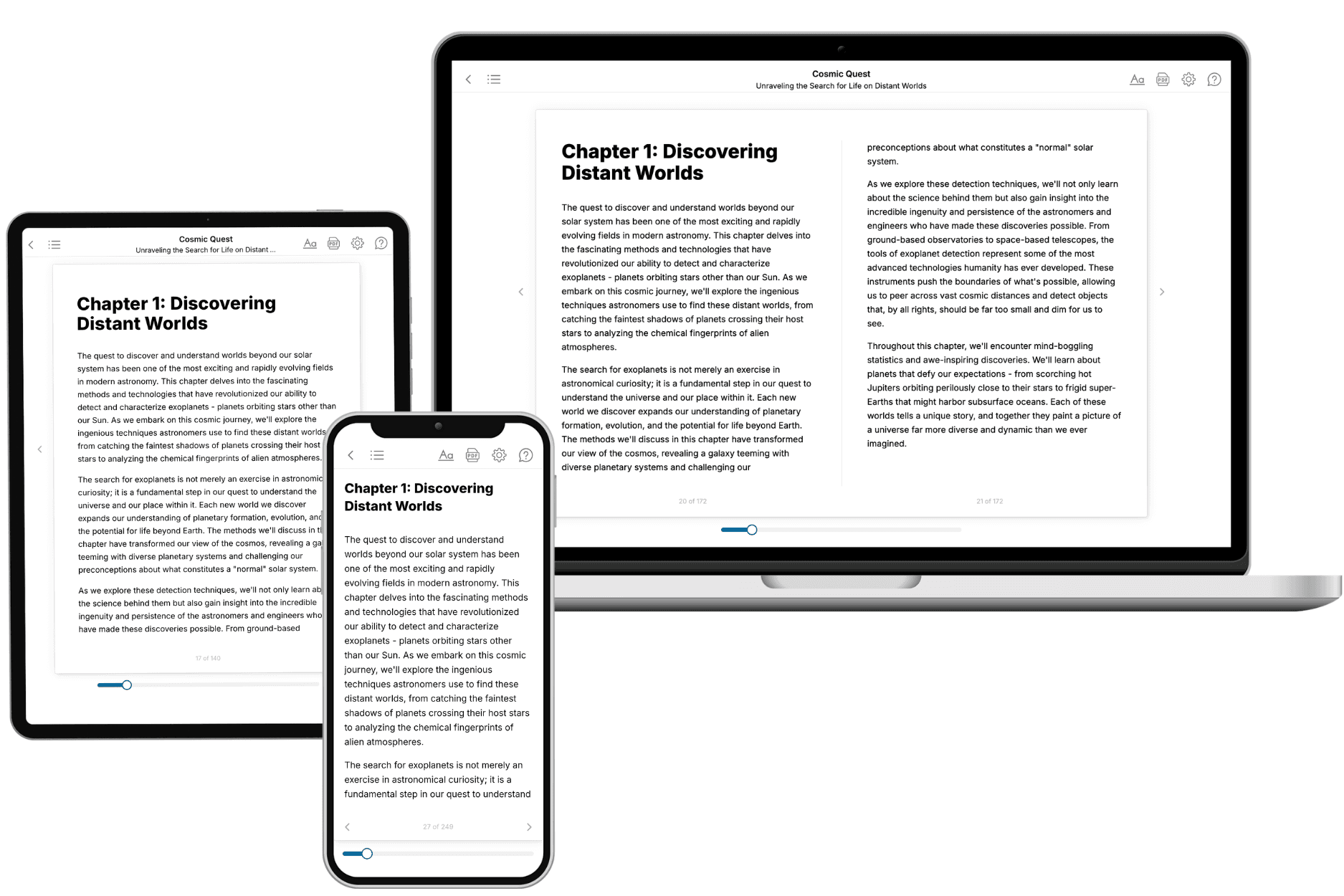
Your book is ready in 10 minutes. Read it online, download as EPUB or PDF, or send to Kindle.
Frequently asked questions
- What is TailoredRead?
TailoredRead creates complete, full-length nonfiction ebooks, written specifically for you. Tell us what you want to learn and why, and TailoredRead writes you a complete ebook on it, with charts, tables, and diagrams throughout. Read it online, on Kindle, or on any e-reader, or download it as a PDF or EPUB. Every book is written fresh the day you order it.
- How is the book tailored to me?
Before anything is written, you answer a few short questions about your goals, your background, and the topics you care about. Your book is then planned around your answers: written at your level, focused on your goals, and covering the topics you chose, instead of the one-size-fits-all book a store sells everyone.
- Will it read like generic AI content?
No. Your book isn't a chat transcript: it's planned chapter by chapter before a single word is written, told in a clear book voice, and explains ideas visually with charts, tables, and diagrams. After writing, every book goes through an editorial pass that polishes chapters so the book reads consistent from start to finish. Judge for yourself: browse thousands of sample books on our Explore Books page.
- How accurate is the content?
Our AI first checks whether your subject needs live research. Niche and fast-moving subjects are researched before writing, and the book plan and chapters are grounded in what it finds. After writing, every book goes through a quality pass that checks its facts and consistency, and researched books list their sources in a Notes section at the back.
- How long is the book?
You choose the length: Comprehensive (250-300 pages), Detailed (150-200 pages), Essential (70-100 pages), or Short (30-50 pages).
- Does the book include visuals?
Yes. Every book includes visual elements such as timelines, checklists, step-by-step guides, decision trees, comparison tables, and matrices, and many include bar charts. A typical book includes dozens of these visual elements.
- Can I read it on Kindle? What formats can I download?
Yes. Every book can be read in our online reader or downloaded as a PDF or EPUB. The EPUB can be opened with Kindle, Apple Books, Kobo, and any e-reader. The Commercial and Author licenses also include an editable Word (DOCX) and Markdown download.
- How much does it cost?
About the price of a regular ebook. The exact price depends on your book's length and complexity, from $2 for the shortest books to $35 for the most comprehensive, and it's shown when you review your book, before you commit to anything. Each book is a one-time purchase, yours to keep, no subscription. Licenses that let you share, teach, or publish your book range from $35.99 to $49.99.
- Can I preview the book before purchasing?
Before you pay, you'll see what your book will cover: the title, a detailed description, the estimated length, and the complete chapter-by-chapter table of contents, so you know what you're getting before you decide. The full text itself is written after you purchase.
- How long does it take to create a book?
About 10 minutes. You can start reading the opening chapters while the rest is still being written.