Mastering Gerunds
The Complete Guide to Understanding and Using Gerunds in English
Many English learners struggle with gerunds because they look like present participles but function completely differently—and this confusion leads to awkward sentences and grammatical errors.
207 pages10 chaptersApr 24, 2026English Grammar
About this book
The challenge isn't just recognizing the -ing form; it's understanding when and how to use gerunds as nouns, what pronouns must precede them, and how they fit into the larger patterns of English grammar. This guide cuts through the confusion by breaking down gerund formation into clear, manageable concepts. You'll learn the fundamental rules that govern gerund creation, discover how gerunds differ from participles and infinitives, and master the verb patterns that determine when gerunds are the correct choice. Through practical examples, real-world applications, and progressive exercises, you'll develop the confidence to use gerunds naturally in your writing and speech. Whether you're preparing for language proficiency exams, improving your professional communication, or simply aiming for greater grammatical accuracy, this book provides the structured knowledge and practical skills you need to master one of English's most important grammatical features.
Table of contents
- IntroductionWhy Gerunds Matter in English, Common Misconceptions About Gerunds, How to Use This BookRead below
- Chapter 1: What Are Gerunds?Definition and Basic Characteristics, How Gerunds Function as Nouns, The Simple Rules of Gerund Formation
- Chapter 2: Gerunds vs. Participles vs. InfinitivesUnderstanding Present Participles, Infinitives and Their Functions, How to Tell Them Apart in Context, Practice: Identifying Each Form
- Chapter 3: Gerunds as Subjects and ObjectsUsing Gerunds as Sentence Subjects, Gerunds as Direct Objects of Verbs, Gerunds as Indirect Objects and Complements
- Chapter 4: Gerunds After PrepositionsWhy Gerunds Follow Prepositions, Common Prepositions Used with Gerunds, Phrasal Verbs and Gerund Patterns
- Chapter 5: Possessive Forms Before GerundsUsing Possessive Pronouns with Gerunds, Possessive Noun Forms Before Gerunds, Formal vs. Informal Usage Patterns
- Chapter 6: Verb Patterns with GerundsVerbs That Always Take Gerunds, Verbs That Accept Both Gerunds and Infinitives, How Meaning Changes with Gerunds vs. Infinitives, Strategies for Memorizing Verb Patterns
- Chapter 7: Gerunds in Idiomatic ExpressionsEssential Idioms Featuring Gerunds, Cultural and Colloquial Gerund Expressions, Using Idioms Naturally in Conversation
- Chapter 8: Advanced Gerund StructuresBuilding Complex Gerund Phrases, Gerunds with Their Own Objects and Modifiers, Perfect Gerunds and Their Uses
- Chapter 9: Gerunds in Writing and CommunicationUsing Gerunds for More Concise Writing, Gerunds in Professional and Academic Writing, Incorporating Gerunds into Natural Speech
- Chapter 10: Common Errors and How to Avoid ThemThe Most Common Gerund Mistakes, Strategies for Self-Correction, Analyzing and Learning from Your Errors
- ConclusionYour Path to Gerund Mastery, Continuing Your Learning Journey
- Appendix: Quick Reference GuideComplete List of Verbs Followed by Gerunds, Common Prepositions Used with Gerunds, Essential Gerund Idioms Reference
Introduction
There is a moment that almost every English learner knows well. You are writing a sentence, and you reach a point where you need to express an action as a thing. You know the verb. You know what you want to say. But something about the grammar feels uncertain, and you pause. Should you write swim or swimming? Should it be to swim or swimming? Is the word you are reaching for a gerund, a participle, or something else entirely? That moment of hesitation is exactly what this book is designed to eliminate.
Gerunds are one of the most frequently used grammatical structures in English, yet they are also one of the most misunderstood. They appear in everyday conversation, in professional emails, in academic writing, and in idiomatic expressions that native speakers use without a second thought. Phrases like I enjoy reading
, She is good at solving problems
, and Thank you for coming
all rely on gerunds. These structures are not exotic or rare. They are woven into the fabric of natural English, which means that understanding them is not optional if your goal is genuine fluency.
The confusion around gerunds usually comes from one simple fact: they look exactly like present participles. Both forms end in -ing, and both are built from verbs. But they do completely different jobs in a sentence. A gerund acts as a noun. A present participle acts as part of a verb phrase or as an adjective. Mixing them up leads to sentences that feel grammatically off, even when the reader cannot immediately explain why. This book will give you the tools to tell them apart every time, and to use each form with confidence.
This guide is built for intermediate English learners and language enthusiasts who already have a foundation in basic grammar. You do not need to be an expert to benefit from what follows. What you do need is a willingness to look closely at how English works and a desire to move beyond guessing. Each chapter builds on the last, taking you from the basic definition of a gerund all the way through advanced structures, idiomatic expressions, and practical writing strategies. By the time you reach the final pages, gerunds will no longer feel like a mystery. They will feel like a tool you know how to use.
Why Gerunds Matter in English
English is a language that constantly turns actions into things. This is not a quirk or an accident. It reflects the way English speakers think and communicate. When you say Running is good for your health
, you are treating the act of running as a concept, a subject that can be discussed, evaluated, and compared. Gerunds make this possible. Without them, expressing ideas about actions would require far more complicated sentence structures, and natural English would become clunky and indirect.
Consider how often gerunds appear in professional communication alone. Job descriptions are filled with phrases like responsible for managing a team
, experienced in developing software
, and skilled at communicating with clients
. Academic writing relies on gerunds to discuss processes and methods: analyzing data
, conducting research
, interpreting results
. Even casual conversation depends on them. When a friend says I can't stand waiting in line
or She suggested going to the new restaurant
, they are using gerunds naturally and automatically.
For language learners, mastering gerunds has a direct and measurable impact on fluency. Research in second language acquisition consistently shows that learners who understand verb complementation patterns, including which verbs take gerunds and which take infinitives, make significantly fewer grammatical errors in both writing and speech.[1] This is not just about passing grammar tests. It is about sounding natural, being understood clearly, and expressing complex ideas without hesitation.
Gerunds also play a critical role in standardized English proficiency exams. Tests like the TOEFL, IELTS, and Cambridge exams regularly include questions that test knowledge of gerund versus infinitive patterns, possessive forms before gerunds, and gerunds after prepositions. These are not obscure edge cases. They are core grammar points that appear again and again because they reflect real patterns in how English is used. Preparing for these exams without a solid understanding of gerunds puts you at a significant disadvantage.
Beyond exams and professional writing, gerunds matter because they are the gateway to idiomatic English. Many of the most common English idioms and fixed expressions are built around gerunds. Phrases like it goes without saying
, there is no point in waiting
, and I look forward to hearing from you
are all gerund-based. Native speakers use these expressions constantly, and recognizing them as gerund structures helps you understand why they are formed the way they are, rather than just memorizing them as isolated chunks.
Finally, gerunds give your writing and speech a level of sophistication and conciseness that other structures simply cannot match. Instead of writing The fact that she arrived late caused problems
, you can write Her arriving late caused problems
. Instead of It is important that you practice every day
, you can write Practicing every day is important
. These are not just stylistic preferences. They represent a more efficient, more natural way of expressing ideas, and they are the kind of choices that distinguish a competent English user from a truly fluent one.
Common Misconceptions About Gerunds
One of the biggest obstacles to learning gerunds is not a lack of information. It is misinformation, or more precisely, oversimplified rules that break down the moment you encounter a real sentence. Many learners arrive with a handful of half-remembered grammar rules that create more confusion than clarity. Before moving forward, it is worth addressing the most common misconceptions directly, so you can set them aside and build on a more accurate foundation.
Misconception 1: Any word ending in -ing is a gerund. This is probably the most widespread misunderstanding. The -ing ending appears in three different grammatical contexts in English: gerunds, present participles, and adjectives derived from verbs. In the sentence Swimming is my favorite sport
, swimming is a gerund because it functions as the subject of the sentence, a noun. In She is swimming in the pool
, swimming is a present participle forming part of the verb phrase. In The swimming pool is closed
, swimming is an adjective modifying the noun pool. The form is identical in all three cases. Only the grammatical function tells you what it actually is.
Misconception 2: Gerunds and infinitives are always interchangeable. Many learners assume that if a verb can be followed by a gerund, it can also be followed by an infinitive with no change in meaning. This is sometimes true, but often it is not. With certain verbs, the choice between a gerund and an infinitive changes the meaning of the sentence entirely. Compare I stopped smoking
(I quit the habit) with I stopped to smoke
(I paused in order to smoke). These sentences describe opposite situations. Treating gerunds and infinitives as freely interchangeable leads to exactly this kind of error.
Misconception 3: Gerunds are only used in formal writing. Some learners avoid gerunds in conversation because they associate them with academic or formal language. In reality, gerunds are just as common in casual speech as they are in formal writing. When you say I hate getting up early
or Do you mind opening the window?
, you are using gerunds in completely natural, everyday contexts. Avoiding them in speech does not make you sound more natural. It often makes your sentences sound more awkward and stilted.
Misconception 4: You never need a possessive before a gerund. This is a rule that many learners have simply never encountered. In formal English, when a noun or pronoun precedes a gerund, it should take the possessive form. The correct formal version of I appreciate him helping me
is I appreciate his helping me
. The gerund helping is the object of the verb appreciate, and the word before it should be possessive. This rule is frequently ignored in informal speech, but it matters in professional and academic writing, and it appears on language proficiency exams.
Misconception 5: Gerunds are a minor grammar point. Some learners treat gerunds as a small, optional topic that can be skimmed over once and then forgotten. The reality is that gerund patterns are embedded in hundreds of common verbs, prepositions, and idiomatic expressions. A learner who does not understand gerunds will make errors constantly, often without realizing it. These errors accumulate and create a persistent ceiling on fluency that is difficult to break through without directly addressing the underlying grammar.
Understanding where these misconceptions come from is actually useful. They often arise from grammar rules that were taught in isolation, without enough context or examples to show how the rules work in real sentences. This book takes a different approach. Every rule is accompanied by multiple examples, and every example is drawn from the kind of English you will actually encounter and need to produce. The goal is not to memorize rules in the abstract. It is to develop an intuition for how gerunds work, so that using them correctly becomes natural rather than effortful.
A quick reality check: If you have ever written a sentence and then second-guessed whether to use -ing or to + verb, you have already encountered the gerund problem firsthand. That uncertainty is not a sign of weakness. It is a sign that you are paying attention to grammar, and paying attention is exactly where mastery begins.
It is also worth noting that native English speakers make gerund-related errors too, particularly around possessive forms and the gerund-versus-participle distinction. This is not a topic that only challenges language learners. It is a genuine complexity in English grammar that rewards careful study. The fact that you are approaching it deliberately and systematically already puts you ahead of many people who use English every day without ever examining these patterns closely.
How to Use This Book
This book is designed to be read in order, at least for the first time through. Each chapter builds on the concepts introduced in the previous one, so jumping ahead can leave gaps in your understanding that make later material harder to follow. That said, once you have read through the book once, it works equally well as a reference guide. The appendix at the back provides quick-reference lists of verbs, prepositions, and idioms that you can consult whenever you need a fast answer.
The structure of the book follows a clear progression. Here is what each section covers and why it appears in this order:
- Chapters 1 and 2 establish the foundation. You will learn what gerunds are, how they are formed, and how they differ from present participles and infinitives. This is the conceptual groundwork that everything else depends on.
- Chapters 3 and 4 cover the main grammatical functions of gerunds: as subjects, objects, complements, and objects of prepositions. These chapters show you where gerunds appear in sentences and why.
- Chapter 5 addresses possessive forms before gerunds, a rule that many learners have never been taught and that makes a significant difference in formal writing.
- Chapter 6 tackles verb patterns, including which verbs always take gerunds, which take infinitives, and which can take both with different meanings. This chapter includes strategies for memorizing these patterns effectively.
- Chapters 7 and 8 move into more advanced territory: idiomatic expressions featuring gerunds and complex gerund phrase structures, including perfect gerunds.
- Chapter 9 focuses on practical application, showing you how to use gerunds to write more concisely and naturally in both professional and everyday contexts.
- Chapter 10 addresses common errors and gives you strategies for identifying and correcting your own mistakes.
Throughout the book, you will find examples drawn from real-world English: professional emails, academic writing, everyday conversation, and idiomatic speech. These examples are not invented to be artificially simple. They reflect the kind of language you will actually encounter. Where a concept is particularly tricky, you will find side-by-side comparisons showing both the correct and incorrect versions, along with an explanation of why one works and the other does not.
Each chapter also includes practice opportunities. These are not optional extras. They are an essential part of the learning process. Research in language learning consistently shows that passive reading of grammar rules produces far less retention than active practice and application.[2] Reading about gerunds will give you knowledge. Practicing with them will give you skill. Both are necessary, and neither is sufficient on its own.
Here are some practical suggestions for getting the most out of this book:
- Read actively, not passively. When you encounter an example sentence, pause and ask yourself why the gerund is used there. What function is it serving? Could an infinitive work instead? This kind of active engagement accelerates learning significantly.
- Keep a notebook. Write down examples that surprise you or that illustrate a rule particularly well. Writing by hand reinforces memory in ways that simply reading does not.
- Look for gerunds in the wild. As you read articles, emails, or books in English, notice when gerunds appear. Try to identify their grammatical function. This habit of noticing will accelerate your progress more than almost anything else.
- Do not skip the error analysis in Chapter 10. Many learners are tempted to skip chapters that focus on mistakes, either because they feel discouraging or because they seem less interesting than the main content. In reality, understanding common errors is one of the fastest ways to improve, because it helps you recognize and correct patterns that may already be present in your own writing.
- Return to the appendix regularly. The quick-reference lists at the back of the book are designed to be used repeatedly, not just once. Keep the book accessible so you can check verb patterns and preposition lists whenever you need them.
One more thing worth saying at the outset: progress with grammar is rarely linear. You may read a chapter, feel confident, and then encounter a sentence in the wild that confuses you again. This is completely normal. It does not mean you have failed to learn. It means you are encountering the natural complexity of a living language. Each time you work through that confusion, your understanding deepens. The goal is not to reach a point where English grammar never surprises you. The goal is to build enough knowledge and skill that you can work through surprises confidently, rather than being stopped by them.
Gerunds are not the most glamorous topic in English grammar. They do not have the drama of irregular verbs or the mystique of the subjunctive mood. But they are quietly essential. They appear in thousands of sentences every day, in every register of English, from the most casual text message to the most formal academic paper. Mastering them will not just improve your grammar scores. It will change the way you write and speak, making your English more natural, more precise, and more confident. That is a worthwhile goal, and this book is designed to help you reach it.
A note on terminology: This book uses standard grammatical terms like subject, object, complement, and preposition. If any of these terms feel unfamiliar, do not worry. Each one is explained clearly when it first appears, and the focus throughout is always on practical understanding rather than technical jargon. The terminology is a tool for clarity, not a barrier to entry.
With that, it is time to begin. Chapter 1 starts at the very beginning: what a gerund actually is, where it comes from, and what makes it different from every other -ing form in English. By the end of that chapter, you will have a clear, solid definition to build on, and the rest of the book will follow naturally from there. Let's get started.
This is the end of the free sample. The full book has 10 chapters.
Want this book written for you?
Tell us your goals and background, and get your own version of this book, tailored by AI to you.


Benefits of AI-tailored books
- Read one book, not ten:
- all the English Grammar knowledge you need, gathered into a single book.
- Save days of learning:
- tell us your goals, choose your topics, and the whole book is built around them.
- Learn effortlessly:
- English Grammar book written for your specific background and expertise.
- Understand at a glance:
- includes charts, tables, timelines, checklists, decision trees, and more.
- Stay current:
- written the day you order it, not years ago.
- Trust what you read:
- every book is checked for accuracy, with real research when your subject needs it.
Create your unique book in 3 steps
- 1. Select your focus
Select the focus of your English Grammar book and share your background
- 2. Personalize your book
Specify your goals and choose sub-topics to include
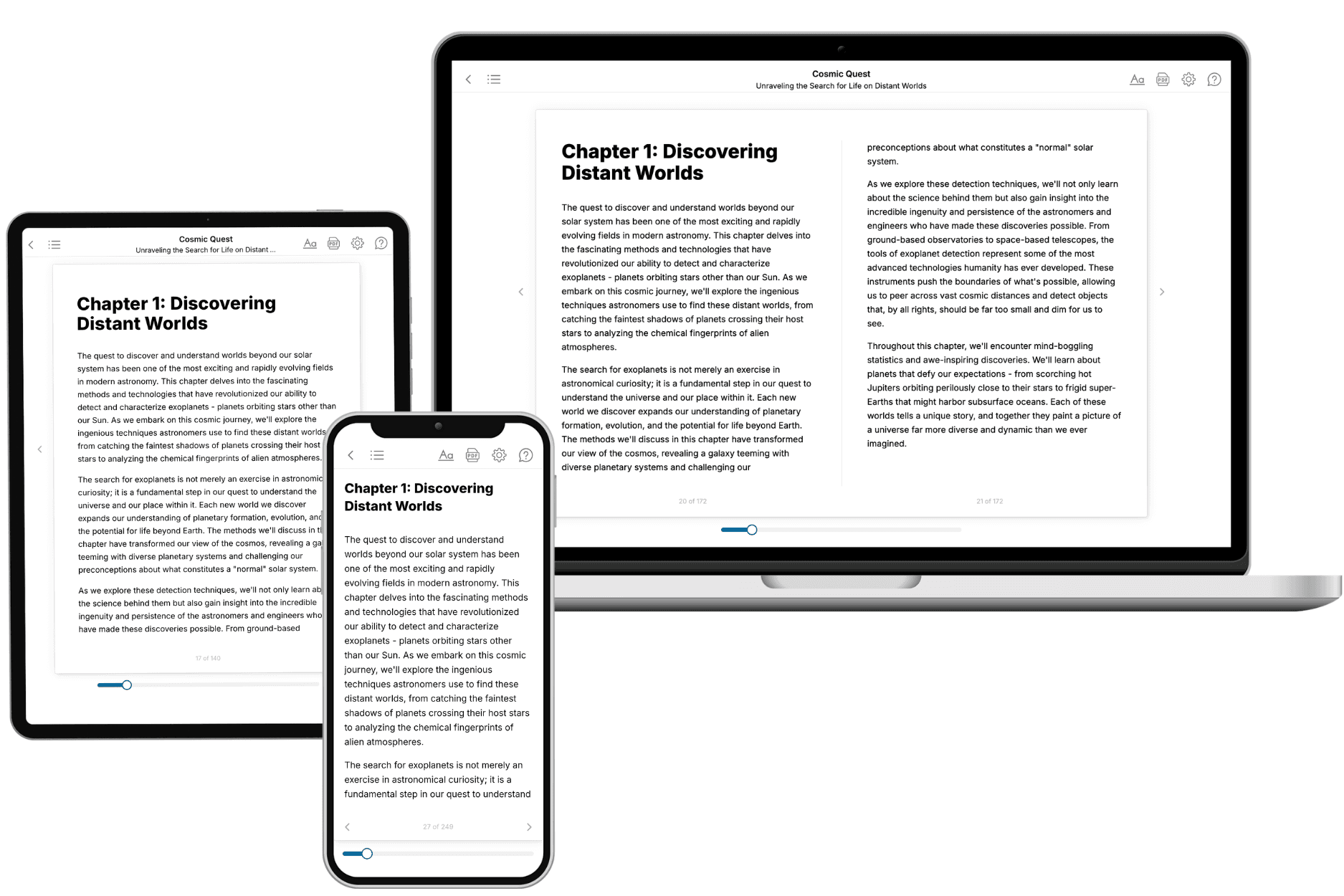
- 3. Get your tailored book
Your book is ready in 10 minutes. Read it online, download as EPUB or PDF, or send to Kindle.
Frequently asked questions
- What is TailoredRead?
TailoredRead creates complete, full-length nonfiction ebooks, written specifically for you. Tell us what you want to learn and why, and TailoredRead writes you a complete ebook on it, with charts, tables, and diagrams throughout. Read it online, on Kindle, or on any e-reader, or download it as a PDF or EPUB. Every book is written fresh the day you order it.
- How is the book tailored to me?
Before anything is written, you answer a few short questions about your goals, your background, and the topics you care about. Your book is then planned around your answers: written at your level, focused on your goals, and covering the topics you chose, instead of the one-size-fits-all book a store sells everyone.
- Will it read like generic AI content?
No. Your book isn't a chat transcript: it's planned chapter by chapter before a single word is written, told in a clear book voice, and explains ideas visually with charts, tables, and diagrams. After writing, every book goes through an editorial pass that polishes chapters so the book reads consistent from start to finish. Judge for yourself: browse thousands of sample books on our Explore Books page.
- How accurate is the content?
Our AI first checks whether your subject needs live research. Niche and fast-moving subjects are researched before writing, and the book plan and chapters are grounded in what it finds. After writing, every book goes through a quality pass that checks its facts and consistency, and researched books list their sources in a Notes section at the back.
- How long is the book?
You choose the length: Comprehensive (250-300 pages), Detailed (150-200 pages), Essential (70-100 pages), or Short (30-50 pages).
- Does the book include visuals?
Yes. Every book includes visual elements such as timelines, checklists, step-by-step guides, decision trees, comparison tables, and matrices, and many include bar charts. A typical book includes dozens of these visual elements.
- Can I read it on Kindle? What formats can I download?
Yes. Every book can be read in our online reader or downloaded as a PDF or EPUB. The EPUB can be opened with Kindle, Apple Books, Kobo, and any e-reader. The Commercial and Author licenses also include an editable Word (DOCX) and Markdown download.
- How much does it cost?
About the price of a regular ebook. The exact price depends on your book's length and complexity, from $2 for the shortest books to $35 for the most comprehensive, and it's shown when you review your book, before you commit to anything. Each book is a one-time purchase, yours to keep, no subscription. Licenses that let you share, teach, or publish your book range from $35.99 to $49.99.
- Can I preview the book before purchasing?
Before you pay, you'll see what your book will cover: the title, a detailed description, the estimated length, and the complete chapter-by-chapter table of contents, so you know what you're getting before you decide. The full text itself is written after you purchase.
- How long does it take to create a book?
About 10 minutes. You can start reading the opening chapters while the rest is still being written.