Mastering Hamiltonian Monte Carlo
Advanced Sampling Techniques for Machine Learning and Computational Statistics
Picture yourself confidently tackling the most challenging probabilistic models in machine learning, where traditional sampling methods fail and computational bottlenecks disappear.
300 pages17 chaptersSep 28, 2025Machine Learning
About this book
You'll move beyond the limitations of basic MCMC techniques, wielding the power of physics-inspired algorithms that slice through high-dimensional parameter spaces with unprecedented efficiency. This comprehensive guide transforms complex mathematical concepts into practical, implementable knowledge. You'll discover how Hamiltonian dynamics revolutionize sampling from posterior distributions, enabling you to work with models that were previously computationally intractable. Through clear explanations and hands-on examples, you'll master the art of leveraging gradient information to create sampling chains that explore parameter space more intelligently than ever before. Your journey progresses from fundamental concepts to advanced implementations, covering everything from basic HMC mechanics to sophisticated variants like NUTS (No-U-Turn Sampler). You'll learn to diagnose sampling problems, optimize performance, and adapt these techniques to your specific machine learning challenges. Real-world case studies demonstrate how HMC transforms Bayesian deep learning, hierarchical models, and complex statistical inference problems. By the final page, you'll possess the expertise to implement, tune, and troubleshoot Hamiltonian Monte Carlo methods across diverse applications. You'll understand not just how these algorithms work, but why they work, giving you the insight needed to push the boundaries of what's computationally possible in your own research and projects.
Table of contents
- IntroductionThe Challenge of High-Dimensional Sampling, When Physics Meets Statistics, Your Learning Roadmap, What You Need to KnowRead below
- Chapter 1: MCMC Foundations and LimitationsMarkov Chain Fundamentals, The Metropolis-Hastings Algorithm, Gibbs Sampling and Its Applications, Where Traditional Methods Fall Short
- Chapter 2: Hamiltonian Mechanics for StatisticiansClassical Mechanics Primer, Hamiltonian Systems and Phase Space, Energy Conservation and Symplectic Integration, Connecting Physics to Statistical Sampling
- Chapter 3: Hamiltonian Monte Carlo BasicsThe Geometric Intuition Behind HMC, Introducing Auxiliary Momentum Variables, Leapfrog Integration Scheme, The Metropolis Accept-Reject Step
- Chapter 4: Computing Gradients for HMCAutomatic Differentiation Fundamentals, Numerical Challenges in Gradient Computation, Efficient Implementation Strategies, Debugging and Validating Gradients
- Chapter 5: Tuning HMC ParametersStep Size Selection and Adaptation, Choosing Optimal Trajectory Length, Mass Matrix Adaptation, Warm-up and Initialization Strategies
- Chapter 6: The No-U-Turn Sampler (NUTS)Motivation and Design Principles, The U-Turn Stopping Criterion, Slice Sampling Integration, Efficient NUTS Implementation
- Chapter 7: Diagnostics and MonitoringConvergence Diagnostics for HMC, Effective Sample Size Estimation, Energy-Based Diagnostic Tools, Visual Diagnostic Techniques
- Chapter 8: Performance OptimizationIdentifying Computational Bottlenecks, Parallel Chain Execution, Memory-Efficient Implementations, GPU Acceleration Strategies
- Chapter 9: Constrained and Manifold SamplingHandling Parameter Constraints, Manifold Hamiltonian Monte Carlo, Riemannian Hamiltonian Monte Carlo, Transformation and Reparameterization
- Chapter 10: HMC for Bayesian Deep LearningPrior Specification for Neural Networks, Scalability Challenges and Solutions, Minibatch and Stochastic HMC, Uncertainty Quantification in Deep Models
- Chapter 11: Hierarchical and Multilevel ModelsUnderstanding Hierarchical Model Structure, Centering and Non-Centering Parameterizations, Mixed Effects and Random Effects Models, Computational Strategies for Complex Hierarchies
- Chapter 12: Time Series and Dynamic ModelsState Space Model Formulation, Dynamic Linear Models with HMC, Nonlinear Dynamic Systems, Sequential Inference Strategies
- Chapter 13: Model Comparison and SelectionMarginal Likelihood Estimation, Information Criteria and Model Selection, Cross-Validation with MCMC Samples, Bayes Factors and Model Evidence
- Chapter 14: Advanced HMC VariantsShadow Hamiltonian Monte Carlo, Discontinuous Hamiltonian Monte Carlo, Relativistic Hamiltonian Monte Carlo, Magnetic Hamiltonian Monte Carlo
- Chapter 15: Software Tools and FrameworksStan and the Stan Ecosystem, PyMC and Modern Python Tools, Building Custom HMC Implementations, Integration with Machine Learning Workflows
- Chapter 16: Real-World Case StudiesGenomics and Bioinformatics Applications, Climate and Environmental Modeling, Risk Modeling and Quantitative Analysis, Social Science and Survey Analysis
- Chapter 17: Troubleshooting Common ProblemsDiagnosing and Fixing Divergent Transitions, Addressing Poor Mixing and Slow Convergence, Numerical Instability and Overflow Issues, Model Specification and Identifiability Problems
- ConclusionKey Takeaways and Best Practices, Future Directions in HMC Research
Introduction
The landscape of computational statistics has been fundamentally transformed by the emergence of sophisticated sampling algorithms that can tackle previously intractable problems. At the heart of this revolution lies Hamiltonian Monte Carlo (HMC), a method that bridges the elegant principles of classical physics with the practical demands of modern statistical inference. Unlike traditional sampling approaches that stumble through parameter space with limited guidance, HMC harnesses the power of gradient information to navigate complex probability distributions with remarkable efficiency. This physics-inspired approach has opened doors to Bayesian analysis of high-dimensional models that were once considered computationally impossible, from deep neural networks with millions of parameters to intricate hierarchical models spanning multiple levels of variation.
Your journey into mastering HMC represents more than learning another computational tool—it's about fundamentally changing how you approach complex statistical problems. Traditional Markov Chain Monte Carlo (MCMC) methods often require thousands or millions of iterations to adequately explore parameter space, particularly in high-dimensional settings where correlations between parameters create challenging geometric landscapes. HMC transforms this inefficient random walk into a guided exploration, using the gradient of the log-probability density to propose moves that follow the natural contours of the distribution. The result is a sampling algorithm that can traverse vast parameter spaces in fewer steps, with reduced autocorrelation between samples and improved convergence properties that make previously intractable models accessible to practitioners.
The practical implications of mastering HMC extend far beyond academic curiosity into real-world applications that demand robust uncertainty quantification and sophisticated modeling capabilities. Modern machine learning increasingly requires Bayesian approaches that can capture model uncertainty, estimate prediction intervals, and provide principled methods for model comparison and selection. HMC makes these approaches computationally feasible for complex models, enabling practitioners to move beyond point estimates toward full posterior distributions that capture the uncertainty inherent in their data and models. Whether you're working with genomic data requiring hierarchical modeling, climate simulations demanding sophisticated time series analysis, or deep learning applications needing uncertainty quantification, HMC provides the computational foundation for principled Bayesian inference.
This book is designed to take you from conceptual understanding to practical mastery, providing both the theoretical foundation and hands-on experience necessary to implement and optimize HMC for your specific applications. You'll discover not just how these algorithms work, but why they work, giving you the insight needed to diagnose problems, optimize performance, and adapt these methods to novel situations. The journey ahead combines rigorous mathematical exposition with practical implementation guidance, ensuring that you develop both the theoretical understanding and practical skills necessary to push the boundaries of what's computationally possible in your own research and applications.
The Challenge of High-Dimensional Sampling
The curse of dimensionality presents one of the most formidable challenges in computational statistics, fundamentally altering the behavior of probability distributions in ways that confound traditional sampling methods. As the number of parameters increases, the volume of parameter space grows exponentially, but the probability mass becomes increasingly concentrated in narrow regions that are difficult to locate and explore efficiently. Consider a simple multivariate normal distribution: while a two-dimensional version might have its probability mass spread relatively evenly around the mean, a 100-dimensional version concentrates almost all its mass in a thin shell at a specific distance from the mean. Traditional random walk methods like Metropolis-Hastings struggle in these high-dimensional spaces because they propose moves that are either too small (leading to slow exploration) or too large (leading to frequent rejections), creating an inefficient sampling process that can require millions of iterations to adequately explore the parameter space.
The geometric challenges of high-dimensional sampling become even more pronounced when dealing with complex, multimodal distributions or distributions with strong correlations between parameters. In such cases, the probability landscape resembles a twisted, narrow valley where traditional methods can become trapped in local regions for extended periods. The acceptance rate of proposed moves often drops dramatically as dimensionality increases, leading to chains that mix poorly and require extensive burn-in periods before reaching their stationary distribution. These challenges are not merely theoretical concerns but practical barriers that limit the complexity of models that can be fit using traditional MCMC methods. Real-world applications in machine learning, genomics, and climate modeling routinely involve parameter spaces with hundreds, thousands, or even millions of dimensions, making efficient sampling algorithms essential for practical Bayesian inference.
The computational cost of poor sampling efficiency extends beyond mere inconvenience to fundamental limitations on the types of problems that can be addressed. When a sampling algorithm requires millions of iterations to produce reliable estimates, the computational burden becomes prohibitive for complex models or large datasets. This limitation has historically forced practitioners to make compromising choices between model complexity and computational feasibility, often settling for simplified models that may not capture the full richness of their data. The situation becomes even more challenging when considering the need for multiple chains to assess convergence, cross-validation procedures that require fitting models multiple times, or sensitivity analyses that explore different model specifications. These practical constraints have created a significant gap between the sophisticated models that theoretically could provide better insights and the simpler models that are computationally tractable with traditional methods.
Modern applications in machine learning and data science have pushed these limitations to their breaking point, demanding new approaches that can handle the scale and complexity of contemporary problems. Bayesian deep learning, for example, requires sampling from posterior distributions over neural network weights that may involve millions of parameters with complex, non-convex probability landscapes. Hierarchical models in genomics or social sciences often involve nested structures with hundreds of groups and multiple levels of variation, creating parameter spaces that are both high-dimensional and highly structured. Time series models for climate or economic data may require capturing complex temporal dependencies across multiple scales, leading to parameter spaces with intricate correlation structures that confound traditional sampling methods. These applications represent not just incremental increases in problem complexity but qualitative changes that require fundamentally different approaches to sampling and inference.
The recognition of these limitations has driven the development of more sophisticated sampling algorithms that can leverage additional information about the target distribution to improve efficiency. Rather than treating the probability distribution as a black box that can only be evaluated pointwise, modern methods seek to exploit structural information such as gradients, curvature, or geometric properties to guide the sampling process more intelligently. This shift from uninformed random walks to informed exploration represents a fundamental paradigm change in computational statistics, opening up new possibilities for tackling problems that were previously considered intractable. The development of these methods has been driven not just by theoretical interest but by practical necessity, as researchers and practitioners have encountered increasingly complex problems that demand more powerful computational tools.
The impact of these sampling challenges extends beyond computational efficiency to affect the reliability and interpretability of statistical analyses. When sampling algorithms mix poorly or converge slowly, the resulting estimates may be biased, confidence intervals may be incorrectly calibrated, and model comparisons may be unreliable. These issues can be particularly problematic in applied settings where statistical analyses inform important decisions or policy recommendations. The need for robust, efficient sampling methods is therefore not just a technical concern but a fundamental requirement for trustworthy statistical inference in complex, high-dimensional settings. Understanding these challenges and their solutions is essential for anyone seeking to apply sophisticated statistical methods to real-world problems where both accuracy and computational efficiency are critical.
The evolution of sampling methods in response to these challenges reflects broader trends in computational statistics toward methods that can scale to modern problem sizes while maintaining statistical rigor. This evolution has been facilitated by advances in automatic differentiation, which make gradient computation feasible for complex models, and improvements in computational hardware that enable more sophisticated algorithms to be practically implemented. The convergence of these technological advances with theoretical developments in sampling algorithms has created new opportunities for tackling problems that were previously beyond reach. However, realizing these opportunities requires not just access to new tools but a deep understanding of how to apply them effectively, including knowledge of their strengths, limitations, and optimal use cases.
The transition from traditional to modern sampling methods also requires a shift in how practitioners think about the sampling process itself. Rather than viewing sampling as a necessary computational burden to be minimized, modern approaches treat it as an opportunity to gain deeper insights into the structure of probability distributions and the behavior of complex models. This perspective emphasizes the importance of understanding not just how to run sampling algorithms but how to interpret their output, diagnose potential problems, and optimize their performance for specific applications. The goal is not just to obtain samples from a target distribution but to do so in a way that provides reliable, interpretable results that can inform scientific understanding or practical decision-making.
When Physics Meets Statistics
The marriage of classical mechanics and statistical sampling represents one of the most elegant and powerful developments in computational statistics, transforming abstract mathematical concepts into practical algorithms with remarkable efficiency. Hamiltonian Monte Carlo draws its inspiration from the centuries-old principles of classical mechanics, particularly the Hamiltonian formulation developed by William Rowan Hamilton in the 19th century. In this framework, the motion of physical systems is described in terms of position and momentum variables that evolve according to Hamilton's equations, which preserve certain fundamental quantities like energy over time. The genius of HMC lies in recognizing that these same principles can be applied to statistical sampling by treating the negative log-probability density as a potential energy function and introducing auxiliary momentum variables that guide the exploration of parameter space. This physics-inspired approach transforms the random walk behavior of traditional MCMC into a more directed exploration that follows the natural dynamics of the system.
The conceptual breakthrough that enables this physics-statistics connection involves reimagining the sampling problem as a physical system where particles move through a landscape defined by the target probability distribution. In this analogy, regions of high probability correspond to valleys in the potential energy landscape, while regions of low probability correspond to hills or peaks that particles naturally avoid. The introduction of momentum variables allows the sampling algorithm to build up "kinetic energy" that can carry it through regions of low probability to reach distant high-probability regions, much like a ball rolling through a hilly landscape can use its momentum to climb over small hills to reach deeper valleys. This physical intuition provides not only a powerful algorithmic framework but also valuable insights into why certain sampling problems are difficult and how they might be addressed through modifications to the underlying dynamics.
The mathematical elegance of Hamiltonian dynamics provides several key advantages that directly translate into improved sampling performance. First, the symplectic structure of Hamiltonian systems ensures that certain geometric properties are preserved during the evolution of the system, leading to more stable and reliable numerical integration. Second, the reversibility of Hamiltonian dynamics guarantees that the sampling algorithm satisfies detailed balance, a crucial requirement for MCMC methods that ensures the chain converges to the correct stationary distribution. Third, the volume-preserving property of Hamiltonian flows means that the Jacobian of the transformation is always unity, simplifying the acceptance probability calculation and eliminating the need for complex correction terms that arise in other advanced sampling methods. These mathematical properties are not merely technical conveniences but fundamental features that make HMC both theoretically sound and practically robust.
The practical implementation of these physics principles requires careful attention to numerical integration schemes that can approximate the continuous Hamiltonian dynamics using discrete time steps. The leapfrog integrator, also known as the Störmer-Verlet method in physics, has emerged as the standard choice for HMC because it preserves the symplectic structure of Hamiltonian systems even when using finite step sizes. This preservation is crucial because it ensures that the numerical approximation maintains the key properties that make Hamiltonian dynamics suitable for sampling, including energy conservation (up to numerical errors) and reversibility. The leapfrog scheme alternates between updating position and momentum variables in a way that maintains these properties while being computationally efficient and relatively simple to implement. Understanding the connection between the continuous dynamics and their discrete approximation is essential for practitioners who need to tune step sizes and trajectory lengths to achieve optimal performance.
The energy conservation principle that underlies Hamiltonian mechanics provides a powerful diagnostic tool for assessing the quality of HMC sampling. In an ideal system with perfect numerical integration, the total energy (kinetic plus potential) would remain exactly constant throughout each trajectory. In practice, numerical errors cause small fluctuations in energy, and the magnitude of these fluctuations provides valuable information about the appropriateness of the step size and the numerical stability of the integration. Large energy fluctuations indicate that the step size may be too large, leading to poor approximation of the continuous dynamics and potentially biased sampling. Conversely, very small energy fluctuations may indicate that the step size is unnecessarily small, leading to computational inefficiency without corresponding improvements in sampling quality. This energy-based perspective provides practitioners with intuitive tools for diagnosing and optimizing HMC performance that are grounded in well-understood physical principles.
The geometric intuition provided by the physics perspective also illuminates why HMC performs particularly well in high-dimensional spaces where traditional methods struggle. In high dimensions, the typical set (the region where most of the probability mass is concentrated) often has a complex, curved geometry that is difficult for random walk methods to navigate efficiently. However, the gradient information used by HMC provides direct information about the local geometry of the probability distribution, allowing the algorithm to follow the natural contours of the distribution rather than fighting against them. This geometric insight explains why HMC can take much larger steps than traditional methods while maintaining high acceptance rates, and why it tends to produce samples with lower autocorrelation and better mixing properties. The physics perspective thus provides not just a computational algorithm but a conceptual framework for understanding the fundamental challenges of high-dimensional sampling and how they can be addressed.
The connection to physics also opens up possibilities for extending and modifying HMC to address specific sampling challenges or to incorporate additional information about the target distribution. For example, the concept of mass matrices in HMC corresponds directly to the inertia tensor in classical mechanics, providing a natural way to incorporate information about the local curvature of the probability distribution to improve sampling efficiency. Similarly, the idea of magnetic fields in physics has inspired variants of HMC that can handle certain types of constraints or non-reversible dynamics that may be advantageous in specific contexts. These extensions demonstrate how the physics foundation of HMC provides not just a single algorithm but a rich framework for developing new sampling methods that can be tailored to specific applications or problem structures.
The interdisciplinary nature of HMC also highlights the broader trend toward cross-pollination between different fields of science and mathematics in developing computational methods. The success of HMC has inspired researchers to look for other connections between physics and statistics, leading to developments such as thermodynamic integration for model comparison, annealing methods for optimization, and quantum-inspired algorithms for sampling. This trend reflects a growing recognition that the mathematical structures underlying different scientific disciplines often share deep connections that can be exploited to develop more powerful computational tools. For practitioners, this interdisciplinary perspective emphasizes the value of understanding not just the technical details of algorithms but also their conceptual foundations and the broader principles that make them effective.
Your Learning Roadmap
This book is structured as a comprehensive journey that takes you from foundational concepts to advanced applications, with each chapter building systematically on the knowledge developed in previous sections. The learning path is designed to accommodate readers with varying backgrounds while ensuring that everyone develops both the theoretical understanding and practical skills necessary to apply HMC effectively in real-world situations. The early chapters establish the mathematical and conceptual foundations, beginning with a thorough review of traditional MCMC methods and their limitations, followed by an introduction to the physics principles that underlie Hamiltonian mechanics. This foundation is essential because understanding where traditional methods fail helps illuminate why HMC's approach is so effective, while the physics background provides the conceptual framework that makes HMC's behavior intuitive and predictable. The progression from familiar territory (traditional MCMC) through new concepts (Hamiltonian mechanics) to their synthesis (HMC) follows a pedagogical approach that builds confidence and understanding incrementally.
The middle sections of the book focus on the practical implementation and optimization of HMC, covering everything from basic algorithm mechanics to advanced tuning strategies. You'll learn how to compute gradients efficiently using automatic differentiation, how to choose appropriate step sizes and trajectory lengths, and how to diagnose and fix common problems that arise in practice. Special attention is given to the No-U-Turn Sampler (NUTS), which automates many of the tuning decisions that make HMC challenging for beginners. These chapters emphasize hands-on learning with concrete examples and implementation details that you can immediately apply to your own problems. The goal is not just to understand how HMC works in theory but to develop the practical expertise needed to implement, tune, and troubleshoot these methods in real applications where perfect conditions rarely exist and computational efficiency matters.
The advanced sections explore specialized variants of HMC and their applications to specific problem domains that are particularly relevant to modern machine learning and computational statistics. These chapters cover constrained sampling for parameters with bounds or other restrictions, manifold sampling for problems with geometric constraints, and extensions to discrete parameter spaces that arise in model selection and combinatorial problems. You'll also explore applications to Bayesian deep learning, where HMC enables uncertainty quantification in neural networks with millions of parameters, and hierarchical modeling, where complex nested structures require sophisticated sampling strategies. Each application area is treated not just as a technical exercise but as a case study that illustrates how the principles and methods developed in earlier chapters can be adapted and extended to address specific challenges that arise in practice.
Throughout the book, special emphasis is placed on diagnostic tools and performance optimization techniques that are essential for reliable application of HMC in practice. You'll learn how to assess convergence using both traditional diagnostics and HMC-specific tools that leverage the energy conservation properties of Hamiltonian dynamics. The book covers strategies for parallel computation, memory optimization, and GPU acceleration that can dramatically improve the computational efficiency of HMC for large-scale problems. These practical considerations are often overlooked in theoretical treatments but are crucial for anyone seeking to apply these methods to real problems where computational resources are limited and reliability is paramount. The diagnostic and optimization techniques are presented not as afterthoughts but as integral parts of the HMC workflow that should be considered from the beginning of any analysis.
The book's structure also reflects the iterative nature of learning complex computational methods, with concepts introduced at a basic level and then revisited with increasing sophistication as your understanding develops. For example, the concept of step size tuning is first introduced in the context of basic HMC, then explored in more detail when discussing NUTS, and finally examined from a theoretical perspective when covering advanced optimization techniques. This spiral approach ensures that you develop both intuitive understanding and technical expertise, with each pass through a concept adding new layers of insight and practical knowledge. The goal is to create a learning experience that mirrors the way these methods are actually used in practice, where initial implementations are gradually refined and optimized as experience and understanding grow.
Each chapter includes extensive examples and case studies drawn from real applications in machine learning, statistics, and scientific computing. These examples are chosen not just to illustrate technical points but to demonstrate how HMC can be applied to solve meaningful problems that arise in practice. The case studies progress from relatively simple examples that clearly illustrate key concepts to complex, realistic applications that demonstrate the full power and flexibility of HMC methods. You'll see how HMC is used in genomics to analyze complex inheritance patterns, in climate science to fit sophisticated time series models, and in machine learning to perform Bayesian inference in deep neural networks. These examples provide both inspiration for your own applications and concrete templates that you can adapt to similar problems in your own work.
The book also includes extensive coverage of software tools and implementation frameworks that make HMC accessible to practitioners without requiring them to implement everything from scratch. You'll learn how to use established tools like Stan and PyMC effectively, understanding not just how to specify models but how to optimize their performance and interpret their output. The book also covers the principles behind building custom HMC implementations for specialized applications where existing tools may not be sufficient. This dual approach ensures that you can both leverage existing tools effectively and understand them deeply enough to extend or modify them when necessary. The software coverage is integrated throughout the book rather than relegated to separate chapters, emphasizing that computational tools are not separate from statistical concepts but integral parts of the modern statistical workflow.
The final sections of the book focus on troubleshooting, advanced applications, and future directions, providing you with the knowledge needed to handle challenging situations and stay current with ongoing developments in the field. The troubleshooting section covers common problems that arise in practice, from divergent transitions and poor mixing to numerical instability and model specification issues. Rather than just listing problems and solutions, these sections help you develop the diagnostic skills and conceptual understanding needed to identify and address novel problems that may not have standard solutions. The coverage of future directions is designed not just to inform you about current research but to help you understand the principles and trends that are likely to drive future developments, enabling you to evaluate and adopt new methods as they become available.
What You Need to Know
To get the most out of this book, you should have a solid foundation in probability theory and statistics, including understanding of probability distributions, Bayes' theorem, and the basic principles of statistical inference. You should be comfortable with concepts like likelihood functions, prior and posterior distributions, and the interpretation of confidence intervals and credible intervals. While the book provides refreshers on key concepts, it assumes that you have previously encountered these ideas and can focus on their application to sampling problems rather than their basic definitions. Experience with multivariate distributions and an understanding of how correlation and dependence affect statistical inference will be particularly valuable, as these concepts are central to understanding why traditional sampling methods struggle in high-dimensional spaces and how HMC addresses these challenges. You should also be familiar with the basic concepts of computational statistics, including the idea that complex statistical problems often require numerical approximation methods rather than analytical solutions.
Mathematical prerequisites include multivariable calculus, particularly partial derivatives and gradients, which are fundamental to understanding how HMC uses gradient information to guide sampling. You should be comfortable with vector and matrix operations, including matrix multiplication, eigenvalues and eigenvectors, and basic linear algebra concepts that arise in the context of covariance matrices and linear transformations. While the book provides intuitive explanations of the physics concepts underlying HMC, some familiarity with basic mechanics concepts like energy, momentum, and conservation laws will help you develop deeper insights into why these methods work. You don't need to be a physicist, but you should be willing to engage with physical analogies and mathematical formulations that draw on classical mechanics. The book assumes comfort with mathematical notation and the ability to follow mathematical derivations, though it emphasizes intuitive understanding alongside formal rigor.
Programming experience is essential, as HMC is fundamentally a computational method that requires implementation and experimentation to master fully. You should be proficient in at least one programming language commonly used for statistical computing, such as Python, R, or Julia. The book includes examples in multiple languages, but focuses primarily on Python due to its widespread adoption in machine learning and the availability of excellent automatic differentiation libraries. You should be comfortable with basic programming concepts like functions, loops, and data structures, and have some experience with numerical computing libraries like NumPy or similar tools in other languages. While the book covers the principles behind automatic differentiation, some prior exposure to computational frameworks like TensorFlow, PyTorch, or JAX will be helpful for understanding how gradients are computed efficiently in practice. Experience with version control, debugging, and performance profiling will also be valuable as you work with increasingly complex implementations.
Prior experience with Markov Chain Monte Carlo methods is highly recommended, though not strictly required. You should understand the basic principles of MCMC, including concepts like Markov chains, stationary distributions, burn-in periods, and convergence diagnostics. Familiarity with specific algorithms like Metropolis-Hastings and Gibbs sampling will provide valuable context for understanding how HMC differs from and improves upon these traditional methods. If you haven't worked extensively with MCMC before, you should plan to spend extra time on the foundational chapters that review these concepts. Experience with the practical challenges of MCMC, such as tuning proposal distributions, assessing convergence, and dealing with poor mixing, will help you appreciate the advantages that HMC provides and understand the motivation for its development. You should also be familiar with basic concepts in Bayesian statistics, including the specification of prior distributions and the interpretation of posterior samples.
Machine learning background will be valuable for understanding the applications covered in later chapters, particularly those dealing with Bayesian deep learning and high-dimensional inference problems. You should understand basic concepts like neural networks, gradient descent, regularization, and cross-validation. Familiarity with probabilistic machine learning concepts such as Bayesian linear regression, Gaussian processes, and variational inference will provide useful context for understanding how HMC fits into the broader landscape of approximate inference methods. Experience with machine learning frameworks and an understanding of the computational challenges involved in training complex models will help you appreciate how HMC can be applied to uncertainty quantification and model selection problems in machine learning. However, the book is designed to be accessible to statisticians and computational scientists who may not have extensive machine learning backgrounds, with sufficient context provided for the applications discussed.
Computational considerations require some understanding of algorithm complexity, numerical stability, and performance optimization. You should be aware of how computational cost scales with problem size and understand basic concepts like time and space complexity. Some familiarity with numerical analysis concepts such as floating-point arithmetic, numerical integration, and iterative algorithms will be helpful for understanding the practical challenges involved in implementing HMC. Experience with parallel computing, whether through multi-threading, multi-processing, or distributed computing, will be valuable for the performance optimization sections. While not required, some exposure to GPU computing concepts will help you understand the acceleration strategies discussed in later chapters. The book assumes that you are interested in not just using HMC but understanding how to make it work efficiently for your specific applications.
Perhaps most importantly, you should approach this material with a willingness to engage with interdisciplinary concepts that bridge statistics, physics, and computer science. The power of HMC comes from its synthesis of ideas from these different fields, and fully understanding the method requires comfort with moving between different conceptual frameworks and mathematical formulations. You should be prepared to think about statistical problems from new perspectives and to consider how insights from physics can inform computational strategies. The book is designed to guide you through these conceptual transitions, but you'll get the most out of it if you approach the material with curiosity about the connections between different fields and openness to new ways of thinking about familiar problems. The goal is not just to learn a new computational tool but to develop a deeper understanding of the principles that make sophisticated sampling methods possible and effective.
Finally, practical experience with real data analysis projects will help you appreciate the challenges and opportunities that HMC addresses. You should have encountered situations where computational limitations constrained your modeling choices or where traditional methods produced unsatisfactory results due to convergence problems or computational inefficiency. This practical context will help you understand not just how HMC works but why it matters and when it's likely to provide significant advantages over alternative approaches. The book includes extensive examples and case studies, but your own experience with the frustrations and limitations of traditional methods will provide valuable motivation for mastering the more sophisticated approaches that HMC makes possible. If you're new to applied statistics or machine learning, consider working through some traditional MCMC examples before diving into HMC to develop appreciation for the problems that these advanced methods are designed to solve.
This is the end of the free sample. The full book has 17 chapters.
Want this book written for you?
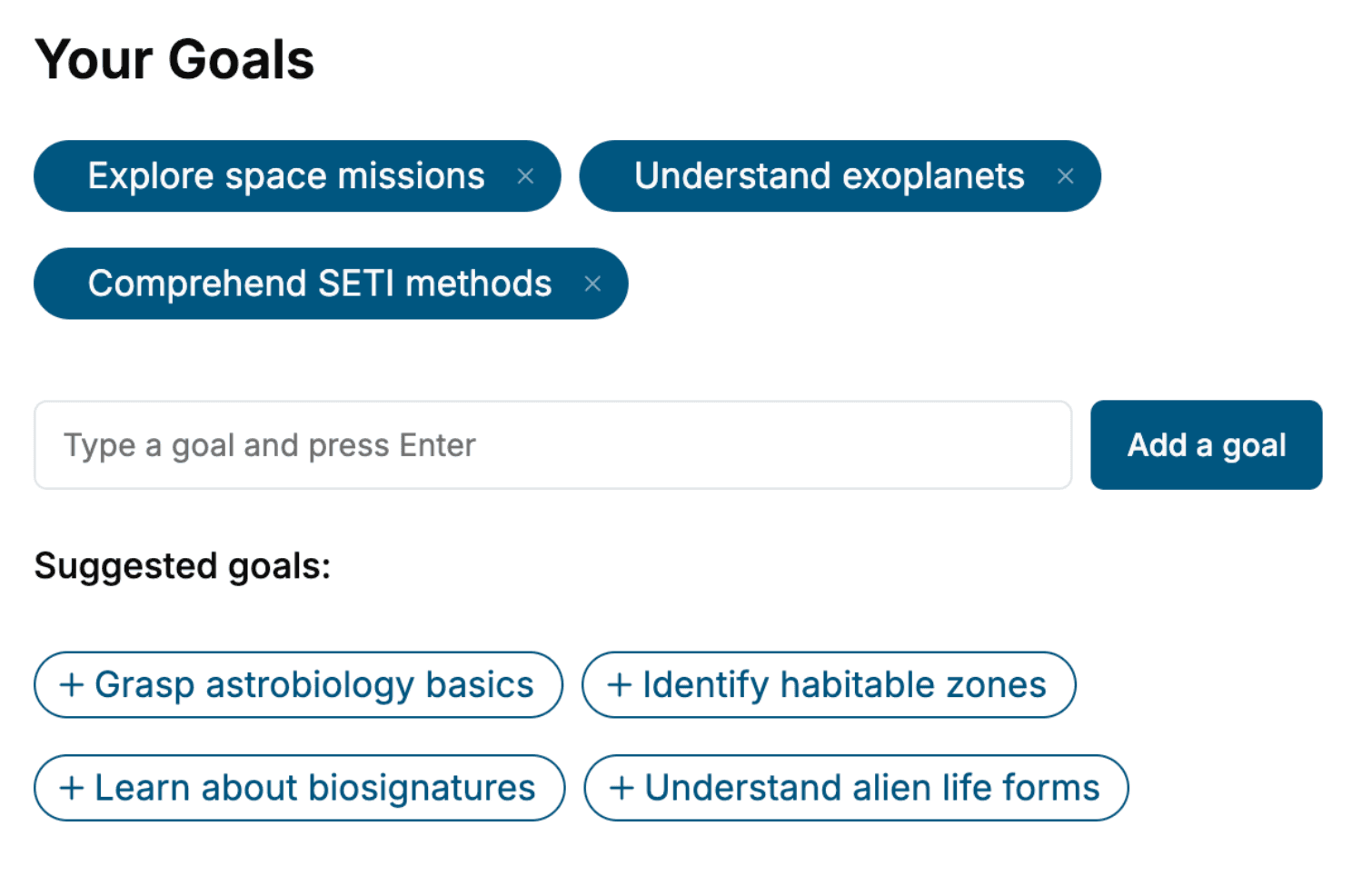
Tell us your goals and background, and get your own version of this book, tailored by AI to you.


Benefits of AI-tailored books
- Read one book, not ten:
- all the Machine Learning knowledge you need, gathered into a single book.
- Save days of learning:
- tell us your goals, choose your topics, and the whole book is built around them.
- Learn effortlessly:
- Machine Learning book written for your specific background and expertise.
- Understand at a glance:
- includes charts, tables, timelines, checklists, decision trees, and more.
- Stay current:
- written the day you order it, not years ago.
- Trust what you read:
- every book is checked for accuracy, with real research when your subject needs it.
Create your unique book in 3 steps
- 1. Select your focus
Select the focus of your Machine Learning book and share your background
- 2. Personalize your book
Specify your goals and choose sub-topics to include
- 3. Get your tailored book
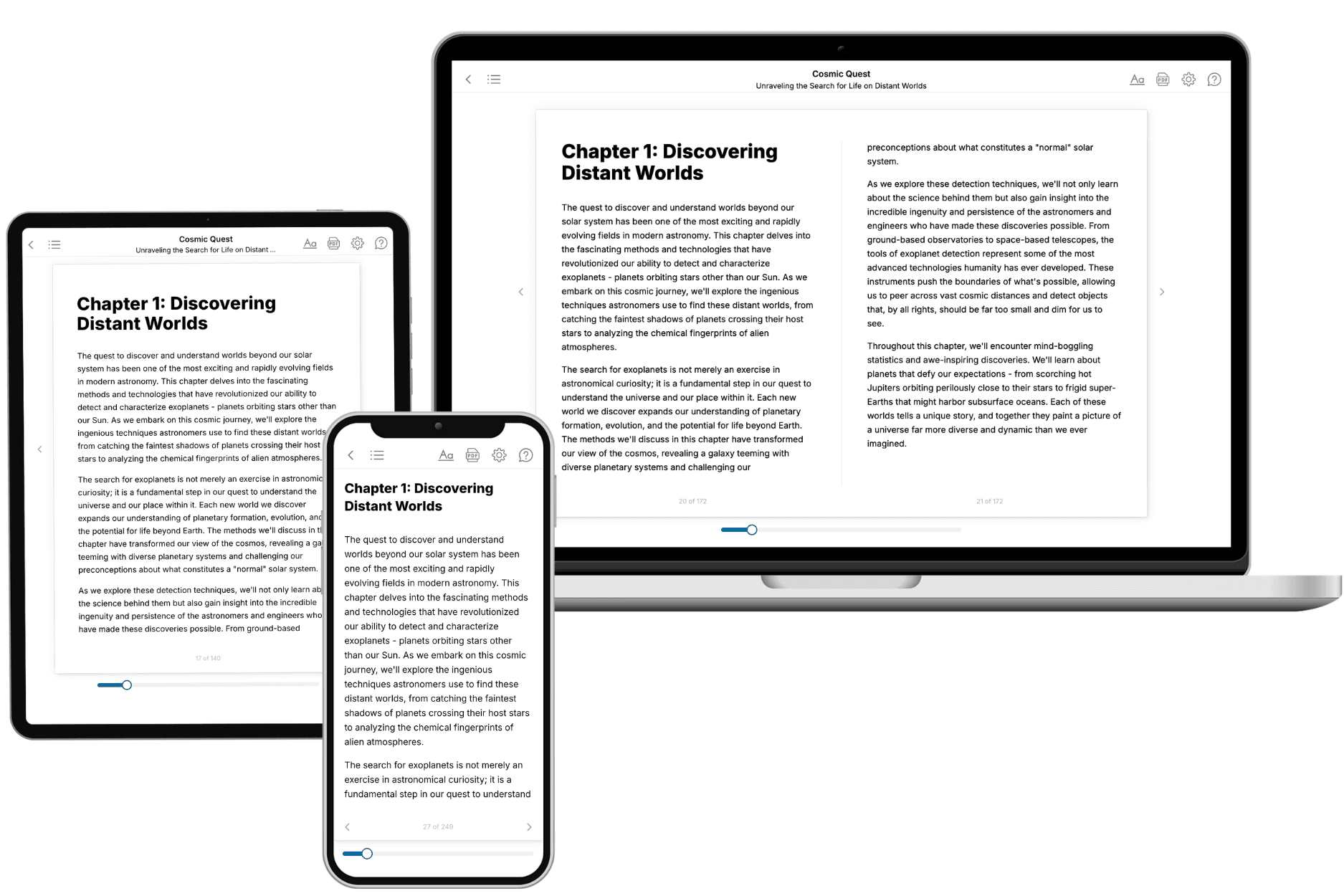
Your book is ready in 10 minutes. Read it online, download as EPUB or PDF, or send to Kindle.

Frequently asked questions
- What is TailoredRead?
TailoredRead creates complete, full-length nonfiction ebooks, written specifically for you. Tell us what you want to learn and why, and TailoredRead writes you a complete ebook on it, with charts, tables, and diagrams throughout. Read it online, on Kindle, or on any e-reader, or download it as a PDF or EPUB. Every book is written fresh the day you order it.
- How is the book tailored to me?
Before anything is written, you answer a few short questions about your goals, your background, and the topics you care about. Your book is then planned around your answers: written at your level, focused on your goals, and covering the topics you chose, instead of the one-size-fits-all book a store sells everyone.
- Will it read like generic AI content?
No. Your book isn't a chat transcript: it's planned chapter by chapter before a single word is written, told in a clear book voice, and explains ideas visually with charts, tables, and diagrams. After writing, every book goes through an editorial pass that polishes chapters so the book reads consistent from start to finish. Judge for yourself: browse thousands of sample books on our Explore Books page.
- How accurate is the content?
Our AI first checks whether your subject needs live research. Niche and fast-moving subjects are researched before writing, and the book plan and chapters are grounded in what it finds. After writing, every book goes through a quality pass that checks its facts and consistency, and researched books list their sources in a Notes section at the back.
- How long is the book?
You choose the length: Comprehensive (250-300 pages), Detailed (150-200 pages), Essential (70-100 pages), or Short (30-50 pages).
- Does the book include visuals?
Yes. Every book includes charts, tables, and diagrams: timelines, checklists, step-by-step guides, decision trees, comparison tables, matrices, and bar charts. A typical book includes dozens of these visual elements.
- Can I read it on Kindle? What formats can I download?
Yes. Every book can be read in our online reader or downloaded as a PDF or EPUB. The EPUB can be opened with Kindle, Apple Books, Kobo, and any e-reader. The Commercial and Author licenses also include an editable Word (DOCX) and Markdown download.
- How much does it cost?
About the price of a regular ebook. The exact price depends on your book's length and complexity, from $2 for the shortest books to $35 for the most comprehensive, and it's shown when you review your book, before you commit to anything. Each book is a one-time purchase, yours to keep, no subscription. Licenses that let you share, teach, or publish your book range from $35.99 to $49.99.
- Can I preview the book before purchasing?
Before you pay, you'll see what your book will cover: the title, a detailed description, the estimated length, and the complete chapter-by-chapter table of contents, so you know what you're getting before you decide. The full text itself is written after you purchase.
- How long does it take to create a book?
About 10 minutes. You can start reading the opening chapters while the rest is still being written.