Mastering Impedance Matching
A Practical Guide to Optimizing Signal Integrity in PCB Design
Struggling with signal integrity issues in your PCB designs?
269 pages13 chaptersMay 1, 2025Electronics
About this book
Impedance mismatches can wreak havoc on your circuits, causing reflections, distortions, and poor performance. This comprehensive guide demystifies the complex world of impedance matching, providing you with the knowledge and tools to tackle these challenges head-on. Delve into the fundamental principles of impedance and learn how to apply them effectively in your PCB designs. Discover practical techniques for matching impedances across various components, transmission lines, and interfaces. Through clear explanations, real-world examples, and step-by-step tutorials, you'll gain the confidence to analyze, simulate, and implement robust impedance matching solutions. Whether you're working on high-speed digital circuits, RF applications, or mixed-signal designs, this book equips you with the expertise to enhance signal quality, reduce electromagnetic interference, and maximize power transfer in your electronic projects. By mastering impedance matching, you'll be able to create more reliable, efficient, and high-performing PCB designs that stand out in today's competitive electronics industry.
Table of contents
- IntroductionThe Importance of Impedance Matching in PCB Design, Book Overview and How to Use This Guide, Prerequisites and Assumed KnowledgeRead below
- Chapter 1: Fundamentals of ImpedanceWhat is Impedance?, Understanding Complex Impedance, Characteristic Impedance of Transmission Lines, Impedance in Various Circuit Components
- Chapter 2: Transmission Line TheoryTypes of Transmission Lines in PCBs, Signal Propagation and Delay, Understanding Signal Reflections, Standing Waves and Their Effects
- Chapter 3: Basics of Impedance MatchingWhy Match Impedance?, Reflection Coefficient and Return Loss, Voltage Standing Wave Ratio (VSWR), Maximum Power Transfer Theorem
- Chapter 4: Impedance Matching TechniquesLumped Element Matching, Quarter-Wave Transformers, Stub Matching Techniques, Tapered Transmission Lines
- Chapter 5: Impedance Matching in Digital CircuitsHigh-Speed Digital Design Considerations, Source Termination Techniques, End Termination Methods, Matching in Differential Signaling
- Chapter 6: Impedance Matching in Analog CircuitsMatching in Audio Circuits, Matching in Video Circuits, Sensor Interface Matching, Operational Amplifier Input and Output Matching
- Chapter 7: Impedance Matching in RF CircuitsSpecial Considerations for RF Design, Using the Smith Chart for Matching, Designing RF Matching Networks, Antenna Impedance Matching
- Chapter 8: PCB Layout for Impedance ControlPCB Stackup Design for Impedance Control, Trace Geometry and Impedance, Effective Use of Ground Planes, Via Design and Impedance Matching
- Chapter 9: Simulation and Analysis ToolsSPICE Simulation for Impedance Analysis, 2D Field Solvers for Impedance Calculation, 3D Electromagnetic Simulation Tools, Time Domain Reflectometry (TDR) Analysis
- Chapter 10: Measurement and Verification TechniquesVector Network Analyzer Measurements, Using Impedance Analyzers, Time Domain Reflectometry Measurements, Eye Diagram Analysis for Signal Integrity
- Chapter 11: Advanced Impedance Matching TopicsBroadband Impedance Matching Techniques, Active Impedance Matching Circuits, Adaptive Impedance Matching Systems, Impedance Matching in MMIC Design
- Chapter 12: Troubleshooting Common Impedance Matching IssuesIdentifying and Solving Reflection Problems, Crosstalk Mitigation through Proper Matching, Reducing EMI through Impedance Control, Thermal Considerations in Impedance Matching
- Chapter 13: Future Trends in Impedance MatchingChallenges in High-Frequency Impedance Matching, Emerging Materials for Improved Impedance Control, AI and Machine Learning in Impedance Optimization, Impedance Matching for Quantum Computing Circuits
- ConclusionKey Takeaways, Continuing Your Impedance Matching Journey
- Glossary
- Further Reading
Introduction
Welcome to "Mastering Impedance Matching: A Practical Guide to Optimizing Signal Integrity in PCB Design." This comprehensive guide is designed to equip you with the knowledge and skills necessary to tackle one of the most critical aspects of PCB design: impedance matching. As an electronics professional or enthusiast with intermediate knowledge of PCB design, you're likely aware of the challenges that impedance mismatches can present. This book aims to deepen your understanding and provide you with practical tools to overcome these challenges, ultimately leading to improved circuit performance and signal integrity in your electronic projects.
In today's rapidly evolving world of electronics, where devices are becoming smaller, faster, and more complex, the importance of proper impedance matching cannot be overstated. From high-speed digital circuits to sensitive analog designs and cutting-edge RF applications, maintaining signal integrity through effective impedance control is crucial for achieving optimal performance. This book will take you on a journey through the fundamental principles of impedance, advanced matching techniques, and practical implementation strategies that you can apply directly to your PCB designs.
Throughout this guide, you'll find a blend of theoretical concepts and hands-on advice, all presented in a clear, accessible manner. We'll explore various aspects of impedance matching, from the basics of transmission line theory to advanced topics like adaptive matching systems and emerging trends in the field. By the end of this book, you'll have a solid foundation in impedance matching principles and the confidence to apply these concepts to real-world design challenges.
The Importance of Impedance Matching in PCB Design
Impedance matching is a fundamental concept in electrical engineering that plays a crucial role in PCB design. At its core, impedance matching is about ensuring that the impedance of one part of a circuit matches the impedance of another part, or that the impedance of a transmission line matches the impedance of its source and load. This might seem like a simple concept, but its implications for circuit performance are profound and far-reaching.
One of the primary reasons why impedance matching is so important is its direct impact on signal integrity. In high-speed digital circuits, for instance, mismatched impedances can lead to signal reflections. These reflections occur when a signal encounters a change in impedance along its path, causing part of the signal to be reflected back towards its source. This phenomenon can result in a variety of issues, including ringing (oscillations in the signal), overshoot and undershoot (where the signal exceeds its intended high or low levels), and increased electromagnetic interference (EMI)[1].
In analog circuits, proper impedance matching is essential for maximizing power transfer between stages. The maximum power transfer theorem states that maximum power is transferred from a source to a load when the load impedance is equal to the complex conjugate of the source impedance. This principle is particularly important in audio and video applications, where maintaining signal strength and quality across multiple stages is critical.
For RF circuits, impedance matching becomes even more critical. In these high-frequency applications, even small impedance mismatches can lead to significant power loss and signal distortion. Proper matching in RF circuits ensures efficient power transfer, minimizes signal reflections, and helps maintain the intended frequency response of the system.
Beyond these specific applications, impedance matching has broader implications for overall system performance. Well-matched impedances contribute to reduced electromagnetic emissions, improved signal-to-noise ratio, and better overall system reliability. In today's increasingly connected world, where electronic devices must coexist in close proximity without interfering with each other, proper impedance control is a key factor in ensuring electromagnetic compatibility (EMC).
Furthermore, as clock speeds and data rates continue to increase, the importance of impedance matching grows exponentially. In high-speed digital systems, traces on a PCB begin to behave more like transmission lines, making impedance control critical for maintaining signal integrity. Without proper matching, the fast edge rates of modern digital signals can lead to severe signal degradation, timing errors, and increased bit error rates.
It's also worth noting that impedance matching isn't just about preventing problems—it's about optimizing performance. In many cases, careful attention to impedance matching can lead to improved bandwidth, reduced power consumption, and enhanced overall system efficiency. This can translate into tangible benefits such as longer battery life in portable devices, increased range in wireless systems, or higher data throughput in communication networks.
As PCB designs become more complex and densely packed, with multiple layers and a mix of analog, digital, and RF signals, the challenge of maintaining proper impedance matching increases. This is where a deep understanding of impedance matching principles, combined with practical knowledge of PCB layout techniques and modern simulation tools, becomes invaluable.
Throughout this book, we'll explore these concepts in depth, providing you with the knowledge and tools to tackle impedance matching challenges in your own designs. By mastering these principles, you'll be well-equipped to create PCBs that not only function correctly but perform optimally across a wide range of operating conditions.
Book Overview and How to Use This Guide
"Mastering Impedance Matching" is structured to provide a comprehensive and logical progression through the world of impedance matching in PCB design. The book is divided into several key sections, each building upon the knowledge gained in the previous chapters. This structure allows you to either read the book from start to finish for a complete understanding of the subject, or to use it as a reference guide, focusing on specific topics as needed in your design work.
We begin with the fundamentals, exploring the concept of impedance and its various manifestations in electronic circuits. This foundation is crucial for understanding the more complex topics that follow. The book then delves into transmission line theory, which is essential for grasping how signals propagate in PCBs and why impedance matching is so critical, especially at high frequencies.
Following these foundational chapters, we explore the basics of impedance matching, including key concepts like reflection coefficients, return loss, and the maximum power transfer theorem. This sets the stage for an in-depth look at various impedance matching techniques, from simple lumped element matching to more advanced methods like stub matching and tapered transmission lines.
The book then takes a practical turn, with separate chapters dedicated to impedance matching in digital, analog, and RF circuits. Each of these domains has its own unique challenges and best practices, which are thoroughly explored. We also dedicate a full chapter to PCB layout techniques for impedance control, providing you with actionable advice for implementing these concepts in your designs.
Recognizing the importance of modern design tools, we include a comprehensive chapter on simulation and analysis tools for impedance matching. This is complemented by a chapter on measurement and verification techniques, ensuring that you not only know how to design for proper impedance matching but also how to verify your results in the real world.
For those looking to push the boundaries of their knowledge, we include chapters on advanced impedance matching topics and future trends in the field. These sections provide insights into cutting-edge techniques and emerging technologies that are shaping the future of PCB design.
Throughout the book, you'll find practical examples, case studies, and hands-on exercises that help reinforce the concepts being discussed. These real-world applications are designed to bridge the gap between theory and practice, giving you the confidence to apply these principles in your own work.
To get the most out of this guide, we recommend the following approach:
- If you're new to impedance matching or need a refresher, start from the beginning and work your way through the chapters sequentially. This will provide you with a solid foundation before tackling more advanced topics.
- Pay special attention to the practical examples and case studies. Try to relate these to your own design challenges and think about how you might apply the principles in your work.
- Don't hesitate to revisit earlier chapters as you progress. Many of the concepts in impedance matching are interconnected, and you may find that later chapters shed new light on earlier topics.
- Make use of the simulation tools and measurement techniques discussed in the book. Hands-on experience is invaluable in mastering impedance matching.
- Use the glossary and further reading sections to deepen your understanding of specific terms or concepts.
Remember, mastering impedance matching is an ongoing process. As you apply these principles in your work, you'll likely encounter new challenges and insights. Use this book as a companion in your journey, referring back to it as needed to refresh your knowledge or explore new aspects of impedance matching.
By the end of this book, you'll have a comprehensive understanding of impedance matching in PCB design, from fundamental principles to advanced techniques. More importantly, you'll have the practical knowledge to implement these concepts in your own designs, leading to improved signal integrity, better performance, and more reliable electronic systems.
Prerequisites and Assumed Knowledge
While "Mastering Impedance Matching" is designed to be a comprehensive guide, it does assume a certain level of background knowledge in electronics and PCB design. This section outlines the prerequisites that will help you get the most out of this book and provides suggestions for supplementary learning if you need to brush up on certain topics.
First and foremost, this book assumes an intermediate level of knowledge in electrical engineering and PCB design. You should be comfortable with basic circuit theory, including concepts such as voltage, current, resistance, capacitance, and inductance. A solid understanding of Ohm's law and Kirchhoff's laws is essential. If you need a refresher on these topics, resources such as "The Art of Electronics" by Horowitz and Hill or "Practical Electronics for Inventors" by Scherz and Monk are excellent starting points[2].
A basic understanding of complex numbers and their application in AC circuit analysis is also assumed. You should be familiar with concepts such as reactance, phase angles, and phasor notation. If these topics are unfamiliar or you need a review, consider referring to a text like "Engineering Circuit Analysis" by Hayt, Kemmerly, and Durbin.
Familiarity with common electronic components and their behavior in circuits is crucial. This includes passive components like resistors, capacitors, and inductors, as well as active components such as transistors and operational amplifiers. You should have a basic understanding of how these components affect signal behavior in both time and frequency domains.
A working knowledge of PCB design principles is also assumed. You should be familiar with concepts such as layer stackups, trace routing, ground planes, and basic design rules for PCB layout. Experience with at least one PCB design software package (such as Altium Designer, Eagle, or KiCad) will be beneficial, although specific software knowledge is not required to understand the concepts presented in this book.
Some exposure to high-frequency circuit behavior and basic RF concepts will be helpful, especially when we delve into topics related to transmission line theory and RF circuit matching. If you're not familiar with these areas, don't worry—we'll cover the essentials, but having some background will make these sections easier to grasp.
A basic understanding of signal integrity concepts, such as reflections, crosstalk, and electromagnetic interference (EMI), will also be beneficial. If these topics are new to you, consider reading introductory material on signal integrity before diving into the more advanced concepts in this book.
Familiarity with common test and measurement equipment used in electronics, such as oscilloscopes, spectrum analyzers, and network analyzers, will be helpful when we discuss measurement and verification techniques. However, we'll provide explanations of these tools and their use in the context of impedance matching.
While not strictly necessary, some knowledge of programming and simulation tools can be advantageous. We'll discuss the use of SPICE simulators and other software tools for impedance analysis, so familiarity with these concepts will be helpful.
If you find that you need to strengthen your knowledge in any of these areas, don't be discouraged. There are many excellent resources available, both online and in print, to help you build your foundational knowledge. Some recommendations include:
- "Electromagnetic Compatibility Engineering" by Henry Ott for a comprehensive look at EMC principles[3].
- "High-Speed Digital Design: A Handbook of Black Magic" by Howard Johnson and Martin Graham for insights into high-speed circuit behavior.
- "RF Circuit Design" by Christopher Bowick for an introduction to RF concepts.
- Online resources such as the Signal Integrity Journal (www.signalintegrityjournal.com) for current trends and practical articles on signal integrity and PCB design.
Remember, the field of electronics is vast, and no one is expected to be an expert in every area. This book is designed to guide you through the specifics of impedance matching, building on your existing knowledge and introducing new concepts along the way. Don't hesitate to use the glossary and further reading sections to supplement your understanding as you progress through the material.
As you work through this book, you'll find that your understanding of these prerequisite topics will deepen and expand. Impedance matching touches on many aspects of electronic design, and by mastering this subject, you'll also enhance your overall expertise in PCB design and signal integrity. Embrace the learning process, and don't be afraid to revisit earlier sections or seek out additional resources as needed. With dedication and practice, you'll soon be applying advanced impedance matching techniques to your own designs with confidence.
Notes
Introduction
This is the end of the free sample. The full book has 13 chapters.
Want this book written for you?
Tell us your goals and background, and get your own version of this book, tailored by AI to you.


Benefits of AI-tailored books
- Read one book, not ten:
- all the Electronics knowledge you need, gathered into a single book.
- Save days of learning:
- tell us your goals, choose your topics, and the whole book is built around them.
- Learn effortlessly:
- Electronics book written for your specific background and expertise.
- Understand at a glance:
- includes charts, tables, timelines, checklists, decision trees, and more.
- Stay current:
- written the day you order it, not years ago.
- Trust what you read:
- every book is checked for accuracy, with real research when your subject needs it.
Create your unique book in 3 steps
- 1. Select your focus
Select the focus of your Electronics book and share your background
- 2. Personalize your book
Specify your goals and choose sub-topics to include
- 3. Get your tailored book
Your book is ready in 10 minutes. Read it online, download as EPUB or PDF, or send to Kindle.


Frequently asked questions
- What is TailoredRead?
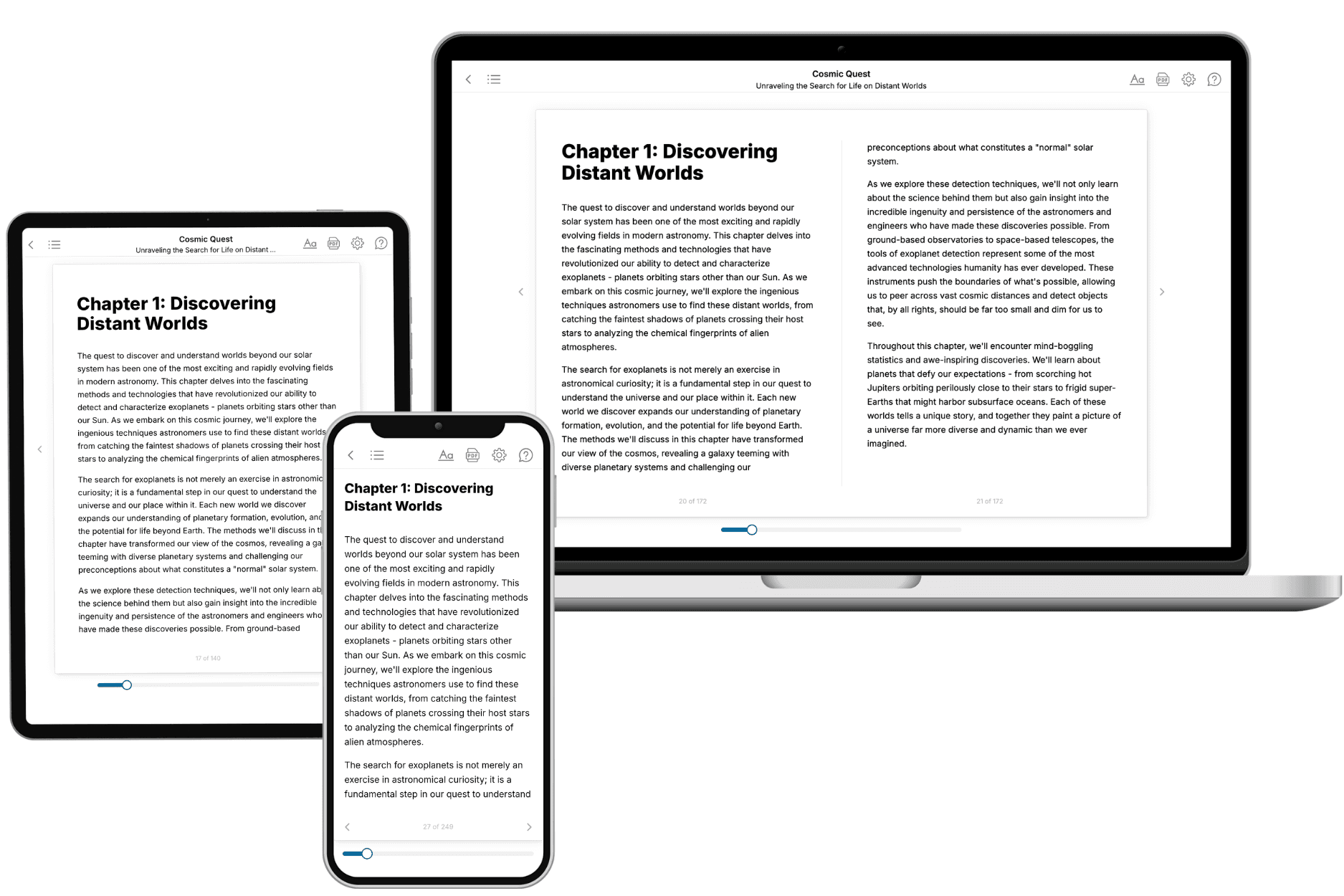
TailoredRead creates complete, full-length nonfiction ebooks, written specifically for you. Tell us what you want to learn and why, and TailoredRead writes you a complete ebook on it, with charts, tables, and diagrams throughout. Read it online, on Kindle, or on any e-reader, or download it as a PDF or EPUB. Every book is written fresh the day you order it.
- How is the book tailored to me?
Before anything is written, you answer a few short questions about your goals, your background, and the topics you care about. Your book is then planned around your answers: written at your level, focused on your goals, and covering the topics you chose, instead of the one-size-fits-all book a store sells everyone.
- Will it read like generic AI content?
No. Your book isn't a chat transcript: it's planned chapter by chapter before a single word is written, told in a clear book voice, and explains ideas visually with charts, tables, and diagrams. After writing, every book goes through an editorial pass that polishes chapters so the book reads consistent from start to finish. Judge for yourself: browse thousands of sample books on our Explore Books page.
- How accurate is the content?
Our AI first checks whether your subject needs live research. Niche and fast-moving subjects are researched before writing, and the book plan and chapters are grounded in what it finds. After writing, every book goes through a quality pass that checks its facts and consistency, and researched books list their sources in a Notes section at the back.
- How long is the book?
You choose the length: Comprehensive (250-300 pages), Detailed (150-200 pages), Essential (70-100 pages), or Short (30-50 pages).
- Does the book include visuals?
Yes. Every book includes visual elements such as timelines, checklists, step-by-step guides, decision trees, comparison tables, and matrices, and many include bar charts. A typical book includes dozens of these visual elements.
- Can I read it on Kindle? What formats can I download?
Yes. Every book can be read in our online reader or downloaded as a PDF or EPUB. The EPUB can be opened with Kindle, Apple Books, Kobo, and any e-reader. The Commercial and Author licenses also include an editable Word (DOCX) and Markdown download.
- How much does it cost?
About the price of a regular ebook. The exact price depends on your book's length and complexity, from $2 for the shortest books to $35 for the most comprehensive, and it's shown when you review your book, before you commit to anything. Each book is a one-time purchase, yours to keep, no subscription. Licenses that let you share, teach, or publish your book range from $35.99 to $49.99.
- Can I preview the book before purchasing?
Before you pay, you'll see what your book will cover: the title, a detailed description, the estimated length, and the complete chapter-by-chapter table of contents, so you know what you're getting before you decide. The full text itself is written after you purchase.
- How long does it take to create a book?
About 10 minutes. You can start reading the opening chapters while the rest is still being written.