Mastering Parametric Curves
Essential Mathematics and Implementation Techniques for Computer Graphics
Picture yourself creating fluid character animations where every movement flows naturally, designing user interfaces with perfectly smooth transitions, and building graphics applications that render complex curves in real-time without performance bottlenecks.
300 pages16 chaptersSep 12, 2025Computer Graphics
About this book
Your graphics programming will reach new levels of sophistication as you gain complete mastery over the mathematical foundations that power modern computer graphics. This comprehensive guide takes you deep into the world of parametric curves, from fundamental concepts to advanced implementation techniques. You'll discover how Bézier curves, B-splines, and NURBS work under the hood, learning not just the theory but the practical skills needed to implement these powerful tools in your own graphics applications. Each concept is presented with clear mathematical explanations, visual examples, and ready-to-use code implementations. Whether you're developing games, creating animation software, or building CAD applications, you'll learn to harness the full power of parametric curves. The book covers everything from basic curve evaluation and rendering to advanced topics like curve fitting, intersection algorithms, and performance optimization techniques that professional graphics programmers rely on daily. By the end of this book, you'll have the knowledge and confidence to tackle any curve-related challenge in computer graphics, creating smooth, efficient, and visually stunning results that set your work apart from the competition.
Table of contents
- IntroductionCurves Are Everywhere in Graphics, The Mathematical Foundation, Practical Applications in Modern Graphics, How This Book Is StructuredRead below
- Chapter 1: Parametric FundamentalsWhat Makes a Curve Parametric, Understanding Parameter Space, Vector Functions and Derivatives, Geometric Properties of Parametric Curves
- Chapter 2: Linear and Quadratic CurvesLinear Interpolation Basics, Quadratic Parametric Curves, Control Points and Influence, Efficient Evaluation Methods
- Chapter 3: Bézier CurvesThe Bézier Curve Definition, Bernstein Polynomials, Cubic Bézier Curves, Higher-Order Bézier Curves, Key Properties and Characteristics
- Chapter 4: Bézier Curve AlgorithmsDe Casteljau's Algorithm, Curve Subdivision Techniques, Degree Elevation and Reduction, Bézier Clipping Methods
- Chapter 5: Curve Continuity and SmoothnessC0, C1, and C2 Continuity, Geometric vs Parametric Continuity, Creating Smooth Curve Connections, Curvature Analysis and Control
- Chapter 6: Introduction to SplinesThe Spline Concept, Piecewise Polynomial Curves, Knot Vectors and Parameterization, Advantages Over Single Curves
- Chapter 7: B-Spline CurvesB-Spline Definition and Basis, B-Spline Basis Functions, Cox-de Boor Recursion Formula, Uniform vs Non-Uniform B-Splines, Key Properties of B-Splines
- Chapter 8: B-Spline AlgorithmsDe Boor's Algorithm, Knot Insertion Techniques, Knot Removal Methods, Degree Elevation and Reduction
- Chapter 9: NURBS CurvesNon-Uniform Rational B-Splines, Rational Basis Functions, Weights and Their Effects, Representing Conic Sections, NURBS Advantages and Applications
- Chapter 10: Efficient Curve EvaluationHorner's Method for Polynomials, Forward Differencing Techniques, Adaptive Sampling Strategies, Performance Optimization Tips
- Chapter 11: Curve Rendering and TessellationTessellation Fundamentals, Adaptive Tessellation Methods, Flatness Criteria and Tolerance, GPU-Based Tessellation
- Chapter 12: Curve Fitting and ApproximationInterpolation vs Approximation, Least Squares Fitting, Fitting Curves to Data Points, Error Analysis and Quality Metrics
- Chapter 13: Curve Operations and TransformationsAffine Transformations, Curve Offsetting Techniques, Curve Blending and Morphing, Curve Composition Operations
- Chapter 14: Curve Intersection AlgorithmsIntersection Problem Overview, Subdivision-Based Methods, Newton-Raphson Iteration, Robust Intersection Techniques
- Chapter 15: Curves in AnimationKeyframe Interpolation, Easing Functions and Timing, Motion Paths and Trajectories, Camera Path Animation
- Chapter 16: Implementation GuideCurve Data Structures, Memory Management Strategies, Numerical Stability Considerations, Debugging and Validation Techniques
- Conclusion
- Glossary
Introduction
Computer graphics has evolved from simple line drawings to breathtakingly realistic visual experiences that captivate audiences worldwide. Behind every smooth animation, elegant user interface transition, and organic shape lies a mathematical foundation that transforms discrete digital data into continuous, flowing forms. Parametric curves represent one of the most fundamental and powerful tools in this transformation, serving as the invisible backbone that brings life and fluidity to digital creations.
The journey from understanding basic mathematical concepts to implementing sophisticated curve algorithms might seem daunting, but the rewards are immense. When you master parametric curves, you gain the ability to create motion that feels natural, interfaces that respond intuitively, and visual effects that seamlessly blend mathematics with artistry. This book bridges the gap between theoretical knowledge and practical implementation, providing you with both the conceptual understanding and the technical skills needed to excel in modern graphics programming.
Whether you're developing the next breakthrough game engine, creating professional animation software, or building cutting-edge visualization tools, parametric curves will become an indispensable part of your toolkit. The techniques you'll learn here are not merely academic exercises—they're the same methods used by industry professionals to create the smooth character movements in blockbuster animated films, the precise toolpaths in computer-aided design software, and the fluid transitions in award-winning user interfaces.
This introduction will establish the foundation for your journey into parametric curves by exploring their ubiquitous presence in graphics applications, examining the mathematical principles that make them so powerful, and outlining the practical skills you'll develop throughout this book. By the end of this chapter, you'll understand not only what parametric curves are, but why they're essential for any serious graphics programmer and how they'll transform your approach to creating digital visual experiences.
Curves Are Everywhere in Graphics
Open any modern graphics application, game, or digital interface, and you'll find parametric curves working behind the scenes in countless ways. Vector graphics editors like Adobe Illustrator and Inkscape rely heavily on Bézier curves to create scalable artwork that maintains crisp edges at any zoom level. When a designer draws a smooth logo or creates flowing typography, they're manipulating control points that define parametric curves. These curves ensure that the final artwork can be scaled from business card size to billboard dimensions without losing quality or requiring additional storage space.
In the realm of 3D animation and modeling, parametric curves serve multiple critical functions that directly impact the quality and efficiency of the final product. Character animators use curve-based interpolation to create smooth transitions between keyframes, ensuring that a character's movement appears natural rather than robotic. The difference between amateur and professional animation often lies in the subtle application of easing curves that govern how quickly movements accelerate and decelerate. Consider how a bouncing ball should move: it accelerates as it falls due to gravity, then decelerates as it rises, with the timing following precise mathematical curves that mirror real-world physics.
Modern user interface design has embraced parametric curves as essential tools for creating engaging, responsive experiences. When you swipe through photos on your smartphone or watch a menu slide smoothly into view, you're experiencing carefully crafted motion curves that make digital interactions feel intuitive and satisfying. Companies like Apple and Google have invested heavily in defining standard easing curves that create consistent, polished user experiences across their platforms. These curves are not arbitrary—they're based on research into human perception and expectation, designed to feel natural and responsive.
The gaming industry represents perhaps the most demanding application of parametric curves, where real-time performance constraints require both mathematical precision and computational efficiency. Game developers use curves to define camera movements that smoothly follow players through complex 3D environments, create particle systems that simulate realistic fire and water effects, and generate procedural content that appears organic and varied. Racing games use parametric curves to define track layouts that provide exciting driving experiences while maintaining realistic vehicle physics. The challenge lies in evaluating these curves quickly enough to maintain smooth frame rates while preserving the mathematical accuracy needed for consistent gameplay.
In computer-aided design (CAD) and manufacturing, parametric curves enable engineers and designers to create precise, manufacturable products. NURBS curves allow designers to represent both free-form surfaces and exact geometric shapes like circles and ellipses within a unified mathematical framework. This capability is crucial for industries like automotive and aerospace, where components must meet exact specifications while maintaining smooth, aerodynamic surfaces. The ability to modify a curve by adjusting control points and immediately see the impact on the entire design accelerates the iterative design process and reduces the time from concept to production.
Even in emerging fields like data visualization and scientific computing, parametric curves play increasingly important roles. Scientists use curve fitting algorithms to identify trends in experimental data, while data visualization specialists employ smooth curves to create compelling charts and graphs that communicate complex information clearly. Interactive data exploration tools rely on parametric curves to create smooth transitions between different views of the same dataset, helping users understand relationships and patterns that might be hidden in static presentations.
The film and visual effects industry pushes parametric curves to their limits, creating impossible worlds and creatures that must appear believable to audiences. Motion capture data is often processed through curve-fitting algorithms to create smooth, natural character movements from noisy sensor data. Visual effects artists use curves to define the paths of digital cameras flying through computer-generated environments, ensuring that the resulting footage integrates seamlessly with live-action plates. The mathematical precision of parametric curves enables artists to create repeatable, controllable effects that can be refined through multiple iterations without starting from scratch.
Understanding the pervasive nature of parametric curves in graphics applications reveals why mastering these mathematical tools is so valuable for graphics programmers. Every smooth transition, organic shape, and fluid animation you encounter in digital media likely involves parametric curves at some level. By learning to implement and manipulate these curves effectively, you gain the ability to create more sophisticated, polished, and professional graphics applications that meet the high standards users have come to expect from modern digital experiences.
The Mathematical Foundation
At its core, a parametric curve is a mathematical function that describes a path through space using one or more parameters, typically denoted as t. Unlike traditional y = f(x) functions that can only represent curves that pass the vertical line test, parametric curves can describe any continuous path, including loops, spirals, and complex shapes that fold back on themselves. The fundamental concept involves expressing both x and y coordinates (and z in three dimensions) as separate functions of the parameter t: x = f(t), y = g(t), and optionally z = h(t).
The parameter t typically ranges from 0 to 1, creating a normalized parameter space that provides several important advantages for graphics programming. This normalization means that t = 0 represents the start of the curve, t = 1 represents the end, and t = 0.5 represents the midpoint in parameter space (though not necessarily the geometric midpoint of the curve). This standardization allows for consistent interfaces across different curve types and simplifies many algorithmic operations. For example, when blending between two curves or creating animations, the normalized parameter space provides a natural framework for interpolation and timing calculations.
The mathematical elegance of parametric curves becomes apparent when examining their geometric properties. The first derivative of a parametric curve with respect to the parameter t gives the tangent vector at any point, providing information about the curve's direction and speed of traversal. The magnitude of this tangent vector indicates how quickly the curve is being traced as the parameter changes, which is crucial for applications requiring constant speed motion or arc-length parameterization. The second derivative provides curvature information, allowing algorithms to determine how sharply the curve bends at any point.
One of the most powerful aspects of parametric curves is their ability to represent control point-based systems where the curve's shape is determined by a set of points that may or may not lie on the curve itself. This approach provides intuitive control for designers and animators while maintaining mathematical precision. Bézier curves exemplify this concept, using control points to define the curve's shape through weighted combinations of basis functions. The mathematical framework ensures that moving a control point produces predictable changes in the curve's shape, enabling interactive design tools that feel responsive and intuitive.
The concept of basis functions forms the theoretical foundation for most parametric curve types used in computer graphics. These functions determine how control points influence the curve's shape at different parameter values. Bernstein polynomials serve as the basis functions for Bézier curves, while B-spline basis functions provide the foundation for B-spline and NURBS curves. Understanding these basis functions is crucial for implementing efficient evaluation algorithms and for understanding how different curve types behave under various operations like subdivision, degree elevation, and transformation.
Linear algebra plays a central role in parametric curve mathematics, particularly in the representation and manipulation of curves using matrix operations. Many curve evaluation algorithms can be expressed as matrix multiplications, enabling efficient implementation using optimized linear algebra libraries. This matrix representation also facilitates operations like curve transformation, where applying an affine transformation to a curve reduces to multiplying the control points by a transformation matrix. The mathematical consistency of this approach ensures that transformed curves maintain their essential properties while adapting to new coordinate systems.
Continuity theory provides the mathematical framework for understanding how curve segments can be joined to create smooth, complex shapes. Different levels of continuity—C0 (positional), C1 (tangent), and C2 (curvature)—define increasingly strict requirements for smoothness at connection points. This mathematical foundation enables the creation of complex curves from simpler segments while maintaining visual smoothness and mathematical properties. Understanding continuity requirements is essential for implementing spline systems that can represent arbitrary shapes while preserving smoothness constraints.
The mathematical foundation of parametric curves extends to numerical methods that enable efficient computation and robust implementation. Algorithms like de Casteljau's method for Bézier curves and de Boor's algorithm for B-splines provide numerically stable ways to evaluate curves even in challenging conditions like extreme parameter values or nearly degenerate control point configurations. These algorithms often have elegant recursive structures that reflect the underlying mathematical properties of the curves, making them both computationally efficient and conceptually clear.
Understanding the mathematical foundation of parametric curves provides more than just theoretical knowledge—it enables you to make informed decisions about which curve types to use for specific applications, how to implement algorithms efficiently, and how to troubleshoot problems when they arise. The mathematical principles also reveal optimization opportunities and guide the development of new algorithms tailored to specific requirements. This deep understanding transforms parametric curves from mysterious black boxes into powerful, controllable tools that can be adapted and extended to meet the evolving needs of graphics programming.
Practical Applications in Modern Graphics
The transition from mathematical theory to practical implementation reveals the true power of parametric curves in solving real-world graphics programming challenges. Animation systems represent one of the most common and impactful applications, where curves control not just spatial movement but also the timing and feel of motion. Modern animation frameworks use parametric curves to interpolate between keyframes, creating smooth transitions that can be fine-tuned by adjusting curve parameters. For instance, a simple ease-in-ease-out animation might use a cubic Bézier curve with control points positioned to create gentle acceleration at the beginning and deceleration at the end, resulting in motion that feels natural and polished.
Consider a practical example of character animation in a game engine where a character needs to jump from one platform to another. The trajectory cannot be a simple parabola because the character must avoid obstacles and land precisely on the target platform. A parametric curve allows the animator to define control points that guide the character around obstacles while maintaining realistic motion. The curve's first derivative provides velocity information for physics calculations, while the second derivative can inform particle systems that create dust clouds when the character lands. This integration of mathematical precision with artistic control exemplifies the practical power of parametric curves.
In user interface development, parametric curves have become essential for creating responsive, engaging interactions that meet modern user expectations. Touch-based interfaces rely heavily on curve-based animations to provide visual feedback and guide user attention. When implementing a pull-to-refresh gesture, the visual elements must follow curves that feel connected to the user's finger movement while providing clear feedback about the gesture's progress. The mathematical precision of parametric curves ensures that these interactions remain smooth and responsive across different devices and performance conditions.
A practical implementation might involve using a cubic Bézier curve to control the opacity and scale of UI elements during a transition. As the user drags down to refresh, the parameter t increases from 0 to 1, with the curve's output controlling multiple visual properties simultaneously. The curve's shape determines whether the transition feels snappy and responsive or smooth and elegant, directly impacting the user's perception of the application's quality.
Procedural content generation represents another area where parametric curves provide significant practical value. Game developers use curves to generate varied, interesting terrain and level layouts without requiring manual design of every element. A racing game might use parametric curves to generate track layouts that provide exciting driving experiences while maintaining proper banking angles and safe turning radii. The curves can be modified procedurally to create variations, ensuring that each generated track feels unique while maintaining playability and visual appeal.
The implementation of camera control systems showcases how parametric curves solve complex practical problems in 3D graphics applications. A cinematic camera system must smoothly transition between different viewpoints while maintaining proper framing and avoiding jarring movements. Parametric curves enable developers to define camera paths that can be evaluated in real-time, providing smooth motion even when the target objects are moving unpredictably. The curves can incorporate look-ahead algorithms that anticipate the target's movement, creating camera motion that feels intelligent and cinematic rather than mechanical.
In data visualization applications, parametric curves enable the creation of smooth, animated transitions between different data representations. When users switch from a bar chart to a line graph, parametric curves can control the morphing animation that transforms one visualization into another. This application requires careful consideration of both mathematical accuracy and visual clarity—the curves must preserve data relationships while creating visually appealing transitions that help users understand the connection between different representations of the same information.
Real-time graphics rendering presents unique challenges where parametric curves must be evaluated efficiently enough to maintain smooth frame rates while providing sufficient visual quality. Modern graphics hardware includes specialized tessellation units that can subdivide parametric curves into renderable geometry on the GPU, enabling complex curved surfaces to be rendered efficiently. The practical implementation involves balancing curve complexity against rendering performance, often using adaptive algorithms that provide more detail where the curve bends sharply and less detail in flatter regions.
The development of interactive design tools demonstrates how parametric curves can be made accessible to non-programmers while maintaining mathematical precision. Vector graphics editors provide intuitive interfaces for manipulating Bézier curves through direct manipulation of control points and handles. The challenge lies in translating user gestures into mathematically valid curve modifications while providing immediate visual feedback. This requires efficient curve evaluation algorithms that can update the display in real-time as users drag control points, along with robust algorithms that maintain curve validity even when users make extreme adjustments.
These practical applications reveal that successful implementation of parametric curves requires more than just mathematical knowledge—it demands understanding of performance constraints, user experience principles, and the specific requirements of different graphics domains. The most effective graphics programmers combine mathematical rigor with practical engineering skills, creating implementations that are both mathematically sound and optimized for real-world use. This balance between theory and practice forms the foundation for creating graphics applications that are both powerful and accessible to their intended users.
How This Book Is Structured
This book follows a carefully designed progression that builds your understanding and skills systematically, starting with fundamental concepts and advancing to sophisticated implementation techniques. The structure reflects the natural learning path for mastering parametric curves, ensuring that each chapter provides the foundation needed for subsequent topics. Early chapters focus on mathematical foundations and basic curve types, establishing the conceptual framework that underlies all parametric curve work. This foundation is essential because the mathematical principles learned with simple curves apply directly to more complex systems, and understanding these fundamentals prevents confusion when working with advanced algorithms.
The book is organized into four main sections that address different aspects of parametric curve mastery:
- Foundations (Chapters 1-2): Mathematical fundamentals and basic curve types
- Core Curve Types (Chapters 3-9): Detailed coverage of Bézier curves, B-splines, and NURBS
- Advanced Techniques (Chapters 10-14): Algorithms, operations, and specialized applications
- Practical Implementation (Chapters 15-16): Real-world applications and implementation guidance
Chapters 1 and 2 establish the mathematical foundation by exploring what makes curves parametric and how parameter spaces work. You'll learn about vector functions, derivatives, and the geometric properties that make parametric curves so powerful for graphics applications. These chapters include practical exercises that help you visualize abstract mathematical concepts and understand how they translate into code. The linear and quadratic curves covered in Chapter 2 provide concrete examples that illustrate fundamental principles without the complexity of higher-order systems.
The Bézier curve section (Chapters 3-4) provides comprehensive coverage of the most widely used parametric curves in computer graphics. Chapter 3 covers the mathematical definition, Bernstein polynomials, and the key properties that make Bézier curves so intuitive for designers and animators. Chapter 4 delves into the algorithms that make Bézier curves practical, including de Casteljau's method, subdivision techniques, and clipping methods. These chapters include extensive code examples and visual demonstrations that show how mathematical concepts translate into working implementations.
Chapter 5 addresses the crucial topic of curve continuity and smoothness, providing the theoretical foundation needed to create complex shapes from multiple curve segments. This chapter bridges the gap between individual curves and the spline systems covered in subsequent chapters. You'll learn about different types of continuity, how to analyze and control curvature, and practical techniques for creating smooth connections between curve segments. This knowledge is essential for implementing professional-quality curve systems that produce visually smooth results.
The spline and NURBS section (Chapters 6-9) covers the most sophisticated parametric curve systems used in professional graphics applications. These chapters progress from basic spline concepts through B-spline theory and algorithms, culminating in NURBS curves that combine the flexibility of B-splines with the precision of rational mathematics. Each chapter includes detailed algorithm descriptions, implementation guidance, and practical examples that demonstrate the advantages of these advanced curve types. The coverage includes both theoretical understanding and practical implementation techniques needed for professional development work.
Chapters 10-14 focus on advanced techniques that separate professional implementations from academic exercises. These chapters cover efficient evaluation algorithms, rendering and tessellation techniques, curve fitting methods, geometric operations, and intersection algorithms. Each topic is presented with both theoretical background and practical implementation guidance, including performance optimization techniques and numerical stability considerations. These chapters prepare you to handle the challenging problems encountered in real-world graphics programming where mathematical elegance must be balanced with computational efficiency.
The final section (Chapters 15-16) brings together all the previous concepts in the context of practical applications and implementation guidance. Chapter 15 focuses specifically on animation applications, showing how parametric curves solve real-world problems in keyframe interpolation, easing functions, and motion path design. Chapter 16 provides comprehensive implementation guidance, covering data structures, memory management, numerical stability, and debugging techniques that ensure your curve implementations are robust and maintainable.
Throughout the book, code examples are provided in multiple programming languages commonly used in graphics development, including C++, Python, and JavaScript. The examples progress from simple demonstrations of mathematical concepts to complete, optimized implementations suitable for production use. Each code example is accompanied by detailed explanations that connect the implementation to the underlying mathematical principles, ensuring that you understand not just how the code works, but why it's structured the way it is.
The book also includes practical exercises and projects that reinforce the concepts covered in each chapter. These range from simple mathematical calculations that can be done by hand to complex programming projects that result in working curve editing tools and animation systems. The exercises are designed to build your intuition about how parametric curves behave while developing the practical skills needed for professional graphics programming. By completing these exercises, you'll develop both theoretical understanding and hands-on experience with the algorithms and techniques that make parametric curves so powerful in computer graphics applications.
This is the end of the free sample. The full book has 16 chapters.
Want this book written for you?
Tell us your goals and background, and get your own version of this book, tailored by AI to you.


Benefits of AI-tailored books
- Read one book, not ten:
- all the Computer Graphics knowledge you need, gathered into a single book.
- Save days of learning:
- tell us your goals, choose your topics, and the whole book is built around them.
- Learn effortlessly:
- Computer Graphics book written for your specific background and expertise.
- Understand at a glance:
- includes charts, tables, timelines, checklists, decision trees, and more.
- Stay current:
- written the day you order it, not years ago.
- Trust what you read:
- every book is checked for accuracy, with real research when your subject needs it.
Create your unique book in 3 steps
- 1. Select your focus
Select the focus of your Computer Graphics book and share your background
- 2. Personalize your book
Specify your goals and choose sub-topics to include
- 3. Get your tailored book
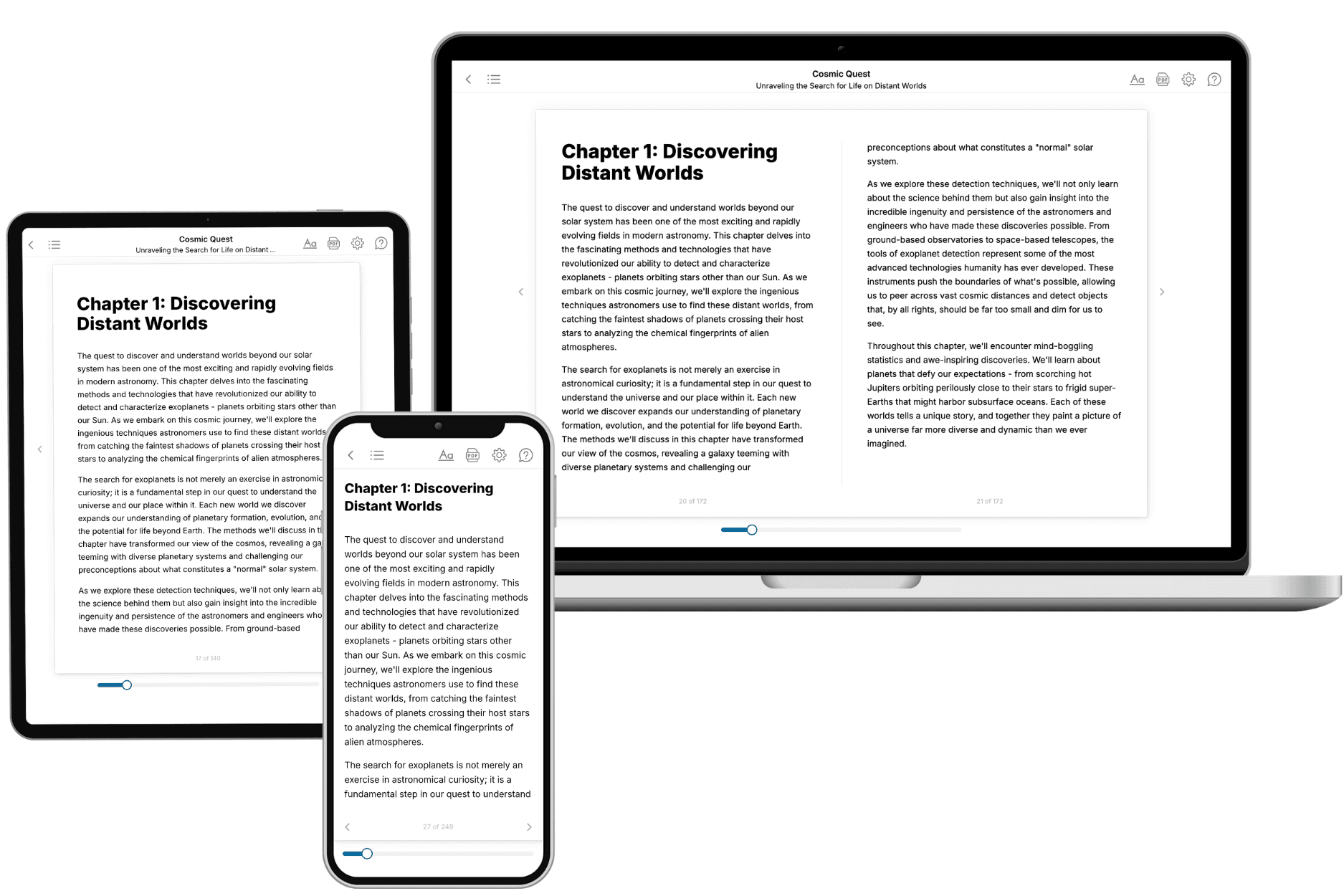
Your book is ready in 10 minutes. Read it online, download as EPUB or PDF, or send to Kindle.

Frequently asked questions
- What is TailoredRead?
TailoredRead creates complete, full-length nonfiction ebooks, written specifically for you. Tell us what you want to learn and why, and TailoredRead writes you a complete ebook on it, with charts, tables, and diagrams throughout. Read it online, on Kindle, or on any e-reader, or download it as a PDF or EPUB. Every book is written fresh the day you order it.
- How is the book tailored to me?
Before anything is written, you answer a few short questions about your goals, your background, and the topics you care about. Your book is then planned around your answers: written at your level, focused on your goals, and covering the topics you chose, instead of the one-size-fits-all book a store sells everyone.
- Will it read like generic AI content?
No. Your book isn't a chat transcript: it's planned chapter by chapter before a single word is written, told in a clear book voice, and explains ideas visually with charts, tables, and diagrams. After writing, every book goes through an editorial pass that polishes chapters so the book reads consistent from start to finish. Judge for yourself: browse thousands of sample books on our Explore Books page.
- How accurate is the content?
Our AI first checks whether your subject needs live research. Niche and fast-moving subjects are researched before writing, and the book plan and chapters are grounded in what it finds. After writing, every book goes through a quality pass that checks its facts and consistency, and researched books list their sources in a Notes section at the back.
- How long is the book?
You choose the length: Comprehensive (250-300 pages), Detailed (150-200 pages), Essential (70-100 pages), or Short (30-50 pages).
- Does the book include visuals?
Yes. Every book includes charts, tables, and diagrams: timelines, checklists, step-by-step guides, decision trees, comparison tables, matrices, and bar charts. A typical book includes dozens of these visual elements.
- Can I read it on Kindle? What formats can I download?
Yes. Every book can be read in our online reader or downloaded as a PDF or EPUB. The EPUB can be opened with Kindle, Apple Books, Kobo, and any e-reader. The Commercial and Author licenses also include an editable Word (DOCX) and Markdown download.
- How much does it cost?
About the price of a regular ebook. The exact price depends on your book's length and complexity, from $2 for the shortest books to $35 for the most comprehensive, and it's shown when you review your book, before you commit to anything. Each book is a one-time purchase, yours to keep, no subscription. Licenses that let you share, teach, or publish your book range from $35.99 to $49.99.
- Can I preview the book before purchasing?
Before you pay, you'll see what your book will cover: the title, a detailed description, the estimated length, and the complete chapter-by-chapter table of contents, so you know what you're getting before you decide. The full text itself is written after you purchase.
- How long does it take to create a book?
About 10 minutes. You can start reading the opening chapters while the rest is still being written.