Mastering Partial Derivatives
A Step-by-Step Guide to Conquering Intermediate Algebra
Imagine confidently tackling complex mathematical problems, effortlessly breaking them down into manageable components.
269 pages13 chaptersDec 11, 2024Mathematics
About this book
Picture yourself elegantly manipulating equations, understanding the intricate relationships between variables, and applying your knowledge to real-world scenarios. This is the power of mastering partial derivatives. "Mastering Partial Derivatives" is your comprehensive guide to navigating the fascinating world of intermediate algebra. This book demystifies the concept of partial derivatives, transforming it from an intimidating mathematical construct into an intuitive tool at your fingertips. You'll discover how partial derivatives serve as a bridge between basic algebraic concepts and more advanced mathematical territories. Through clear explanations, practical examples, and engaging exercises, you'll develop a deep understanding of how partial derivatives work and why they're crucial in various fields. From analyzing rates of change in multivariable functions to optimizing complex systems, you'll gain the skills to approach problems with confidence and precision. Whether you're a student aiming to excel in your mathematics courses or a professional looking to enhance your analytical capabilities, this book will equip you with the knowledge and techniques to elevate your mathematical prowess. Get ready to unravel the mysteries of partial derivatives and open doors to new realms of problem-solving mastery.
Table of contents
- IntroductionThe Importance of Partial Derivatives in Mathematics, Overview of the Book's Structure, Learning Objectives and Outcomes, Prerequisites and Review of Basic ConceptsRead below
- Chapter 1: Foundations of Partial DerivativesReview of Functions and Variables, Limits and Continuity in Multiple Variables, Basic Derivative Concepts, Introduction to Multivariable Functions
- Chapter 2: Introducing Partial DerivativesDefinition and Explanation, Notation and Symbols, Geometric Interpretation, Comparison with Ordinary Derivatives
- Chapter 3: Computation TechniquesBasic Rules for Computing Partial Derivatives, The Chain Rule for Partial Derivatives, Implicit Differentiation in Multiple Variables, Higher-Order Partial Derivatives
- Chapter 4: Applications in PhysicsAnalyzing Motion in Multiple Dimensions, Thermodynamic Equations and Partial Derivatives, Wave Equations and Partial Derivatives, Electromagnetic Theory and Vector Calculus
- Chapter 5: Engineering ApplicationsFluid Dynamics and Partial Differential Equations, Heat Transfer Analysis, Structural Mechanics and Stress Analysis, Control Systems and Feedback Loops
- Chapter 6: Economic ApplicationsMarginal Analysis in Microeconomics, Production Functions and Elasticity, Utility Optimization Problems, Partial Derivatives in Economic Models
- Chapter 7: Optimization TechniquesFinding Critical Points, Determining Local Maxima and Minima, Method of Lagrange Multipliers, Constrained Optimization Problems
- Chapter 8: Visualization Techniques3D Graphing of Multivariable Functions, Contour Plots and Level Curves, Gradient Vectors and Directional Derivatives, Tangent Planes and Normal Lines
- Chapter 9: Numerical Methods for Partial DerivativesFinite Difference Methods, Numerical Optimization Algorithms, Error Analysis and Approximation, Computer Implementation of Numerical Methods
- Chapter 10: Advanced Topics in Partial DerivativesIntroduction to Partial Differential Equations, Vector Calculus and Partial Derivatives, Partial Derivatives in Complex Variables, Functional Analysis and Partial Derivatives
- Chapter 11: Real-World Case StudiesWeather Prediction Models, Financial Modeling and Risk Analysis, Image Processing and Computer Vision, Machine Learning Algorithms
- Chapter 12: Problem-Solving StrategiesIdentifying Problems Suitable for Partial Derivatives, Approaches to Solving Complex Problems, Common Pitfalls and How to Avoid Them, Practice Problems and Solutions
- Chapter 13: Future Directions and Advanced StudiesCurrent Research and Frontiers, Interdisciplinary Applications, Emerging Technologies and Partial Derivatives, Resources for Further Learning and Exploration
- ConclusionKey Takeaways and Summary, The Future of Partial Derivatives in Mathematics and Beyond
- Glossary
- AppendixAdditional Mathematical Proofs, Tables of Important Formulas
Introduction
Welcome to the fascinating world of partial derivatives, a cornerstone of intermediate algebra and a powerful tool in the mathematician's arsenal. As you embark on this journey through "Mastering Partial Derivatives: A Step-by-Step Guide to Conquering Intermediate Algebra," you are about to unlock a new dimension of mathematical understanding that will transform your approach to problem-solving and analytical thinking. This introduction serves as your gateway to the intricate realm of multivariable calculus, setting the stage for the exciting concepts and applications that await you in the chapters to come.
Partial derivatives represent a natural progression from the basic principles of calculus, extending the concept of differentiation to functions of multiple variables. They provide a means to analyze how a function changes with respect to one variable while holding others constant, a capability that proves invaluable across a wide spectrum of scientific and practical applications. As you delve deeper into this book, you will discover how partial derivatives serve as a bridge between elementary calculus and more advanced mathematical territories, opening up new avenues for exploration and understanding.
Throughout this introductory chapter, we will lay the groundwork for your journey into the world of partial derivatives. We'll explore their significance in mathematics and various fields of study, provide an overview of the book's structure, outline the learning objectives that will guide your progress, and review some essential prerequisites to ensure you're well-prepared for the material ahead. By the end of this introduction, you'll have a clear roadmap for your studies and a solid foundation upon which to build your expertise in partial derivatives.
The Importance of Partial Derivatives in Mathematics
Partial derivatives stand as a fundamental concept in mathematics, serving as a crucial tool for understanding and analyzing multivariable functions. Their importance cannot be overstated, as they provide a means to navigate the complexities of functions that depend on multiple variables, a scenario frequently encountered in real-world applications. At its core, a partial derivative measures the rate of change of a function with respect to one variable while holding all other variables constant. This seemingly simple concept opens up a world of possibilities in mathematical analysis and problem-solving.
One of the primary reasons partial derivatives hold such significance is their ability to break down complex problems into manageable components. In multivariable calculus, functions often depend on several variables, making it challenging to analyze their behavior comprehensively. Partial derivatives allow mathematicians and scientists to focus on the impact of individual variables, providing insights into the function's behavior that would be difficult or impossible to obtain otherwise. This decomposition of complex functions into simpler, more tractable parts is a powerful technique that finds applications across various fields of study.
In the realm of optimization, partial derivatives play a crucial role. Many real-world problems involve finding the maximum or minimum values of functions with multiple variables. Whether it's maximizing profit in economics, minimizing energy consumption in engineering, or optimizing the design of a chemical process, partial derivatives provide the tools necessary to identify critical points and determine optimal solutions. The ability to find these extrema is not just a mathematical exercise but a practical necessity in many industries and scientific endeavors.
The geometric interpretation of partial derivatives offers another layer of importance. They provide a means to understand the shape and behavior of multidimensional surfaces, allowing for the visualization of complex functions in three-dimensional space and beyond. This geometric insight is invaluable in fields such as computer graphics, where understanding the curvature and gradients of surfaces is essential for rendering realistic images and animations. Moreover, the concept of directional derivatives, closely related to partial derivatives, allows for the analysis of rates of change in any direction, providing a comprehensive understanding of a function's behavior in multidimensional space.
In physics and engineering, partial derivatives are indispensable for describing and analyzing natural phenomena. Many fundamental laws of physics, such as Maxwell's equations in electromagnetism or the heat equation in thermodynamics, are expressed in terms of partial differential equations. These equations, which involve partial derivatives, describe how physical quantities change with respect to multiple variables such as time and space. The ability to work with and solve these equations is crucial for understanding everything from the behavior of electromagnetic fields to the flow of heat through materials.
The importance of partial derivatives extends to the field of economics, where they are used to analyze marginal changes in economic variables. Concepts such as marginal utility, marginal cost, and elasticity all rely on partial derivatives to quantify how small changes in one variable affect others while holding certain factors constant. This application of partial derivatives allows economists to make predictions about market behavior, optimize resource allocation, and develop economic policies based on rigorous mathematical analysis.
In the rapidly evolving field of machine learning and artificial intelligence, partial derivatives play a critical role in the training of neural networks. The backpropagation algorithm, which is fundamental to the learning process of many AI models, relies heavily on the computation of partial derivatives to adjust the weights of the network and minimize the error function. This application demonstrates how partial derivatives are not just a theoretical concept but a practical tool driving some of the most cutting-edge technologies of our time.
Furthermore, partial derivatives are essential in the study of differential geometry, a branch of mathematics that combines analysis and geometry. This field has applications ranging from the theory of relativity in physics to the design of computer-aided geometric design (CAGD) systems used in industries such as automotive and aerospace engineering. The ability to analyze curved surfaces and manifolds using partial derivatives provides insights into the intrinsic properties of geometric objects, bridging the gap between abstract mathematical concepts and practical applications in design and physics.
The importance of partial derivatives also lies in their role as a stepping stone to more advanced mathematical concepts. They serve as a foundation for understanding vector calculus, tensor analysis, and functional analysis, areas of mathematics that are crucial in advanced physics, engineering, and theoretical mathematics. Mastering partial derivatives opens the door to these more sophisticated mathematical tools, enabling you to tackle even more complex problems and contribute to cutting-edge research in various scientific disciplines.
In conclusion, the importance of partial derivatives in mathematics cannot be overstated. They provide a powerful framework for analyzing multivariable functions, optimizing complex systems, and understanding the behavior of natural phenomena. From their applications in physics and engineering to their role in economics and machine learning, partial derivatives are a versatile tool that bridges the gap between theoretical mathematics and practical problem-solving. As you delve deeper into this book, you'll discover how mastering partial derivatives will enhance your analytical skills, broaden your mathematical horizons, and equip you with the tools to tackle a wide range of challenges in your academic and professional pursuits.
Overview of the Book's Structure
"Mastering Partial Derivatives: A Step-by-Step Guide to Conquering Intermediate Algebra" is meticulously structured to provide a comprehensive and accessible journey through the world of partial derivatives. The book is designed to cater to your needs as a college student or young professional with a moderate understanding of mathematics, aiming to deepen your knowledge and enhance your problem-solving abilities in intermediate algebra. This overview will guide you through the book's structure, highlighting the key areas of focus and the progression of topics that will lead you to mastery of partial derivatives.
The book begins with this introduction, setting the stage for your learning journey by emphasizing the importance of partial derivatives in mathematics and various fields of application. Following this introductory chapter, the book is divided into thirteen main chapters, each focusing on a specific aspect of partial derivatives and their applications. This structured approach ensures that you build your knowledge systematically, with each chapter laying the foundation for the next.
Chapter 1, "Foundations of Partial Derivatives," serves as a crucial starting point, reviewing essential concepts in functions, variables, limits, and continuity. This chapter bridges the gap between basic calculus and the more advanced concepts you'll encounter, ensuring that you have a solid foundation upon which to build your understanding of partial derivatives. It introduces multivariable functions, setting the stage for the core concepts to come.
Chapter 2, "Introducing Partial Derivatives," dives into the heart of the subject. Here, you'll encounter the formal definition of partial derivatives, learn the notation and symbols used to represent them, and explore their geometric interpretation. This chapter also compares partial derivatives with ordinary derivatives, helping you understand the unique characteristics and applications of partial derivatives in multivariable functions.
As you progress, Chapter 3 focuses on "Computation Techniques," equipping you with the tools and methods needed to calculate partial derivatives efficiently. You'll learn basic rules, explore the chain rule for partial derivatives, and delve into more advanced topics such as implicit differentiation in multiple variables and higher-order partial derivatives. This chapter is designed to build your computational skills, preparing you for more complex applications in later chapters.
Chapters 4, 5, and 6 are dedicated to applications of partial derivatives in physics, engineering, and economics, respectively. These chapters demonstrate the wide-ranging relevance of partial derivatives across different disciplines. In physics, you'll explore motion analysis, thermodynamics, wave equations, and electromagnetic theory. The engineering applications cover fluid dynamics, heat transfer, structural mechanics, and control systems. In economics, you'll apply partial derivatives to marginal analysis, production functions, utility optimization, and economic modeling. These chapters not only illustrate the practical importance of partial derivatives but also provide you with valuable context for how these mathematical tools are used in real-world scenarios.
Chapter 7 delves into "Optimization Techniques," a critical application of partial derivatives. You'll learn how to find critical points, determine local maxima and minima, and tackle constrained optimization problems using methods like Lagrange multipliers. This chapter is particularly valuable for those interested in applying mathematics to solve practical problems in various fields, from engineering design to economic analysis.
Visualization is key to understanding complex mathematical concepts, and Chapter 8 focuses on "Visualization Techniques" for partial derivatives. You'll explore 3D graphing of multivariable functions, contour plots, gradient vectors, and tangent planes. These visual tools will help solidify your understanding of the geometric aspects of partial derivatives and enhance your ability to interpret mathematical results intuitively.
Chapter 9 introduces "Numerical Methods for Partial Derivatives," bridging the gap between theoretical understanding and practical implementation. You'll learn about finite difference methods, numerical optimization algorithms, error analysis, and computer implementation of these techniques. This chapter is particularly relevant in today's computational age, where many complex problems are solved using numerical approximations.
As you near the end of the book, Chapter 10 explores "Advanced Topics in Partial Derivatives," introducing you to partial differential equations, vector calculus, complex variables, and functional analysis. This chapter serves as a gateway to more advanced mathematical concepts, providing a glimpse into the broader landscape of mathematics that builds upon partial derivatives.
Chapter 11 presents "Real-World Case Studies," applying the knowledge you've gained to practical scenarios in weather prediction, financial modeling, image processing, and machine learning. These case studies demonstrate the relevance and power of partial derivatives in solving complex, real-world problems across various industries and scientific domains.
Chapter 12 focuses on "Problem-Solving Strategies," equipping you with the skills to approach and solve complex problems involving partial derivatives. You'll learn how to identify problems suitable for partial derivatives, explore different solution approaches, and avoid common pitfalls. This chapter also includes practice problems and solutions to reinforce your learning and build your confidence in applying partial derivatives to diverse scenarios.
The final chapter, Chapter 13, looks at "Future Directions and Advanced Studies," exploring current research frontiers, interdisciplinary applications, and emerging technologies related to partial derivatives. This chapter aims to inspire your continued exploration of the subject and provides resources for further learning and potential career paths in fields that heavily utilize partial derivatives.
Throughout the book, you'll find numerous examples, exercises, and real-world applications to reinforce your understanding and develop your problem-solving skills. The book concludes with a comprehensive glossary of terms and an appendix containing additional mathematical proofs and important formulas, serving as valuable references as you continue your mathematical journey.
This carefully structured approach ensures that you progress from foundational concepts to advanced applications, building your knowledge and skills systematically. By the end of the book, you'll have gained a deep understanding of partial derivatives, their applications, and their significance in various fields, empowering you to tackle complex mathematical challenges with confidence and precision.
Learning Objectives and Outcomes
As you embark on your journey through "Mastering Partial Derivatives," it's essential to have a clear understanding of the learning objectives and outcomes that will guide your studies. These objectives are designed to ensure that by the end of this book, you will have developed a comprehensive understanding of partial derivatives and their applications, along with the skills necessary to apply this knowledge in various academic and professional contexts. The following learning objectives and outcomes have been carefully crafted to align with the book's content and structure, providing you with a roadmap for your learning journey.
First and foremost, upon completing this book, you will be able to define and explain the concept of partial derivatives with precision and clarity. This foundational understanding is crucial for all subsequent learning and applications. You'll be able to articulate how partial derivatives differ from ordinary derivatives and why they are necessary for analyzing functions of multiple variables. This conceptual understanding will serve as the cornerstone for more advanced topics and applications explored throughout the book.
A key objective is to develop proficiency in calculating partial derivatives using various techniques. By the end of your studies, you will be adept at applying basic differentiation rules, the chain rule, and implicit differentiation to compute partial derivatives of complex multivariable functions. This computational skill is essential for solving problems across various disciplines and forms the basis for more advanced mathematical analysis. You'll also gain the ability to calculate higher-order partial derivatives, understanding their significance and applications in describing the behavior of functions.
Geometric interpretation is another crucial aspect of understanding partial derivatives. As a learning outcome, you will be able to visualize and interpret partial derivatives geometrically, understanding concepts such as tangent planes, normal lines, and directional derivatives. This visual understanding will enhance your intuition about the behavior of multivariable functions and aid in problem-solving across various applications. You'll be capable of sketching level curves and surfaces, and using these visual tools to analyze the properties of functions in three-dimensional space and beyond.
An important objective is to equip you with the ability to apply partial derivatives in optimization problems. By the conclusion of this book, you will be proficient in finding critical points, determining local and global extrema, and solving constrained optimization problems using techniques such as the method of Lagrange multipliers. This skill set is particularly valuable in fields such as economics, engineering, and physics, where optimization plays a crucial role in decision-making and system design.
Understanding the applications of partial derivatives across various disciplines is a key learning outcome. You will gain the ability to recognize and formulate problems in physics, engineering, and economics that require the use of partial derivatives. This includes analyzing motion in multiple dimensions, solving thermodynamic equations, modeling economic phenomena, and addressing engineering challenges in fluid dynamics and heat transfer. By the end of the book, you'll be able to apply partial derivatives to real-world problems, demonstrating the practical relevance of these mathematical tools.
Developing problem-solving strategies is another crucial objective. You will learn to approach complex problems systematically, breaking them down into manageable components and selecting appropriate techniques for solution. This includes identifying when and how to apply partial derivatives, recognizing patterns in problem types, and avoiding common pitfalls in mathematical reasoning. The ability to strategize and solve diverse problems will significantly enhance your analytical skills and prepare you for advanced studies in mathematics and related fields.
An important learning outcome is the ability to connect partial derivatives to more advanced mathematical concepts. By the end of this book, you will have a foundational understanding of how partial derivatives relate to vector calculus, partial differential equations, and functional analysis. This knowledge will prepare you for further studies in advanced mathematics and provide a glimpse into the broader mathematical landscape that builds upon the concept of partial derivatives.
Numerical methods and computational techniques form another key learning objective. You will gain proficiency in applying numerical methods to approximate partial derivatives, understand the principles of error analysis, and implement basic algorithms for solving problems involving partial derivatives. This computational aspect is increasingly important in today's data-driven world and will equip you with practical skills applicable in various scientific and engineering contexts.
Developing the ability to communicate mathematical ideas effectively is also a crucial outcome. Throughout your study of this book, you will enhance your skills in expressing mathematical concepts clearly, both in writing and through visual representations. You'll learn to construct logical arguments, explain your problem-solving process, and present results in a coherent and professional manner. These communication skills are invaluable in academic settings and professional environments where mathematical concepts need to be conveyed to diverse audiences.
Finally, a key objective is to foster an appreciation for the elegance and power of partial derivatives in mathematical analysis. By the end of this book, you will have developed a deep understanding of how partial derivatives serve as a fundamental tool in mathematics, bridging various branches of the field and enabling the analysis of complex, real-world phenomena. This appreciation will motivate further exploration and study in advanced mathematics and its applications.
In summary, these learning objectives and outcomes are designed to transform your understanding of partial derivatives from a theoretical concept to a practical, powerful tool in your mathematical arsenal. By achieving these objectives, you will not only master the technical aspects of partial derivatives but also develop the critical thinking and problem-solving skills necessary to apply this knowledge effectively in various academic and professional contexts. As you progress through the book, keep these objectives in mind, using them as guideposts for your learning journey and as benchmarks to assess your growing mastery of partial derivatives.
Prerequisites and Review of Basic Concepts
Before delving into the intricacies of partial derivatives, it's crucial to ensure that you have a solid foundation in certain mathematical concepts. This section will outline the prerequisites necessary for a successful journey through this book and provide a brief review of key concepts that will be fundamental to your understanding of partial derivatives. While "Mastering Partial Derivatives" is designed to be accessible to those with a moderate understanding of mathematics, familiarity with the following topics will greatly enhance your learning experience and comprehension of the material presented.
First and foremost, a strong grasp of basic algebra is essential. You should be comfortable with manipulating algebraic expressions, solving equations, and working with functions. This includes understanding concepts such as variables, constants, exponents, and radicals. Familiarity with different types of functions (linear, quadratic, exponential, logarithmic) and their properties is also important, as these will form the basis for many of the multivariable functions you'll encounter in this book.
Trigonometry is another crucial prerequisite. You should be familiar with trigonometric functions (sine, cosine, tangent) and their basic properties. Understanding trigonometric identities and being able to manipulate trigonometric expressions will be valuable, especially when dealing with applications in physics and engineering. The ability to visualize and work with angles in both degrees and radians is also important for understanding the geometric aspects of partial derivatives.
A foundational understanding of analytic geometry is necessary. This includes knowledge of the coordinate plane, graphing techniques, and the ability to interpret graphs of functions. Familiarity with conic sections (circles, ellipses, parabolas, hyperbolas) will be helpful, as these shapes often appear in multivariable functions and their level curves. Understanding the concept of three-dimensional space and the ability to visualize points and surfaces in 3D will be crucial as we explore the geometric interpretation of partial derivatives.
Perhaps most importantly, a solid grounding in single-variable calculus is essential. You should be comfortable with the concept of limits, including one-sided limits and limits at infinity. Understanding continuity and being able to determine whether a function is continuous at a point or over an interval is crucial. Proficiency in differentiation techniques, including the power rule, product rule, quotient rule, and chain rule, is necessary, as these form the basis for many of the techniques used in partial differentiation.
Familiarity with the concept of the derivative as a rate of change and its geometric interpretation as the slope of a tangent line is fundamental. You should be comfortable with using derivatives to analyze functions, including finding critical points, determining intervals of increase and decrease, and identifying local and global extrema. Understanding the relationship between the derivative and the shape of a function's graph will be crucial as we extend these concepts to functions of multiple variables.
Basic integration techniques and their applications are also important prerequisites. While this book focuses primarily on differentiation, understanding the relationship between differentiation and integration will provide valuable context and insight. Familiarity with definite and indefinite integrals, as well as basic integration rules and techniques (such as u-substitution), will be helpful, especially when we explore applications of partial derivatives in physics and engineering.
A basic understanding of vector algebra is beneficial, though not strictly necessary, as we will review and expand upon these concepts as needed. Familiarity with vectors, vector operations (addition, scalar multiplication, dot product), and their geometric interpretations will provide a strong foundation for understanding gradient vectors and directional derivatives later in the book.
Lastly, while not a mathematical prerequisite per se, a degree of mathematical maturity and problem-solving ability is important. This includes the ability to think abstractly, recognize patterns, and approach problems systematically. The willingness to grapple with complex concepts, persevere through challenging problems, and seek alternative solution methods when faced with difficulties will be crucial to your success in mastering partial derivatives.
If you find that your knowledge in any of these areas is rusty or incomplete, don't be discouraged. Throughout the book, we will provide reviews and explanations of key concepts as they become relevant. Additionally, the appendix contains a collection of important formulas and theorems that you can refer to as needed. It may be beneficial to spend some time reviewing these topics before diving into the main content of the book, perhaps by revisiting your notes from previous mathematics courses or consulting supplementary resources.
Remember, the goal of this book is not just to teach you about partial derivatives in isolation, but to help you build upon your existing mathematical knowledge to develop a comprehensive understanding of multivariable calculus. By ensuring you have a solid grasp of these prerequisites, you'll be well-prepared to tackle the challenges and opportunities that lie ahead in your study of partial derivatives.
As we progress through the book, we'll build upon these foundational concepts, gradually introducing more complex ideas and techniques. Don't hesitate to revisit this section or seek additional resources if you find yourself struggling with any of the prerequisite material. A strong foundation in these basic concepts will greatly enhance your ability to understand and apply partial derivatives, setting you up for success in your mathematical journey.
This is the end of the free sample. The full book has 13 chapters.
Want this book written for you?
Tell us your goals and background, and get your own version of this book, tailored by AI to you.


Benefits of AI-tailored books
- Read one book, not ten:
- all the Mathematics knowledge you need, gathered into a single book.
- Save days of learning:
- tell us your goals, choose your topics, and the whole book is built around them.
- Learn effortlessly:
- Mathematics book written for your specific background and expertise.
- Understand at a glance:
- includes charts, tables, timelines, checklists, decision trees, and more.
- Stay current:
- written the day you order it, not years ago.
- Trust what you read:
- every book is checked for accuracy, with real research when your subject needs it.
Create your unique book in 3 steps
- 1. Select your focus
Select the focus of your Mathematics book and share your background
- 2. Personalize your book
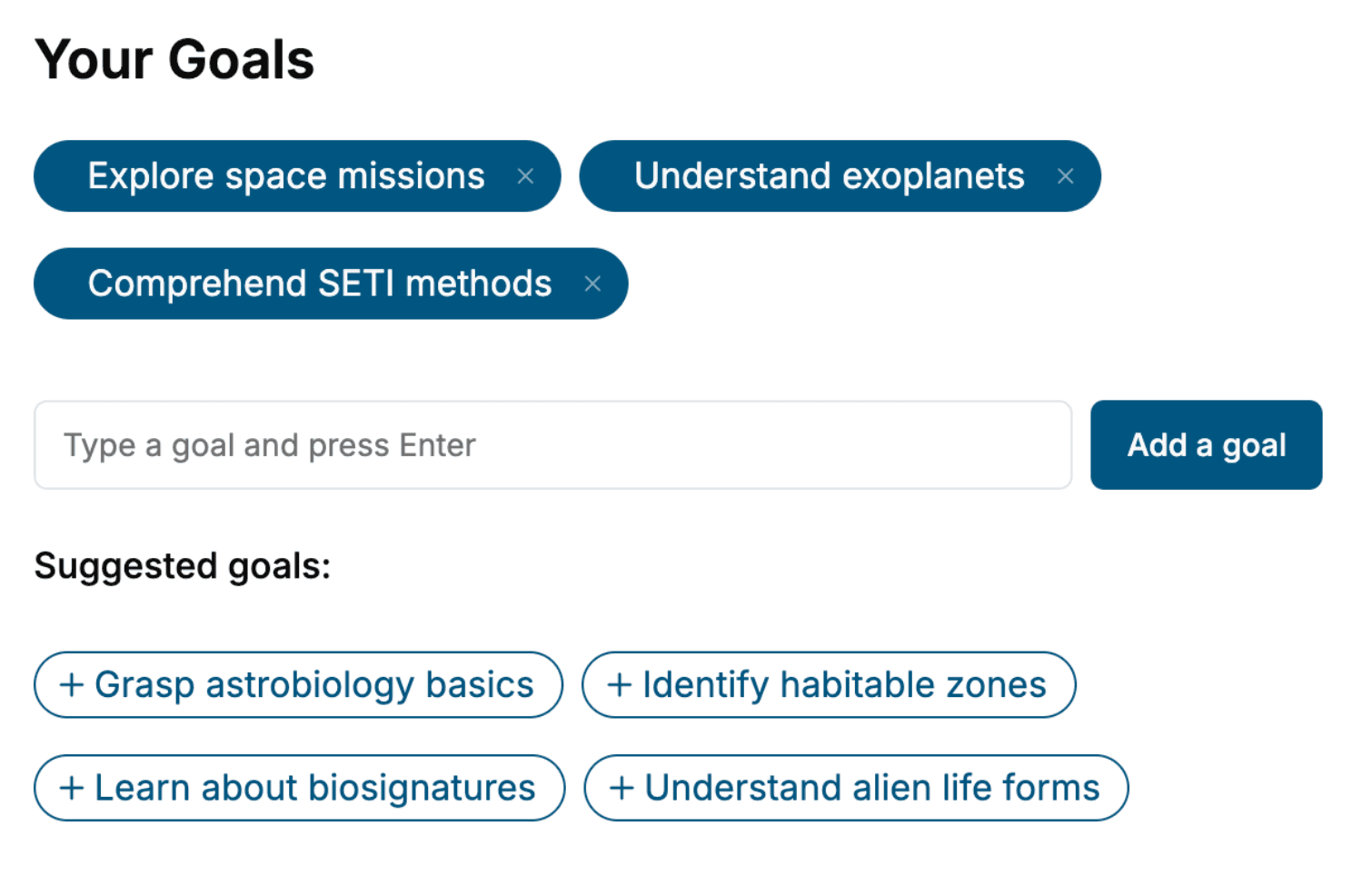
Specify your goals and choose sub-topics to include
- 3. Get your tailored book
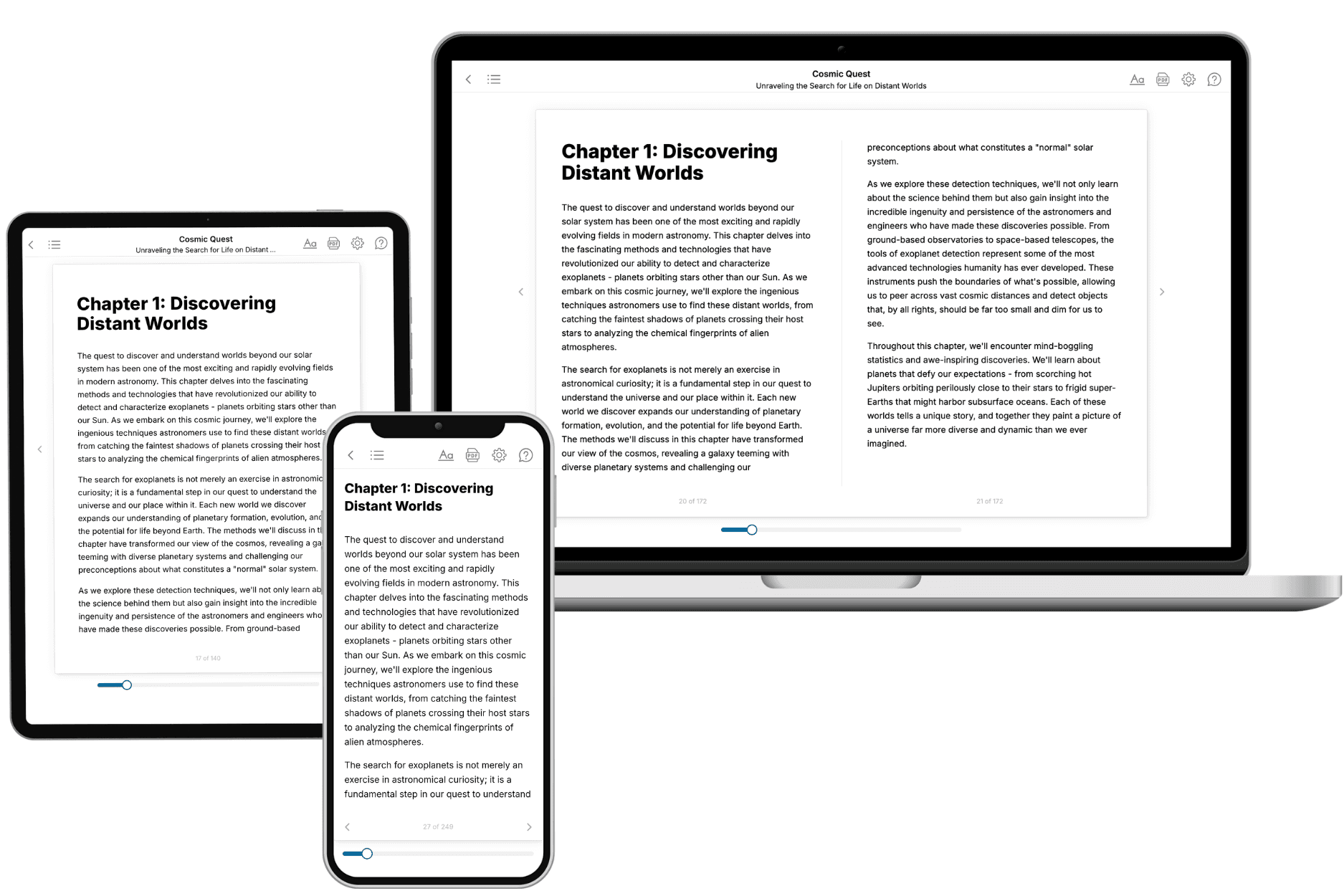
Your book is ready in 10 minutes. Read it online, download as EPUB or PDF, or send to Kindle.

Frequently asked questions
- What is TailoredRead?
TailoredRead creates complete, full-length nonfiction ebooks, written specifically for you. Tell us what you want to learn and why, and TailoredRead writes you a complete ebook on it, with charts, tables, and diagrams throughout. Read it online, on Kindle, or on any e-reader, or download it as a PDF or EPUB. Every book is written fresh the day you order it.
- How is the book tailored to me?
Before anything is written, you answer a few short questions about your goals, your background, and the topics you care about. Your book is then planned around your answers: written at your level, focused on your goals, and covering the topics you chose, instead of the one-size-fits-all book a store sells everyone.
- Will it read like generic AI content?
No. Your book isn't a chat transcript: it's planned chapter by chapter before a single word is written, told in a clear book voice, and explains ideas visually with charts, tables, and diagrams. After writing, every book goes through an editorial pass that polishes chapters so the book reads consistent from start to finish. Judge for yourself: browse thousands of sample books on our Explore Books page.
- How accurate is the content?
Our AI first checks whether your subject needs live research. Niche and fast-moving subjects are researched before writing, and the book plan and chapters are grounded in what it finds. After writing, every book goes through a quality pass that checks its facts and consistency, and researched books list their sources in a Notes section at the back.
- How long is the book?
You choose the length: Comprehensive (250-300 pages), Detailed (150-200 pages), Essential (70-100 pages), or Short (30-50 pages).
- Does the book include visuals?
Yes. Every book includes charts, tables, and diagrams: timelines, checklists, step-by-step guides, decision trees, comparison tables, matrices, and bar charts. A typical book includes dozens of these visual elements.
- Can I read it on Kindle? What formats can I download?
Yes. Every book can be read in our online reader or downloaded as a PDF or EPUB. The EPUB can be opened with Kindle, Apple Books, Kobo, and any e-reader. The Commercial and Author licenses also include an editable Word (DOCX) and Markdown download.
- How much does it cost?
About the price of a regular ebook. The exact price depends on your book's length and complexity, from $2 for the shortest books to $35 for the most comprehensive, and it's shown when you review your book, before you commit to anything. Each book is a one-time purchase, yours to keep, no subscription. Licenses that let you share, teach, or publish your book range from $35.99 to $49.99.
- Can I preview the book before purchasing?
Before you pay, you'll see what your book will cover: the title, a detailed description, the estimated length, and the complete chapter-by-chapter table of contents, so you know what you're getting before you decide. The full text itself is written after you purchase.
- How long does it take to create a book?
About 10 minutes. You can start reading the opening chapters while the rest is still being written.