Mastering Queuing Theory
From Fundamentals to Advanced Applications in System Optimization
Level up your analytical skills and become a master of system optimization with "Mastering Queuing Theory." This comprehensive guide takes you on a deep dive into the world of queues, offering practical insights and powerful techniques to revolutionize your approach to process management.
284 pages14 chaptersDec 30, 2024Mathematics
About this book
You'll gain a solid foundation in queuing theory fundamentals before exploring advanced concepts and real-world applications. Through clear explanations, illustrative examples, and hands-on exercises, you'll develop the skills to model, analyze, and optimize complex systems across various industries. Whether you're a professional seeking to enhance operational efficiency or a student aiming to excel in your studies, this book equips you with the tools to tackle challenging queuing problems with confidence. By the end, you'll possess the expertise to make data-driven decisions, improve service quality, and drive performance in any system involving waiting lines and resource allocation.
Table of contents
- IntroductionOverview of Queuing Theory, Importance and Applications, Structure of the Book, Prerequisites and Mathematical BackgroundRead below
- Chapter 1: Fundamentals of Queuing SystemsComponents of a Queuing System, Arrival Processes, Service Processes, Queue Disciplines
- Chapter 2: Probability Theory ReviewRandom Variables and Distributions, Expectation and Variance, The Poisson Process, The Exponential Distribution
- Chapter 3: Markov Chains in Queuing TheoryBasics of Markov Chains, Transition Probabilities, Steady-State Distributions, Birth-Death Processes
- Chapter 4: Little's Law and Fundamental RelationshipsExplanation of Little's Law, Applications of Little's Law, Related Formulas and Relationships, Examples and Exercises
- Chapter 5: The M/M/1 QueueCharacteristics of M/M/1 Queues, Steady-State Probabilities, Performance Measures, Variations of the M/M/1 Queue
- Chapter 6: Multi-Server Queuing SystemsThe M/M/c Queue, Erlang C Formula, Performance Measures for Multi-Server Systems, Determining the Optimal Number of Servers
- Chapter 7: Finite Capacity QueuesThe M/M/c/K Model, Blocking Probability, Finite Source Queues, Capacity Planning with Finite Queues
- Chapter 8: Priority QueuesTypes of Priority Disciplines, Preemptive Priority Queues, Non-Preemptive Priority Queues, Performance Analysis of Priority Queues
- Chapter 9: Bulk QueuesBulk Arrival Processes, Bulk Service Processes, Models for Bulk Queues, Applications of Bulk Queuing Systems
- Chapter 10: Queuing NetworksOpen Queuing Networks, Closed Queuing Networks, Jackson Networks, Performance Analysis of Queuing Networks
- Chapter 11: Optimization in Queuing SystemsCost Models in Queuing Systems, Determining Optimal Service Rates, Optimizing Staffing Levels, Queue Design and Layout Optimization
- Chapter 12: Simulation of Queuing SystemsBasics of Discrete Event Simulation, Random Number Generation, Queuing Simulation Software, Analysis of Simulation Results
- Chapter 13: Real-World Applications of Queuing TheoryCall Center Management, Manufacturing and Production Systems, Healthcare Systems, Computer Networks and Telecommunications, Transportation and Logistics
- Chapter 14: Advanced Topics in Queuing TheoryNon-Stationary Queues, Retrial Queues, Vacation Models, Fluid Approximations, Heavy Traffic Approximations
- ConclusionSummary of Key Concepts, Future Directions in Queuing Theory, Final Thoughts and Recommendations
- Glossary
- Further Reading
Introduction
Welcome to the fascinating world of Queuing Theory, a powerful analytical framework that has revolutionized our understanding of waiting lines and service systems. As you embark on this journey through "Mastering Queuing Theory: From Fundamentals to Advanced Applications in System Optimization," you are about to discover a set of tools and concepts that will transform the way you perceive and analyze the systems around you. Whether you're a professional seeking to enhance operational efficiency or a student aiming to excel in your studies, this book will equip you with the knowledge and skills to tackle complex queuing problems with confidence and precision.
In our daily lives, we encounter queues in various forms - from waiting in line at a coffee shop to experiencing delays in computer networks. These seemingly mundane experiences are governed by intricate mathematical principles that, when understood and applied correctly, can lead to significant improvements in service quality, resource allocation, and overall system performance. Queuing Theory provides the analytical framework to model, analyze, and optimize these waiting line systems, offering insights that can drive data-driven decision-making across a wide range of industries and applications.
Throughout this book, you will develop a comprehensive understanding of Queuing Theory, starting from its fundamental concepts and progressing to advanced techniques and real-world applications. By the end of your journey, you will possess the expertise to model complex systems, evaluate performance metrics, and implement strategies to optimize queuing processes. This introduction chapter will set the stage for your learning adventure, providing an overview of Queuing Theory, highlighting its importance and applications, outlining the structure of the book, and reviewing the prerequisites needed to make the most of this educational experience.
Overview of Queuing Theory
Queuing Theory, at its core, is a branch of mathematics that deals with the analysis of waiting lines. It provides a set of analytical tools and probabilistic methods to model and evaluate the performance of systems where demands for service fluctuate and the capacity to provide that service is limited. The origins of Queuing Theory can be traced back to the early 20th century when A.K. Erlang, a Danish engineer, developed models to describe the Copenhagen telephone exchange[1]. Since then, the field has grown exponentially, finding applications in diverse areas such as telecommunications, computer science, manufacturing, healthcare, and transportation.
At the heart of Queuing Theory lies the concept of a queuing system, which typically consists of four main components: the arrival process, the service mechanism, the queue discipline, and the system capacity. The arrival process describes how customers or jobs enter the system, often characterized by statistical distributions such as the Poisson process. The service mechanism defines how these customers are processed, including the number of servers and the distribution of service times. The queue discipline determines the order in which customers are served, with common examples being First-Come-First-Served (FCFS) or priority-based systems. Finally, the system capacity may be finite or infinite, depending on whether there's a limit to the number of customers that can be in the system at any given time.
One of the fundamental relationships in Queuing Theory is Little's Law, which provides a simple yet powerful connection between the average number of customers in a system (L), the average arrival rate (λ), and the average time spent in the system (W). Expressed mathematically as L = λW, this law holds true for a wide range of queuing systems under steady-state conditions and serves as a cornerstone for many queuing analyses[2].
Queuing Theory employs various mathematical techniques to analyze and predict system behavior. Markov chains, for instance, are extensively used to model the state transitions in queuing systems, particularly for systems with memoryless properties. Probability theory and stochastic processes form the foundation for deriving steady-state probabilities and performance measures such as average queue length, waiting time, and system utilization. As systems become more complex, techniques like queuing networks and simulation methods come into play, allowing for the analysis of interconnected queues and systems that defy simple analytical solutions.
One of the strengths of Queuing Theory lies in its ability to provide quantitative insights into system performance under various conditions. By manipulating parameters such as arrival rates, service rates, or the number of servers, analysts can predict how changes will affect key performance metrics. This predictive power makes Queuing Theory an invaluable tool for system design, capacity planning, and performance optimization across a wide range of applications.
As you delve deeper into this book, you will encounter various queuing models, each with its own notation and characteristics. The Kendall notation, for example, provides a standardized way to describe queuing systems using a series of letters and numbers. An M/M/1 queue, for instance, represents a system with Markovian (exponential) arrival and service times, and a single server. Understanding these models and their properties will be crucial in applying Queuing Theory to real-world scenarios.
It's important to note that while Queuing Theory provides powerful analytical tools, it also has limitations. Many real-world systems are too complex to be fully captured by analytical models alone. In such cases, simulation techniques often complement theoretical approaches, allowing for the study of more intricate scenarios and providing insights where closed-form solutions are not available. As you progress through this book, you'll learn to navigate these challenges and develop a nuanced understanding of when and how to apply different queuing analysis techniques.
In the following sections, we will explore the importance and wide-ranging applications of Queuing Theory, providing you with a glimpse of the practical impact this field has across various industries and disciplines. This overview sets the stage for the in-depth exploration of queuing concepts, techniques, and applications that will follow throughout the book, equipping you with the knowledge and skills to become a proficient practitioner of Queuing Theory.
Importance and Applications
The importance of Queuing Theory in today's world cannot be overstated. As systems become increasingly complex and interconnected, the ability to analyze and optimize waiting lines and service processes has become crucial across a wide range of industries and applications. Queuing Theory provides a systematic approach to understanding and improving these systems, offering insights that can lead to significant enhancements in efficiency, customer satisfaction, and resource utilization. In this section, we'll explore the importance of Queuing Theory and delve into some of its key applications, demonstrating why mastering this field is invaluable for professionals and researchers alike.
One of the primary reasons Queuing Theory is so important is its ability to balance two often conflicting objectives: minimizing waiting times and maximizing resource utilization. In many service systems, there's a trade-off between these goals. Increasing service capacity can reduce waiting times but may lead to underutilized resources and higher costs. Conversely, maximizing resource utilization can result in longer queues and dissatisfied customers. Queuing Theory provides the analytical tools to find the optimal balance, allowing decision-makers to make informed choices about system design and resource allocation[3].
The applications of Queuing Theory span a diverse range of fields, each benefiting from its analytical power in unique ways. In telecommunications and computer networks, Queuing Theory plays a crucial role in modeling data packet transmission, buffer management, and network congestion control. For instance, the design of routers and switches relies heavily on queuing models to ensure efficient data flow and minimize packet loss. In the era of cloud computing and big data, understanding how to manage queues of data requests and optimize server allocation has become increasingly important for maintaining high-performance computing environments.
In the manufacturing sector, Queuing Theory is instrumental in optimizing production lines and managing inventory. By modeling the flow of materials and products through various stages of production, managers can identify bottlenecks, determine optimal buffer sizes, and improve overall throughput. Just-In-Time (JIT) manufacturing systems, which aim to minimize inventory and reduce waste, rely on queuing principles to ensure smooth production flow and timely delivery of components. The application of Queuing Theory in this context has led to significant improvements in manufacturing efficiency and cost reduction across industries.
Healthcare systems represent another critical area where Queuing Theory has made substantial contributions. In hospitals and clinics, patient flow management is a complex challenge that directly impacts patient care quality and operational efficiency. Queuing models are used to analyze and optimize emergency department operations, appointment scheduling systems, and resource allocation in various hospital departments. By applying Queuing Theory, healthcare providers can reduce patient waiting times, improve staff utilization, and ultimately enhance the quality of care provided. For example, a study using queuing models to optimize bed allocation in a hospital led to a 50% reduction in emergency department boarding times[4].
In the realm of customer service, Queuing Theory is fundamental to the design and management of call centers and customer support systems. By analyzing arrival patterns, service times, and abandonment rates, companies can determine optimal staffing levels, predict peak demand periods, and implement strategies to minimize customer wait times while maintaining cost-effectiveness. The insights provided by queuing models have led to the development of sophisticated workforce management systems and call routing algorithms that significantly improve customer satisfaction and operational efficiency.
Transportation and logistics systems heavily rely on Queuing Theory for optimizing various processes. In airports, queuing models are used to manage check-in counters, security checkpoints, and runway operations. Traffic flow on highways and in urban areas can be analyzed using queuing principles to optimize traffic light timing and reduce congestion. In logistics, Queuing Theory helps in designing efficient warehouse operations, optimizing shipping and receiving processes, and managing supply chain dynamics.
The financial sector also benefits from the application of Queuing Theory. In banking, queuing models are used to optimize teller staffing, ATM placement, and online transaction processing. In financial markets, high-frequency trading systems employ queuing principles to manage order flows and minimize latency. Risk management strategies in insurance and finance often incorporate queuing models to analyze claim processes and manage financial reserves.
Beyond these specific applications, Queuing Theory provides a framework for understanding and improving any system where resources are shared among competing demands. This broad applicability makes it a valuable tool in fields as diverse as environmental management (e.g., modeling pollution control systems), public policy (e.g., analyzing social service delivery), and even in the design of computer algorithms (e.g., optimizing task scheduling in operating systems).
The importance of Queuing Theory is further underscored by its role in driving innovation and technological advancement. As systems become more complex and data-driven, the ability to model and analyze queuing phenomena becomes increasingly critical. Emerging technologies such as Internet of Things (IoT) devices, autonomous vehicles, and smart cities all rely on efficient queue management to function effectively. Understanding Queuing Theory is essential for designing and optimizing these next-generation systems.
Moreover, the principles of Queuing Theory extend beyond traditional applications, finding relevance in addressing global challenges. For instance, in the context of climate change, queuing models can be applied to optimize renewable energy systems, managing the intermittent nature of solar and wind power generation. In disaster response and emergency management, Queuing Theory helps in planning resource allocation and prioritizing aid distribution.
As you progress through this book, you'll gain a deeper appreciation for the versatility and power of Queuing Theory. The concepts and techniques you'll learn will equip you with the tools to analyze and optimize a wide range of systems, making you a valuable asset in any field that deals with resource allocation, process optimization, or system design. The ability to apply Queuing Theory effectively can lead to significant improvements in efficiency, cost reduction, and customer satisfaction, making it an essential skill in today's data-driven, efficiency-focused world.
Structure of the Book
"Mastering Queuing Theory: From Fundamentals to Advanced Applications in System Optimization" is structured to provide a comprehensive and logical progression through the field of Queuing Theory. The book is designed to cater to readers with varying levels of expertise, from those new to the subject to professionals looking to deepen their understanding and application skills. Each chapter builds upon the knowledge gained in previous sections, gradually introducing more complex concepts and techniques. This structure ensures that you develop a solid foundation before tackling advanced topics, allowing for a thorough and practical understanding of Queuing Theory.
The book begins with this introduction, which you are currently reading, providing an overview of Queuing Theory, its importance, and applications. This chapter sets the stage for your learning journey, offering a glimpse into the power and versatility of queuing analysis. Following this introduction, the book is organized into several key sections, each focusing on specific aspects of Queuing Theory and its applications.
Chapter 1, "Fundamentals of Queuing Systems," lays the groundwork for your understanding of Queuing Theory. This chapter introduces the basic components of a queuing system, including arrival processes, service mechanisms, queue disciplines, and system capacity. You'll learn about the terminology and concepts that form the building blocks of queuing analysis, providing a solid foundation for the more advanced topics to come.
Chapter 2, "Probability Theory Review," offers a refresher on essential probability concepts that are crucial for understanding and applying Queuing Theory. This chapter covers topics such as random variables, probability distributions, expectation, and variance. Special attention is given to the Poisson process and the exponential distribution, which play central roles in many queuing models. This review ensures that all readers have the necessary mathematical background to engage with the material effectively.
In Chapter 3, "Markov Chains in Queuing Theory," you'll delve into the powerful analytical tool of Markov chains and their application to queuing systems. This chapter covers the basics of Markov chains, transition probabilities, steady-state distributions, and birth-death processes. Understanding Markov chains is crucial for analyzing many queuing systems, particularly those with memoryless properties.
Chapter 4 focuses on "Little's Law and Fundamental Relationships," introducing you to one of the most important principles in Queuing Theory. You'll learn about Little's Law, its applications, and related formulas that provide insights into the relationships between key system parameters. This chapter includes numerous examples and exercises to reinforce your understanding of these fundamental concepts.
Chapters 5 through 9 explore specific queuing models in depth, starting with the basic M/M/1 queue and progressing to more complex systems. These chapters cover multi-server queues, finite capacity queues, priority queues, and bulk queues. Each chapter provides detailed analysis of the model's characteristics, steady-state probabilities, and performance measures, along with variations and practical applications.
Chapter 10, "Queuing Networks," extends your knowledge to systems of interconnected queues. You'll learn about open and closed queuing networks, Jackson networks, and techniques for analyzing the performance of these complex systems. This chapter is particularly relevant for understanding and optimizing large-scale service systems and computer networks.
In Chapter 11, "Optimization in Queuing Systems," you'll explore techniques for improving system performance. This chapter covers cost models, methods for determining optimal service rates and staffing levels, and approaches to queue design and layout optimization. The skills learned in this chapter are directly applicable to real-world system improvement projects.
Chapter 12 introduces "Simulation of Queuing Systems," complementing the analytical methods covered in previous chapters. You'll learn about discrete event simulation techniques, random number generation, and the use of simulation software for queuing analysis. This chapter also covers the interpretation and analysis of simulation results, providing you with a powerful tool for studying complex systems that defy simple analytical solutions.
Chapter 13, "Real-World Applications of Queuing Theory," brings the theoretical concepts to life by exploring their practical implementation across various industries. This chapter covers applications in call center management, manufacturing and production systems, healthcare, computer networks, and transportation and logistics. Through case studies and examples, you'll gain insights into how Queuing Theory is applied to solve real-world problems and drive improvements in diverse fields.
The book concludes with Chapter 14, "Advanced Topics in Queuing Theory," which introduces you to cutting-edge areas of research and advanced techniques. Topics covered include non-stationary queues, retrial queues, vacation models, fluid approximations, and heavy traffic approximations. This chapter provides a glimpse into the frontiers of Queuing Theory and prepares you for further exploration and research in the field.
Throughout the book, you'll find numerous examples, case studies, and exercises that help reinforce the concepts and demonstrate their practical application. Code snippets and computational examples are provided where relevant, allowing you to implement and experiment with the techniques you're learning. The book also includes a comprehensive glossary of terms and a section on further reading, providing resources for continued learning and exploration of specific topics in greater depth.
This structured approach ensures that by the end of the book, you'll have a comprehensive understanding of Queuing Theory, from its fundamental principles to advanced applications. You'll be equipped with the analytical tools and practical knowledge to model, analyze, and optimize a wide range of queuing systems, making you well-prepared to tackle complex challenges in your professional or academic pursuits.
Prerequisites and Mathematical Background
While "Mastering Queuing Theory" is designed to be accessible to a wide range of readers, having a solid foundation in certain mathematical concepts will greatly enhance your ability to understand and apply the principles of Queuing Theory. This section outlines the key prerequisites and mathematical background that will be beneficial as you work through the book. Don't worry if you feel rusty in some of these areas – the book includes reviews and explanations of essential concepts, and you can always refer back to this section or seek additional resources if needed.
First and foremost, a strong grasp of basic probability theory is essential for understanding Queuing Theory. You should be comfortable with concepts such as probability distributions, expected values, and variance. Familiarity with common probability distributions, particularly the Poisson distribution and the exponential distribution, is crucial as these play a central role in many queuing models. If you need a refresher on these topics, Chapter 2 provides a comprehensive review of the necessary probability concepts.
A solid foundation in calculus is also important for deriving and understanding many of the formulas and relationships in Queuing Theory. You should be comfortable with concepts such as limits, derivatives, and integrals. In particular, the ability to work with exponential and logarithmic functions is crucial, as these appear frequently in queuing analyses. While the book doesn't delve into complex calculus proofs, a basic understanding will help you grasp the derivations and intuitions behind key formulas.
Linear algebra, while not as central as probability and calculus, is useful for understanding certain aspects of Queuing Theory, particularly when dealing with Markov chains and matrix representations of queuing systems. Familiarity with concepts such as vectors, matrices, and eigenvalues can be helpful, especially in more advanced topics. However, the book provides explanations of these concepts where they are used, so a deep background in linear algebra is not strictly necessary.
Basic statistics knowledge is also beneficial, particularly in understanding performance measures and analyzing simulation results. Concepts such as mean, median, standard deviation, and confidence intervals are used throughout the book. If you're comfortable with descriptive statistics and have some exposure to inferential statistics, you'll be well-prepared for these aspects of Queuing Theory.
In terms of computer skills, while not strictly necessary for understanding the theoretical concepts, some programming experience can be very helpful for implementing and experimenting with queuing models. The book includes examples and exercises that can be implemented in various programming languages. Familiarity with a language such as Python, R, or MATLAB can be advantageous, particularly when working with simulations or analyzing large datasets. However, the book's core content is accessible even without programming skills.
A background in operations research or industrial engineering can provide helpful context for Queuing Theory, as these fields often apply queuing principles to real-world problems. However, this background is not a prerequisite, and the book is designed to be self-contained, providing all necessary context and explanations.
For those coming from specific professional backgrounds, certain domain knowledge can enhance your appreciation and application of Queuing Theory:
- If you're in computer science or telecommunications, familiarity with network protocols and data transmission concepts can help you relate queuing principles to practical scenarios in these fields.
- For those in manufacturing or operations management, knowledge of production processes and inventory management can provide valuable context for applying Queuing Theory in these areas.
- Healthcare professionals will find that an understanding of patient flow and hospital operations enhances their ability to apply queuing concepts in medical settings.
- Those in finance or business may find that knowledge of customer service operations or financial transaction processing provides helpful background for certain applications of Queuing Theory.
It's important to note that while these prerequisites are helpful, the book is designed to be accessible to readers with varying levels of mathematical sophistication. Key concepts are explained thoroughly, and more complex ideas are introduced gradually. If you find certain sections challenging, don't be discouraged – practice with the provided examples and exercises, and consider seeking additional resources or discussions with peers to reinforce your understanding.
Remember, learning Queuing Theory is a journey, and this book is designed to guide you through it step by step. As you progress, you'll find that your mathematical intuition and problem-solving skills improve, allowing you to tackle increasingly complex queuing problems with confidence. The diverse applications and real-world examples provided throughout the book will help you connect abstract concepts to practical scenarios, making the learning process both engaging and rewarding.
If you feel you need additional preparation in any of these areas, consider reviewing relevant textbooks or online resources before diving into the more advanced chapters. Many universities also offer free online courses in probability, statistics, and basic programming that can be excellent resources for building or refreshing your skills.
With these prerequisites in mind, you're well-prepared to embark on your journey through the fascinating world of Queuing Theory. As you progress through the book, you'll find that your understanding of these foundational concepts deepens, and you'll develop the ability to apply them to increasingly complex and realistic scenarios. The knowledge and skills you gain will equip you to analyze and optimize a wide range of systems, making you a valuable asset in any field that deals with resource allocation, process optimization, or system design.
Notes
Introduction
- 1. A. K. Erlang, The theory of probabilities and telephone conversations, Nyt Tidsskrift for Matematik B, 1909
- 2. J. D. C. Little, "A Proof for the Queuing Formula," Operations Research, 1961
- 3. F. S. Hillier and G. J. Lieberman, Introduction to Operations Research (10th ed.), McGraw-Hill Education, 2015
- 4. L. V. Green and others, "Using Queueing Theory to Increase the Effectiveness of Emergency Department Provider Staffing," Academic Emergency Medicine, 2006
This is the end of the free sample. The full book has 14 chapters.
Want this book written for you?
Tell us your goals and background, and get your own version of this book, tailored by AI to you.


Benefits of AI-tailored books
- Read one book, not ten:
- all the Mathematics knowledge you need, gathered into a single book.
- Save days of learning:
- tell us your goals, choose your topics, and the whole book is built around them.
- Learn effortlessly:
- Mathematics book written for your specific background and expertise.
- Understand at a glance:
- includes charts, tables, timelines, checklists, decision trees, and more.
- Stay current:
- written the day you order it, not years ago.
- Trust what you read:
- every book is checked for accuracy, with real research when your subject needs it.
Create your unique book in 3 steps
- 1. Select your focus
Select the focus of your Mathematics book and share your background
- 2. Personalize your book
Specify your goals and choose sub-topics to include
- 3. Get your tailored book
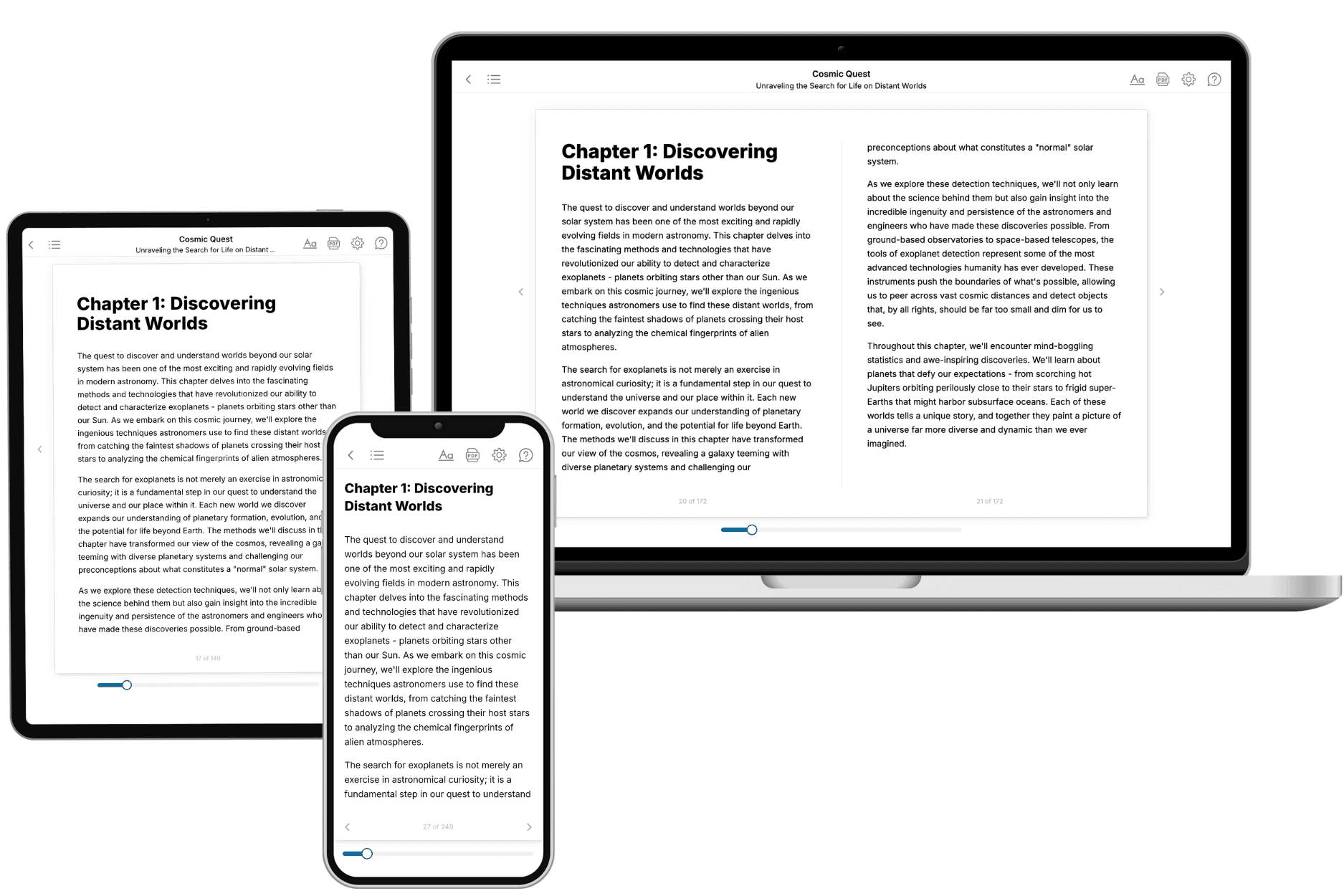
Your book is ready in 10 minutes. Read it online, download as EPUB or PDF, or send to Kindle.
Frequently asked questions
- What is TailoredRead?
TailoredRead creates complete, full-length nonfiction ebooks, written specifically for you. Tell us what you want to learn and why, and TailoredRead writes you a complete ebook on it, with charts, tables, and diagrams throughout. Read it online, on Kindle, or on any e-reader, or download it as a PDF or EPUB. Every book is written fresh the day you order it.
- How is the book tailored to me?
Before anything is written, you answer a few short questions about your goals, your background, and the topics you care about. Your book is then planned around your answers: written at your level, focused on your goals, and covering the topics you chose, instead of the one-size-fits-all book a store sells everyone.
- Will it read like generic AI content?
No. Your book isn't a chat transcript: it's planned chapter by chapter before a single word is written, told in a clear book voice, and explains ideas visually with charts, tables, and diagrams. After writing, every book goes through an editorial pass that polishes chapters so the book reads consistent from start to finish. Judge for yourself: browse thousands of sample books on our Explore Books page.
- How accurate is the content?
Our AI first checks whether your subject needs live research. Niche and fast-moving subjects are researched before writing, and the book plan and chapters are grounded in what it finds. After writing, every book goes through a quality pass that checks its facts and consistency, and researched books list their sources in a Notes section at the back.
- How long is the book?
You choose the length: Comprehensive (250-300 pages), Detailed (150-200 pages), Essential (70-100 pages), or Short (30-50 pages).
- Does the book include visuals?
Yes. Every book includes charts, tables, and diagrams: timelines, checklists, step-by-step guides, decision trees, comparison tables, matrices, and bar charts. A typical book includes dozens of these visual elements.
- Can I read it on Kindle? What formats can I download?
Yes. Every book can be read in our online reader or downloaded as a PDF or EPUB. The EPUB can be opened with Kindle, Apple Books, Kobo, and any e-reader. The Commercial and Author licenses also include an editable Word (DOCX) and Markdown download.
- How much does it cost?
About the price of a regular ebook. The exact price depends on your book's length and complexity, from $2 for the shortest books to $35 for the most comprehensive, and it's shown when you review your book, before you commit to anything. Each book is a one-time purchase, yours to keep, no subscription. Licenses that let you share, teach, or publish your book range from $35.99 to $49.99.
- Can I preview the book before purchasing?
Before you pay, you'll see what your book will cover: the title, a detailed description, the estimated length, and the complete chapter-by-chapter table of contents, so you know what you're getting before you decide. The full text itself is written after you purchase.
- How long does it take to create a book?
About 10 minutes. You can start reading the opening chapters while the rest is still being written.