Mastering Supervised Learning with Scikit-Learn
A Hands-On Guide to Object-Based Classification of RPAS Imagery
Achieve accurate object-based classification of RPAS imagery using supervised learning techniques with Scikit-Learn.
300 pages15 chaptersJul 29, 2025Machine Learning
About this book
This comprehensive guide takes you from the basics of machine learning to advanced model optimization and evaluation. You'll gain practical skills in building ML models, enhancing feature selection, and implementing cross-validation techniques. Through hands-on examples and real-world applications, you'll master the art of data visualization, explore ensemble methods like Random Forests, and dive deep into algorithms such as Support Vector Machines and Neural Networks. By the end of this book, you'll have the confidence to apply machine learning to real data, present your findings effectively, and tackle complex classification problems with ease. Whether you're looking to enhance your Python skills or seeking to apply cutting-edge ML techniques to imagery analysis, this book is your ultimate companion in the journey to becoming a proficient machine learning practitioner.
Table of contents
- IntroductionUnderstanding Supervised Learning, Introduction to Scikit-Learn, RPAS Imagery and Object-Based Classification, Book Overview and Learning PathRead below
- Chapter 1: Python Fundamentals for Machine LearningEssential Python Data Structures, NumPy: The Foundation of Scientific Computing, Data Manipulation with Pandas, Introduction to Data Visualization with Matplotlib
- Chapter 2: Machine Learning FundamentalsThe Machine Learning Workflow, Supervised vs. Unsupervised Learning, Classification and Regression Tasks, Training and Testing Data Sets, Model Evaluation Metrics
- Chapter 3: Getting Started with Scikit-LearnInstalling and Setting Up Scikit-Learn, Data Formats and Preprocessing in Scikit-Learn, Understanding Scikit-Learn Estimators, Model Selection and Evaluation Tools
- Chapter 4: Data Preprocessing and Feature EngineeringHandling Missing Data, Feature Scaling and Normalization, Encoding Categorical Variables, Feature Creation and Extraction, Dimensionality Reduction Techniques
- Chapter 5: Linear Models for ClassificationLogistic Regression, Linear Discriminant Analysis, The Perceptron Algorithm, Regularization in Linear Models
- Chapter 6: Decision Trees and Random ForestsUnderstanding Decision Trees, Implementing Decision Trees in Scikit-Learn, Introduction to Random Forests, Tuning Random Forest Models, Feature Importance in Tree-Based Models
- Chapter 7: Support Vector MachinesTheory Behind Support Vector Machines, Linear SVM Classification, Non-linear SVM and Kernel Tricks, SVM Parameter Tuning
- Chapter 8: Neural Networks with Scikit-LearnBasic Concepts of Neural Networks, Multi-layer Perceptron Classifier, Designing Neural Network Architecture, Training and Optimizing Neural Networks
- Chapter 9: Ensemble MethodsBagging and Pasting, Advanced Random Forests Techniques, Boosting Algorithms, Voting Classifiers
- Chapter 10: Model Selection and EvaluationCross-Validation Techniques, Grid Search for Hyperparameter Tuning, Randomized Search for Large Parameter Spaces, Learning Curves and Validation Curves, Comparing Different Models
- Chapter 11: Feature Selection TechniquesFilter Methods for Feature Selection, Wrapper Methods for Feature Selection, Embedded Methods for Feature Selection, Incorporating Feature Selection in Scikit-Learn Pipelines
- Chapter 12: Image Classification with Scikit-LearnPreprocessing Image Data for ML, Feature Extraction from Images, Applying Classification Models to Images, Transfer Learning for Image Classification
- Chapter 13: Object-Based Classification of RPAS ImageryPreparing RPAS Imagery Data, Extracting Object-Based Features, Building a Classification Workflow, Evaluating Classification Results, Strategies for Improving Classification Accuracy
- Chapter 14: Advanced Techniques and Best PracticesHandling Imbalanced Datasets, Advanced Feature Engineering, Ensemble Stacking, Model Interpretability Techniques
- Chapter 15: Visualization and ReportingAdvanced Matplotlib Techniques, Statistical Data Visualization with Seaborn, Interactive Visualizations with Plotly, Creating Effective Machine Learning Reports
- Conclusion
- Appendix
- Glossary
Introduction
Welcome to "Mastering Supervised Learning with Scikit-Learn: A Hands-On Guide to Object-Based Classification of RPAS Imagery." This comprehensive guide is designed to equip you with the practical skills and knowledge necessary to harness the power of supervised learning using Scikit-Learn, with a specific focus on object-based classification of Remotely Piloted Aircraft Systems (RPAS) imagery. As a graduate student in Applied Science with a basic understanding of machine learning, you are about to embark on an exciting journey that will enhance your skills and open up new possibilities in the field of image classification and analysis.
In today's rapidly evolving technological landscape, the ability to extract meaningful information from complex data sets is becoming increasingly crucial. RPAS, also known as drones, have revolutionized the way we capture and analyze aerial imagery across various domains, including agriculture, environmental monitoring, urban planning, and disaster response. The high-resolution imagery obtained from RPAS provides a wealth of information, but the challenge lies in efficiently and accurately processing this data to derive actionable insights. This is where supervised learning techniques, particularly those implemented using Scikit-Learn, come into play.
Throughout this book, you will discover how supervised learning algorithms can be leveraged to perform object-based classification on RPAS imagery, enabling you to identify and categorize various features within the landscape with remarkable accuracy. From understanding the fundamental concepts of machine learning to implementing advanced algorithms and optimizing model performance, this guide will take you through each step of the process, providing you with the tools and knowledge to tackle real-world classification problems confidently.
As we delve into the world of supervised learning and Scikit-Learn, you will gain hands-on experience with a wide range of techniques and methodologies. You'll learn how to preprocess and prepare your data, select and engineer relevant features, implement various classification algorithms, and evaluate and fine-tune your models for optimal performance. By the end of this journey, you will have developed a robust skill set that will enable you to apply machine learning techniques to complex imagery analysis tasks and present your findings effectively.
Let's begin our exploration of supervised learning and its applications in object-based classification of RPAS imagery by diving into the key concepts and tools that will form the foundation of our learning journey.
Understanding Supervised Learning
Supervised learning is a fundamental paradigm in machine learning that forms the backbone of many powerful classification and regression algorithms. At its core, supervised learning is about teaching a computer to make predictions or decisions based on labeled examples. This approach mimics the way humans learn from experience and guidance, making it an intuitive and effective method for tackling a wide range of real-world problems.
In the context of supervised learning, we start with a dataset consisting of input features and their corresponding output labels. These labeled examples serve as the "training data" from which the algorithm learns patterns and relationships. The goal is to develop a model that can accurately predict the labels for new, unseen data points. This process can be likened to a student learning from a teacher who provides examples and correct answers, allowing the student to recognize patterns and apply this knowledge to solve new problems.
There are two main types of supervised learning tasks: classification and regression. Classification involves predicting a discrete category or class label, such as determining whether an image contains a car, a pedestrian, or a building. Regression, on the other hand, aims to predict a continuous numerical value, such as estimating the height of a tree or the biomass of a crop field. In the context of RPAS imagery classification, we will primarily focus on classification tasks, as our goal is to categorize different objects and features within the imagery.
One of the key strengths of supervised learning is its ability to generalize from the training data to make accurate predictions on new, unseen data. This generalization capability is what makes supervised learning algorithms so powerful and widely applicable across various domains. However, achieving good generalization requires careful consideration of several factors, including the quality and quantity of training data, the selection of appropriate features, and the choice of algorithm and its hyperparameters.
The supervised learning process typically involves several stages:
- Data Collection and Preparation: Gathering a representative dataset and preprocessing it to ensure quality and consistency.
- Feature Selection and Engineering: Identifying and creating relevant features that capture the essential characteristics of the data.
- Model Selection: Choosing an appropriate algorithm based on the nature of the problem and the available data.
- Training: Feeding the labeled data into the chosen algorithm to learn the underlying patterns.
- Evaluation: Assessing the model's performance using various metrics and techniques such as cross-validation.
- Tuning: Adjusting the model's hyperparameters to optimize its performance.
- Prediction: Using the trained model to make predictions on new, unseen data.
In the realm of RPAS imagery classification, supervised learning offers numerous advantages. It allows us to automate the process of identifying and categorizing objects within complex aerial images, a task that would be time-consuming and error-prone if done manually. By leveraging the power of machine learning algorithms, we can quickly analyze large volumes of imagery data, extract meaningful information, and make informed decisions based on the results.
Moreover, supervised learning algorithms can often uncover subtle patterns and relationships in the data that might not be immediately apparent to human observers. This can lead to more accurate and consistent classifications, especially when dealing with large-scale datasets or when trying to distinguish between similar object classes.
As we progress through this book, you will gain a deep understanding of how to apply supervised learning techniques to RPAS imagery classification using Scikit-Learn. You'll learn about various algorithms, from simple linear models to complex ensemble methods, and understand their strengths and limitations. You'll also discover how to overcome common challenges in supervised learning, such as overfitting, class imbalance, and feature selection, ensuring that your models are robust and reliable.
By mastering supervised learning techniques, you'll be well-equipped to tackle a wide range of classification problems beyond RPAS imagery. The skills and knowledge you gain will be transferable to many other domains, opening up exciting opportunities in fields such as computer vision, remote sensing, and data science.
As we embark on this learning journey, remember that supervised learning is not just about implementing algorithms, but also about developing a deep understanding of the underlying principles and best practices. This understanding will enable you to approach new problems creatively, select the most appropriate techniques, and continuously improve your models as you gain more experience and encounter new challenges.
Introduction to Scikit-Learn
Scikit-Learn, often stylized as sklearn, is a powerful and widely-used machine learning library for Python. It provides a comprehensive set of tools for data mining and data analysis, with a particular focus on machine learning tasks. Developed by a community of contributors and maintained under the umbrella of the SciPy (Scientific Python) project, Scikit-Learn has become an indispensable tool for data scientists, researchers, and machine learning practitioners around the world.
The popularity of Scikit-Learn can be attributed to several key factors. First and foremost is its user-friendly and consistent API (Application Programming Interface). Scikit-Learn follows a simple and intuitive design philosophy that makes it accessible to beginners while still providing the flexibility and power required by experienced practitioners. This consistency across different algorithms and tools within the library significantly reduces the learning curve and allows users to quickly experiment with various machine learning techniques.
Another major advantage of Scikit-Learn is its extensive documentation and vibrant community support. The library's official documentation is comprehensive, well-organized, and filled with examples and tutorials. This wealth of resources, combined with the active community forums and extensive third-party tutorials, makes it easier for users to find solutions to their problems and stay updated with the latest best practices in machine learning.
Scikit-Learn is built on top of other popular scientific computing libraries in Python, namely NumPy, SciPy, and Matplotlib. This integration allows for seamless interoperability with these libraries, enabling efficient numerical computations and easy visualization of results. The library also plays well with other data manipulation tools like Pandas, making it an excellent choice for end-to-end machine learning workflows.
In the context of supervised learning and RPAS imagery classification, Scikit-Learn offers a wide array of tools and algorithms that we will explore throughout this book. Some of the key features and modules that are particularly relevant to our focus include:
- Classification algorithms: From simple linear classifiers to complex ensemble methods, Scikit-Learn provides implementations of numerous classification algorithms such as Logistic Regression, Support Vector Machines, Decision Trees, Random Forests, and Neural Networks.
- Preprocessing tools: The library offers various tools for data preprocessing, including scaling, normalization, encoding categorical variables, and handling missing data.
- Feature selection and dimensionality reduction: Scikit-Learn provides methods for selecting the most relevant features and reducing the dimensionality of the data, which is crucial for working with high-dimensional imagery data.
- Model selection and evaluation: The library includes tools for cross-validation, grid search, and various performance metrics, enabling thorough evaluation and optimization of machine learning models.
- Pipeline construction: Scikit-Learn's Pipeline class allows for the creation of composite estimators, streamlining the process of chaining multiple processing steps and machine learning models.
One of the strengths of Scikit-Learn that we will leverage extensively in this book is its ability to handle large datasets efficiently. This is particularly important when working with RPAS imagery, which often involves processing and analyzing substantial volumes of high-resolution data. Scikit-Learn's implementations are optimized for performance, allowing us to train and evaluate models on large datasets without excessive computational overhead.
Moreover, Scikit-Learn's modular design facilitates easy experimentation with different algorithms and preprocessing techniques. This flexibility is invaluable when tackling complex classification problems, as it allows us to quickly iterate and compare various approaches to find the most effective solution for a given dataset.
As we progress through this book, you will gain hands-on experience with many of Scikit-Learn's features and capabilities. You'll learn how to load and preprocess RPAS imagery data, implement various classification algorithms, tune model parameters, and evaluate performance using Scikit-Learn's extensive toolkit. By the end of our journey, you'll be proficient in leveraging Scikit-Learn to build robust and accurate classification models for RPAS imagery and beyond.
It's worth noting that while Scikit-Learn is incredibly powerful and versatile, it is not the only tool available for machine learning tasks. Other libraries and frameworks, such as TensorFlow and PyTorch, offer more advanced capabilities, particularly in deep learning. However, Scikit-Learn's simplicity, extensive documentation, and wide range of classical machine learning algorithms make it an excellent choice for our focus on supervised learning and object-based classification of RPAS imagery.
As we delve deeper into Scikit-Learn throughout this book, you'll discover how its various components work together to create efficient and effective machine learning workflows. You'll also learn best practices for using Scikit-Learn, including how to avoid common pitfalls and how to optimize your code for better performance. By mastering Scikit-Learn, you'll not only be able to tackle the specific challenge of RPAS imagery classification but also gain a solid foundation in machine learning that you can apply to a wide range of other problems and domains.
RPAS Imagery and Object-Based Classification
Remotely Piloted Aircraft Systems (RPAS), commonly known as drones, have revolutionized the field of aerial imagery acquisition. These unmanned aerial vehicles equipped with high-resolution cameras and various sensors have opened up new possibilities in fields such as agriculture, environmental monitoring, urban planning, and disaster response. The ability to capture detailed, up-to-date imagery at a relatively low cost and with high flexibility has made RPAS an invaluable tool for a wide range of applications.
RPAS imagery offers several advantages over traditional satellite or manned aircraft imagery. First, it provides much higher spatial resolution, often in the range of centimeters, allowing for the detection and analysis of fine-scale features that might be missed in lower-resolution imagery. Second, RPAS can be deployed quickly and repeatedly, enabling frequent monitoring and the capture of temporal changes in the landscape. Third, RPAS can fly at lower altitudes and in more flexible patterns than traditional platforms, allowing for the collection of oblique imagery and 3D data through techniques like photogrammetry.
However, the high resolution and large volume of data generated by RPAS also present challenges in terms of data processing and analysis. This is where object-based classification comes into play. Object-based classification is an approach to image analysis that focuses on identifying and classifying meaningful objects or segments within an image, rather than working with individual pixels. This approach is particularly well-suited to high-resolution RPAS imagery for several reasons:
- Reduced salt-and-pepper effect: High-resolution imagery often suffers from the "salt-and-pepper" effect when classified on a pixel-by-pixel basis. Object-based classification reduces this noise by working with groups of similar pixels.
- Incorporation of spatial context: Objects in RPAS imagery often have distinct shapes, sizes, and spatial relationships. Object-based classification can take these characteristics into account, leading to more accurate and meaningful results.
- Efficiency: By working with objects rather than individual pixels, object-based classification can be more computationally efficient, especially when dealing with large volumes of high-resolution data.
- Multi-scale analysis: Object-based approaches allow for the analysis of features at multiple scales, which is often necessary when dealing with complex landscapes captured in RPAS imagery.
The process of object-based classification typically involves several steps:
- Segmentation: The image is divided into homogeneous segments or objects based on spectral and spatial characteristics.
- Feature extraction: Various features are calculated for each object, including spectral properties, shape, texture, and contextual relationships.
- Classification: Machine learning algorithms are applied to classify the objects based on their extracted features.
- Post-processing: The classification results are refined and validated, often incorporating additional data or expert knowledge.
In the context of supervised learning, which is the focus of this book, the classification step involves training a model on a set of labeled objects and then using that model to classify new, unseen objects. This approach allows us to leverage the power of machine learning algorithms to automatically identify and categorize features within RPAS imagery.
The applications of object-based classification of RPAS imagery are vast and diverse. In agriculture, it can be used to map crop types, assess plant health, and detect pest infestations. In urban planning, it can help identify building types, measure urban sprawl, and assess infrastructure conditions. In environmental monitoring, it can be used to track changes in vegetation cover, detect invasive species, and assess the impact of natural disasters.
However, applying supervised learning techniques to object-based classification of RPAS imagery also comes with its own set of challenges. These include:
- Data preparation: RPAS imagery often requires significant preprocessing, including radiometric and geometric corrections, to ensure consistency and accuracy.
- Feature selection: With the high dimensionality of RPAS data and the numerous features that can be extracted from objects, choosing the most relevant features for classification can be complex.
- Class imbalance: In many real-world scenarios, some classes of objects may be much more prevalent than others, leading to challenges in model training and evaluation.
- Spatial autocorrelation: Objects in close proximity often share similar characteristics, which can lead to overfitting if not properly accounted for in the model training process.
- Generalization: Models trained on one set of RPAS imagery may not always generalize well to imagery captured under different conditions or in different geographic areas.
Throughout this book, we will address these challenges and explore strategies for overcoming them using the tools and techniques provided by Scikit-Learn. You will learn how to effectively preprocess RPAS imagery data, select and engineer relevant features, implement various classification algorithms, and evaluate and optimize your models for robust performance.
By mastering the application of supervised learning techniques to object-based classification of RPAS imagery, you will be well-equipped to tackle a wide range of real-world problems in remote sensing and image analysis. The skills and knowledge you gain will be valuable not only in working with RPAS data but also in applying machine learning techniques to other types of geospatial and image data.
As we progress through the chapters of this book, we will build upon the foundational concepts introduced here, diving deeper into the specifics of working with RPAS imagery and applying advanced machine learning techniques to extract meaningful information from this rich data source. You will gain hands-on experience with real-world datasets and learn how to apply your skills to solve practical problems in various domains.
Book Overview and Learning Path
"Mastering Supervised Learning with Scikit-Learn: A Hands-On Guide to Object-Based Classification of RPAS Imagery" is designed to take you on a comprehensive journey through the world of supervised learning, with a specific focus on its application to RPAS imagery classification. This book is structured to provide a logical progression from foundational concepts to advanced techniques, ensuring that you build a solid understanding of both the theoretical principles and practical applications of supervised learning in the context of image classification.
The learning path outlined in this book is carefully crafted to cater to your background as a graduate student in Applied Science with a basic understanding of machine learning. We will build upon your existing knowledge, introducing new concepts and techniques in a gradual and intuitive manner. By the end of this book, you will have developed a comprehensive skill set that will enable you to confidently tackle complex classification problems using RPAS imagery.
Here's an overview of the journey that lies ahead:
- Python Fundamentals for Machine Learning: We'll start by ensuring you have a solid foundation in Python programming, focusing on the essential libraries and tools used in data science and machine learning.
- Machine Learning Fundamentals: You'll gain a deeper understanding of core machine learning concepts, including the supervised learning workflow, different types of learning tasks, and key considerations in model evaluation.
- Getting Started with Scikit-Learn: We'll introduce you to the Scikit-Learn library, its architecture, and basic usage patterns, setting the stage for more advanced applications.
- Data Preprocessing and Feature Engineering: You'll learn crucial techniques for preparing RPAS imagery data for machine learning, including handling missing data, feature scaling, and creating meaningful features from raw image data.
- Linear Models for Classification: We'll explore various linear classification algorithms, providing insights into their strengths, limitations, and applications in image classification tasks.
- Decision Trees and Random Forests: You'll delve into tree-based methods, learning how to implement and optimize these powerful algorithms for object-based classification.
- Support Vector Machines: We'll cover the theory and practical implementation of SVMs, a versatile algorithm well-suited for many image classification tasks.
- Neural Networks with Scikit-Learn: You'll gain hands-on experience with implementing and training neural networks using Scikit-Learn, understanding their potential in complex classification scenarios.
- Ensemble Methods: We'll explore advanced techniques for combining multiple models to improve classification accuracy and robustness.
- Model Selection and Evaluation: You'll learn strategies for choosing the best model for your specific classification task and rigorously evaluating its performance.
- Feature Selection Techniques: We'll dive deep into methods for identifying the most relevant features for your classification task, crucial for working with high-dimensional RPAS imagery data.
- Image Classification with Scikit-Learn: You'll apply the knowledge gained in previous chapters to tackle image classification tasks, learning techniques specific to working with image data.
- Object-Based Classification of RPAS Imagery: We'll bring everything together, focusing on the unique challenges and opportunities presented by RPAS imagery and object-based classification approaches.
- Advanced Techniques and Best Practices: You'll explore cutting-edge techniques and industry best practices for improving classification accuracy and handling real-world challenges.
- Visualization and Reporting: Finally, you'll learn how to effectively visualize and communicate your results, a crucial skill for any data scientist or machine learning practitioner.
Throughout this learning journey, you will be exposed to a blend of theoretical explanations and practical, hands-on exercises. Each chapter will include code examples, case studies, and challenges that will allow you to apply your learning to real-world scenarios. By working through these exercises, you'll not only gain proficiency in using Scikit-Learn for supervised learning tasks but also develop the problem-solving skills necessary to tackle novel classification problems.
One of the key features of this book is its focus on practical applications. While we will cover the theoretical foundations of various algorithms and techniques, our primary goal is to equip you with the skills to apply these concepts to real-world RPAS imagery classification tasks. You'll learn how to:
- Preprocess and prepare RPAS imagery data for machine learning
- Select and engineer relevant features for object-based classification
- Choose appropriate algorithms based on the characteristics of your data and classification task
- Implement and optimize various classification models using Scikit-Learn
- Evaluate model performance and interpret results in the context of RPAS imagery analysis
- Address common challenges in RPAS imagery classification, such as class imbalance and spatial autocorrelation
- Develop end-to-end workflows for object-based classification of RPAS imagery
As you progress through the book, you'll notice that each chapter builds upon the knowledge and skills developed in previous sections. This cumulative approach ensures that you develop a comprehensive understanding of supervised learning and its application to RPAS imagery classification. By the time you reach the later chapters, you'll be working with advanced techniques and tackling complex, real-world classification problems with confidence.
To get the most out of this book, we recommend following the chapters in order, as each builds upon the concepts introduced in the previous ones. However, if you're already familiar with certain topics, feel free to skip ahead or focus on the sections most relevant to your specific needs and interests. The hands-on exercises and code examples provided throughout the book are crucial for reinforcing your learning, so we encourage you to work through them diligently.
Remember that mastering supervised learning and RPAS imagery classification is an ongoing journey. While this book provides a comprehensive foundation, the field of machine learning is constantly evolving. We encourage you to continue exploring beyond the contents of this book, experimenting with new techniques, and staying updated with the latest developments in the field.
By the end of this book, you will have gained not only technical skills but also the confidence to approach complex classification problems systematically. You'll be equipped to select appropriate algorithms, preprocess data effectively, optimize model performance, and interpret results in meaningful ways. These skills will be valuable not only in working with RPAS imagery but also in applying machine learning techniques to a wide range of other data analysis and classification tasks.
So, let's embark on this exciting journey into the world of supervised learning and RPAS imagery classification. Whether you're looking to enhance your skills for academic research, prepare for a career in data science, or solve real-world problems in fields like remote sensing or environmental monitoring, this book will provide you with the knowledge and practical skills to achieve your goals. Get ready to unlock the power of machine learning and transform the way you analyze and interpret RPAS imagery!
This is the end of the free sample. The full book has 15 chapters.
Want this book written for you?
Tell us your goals and background, and get your own version of this book, tailored by AI to you.


Benefits of AI-tailored books
- Read one book, not ten:
- all the Machine Learning knowledge you need, gathered into a single book.
- Save days of learning:
- tell us your goals, choose your topics, and the whole book is built around them.
- Learn effortlessly:
- Machine Learning book written for your specific background and expertise.
- Understand at a glance:
- includes charts, tables, timelines, checklists, decision trees, and more.
- Stay current:
- written the day you order it, not years ago.
- Trust what you read:
- every book is checked for accuracy, with real research when your subject needs it.
Create your unique book in 3 steps
- 1. Select your focus
Select the focus of your Machine Learning book and share your background
- 2. Personalize your book
Specify your goals and choose sub-topics to include
- 3. Get your tailored book
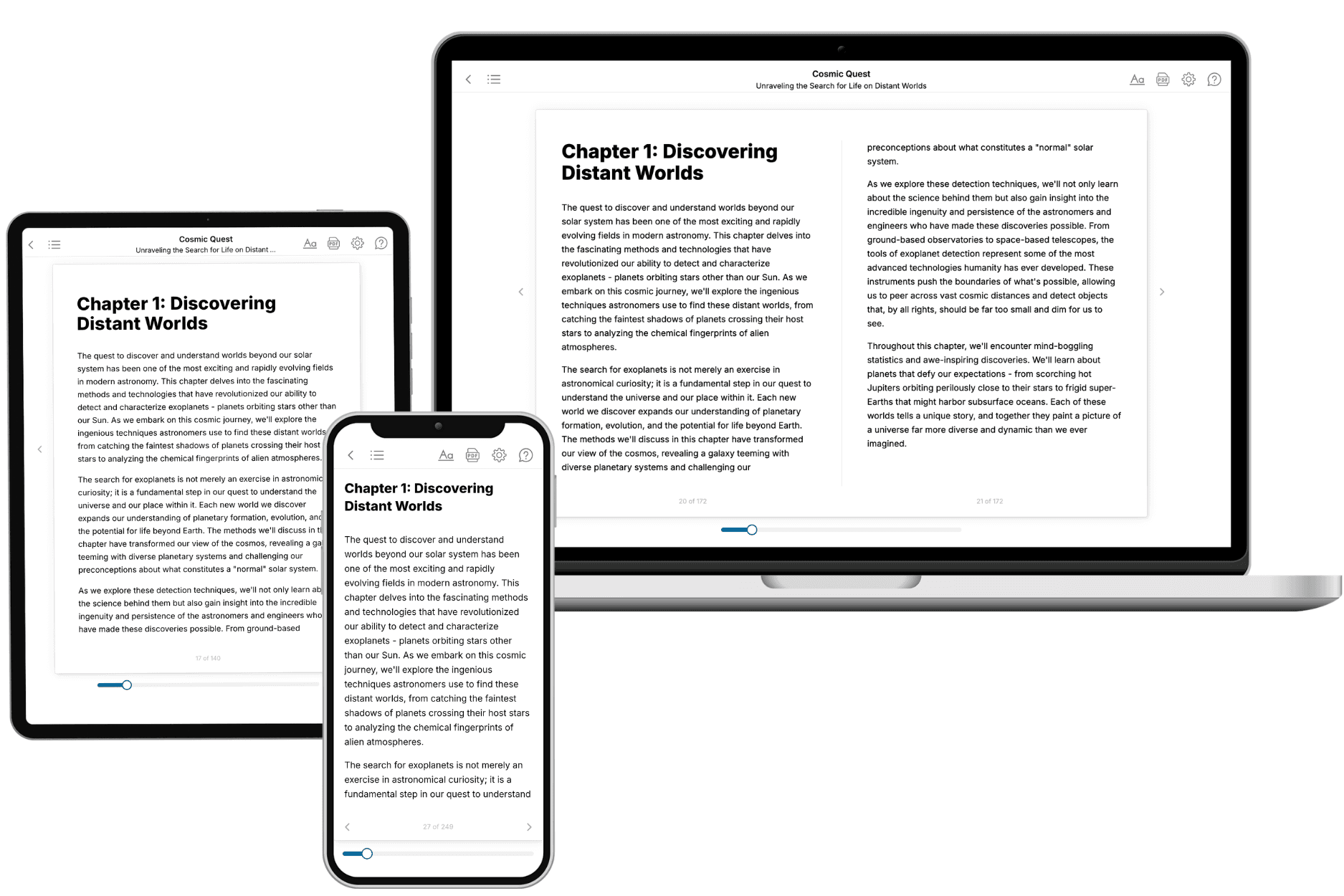
Your book is ready in 10 minutes. Read it online, download as EPUB or PDF, or send to Kindle.
Frequently asked questions
- What is TailoredRead?
TailoredRead creates complete, full-length nonfiction ebooks, written specifically for you. Tell us what you want to learn and why, and TailoredRead writes you a complete ebook on it, with charts, tables, and diagrams throughout. Read it online, on Kindle, or on any e-reader, or download it as a PDF or EPUB. Every book is written fresh the day you order it.
- How is the book tailored to me?
Before anything is written, you answer a few short questions about your goals, your background, and the topics you care about. Your book is then planned around your answers: written at your level, focused on your goals, and covering the topics you chose, instead of the one-size-fits-all book a store sells everyone.
- Will it read like generic AI content?
No. Your book isn't a chat transcript: it's planned chapter by chapter before a single word is written, told in a clear book voice, and explains ideas visually with charts, tables, and diagrams. After writing, every book goes through an editorial pass that polishes chapters so the book reads consistent from start to finish. Judge for yourself: browse thousands of sample books on our Explore Books page.
- How accurate is the content?
Our AI first checks whether your subject needs live research. Niche and fast-moving subjects are researched before writing, and the book plan and chapters are grounded in what it finds. After writing, every book goes through a quality pass that checks its facts and consistency, and researched books list their sources in a Notes section at the back.
- How long is the book?
You choose the length: Comprehensive (250-300 pages), Detailed (150-200 pages), Essential (70-100 pages), or Short (30-50 pages).
- Does the book include visuals?
Yes. Every book includes charts, tables, and diagrams: timelines, checklists, step-by-step guides, decision trees, comparison tables, matrices, and bar charts. A typical book includes dozens of these visual elements.
- Can I read it on Kindle? What formats can I download?
Yes. Every book can be read in our online reader or downloaded as a PDF or EPUB. The EPUB can be opened with Kindle, Apple Books, Kobo, and any e-reader. The Commercial and Author licenses also include an editable Word (DOCX) and Markdown download.
- How much does it cost?
About the price of a regular ebook. The exact price depends on your book's length and complexity, from $2 for the shortest books to $35 for the most comprehensive, and it's shown when you review your book, before you commit to anything. Each book is a one-time purchase, yours to keep, no subscription. Licenses that let you share, teach, or publish your book range from $35.99 to $49.99.
- Can I preview the book before purchasing?
Before you pay, you'll see what your book will cover: the title, a detailed description, the estimated length, and the complete chapter-by-chapter table of contents, so you know what you're getting before you decide. The full text itself is written after you purchase.
- How long does it take to create a book?
About 10 minutes. You can start reading the opening chapters while the rest is still being written.