Mastering Traditional Chinese Characters
A Practical Guide to Reading, Writing, and Understanding the Foundation of Chinese Language
Many Chinese learners hit a plateau when confronting traditional characters—they feel overwhelming, disconnected, and impossible to master.
222 pages10 chaptersFeb 21, 2026Chinese Language
About this book
The problem isn't your ability; it's that you've been approaching them as random symbols to memorize rather than as a logical system to understand. This book reveals the hidden architecture of traditional characters, showing you how each stroke, radical, and component carries meaning and follows predictable patterns. You'll discover how to organize your learning around frequency and radicals, dramatically reducing study time while improving retention. Through practical exercises, real-world examples, and proven techniques, you'll develop the ability to recognize unfamiliar characters, write with confidence, and understand the cultural and historical layers embedded in Chinese writing. Whether you're preparing for proficiency exams, reading classical literature, or simply want to engage more deeply with Chinese culture, this guide provides the systematic approach you need to move from frustration to fluency.
Table of contents
- IntroductionWhy Traditional Characters Matter in Modern Chinese Learning, Common Misconceptions About Character Mastery, How to Use This Book for Maximum Results, Your Personalized Learning PathRead below
- Chapter 1: The Architecture of Traditional CharactersUnderstanding the Visual Logic Behind Character Design, From Pictures to Symbols: Pictographic and Ideographic Foundations, How Characters Evolved from Oracle Bone Script to Modern Forms
- Chapter 2: Radicals: The Building Blocks of CharactersWhat Radicals Are and Why They Matter, The 214 Radicals: Organization and Classification, How Radical Meanings Unlock Character Meanings, Strategic Approach to Learning Radicals Efficiently
- Chapter 3: Stroke Order and StructureThe Eight Fundamental Strokes and Their Variations, The Five Essential Rules of Stroke Order, Common Structural Patterns and How to Recognize Them
- Chapter 4: Frequency and PrioritizationUnderstanding Character Frequency in Written Chinese, The Essential 1,000 Characters: Your Foundation, Expanding to 2,000 Characters for Advanced Reading, Smart Prioritization: Learning What Matters Most First
- Chapter 5: Etymological Connections and Cultural MeaningTracing the Etymology of Common Characters, Semantic Relationships: How Characters Connect to Each Other, Cultural and Historical Significance Embedded in Characters
- Chapter 6: Recognition vs. Production: Different Skills, Different StrategiesBuilding Rapid Character Recognition for Reading, Developing Writing Ability and Character Production, Bridging Recognition and Production Skills, Using Context Clues to Infer Unknown Characters
- Chapter 7: Spaced Repetition and Memory ScienceHow Your Brain Learns and Retains Characters, Implementing Spaced Repetition for Long-Term Retention, Active Recall: The Most Effective Learning Technique
- Chapter 8: Digital Tools and TechnologyChoosing and Using Flashcard Applications Effectively, Leveraging Handwriting Recognition and Input Methods, Best Online Resources and Databases for Character Study, Integrating Technology Into Your Learning Routine
- Chapter 9: Reading Authentic TextsSelecting Appropriate Reading Materials for Your Level, Effective Strategies for Reading Unfamiliar Texts, Approaching Classical Chinese Literature and Historical Texts
- Chapter 10: Practical Writing PracticeStructured Handwriting Practice for Character Mastery, Writing Exercises: From Characters to Sentences, Digital Writing: Typing and Input Method Mastery
- ConclusionYour Journey to Character Mastery, Next Steps and Continued Growth
- AppendixComplete Radical Reference Guide, Stroke Order Reference for Common Characters, Character Frequency Lists and Rankings
- Further Reading and ResourcesRecommended Books on Chinese Characters and Linguistics, Online Communities and Learning Platforms
Introduction
There is a moment that almost every Chinese learner knows. You are sitting with a page of traditional Chinese text in front of you, and instead of seeing words, you see a wall of intricate, unfamiliar symbols. Some look vaguely familiar. Others seem impossibly complex, with dozens of strokes packed into a single square. Your eyes slide across the page without finding purchase, and a familiar frustration sets in. You have studied Chinese for months, maybe years, and yet this writing system still feels like it belongs to someone else. That moment is not a sign of failure. It is a sign that you have been learning characters the wrong way.
The most common approach to learning Chinese characters is also the least effective one: brute-force memorization. You see a character, you write it twenty times, you move on. This method treats each character as an isolated, arbitrary symbol with no connection to anything else. It works, barely, for the first hundred characters. After that, the sheer volume of material overwhelms the brain's ability to store and retrieve information reliably. Characters blur together. Strokes get confused. Retention drops. The learner concludes that they simply are not talented enough for this writing system, when in reality the problem was never talent. It was strategy.
Traditional Chinese characters are not random. They are a system, and like any system, they follow rules, patterns, and internal logic that become visible once you know where to look. Each character is built from components that carry meaning. Those components are organized according to structural principles that have remained consistent for centuries. The strokes that make up each character follow a sequence that reflects how the character was designed to be written. Once you understand this architecture, learning new characters stops feeling like memorization and starts feeling like recognition. You are not storing isolated facts; you are reading a map that was drawn a very long time ago and has been waiting for you to learn how to read it.
This book is built around that insight. It is designed for learners who already have a foundational grasp of Chinese, who know some characters and some grammar, but who feel stuck when it comes to traditional characters specifically. Perhaps you learned simplified characters first and are now making the transition. Perhaps you have been studying traditional characters but feel like your progress has stalled. Perhaps you are preparing for a proficiency exam, planning to read classical literature, or simply want to engage more deeply with Chinese-speaking cultures in Taiwan, Hong Kong, or the broader diaspora. Whatever your specific goal, this book gives you a systematic, practical framework for getting there.
The chapters ahead cover everything from the visual logic embedded in character design, to the radical system that organizes thousands of characters into manageable categories, to the memory science behind effective long-term retention. You will find concrete strategies, real examples, and actionable exercises throughout. The goal is not just to give you information but to change how you approach the writing system entirely, so that every character you encounter becomes an opportunity to apply what you know rather than a problem to solve from scratch.
Why Traditional Characters Matter in Modern Chinese Learning
A reasonable question to ask at the outset is why traditional characters deserve special attention at all. Simplified characters, introduced in mainland China during the 1950s and 1960s, are used by the world's largest Chinese-speaking population. Many learners choose simplified characters for practical reasons and never look back. So what does the traditional system offer that simplified does not? The answer is more substantial than most learners expect.
Traditional characters are the living form of a writing system that has been in continuous use for over two thousand years. They are the characters used in Taiwan, Hong Kong, Macau, and by a significant portion of the global Chinese diaspora. If you want to read a Taiwanese newspaper, navigate a Hong Kong street sign, study classical Chinese poetry, or engage with pre-twentieth-century Chinese literature and philosophy, traditional characters are not optional. They are the only path in. For learners with these goals, the traditional system is not a detour. It is the destination.
Beyond geography and history, traditional characters carry etymological information that simplified characters have lost. Consider the simplified character for 愛 (love), which in simplified form becomes 爱. The traditional version contains the component 心 (heart) at its center. The simplified version removes it. This is not a trivial difference. The heart component signals that love is an emotion, connecting the character visually and conceptually to dozens of other emotion-related characters. When you learn traditional characters, you are learning a system that preserves these connections. That makes the system more learnable, not less, because meaning is embedded in the structure itself.[1]
Traditional characters also serve as a bridge to classical Chinese texts that form the foundation of East Asian intellectual and literary culture. Works like the Analects of Confucius, the Tao Te Ching, and the poetry of the Tang dynasty were written in a form of Chinese that uses traditional characters. Reading these texts in their original form, even partially, gives you access to layers of meaning that translations inevitably flatten. For learners interested in Chinese history, philosophy, or literature, this access is genuinely transformative.
There is also a practical argument for learning traditional characters even if your primary focus is simplified. Because traditional characters are more visually complex and etymologically rich, learners who master them tend to find simplified characters easy to read afterward. The reverse is not always true. Traditional characters contain more visual information, and that information, once understood, makes the simplified versions feel like natural abbreviations rather than foreign symbols. Many serious learners of Chinese eventually study both systems, and starting with traditional gives you a stronger foundation for that broader literacy.
Finally, there is the cultural dimension. Traditional characters are not just a writing system. They are a form of cultural heritage that connects modern readers to thousands of years of human thought, art, and expression. Calligraphy, one of the most celebrated art forms in Chinese culture, is practiced almost exclusively with traditional characters. Temple inscriptions, historical monuments, classical paintings with accompanying text, and ceremonial documents all use the traditional system. Engaging with these artifacts in their original form, rather than through translation or transliteration, is a qualitatively different experience. It is the difference between looking at a painting through glass and standing in the same room with it.
None of this is meant to diminish simplified characters or the learners who focus on them. Both systems have value, and the choice between them depends on your goals. But if traditional characters are part of your path, understanding why they matter helps you approach the learning process with the right mindset. You are not learning an archaic relic. You are learning a living system with deep roots and wide reach, one that rewards the effort you put into understanding it.
Common Misconceptions About Character Mastery
Before diving into strategies and techniques, it is worth clearing away some of the most persistent myths about learning Chinese characters. These misconceptions are not just harmless misunderstandings. They actively shape how learners approach the writing system, and they often lead to wasted effort, unnecessary frustration, and premature discouragement. Identifying them clearly is the first step toward replacing them with more accurate and productive beliefs.
Misconception 1: You need to memorize thousands of characters before you can read anything useful. This belief leads learners to delay engaging with real texts until they feel "ready," which often means never. The reality is that character frequency in Chinese is highly skewed. Research consistently shows that the most common 1,000 characters account for roughly 90% of characters encountered in everyday texts, and the top 2,000 cover approximately 97-98%.[2] You do not need to master the entire system before you start reading. You need to master the right characters in the right order.
Misconception 2: Traditional characters are just harder versions of simplified characters. This framing positions traditional characters as a more difficult variant of something you already know, which is misleading in both directions. Traditional characters are not simply "more strokes." They are a different system with its own internal logic, and that logic is often clearer and more consistent than the simplified version. For learners approaching traditional characters fresh, without the simplified system as a reference point, the complexity is often less daunting than expected because the visual components carry meaning that aids recognition.
Misconception 3: Stroke order does not really matter as long as the character looks right. This is one of the most common shortcuts learners take, and it creates problems that compound over time. Correct stroke order is not arbitrary. It reflects the natural flow of the brush or pen and produces characters that look balanced and proportional. More importantly, consistent stroke order builds muscle memory that makes writing faster and more automatic. Learners who skip this step often find that their handwriting looks awkward and that they struggle to write characters quickly under pressure, such as during exams or note-taking.
Misconception 4: You either have a "good memory for characters" or you do not. This belief attributes character learning success to an innate talent that some people have and others lack. The research on memory does not support this view. What looks like a natural talent for characters is almost always the result of using effective learning strategies, particularly spaced repetition, active recall, and meaning-based encoding. These strategies are learnable. Anyone who applies them consistently will see results that look, from the outside, like natural ability.
Misconception 5: Writing characters by hand is obsolete in the digital age. With smartphones, pinyin input, and handwriting recognition apps, it is tempting to conclude that physical handwriting practice is no longer necessary. This is a mistake. Handwriting practice engages motor memory in ways that digital input does not, creating stronger and more durable neural pathways for character recall.[3] Learners who rely exclusively on digital input often find that they can recognize characters on a screen but cannot reproduce them from memory. For genuine mastery, both skills matter.
Replacing these misconceptions with accurate beliefs does not make the work easier, but it does make it more efficient. When you understand that character learning is a skill governed by learnable principles rather than a talent lottery, you approach the process differently. You make better decisions about what to study, how to study it, and how to measure your progress. That shift in perspective is, in many ways, the most important thing this introduction can offer you.
The learner who treats characters as a system to understand will always outpace the learner who treats them as a list to memorize, not because they are smarter, but because they are working with the structure of the material rather than against it.
How to Use This Book for Maximum Results
This book is organized to build your understanding progressively, starting with the foundational architecture of characters and moving toward practical application in reading and writing. Each chapter introduces concepts that build on the ones before it, so reading in order is generally the most effective approach, especially if you are new to thinking about characters systematically. That said, the book is also designed to function as a reference. If you are already comfortable with radicals but want to improve your stroke order, you can go directly to Chapter 3. If you are ready to start working with authentic texts, Chapter 9 stands on its own.
The most important thing to understand about using this book is that reading it is not the same as learning from it. Every chapter contains exercises, frameworks, and strategies that require active engagement. The chapters on spaced repetition and memory science, for example, are only useful if you actually implement a spaced repetition system. The chapters on stroke order only help if you practice writing characters with the correct sequence. Reading about these techniques without applying them is like reading a book about swimming without getting in the water. The knowledge is necessary but not sufficient.
Here is a practical approach to getting the most out of each chapter:
- Read each chapter once for overall understanding before going back to work through the exercises.
- Keep a dedicated study notebook for handwriting practice, character analysis, and notes on etymology and radical meanings.
- Set up a spaced repetition system (covered in Chapter 7) before you finish Chapter 2, so you can start adding characters to your review queue immediately.
- Do not try to master every character in a chapter before moving on. Exposure and review over time is more effective than intensive drilling in a single session.
- Return to earlier chapters periodically. Concepts that seemed abstract at first often become much clearer after you have spent time working with actual characters.
The exercises in this book range from simple recognition tasks to more demanding writing and composition activities. Some are designed to be completed in a few minutes; others are meant to be ongoing practices that you return to regularly. Pay attention to the distinction. A five-minute daily writing practice is more valuable than a two-hour session once a week, because consistency builds the kind of automatic recall that makes characters feel natural rather than effortful.
You will also notice that this book uses real characters throughout, not just descriptions of them. Engaging with actual characters as you read, rather than just reading about them in the abstract, is intentional. When a concept is illustrated with a specific character, take a moment to look at it carefully. Notice its components. Think about how the radical connects to the meaning. Try writing it in the air or on paper. These small moments of active engagement, repeated across hundreds of examples, add up to a qualitatively different learning experience than passive reading alone.
One more practical note: this book assumes you have access to some form of character input on your devices, whether that is a pinyin keyboard, a handwriting input app, or a dedicated Chinese learning application. Several chapters reference specific digital tools and how to use them effectively. You do not need to have these set up before you start reading, but having them ready by the time you reach Chapter 8 will make the technology integration section much more immediately useful.
Finally, be patient with yourself. Mastering traditional characters is a long-term project, not a sprint. The learners who succeed are not the ones who study the hardest in a single burst of effort. They are the ones who build sustainable habits, stay curious about the material, and keep showing up even when progress feels slow. This book gives you the framework. The results come from consistent application over time.
Your Personalized Learning Path
Not every learner comes to this book from the same starting point, and not every learner has the same goals. A student preparing for the TOCFL (Test of Chinese Language Proficiency) in Taiwan has different priorities than someone who wants to read classical poetry for personal enrichment. A learner who already knows simplified characters faces different challenges than someone approaching Chinese writing for the first time. Recognizing where you are and where you want to go is essential for using this book efficiently.
Before you begin working through the chapters, it helps to do a quick honest assessment of your current situation. Ask yourself the following questions:
- How many traditional characters can you currently recognize with confidence?
- Can you write characters from memory, or do you rely on looking them up?
- Do you know what a radical is, and can you identify the radical in an unfamiliar character?
- Have you worked with a spaced repetition system before?
- What is your primary goal: reading, writing, exam preparation, or cultural engagement?
- How much time can you realistically dedicate to study each day?
Your answers to these questions will shape how you move through the book. If you are relatively new to traditional characters and cannot yet identify radicals reliably, prioritize Chapters 1 and 2 before anything else. These chapters build the conceptual foundation that everything else depends on. If you already have a solid grasp of radicals and stroke order but struggle with retention, jump to Chapter 7 on spaced repetition and memory science early, then come back to fill in any gaps in the earlier chapters.
For learners transitioning from simplified to traditional characters, the path is slightly different. You already have a mental model of Chinese characters, which is both an advantage and a potential source of confusion. Some traditional characters look very similar to their simplified counterparts; others look quite different. Chapter 1 will help you understand why those differences exist, which makes them easier to remember. It is also worth spending extra time on the radical system in Chapter 2, because some radicals that were merged or altered in simplification are restored to their original forms in traditional characters.
For learners with exam preparation as their primary goal, frequency matters enormously. The TOCFL and similar proficiency exams test a defined set of characters at each level, and knowing which characters appear most frequently in exam materials allows you to prioritize your study time effectively. Chapter 4, on frequency and prioritization, is especially important for this group. Pair it with a good spaced repetition system and a clear timeline, and you have the core of a solid exam preparation strategy.
For learners whose goal is reading classical literature or historical texts, the etymological and cultural chapters (Chapters 5 and 9) deserve particular attention. Classical Chinese uses a somewhat different vocabulary and grammatical structure than modern Chinese, and understanding the historical development of characters helps enormously when you encounter archaic usages. Building a reading practice around classical texts, even short ones, from early in your study process will accelerate your progress more than almost any other single habit.
Whatever your starting point and goals, there are a few universal principles that apply to every learner. Consistency beats intensity. Thirty minutes of focused study every day produces better results than four hours on a Saturday. Active engagement beats passive exposure. Writing characters, recalling them from memory, and using them in context builds stronger retention than reading about them. And understanding beats memorization. Every time you learn why a character looks the way it does, you make it easier to remember and easier to recognize in new contexts.
Think of your learning path not as a straight line from ignorance to mastery, but as a spiral. You will return to the same characters, the same radicals, the same structural principles again and again, each time with a slightly deeper understanding and a slightly more automatic recognition. That spiral motion is not inefficiency. It is how durable learning actually works. The goal of this book is to give you the tools to navigate that spiral with intention, so that each pass through the material builds on the last and moves you steadily toward the fluency you are working toward.
The chapters ahead are organized to support that spiral learning process. Each one introduces new material while reinforcing concepts from earlier chapters. By the time you reach the end, you will not just know more characters. You will think about characters differently, approach unfamiliar ones with confidence, and have a set of practical habits that will continue to serve you long after you have finished reading. That transformation in how you see and engage with the writing system is the real goal of this book, and it begins right now, on this page, with the decision to approach traditional characters as a system worth understanding rather than a mountain worth dreading.
Notes
Introduction
- 1. Rick Harbaugh, Chinese Characters: A Genealogy and Dictionary, Zhongwen.com, 1998
- 2. Jun Da, Chinese Text Computing: Character Frequency Lists, Corpus-based frequency analysis of Modern Chinese, 2004
- 3. M. Longcamp and others, "The influence of writing practice on letter recognition in preschool children," Acta Psychologica, 2005
This is the end of the free sample. The full book has 10 chapters.
Want this book written for you?
Tell us your goals and background, and get your own version of this book, tailored by AI to you.


Benefits of AI-tailored books
- Read one book, not ten:
- all the Chinese Language knowledge you need, gathered into a single book.
- Save days of learning:
- tell us your goals, choose your topics, and the whole book is built around them.
- Learn effortlessly:
- Chinese Language book written for your specific background and expertise.
- Understand at a glance:
- includes charts, tables, timelines, checklists, decision trees, and more.
- Stay current:
- written the day you order it, not years ago.
- Trust what you read:
- every book is checked for accuracy, with real research when your subject needs it.
Create your unique book in 3 steps
- 1. Select your focus
Select the focus of your Chinese Language book and share your background
- 2. Personalize your book
Specify your goals and choose sub-topics to include
- 3. Get your tailored book
Your book is ready in 10 minutes. Read it online, download as EPUB or PDF, or send to Kindle.


Frequently asked questions
- What is TailoredRead?
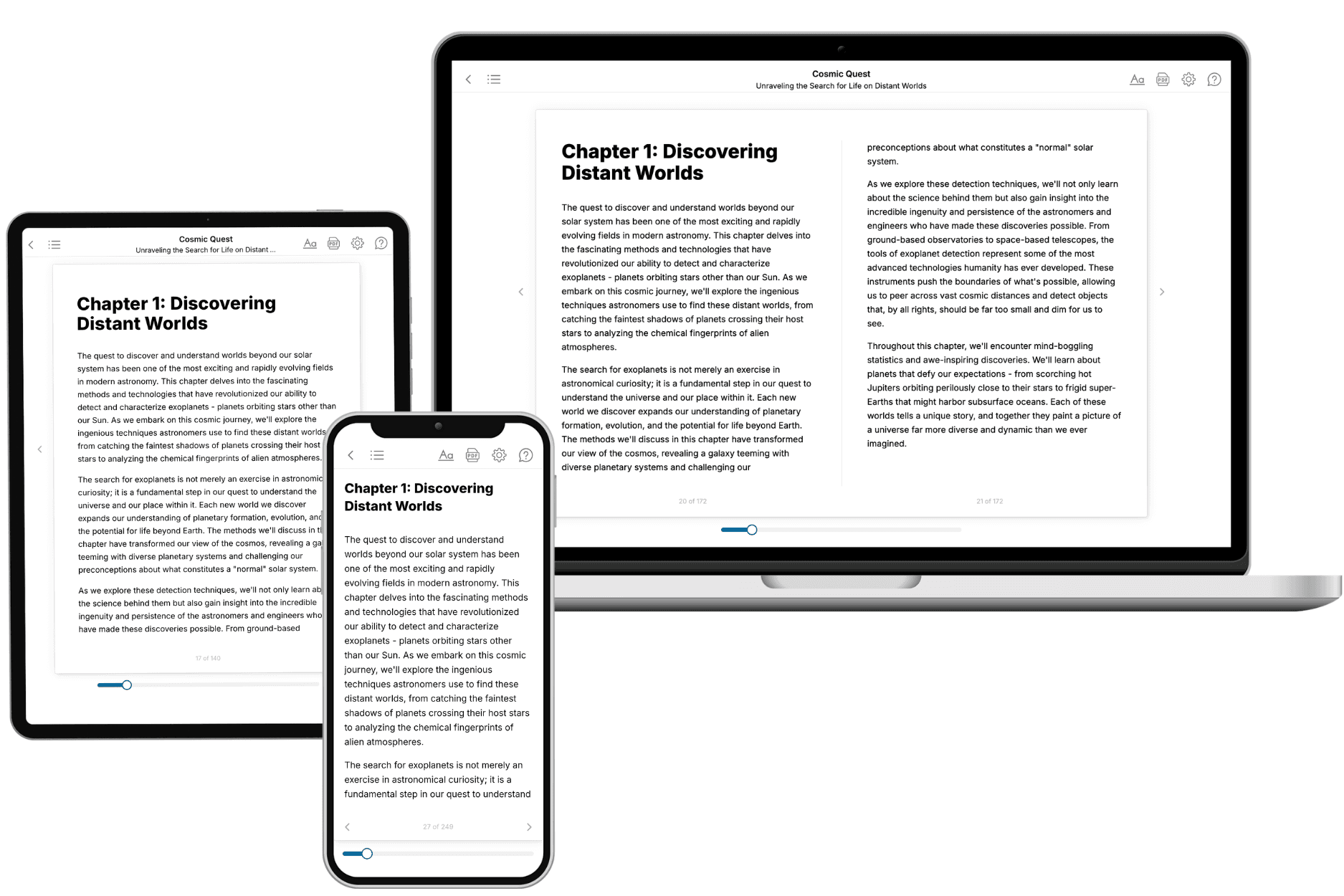
TailoredRead creates complete, full-length nonfiction ebooks, written specifically for you. Tell us what you want to learn and why, and TailoredRead writes you a complete ebook on it, with charts, tables, and diagrams throughout. Read it online, on Kindle, or on any e-reader, or download it as a PDF or EPUB. Every book is written fresh the day you order it.
- How is the book tailored to me?
Before anything is written, you answer a few short questions about your goals, your background, and the topics you care about. Your book is then planned around your answers: written at your level, focused on your goals, and covering the topics you chose, instead of the one-size-fits-all book a store sells everyone.
- Will it read like generic AI content?
No. Your book isn't a chat transcript: it's planned chapter by chapter before a single word is written, told in a clear book voice, and explains ideas visually with charts, tables, and diagrams. After writing, every book goes through an editorial pass that polishes chapters so the book reads consistent from start to finish. Judge for yourself: browse thousands of sample books on our Explore Books page.
- How accurate is the content?
Our AI first checks whether your subject needs live research. Niche and fast-moving subjects are researched before writing, and the book plan and chapters are grounded in what it finds. After writing, every book goes through a quality pass that checks its facts and consistency, and researched books list their sources in a Notes section at the back.
- How long is the book?
You choose the length: Comprehensive (250-300 pages), Detailed (150-200 pages), Essential (70-100 pages), or Short (30-50 pages).
- Does the book include visuals?
Yes. Every book includes visual elements such as timelines, checklists, step-by-step guides, decision trees, comparison tables, and matrices, and many include bar charts. A typical book includes dozens of these visual elements.
- Can I read it on Kindle? What formats can I download?
Yes. Every book can be read in our online reader or downloaded as a PDF or EPUB. The EPUB can be opened with Kindle, Apple Books, Kobo, and any e-reader. The Commercial and Author licenses also include an editable Word (DOCX) and Markdown download.
- How much does it cost?
About the price of a regular ebook. The exact price depends on your book's length and complexity, from $2 for the shortest books to $35 for the most comprehensive, and it's shown when you review your book, before you commit to anything. Each book is a one-time purchase, yours to keep, no subscription. Licenses that let you share, teach, or publish your book range from $35.99 to $49.99.
- Can I preview the book before purchasing?
Before you pay, you'll see what your book will cover: the title, a detailed description, the estimated length, and the complete chapter-by-chapter table of contents, so you know what you're getting before you decide. The full text itself is written after you purchase.
- How long does it take to create a book?
About 10 minutes. You can start reading the opening chapters while the rest is still being written.