Mastering Tries
Efficient Data Structures for Advanced Search Algorithms
Level up your programming skills with a deep dive into one of the most powerful data structures in computer science.
253 pages12 chaptersJan 12, 2025Computer Science and Algorithms
About this book
Mastering Tries: Efficient Data Structures for Advanced Search Algorithms is your comprehensive guide to understanding, implementing, and optimizing Trie data structures for real-world applications. This book takes you on a journey from the fundamentals of Tries to advanced techniques and practical implementations. You'll gain insights into how Tries can dramatically improve the efficiency of search algorithms and learn to apply this knowledge to solve complex programming challenges. Through clear explanations, practical examples, and hands-on exercises, you'll develop a strong foundation in Trie-based algorithms. By the end of this book, you'll have the skills and confidence to implement Tries in your own projects, optimize search functionalities, and tackle advanced problems in computer science with ease.
Table of contents
- IntroductionWhat are Tries?, The Importance of Tries in Computer Science, Book Overview and Learning ObjectivesRead below
- Chapter 1: Foundations of TriesBasic Trie Structure and Terminology, Properties and Characteristics of Tries, Tries vs. Other Data Structures, Advantages and Limitations of Tries
- Chapter 2: Implementing a Basic TrieDesigning the Trie Node, Implementing the Insert Operation, Implementing the Search Operation, Implementing the Delete Operation
- Chapter 3: Time and Space Complexity AnalysisTime Complexity of Trie Operations, Space Complexity of Tries, Comparing Trie Complexity with Other Data Structures, Strategies for Optimizing Trie Performance
- Chapter 4: Advanced Trie OperationsPrefix Matching and Autocomplete, Wildcard Search in Tries, Finding the Longest Common Prefix, Solving the Word Break Problem
- Chapter 5: Trie Variants and OptimizationsCompressed Tries, Ternary Search Tries, Radix Trees, Suffix Trees and Their Relation to Tries
- Chapter 6: Memory Management in TriesMemory-Efficient Trie Implementations, Cache-Friendly Trie Designs, Dynamic Node Allocation Strategies, Garbage Collection in Tries
- Chapter 7: Parallel and Distributed TriesConcurrent Trie Implementations, Distributed Trie Architectures, Sharding Strategies for Large-Scale Tries, Maintaining Consistency in Distributed Tries
- Chapter 8: Real-World Applications of TriesAutocomplete Systems, IP Routing Tables, Spell Checkers and Predictive Text, Search Engine Indexing
- Chapter 9: Algorithms Using TriesEfficient String Matching Algorithms, Pattern Searching in Text, Dictionary Compression Techniques, Sorting Strings Using Tries
- Chapter 10: Tries in Big Data ProcessingProcessing Streaming Data with Tries, Tries in MapReduce Frameworks, Trie-based Techniques in Data Mining, Real-time Analytics Using Tries
- Chapter 11: Tries in Machine LearningFeature Extraction Using Tries, Tries and Decision Trees, Tries in Natural Language Processing, Trie-based Recommendation Systems
- Chapter 12: Advanced Topics and Future DirectionsQuantum Tries and Quantum Computing, Tries in Blockchain Technology, AI-driven Trie Optimization, Future Research Directions in Trie Structures
- ConclusionKey Takeaways, The Future of Tries in Computer Science
- Glossary
- Further Reading
Introduction
Welcome to the fascinating world of Tries, a powerful and efficient data structure that has revolutionized the way we approach string operations and search algorithms in computer science. As you embark on this journey through "Mastering Tries: Efficient Data Structures for Advanced Search Algorithms," you'll discover the immense potential of this often-underappreciated tool and learn how to harness its capabilities to solve complex problems with elegance and efficiency.
In this introduction, we'll lay the groundwork for your exploration of Tries. We'll begin by defining what Tries are and their fundamental characteristics. Then, we'll delve into the importance of Tries in computer science, highlighting their unique advantages and the problems they excel at solving. Finally, we'll provide an overview of the book's structure and the learning objectives you can expect to achieve as you progress through its chapters.
By the end of this introduction, you'll have a solid foundation for understanding the significance of Tries and be well-prepared to dive deeper into their implementation, optimization, and practical applications. So, let's begin our journey into the world of Tries, where efficiency meets elegance in the realm of data structures and algorithms.
What are Tries?
Tries, pronounced "tries" as in "retrieval" or sometimes called "prefix trees," are tree-like data structures specifically designed for efficient storage and retrieval of strings. The name "trie" comes from the word "retrieval," emphasizing its primary purpose: fast and efficient data retrieval. Unlike binary trees or hash tables, Tries are optimized for operations on strings and sequences, making them particularly useful for tasks involving text processing and search algorithms.
At its core, a Trie is a tree where each node represents a character in a string. The root node is typically empty, and each path from the root to a node represents a prefix of one or more strings stored in the Trie. This unique structure allows Tries to efficiently store and search for strings based on their prefixes, which is a key advantage over other data structures.
One of the defining characteristics of a Trie is that all descendants of a node share a common prefix. This property makes Tries exceptionally efficient for prefix-based searches, as you can quickly determine if a given prefix exists in the dataset by traversing the Trie from the root. This efficiency is particularly valuable in applications like autocomplete systems, where you need to find all words that start with a given prefix rapidly.
The structure of a Trie node typically consists of two main components:
- A boolean flag indicating whether the node represents the end of a word
- An array or map of child nodes, each corresponding to a possible next character in the sequence
One of the key advantages of Tries is their time complexity for basic operations. Insertion, deletion, and search operations in a Trie have a time complexity of O(m), where m is the length of the string being processed. This is particularly impressive when compared to other data structures, especially for large datasets with many shared prefixes.
To illustrate the structure of a Trie, let's consider a simple example. Imagine we want to store the words "cat," "car," and "dog" in a Trie. The resulting structure would look something like this:
       (root)
       /    \
      c      d
     /        \
    a          o
   / \          \
  t   r          g
Tries excel in scenarios where you need to perform operations on a large set of strings, especially when those strings share common prefixes. Some common applications of Tries include:
- Autocomplete and predictive text systems
- Spell checkers
- IP routing tables in network routers
- Dictionary implementations
- Search engine indexing and query processing
While Tries offer significant advantages for certain types of operations, they also have some limitations. The primary drawback of Tries is their potential for high memory usage, especially when storing a large number of strings with few common prefixes. Each node in a Trie typically requires space for multiple child pointers, which can lead to increased memory consumption compared to some other data structures.
However, this limitation has led to the development of various optimized Trie variants, such as compressed Tries and ternary search Tries, which we'll explore in later chapters. These variants aim to reduce the space complexity of Tries while maintaining their performance benefits for string operations.
As we progress through this book, you'll gain a deep understanding of how Tries work, how to implement them efficiently, and how to leverage their strengths in various applications. You'll also learn about advanced techniques for optimizing Tries and combining them with other data structures and algorithms to solve complex problems in computer science.
In the next section, we'll delve deeper into the importance of Tries in computer science and explore why mastering this data structure can significantly enhance your problem-solving skills and efficiency as a programmer or computer scientist.
The Importance of Tries in Computer Science
Tries have emerged as a crucial data structure in computer science, playing a pivotal role in numerous applications and algorithms. Their importance stems from their unique ability to efficiently handle string-based operations, which are fundamental to many computational tasks. As data processing and information retrieval become increasingly central to modern computing, the significance of Tries continues to grow. In this section, we'll explore why Tries are so important in computer science and how they contribute to solving complex problems across various domains.
One of the primary reasons for the importance of Tries is their exceptional performance in string-related operations. In many applications, the ability to quickly search, insert, and delete strings is crucial. Tries excel in these operations, offering a time complexity of O(m) for each operation, where m is the length of the string. This efficiency is particularly notable when compared to other data structures like hash tables or binary search trees, which may require O(m log n) or O(m * n) time for similar operations, where n is the number of strings in the dataset[1].
The efficiency of Tries becomes even more apparent when dealing with large datasets of strings, especially those with common prefixes. In such scenarios, Tries can significantly outperform other data structures by leveraging the shared prefixes to reduce both time and space complexity. This characteristic makes Tries particularly valuable in applications like:
- Dictionary implementations, where fast word lookup is essential
- Spell checkers, which need to quickly verify the correctness of words
- IP routing tables, where efficient prefix matching is crucial for routing network packets
- Search engine indexing and query processing, where rapid retrieval of relevant documents based on keywords is necessary
Another key aspect of Tries' importance lies in their role in solving specific types of problems that are challenging for other data structures. For instance, Tries are exceptionally well-suited for implementing autocomplete and predictive text systems. These systems require the ability to quickly find all words that start with a given prefix, a task at which Tries excel. The structure of a Trie allows for efficient traversal of all paths from a given node, making it possible to generate suggestions in real-time as a user types. This capability has become increasingly important in modern user interfaces, from search engines to mobile keyboards, where responsive and accurate text prediction significantly enhances user productivity.
Tries also play a crucial role in various string matching algorithms, which are fundamental to many areas of computer science, including:
- Text processing and analysis
- Bioinformatics, for DNA sequence matching
- Natural Language Processing (NLP) tasks
- Data compression algorithms
The importance of Tries extends beyond their direct applications in string processing. They also serve as a valuable educational tool in computer science curricula. Studying Tries provides students with insights into:
- Tree-based data structures and their properties
- Space-time tradeoffs in algorithm design
- The importance of choosing appropriate data structures for specific problems
- Techniques for optimizing memory usage in data-intensive applications
In the realm of big data and information retrieval, Tries have gained renewed importance. As the volume of textual data continues to grow exponentially, efficient methods for storing, indexing, and searching this data become increasingly critical. Tries offer a scalable solution for managing large volumes of string data, particularly when combined with distributed computing techniques. Their ability to compress common prefixes makes them valuable in scenarios where data needs to be distributed across multiple nodes or machines.
The importance of Tries is further underscored by their role in emerging technologies and research areas. For example:
- In blockchain technology, Tries (specifically, Merkle Patricia Tries) are used to efficiently store and verify the state of Ethereum accounts[3].
- In machine learning and artificial intelligence, Tries are being explored for efficient feature extraction and representation learning from textual data.
- In quantum computing research, quantum variants of Tries are being investigated for potential speedups in string matching and search problems.
As we continue to generate and process increasingly large volumes of textual and sequential data, the importance of Tries in computer science is likely to grow. Their efficiency in handling string operations, combined with their adaptability to various problem domains, makes them an indispensable tool in the modern programmer's toolkit. By mastering Tries, you'll not only enhance your ability to solve a wide range of computational problems but also gain insights into efficient algorithm design and data structure optimization.
In the next section, we'll provide an overview of what you can expect to learn from this book and outline the key learning objectives that will guide your journey through the world of Tries.
Book Overview and Learning Objectives
"Mastering Tries: Efficient Data Structures for Advanced Search Algorithms" is designed to provide you with a comprehensive understanding of Tries, from their fundamental concepts to advanced applications and optimizations. This book is structured to gradually build your knowledge and skills, ensuring that by the end, you'll have a deep and practical understanding of Tries and their role in modern computer science.
The book is organized into several key sections, each focusing on different aspects of Tries:
- Foundations of Tries: We'll start by laying a solid groundwork, exploring the basic structure, properties, and characteristics of Tries. You'll learn how Tries compare to other data structures and understand their advantages and limitations.
- Implementation and Analysis: Next, we'll dive into the practical aspects of implementing Tries, covering basic operations like insertion, search, and deletion. We'll also conduct a thorough analysis of the time and space complexity of these operations.
- Advanced Operations and Variants: Building on the basics, we'll explore more complex operations and introduce you to various Trie variants like compressed Tries and ternary search Tries, each offering specific optimizations for different scenarios.
- Memory Management and Scalability: We'll delve into the crucial aspects of efficient memory management in Tries and explore techniques for making Tries scalable for large datasets, including parallel and distributed implementations.
- Real-world Applications: You'll learn how Tries are applied in various domains, from autocomplete systems and IP routing to search engines and machine learning applications.
- Advanced Topics and Future Directions: Finally, we'll look at cutting-edge research and emerging applications of Tries, giving you a glimpse into the future of this powerful data structure.
Throughout the book, you'll find practical examples, code snippets, and exercises that will help you apply the concepts you're learning. These hands-on elements are crucial for solidifying your understanding and developing the skills to implement and optimize Tries in real-world scenarios.
By the end of this book, you will have achieved the following learning objectives:
- Understand the fundamental structure and properties of Tries, including their advantages and limitations compared to other data structures.
- Implement basic Trie operations (insertion, search, deletion) efficiently in your chosen programming language.
- Analyze the time and space complexity of Trie operations and understand the trade-offs involved in different implementations.
- Master advanced Trie operations such as prefix matching, wildcard search, and solving complex string-related problems.
- Gain proficiency in implementing and using various Trie variants, including compressed Tries and ternary search Tries.
- Develop strategies for efficient memory management in Trie implementations, crucial for handling large-scale data.
- Understand how to design and implement concurrent and distributed Trie structures for improved scalability.
- Apply Tries to solve real-world problems in areas such as autocomplete systems, IP routing, and search engine indexing.
- Explore the role of Tries in advanced algorithms for string matching, pattern searching, and data compression.
- Gain insights into how Tries are used in big data processing, machine learning, and emerging technologies like blockchain and quantum computing.
- Develop the ability to choose the most appropriate Trie variant or implementation for specific problem scenarios.
- Cultivate a deep understanding of the principles behind efficient algorithm design and data structure optimization.
To get the most out of this book, it's recommended that you have a basic understanding of data structures and algorithms, as well as proficiency in at least one programming language. While the concepts will be explained in a language-agnostic manner, having programming experience will help you better understand and implement the examples and exercises provided.
As you progress through the book, you'll find that each chapter builds upon the knowledge gained in previous sections. It's advisable to work through the chapters sequentially, but feel free to focus on specific areas of interest if you already have some familiarity with Tries. The exercises and practical examples provided throughout the book are crucial for reinforcing your learning, so make sure to engage with them actively.
Remember, mastering Tries is not just about understanding their structure and operations; it's about developing the intuition to know when and how to apply them effectively in various scenarios. As you work through this book, try to think critically about how the concepts you're learning can be applied to problems you've encountered or might encounter in your work or studies.
By the time you complete "Mastering Tries: Efficient Data Structures for Advanced Search Algorithms," you'll have gained a powerful tool in your programming arsenal. You'll be equipped to tackle complex string processing and search problems with increased efficiency and elegance. Moreover, you'll have developed a deeper understanding of data structure design principles that will benefit you across various areas of computer science and software development.
So, let's embark on this journey to master Tries. Whether you're a student looking to deepen your understanding of data structures, a professional programmer seeking to optimize your code, or a researcher exploring advanced algorithms, this book will provide you with the knowledge and skills to leverage the power of Tries in your work. Get ready to unlock new levels of efficiency in your string processing and search algorithms!
This is the end of the free sample. The full book has 12 chapters.
Want this book written for you?
Tell us your goals and background, and get your own version of this book, tailored by AI to you.


Benefits of AI-tailored books
- Read one book, not ten:
- all the Computer Science and Algorithms knowledge you need, gathered into a single book.
- Save days of learning:
- tell us your goals, choose your topics, and the whole book is built around them.
- Learn effortlessly:
- Computer Science and Algorithms book written for your specific background and expertise.
- Understand at a glance:
- includes charts, tables, timelines, checklists, decision trees, and more.
- Stay current:
- written the day you order it, not years ago.
- Trust what you read:
- every book is checked for accuracy, with real research when your subject needs it.
Create your unique book in 3 steps
- 1. Select your focus
Select the focus of your Computer Science and Algorithms book and share your background
- 2. Personalize your book
Specify your goals and choose sub-topics to include
- 3. Get your tailored book
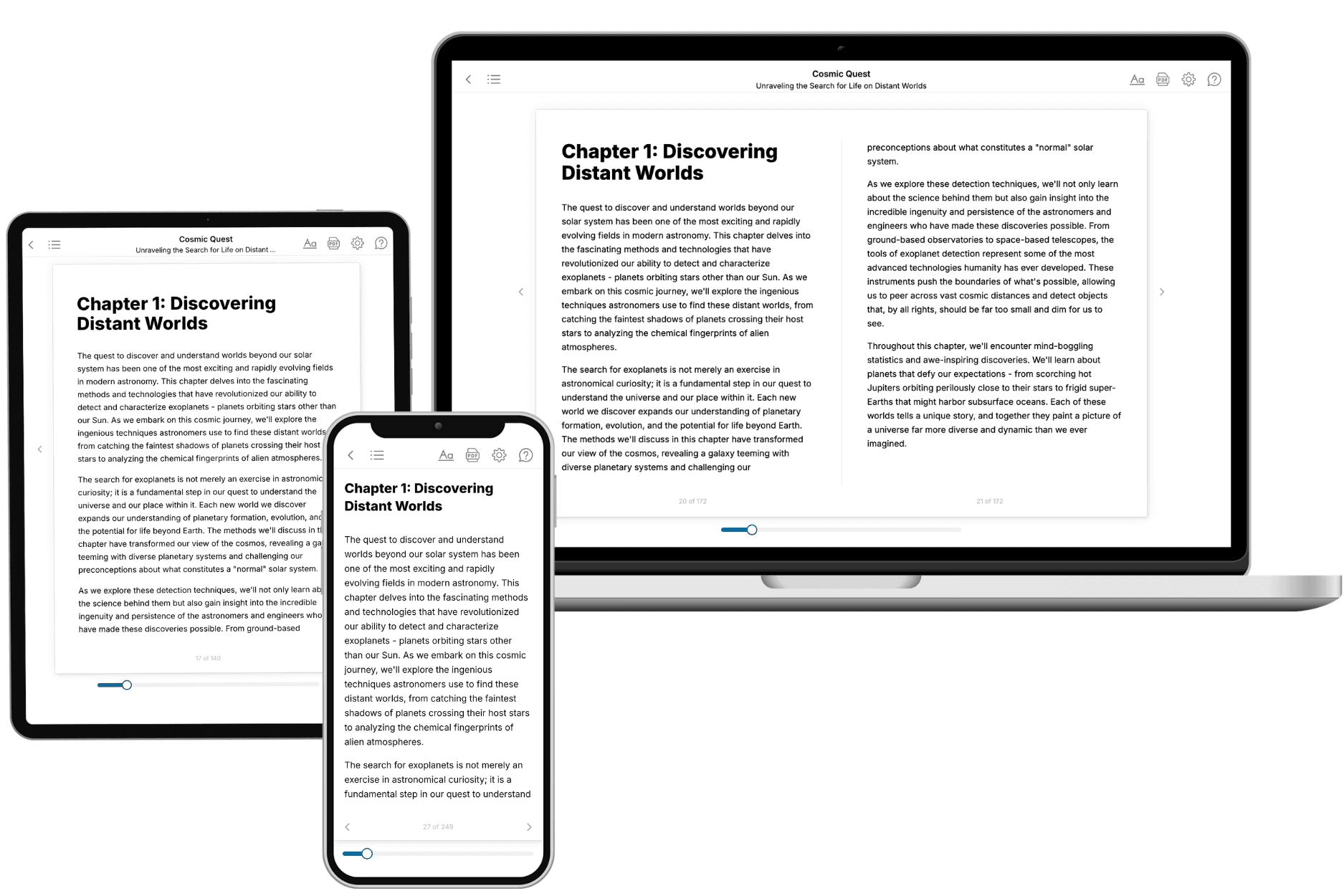
Your book is ready in 10 minutes. Read it online, download as EPUB or PDF, or send to Kindle.
Frequently asked questions
- What is TailoredRead?
TailoredRead creates complete, full-length nonfiction ebooks, written specifically for you. Tell us what you want to learn and why, and TailoredRead writes you a complete ebook on it, with charts, tables, and diagrams throughout. Read it online, on Kindle, or on any e-reader, or download it as a PDF or EPUB. Every book is written fresh the day you order it.
- How is the book tailored to me?
Before anything is written, you answer a few short questions about your goals, your background, and the topics you care about. Your book is then planned around your answers: written at your level, focused on your goals, and covering the topics you chose, instead of the one-size-fits-all book a store sells everyone.
- Will it read like generic AI content?
No. Your book isn't a chat transcript: it's planned chapter by chapter before a single word is written, told in a clear book voice, and explains ideas visually with charts, tables, and diagrams. After writing, every book goes through an editorial pass that polishes chapters so the book reads consistent from start to finish. Judge for yourself: browse thousands of sample books on our Explore Books page.
- How accurate is the content?
Our AI first checks whether your subject needs live research. Niche and fast-moving subjects are researched before writing, and the book plan and chapters are grounded in what it finds. After writing, every book goes through a quality pass that checks its facts and consistency, and researched books list their sources in a Notes section at the back.
- How long is the book?
You choose the length: Comprehensive (250-300 pages), Detailed (150-200 pages), Essential (70-100 pages), or Short (30-50 pages).
- Does the book include visuals?
Yes. Every book includes charts, tables, and diagrams: timelines, checklists, step-by-step guides, decision trees, comparison tables, matrices, and bar charts. A typical book includes dozens of these visual elements.
- Can I read it on Kindle? What formats can I download?
Yes. Every book can be read in our online reader or downloaded as a PDF or EPUB. The EPUB can be opened with Kindle, Apple Books, Kobo, and any e-reader. The Commercial and Author licenses also include an editable Word (DOCX) and Markdown download.
- How much does it cost?
About the price of a regular ebook. The exact price depends on your book's length and complexity, from $2 for the shortest books to $35 for the most comprehensive, and it's shown when you review your book, before you commit to anything. Each book is a one-time purchase, yours to keep, no subscription. Licenses that let you share, teach, or publish your book range from $35.99 to $49.99.
- Can I preview the book before purchasing?
Before you pay, you'll see what your book will cover: the title, a detailed description, the estimated length, and the complete chapter-by-chapter table of contents, so you know what you're getting before you decide. The full text itself is written after you purchase.
- How long does it take to create a book?
About 10 minutes. You can start reading the opening chapters while the rest is still being written.