Mastering Trigonometric Ratios
A Complete Guide to Understanding, Calculating, and Applying Sine, Cosine, Tangent, and Beyond
Have you ever wondered why trigonometry seems to appear everywhere from architecture to astronomy, yet feels so abstract in the classroom?
300 pages15 chaptersSep 30, 2025Trigonometry
About this book
This comprehensive guide bridges that gap by making trigonometric ratios both understandable and immediately applicable to your academic and professional pursuits. You'll discover how the six fundamental trigonometric ratios work as powerful tools for solving real-world problems, from calculating building heights to analyzing wave patterns. Through clear explanations, step-by-step examples, and practical applications, you'll build confidence in working with sine, cosine, tangent, and their reciprocal functions. The book progresses systematically from basic right triangle relationships to advanced concepts like the unit circle, trigonometric identities, and inverse functions. Each chapter includes worked examples, practice problems, and connections to real-world scenarios that demonstrate the practical value of these mathematical relationships. Whether you're strengthening your foundation for advanced mathematics, preparing for standardized tests, or applying trigonometry in your professional work, this guide provides the comprehensive understanding and problem-solving skills you need to succeed with trigonometric ratios.
Table of contents
- IntroductionWhat Are Trigonometric Ratios?, Why Trigonometric Ratios Matter, How to Use This Book, Mathematical PrerequisitesRead below
- Chapter 1: Foundations of Trigonometric RatiosRight Triangles and Their Properties, Angle Measurement Systems, The Pythagorean Theorem Connection, Similar Triangles and Proportions
- Chapter 2: The Primary Trigonometric RatiosUnderstanding the Sine Ratio, Understanding the Cosine Ratio, Understanding the Tangent Ratio, Memory Techniques and SOHCAHTOA
- Chapter 3: Reciprocal Trigonometric RatiosThe Cosecant Ratio, The Secant Ratio, The Cotangent Ratio, Understanding Reciprocal Relationships
- Chapter 4: Special Angles and Their Ratios30-60-90 Triangle Ratios, 45-45-90 Triangle Ratios, Reference Angles and Quadrants, Memorizing Special Angle Values
- Chapter 5: The Unit Circle ApproachUnit Circle Fundamentals, Coordinates and Trigonometric Ratios, Ratios in All Four Quadrants, Negative Angles and Coterminal Angles
- Chapter 6: Calculating Trigonometric RatiosFinding Ratios from Triangle Measurements, Using Calculators Effectively, Exact Values vs. Decimal Approximations, Rounding and Precision Guidelines
- Chapter 7: Solving Right TrianglesFinding Unknown Side Lengths, Finding Unknown Angles, Angles of Elevation and Depression, Problem-Solving Strategies
- Chapter 8: Inverse Trigonometric FunctionsUnderstanding Inverse Functions, Arcsine and Arccosine Functions, Arctangent and Other Inverse Functions, Domain and Range Considerations
- Chapter 9: Fundamental Trigonometric IdentitiesPythagorean Identities, Quotient and Reciprocal Identities, Cofunction Identities, Techniques for Proving Identities
- Chapter 10: Graphing Trigonometric FunctionsGraphing Sine and Cosine Functions, Graphing Tangent and Cotangent Functions, Amplitude, Period, and Phase Shifts, Function Transformations
- Chapter 11: Solving Trigonometric EquationsBasic Trigonometric Equations, Equations in Quadratic Form, Multiple Angle Solutions, Advanced Solving Strategies
- Chapter 12: Real-World ApplicationsNavigation and Surveying, Architecture and Engineering, Physics and Wave Motion, Astronomy and Geography
- Chapter 13: Advanced Trigonometric ConceptsSum and Difference Formulas, Double and Half Angle Formulas, Product-to-Sum Formulas, Complex Trigonometric Applications
- Chapter 14: Mastering Problem-Solving TechniquesAnalyzing Trigonometric Problems, Common Mistakes and How to Avoid Them, Verification and Checking Methods, Test-Taking Strategies
- Chapter 15: Technology and Computational ToolsAdvanced Calculator Techniques, Graphing Software and Apps, Online Resources and Tools, Using Technology for Verification
- Conclusion
- Glossary
- Further Reading
Introduction
Trigonometric ratios represent one of mathematics' most elegant and practical discoveries, connecting the abstract world of angles with the concrete reality of measurements and calculations. These fundamental relationships between angles and side lengths in triangles have shaped human understanding of space, motion, and periodic phenomena for over two millennia. From ancient astronomers calculating celestial distances to modern engineers designing skyscrapers, trigonometric ratios serve as essential tools that bridge theoretical mathematics with real-world problem-solving. The beauty of these ratios lies not just in their mathematical precision, but in their universal applicability across countless fields and situations.
Understanding trigonometric ratios opens doors to advanced mathematical concepts while simultaneously providing immediate practical benefits in everyday problem-solving scenarios. Whether you're determining the height of a building using shadows, analyzing the oscillation of a pendulum, or calculating the optimal angle for a solar panel installation, trigonometric ratios provide the mathematical framework necessary for accurate solutions. These relationships form the foundation for more complex mathematical topics including calculus, differential equations, and advanced physics, making their mastery essential for academic and professional success in STEM fields.
This comprehensive guide approaches trigonometric ratios from multiple perspectives, ensuring that you develop both conceptual understanding and practical computational skills. Rather than treating these ratios as abstract mathematical entities, you'll discover how they emerge naturally from geometric relationships and extend seamlessly into analytical and applied contexts. The systematic progression from basic right triangle relationships to advanced applications ensures that you build confidence and competence at each stage, creating a solid foundation for lifelong mathematical learning and problem-solving success.
What Are Trigonometric Ratios?
Trigonometric ratios are mathematical relationships that express the proportional connections between the angles and sides of right triangles. At their core, these ratios represent consistent patterns that remain constant regardless of the triangle's size, making them powerful tools for solving problems involving unknown measurements. The six primary trigonometric ratios—sine, cosine, tangent, cosecant, secant, and cotangent—each capture a specific relationship between an angle and the triangle's side lengths. These ratios transform geometric problems into algebraic calculations, allowing you to find unknown sides or angles using known information.
The fundamental principle underlying all trigonometric ratios is the concept of similarity in right triangles. When two right triangles share the same acute angle, they are similar triangles, meaning their corresponding sides are proportional. This proportionality creates consistent ratios that depend only on the angle's measure, not on the triangle's absolute size. For example, in any right triangle with a 30-degree angle, the ratio of the opposite side to the hypotenuse will always equal approximately 0.5, regardless of whether the triangle has a hypotenuse of 2 units or 200 units. This consistency makes trigonometric ratios reliable mathematical tools for calculations and predictions.
The three primary ratios—sine, cosine, and tangent—form the foundation of trigonometric analysis and are defined as follows:
- Sine (sin): The ratio of the opposite side to the hypotenuse
- Cosine (cos): The ratio of the adjacent side to the hypotenuse
- Tangent (tan): The ratio of the opposite side to the adjacent side
Beyond their geometric origins, trigonometric ratios extend into analytical mathematics through the unit circle approach, where angles can exceed 90 degrees and take on negative values. This extension transforms trigonometric ratios from simple triangle relationships into periodic functions that model cyclical phenomena such as sound waves, seasonal temperature variations, and mechanical oscillations. The unit circle representation reveals that trigonometric ratios are actually coordinates of points on a circle, providing a powerful geometric interpretation that connects algebra, geometry, and analysis in elegant mathematical unity.
The reciprocal ratios—cosecant, secant, and cotangent—complement the primary ratios by providing alternative expressions for trigonometric relationships. These reciprocal functions often simplify complex calculations and appear frequently in advanced mathematical applications. Understanding both primary and reciprocal ratios provides you with a complete toolkit for trigonometric problem-solving, ensuring that you can approach problems from multiple angles and select the most efficient solution method for any given situation.
Modern applications of trigonometric ratios extend far beyond traditional geometry problems, encompassing fields such as signal processing, computer graphics, navigation systems, and architectural design. In digital technology, trigonometric ratios enable the creation of realistic 3D graphics, the compression of audio and video files, and the operation of GPS navigation systems. These contemporary applications demonstrate that trigonometric ratios are not merely academic concepts but essential tools in our technology-driven world, making their mastery increasingly valuable for career success and technological literacy.
The study of trigonometric ratios also develops critical thinking skills and mathematical reasoning abilities that transfer to other areas of study and professional work. Learning to visualize geometric relationships, manipulate algebraic expressions, and verify solutions using multiple methods strengthens analytical thinking and problem-solving capabilities. These cognitive skills prove valuable in fields ranging from engineering and physics to economics and computer science, where logical reasoning and quantitative analysis are essential for success.
Understanding trigonometric ratios requires mastering both computational techniques and conceptual relationships, creating a balanced approach to mathematical learning. While memorizing key values and formulas provides efficiency in calculations, developing intuitive understanding of how ratios behave and relate to each other enables creative problem-solving and error detection. This dual approach ensures that you can both perform accurate calculations and understand the underlying mathematical principles that govern trigonometric relationships.
Why Trigonometric Ratios Matter
Trigonometric ratios serve as fundamental building blocks for numerous academic disciplines and professional fields, making their mastery essential for educational advancement and career success. In mathematics, these ratios provide the foundation for calculus concepts including derivatives and integrals of trigonometric functions, differential equations modeling periodic phenomena, and complex number analysis. Physics relies heavily on trigonometric ratios for analyzing wave motion, electromagnetic radiation, quantum mechanics, and rotational dynamics. Engineering applications span structural analysis, signal processing, control systems, and mechanical design, where trigonometric calculations ensure safety, efficiency, and optimal performance.
The practical applications of trigonometric ratios in everyday problem-solving scenarios demonstrate their immediate relevance and utility. Construction workers use trigonometric ratios to calculate roof angles, determine proper drainage slopes, and ensure structural stability. Surveyors employ these ratios to measure distances across obstacles, map terrain features, and establish property boundaries with precision. Navigation systems, from traditional compass-based methods to modern GPS technology, rely on trigonometric calculations to determine positions, plot courses, and calculate distances between locations.
In the digital age, trigonometric ratios have become increasingly important for understanding and creating technology-based solutions. Computer graphics and animation depend on trigonometric functions to render realistic lighting effects, simulate natural motion, and create immersive virtual environments. Audio and video compression algorithms use trigonometric transforms to reduce file sizes while maintaining quality. Robotics and automation systems employ trigonometric calculations for precise movement control, path planning, and sensor data interpretation. These technological applications highlight the growing importance of trigonometric literacy in our interconnected world.
The study of trigonometric ratios develops essential mathematical thinking skills that extend beyond specific calculations to general problem-solving approaches. Working with these ratios teaches you to:
- Analyze complex problems by breaking them into manageable components
- Recognize patterns and relationships in mathematical data
- Verify solutions using multiple approaches and checking methods
- Translate between different mathematical representations and models
- Apply abstract mathematical concepts to concrete real-world situations
Trigonometric ratios also provide a gateway to understanding periodic phenomena that occur throughout nature and human-made systems. From the oscillation of pendulums and springs to the cyclical patterns of tides, seasons, and biological rhythms, trigonometric functions model these repetitive behaviors with mathematical precision. Understanding these patterns enables prediction, optimization, and control of systems ranging from electrical power generation to ecological population dynamics. This predictive capability makes trigonometric ratios invaluable tools for scientific research and technological development.
The historical significance of trigonometric ratios reveals their enduring importance in human intellectual development and practical achievement. Ancient civilizations used trigonometric principles for astronomical observations, architectural construction, and navigation across vast distances. The mathematical formalization of these ratios enabled the scientific revolution, supporting advances in astronomy, physics, and engineering that transformed human civilization. Today's technological achievements, from satellite communications to medical imaging, build upon centuries of trigonometric knowledge and innovation.
Mastering trigonometric ratios provides competitive advantages in standardized testing and academic assessments that influence educational and career opportunities. These ratios appear prominently on SAT, ACT, and AP mathematics examinations, as well as professional certification tests in engineering, surveying, and other technical fields. Strong trigonometric skills demonstrate mathematical competence and analytical thinking abilities that admissions committees and employers value highly. The time invested in mastering these concepts pays dividends through improved test scores, expanded academic options, and enhanced career prospects.
The interconnected nature of trigonometric ratios with other mathematical topics makes their understanding essential for advanced mathematical study. Calculus courses assume fluency with trigonometric functions and their properties, while statistics and probability theory employ trigonometric concepts in data analysis and modeling applications. Linear algebra and differential equations frequently involve trigonometric solutions and transformations. Without solid trigonometric foundations, students struggle with these advanced topics and may find their mathematical progress limited by gaps in fundamental knowledge.
Contemporary research in fields such as data science, artificial intelligence, and quantum computing increasingly relies on trigonometric concepts and calculations. Machine learning algorithms use trigonometric functions for feature extraction and pattern recognition. Quantum computing employs trigonometric operations for quantum state manipulation and measurement. Signal processing applications in telecommunications, medical imaging, and audio engineering depend on trigonometric transforms and analysis techniques. These cutting-edge applications demonstrate that trigonometric ratios remain relevant and essential for understanding and contributing to technological advancement.
How to Use This Book
This book follows a carefully structured progression that builds your understanding of trigonometric ratios from fundamental concepts to advanced applications, ensuring that each chapter prepares you for the next level of complexity. The sequential organization allows you to develop mastery systematically, with each new concept building upon previously established knowledge and skills. However, the modular design also accommodates different learning styles and needs, allowing you to focus on specific topics or review particular concepts as needed. Each chapter includes clear learning objectives, worked examples, and practical applications that reinforce theoretical understanding with concrete problem-solving experience.
The early chapters establish essential foundations by reviewing right triangle properties, angle measurement systems, and the geometric principles underlying trigonometric relationships. These foundational topics ensure that all readers begin with the necessary background knowledge, regardless of their previous mathematical experience. If you have strong geometry skills, you may move through these chapters quickly, using them primarily for review and reference. Students with less geometric background should work through these chapters carefully, completing all examples and exercises to build solid foundations for later topics.
The middle chapters focus on developing computational skills and conceptual understanding of the six trigonometric ratios, their relationships, and their applications to problem-solving. These chapters emphasize both memorization of key values and understanding of underlying patterns and relationships. The presentation includes multiple approaches to each concept, allowing you to find the methods that work best for your learning style. Visual learners will benefit from the geometric diagrams and unit circle representations, while analytical learners may prefer the algebraic manipulations and formula derivations.
Each chapter incorporates several pedagogical features designed to enhance learning and retention:
- Worked Examples: Step-by-step solutions to representative problems that demonstrate proper techniques and reasoning
- Practice Problems: Graduated exercises that allow you to apply new concepts with increasing complexity
- Real-World Applications: Concrete examples showing how trigonometric ratios solve practical problems
- Common Mistakes: Identification and correction of typical errors to help you avoid pitfalls
- Technology Integration: Guidance on using calculators and software tools effectively
- Review Summaries: Concise overviews of key concepts and formulas for quick reference
The later chapters address advanced topics including trigonometric identities, equation solving, and complex applications that prepare you for calculus and other advanced mathematical courses. These chapters assume mastery of earlier material and focus on developing sophisticated problem-solving strategies and mathematical reasoning skills. The applications chapters demonstrate how trigonometric ratios connect to various fields and career paths, providing motivation and context for continued study. These real-world connections help you understand why trigonometric ratios matter and how they contribute to technological and scientific advancement.
To maximize your learning effectiveness, approach each chapter with active engagement rather than passive reading. Work through examples before looking at solutions, attempt practice problems independently, and seek to understand the reasoning behind each step rather than simply memorizing procedures. Keep a notebook for recording key formulas, important relationships, and personal insights that emerge during your study. Regular review of previous chapters helps maintain and strengthen your understanding while building connections between different topics and concepts.
The book includes extensive cross-referencing that helps you navigate between related topics and find relevant information quickly. When encountering unfamiliar terms or concepts, use the comprehensive glossary and index to locate definitions and explanations. The appendices provide quick reference materials including formula summaries, special angle values, and problem-solving checklists that support efficient study and review. These resources make the book valuable not only for initial learning but also for ongoing reference throughout your mathematical education and professional career.
Technology plays an important supporting role throughout the book, with guidance on using calculators, graphing software, and online resources effectively. However, the emphasis remains on understanding concepts and developing analytical skills rather than relying solely on computational tools. Learn to use technology to verify your work, explore patterns, and visualize relationships, but ensure that you can also perform calculations and solve problems without technological assistance. This balanced approach prepares you for various testing situations and develops the mathematical intuition necessary for advanced study.
Different readers may benefit from different approaches to using this book based on their goals and background. Students preparing for standardized tests should focus on computational fluency and problem-solving speed, emphasizing the practice problems and review materials. Those planning to continue with advanced mathematics should pay particular attention to the conceptual explanations and theoretical foundations that support later learning. Professionals seeking to apply trigonometric ratios in their work should concentrate on the applications chapters and real-world examples that demonstrate practical problem-solving techniques.
Mathematical Prerequisites
Success with trigonometric ratios requires a solid foundation in several key mathematical areas, though the specific depth of knowledge needed varies depending on your goals and the level at which you plan to apply these concepts. At minimum, you should have comfortable fluency with basic arithmetic operations including addition, subtraction, multiplication, and division of whole numbers, fractions, and decimals. Additionally, you need working knowledge of exponents and radicals, as these appear frequently in trigonometric calculations and formula manipulations. Square roots are particularly important since they arise naturally from the Pythagorean theorem and distance calculations that underlie many trigonometric applications.
Algebraic skills form another essential prerequisite, as trigonometric problems frequently involve solving equations, manipulating expressions, and working with variables and formulas. You should be comfortable with basic equation-solving techniques including isolating variables, combining like terms, and applying inverse operations. Familiarity with quadratic equations and their solutions proves helpful for more advanced trigonometric applications, though not essential for basic ratio calculations. The ability to substitute values into formulas and evaluate expressions accurately is crucial for computational success with trigonometric ratios.
Geometric knowledge provides the conceptual foundation for understanding trigonometric ratios and their applications. Essential geometric prerequisites include:
- Triangle properties: Understanding of triangle classification, angle sum relationships, and basic triangle terminology
- Right triangle concepts: Recognition of right angles, hypotenuse identification, and leg relationships
- Pythagorean theorem: Ability to apply a² + b² = c² for finding unknown side lengths
- Similar triangles: Understanding of proportional relationships and scaling factors
- Angle measurement: Familiarity with degree measurement and basic angle relationships
- Coordinate geometry: Basic understanding of the coordinate plane and distance formulas
Proportional reasoning skills are fundamental to trigonometric success, as ratios represent proportional relationships between triangle sides. You should understand how to set up and solve proportion equations, recognize equivalent ratios, and work with scaling relationships. The concept that ratios remain constant in similar figures underlies the entire theoretical foundation of trigonometry, making proportional thinking essential for conceptual understanding. Practice with ratio and proportion problems in non-trigonometric contexts helps develop the mathematical intuition necessary for trigonometric applications.
Basic calculator skills are increasingly important for trigonometric work, as most practical applications involve decimal approximations rather than exact values. You should know how to use scientific calculators for basic arithmetic operations, exponent calculations, and square root computations. Familiarity with calculator order of operations and parentheses usage prevents computational errors that can undermine problem-solving success. While advanced calculator features like trigonometric function keys will be introduced in this book, basic calculator competence is assumed from the beginning.
Mathematical communication skills, including the ability to interpret word problems and translate between verbal descriptions and mathematical expressions, support successful application of trigonometric ratios to real-world situations. Many trigonometric problems are presented as applied scenarios requiring you to identify relevant information, choose appropriate solution strategies, and interpret results in context. Strong reading comprehension and analytical thinking skills help you navigate these complex problem-solving situations effectively.
If you identify gaps in any of these prerequisite areas, consider addressing them before beginning intensive trigonometric study. Many online resources, textbooks, and educational platforms provide targeted review materials for algebra and geometry topics. Spending time strengthening weak areas pays dividends through improved understanding and reduced frustration as you work through trigonometric concepts. The investment in prerequisite review often accelerates overall learning progress and builds confidence for tackling challenging problems.
For students with strong mathematical backgrounds, these prerequisites may seem elementary, but reviewing them in the context of trigonometric applications can reveal new connections and deepen understanding. Advanced students should focus on how these foundational concepts extend and generalize in trigonometric contexts, preparing for the sophisticated mathematical reasoning required in calculus and beyond. Even experienced mathematicians benefit from occasionally revisiting fundamental concepts to maintain sharp computational skills and clear conceptual understanding.
The prerequisite knowledge described here represents the minimum foundation necessary for success with trigonometric ratios. Additional mathematical background in areas such as functions, graphing, and advanced algebra will enhance your understanding and expand your ability to apply trigonometric concepts in sophisticated ways. However, this book is designed to be accessible to students meeting the basic prerequisites while providing sufficient depth and challenge for more advanced learners. The key is honest self-assessment of your current knowledge and willingness to seek additional support in areas where you need strengthening.
This is the end of the free sample. The full book has 15 chapters.
Want this book written for you?
Tell us your goals and background, and get your own version of this book, tailored by AI to you.


Benefits of AI-tailored books
- Read one book, not ten:
- all the Trigonometry knowledge you need, gathered into a single book.
- Save days of learning:
- tell us your goals, choose your topics, and the whole book is built around them.
- Learn effortlessly:
- Trigonometry book written for your specific background and expertise.
- Understand at a glance:
- includes charts, tables, timelines, checklists, decision trees, and more.
- Stay current:
- written the day you order it, not years ago.
- Trust what you read:
- every book is checked for accuracy, with real research when your subject needs it.
Create your unique book in 3 steps
- 1. Select your focus
Select the focus of your Trigonometry book and share your background
- 2. Personalize your book
Specify your goals and choose sub-topics to include
- 3. Get your tailored book
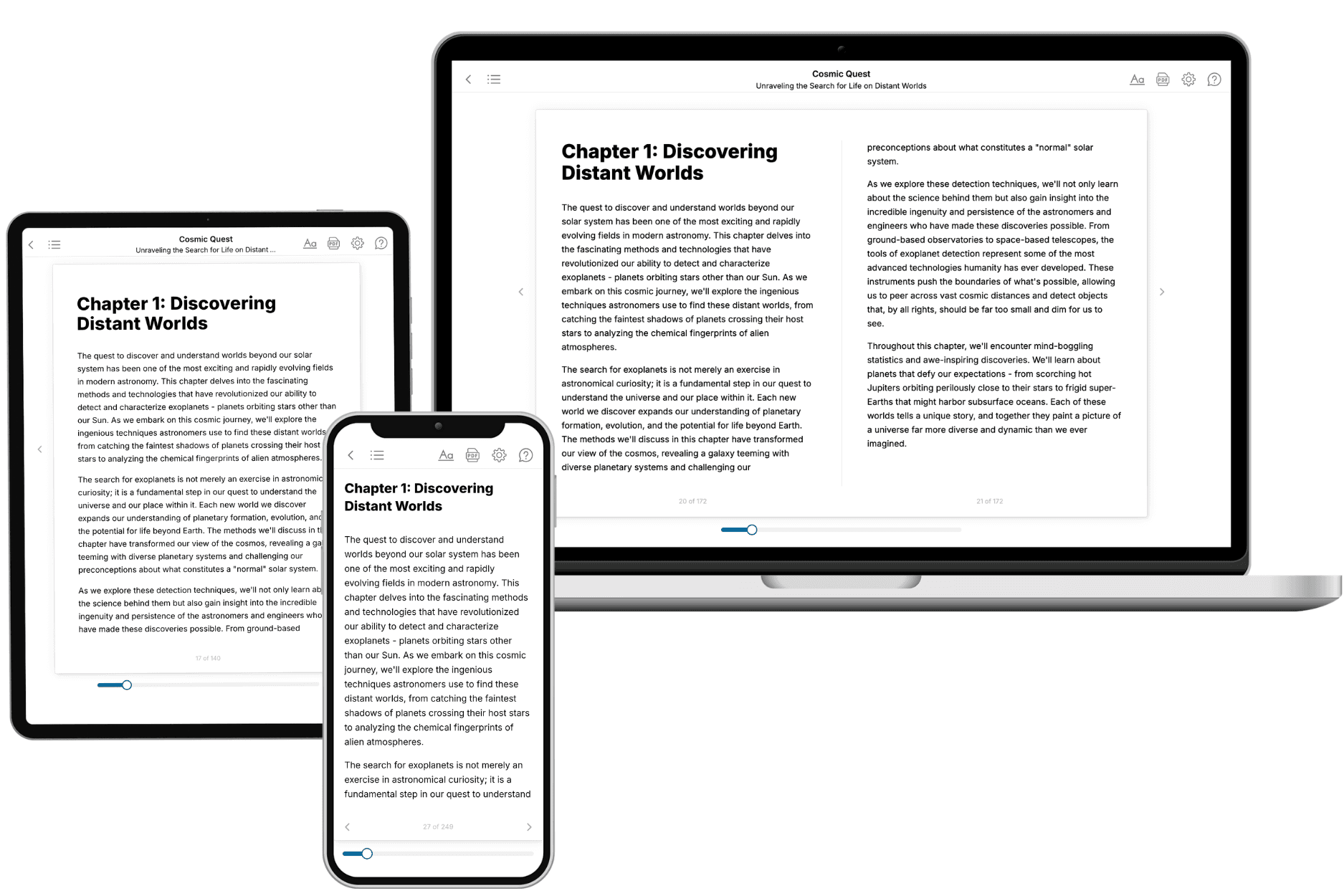
Your book is ready in 10 minutes. Read it online, download as EPUB or PDF, or send to Kindle.

Frequently asked questions
- What is TailoredRead?
TailoredRead creates complete, full-length nonfiction ebooks, written specifically for you. Tell us what you want to learn and why, and TailoredRead writes you a complete ebook on it, with charts, tables, and diagrams throughout. Read it online, on Kindle, or on any e-reader, or download it as a PDF or EPUB. Every book is written fresh the day you order it.
- How is the book tailored to me?
Before anything is written, you answer a few short questions about your goals, your background, and the topics you care about. Your book is then planned around your answers: written at your level, focused on your goals, and covering the topics you chose, instead of the one-size-fits-all book a store sells everyone.
- Will it read like generic AI content?
No. Your book isn't a chat transcript: it's planned chapter by chapter before a single word is written, told in a clear book voice, and explains ideas visually with charts, tables, and diagrams. After writing, every book goes through an editorial pass that polishes chapters so the book reads consistent from start to finish. Judge for yourself: browse thousands of sample books on our Explore Books page.
- How accurate is the content?
Our AI first checks whether your subject needs live research. Niche and fast-moving subjects are researched before writing, and the book plan and chapters are grounded in what it finds. After writing, every book goes through a quality pass that checks its facts and consistency, and researched books list their sources in a Notes section at the back.
- How long is the book?
You choose the length: Comprehensive (250-300 pages), Detailed (150-200 pages), Essential (70-100 pages), or Short (30-50 pages).
- Does the book include visuals?
Yes. Every book includes visual elements such as timelines, checklists, step-by-step guides, decision trees, comparison tables, and matrices, and many include bar charts. A typical book includes dozens of these visual elements.
- Can I read it on Kindle? What formats can I download?
Yes. Every book can be read in our online reader or downloaded as a PDF or EPUB. The EPUB can be opened with Kindle, Apple Books, Kobo, and any e-reader. The Commercial and Author licenses also include an editable Word (DOCX) and Markdown download.
- How much does it cost?
About the price of a regular ebook. The exact price depends on your book's length and complexity, from $2 for the shortest books to $35 for the most comprehensive, and it's shown when you review your book, before you commit to anything. Each book is a one-time purchase, yours to keep, no subscription. Licenses that let you share, teach, or publish your book range from $35.99 to $49.99.
- Can I preview the book before purchasing?
Before you pay, you'll see what your book will cover: the title, a detailed description, the estimated length, and the complete chapter-by-chapter table of contents, so you know what you're getting before you decide. The full text itself is written after you purchase.
- How long does it take to create a book?
About 10 minutes. You can start reading the opening chapters while the rest is still being written.