Vector Calculus: Foundations to Field Theory
Gradients, divergence, curl, line and surface integrals explained
Your mathematical toolkit is about to expand dramatically as you dive deep into the elegant world of vector calculus.
284 pages15 chaptersOct 14, 2025Math
About this book
This comprehensive guide takes you from the familiar territory of linear algebra into the rich landscape of multivariable calculus, where vectors become powerful tools for describing motion, fields, and complex geometric relationships. You'll discover how seemingly abstract mathematical concepts translate into practical solutions for real-world problems. From understanding how gradients guide optimization algorithms to seeing how divergence and curl describe fluid flow and electromagnetic fields, each concept builds naturally upon the last. The book emphasizes both computational techniques and geometric intuition, ensuring you can both solve problems efficiently and understand what your calculations actually mean. Through carefully crafted examples and progressive exercises, you'll master the fundamental operations of vector calculus: gradients, divergence, curl, and the powerful integral theorems that connect them. You'll learn to work confidently with parametric curves and surfaces, tackle line and surface integrals, and apply Green's theorem, Stokes' theorem, and the divergence theorem to solve complex problems. Whether you're preparing for advanced coursework in physics or engineering, developing skills for computer graphics and modeling, or simply seeking to deepen your mathematical understanding, this book provides the solid foundation and practical insights you need to excel in vector calculus and its applications.
Table of contents
- IntroductionWhy Vector Calculus Matters, Building from Linear Algebra, The Power of Geometric Intuition, How to Use This BookRead below
- Chapter 1: Vector Foundations and OperationsVector Basics and Notation, Vector Arithmetic in Multiple Dimensions, The Dot Product and Its Applications, The Cross Product and Vector Areas
- Chapter 2: Coordinate Systems and TransformationsCartesian Coordinate Systems, Cylindrical Coordinate Systems, Spherical Coordinate Systems, Transformations Between Systems
- Chapter 3: Vector Functions and Parametric CurvesVector-Valued Functions, Parametric Representation of Curves, Derivatives of Vector Functions, Arc Length and Curvature
- Chapter 4: Multivariable Functions and Partial DerivativesFunctions of Several Variables, Partial Derivatives and Their Meaning, Higher-Order Partial Derivatives, The Chain Rule for Multivariable Functions
- Chapter 5: The Gradient VectorDefinition and Computation of Gradients, Geometric Interpretation of Gradients, Directional Derivatives and Maximum Rate of Change, Applications in Optimization and Physics
- Chapter 6: Divergence and CurlUnderstanding Vector Fields, Divergence: Measuring Field Expansion, Curl: Measuring Field Rotation, Physical Interpretations and Examples
- Chapter 7: Line IntegralsLine Integrals of Scalar Functions, Line Integrals of Vector Fields, Work and Circulation, Path Independence and Conservative Fields
- Chapter 8: Surface IntegralsParametric Representation of Surfaces, Surface Area Calculations, Surface Integrals of Scalar Functions, Flux Integrals Through Surfaces
- Chapter 9: Green's TheoremStatement and Geometric Meaning, Applications to Area and Circulation, Simply Connected Regions and Extensions, Worked Examples and Problem-Solving
- Chapter 10: Stokes' TheoremStatement and Three-Dimensional Interpretation, Orientation of Surfaces and Boundaries, Relating Circulation to Curl, Applications in Physics and Engineering
- Chapter 11: The Divergence TheoremStatement and Physical Interpretation, Flux Through Closed Surfaces, Converting to Volume Integrals, Applications in Fluid Dynamics and Electromagnetism
- Chapter 12: Conservative Vector Fields and Potential FunctionsDefinition and Properties of Conservative Fields, Finding Potential Functions, The Fundamental Theorem for Line Integrals, Energy Conservation and Physical Applications
- Chapter 13: Applications in Physics and EngineeringElectromagnetic Fields and Maxwell's Equations, Fluid Flow and Continuity Equations, Heat Transfer and Diffusion, Gravitational Fields and Potential Theory
- Chapter 14: Computational Methods and Numerical TechniquesNumerical Differentiation of Vector Fields, Numerical Integration Techniques, Computer Visualization of Vector Fields, Software Tools and Programming Applications
- Chapter 15: Advanced Topics and ExtensionsIntroduction to Differential Forms, Connections to Tensor Calculus, Vector Calculus on Manifolds, Directions for Further Study
- Conclusion
- Appendix: Mathematical Reference
Introduction
Vector calculus stands as one of the most powerful and elegant branches of mathematics, bridging the gap between abstract mathematical theory and tangible real-world applications. This field extends the familiar concepts of single-variable calculus into the rich, multidimensional world where vectors describe everything from electromagnetic fields to fluid flow patterns. When you master vector calculus, you gain access to the mathematical language that describes how quantities change across space and time, how fields interact with matter, and how complex systems behave in three-dimensional reality. The concepts you'll encounter—gradients, divergence, curl, and the fundamental integral theorems—form the backbone of modern physics, engineering, and computer science.
The journey from basic algebra to vector calculus represents a significant leap in mathematical sophistication, yet it's a natural progression that builds systematically on concepts you already understand. Where single-variable calculus deals with rates of change along a line, vector calculus explores how quantities vary across surfaces and throughout volumes. This expansion opens up entirely new ways of thinking about mathematical relationships and provides tools for solving problems that would be impossible to approach with elementary methods. The geometric intuition that underlies vector operations makes these advanced concepts surprisingly accessible once you understand the visual and physical meanings behind the mathematical symbols.
Your success in mastering vector calculus depends not just on computational skill, but on developing a deep understanding of the geometric and physical principles that give meaning to the mathematics. Each operation in vector calculus has a clear geometric interpretation that connects abstract calculations to concrete physical phenomena. When you compute a gradient, you're finding the direction of steepest increase of a function. When you calculate divergence, you're measuring how much a vector field spreads out from a point. When you evaluate curl, you're quantifying the rotational tendency of a field. These geometric insights transform vector calculus from a collection of computational procedures into a coherent framework for understanding the mathematical structure of the physical world.
Why Vector Calculus Matters
Vector calculus serves as the mathematical foundation for virtually every field that deals with quantities varying in space and time. In physics, Maxwell's equations describing electromagnetic phenomena are expressed entirely in the language of vector calculus, using divergence and curl to capture the fundamental relationships between electric and magnetic fields. Engineers rely on vector calculus to analyze fluid flow through pipes and around aircraft wings, to design antenna systems that efficiently radiate electromagnetic energy, and to model heat transfer in complex geometries. Computer graphics professionals use vector calculus to create realistic lighting effects, simulate particle systems, and generate smooth surfaces from mathematical descriptions. The ubiquity of vector calculus across these diverse fields reflects its power as a unifying mathematical language for describing multidimensional phenomena.
The practical applications of vector calculus extend far beyond traditional engineering and physics domains into cutting-edge technological fields. Machine learning algorithms use gradient-based optimization techniques to train neural networks, relying on multivariable calculus concepts to navigate high-dimensional parameter spaces efficiently. Computer vision systems employ vector field analysis to track motion in video sequences and to reconstruct three-dimensional scenes from two-dimensional images. Robotics applications use vector calculus to plan smooth trajectories through space and to control the forces and torques applied by robotic manipulators. Even in finance and economics, vector calculus concepts appear in portfolio optimization problems and in models of market dynamics where multiple variables interact in complex ways.
Understanding vector calculus provides you with a powerful problem-solving toolkit that extends well beyond specific technical applications. The mathematical thinking skills you develop—visualizing multidimensional relationships, decomposing complex problems into manageable components, and connecting local properties to global behaviors—transfer to many other areas of study and work. Vector calculus teaches you to think systematically about how changes in one part of a system affect other parts, a skill that's valuable whether you're analyzing supply chain networks, designing user interfaces, or studying biological systems. The logical structure of vector calculus, with its careful progression from basic operations to sophisticated integral theorems, also provides excellent training in mathematical reasoning and proof techniques.
The historical development of vector calculus illustrates its fundamental importance in advancing human understanding of the natural world. The mathematical tools you'll learn were developed by some of history's greatest scientists and mathematicians—including Newton, Leibniz, Gauss, Green, and Stokes—specifically to solve pressing problems in physics and engineering. These tools enabled the scientific revolution that gave us modern technology, from electric power systems to satellite communications to medical imaging devices. By mastering vector calculus, you're not just learning computational techniques; you're gaining access to the mathematical insights that have shaped our modern technological civilization. The concepts remain as relevant today as they were centuries ago because they capture fundamental truths about how quantities behave in multidimensional space.
Vector calculus also provides essential preparation for advanced study in many fields. Graduate-level physics courses assume fluency with vector calculus concepts, using them as basic tools for exploring quantum mechanics, relativity, and statistical mechanics. Advanced engineering courses in electromagnetics, fluid mechanics, and heat transfer build directly on vector calculus foundations. Mathematics students need vector calculus as preparation for differential geometry, partial differential equations, and mathematical physics. Even in applied fields like data science and computational biology, the multivariable optimization and field analysis techniques of vector calculus appear regularly in research and practical applications.
The intellectual satisfaction of mastering vector calculus comes from seeing how seemingly disparate phenomena share common mathematical structures. When you understand that the same divergence theorem applies to fluid flow, electromagnetic fields, and heat conduction, you begin to appreciate the deep unity underlying physical laws. This mathematical perspective reveals patterns and connections that aren't obvious from a purely empirical approach, providing insights that can lead to new discoveries and innovations. The elegance of vector calculus lies not just in its computational power, but in its ability to reveal the mathematical harmony that governs the physical world.
Building from Linear Algebra
Vector calculus builds naturally and systematically on the linear algebra concepts you already know, extending familiar operations into the realm of continuous functions and infinite-dimensional spaces. The vectors you worked with in linear algebra—with their addition, scalar multiplication, and dot products—remain central to vector calculus, but now these vectors can vary continuously as functions of position and time. Instead of working with fixed vectors in n-dimensional space, you'll analyze vector fields that assign a vector to every point in a region of space. This transition from discrete to continuous represents the fundamental conceptual leap from linear algebra to vector calculus, yet the underlying algebraic structures remain remarkably similar.
The dot product and cross product operations from linear algebra become essential tools for defining and computing the fundamental operations of vector calculus. When you calculate the divergence of a vector field, you're essentially taking a generalized dot product between the gradient operator and the vector field. The curl operation relies heavily on cross product calculations, extending the concept of rotational relationships between vectors into the continuous setting. These connections mean that your intuition about vector operations from linear algebra directly transfers to vector calculus, providing a solid foundation for understanding more advanced concepts. The geometric interpretations you learned for dot products (measuring alignment) and cross products (measuring perpendicular relationships) remain valid and become even more important in the continuous setting.
Matrix operations and linear transformations from linear algebra provide crucial background for understanding coordinate system transformations in vector calculus. When you work with cylindrical or spherical coordinates, you're applying linear transformation concepts to convert between different coordinate representations of the same geometric objects. The Jacobian matrices that appear in coordinate transformations are direct applications of linear algebra techniques to the problem of changing variables in multivariable calculus. Understanding eigenvalues and eigenvectors helps in analyzing the behavior of vector fields near critical points and in understanding the geometric properties of quadratic forms that appear in optimization problems.
The concept of linear independence from linear algebra extends naturally to vector calculus through the study of parametric curves and surfaces. When you parameterize a surface using two parameters, you're essentially creating a linear combination of basis vectors that varies continuously with the parameters. The requirement that parametric representations be well-defined corresponds to linear independence conditions on the partial derivatives of the parameterization. These connections help explain why certain parameterizations work well while others lead to singularities or other problems. The geometric intuition you developed for linear independence in finite-dimensional spaces provides valuable guidance for understanding these more complex situations.
Linear algebra's emphasis on geometric interpretation proves invaluable in vector calculus, where visual understanding often provides the key to solving complex problems. The techniques you learned for visualizing vectors, planes, and linear transformations extend directly to visualizing vector fields, level surfaces, and the geometric meaning of differential operations. Many students find that their linear algebra experience with thinking geometrically about algebraic operations provides the foundation they need to develop strong geometric intuition for vector calculus concepts. This geometric perspective becomes especially important when working with integral theorems, where understanding the relationship between boundaries and regions is crucial for applying the theorems correctly.
The computational techniques from linear algebra—systematic approaches to calculation, careful attention to algebraic manipulation, and strategies for checking results—transfer directly to vector calculus computations. The discipline of organizing calculations clearly and checking dimensional consistency that you developed in linear algebra becomes even more important in vector calculus, where calculations often involve multiple coordinate systems and complex geometric relationships. Many of the algebraic identities and computational shortcuts you learned in linear algebra have direct analogs in vector calculus, helping you perform calculations more efficiently and with greater confidence in the results.
Perhaps most importantly, linear algebra provides the mathematical maturity and abstract thinking skills necessary for success in vector calculus. The experience of working with abstract vector spaces, understanding the relationship between algebraic operations and geometric concepts, and developing systematic approaches to problem-solving all prepare you for the more sophisticated mathematical thinking required in vector calculus. The progression from concrete numerical calculations to abstract symbolic manipulations that characterizes advanced linear algebra courses provides excellent preparation for the similar progression you'll encounter as you move from basic vector operations to advanced integral theorems and their applications.
The Power of Geometric Intuition
Geometric intuition serves as the cornerstone of deep understanding in vector calculus, transforming abstract mathematical operations into concrete, visualizable concepts that connect directly to physical reality. Every operation in vector calculus has a clear geometric meaning that provides insight into both the mathematical structure and the practical applications of the concepts. When you visualize the gradient as arrows pointing uphill on a topographic map, divergence as the tendency of a fluid to expand or contract at a point, and curl as the rotational motion of a paddle wheel placed in a flowing stream, you're developing the kind of geometric understanding that makes vector calculus both comprehensible and powerful. This visual approach doesn't replace rigorous mathematical analysis; instead, it provides the conceptual framework that makes the mathematics meaningful and memorable.
The geometric interpretation of vector fields provides a natural starting point for developing visual intuition about vector calculus operations. A vector field assigns a vector to each point in space, creating a pattern that you can visualize as arrows of varying length and direction distributed throughout a region. These patterns reveal important information about the underlying physical phenomena: uniform parallel arrows might represent a steady wind, arrows pointing radially outward could represent the electric field around a positive charge, and arrows forming circular patterns might represent the magnetic field around a current-carrying wire. Learning to read these vector field patterns and understand their geometric properties provides the foundation for understanding how differential operations extract specific information about field behavior.
Level curves and level surfaces offer another powerful geometric tool for understanding multivariable functions and their derivatives. When you visualize a function of two variables as a topographic map with contour lines connecting points of equal elevation, you create a geometric representation that makes the behavior of the function immediately apparent. The gradient vector at any point is perpendicular to the level curve through that point and points in the direction of steepest increase. This geometric relationship provides intuitive understanding of optimization problems, where you're looking for peaks and valleys in the function's landscape. Extending this visualization to functions of three variables through level surfaces helps you understand the three-dimensional structure of scalar fields and their gradients.
The geometric meaning of line integrals becomes clear when you think about walking along a path through a vector field and measuring how much the field helps or hinders your progress. If the vector field represents a force field, the line integral measures the work done by the field as you move along the path. If the vectors are generally aligned with your direction of motion, the field does positive work; if they oppose your motion, the work is negative. This physical interpretation helps explain why line integrals depend on the path taken and why certain vector fields (conservative fields) have the special property that line integrals between two points are independent of the path. The geometric visualization of this process makes the abstract mathematical definition of line integrals concrete and understandable.
Surface integrals have equally clear geometric interpretations that connect the mathematical formalism to physical applications. When you compute the flux of a vector field through a surface, you're measuring how much of the field passes through the surface, taking into account both the strength of the field and its alignment with the surface normal. Imagine a surface placed in a flowing fluid: the flux integral measures the net rate at which fluid crosses the surface. If the field vectors are generally perpendicular to the surface and pointing in the same direction as the surface normal, the flux is positive; if they point in the opposite direction, the flux is negative. This geometric understanding makes surface integrals intuitive and helps explain their importance in applications like electromagnetic theory and fluid dynamics.
The great integral theorems of vector calculus—Green's theorem, Stokes' theorem, and the divergence theorem—all have beautiful geometric interpretations that reveal deep connections between local and global properties of vector fields. Green's theorem relates the circulation around a closed curve to the curl throughout the enclosed region, essentially saying that the total rotation around the boundary equals the sum of all the little rotations inside. Stokes' theorem extends this idea to three dimensions, relating circulation around a space curve to the curl over any surface bounded by that curve. The divergence theorem connects the flux through a closed surface to the divergence throughout the enclosed volume, stating that the net outflow through the boundary equals the total expansion inside. These geometric relationships provide intuitive understanding of why the theorems are true and when they can be applied.
Developing strong geometric intuition requires active engagement with visual representations and physical analogies. Sketching vector fields, drawing level curves, and visualizing the geometric relationships described by theorems helps build the mental models that make vector calculus concepts accessible. Modern computational tools can generate sophisticated visualizations of vector fields and their properties, but the ability to sketch rough diagrams and understand geometric relationships without computational aids remains crucial for developing mathematical insight. The most successful students of vector calculus are those who combine rigorous analytical skills with strong geometric intuition, using visual understanding to guide their mathematical reasoning and to check the plausibility of their results.
How to Use This Book
This book is designed as a comprehensive learning system that builds your understanding of vector calculus systematically, from fundamental concepts to advanced applications. Each chapter introduces new ideas while reinforcing and extending concepts from previous chapters, creating a coherent progression that helps you develop both computational skills and conceptual understanding. The structure follows a logical mathematical development: starting with vector operations and coordinate systems, progressing through derivatives and differential operations, exploring integral concepts, and culminating with the major integral theorems that unify the entire subject. However, the book is also designed to be flexible enough to accommodate different learning styles and course requirements, with clear cross-references and review sections that allow you to focus on specific topics or to review prerequisite material as needed.
The pedagogical approach emphasizes the connection between mathematical formalism and geometric intuition, with extensive use of visual aids, physical analogies, and worked examples that illustrate both computational techniques and conceptual understanding. Each major concept is introduced through motivating examples that show why the concept is useful, followed by precise mathematical definitions, geometric interpretations, and step-by-step solution techniques. The examples progress from simple illustrations that clarify basic concepts to complex applications that demonstrate the power and versatility of vector calculus methods. This approach helps you develop the mathematical maturity to handle sophisticated problems while maintaining clear understanding of the underlying principles.
The exercise sets are carefully structured to support your learning progression, with problems ranging from basic computational practice to challenging applications that require creative problem-solving and deep conceptual understanding. Early problems in each section focus on mastering fundamental techniques and building confidence with new concepts. Intermediate problems combine multiple concepts and require you to make connections between different parts of the material. Advanced problems present realistic applications and open-ended investigations that help you develop the kind of mathematical thinking skills needed for advanced coursework and professional work. Solutions and hints are provided for selected problems, with emphasis on explaining the reasoning process rather than just presenting final answers.
The book includes extensive use of technology to enhance understanding and to prepare you for modern applications of vector calculus. Computer algebra systems and graphing software are introduced as tools for visualization, computation, and exploration, but always in service of deeper mathematical understanding rather than as replacements for analytical thinking. Programming examples in languages commonly used in scientific computing illustrate how vector calculus concepts are implemented in practical applications. However, the book maintains a strong emphasis on analytical methods and geometric reasoning, ensuring that you develop the fundamental skills needed to understand and verify computational results.
Special attention is given to helping you develop effective study strategies and problem-solving approaches for vector calculus. Each chapter includes study guides that highlight key concepts, common misconceptions, and effective review techniques. Problem-solving strategies are explicitly discussed, with emphasis on how to approach unfamiliar problems by connecting them to familiar concepts and techniques. The book also addresses common difficulties that students encounter in vector calculus, providing specific guidance on overcoming conceptual obstacles and computational challenges. These metacognitive elements help you become a more effective and independent learner of mathematics.
The applications sections throughout the book demonstrate the relevance of vector calculus to diverse fields, helping you understand why these mathematical concepts are worth mastering and how they connect to your broader academic and professional goals. Applications are drawn from physics, engineering, computer science, economics, and other fields, with careful attention to explaining the physical or practical context that makes the mathematical analysis meaningful. These applications serve multiple purposes: they motivate the mathematical development, provide concrete examples of abstract concepts, and illustrate the problem-solving process in realistic contexts. The goal is to help you see vector calculus not as an abstract mathematical exercise, but as a powerful tool for understanding and solving real-world problems.
To get the most benefit from this book, approach each chapter actively, working through examples as you read and attempting exercises before looking at solutions. Take time to visualize geometric relationships and to connect new concepts to your existing mathematical knowledge. Don't hesitate to review earlier material when needed, as vector calculus builds cumulatively and understanding later concepts often requires solid mastery of earlier ones. Most importantly, focus on understanding the underlying principles and geometric meanings rather than just memorizing computational procedures. Vector calculus is a beautiful and powerful mathematical subject that rewards careful study with deep insights into the mathematical structure of the physical world.
This is the end of the free sample. The full book has 15 chapters.
Want this book written for you?
Tell us your goals and background, and get your own version of this book, tailored by AI to you.


Benefits of AI-tailored books
- Read one book, not ten:
- all the Math knowledge you need, gathered into a single book.
- Save days of learning:
- tell us your goals, choose your topics, and the whole book is built around them.
- Learn effortlessly:
- Math book written for your specific background and expertise.
- Understand at a glance:
- includes charts, tables, timelines, checklists, decision trees, and more.
- Stay current:
- written the day you order it, not years ago.
- Trust what you read:
- every book is checked for accuracy, with real research when your subject needs it.
Create your unique book in 3 steps
- 1. Select your focus
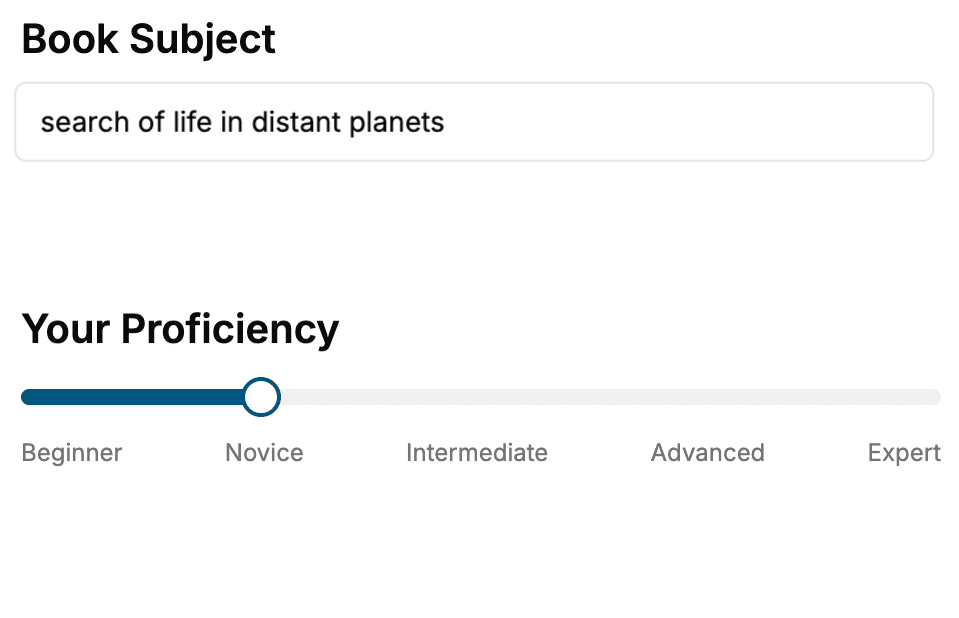
Select the focus of your Math book and share your background
- 2. Personalize your book
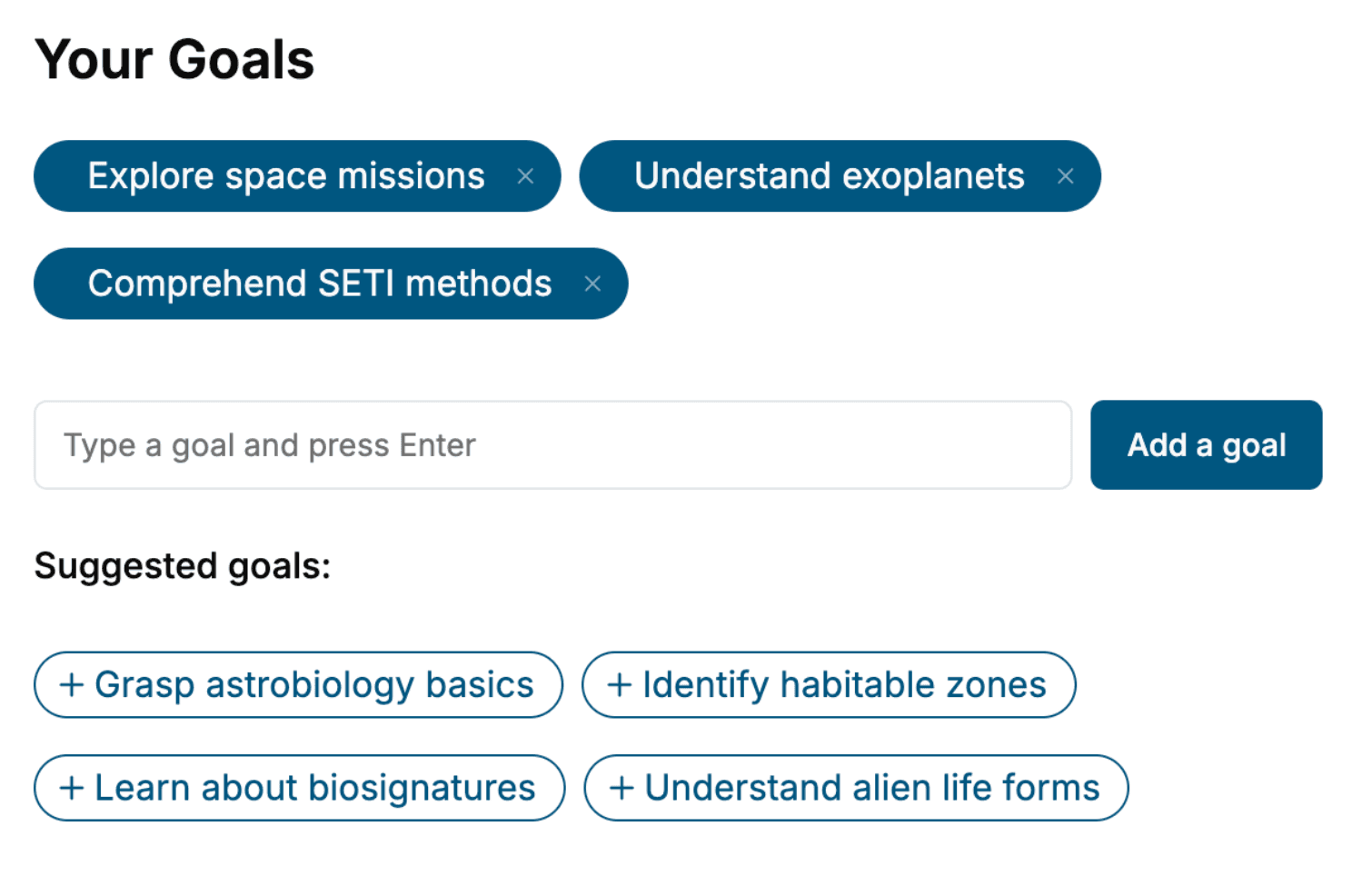
Specify your goals and choose sub-topics to include
- 3. Get your tailored book
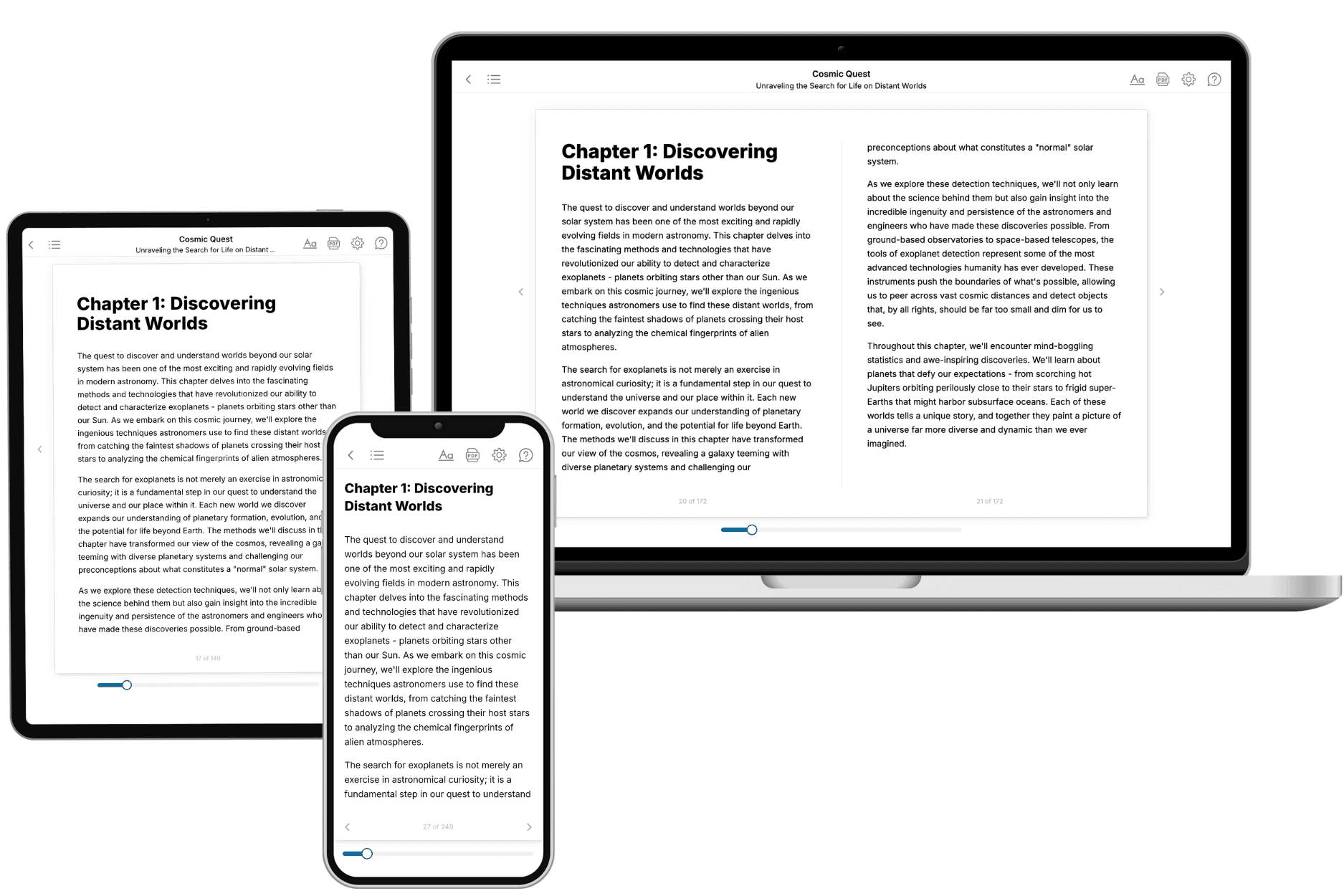
Your book is ready in 10 minutes. Read it online, download as EPUB or PDF, or send to Kindle.
Frequently asked questions
- What is TailoredRead?
TailoredRead creates complete, full-length nonfiction ebooks, written specifically for you. Tell us what you want to learn and why, and TailoredRead writes you a complete ebook on it, with charts, tables, and diagrams throughout. Read it online, on Kindle, or on any e-reader, or download it as a PDF or EPUB. Every book is written fresh the day you order it.
- How is the book tailored to me?
Before anything is written, you answer a few short questions about your goals, your background, and the topics you care about. Your book is then planned around your answers: written at your level, focused on your goals, and covering the topics you chose, instead of the one-size-fits-all book a store sells everyone.
- Will it read like generic AI content?
No. Your book isn't a chat transcript: it's planned chapter by chapter before a single word is written, told in a clear book voice, and explains ideas visually with charts, tables, and diagrams. After writing, every book goes through an editorial pass that polishes chapters so the book reads consistent from start to finish. Judge for yourself: browse thousands of sample books on our Explore Books page.
- How accurate is the content?
Our AI first checks whether your subject needs live research. Niche and fast-moving subjects are researched before writing, and the book plan and chapters are grounded in what it finds. After writing, every book goes through a quality pass that checks its facts and consistency, and researched books list their sources in a Notes section at the back.
- How long is the book?
You choose the length: Comprehensive (250-300 pages), Detailed (150-200 pages), Essential (70-100 pages), or Short (30-50 pages).
- Does the book include visuals?
Yes. Every book includes charts, tables, and diagrams: timelines, checklists, step-by-step guides, decision trees, comparison tables, matrices, and bar charts. A typical book includes dozens of these visual elements.
- Can I read it on Kindle? What formats can I download?
Yes. Every book can be read in our online reader or downloaded as a PDF or EPUB. The EPUB can be opened with Kindle, Apple Books, Kobo, and any e-reader. The Commercial and Author licenses also include an editable Word (DOCX) and Markdown download.
- How much does it cost?
About the price of a regular ebook. The exact price depends on your book's length and complexity, from $2 for the shortest books to $35 for the most comprehensive, and it's shown when you review your book, before you commit to anything. Each book is a one-time purchase, yours to keep, no subscription. Licenses that let you share, teach, or publish your book range from $35.99 to $49.99.
- Can I preview the book before purchasing?
Before you pay, you'll see what your book will cover: the title, a detailed description, the estimated length, and the complete chapter-by-chapter table of contents, so you know what you're getting before you decide. The full text itself is written after you purchase.
- How long does it take to create a book?
About 10 minutes. You can start reading the opening chapters while the rest is still being written.