Mastering Wireless Sensor Networks
A Practical Guide to Designing, Optimizing, and Troubleshooting IoT Sensor Systems
Imagine a world where your IoT devices communicate flawlessly, your smart home runs with clockwork precision, and your wireless sensor networks operate at peak efficiency.
300 pages15 chaptersDec 11, 2024IOT Development
About this book
This isn't a far-off dream—it's the reality you can create with the knowledge and skills you'll gain from "Mastering Wireless Sensor Networks." This comprehensive guide is your key to unlocking the full potential of Wireless Sensor Networks (WSNs) in the Internet of Things (IoT) era. You'll dive deep into the intricacies of WSN design, exploring cutting-edge topics such as Frequency Hopping, IoT Sensor Topologies, and Mesh Network Protocols. With each chapter, you'll build a robust foundation of knowledge that will empower you to tackle real-world challenges in WSN implementation. From understanding RF Propagation Models to mastering WSN Interference Mitigation techniques, this book covers it all. You'll learn how to optimize your network topologies for maximum efficiency, troubleshoot common issues with confidence, and enhance the reliability of your systems. Whether you're designing a smart home network or a large-scale industrial IoT solution, you'll find the insights and strategies you need to succeed. Packed with practical examples, case studies, and hands-on exercises, this book bridges the gap between theory and application. By the time you turn the last page, you'll have the skills and knowledge to design, implement, and maintain robust WSNs that stand up to the demands of today's connected world.
Table of contents
- IntroductionOverview of Wireless Sensor Networks, The IoT Revolution and WSNs, How to Use This BookRead below
- Chapter 1: Fundamentals of Wireless Sensor NetworksWSN Architecture and Components, Types of Sensors and Their Applications, Communication Protocols in WSNs, Energy Considerations in WSNs
- Chapter 2: RF Fundamentals for WSNsThe RF Spectrum and WSN Frequencies, Antenna Basics for WSNs, Signal Propagation and Path Loss, Link Budget Analysis
- Chapter 3: WSN Topologies and Network DesignTypes of Network Topologies, Star Topology in WSNs, Mesh Topology and Its Advantages, Hybrid and Custom Topologies, Selecting the Right Topology for Your Application
- Chapter 4: IoT Sensor TopologiesOverview of IoT Sensor Topologies, Edge Computing in IoT Sensor Networks, Fog Computing and Its Role in IoT, Cloud Integration for IoT Sensor Data
- Chapter 5: RF Propagation Models for WSNsFree Space Path Loss Model, Log-Distance Path Loss Model, Shadowing and Fading Models, Indoor Propagation Models, Selecting and Applying Propagation Models
- Chapter 6: WSN Interference Mitigation TechniquesCommon Sources of Interference in WSNs, Frequency Hopping Spread Spectrum (FHSS), Direct Sequence Spread Spectrum (DSSS), Dynamic Channel Selection and Allocation, Transmit Power Control Strategies
- Chapter 7: Mesh Network Protocols for WSNsBenefits of Mesh Networks in WSNs, ZigBee Protocol and Its Applications, Thread Protocol for IoT Mesh Networks, Bluetooth Mesh Networking, Designing Custom Mesh Protocols
- Chapter 8: Routing Protocols in WSNsChallenges in WSN Routing, Flat Routing Protocols, Hierarchical Routing Protocols, Location-Based Routing
- Chapter 9: Security in Wireless Sensor NetworksSecurity Challenges in WSNs, Encryption Techniques for WSNs, Key Management in WSNs, Intrusion Detection Systems for WSNs
- Chapter 10: Energy Efficiency in WSNsEnergy Constraints in WSNs, Duty Cycling and Sleep Scheduling, Energy Harvesting Techniques, Battery Technologies for WSNs
- Chapter 11: Optimizing WSN PerformanceCoverage and Connectivity Optimization, Data Aggregation and Fusion Techniques, Cross-Layer Optimization Strategies, Quality of Service (QoS) Optimization
- Chapter 12: Smart Home WSN ApplicationsHome Automation with WSNs, Energy Management and Smart Metering, Security and Surveillance Systems, Comfort and Environmental Control
- Chapter 13: Industrial IoT and WSNsFactory Automation and Process Control, Asset Tracking and Management, Predictive Maintenance Applications, Environmental Monitoring in Industry
- Chapter 14: Troubleshooting WSN IssuesCommon WSN Problems and Their Causes, Diagnostic Tools and Techniques, Network Performance Analysis, Systematic Problem-Solving Approaches
- Chapter 15: Future Trends in WSNs and IoT5G Integration with WSNs, AI and Machine Learning in WSNs, Blockchain Technology in WSNs, Emerging WSN Applications
- Conclusion
- Glossary
- Further Reading
Introduction
Welcome to the world of Wireless Sensor Networks (WSNs), a fascinating realm where tiny electronic marvels collaborate to create intelligent, responsive environments. As you embark on this journey through "Mastering Wireless Sensor Networks," you're about to unlock the potential of these remarkable systems that are revolutionizing how we interact with the world around us. Whether you're looking to enhance your smart home, optimize industrial processes, or explore cutting-edge IoT applications, the knowledge you'll gain from this book will prove invaluable.
In this introduction, we'll lay the groundwork for your exploration of WSNs, providing you with a comprehensive overview of these networks, their role in the Internet of Things (IoT) revolution, and how to make the most of this book. By the time you finish this chapter, you'll have a solid foundation upon which to build your expertise in designing, implementing, and troubleshooting WSNs for a wide range of applications.
As we delve into the intricacies of WSNs, remember that you're not just learning about technology; you're gaining the power to shape the future of connected systems. The concepts and techniques you'll master in this book will enable you to create more efficient, reliable, and innovative solutions that can improve lives and transform industries. So, let's begin this exciting journey into the heart of Wireless Sensor Networks and discover how they're changing the world, one sensor at a time.
Overview of Wireless Sensor Networks
Wireless Sensor Networks (WSNs) represent a groundbreaking technological paradigm that has emerged as a cornerstone of modern data collection and environmental monitoring systems. At their core, WSNs consist of spatially distributed autonomous devices, known as sensor nodes, which work in concert to gather, process, and transmit data about their surroundings. These networks have revolutionized our ability to observe and interact with the physical world, offering unprecedented insights into various phenomena and enabling a wide array of applications across multiple domains.
The fundamental components of a WSN include sensor nodes, gateways, and a central system for data collection and analysis. Sensor nodes, often referred to as "motes," are the building blocks of the network. These compact devices typically comprise four main elements: a sensing unit for data acquisition, a processing unit for local data handling and storage, a communication unit for wireless data transmission, and a power source, usually in the form of a battery or energy harvesting system. The versatility of sensor nodes allows them to measure a diverse range of physical or environmental conditions, such as temperature, humidity, pressure, light intensity, vibration, or even complex parameters like air quality and water contamination levels.
One of the most compelling aspects of WSNs is their ability to operate autonomously in challenging environments. Unlike traditional wired sensing systems, WSNs can be deployed in remote, hazardous, or inaccessible locations with minimal infrastructure requirements. This flexibility opens up a world of possibilities for monitoring and data collection in areas that were previously impractical or impossible to observe continuously. For instance, WSNs have been successfully used to track wildlife movements in dense forests, monitor structural health in bridges and buildings, and even detect early signs of volcanic activity in remote regions.
The architecture of a WSN is designed to facilitate efficient data collection and transmission. Sensor nodes are typically organized in a network topology that allows them to communicate with each other and relay data to a central gateway or base station. This multi-hop communication approach enables the network to cover large areas while conserving energy, as nodes can transmit data over shorter distances to their nearest neighbors rather than directly to a distant base station. The gateway serves as an interface between the WSN and external networks, such as the internet, allowing for remote access to the collected data and integration with other systems.
One of the key challenges in WSN design is energy efficiency. Since sensor nodes are often battery-powered and deployed in locations where regular maintenance is difficult, maximizing their operational lifespan is crucial. This has led to the development of sophisticated power management techniques, including duty cycling (where nodes alternate between active and sleep states), energy-efficient routing protocols, and the integration of energy harvesting technologies. These advancements have significantly extended the lifespan of WSNs, with some modern systems capable of operating for years without battery replacement.
The applications of WSNs span a wide spectrum of industries and use cases. In agriculture, WSNs are employed for precision farming, monitoring soil moisture, crop health, and environmental conditions to optimize irrigation and fertilization. In healthcare, wearable sensor networks track vital signs and patient activity, enabling remote monitoring and early detection of health issues. Industrial WSNs play a crucial role in predictive maintenance, asset tracking, and process optimization, leading to increased efficiency and reduced downtime. Environmental monitoring applications leverage WSNs for early warning systems against natural disasters, pollution monitoring, and climate change research.
As WSNs continue to evolve, they are increasingly integrated with other emerging technologies. The convergence of WSNs with artificial intelligence and machine learning algorithms is enabling more sophisticated data analysis and predictive capabilities. Edge computing paradigms are being incorporated into WSN architectures, allowing for local processing of data to reduce latency and bandwidth requirements. Furthermore, the integration of WSNs with blockchain technology is being explored to enhance data security and enable trustless data sharing in distributed sensor networks.
The scalability of WSNs is another significant advantage, allowing networks to grow from a handful of nodes to thousands or even millions of interconnected sensors. This scalability is particularly important in the context of smart cities and large-scale IoT deployments, where vast numbers of sensors work together to create comprehensive monitoring and management systems. For example, citywide WSNs can monitor traffic flow, air quality, noise levels, and energy consumption, providing valuable data for urban planning and resource management.
Despite their numerous advantages, WSNs also face several challenges that continue to drive research and innovation in the field. These include issues related to network security, as the wireless nature of communication makes WSNs potentially vulnerable to eavesdropping and malicious attacks. Data reliability and integrity are also critical concerns, particularly in applications where sensor readings inform critical decisions. Additionally, the heterogeneous nature of many WSNs, where different types of sensors with varying capabilities coexist, presents challenges in terms of network management and data integration.
As you delve deeper into the world of WSNs throughout this book, you'll gain a comprehensive understanding of these challenges and the cutting-edge solutions being developed to address them. You'll learn about advanced networking protocols, security mechanisms, and optimization techniques that are pushing the boundaries of what's possible with wireless sensor technology. By mastering these concepts, you'll be well-equipped to design, implement, and maintain robust WSN solutions that can adapt to the ever-evolving demands of the IoT landscape.
In the following chapters, we'll explore each aspect of WSNs in detail, from the fundamental principles of wireless communication to advanced topics like mesh networking and energy harvesting. Whether you're looking to optimize existing WSN deployments or create innovative new applications, the knowledge you gain will serve as a solid foundation for your journey into the exciting world of Wireless Sensor Networks. So, let's embark on this adventure together and unlock the full potential of these remarkable systems that are shaping the future of connected technologies.
The IoT Revolution and WSNs
The Internet of Things (IoT) has emerged as one of the most transformative technological paradigms of the 21st century, promising to revolutionize how we interact with the world around us. At the heart of this revolution lie Wireless Sensor Networks (WSNs), serving as the nervous system of the IoT ecosystem. The synergy between IoT and WSNs has created a powerful framework for collecting, analyzing, and acting upon vast amounts of real-time data from our physical environment. This convergence is driving innovation across industries, from smart homes and cities to industrial automation and environmental monitoring.
To truly appreciate the role of WSNs in the IoT revolution, it's essential to understand the fundamental concept of IoT. The Internet of Things refers to the interconnected network of physical devices, vehicles, home appliances, and other items embedded with electronics, software, sensors, and network connectivity, which enables these objects to collect and exchange data. The vision of IoT is to create a world where physical objects can communicate with each other and with humans, leading to more efficient processes, improved decision-making, and enhanced quality of life. According to a report by Statista, the number of IoT-connected devices worldwide is projected to reach 30.9 billion by 2025, highlighting the exponential growth and potential of this technology[1].
Wireless Sensor Networks play a crucial role in realizing the full potential of IoT by providing the means to gather detailed, real-time data from the physical world. WSNs act as the sensory organs of IoT systems, capturing a wide range of environmental parameters and physical phenomena. This data forms the foundation upon which IoT applications build their intelligence and functionality. For instance, in a smart city context, WSNs can monitor air quality, traffic flow, noise levels, and energy consumption across urban areas. This information, when integrated into an IoT platform, enables city officials to make data-driven decisions on urban planning, resource allocation, and environmental management.
The integration of WSNs into the IoT framework has led to several key advancements that are driving the IoT revolution:
- Enhanced Data Granularity: WSNs allow for the deployment of large numbers of sensors across wide areas, providing unprecedented levels of data granularity. This fine-grained data collection enables more accurate modeling of complex systems and phenomena, leading to better insights and more informed decision-making.
- Real-Time Monitoring and Response: The ability of WSNs to continuously monitor and transmit data in real-time allows IoT systems to respond quickly to changing conditions. This capability is particularly valuable in applications such as industrial process control, where rapid detection and response to anomalies can prevent costly downtime or safety incidents.
- Scalability and Flexibility: The modular nature of WSNs makes them highly scalable and adaptable to various IoT applications. Networks can be easily expanded or reconfigured to meet changing requirements, allowing IoT solutions to grow and evolve over time.
- Energy Efficiency: Advancements in low-power sensor technologies and energy-efficient communication protocols have significantly extended the battery life of WSN nodes. This increased longevity is crucial for the widespread deployment of IoT devices, particularly in remote or hard-to-reach locations.
- Edge Computing Capabilities: Modern WSNs often incorporate edge computing functionalities, allowing for local data processing and analysis. This distributed intelligence reduces the need for constant communication with central servers, lowering bandwidth requirements and improving system responsiveness.
The impact of WSN-enabled IoT solutions is being felt across numerous sectors. In agriculture, precision farming techniques leveraging WSNs and IoT are optimizing crop yields while minimizing resource usage. Sensors deployed across fields monitor soil moisture, nutrient levels, and crop health, allowing farmers to make data-driven decisions on irrigation, fertilization, and pest control. A study by the United Nations Food and Agriculture Organization estimates that precision agriculture techniques can increase crop yields by up to 70% while reducing water usage by 30%[2].
In the realm of healthcare, the combination of WSNs and IoT is enabling remote patient monitoring and personalized medicine. Wearable devices equipped with various sensors continuously track vital signs, activity levels, and other health indicators. This data is transmitted to healthcare providers in real-time, allowing for early detection of health issues and more timely interventions. According to a report by Grand View Research, the global IoT in healthcare market size is expected to reach $534.3 billion by 2025, driven by the increasing adoption of remote patient monitoring solutions[3].
The industrial sector has also been significantly transformed by the integration of WSNs into IoT systems, giving rise to the concept of Industrial IoT (IIoT). In manufacturing environments, networks of sensors monitor equipment performance, environmental conditions, and production processes in real-time. This continuous monitoring enables predictive maintenance strategies, where potential equipment failures can be identified and addressed before they occur, minimizing downtime and maintenance costs. A report by PwC estimates that predictive maintenance can reduce maintenance costs by 12%, improve uptime by 9%, and extend the lifetime of aging assets by 20%[4].
Smart cities represent another frontier where the synergy between WSNs and IoT is driving innovation. Urban areas are deploying extensive sensor networks to monitor and manage various aspects of city life, from traffic flow and parking availability to air quality and waste management. These smart city initiatives aim to improve the quality of life for residents while optimizing resource usage and reducing environmental impact. For example, the city of Barcelona implemented a comprehensive IoT strategy that included smart water management, intelligent lighting, and sensor-based parking systems. These initiatives resulted in annual savings of €42.5 million on water, increased parking fee revenues by €36.5 million, and created 47,000 new jobs[5].
As WSNs continue to evolve and integrate more deeply with IoT platforms, several emerging trends are shaping the future of this technological convergence:
- 5G Integration: The rollout of 5G networks promises to enhance the capabilities of WSNs by providing higher bandwidth, lower latency, and the ability to connect a massive number of devices. This will enable more sophisticated IoT applications that require real-time data processing and analysis.
- Artificial Intelligence and Machine Learning: The integration of AI and ML algorithms with WSN-generated data is leading to more intelligent and autonomous IoT systems. These systems can learn from historical data, predict future trends, and make decisions with minimal human intervention.
- Blockchain for Data Integrity: The use of blockchain technology in WSNs is being explored to enhance data security and ensure the integrity of sensor readings. This is particularly important in applications where data tampering could have serious consequences, such as in supply chain management or environmental monitoring.
- Energy Harvesting: Advancements in energy harvesting technologies are paving the way for self-powered WSN nodes, which can operate indefinitely by scavenging energy from their environment. This development will greatly expand the potential applications of WSNs in IoT systems, particularly in remote or inaccessible locations.
The IoT revolution, powered by Wireless Sensor Networks, is still in its early stages, with enormous potential for future growth and innovation. As you continue through this book, you'll gain a deeper understanding of the technologies and principles that underpin this revolution. You'll learn how to design, implement, and optimize WSNs for various IoT applications, equipping you with the skills to contribute to this exciting field. The knowledge you acquire will not only help you navigate the current landscape of IoT and WSNs but also prepare you for the emerging trends and challenges that lie ahead in this rapidly evolving domain.
As we move forward, remember that the true power of WSNs in the IoT revolution lies not just in the technology itself, but in its ability to solve real-world problems and improve lives. Whether you're developing solutions for smart homes, industrial automation, or environmental conservation, the principles and techniques you'll learn in this book will empower you to create innovative, efficient, and impactful IoT systems that harness the full potential of Wireless Sensor Networks.
How to Use This Book
"Mastering Wireless Sensor Networks" is designed to be your comprehensive guide to understanding, designing, and implementing effective WSN solutions for IoT applications. To help you make the most of this book and navigate its contents efficiently, this section will outline the structure of the book, provide guidance on how to approach different chapters based on your current knowledge level, and offer tips for practical application of the concepts you'll learn.
The book is structured to take you on a journey from the fundamental principles of WSNs to advanced topics and future trends. Each chapter builds upon the knowledge gained in previous sections, allowing you to progressively deepen your understanding of WSN technologies and applications. Here's an overview of how the book is organized:
- Chapters 1-2: These chapters cover the fundamentals of WSNs and RF basics. They provide a solid foundation for understanding the core concepts that underpin WSN technology.
- Chapters 3-5: Focus on network design, topologies, and RF propagation models. These chapters will help you understand how to plan and structure WSNs for optimal performance.
- Chapters 6-8: Delve into more advanced topics such as interference mitigation, mesh network protocols, and routing in WSNs. These sections are crucial for designing robust and efficient networks.
- Chapters 9-11: Cover critical aspects of WSN implementation, including security, energy efficiency, and performance optimization.
- Chapters 12-13: Explore practical applications of WSNs in smart homes and industrial IoT settings, providing real-world context for the concepts learned.
- Chapters 14-15: Focus on troubleshooting WSN issues and discuss future trends in the field, preparing you for the challenges and opportunities that lie ahead.
To make the most of this book, consider the following approach based on your current level of expertise:
- Beginners: If you're new to WSNs, start from the beginning and work your way through each chapter sequentially. Pay special attention to the fundamental concepts in the early chapters, as they form the basis for understanding more advanced topics.
- Intermediate Users: If you have some experience with WSNs, you may want to skim the early chapters to refresh your knowledge, then focus more deeply on the advanced topics starting from Chapter 6. Don't skip the practical application chapters, as they may provide new insights even for experienced practitioners.
- Advanced Users: For those with extensive WSN experience, this book can serve as a comprehensive reference. Focus on the chapters that cover areas you want to strengthen or explore new developments in the field. The chapters on future trends and advanced optimization techniques may be particularly valuable.
To get the most practical value from this book, consider the following tips:
- Hands-on Practice: Whenever possible, try to implement the concepts you learn in practical projects. Many chapters include code examples or describe techniques that can be applied in real-world scenarios. Set up a small WSN testbed to experiment with different protocols and configurations.
- Case Studies: Pay close attention to the case studies and real-world examples provided throughout the book. These illustrate how theoretical concepts are applied in practice and can inspire ideas for your own projects.
- Further Reading: At the end of each chapter, you'll find suggestions for further reading. Explore these resources to deepen your understanding of specific topics that interest you.
- Problem-Solving Approach: As you read, try to relate the concepts to problems or challenges you've encountered in your own work with WSNs. Think about how you could apply the new knowledge to solve these issues.
- Networking and Community: Join online forums or local meetups related to WSNs and IoT. Discussing the concepts you're learning with peers can enhance your understanding and provide valuable insights into real-world applications.
Remember that mastering WSNs is an ongoing process. Technology in this field is evolving rapidly, and new applications are constantly emerging. Use this book as a foundation to build your expertise, but also stay curious and continue learning beyond its pages. Regularly check for updates in WSN standards, new hardware developments, and emerging IoT applications to keep your knowledge current.
As you progress through the book, don't hesitate to revisit earlier chapters if you need to reinforce your understanding of fundamental concepts. The field of WSNs is interconnected, and a solid grasp of the basics will help you better understand and apply advanced techniques.
Finally, approach this book with a problem-solving mindset. As you learn about different aspects of WSNs, constantly ask yourself how these concepts can be applied to improve existing systems or create new solutions. The true value of your knowledge will be realized when you can use it to innovate and solve real-world challenges in the IoT landscape.
By following these guidelines and actively engaging with the material, you'll be well on your way to mastering Wireless Sensor Networks and positioning yourself at the forefront of IoT innovation. Embrace the journey ahead, and let's explore the fascinating world of WSNs together!
Notes
Introduction
- 1. Statista Research Department, Internet of Things (IoT) connected devices installed base worldwide from 2015 to 2025, Statista, 2021
- 2. Food and Agriculture Organization of the United Nations, E-Agriculture in Action: Drones for Agriculture, Bangkok, 2018
- 3. Grand View Research, IoT in Healthcare Market Size, Share & Trends Analysis Report By Component, By Application, By End Use, By Region, And Segment Forecasts, 2019
- 4. PwC, Industry 4.0: Building the digital enterprise, 2017
- 5. Harvard Business Review, How Smart City Barcelona Brought the Internet of Things to Life, 2017
This is the end of the free sample. The full book has 15 chapters.
Want this book written for you?
Tell us your goals and background, and get your own version of this book, tailored by AI to you.


Benefits of AI-tailored books
- Read one book, not ten:
- all the IOT Development knowledge you need, gathered into a single book.
- Save days of learning:
- tell us your goals, choose your topics, and the whole book is built around them.
- Learn effortlessly:
- IOT Development book written for your specific background and expertise.
- Understand at a glance:
- includes charts, tables, timelines, checklists, decision trees, and more.
- Stay current:
- written the day you order it, not years ago.
- Trust what you read:
- every book is checked for accuracy, with real research when your subject needs it.
Create your unique book in 3 steps
- 1. Select your focus
Select the focus of your IOT Development book and share your background
- 2. Personalize your book
Specify your goals and choose sub-topics to include
- 3. Get your tailored book
Your book is ready in 10 minutes. Read it online, download as EPUB or PDF, or send to Kindle.


Frequently asked questions
- What is TailoredRead?
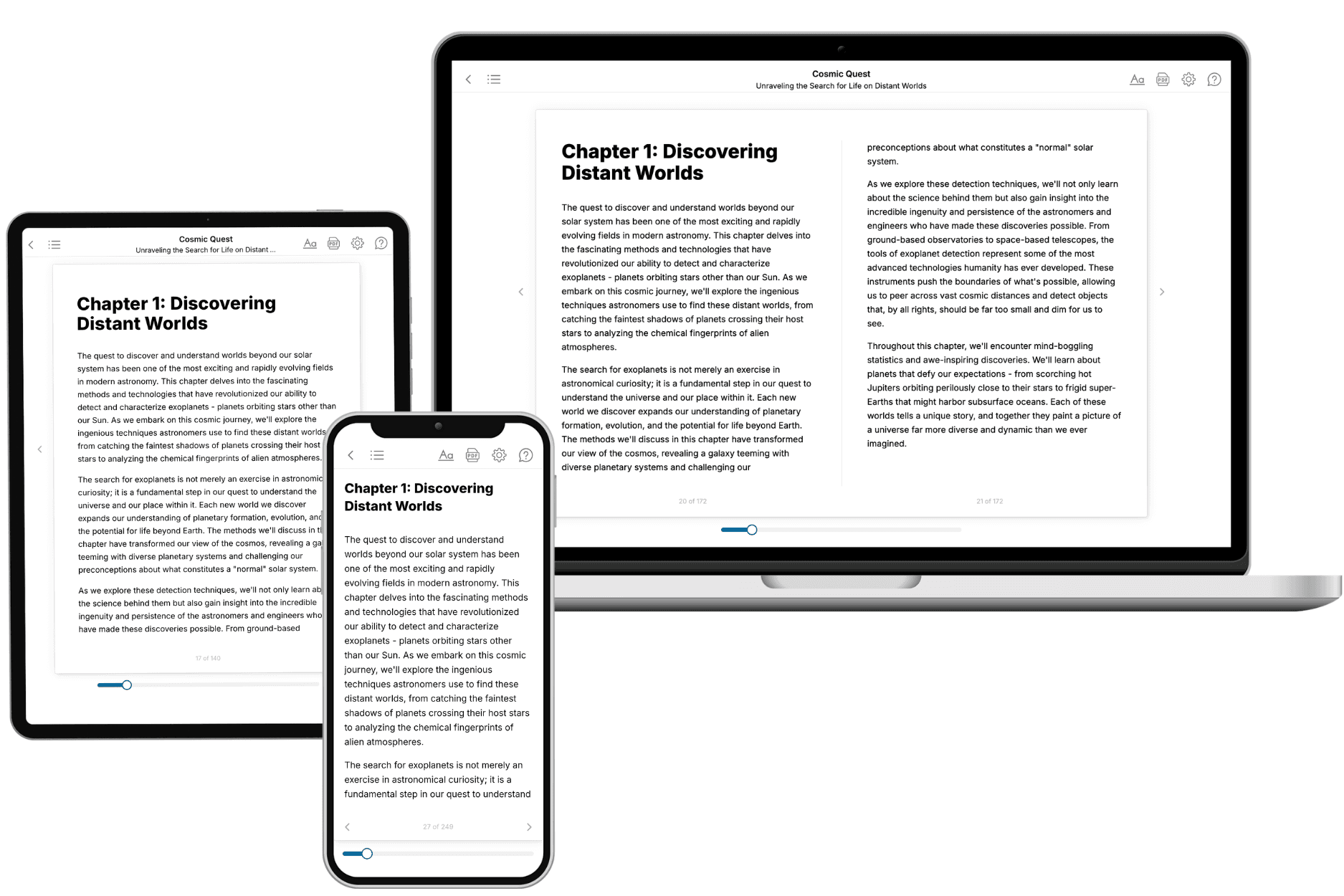
TailoredRead creates complete, full-length nonfiction ebooks, written specifically for you. Tell us what you want to learn and why, and TailoredRead writes you a complete ebook on it, with charts, tables, and diagrams throughout. Read it online, on Kindle, or on any e-reader, or download it as a PDF or EPUB. Every book is written fresh the day you order it.
- How is the book tailored to me?
Before anything is written, you answer a few short questions about your goals, your background, and the topics you care about. Your book is then planned around your answers: written at your level, focused on your goals, and covering the topics you chose, instead of the one-size-fits-all book a store sells everyone.
- Will it read like generic AI content?
No. Your book isn't a chat transcript: it's planned chapter by chapter before a single word is written, told in a clear book voice, and explains ideas visually with charts, tables, and diagrams. After writing, every book goes through an editorial pass that polishes chapters so the book reads consistent from start to finish. Judge for yourself: browse thousands of sample books on our Explore Books page.
- How accurate is the content?
Our AI first checks whether your subject needs live research. Niche and fast-moving subjects are researched before writing, and the book plan and chapters are grounded in what it finds. After writing, every book goes through a quality pass that checks its facts and consistency, and researched books list their sources in a Notes section at the back.
- How long is the book?
You choose the length: Comprehensive (250-300 pages), Detailed (150-200 pages), Essential (70-100 pages), or Short (30-50 pages).
- Does the book include visuals?
Yes. Every book includes visual elements such as timelines, checklists, step-by-step guides, decision trees, comparison tables, and matrices, and many include bar charts. A typical book includes dozens of these visual elements.
- Can I read it on Kindle? What formats can I download?
Yes. Every book can be read in our online reader or downloaded as a PDF or EPUB. The EPUB can be opened with Kindle, Apple Books, Kobo, and any e-reader. The Commercial and Author licenses also include an editable Word (DOCX) and Markdown download.
- How much does it cost?
About the price of a regular ebook. The exact price depends on your book's length and complexity, from $2 for the shortest books to $35 for the most comprehensive, and it's shown when you review your book, before you commit to anything. Each book is a one-time purchase, yours to keep, no subscription. Licenses that let you share, teach, or publish your book range from $35.99 to $49.99.
- Can I preview the book before purchasing?
Before you pay, you'll see what your book will cover: the title, a detailed description, the estimated length, and the complete chapter-by-chapter table of contents, so you know what you're getting before you decide. The full text itself is written after you purchase.
- How long does it take to create a book?
About 10 minutes. You can start reading the opening chapters while the rest is still being written.