The Math Behind the Machine
Linear algebra, calculus, and probability for working in AI
Picture yourself opening a machine learning research paper and following every equation without stopping to search for definitions.
222 pages10 chaptersNov 25, 2026Created by Chaitanya Murthy
About this book
The notation that once looked like a wall starts to read like plain language, because you can see the vectors, matrices, and distributions behind each symbol. This book is written for practitioners who already work with machine learning and want that clarity. It begins with linear algebra, where data, transformations, and model parameters live, and builds toward eigenvalues and eigenvectors and the reasons they matter for dimensionality reduction. From there it moves into calculus, gradients, and gradient descent, showing how backpropagation is the chain rule applied with care. It then covers probability, statistics, and information theory, explaining how loss functions express uncertainty, and closes with optimization and regularization. Each chapter ties the mathematics to the models and papers you already encounter, so every idea has a clear place in your work. Read it to build durable intuition for AI architecture, engineering, and research.
Table of contents
- IntroductionWhy the Mathematics Matters for Practitioners, How to Read This Book's NotationRead below
- Chapter 1: Linear Algebra FoundationsVectors as Representations of Data, Matrices as Linear Transformations, What Matrix Multiplication Actually Does
- Chapter 2: Vector Spaces, Norms, and DistancesSpan, Linear Independence, and Basis, Norms and the Geometry of Distance, Inner Products and Orthogonality
- Chapter 3: Eigenvalues and EigenvectorsEigenvectors as Preserved Directions, Computing Eigenvalues from the Characteristic Equation, Why Eigen-Structure Shows Up in Machine Learning
- Chapter 4: Matrix Decompositions in PracticeThe Spectral Theorem and Symmetric Matrices, Singular Value Decomposition Explained, Principal Component Analysis as a Decomposition
- Chapter 5: Calculus, Derivatives, and GradientsDerivatives as Local Rates of Change, Partial Derivatives and the Gradient Vector, Jacobians and Hessians for Multivariate Functions
- Chapter 6: Gradient Descent and OptimizationTaking Steps Downhill with Gradient Descent, Learning Rate Choices and Their Tradeoffs, Convexity, Saddle Points, and Local Minima
- Chapter 7: Backpropagation and the Chain RuleThe Chain Rule Applied to Nested Functions, Computation Graphs and Reverse-Mode Differentiation, A Worked Backpropagation Example Through a Network
- Chapter 8: Probability, Statistics, and UncertaintyRandom Variables and Probability Distributions, Maximum Likelihood Estimation and Loss Functions, Bayesian Thinking and Prior Beliefs
- Chapter 9: Information Theory for Learning SystemsEntropy as a Measure of Uncertainty, Cross-Entropy and Classification Losses, KL Divergence and Comparing Distributions
- Chapter 10: Regularization and GeneralizationRegularization as Penalties and Constraints, The Bias-Variance Tradeoff in Practice
- ConclusionBuilding on These Foundations in Your Work
- Further Reading and Resources
- Glossary
Introduction
A training run fails to converge, and the loss curve flattens out at a value far worse than expected. One engineer checks the learning rate schedule. Another suspects the data pipeline. A third opens the paper the architecture came from and starts tracing through its notation, looking for a detail about initialization or normalization that might explain the stall. That third path, reading the mathematics directly instead of guessing from symptoms, is the skill this book builds. It is not a skill reserved for researchers publishing new architectures. It belongs to anyone who wants to reason about why a model behaves the way it does rather than treat it as a sealed box.
Machine learning libraries have made it possible to build working systems without writing out a single derivative or eigenvalue by hand. A few lines of code can load a dataset, define a Transformer, and start training. This convenience is genuinely useful, but it also hides the layer where the real decisions live. Learning rate schedules, weight initialization, regularization strength, and architecture choices all trace back to mathematical reasoning. Without that reasoning, debugging becomes guesswork, and reading a paper becomes an exercise in skipping over equations to get to the results table.
This book treats mathematics as a working language rather than a hurdle to clear before the real work begins. Each topic is chosen because it shows up directly in the models, training procedures, and papers encountered in applied and research roles. The chapters move from linear algebra, where data and parameters are represented, through eigenvalues and decompositions, into calculus and the gradient-based optimization that trains nearly every modern model, and finally into probability and information theory, where loss functions get their meaning. Regularization closes the arc by explaining why none of this works without constraints on what a model is allowed to learn.
None of this requires rediscovering mathematics from first principles the way a pure mathematics course might. The goal is fluency with the specific tools that recur across machine learning and generative AI, built through intuition, worked examples, and enough formalism to make the notation in a paper legible. A reader who already has some machine learning background will recognize many of the ideas in disguise. What changes is the ability to see the mechanism underneath the familiar term, whether that term is backpropagation, cross-entropy, or singular value decomposition.
Why the Mathematics Matters for Practitioners
Consider the difference between two engineers debugging the same stalled training run. One adjusts hyperparameters by trial and error, rerunning the job with a slightly smaller learning rate and hoping for improvement. The other looks at the loss landscape, recognizes a symptom consistent with a poorly conditioned gradient, and reasons about which layer or initialization choice is responsible. Both might eventually fix the problem, but only one of them understands why the fix worked and can apply that understanding to the next unrelated failure. That difference compounds over a career, and it is the difference mathematical fluency creates.
Model architecture decisions also rest on mathematical reasoning more than on API familiarity. Choosing between a wider or deeper network, deciding whether to add a residual connection, or understanding why attention layers behave differently from convolutional ones all depend on recognizing how information and gradients flow through a computation graph. A practitioner who treats these as fixed recipes from a tutorial will eventually hit a case the tutorial did not cover. A practitioner who understands the underlying matrix multiplication, gradient flow, and probability assumptions can adapt the architecture to a new problem with confidence instead of trial and error.
Reading research papers is where this gap becomes most visible. A typical paper introduces a model with a notation-heavy section defining vectors, matrices, loss functions, and sometimes an entropy-based regularizer, all within a few paragraphs. Without fluency in that notation, a reader either skips the mathematics and takes the results on faith, or spends hours decoding symbols that a trained eye would recognize instantly. Fluency turns a paper from an opaque artifact into a readable argument, letting a practitioner judge whether a claimed improvement is mathematically sound or whether it depends on an assumption that may not hold in a different setting.
Generative AI systems add another layer of reasons to build this fluency. Large language models and diffusion models are described, trained, and evaluated using exactly the mathematics this book covers: probability distributions over tokens or pixels, loss functions built from cross-entropy or related measures, and optimization procedures built from gradients. Understanding why a language model produces a particular distribution over the next token, or why a diffusion model's training objective involves comparing distributions, requires the probability and information theory developed later. Without it, these systems remain mysterious even to someone who uses them daily.
The mathematics also explains failure modes that otherwise look like bad luck. Overfitting, exploding or vanishing gradients, and poor generalization to new data are not random occurrences. They are consequences of specific mathematical conditions, like a loss landscape with extreme curvature or a model complexity that outpaces the available data. The chapters on gradients, optimization, and regularization each give a vocabulary for naming these conditions precisely instead of describing them vaguely as the model is not working well.
There is a practical career argument here as well. Roles in AI architecture, engineering, and research increasingly expect candidates to explain the reasoning behind a design choice, not just implement it. An interview question about why a particular normalization layer is used, or why a given loss function is appropriate for a task, is really a question about the underlying mathematics. Being able to answer with the mechanism rather than a memorized rule signals the kind of understanding that these roles reward, and it is the understanding this book is built to produce.
Mathematical fluency also shortens the distance between reading about an idea and testing it. A practitioner who understands gradients can quickly reason about whether a proposed change to a loss function will actually push training in the intended direction, before running a single experiment. This saves real time, since training runs for modern models are expensive, and an intuition built on sound mathematics catches many dead ends before they consume compute. The chapters ahead are written with this efficiency in mind: not mathematics for its own sake, but mathematics that changes what you can predict and verify before writing code.
Finally, this fluency builds durability. Specific frameworks, libraries, and even architectures change on a timescale of a few years, but the mathematics underneath them is comparatively stable. A practitioner who learns an API learns something that may be deprecated. A practitioner who learns why gradient descent converges, or why eigenvectors capture directions of variance, has learned something that will still apply to whatever architecture or framework replaces today's dominant ones. That is the long-term case for treating this material as foundational rather than optional.
How to Read This Book's Notation
Mathematical notation in machine learning papers can look intimidating mostly because of density, not because of difficulty. A single line might contain a vector, a matrix, a subscript indexing a training example, a superscript indexing a layer, and a probability distribution, all compressed into a few characters. Learning to read this comfortably is less about memorizing symbols and more about learning a small set of conventions that repeat across almost every paper and textbook, including this one. The rest of this section lays out those conventions so that later chapters can be read without needing to pause and decode the notation itself.
Lowercase letters, usually in bold in printed sources, typically denote vectors: a single data point, a parameter vector, or a direction in space. This book writes vectors as plain lowercase letters like x or w, relying on context to make clear that a vector, not a single number, is meant. Uppercase letters denote matrices, which represent either a collection of vectors (such as a dataset where each row is one example) or a linear transformation (such as the weights connecting one layer of a network to the next). When you see X or W, read it as a table of numbers that acts on or stores vectors, with its exact meaning depending on context, something the linear algebra foundations chapter makes precise.
Subscripts almost always index into a collection. The notation xi refers to the i-th element of a vector or the i-th example in a dataset, while an in a sequence context refers to the n-th term. When two indices appear, as in Aij, the first typically indexes rows and the second columns of a matrix. Superscripts carry more than one meaning depending on context: a superscript in parentheses, like x(i), usually indexes a training example to keep it visually distinct from component indexing, while a plain superscript, like x2, means ordinary exponentiation. This book keeps that distinction consistent, so a parenthesized superscript always means which example, never a power.
Greek letters show up constantly and each tends to have a conventional role worth recognizing on sight. θ commonly denotes the full set of a model's parameters, bundled together as a single vector even though it may represent millions of individual weights. η or sometimes α denotes a learning rate, the step size in gradient descent. λ frequently denotes a regularization strength, controlling how much a penalty term influences training. ε denotes a small quantity, often used to avoid division by zero or to describe an infinitesimal change. σ can mean either a standard deviation in a probability context or an activation function, usually the sigmoid, in a neural network context, and recognizing which chapter or equation you are in resolves the ambiguity.
Operators carry their own grammar worth internalizing early. The gradient symbol ∇ applied to a function, as in ∇f(x), produces a vector of partial derivatives, one for each input dimension, and this vector points in the direction of steepest increase of f at the point x. A subscript on the gradient symbol, as in ∇θL, specifies which variable the derivatives are being taken with respect to, which matters once a function depends on several different kinds of variables at once, such as a loss L that depends on both parameters θ and input data. The summation symbol Σ with limits below and above, as in Σi=1n xi, simply adds up a sequence of terms, and recognizing this quickly prevents a long formula from feeling like an obstacle rather than a sum.
Probability notation follows its own conventions that recur throughout the probability, information theory, and loss function chapters. A capital letter like P or p followed by parentheses, as in p(x), denotes a probability or a probability density over the variable x. A vertical bar inside the parentheses, as in p(y|x), denotes a conditional probability, read as the probability of y given x, which is exactly the quantity a classifier or language model is typically trained to approximate. The expectation symbol 𝔼, sometimes written with a subscript naming the distribution being averaged over, denotes an average computed according to a probability distribution rather than a simple arithmetic mean over a fixed list.
Function notation in machine learning often nests several layers deep, and learning to read that nesting from the inside out resolves most of the apparent complexity. A loss function might be written as L(fθ(x), y), which reads as: first apply the model f, parameterized by θ, to the input x, producing a prediction, then compare that prediction to the true label y using the loss L. Reading outward from the innermost parentheses, rather than trying to parse the whole expression simultaneously, turns a dense formula into a short sequence of simple steps, each of which this book's later chapters cover individually.
Throughout this book, a formula meant to be studied on its own sits apart on its own line, while a short formula mentioned inline stays within the sentence that introduces it. This mirrors the convention used in most textbooks and papers, where a displayed equation marks a result worth pausing on, such as the definition of the gradient or the update rule for gradient descent, shown below as an example of the format used throughout.
θt+1 = θt - η ∇θL(θt)
This single line says that the next set of parameters equals the current set, minus a small step in the direction the gradient points, scaled by the learning rate. Every chapter from the one on gradients onward will return to a formula in this same shape, and being able to parse it on sight, rather than treating it as an unfamiliar block of symbols, is exactly the payoff of spending time on notation now.
A short glossary at the end of the book collects these symbols and terms in one place for quick reference, so a notation that feels unfamiliar partway through a later chapter can be looked up without losing the thread of the argument. Treat that glossary as a companion rather than a prerequisite. Fluency in reading notation, like fluency in a spoken language, comes from repeated exposure in context rather than from memorizing a table in advance. Each chapter ahead introduces its symbols as they first appear, defines them in plain language before using them formally, and reuses them consistently so that by the chapter on backpropagation, an expression like ∂L/∂wij reads as naturally as an ordinary sentence.
One last habit is worth building before moving on: whenever an equation appears, try restating it in words before reading the explanation that follows it. This single practice, done consistently, is what turns notation from a barrier into a second language, and it is the practice this book is structured to reward from the very next chapter onward.
This is the end of the free sample. The full book has 10 chapters.
Want this book written for you?
Tell us your goals and background, and get your own version of this book, tailored by AI to you.


Benefits of AI-tailored books
- Read one book, not ten:
- all the knowledge you need, gathered into a single book.
- Save days of learning:
- tell us your goals, choose your topics, and the whole book is built around them.
- Learn effortlessly:
- a book written for your specific background and expertise.
- Understand at a glance:
- includes charts, tables, timelines, checklists, decision trees, and more.
- Stay current:
- written the day you order it, not years ago.
- Trust what you read:
- every book is checked for accuracy, with real research when your subject needs it.
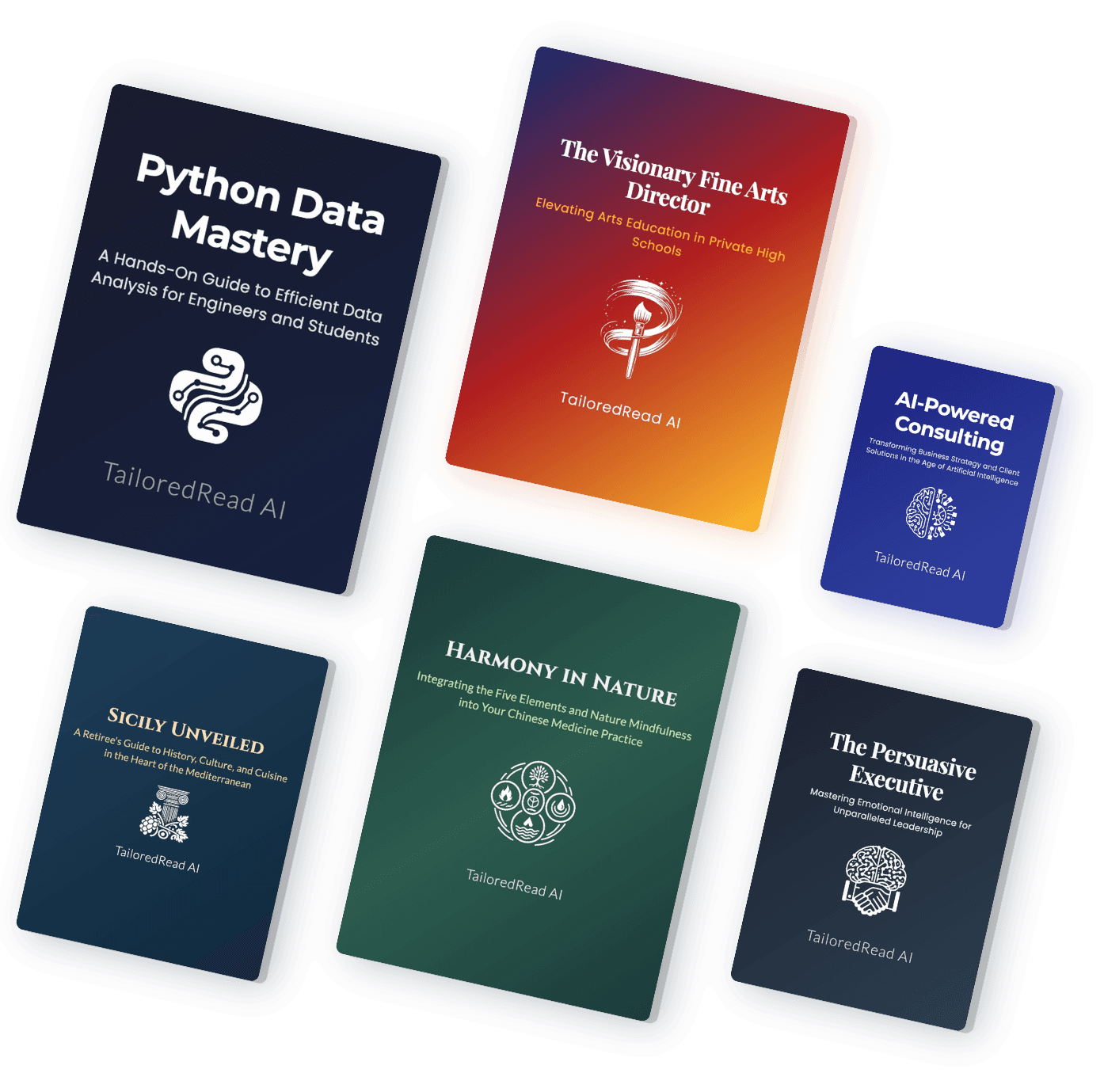
Create your unique book in 3 steps
- 1. Pick a subject
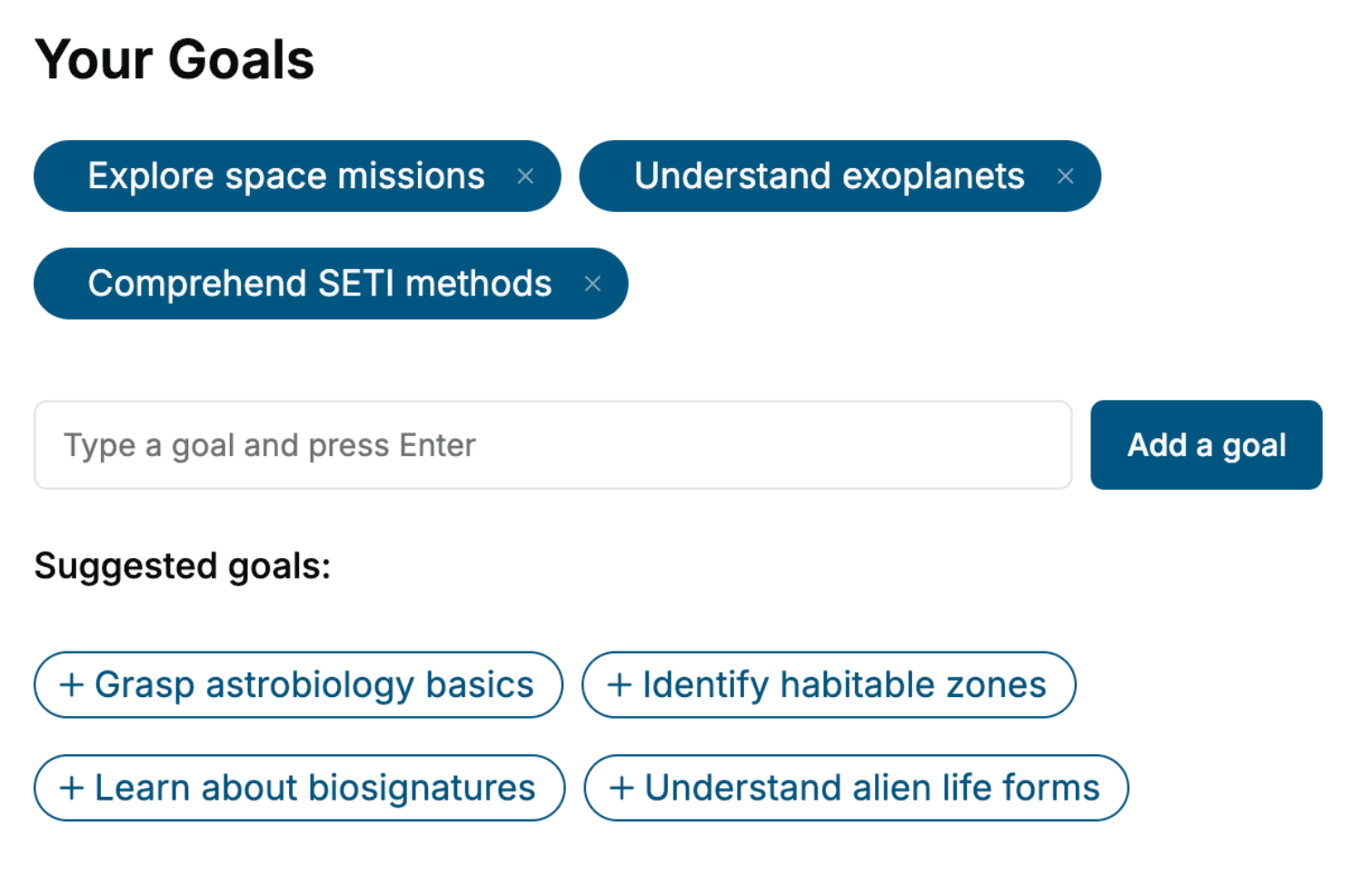
Select what you want to learn and share your background
- 2. Personalize your book
Specify your goals and choose sub-topics to include
- 3. Get your tailored book
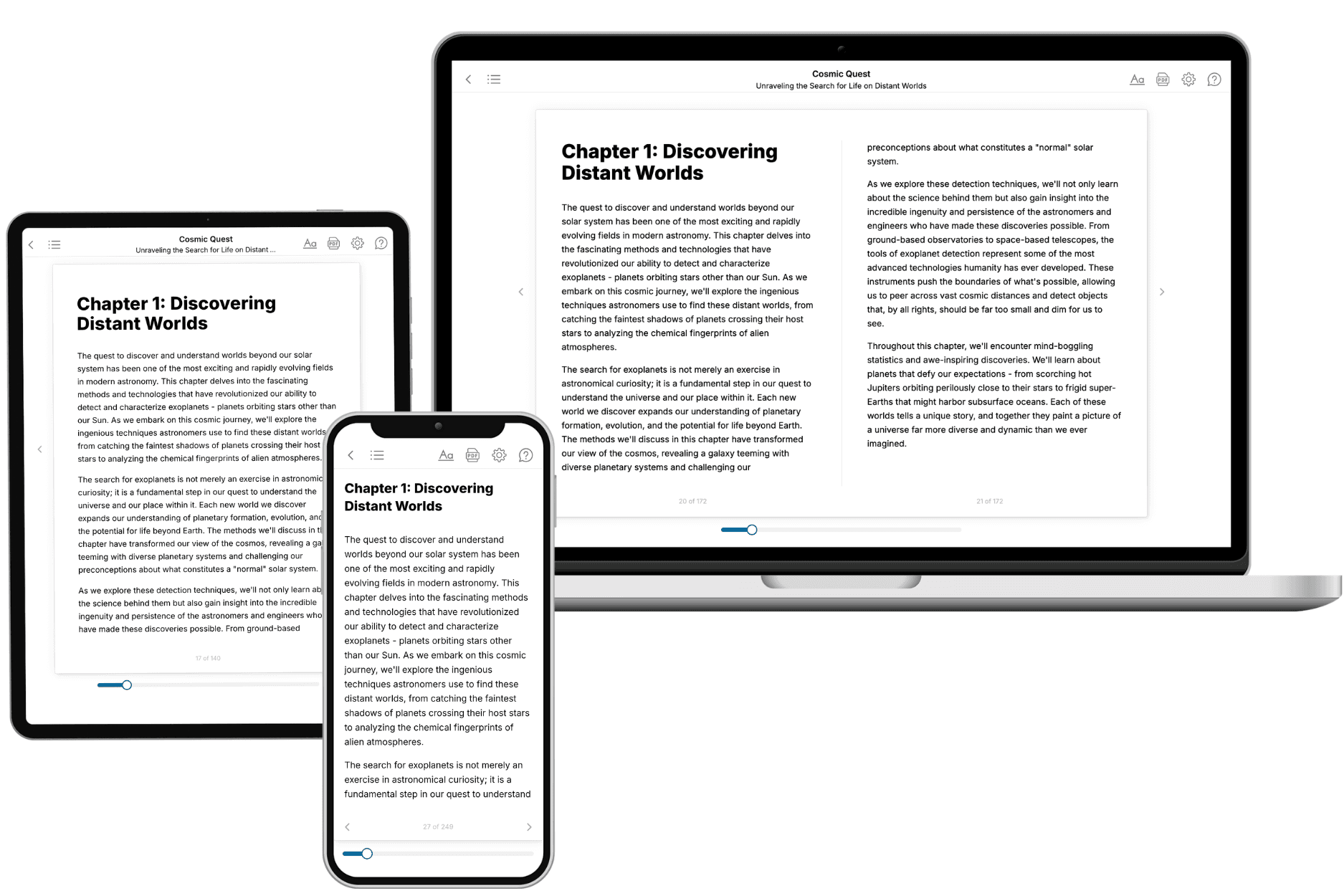
Your book is ready in 10 minutes. Read it online, download as EPUB or PDF, or send to Kindle.

Frequently asked questions
- What is TailoredRead?
TailoredRead creates complete, full-length nonfiction ebooks, written specifically for you. Tell us what you want to learn and why, and TailoredRead writes you a complete ebook on it, with charts, tables, and diagrams throughout. Read it online, on Kindle, or on any e-reader, or download it as a PDF or EPUB. Every book is written fresh the day you order it.
- How is the book tailored to me?
Before anything is written, you answer a few short questions about your goals, your background, and the topics you care about. Your book is then planned around your answers: written at your level, focused on your goals, and covering the topics you chose, instead of the one-size-fits-all book a store sells everyone.
- Will it read like generic AI content?
No. Your book isn't a chat transcript: it's planned chapter by chapter before a single word is written, told in a clear book voice, and explains ideas visually with charts, tables, and diagrams. After writing, every book goes through an editorial pass that polishes chapters so the book reads consistent from start to finish. Judge for yourself: browse thousands of sample books on our Explore Books page.
- How accurate is the content?
Our AI first checks whether your subject needs live research. Niche and fast-moving subjects are researched before writing, and the book plan and chapters are grounded in what it finds. After writing, every book goes through a quality pass that checks its facts and consistency, and researched books list their sources in a Notes section at the back.
- How long is the book?
You choose the length: Comprehensive (250-300 pages), Detailed (150-200 pages), Essential (70-100 pages), or Short (30-50 pages).
- Does the book include visuals?
Yes. Every book includes visual elements such as timelines, checklists, step-by-step guides, decision trees, comparison tables, and matrices, and many include bar charts. A typical book includes dozens of these visual elements.
- Can I read it on Kindle? What formats can I download?
Yes. Every book can be read in our online reader or downloaded as a PDF or EPUB. The EPUB can be opened with Kindle, Apple Books, Kobo, and any e-reader. The Commercial and Author licenses also include an editable Word (DOCX) and Markdown download.
- How much does it cost?
About the price of a regular ebook. The exact price depends on your book's length and complexity, from $2 for the shortest books to $35 for the most comprehensive, and it's shown when you review your book, before you commit to anything. Each book is a one-time purchase, yours to keep, no subscription. Licenses that let you share, teach, or publish your book range from $35.99 to $49.99.
- Can I preview the book before purchasing?
Before you pay, you'll see what your book will cover: the title, a detailed description, the estimated length, and the complete chapter-by-chapter table of contents, so you know what you're getting before you decide. The full text itself is written after you purchase.
- How long does it take to create a book?
10 minutes. You can start reading the opening chapters while the rest is still being written.