Matrix Mastery
Unlocking the Power of Matrices and Determinants in Algebra
Your mathematical journey is about to take an exciting turn as you delve into the fascinating world of matrices and determinants.
269 pages13 chaptersSep 1, 2025Linear Algebra
About this book
This book will guide you through the intricate landscape of these powerful algebraic tools, revealing their beauty and practical applications. As you progress through the pages, you'll discover how matrices and determinants form the backbone of many advanced mathematical concepts. You'll learn to manipulate these mathematical structures with confidence, applying them to solve complex problems in algebra and beyond. By the end of this book, you'll have gained a deep appreciation for the elegance of matrices and determinants. You'll be equipped with the skills to tackle a wide range of mathematical challenges, opening doors to new realms of problem-solving and analytical thinking. Get ready to elevate your algebraic prowess and see the world of mathematics through a new lens.
Table of contents
- IntroductionWhat are Matrices?, Understanding Determinants, Importance in Algebra and Beyond, Overview of the BookRead below
- Chapter 1: Fundamentals of MatricesDefinition and Notation, Types of Matrices, Matrix Equality, Transpose of a Matrix
- Chapter 2: Matrix OperationsAddition and Subtraction, Scalar Multiplication, Matrix Multiplication, Properties of Matrix Operations
- Chapter 3: Introduction to DeterminantsDefinition of Determinants, Calculating 2x2 Determinants, Calculating 3x3 Determinants, Properties of Determinants
- Chapter 4: Advanced Determinant TechniquesCofactor Expansion, Laplace Expansion, Determinants of Larger Matrices, Applications of Determinants
- Chapter 5: Special Types of MatricesIdentity Matrix, Diagonal Matrix, Upper and Lower Triangular Matrices, Symmetric Matrix
- Chapter 6: Matrix InverseDefinition of Matrix Inverse, Finding the Inverse of a 2x2 Matrix, Inverting Larger Matrices, Properties of Matrix Inverse
- Chapter 7: Solving Systems of Linear EquationsMatrix Representation of Linear Systems, Gaussian Elimination, Cramer's Rule, Matrix Inverse Method
- Chapter 8: Eigenvalues and EigenvectorsDefinition of Eigenvalues and Eigenvectors, The Characteristic Equation, Finding Eigenvectors, Applications of Eigenvalues and Eigenvectors
- Chapter 9: Matrix TransformationsLinear Transformations, Rotation Matrices, Scaling Matrices, Reflection Matrices
- Chapter 10: Matrix DecompositionLU Decomposition, QR Decomposition, Singular Value Decomposition, Applications of Matrix Decomposition
- Chapter 11: Introduction to Matrix CalculusMatrix Derivatives, Gradient Vectors, Hessian Matrices, Optimization Problems with Matrices
- Chapter 12: Real-World ApplicationsComputer Graphics and Image Processing, Data Analysis and Machine Learning, Engineering and Physics Applications, Economics and Social Sciences
- Chapter 13: Advanced Topics in Matrix TheoryJordan Canonical Form, Matrix Norms, Positive Definite Matrices, Advanced Matrix Calculus
- ConclusionKey Takeaways, Future Directions in Matrix Theory
- Glossary
- Further Reading
Introduction
Welcome to the fascinating world of matrices and determinants, where numbers and symbols intertwine to form powerful mathematical structures that unlock countless possibilities in algebra and beyond. As you embark on this journey through "Matrix Mastery: Unlocking the Power of Matrices and Determinants in Algebra," you're about to discover how these fundamental concepts serve as the backbone for a wide array of mathematical applications, from solving complex systems of equations to transforming geometric shapes and analyzing vast datasets.
This introduction will lay the groundwork for your exploration, providing you with a solid understanding of what matrices and determinants are, why they're so important in algebra and other fields, and how this book will guide you through mastering these essential mathematical tools. By the time you finish this chapter, you'll have a clear roadmap for the exciting journey ahead and a glimpse into the transformative power of matrix mathematics.
As you progress through this book, you'll find that matrices and determinants are not just abstract concepts confined to textbooks and academic papers. They are dynamic tools used in various real-world applications, from computer graphics and image processing to economic modeling and quantum mechanics. The skills you'll develop in understanding and manipulating these mathematical structures will enhance your problem-solving abilities and open up new avenues of analytical thinking.
Whether you're a student looking to excel in your algebra courses, a professional seeking to apply mathematical concepts in your work, or simply a curious mind eager to delve deeper into the elegant world of mathematics, this book is designed to meet you at your current level of understanding and elevate your knowledge to new heights. So, let's begin our exploration of matrices and determinants, starting with the fundamental concepts that will serve as the building blocks for all that follows.
What are Matrices?
At its core, a matrix is a rectangular array of numbers, symbols, or expressions arranged in rows and columns. This simple definition belies the incredible versatility and power of matrices in mathematical operations and problem-solving. Matrices serve as a compact way to represent and manipulate large sets of data, making them indispensable in fields ranging from pure mathematics to applied sciences and engineering.
The concept of matrices dates back to ancient times, with early forms appearing in Chinese mathematics as early as 250 BCE in the context of solving systems of linear equations. However, the modern theory of matrices began to take shape in the 18th and 19th centuries, with significant contributions from mathematicians such as Arthur Cayley and James Joseph Sylvester[1].
To understand the structure of a matrix, let's consider a simple example:
A = [2  3  1]
    [4  1  5]
    [0  2  6]
Matrices come in various sizes and types, each with its own properties and applications. Some common types include:
- Square matrices: These have an equal number of rows and columns.
- Rectangular matrices: These have a different number of rows and columns.
- Identity matrices: Square matrices with 1s on the main diagonal and 0s elsewhere.
- Zero matrices: All elements are zero.
- Diagonal matrices: All elements outside the main diagonal are zero.
- A system of linear equations
- A linear transformation in geometry
- A graph or network in computer science
- Economic data in input-output models
- Pixel values in digital image processing
One of the most powerful aspects of matrices is the wide range of operations that can be performed on them. These operations, which we'll explore in depth throughout this book, include addition, subtraction, multiplication, and more complex manipulations like finding inverses and calculating determinants. Each of these operations has specific rules and properties that make matrices a rich and complex subject of study.
For instance, matrix multiplication is not commutative (A × B is not necessarily equal to B × A), which is a departure from the multiplication of ordinary numbers. This property leads to interesting consequences in various applications, such as in the composition of geometric transformations or in quantum mechanics, where the order of operations can significantly affect the outcome.
As you progress through this book, you'll discover how matrices serve as a unifying concept in mathematics, bridging various branches such as linear algebra, geometry, and calculus. You'll learn to see mathematical problems through the lens of matrices, often simplifying complex systems into more manageable forms. This matrix perspective will not only enhance your problem-solving skills but also provide you with a powerful tool for modeling and analyzing real-world phenomena.
In the coming chapters, we'll delve deeper into the properties and operations of matrices, building your understanding step by step. You'll learn how to manipulate matrices with confidence, solve systems of equations using matrix methods, and apply matrix concepts to a wide range of mathematical and practical problems. By the end of this journey, you'll see matrices not just as arrays of numbers, but as a fundamental language for expressing and solving complex mathematical relationships.
Understanding Determinants
While matrices provide a powerful framework for organizing and manipulating data, determinants offer a way to extract crucial information from square matrices. A determinant is a scalar value that can be computed from the elements of a square matrix. This single number encapsulates important properties of the matrix and has far-reaching implications in various areas of mathematics and its applications.
The concept of determinants emerged in the 17th century, predating the formal development of matrix theory. Gottfried Wilhelm Leibniz, one of the inventors of calculus, introduced determinants in 1693 as a way to solve systems of linear equations[2]. Since then, determinants have become an integral part of linear algebra and have found applications in diverse fields such as geometry, differential equations, and even quantum mechanics.
To understand what a determinant represents, let's start with a simple 2x2 matrix:
A = [a  b]
    [c  d]
For larger matrices, the calculation of determinants becomes more complex, involving recursive processes or expansion techniques. For instance, the determinant of a 3x3 matrix:
A = [a  b  c]
    [d  e  f]
    [g  h  i]
The importance of determinants in mathematics cannot be overstated. They serve several crucial functions:
- Determining matrix invertibility: A matrix is invertible if and only if its determinant is non-zero.
- Solving systems of linear equations: Cramer's rule uses determinants to solve systems of equations.
- Calculating areas and volumes: Determinants can be used to find areas of triangles and parallelograms, as well as volumes of parallelepipeds in higher dimensions.
- Characterizing linear transformations: The determinant indicates whether a transformation preserves, reverses, or collapses orientation.
- Finding eigenvalues: The characteristic equation, used to find eigenvalues, is based on the determinant.
One of the most fascinating aspects of determinants is their connection to the geometry of space. For example, in two dimensions, the sign of the determinant tells us about the orientation of the vectors. A positive determinant indicates that the column vectors form a right-handed coordinate system, while a negative determinant indicates a left-handed system. In three dimensions, the absolute value of the determinant represents the volume of the parallelepiped formed by the column vectors of the matrix.
As you progress through this book, you'll discover that determinants possess numerous interesting properties. For instance:
- The determinant of a product of matrices is equal to the product of their determinants: det(AB) = det(A) × det(B).
- Transposing a matrix does not change its determinant: det(A) = det(A^T).
- Adding a multiple of one row (or column) to another does not change the determinant.
- The determinant of a triangular matrix is the product of its diagonal elements.
In the chapters that follow, we'll explore various methods for calculating determinants, from elementary techniques for small matrices to more advanced methods for larger ones. You'll learn how to use determinants to solve practical problems, such as finding the area of complex shapes or determining whether a system of equations has a unique solution. We'll also delve into the deep connections between determinants and other mathematical concepts, such as linear independence, vector spaces, and eigenvalues.
By mastering determinants, you'll gain a powerful tool for analyzing and solving problems in linear algebra and beyond. You'll develop an intuition for what determinants represent geometrically and algebraically, allowing you to approach complex mathematical situations with greater confidence and insight. Whether you're studying pure mathematics, engineering, physics, or any field that involves linear systems, a solid understanding of determinants will prove invaluable in your mathematical journey.
Importance in Algebra and Beyond
The significance of matrices and determinants extends far beyond their mathematical elegance. These concepts form the bedrock of linear algebra, a branch of mathematics that has become increasingly crucial in our data-driven world. The importance of matrices and determinants in algebra and various other fields cannot be overstated, as they provide powerful tools for solving complex problems, modeling real-world phenomena, and advancing technological innovations.
In the realm of algebra, matrices and determinants play a pivotal role in several key areas:
- Solving Systems of Linear Equations: Matrices provide a compact way to represent and solve systems of linear equations. Methods like Gaussian elimination and Cramer's rule, which rely on matrix operations and determinants, offer efficient solutions to problems that would be cumbersome to solve using traditional algebraic techniques.
- Linear Transformations: Matrices serve as a natural representation for linear transformations, allowing complex operations in multi-dimensional spaces to be expressed and computed with relative ease. This is particularly important in fields like computer graphics and robotics.
- Eigenvalue Problems: The concepts of eigenvalues and eigenvectors, central to many advanced applications, are intimately tied to matrices and determinants. These concepts find applications in areas ranging from quantum mechanics to Google's PageRank algorithm.
- Abstract Algebra: Matrices form concrete examples of more abstract algebraic structures, helping to bridge the gap between concrete and abstract mathematics.
Beyond pure algebra, the applications of matrices and determinants span a wide array of scientific and practical domains:
- Physics: In quantum mechanics, matrices are used to represent observables and quantum states. The Schrödinger equation, fundamental to quantum theory, is often expressed in matrix form.
- Engineering: Structural engineers use matrices to analyze the forces and stresses in complex structures. In electrical engineering, matrices are essential for circuit analysis and signal processing.
- Computer Science: Matrices are fundamental in many areas of computer science, including computer graphics, machine learning, and cryptography. For instance, neural networks, the backbone of many AI systems, rely heavily on matrix operations.
- Economics: Input-output models in economics use matrices to represent the interdependencies between different sectors of the economy.
- Biology: In population biology, matrices are used to model population growth and interactions between species.
- Statistics: Covariance matrices play a crucial role in multivariate statistics and data analysis.
The power of matrices and determinants lies in their ability to simplify complex problems and reveal underlying structures. For example, in solving a system of linear equations, the use of matrices allows us to apply systematic procedures like Gaussian elimination, which can be easily automated. This is far more efficient than trying to solve each equation individually, especially for large systems.
In the field of computer graphics, matrices are indispensable. Every time you see a 3D object rotate, scale, or move on a computer screen, matrix transformations are at work. The ability to represent complex 3D transformations as simple matrix multiplications has revolutionized the field of computer animation and video game design.
Data science and machine learning, two of the most rapidly growing fields in technology, rely heavily on matrix operations. Techniques like Principal Component Analysis (PCA), which is used for dimensionality reduction in large datasets, are fundamentally based on eigenvalue decomposition of matrices. Similarly, many machine learning algorithms, including neural networks, use matrix operations at their core to process and learn from vast amounts of data.
In the realm of physics, matrices and determinants are not just computational tools but fundamental to the very description of physical reality. In quantum mechanics, observables like position, momentum, and energy are represented by matrices. The eigenvalues of these matrices correspond to the possible outcomes of measurements, while the eigenvectors represent the quantum states that yield these outcomes. This matrix formulation of quantum mechanics, developed by Werner Heisenberg, Max Born, and Pascual Jordan in the 1920s, remains one of the most successful theories in physics[3].
Even in fields that might seem far removed from mathematics, like sociology or ecology, matrices find important applications. In social network analysis, matrices are used to represent relationships between individuals or groups, allowing researchers to quantify and analyze complex social structures. In ecology, matrix models are used to study population dynamics and predict how ecosystems might change over time.
The ubiquity of matrices and determinants in so many diverse fields underscores their fundamental nature. They provide a universal language for expressing and analyzing linear relationships, whether those relationships are between equations, data points, quantum states, or economic factors. This universality is what makes mastering matrices and determinants so valuable – the skills you develop can be applied across a wide range of disciplines.
As you progress through this book, you'll gain not just mathematical knowledge, but a powerful set of tools that can be applied to solve real-world problems. You'll develop an intuition for matrix operations that will allow you to approach complex systems with confidence, breaking them down into manageable components and revealing their underlying structure.
Moreover, the study of matrices and determinants will enhance your overall mathematical thinking. You'll develop skills in abstract reasoning, pattern recognition, and systematic problem-solving that will serve you well in any analytical endeavor. The ability to think in terms of matrices – to see systems of relationships rather than isolated facts – is a valuable skill in our increasingly interconnected and data-driven world.
In essence, matrices and determinants are not just topics in algebra; they are gateways to a more profound understanding of the mathematical structures that underlie much of our modern world. As you embark on this journey of "Matrix Mastery," you're not just learning mathematical techniques – you're gaining a new perspective on how to analyze and solve complex problems across a wide spectrum of fields.
Overview of the Book
"Matrix Mastery: Unlocking the Power of Matrices and Determinants in Algebra" is designed to take you on a comprehensive journey through the world of matrices and determinants. This book is structured to build your understanding progressively, starting from the fundamental concepts and moving towards more advanced applications. Whether you're a student looking to excel in your algebra courses, a professional seeking to apply these concepts in your work, or simply a mathematics enthusiast, this book will provide you with a solid foundation and deep insights into matrix theory.
Here's an overview of what you can expect in the chapters ahead:
- Fundamentals of Matrices: We'll start by laying a strong foundation, introducing the basic concepts of matrices, their types, and fundamental operations like equality and transposition.
- Matrix Operations: This chapter will delve into the essential operations of matrix addition, subtraction, scalar multiplication, and matrix multiplication, along with their properties.
- Introduction to Determinants: Here, we'll introduce the concept of determinants, starting with 2x2 and 3x3 matrices, and explore their basic properties.
- Advanced Determinant Techniques: Building on the basics, we'll explore more advanced methods for calculating determinants, including cofactor expansion and applications of determinants.
- Special Types of Matrices: This chapter will introduce you to important special matrices like identity, diagonal, and triangular matrices, each with unique properties and applications.
- Matrix Inverse: You'll learn about the inverse of a matrix, its properties, and methods for finding inverses, a crucial concept in many applications.
- Solving Systems of Linear Equations: Here, we'll apply matrix methods to solve systems of linear equations, demonstrating the power of matrices in simplifying complex problems.
- Eigenvalues and Eigenvectors: This chapter introduces these important concepts, their calculation, and their wide-ranging applications.
- Matrix Transformations: You'll explore how matrices can represent various geometric transformations, a concept crucial in computer graphics and many other fields.
- Matrix Decomposition: Advanced techniques like LU, QR, and Singular Value Decomposition will be introduced, showcasing powerful tools for matrix analysis.
- Introduction to Matrix Calculus: This chapter will provide a glimpse into the intersection of matrix theory and calculus, introducing concepts like matrix derivatives and optimization.
- Real-World Applications: Here, we'll explore how matrices and determinants are applied in various fields, from computer science to economics, bringing theory into practice.
- Advanced Topics in Matrix Theory: For those looking to delve deeper, this chapter will introduce more advanced concepts in matrix theory.
Throughout the book, you'll find numerous examples, exercises, and real-world applications to reinforce your learning. Each concept is explained in clear, accessible language, with an emphasis on building intuition alongside mathematical rigor. You'll be encouraged to think critically about the concepts, understand their implications, and apply them to solve problems.
Key features of this book include:
- Clear and Concise Explanations: Complex concepts are broken down into manageable parts, making them easier to understand and remember.
- Practical Examples: Real-world examples demonstrate how matrix theory is applied in various fields, helping you see the relevance of what you're learning.
- Problem-Solving Strategies: You'll learn not just the 'what' but also the 'how' and 'why' of matrix problem-solving, developing skills that extend beyond mere calculation.
- Visual Aids: Diagrams, graphs, and visual representations are used to illustrate concepts, catering to different learning styles.
- Historical Context: Brief historical notes provide context and show the evolution of matrix theory, connecting you to the rich history of mathematical discovery.
- Challenging Exercises: Each chapter includes a range of exercises, from basic concept checks to more challenging problems, allowing you to test and deepen your understanding.
- Technology Integration: Guidance on using computational tools for matrix calculations is provided, reflecting the reality of modern mathematical practice.
As you progress through the book, you'll notice recurring themes and connections between different topics. This interconnectedness is one of the beautiful aspects of matrix theory – concepts you learn in early chapters will resurface and find new applications later on. For instance, the determinant, introduced fairly early, will play a crucial role in topics like matrix inverses, solving linear systems, and finding eigenvalues.
The book is designed to be flexible, catering to different learning approaches. If you're new to the subject, you can work through the chapters sequentially, building a solid foundation step by step. If you're looking to refresh or deepen your existing knowledge, you can easily navigate to specific topics of interest. The clear chapter structure and comprehensive index will help you quickly find the information you need.
By the end of this book, you will have gained:
- A solid understanding of matrix and determinant theory
- Proficiency in performing matrix operations and calculations
- The ability to apply matrix methods to solve a wide range of problems
- An appreciation for the role of matrices in various fields of study and real-world applications
- Enhanced analytical and problem-solving skills
- A foundation for further study in advanced mathematics, if you choose to pursue it
Remember, mastering matrices and determinants is not just about learning formulas and procedures. It's about developing a new way of thinking about mathematical relationships and problem-solving. As you work through this book, take the time to reflect on the concepts, make connections between different topics, and think about how you might apply what you're learning to problems in your own field of study or work.
Mathematics, at its core, is about patterns and relationships. Matrices and determinants provide a powerful language for expressing and analyzing these patterns and relationships in a wide variety of contexts. As you embark on this journey of "Matrix Mastery," you're not just learning a mathematical topic – you're gaining access to a fundamental tool of modern scientific and analytical thinking.
So, let's begin this exciting journey into the world of matrices and determinants. Whether this is your first encounter with these concepts or you're looking to deepen your existing knowledge, "Matrix Mastery" is here to guide you every step of the way. Embrace the challenges, enjoy the moments of insight, and prepare to see the world of mathematics – and perhaps the world around you – in a new light.
Notes
Introduction
- 1. I. Kleiner, A History of Abstract Algebra, Birkhäuser Boston, 2007
- 2. T. Muir, The Theory of Determinants in the Historical Order of Development, Macmillan and Co., Limited, 1906
- 3. W. Heisenberg, "Über quantentheoretische Umdeutung kinematischer und mechanischer Beziehungen," Zeitschrift für Physik, 1925
This is the end of the free sample. The full book has 13 chapters.
Want this book written for you?
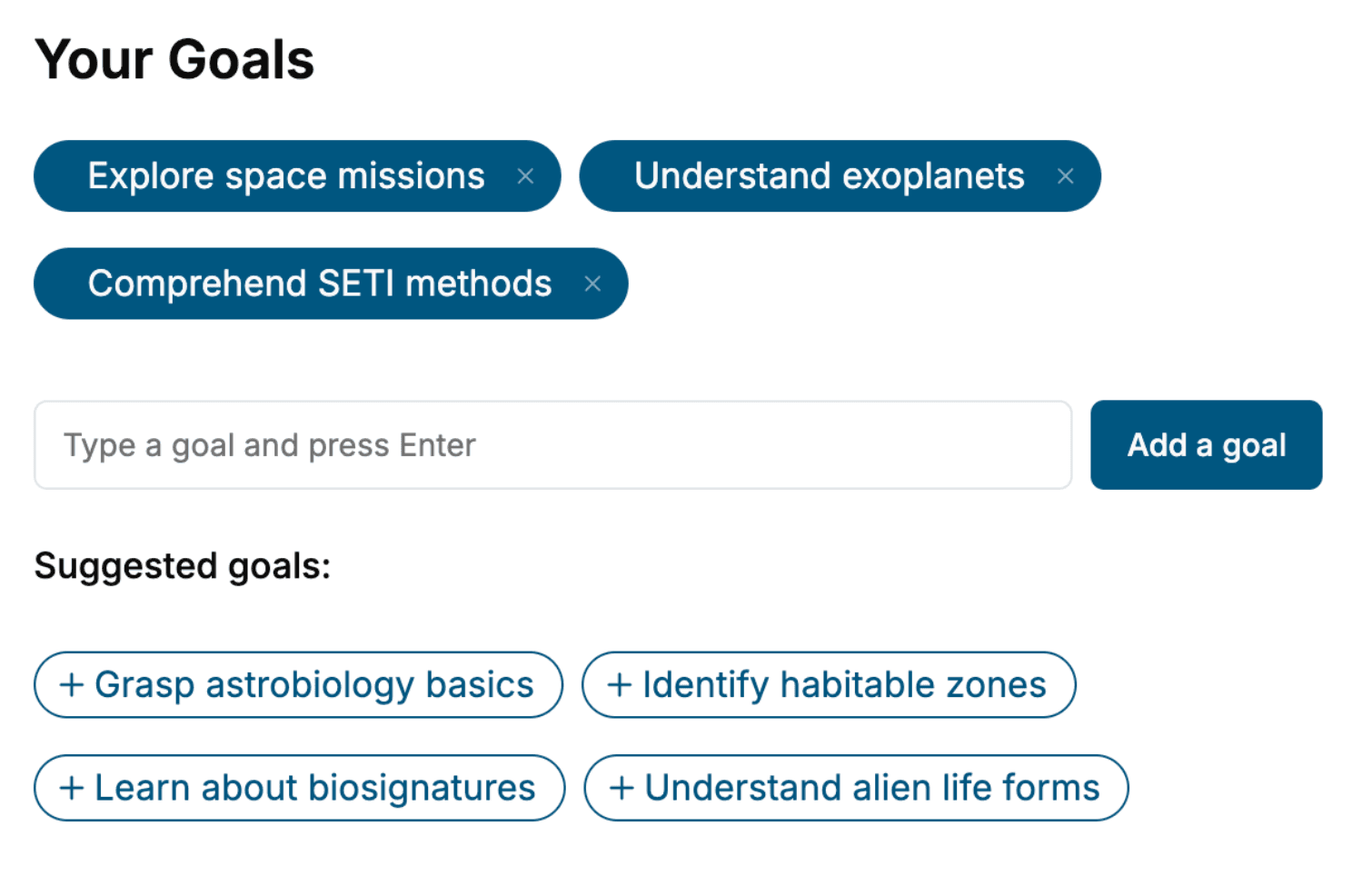
Tell us your goals and background, and get your own version of this book, tailored by AI to you.


Benefits of AI-tailored books
- Read one book, not ten:
- all the Linear Algebra knowledge you need, gathered into a single book.
- Save days of learning:
- tell us your goals, choose your topics, and the whole book is built around them.
- Learn effortlessly:
- Linear Algebra book written for your specific background and expertise.
- Understand at a glance:
- includes charts, tables, timelines, checklists, decision trees, and more.
- Stay current:
- written the day you order it, not years ago.
- Trust what you read:
- every book is checked for accuracy, with real research when your subject needs it.
Create your unique book in 3 steps
- 1. Select your focus
Select the focus of your Linear Algebra book and share your background
- 2. Personalize your book
Specify your goals and choose sub-topics to include
- 3. Get your tailored book
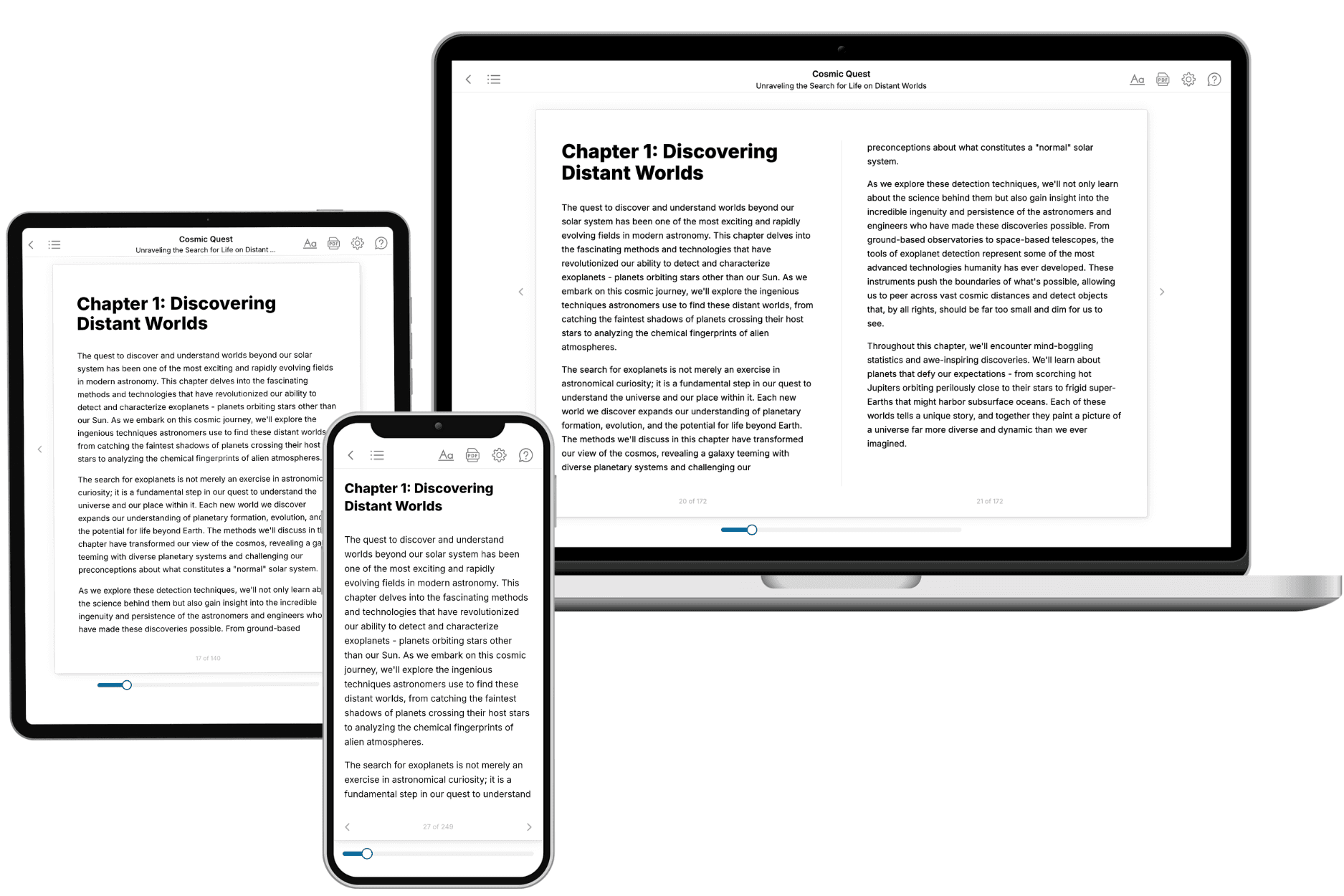
Your book is ready in 10 minutes. Read it online, download as EPUB or PDF, or send to Kindle.

Frequently asked questions
- What is TailoredRead?
TailoredRead creates complete, full-length nonfiction ebooks, written specifically for you. Tell us what you want to learn and why, and TailoredRead writes you a complete ebook on it, with charts, tables, and diagrams throughout. Read it online, on Kindle, or on any e-reader, or download it as a PDF or EPUB. Every book is written fresh the day you order it.
- How is the book tailored to me?
Before anything is written, you answer a few short questions about your goals, your background, and the topics you care about. Your book is then planned around your answers: written at your level, focused on your goals, and covering the topics you chose, instead of the one-size-fits-all book a store sells everyone.
- Will it read like generic AI content?
No. Your book isn't a chat transcript: it's planned chapter by chapter before a single word is written, told in a clear book voice, and explains ideas visually with charts, tables, and diagrams. After writing, every book goes through an editorial pass that polishes chapters so the book reads consistent from start to finish. Judge for yourself: browse thousands of sample books on our Explore Books page.
- How accurate is the content?
Our AI first checks whether your subject needs live research. Niche and fast-moving subjects are researched before writing, and the book plan and chapters are grounded in what it finds. After writing, every book goes through a quality pass that checks its facts and consistency, and researched books list their sources in a Notes section at the back.
- How long is the book?
You choose the length: Comprehensive (250-300 pages), Detailed (150-200 pages), Essential (70-100 pages), or Short (30-50 pages).
- Does the book include visuals?
Yes. Every book includes charts, tables, and diagrams: timelines, checklists, step-by-step guides, decision trees, comparison tables, matrices, and bar charts. A typical book includes dozens of these visual elements.
- Can I read it on Kindle? What formats can I download?
Yes. Every book can be read in our online reader or downloaded as a PDF or EPUB. The EPUB can be opened with Kindle, Apple Books, Kobo, and any e-reader. The Commercial and Author licenses also include an editable Word (DOCX) and Markdown download.
- How much does it cost?
About the price of a regular ebook. The exact price depends on your book's length and complexity, from $2 for the shortest books to $35 for the most comprehensive, and it's shown when you review your book, before you commit to anything. Each book is a one-time purchase, yours to keep, no subscription. Licenses that let you share, teach, or publish your book range from $35.99 to $49.99.
- Can I preview the book before purchasing?
Before you pay, you'll see what your book will cover: the title, a detailed description, the estimated length, and the complete chapter-by-chapter table of contents, so you know what you're getting before you decide. The full text itself is written after you purchase.
- How long does it take to create a book?
About 10 minutes. You can start reading the opening chapters while the rest is still being written.