Matrix Multiplication Mastery
From Naive Algorithms to Cutting-Edge Optimization Techniques
Most programmers implement matrix multiplication the same way they learned it in school—three nested loops with O(n³) time complexity.
222 pages10 chaptersNov 25, 2025Algorithms
About this book
While this works for small matrices, it becomes a computational bottleneck for large-scale applications in machine learning, scientific computing, and data analysis. The problem isn't that you're doing something wrong; it's that you're missing decades of algorithmic innovation. This book reveals how researchers have systematically reduced matrix multiplication complexity from O(n³) to O(n^2.807) and beyond, and more importantly, how you can apply these techniques to your own work. You'll explore the mathematical principles behind Strassen's algorithm, understand why divide-and-conquer strategies work, and learn how to optimize for real hardware constraints. Whether you're building machine learning systems, solving scientific simulations, or simply want to write faster code, understanding matrix multiplication algorithms gives you powerful tools to dramatically improve performance.
Table of contents
- IntroductionWhy Matrix Multiplication Matters, The Performance Problem with Standard Approaches, What You'll Learn in This Book, How to Use This BookRead below
- Chapter 1: Foundations of Matrix MultiplicationMatrix Basics and Notation, The Naive O(n³) Algorithm, Understanding Time Complexity Analysis, Practical Implications of O(n³) Complexity
- Chapter 2: Analyzing Algorithm PerformanceBig-O Notation and Complexity Classes, Measuring and Benchmarking Performance, Theoretical Complexity vs. Practical Performance, Hardware Considerations and Bottlenecks
- Chapter 3: Divide-and-Conquer StrategiesPrinciples of Divide-and-Conquer, Block Matrix Multiplication, Recursive Decomposition Techniques, Implementation Patterns and Best Practices
- Chapter 4: Strassen's AlgorithmThe Breakthrough: Reducing Multiplications, The Mathematics Behind Strassen's Algorithm, Time Complexity Analysis of Strassen's Algorithm, Implementing Strassen's Algorithm
- Chapter 5: Advanced Algorithms and Theoretical LimitsCoppersmith-Winograd and Beyond, Theoretical Lower Bounds and Limits, Recent Developments in Matrix Multiplication, Practical Relevance of Advanced Algorithms
- Chapter 6: Cache Optimization and Memory HierarchyUnderstanding Memory Hierarchy, Cache Efficiency and Data Locality, Cache-Aware Algorithm Design, Practical Optimization Techniques
- Chapter 7: Parallel and Distributed Matrix MultiplicationParallelization Fundamentals, Multi-Threaded Approaches, GPU Acceleration and CUDA, Distributed Computing Frameworks
- Chapter 8: Specialized Matrix Types and Sparse MatricesSparse Matrix Representations, Algorithms for Sparse Matrices, Structured Matrices and Special Cases, Choosing the Right Representation
- Chapter 9: Real-World Applications and Case StudiesMachine Learning and Neural Networks, Scientific Computing and Simulations, Graphics Processing and Computer Vision, Case Study: Choosing Algorithms in Practice
- Chapter 10: Implementation and Practical ConsiderationsLanguage Selection and Libraries, Debugging and Profiling Optimized Code, Testing and Numerical Validation, Production Deployment Strategies
- ConclusionKey Takeaways and Insights, Future Directions in Algorithm Research, Your Next Steps
- Glossary
- Further Reading and Resources
Introduction
Matrix multiplication sits at the heart of modern computing. Every time you use a recommendation system, train a neural network, or render 3D graphics, matrix multiplication algorithms are working behind the scenes. Yet most developers implement these operations the same way they learned in their first linear algebra course—three nested loops that multiply and sum elements. This approach works perfectly well for small matrices, but it becomes a serious performance bottleneck when you scale up to the thousands or millions of elements common in real-world applications. The difference between a naive implementation and an optimized one can mean the difference between waiting seconds or hours for results, between running on a single machine or requiring a cluster of servers.
The story of matrix multiplication algorithms is one of continuous innovation. In 1969, Volker Strassen shocked the mathematical community by proving that the standard approach wasn't optimal. His algorithm reduced the theoretical complexity from O(n³) to approximately O(n^2.807), demonstrating that clever mathematical insights could beat brute force computation. Since then, researchers have pushed the boundaries even further, developing algorithms with complexity approaching O(n²). But here's the surprising part: these theoretical advances don't always translate directly to practical performance improvements. Real-world optimization requires understanding not just algorithmic complexity, but also hardware architecture, memory hierarchies, and the specific characteristics of your problem domain.
This book bridges the gap between theoretical computer science and practical software engineering. You'll learn why the naive algorithm fails at scale, how divide-and-conquer strategies enable dramatic performance improvements, and when advanced algorithms actually help versus when simpler approaches win. More importantly, you'll understand the principles behind these optimizations so you can apply them to your own work. Whether you're building machine learning systems that process massive datasets, developing scientific simulations that require intensive computation, or simply want to write more efficient code, mastering matrix multiplication algorithms gives you powerful tools to solve performance problems that would otherwise seem insurmountable.
Why Matrix Multiplication Matters
Matrix multiplication appears everywhere in computational applications, often in places you might not expect. In machine learning, neural networks perform millions of matrix multiplications during both training and inference. Each layer in a deep learning model essentially applies a matrix transformation to its inputs, and modern networks can have hundreds of layers processing batches of thousands of examples simultaneously. When you train a language model or image classifier, the majority of computation time goes into matrix operations. Improving matrix multiplication efficiency by even ten percent can translate to saving hours of training time and thousands of dollars in computing costs.
Scientific computing relies heavily on matrix operations for solving systems of equations, simulating physical phenomena, and analyzing large datasets. Consider climate modeling, where researchers simulate atmospheric conditions across millions of grid points over extended time periods. Each simulation step involves solving massive systems of linear equations through matrix operations. Finite element analysis in engineering, molecular dynamics in chemistry, and quantum mechanics calculations in physics all depend on efficient matrix multiplication. The difference between an O(n³) and O(n^2.807) algorithm might determine whether a simulation completes overnight or takes weeks to run.
Computer graphics and game development use matrix multiplication for transforming 3D coordinates, applying camera projections, and calculating lighting effects. Every object in a 3D scene undergoes multiple matrix transformations as it moves from model space to world space to screen space. Modern games render millions of polygons per frame at 60 or more frames per second, requiring billions of matrix operations every second. Graphics processing units (GPUs) are essentially specialized hardware designed to perform matrix operations extremely efficiently, demonstrating how central these computations are to visual computing.
Data analysis and recommendation systems process enormous matrices representing user-item interactions, document-term frequencies, or social network connections. When Netflix recommends movies or Amazon suggests products, they're often using matrix factorization techniques that require repeated matrix multiplications on datasets with millions of users and items. Search engines use matrix operations to calculate page rankings and relevance scores. Social networks analyze connection patterns through graph algorithms that rely on adjacency matrix operations. The scale of these applications makes algorithmic efficiency not just desirable but absolutely essential.
Signal processing and communications systems use matrix operations for filtering, compression, and error correction. The Fast Fourier Transform, fundamental to audio processing and wireless communications, can be expressed as matrix multiplication. Image compression algorithms like JPEG use discrete cosine transforms implemented through matrix operations. Radar and sonar systems process signals using beamforming techniques that involve large matrix computations. Even your smartphone's ability to cancel background noise during calls relies on matrix-based signal processing algorithms running in real-time.
The ubiquity of matrix multiplication means that improvements in these algorithms have cascading effects across countless applications. A faster matrix multiplication routine doesn't just speed up one program—it accelerates entire fields of computation. This is why researchers continue to search for better algorithms decades after the problem was first studied. Understanding these algorithms gives you insight into a fundamental operation that powers much of modern technology, and equips you to make informed decisions about performance optimization in your own projects.
Beyond immediate performance benefits, studying matrix multiplication algorithms teaches broader lessons about algorithm design and optimization. You'll learn how mathematical insights can lead to unexpected performance improvements, how theoretical complexity relates to practical performance, and how hardware architecture influences algorithm selection. These principles apply far beyond matrix multiplication, making this knowledge valuable for any computationally intensive work. The techniques you'll learn—divide-and-conquer strategies, cache optimization, parallelization—are fundamental tools in the performance engineer's toolkit.
The Performance Problem with Standard Approaches
The standard matrix multiplication algorithm that most programmers learn first uses three nested loops to compute each element of the result matrix. For two n×n matrices, this approach performs n³ multiplication operations and a similar number of additions. While this seems reasonable for small matrices, the cubic growth rate creates severe performance problems as matrices grow larger. Doubling the matrix size increases computation time by a factor of eight. A matrix that's ten times larger requires a thousand times more computation. This explosive growth makes the naive algorithm impractical for the large matrices common in modern applications.
Consider a concrete example: multiplying two 1000×1000 matrices using the standard algorithm requires one billion multiplications. On a modern processor performing one billion operations per second, this takes about one second—seemingly acceptable. But increase the size to 10,000×10,000 matrices, and you're now performing one trillion operations, requiring roughly 1,000 seconds or about 17 minutes. Scale up to 100,000×100,000 matrices, and you're looking at 1,000,000 seconds—over 11 days of computation. This cubic scaling makes the naive algorithm completely unsuitable for the large-scale problems encountered in machine learning and scientific computing, where matrices with millions of elements are common.
The performance problem extends beyond just raw computation time. Memory access patterns in the naive algorithm are inefficient on modern hardware. The standard implementation accesses matrix elements in patterns that cause frequent cache misses, forcing the processor to wait for data from slower main memory. Modern CPUs can perform operations much faster than they can fetch data from RAM, so poor memory access patterns create bottlenecks where the processor sits idle waiting for data. This means the actual performance is often worse than theoretical operation counts suggest, with the processor achieving only a small fraction of its peak computational throughput.
Real-world applications compound these problems by requiring repeated matrix multiplications. Training a neural network involves performing forward and backward passes through the network thousands or millions of times, with each pass requiring multiple matrix multiplications. A single inefficient matrix multiplication might be tolerable, but when you multiply that inefficiency by millions of iterations, the cumulative cost becomes prohibitive. This is why deep learning frameworks invest heavily in optimized matrix multiplication routines—even small percentage improvements in matrix multiplication speed translate to substantial reductions in total training time.
The standard algorithm also struggles with modern hardware architectures. Contemporary processors achieve high performance through parallelism—executing multiple operations simultaneously through multiple cores, vector instructions, and specialized accelerators like GPUs. The naive three-loop implementation doesn't naturally expose opportunities for parallelization. While you can parallelize the outer loops, doing so effectively requires careful attention to memory access patterns and synchronization overhead. Simply throwing more cores at an unoptimized algorithm often yields disappointing results because the algorithm's structure doesn't align with how modern hardware achieves performance.
Energy consumption presents another critical concern, especially for mobile devices and large-scale data centers. The naive algorithm's inefficiency means more computation time, which translates directly to higher energy usage. Data centers running machine learning workloads consume enormous amounts of electricity, with matrix operations accounting for a substantial portion of that consumption. More efficient algorithms reduce not just time but also energy costs and environmental impact. For battery-powered devices, algorithmic efficiency directly affects battery life—a crucial factor for mobile applications.
These performance problems aren't just theoretical concerns—they represent real barriers to solving important problems. Researchers have abandoned promising approaches because the computational requirements were too high. Companies have spent millions on hardware to compensate for algorithmic inefficiency. Understanding why the standard approach fails and learning better alternatives isn't just an academic exercise; it's essential knowledge for anyone working with computationally intensive applications. The remainder of this book will show you how to overcome these limitations through better algorithms and optimization techniques.
What You'll Learn in This Book
This book provides a comprehensive journey from basic matrix multiplication to cutting-edge optimization techniques. You'll start by thoroughly understanding the naive O(n³) algorithm and why it performs the way it does. This foundation is crucial because you can't effectively optimize what you don't understand. You'll learn to analyze time complexity rigorously, understanding not just how to count operations but how to reason about algorithmic efficiency. This includes distinguishing between best-case, average-case, and worst-case performance, and understanding when each matters in practice.
The core of the book explores divide-and-conquer strategies that fundamentally change how we approach matrix multiplication. You'll learn how breaking matrices into blocks enables recursive algorithms that reduce computational complexity. The centerpiece is Strassen's algorithm, which achieves O(n^2.807) complexity through a clever reduction in the number of multiplications required. You'll understand the mathematical principles behind this breakthrough, implement the algorithm yourself, and learn when it provides practical benefits versus when simpler approaches are better. This section demonstrates how mathematical insight can lead to dramatic performance improvements.
Beyond Strassen's algorithm, you'll explore more advanced theoretical developments including the Coppersmith-Winograd algorithm and recent improvements that push complexity even closer to O(n²). While these algorithms are often impractical for real-world use due to large constant factors, understanding them provides insight into the theoretical limits of computation and the ongoing research frontier. You'll learn why the gap between theoretical and practical performance exists, and what factors determine whether an algorithm with better asymptotic complexity actually runs faster on real hardware.
The book dedicates substantial attention to practical optimization techniques that often matter more than algorithmic complexity for real-world performance. You'll learn about cache-aware algorithm design, understanding how memory hierarchy affects performance and how to structure computations to maximize cache efficiency. This includes techniques like loop tiling, blocking, and data layout optimization. You'll discover why an algorithm with worse theoretical complexity can outperform a theoretically superior one when cache effects are considered, and learn to design algorithms that work with rather than against hardware architecture.
Parallelization and hardware acceleration receive thorough coverage, showing you how to leverage multiple CPU cores, vector instructions, and GPUs to achieve dramatic speedups. You'll learn the principles of parallel algorithm design, including how to partition work effectively, minimize synchronization overhead, and handle load balancing. The GPU acceleration section covers CUDA programming basics and shows how graphics processors achieve orders of magnitude speedup for matrix operations. You'll understand when parallelization helps and when communication overhead negates the benefits of parallel execution.
Specialized topics include algorithms for sparse matrices, where most elements are zero, and structured matrices with special properties. These cases are extremely common in real applications—social network graphs, document-term matrices, and finite element meshes are typically sparse. You'll learn specialized data structures and algorithms that exploit sparsity to achieve massive performance improvements. This section demonstrates how understanding your problem's specific characteristics enables optimizations that generic algorithms can't achieve.
Throughout the book, you'll encounter real-world case studies from machine learning, scientific computing, graphics, and data analysis. These examples show how the concepts apply in practice and help you develop intuition for algorithm selection. You'll learn not just what algorithms exist, but when to use each one based on matrix size, sparsity, hardware constraints, and performance requirements. The final chapters cover implementation considerations including library selection, debugging optimized code, numerical stability, and production deployment strategies. By the end, you'll have both theoretical understanding and practical skills to implement efficient matrix multiplication in your own projects.
How to Use This Book
This book is designed for progressive learning, with each chapter building on concepts from previous ones. If you're new to algorithm analysis or haven't worked with matrix operations recently, start from the beginning and work through sequentially. The early chapters establish foundational concepts that later chapters assume you understand. If you're already comfortable with basic matrix operations and Big-O notation, you might skim the first two chapters and focus more attention on the divide-and-conquer strategies and optimization techniques in later chapters. However, even experienced developers often find value in revisiting fundamentals, as the early chapters present familiar concepts from a performance-oriented perspective.
Each chapter includes concrete code examples and implementation details. You'll get the most value by actually implementing the algorithms yourself rather than just reading about them. Set up a development environment where you can write and test code as you progress through the book. Start with simple implementations to verify your understanding, then experiment with optimizations. Measure performance on different matrix sizes and compare results with your predictions based on complexity analysis. This hands-on practice transforms theoretical knowledge into practical skills and helps you develop intuition about algorithm behavior.
The book includes exercises and challenges at various difficulty levels. Basic exercises reinforce core concepts and ensure you understand the material. Intermediate challenges ask you to apply concepts to new situations or combine techniques in novel ways. Advanced problems explore edge cases, theoretical extensions, or research-level questions. You don't need to complete every exercise to benefit from the book, but working through problems appropriate to your skill level significantly deepens understanding. Consider the exercises as opportunities to test your knowledge and identify areas where you need additional review.
Pay special attention to the performance measurement and benchmarking sections. Understanding how to accurately measure algorithm performance is crucial for making informed optimization decisions. Set up proper benchmarking infrastructure early and use it consistently as you implement different algorithms. This empirical feedback helps you connect theoretical complexity analysis with actual performance characteristics. You'll discover that real-world performance often surprises you—algorithms that should be faster sometimes aren't, and understanding why teaches valuable lessons about the gap between theory and practice.
The book references external resources including research papers, library documentation, and online tools. These references aren't just citations—they're pathways for deeper exploration of topics that interest you. When a concept particularly resonates or you want more detail than the book provides, follow those references. The field of algorithm optimization is vast, and this book provides a curated path through essential concepts, but there's always more to learn. Building the habit of consulting primary sources and documentation will serve you well beyond this book.
Consider forming a study group or finding a learning partner if possible. Discussing algorithms with others helps clarify your thinking and exposes you to different perspectives. Explaining concepts to someone else is one of the best ways to solidify your own understanding. If you're working through the book as part of a course, take advantage of office hours and discussion forums. If you're self-studying, online communities focused on algorithms and performance optimization can provide valuable support and feedback on your implementations.
Finally, remember that mastering these concepts takes time and practice. Don't get discouraged if some topics seem difficult initially—algorithm optimization is genuinely challenging, and even experienced developers continue learning throughout their careers. Focus on steady progress rather than perfection. Implement algorithms, measure their performance, understand why they behave as they do, and gradually build your intuition. The goal isn't to memorize every algorithm but to develop the analytical skills and practical knowledge to approach performance problems systematically. With consistent effort, you'll find that concepts that initially seemed opaque become clear, and you'll develop the confidence to tackle optimization challenges in your own work.
This is the end of the free sample. The full book has 10 chapters.
Want this book written for you?
Tell us your goals and background, and get your own version of this book, tailored by AI to you.


Benefits of AI-tailored books
- Read one book, not ten:
- all the Algorithms knowledge you need, gathered into a single book.
- Save days of learning:
- tell us your goals, choose your topics, and the whole book is built around them.
- Learn effortlessly:
- Algorithms book written for your specific background and expertise.
- Understand at a glance:
- includes charts, tables, timelines, checklists, decision trees, and more.
- Stay current:
- written the day you order it, not years ago.
- Trust what you read:
- every book is checked for accuracy, with real research when your subject needs it.
Create your unique book in 3 steps
- 1. Select your focus
Select the focus of your Algorithms book and share your background
- 2. Personalize your book
Specify your goals and choose sub-topics to include
- 3. Get your tailored book
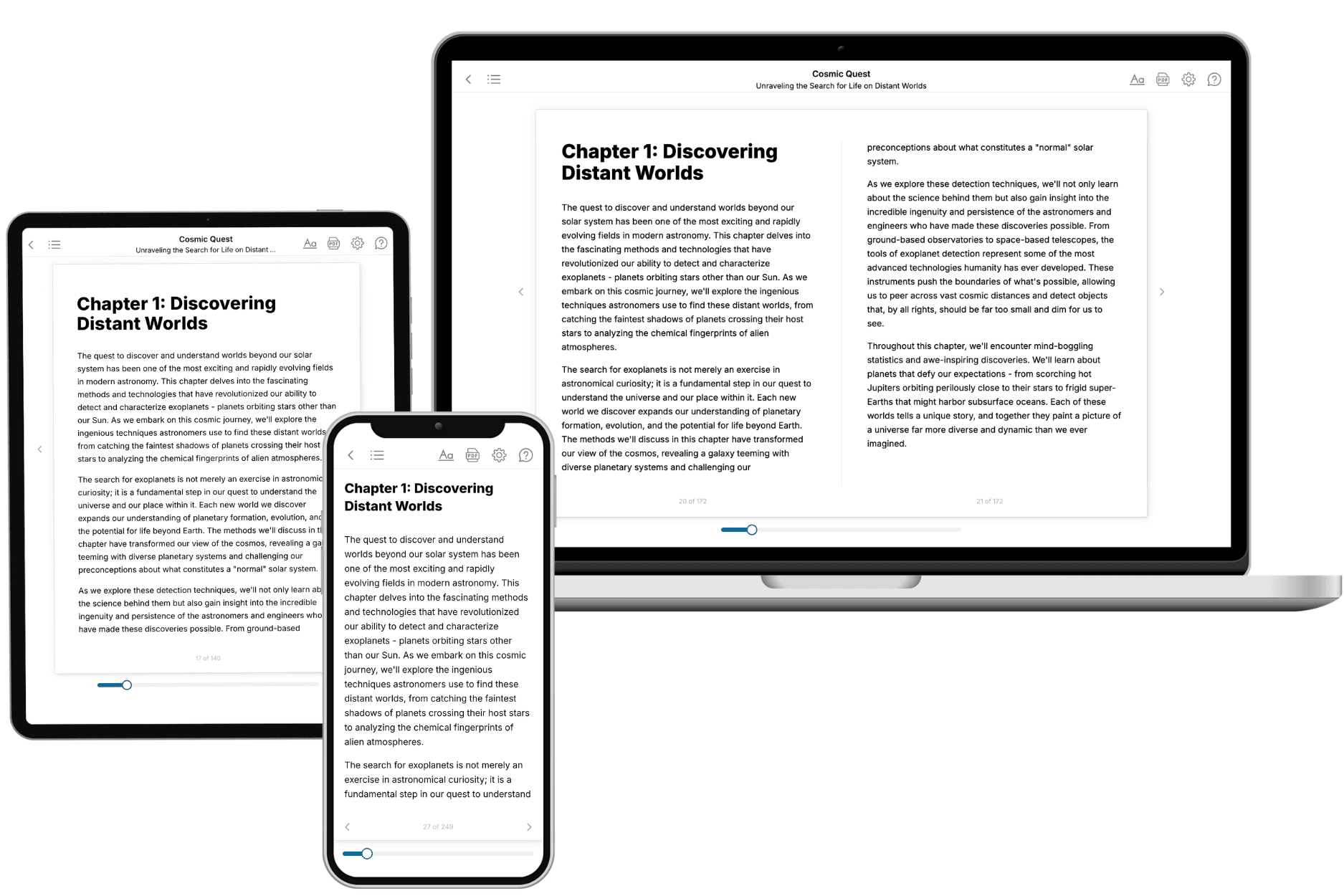
Your book is ready in 10 minutes. Read it online, download as EPUB or PDF, or send to Kindle.

Frequently asked questions
- What is TailoredRead?
TailoredRead creates complete, full-length nonfiction ebooks, written specifically for you. Tell us what you want to learn and why, and TailoredRead writes you a complete ebook on it, with charts, tables, and diagrams throughout. Read it online, on Kindle, or on any e-reader, or download it as a PDF or EPUB. Every book is written fresh the day you order it.
- How is the book tailored to me?
Before anything is written, you answer a few short questions about your goals, your background, and the topics you care about. Your book is then planned around your answers: written at your level, focused on your goals, and covering the topics you chose, instead of the one-size-fits-all book a store sells everyone.
- Will it read like generic AI content?
No. Your book isn't a chat transcript: it's planned chapter by chapter before a single word is written, told in a clear book voice, and explains ideas visually with charts, tables, and diagrams. After writing, every book goes through an editorial pass that polishes chapters so the book reads consistent from start to finish. Judge for yourself: browse thousands of sample books on our Explore Books page.
- How accurate is the content?
Our AI first checks whether your subject needs live research. Niche and fast-moving subjects are researched before writing, and the book plan and chapters are grounded in what it finds. After writing, every book goes through a quality pass that checks its facts and consistency, and researched books list their sources in a Notes section at the back.
- How long is the book?
You choose the length: Comprehensive (250-300 pages), Detailed (150-200 pages), Essential (70-100 pages), or Short (30-50 pages).
- Does the book include visuals?
Yes. Every book includes charts, tables, and diagrams: timelines, checklists, step-by-step guides, decision trees, comparison tables, matrices, and bar charts. A typical book includes dozens of these visual elements.
- Can I read it on Kindle? What formats can I download?
Yes. Every book can be read in our online reader or downloaded as a PDF or EPUB. The EPUB can be opened with Kindle, Apple Books, Kobo, and any e-reader. The Commercial and Author licenses also include an editable Word (DOCX) and Markdown download.
- How much does it cost?
About the price of a regular ebook. The exact price depends on your book's length and complexity, from $2 for the shortest books to $35 for the most comprehensive, and it's shown when you review your book, before you commit to anything. Each book is a one-time purchase, yours to keep, no subscription. Licenses that let you share, teach, or publish your book range from $35.99 to $49.99.
- Can I preview the book before purchasing?
Before you pay, you'll see what your book will cover: the title, a detailed description, the estimated length, and the complete chapter-by-chapter table of contents, so you know what you're getting before you decide. The full text itself is written after you purchase.
- How long does it take to create a book?
About 10 minutes. You can start reading the opening chapters while the rest is still being written.