The McKinley Assassination
How a President's Death Reshaped American Politics and Power
Discover the dramatic story of William McKinley's assassination and the seismic shifts it triggered in American history.
207 pages10 chaptersFeb 16, 2026United States History
About this book
On September 6, 1901, a single gunshot in Buffalo, New York, changed the course of a nation. This book takes you through the circumstances leading to that fateful moment—McKinley's rise to power, his controversial imperial policies, and the anarchist movements that threatened the social order. You'll meet Leon Czolgosz, the assassin, and understand the ideological currents that drove him to violence. More importantly, you'll see how this tragedy reshaped American politics: Theodore Roosevelt's unexpected ascension to the presidency, the transformation of presidential security, and the nation's intensified crackdown on radical movements. Through careful analysis of primary sources and historical evidence, this book reveals how one moment of violence redirected American foreign policy, expanded executive power, and defined the modern presidency. Whether you're a history student, a political enthusiast, or simply curious about pivotal American moments, this examination offers essential insights into how tragedy and leadership intersect to shape national destiny.
Table of contents
- IntroductionWhy McKinley Matters Today, The Moment That Changed Everything, What You'll Discover in This BookRead below
- Chapter 1: McKinley's Rise to PowerFrom Ohio Congressman to National Figure, The 1896 Election and Political Realignment, McKinley the Man and His Vision
- Chapter 2: American Imperialism and ExpansionThe Spanish-American War, Territorial Acquisitions and Global Ambitions, Domestic Controversy Over Empire, McKinley as Imperial President
- Chapter 3: Anarchism and Radical Movements in AmericaThe Rise of Anarchist Ideology, Anarchist Networks and Publications, Violence and Political Assassination, American Society Under Threat
- Chapter 4: Leon Czolgosz: The AssassinEarly Life and Family Background, Descent Into Radicalism, Psychological Profile and Motivations, The Path to Buffalo
- Chapter 5: The Assassination EventMcKinley in Buffalo: September 1901, The Pan-American Exposition, The Fatal Moment, Immediate Aftermath and Chaos
- Chapter 6: McKinley's Final DaysThe Struggle for Survival, Medical Crisis and Hope, The Nation Holds Its Breath, Death and National Mourning
- Chapter 7: Theodore Roosevelt AscendantRoosevelt: The Unexpected President, A Different Vision for America, Roosevelt vs. McKinley: Governing Styles
- Chapter 8: Security and Secret Service TransformationPresidential Protection Before McKinley, The Assassination as Security Failure, Modernizing Presidential Protection, The Secret Service Expansion
- Chapter 9: Political and Social ConsequencesCrackdown on Anarchism and Radicalism, Immigration Policy and Restrictions, Public Fear and Social Order, The Trial of Leon Czolgosz
- Chapter 10: McKinley's Legacy and Historical ImpactMcKinley: The Modernizing President, Expansion of Executive Power, American Foreign Policy Redefined, How History Remembers McKinley
- ConclusionOne Moment, Infinite Consequences, Lessons for Modern America
- Further Reading
Introduction
On September 6, 1901, President William McKinley stood in the Temple of Music at Buffalo's Pan-American Exposition, greeting citizens in a receiving line. The event was meant to showcase American progress and optimism at the dawn of a new century. Within moments, a young man named Leon Czolgosz stepped forward, extended what appeared to be a bandaged hand, and fired two shots into the president's abdomen. McKinley staggered backward, his white vest stained with blood, and the course of American history changed forever. This single act of violence would not only end the life of a sitting president but would also accelerate transformations in American politics, security, and foreign policy that continue to shape the nation today.
The assassination of William McKinley represents far more than a tragic footnote in presidential history. It marked a pivotal transition between two distinct eras of American governance and global engagement. McKinley had guided the United States through its first major imperial venture, acquiring territories from the Caribbean to the Pacific and establishing America as a world power. His death brought Theodore Roosevelt to the presidency, a man whose energetic progressivism and assertive foreign policy would define the early twentieth century. The contrast between these two leaders—and the abrupt transition from one to the other—created ripples that extended through American institutions, from the Secret Service to immigration policy, from executive power to the nation's approach to radical political movements.
Understanding this assassination requires examining multiple intersecting forces: the rise of anarchist ideology and political violence, the tensions created by rapid industrialization and immigration, the expansion of American power abroad, and the vulnerabilities of democratic leadership in an age of mass politics. McKinley's death was not simply the act of a lone madman, though Czolgosz certainly acted alone. It emerged from a specific historical context where radical movements challenged established order, where America's new imperial role generated both pride and controversy, and where presidential security remained dangerously inadequate. By exploring these dimensions, we can grasp how a single moment of violence became a catalyst for profound institutional and political change.
This book takes you through the complete story of McKinley's assassination and its far-reaching consequences. You'll discover the president's rise to power, his controversial policies of expansion, and the anarchist movements that threatened the social fabric of turn-of-the-century America. You'll meet Leon Czolgosz and understand the ideological and psychological forces that drove him to violence. Most importantly, you'll see how McKinley's death reshaped American politics, security, and power in ways that established patterns still visible in contemporary governance. This is not merely a story of what happened, but an exploration of why it mattered then and why it continues to matter now.
Why McKinley Matters Today
William McKinley remains one of the most underappreciated presidents in American history, often overshadowed by his successor's larger-than-life personality and progressive reforms. Yet McKinley's presidency fundamentally transformed America's role in the world and established precedents for executive power that persist to this day. He presided over the Spanish-American War, which resulted in the United States acquiring Puerto Rico, Guam, and the Philippines, effectively announcing America's arrival as a global imperial power. He championed protective tariffs and the gold standard, shaping economic policy debates that would dominate the next generation. His administration marked the beginning of the modern presidency, with expanded executive authority and a more active role in both domestic and international affairs.
The circumstances of McKinley's death illuminate critical tensions in American democracy that remain relevant today. How should a democratic society balance openness and accessibility with security and protection? McKinley believed deeply in maintaining contact with ordinary citizens, insisting on public receptions despite security concerns. His assassination forced a reckoning with this ideal, leading to the creation of modern presidential protection protocols that fundamentally altered the relationship between leaders and citizens. The Secret Service, which had previously focused on counterfeiting, was transformed into the comprehensive protective agency we know today. This shift represented a permanent change in how American democracy functions, trading some accessibility for security in ways that continue to shape presidential life and public engagement.
McKinley's assassination also triggered one of the most significant anti-radical crackdowns in American history, with consequences that extended far beyond anarchist circles. In the aftermath of his death, Congress passed the Anarchist Exclusion Act of 1903, the first federal law to restrict immigration based on political beliefs rather than nationality or race. This legislation established a precedent for ideological screening that would expand throughout the twentieth century, particularly during the Red Scares and Cold War era. The government's response to McKinley's assassination demonstrated how political violence could justify restrictions on civil liberties and immigration, a pattern that has repeated itself throughout American history, from the Palmer Raids to post-9/11 security measures.
The transition from McKinley to Roosevelt represents one of the most dramatic shifts in presidential style and policy in American history. McKinley was cautious, consultative, and diplomatic in his approach to governance. Roosevelt was bold, assertive, and willing to expand executive power in unprecedented ways. McKinley's foreign policy, while expansionist, was reluctant and reactive. Roosevelt's was aggressive and proactive, exemplified by his corollary to the Monroe Doctrine and his intervention in Panama. This contrast illustrates how individual leadership matters in shaping national direction, and how unexpected succession can redirect the course of history. Had McKinley lived to complete his second term, American progressivism, conservation policy, and foreign relations might have developed along very different lines.
Understanding McKinley's presidency and assassination also provides essential context for comprehending America's complex relationship with empire and global power. The territories acquired during McKinley's administration created ongoing questions about American identity, citizenship, and governance that persist today. Puerto Rico remains a territory without full representation, a direct legacy of McKinley-era expansion. The Philippines endured decades of American colonial rule before gaining independence. These imperial ventures established patterns of American intervention and influence that would characterize twentieth-century foreign policy, from Latin America to Southeast Asia. McKinley's decisions about expansion set precedents that subsequent presidents would follow, modify, or reject, but could never ignore.
The McKinley assassination also offers insights into the psychology of political violence and the appeal of radical ideologies during periods of rapid social change. Leon Czolgosz was not simply a madman but a product of specific social and economic conditions: industrial exploitation, immigrant alienation, and the appeal of anarchist philosophy to those who felt powerless in an increasingly corporate and centralized society. His act of violence reflected broader anxieties about modernity, capitalism, and democracy that continue to manifest in different forms today. By examining the roots of Czolgosz's radicalization, we can better understand how individuals become drawn to extremist ideologies and political violence, a question that remains urgently relevant in contemporary America.
Finally, McKinley matters because his presidency and death illustrate the contingency of history—how individual decisions, chance events, and unexpected tragedies can redirect the course of nations. Had McKinley's security detail been more vigilant, had the exposition organizers implemented different protocols, had Czolgosz been identified and stopped before reaching the president, the entire trajectory of early twentieth-century America might have been different. Roosevelt might never have become president, or might have arrived at the office through different circumstances with different political capital. The progressive era might have unfolded differently, and America's approach to world affairs might have taken another path. Studying McKinley's assassination reminds us that history is not inevitable but shaped by human choices, accidents, and the complex interplay of individual agency and structural forces.
The Moment That Changed Everything
The Temple of Music at Buffalo's Pan-American Exposition was designed to showcase American cultural achievement and technological progress. On that September afternoon, it became the site of national tragedy. McKinley had arrived in Buffalo to tour the exposition, which celebrated the Americas' industrial and cultural development. Despite concerns from his security detail and personal secretary, George Cortelyou, McKinley insisted on holding a public reception. He believed that maintaining contact with ordinary citizens was an essential presidential duty, a democratic principle that should not be sacrificed to security concerns. This decision, rooted in McKinley's genuine commitment to accessibility and his faith in the American people, would prove fatal.
The receiving line moved quickly that afternoon, with McKinley greeting visitors at a rate of approximately fifty per minute. Leon Czolgosz had been waiting for hours, a .32 caliber Iver Johnson revolver concealed beneath a handkerchief wrapped around his right hand. As he approached the president, Czolgosz appeared to have an injured hand, a detail that drew sympathy rather than suspicion. When he reached McKinley, instead of extending his left hand for a handshake, Czolgosz pushed away the president's outstretched hand and fired two shots at point-blank range. The first bullet struck a button and deflected, causing only a superficial wound. The second penetrated McKinley's abdomen, tearing through his stomach, pancreas, and kidney before lodging in the muscles of his back.
The immediate aftermath was chaotic and revealing. Secret Service agents and exposition guards immediately tackled Czolgosz, beating him severely before McKinley, despite his wounds, called out for them to stop: Go easy on him, boys.
This moment of compassion, even toward his assassin, exemplified McKinley's character and the gentler political culture of his era. The president was rushed to the exposition's emergency hospital, where doctors performed surgery under primitive conditions. They located the entry wound but could not find the bullet or fully assess the internal damage. The operating room lacked adequate lighting, and doctors declined to use the exposition's X-ray machine, a new technology they considered unreliable. These medical limitations would prove consequential in the days ahead.
News of the shooting spread rapidly through telegraph lines, creating a national crisis. Vice President Theodore Roosevelt, who had been vacationing in Vermont, rushed to Buffalo. Cabinet members converged on the city. Newspapers issued special editions with fragmentary and often contradictory information. The nation, which had experienced two previous presidential assassinations within living memory—Lincoln in 1865 and Garfield in 1881—understood the gravity of the situation. Yet initial reports were cautiously optimistic. McKinley appeared to be recovering, his vital signs stabilized, and doctors issued reassuring bulletins. For several days, it seemed the president might survive, and Roosevelt even left Buffalo to rejoin his family, believing the crisis had passed.
This false hope made the eventual outcome even more shocking. On September 13, eight days after the shooting, McKinley's condition suddenly deteriorated. The bullet wound had caused gangrene in his stomach and pancreas, infections that 1901 medicine could not effectively treat. Antibiotics did not yet exist, and the surgical techniques available were inadequate for the internal damage McKinley had sustained. He died in the early morning hours of September 14, with his wife Ida at his bedside. His last words, according to witnesses, were from his favorite hymn: Nearer, My God, to Thee.
At 2:15 AM, William McKinley became the third American president to be assassinated, and Theodore Roosevelt, at age forty-two, became the youngest president in American history.
The moment of McKinley's death marked an immediate and dramatic shift in American governance. Roosevelt took the oath of office that same day in Buffalo, pledging to continue McKinley's policies while privately planning significant departures from his predecessor's approach. The contrast between the two men was stark and immediately apparent. McKinley had been cautious, consultative, and diplomatic. Roosevelt was energetic, assertive, and willing to challenge established interests. McKinley had expanded American power reluctantly, responding to events and public pressure. Roosevelt would pursue expansion and intervention actively, seeing American power as a force for global order and progress. This transition would reshape American domestic and foreign policy for decades to come.
The assassination also triggered immediate security and political responses that transformed American institutions. The Secret Service, which had provided minimal protection to McKinley, was rapidly expanded and given comprehensive responsibility for presidential security. Congress began drafting legislation to restrict anarchist immigration and activity, culminating in the Anarchist Exclusion Act of 1903. Law enforcement agencies launched a nationwide crackdown on radical organizations, particularly anarchist groups. Public sentiment turned sharply against immigrants and radicals, with calls for deportations and restrictions. These responses established patterns of reaction to political violence that would recur throughout American history: expanded security measures, restrictions on civil liberties, and heightened suspicion of foreign ideologies and immigrants.
Beyond these immediate consequences, McKinley's assassination represented a symbolic turning point in American history. The nineteenth century, with its continental expansion, Civil War, and industrial development, had definitively ended. The twentieth century, with its global conflicts, progressive reforms, and expanded federal power, had begun. McKinley, born in 1843, represented the older generation shaped by the Civil War and Reconstruction. Roosevelt, born in 1858, represented a new generation ready to assert American power globally and reform American society domestically. The transition from one to the other, forced by an assassin's bullet, accelerated changes that might otherwise have unfolded more gradually. In this sense, September 14, 1901, was not just the day a president died but the day America's twentieth century truly began.
What You'll Discover in This Book
This book provides a comprehensive examination of the McKinley assassination and its multifaceted consequences, organized to give you both narrative understanding and analytical insight. The early chapters establish essential context by exploring McKinley's rise to power, his presidency, and the imperial policies that defined his administration. You'll discover how a Civil War veteran and Ohio congressman became president during a period of profound economic and social transformation. You'll understand the 1896 election that brought McKinley to power and realigned American politics for a generation. Most importantly, you'll grasp McKinley's vision for America and how his policies of expansion and economic nationalism shaped the nation's trajectory at the turn of the century.
The book then examines American imperialism and expansion under McKinley, providing detailed analysis of the Spanish-American War and its consequences. You'll explore how the United States acquired territories in the Caribbean and Pacific, transforming from a continental republic into a global empire. This section addresses the controversies surrounding expansion, including domestic opposition from anti-imperialists who argued that empire contradicted American democratic principles. You'll see how McKinley justified these acquisitions and how they established precedents for American intervention and influence that would characterize twentieth-century foreign policy. The analysis includes specific examples of territorial governance, resistance movements in acquired territories, and the long-term implications of McKinley's imperial decisions.
A crucial section of the book explores anarchism and radical movements in turn-of-the-century America, providing essential context for understanding Czolgosz's motivations and actions. You'll discover the ideological foundations of anarchism, its appeal to workers and immigrants, and its advocacy of political violence as a tool for social change. This examination includes:
- The philosophical origins of anarchist thought in European thinkers like Mikhail Bakunin and Peter Kropotkin
- The development of anarchist networks and publications in American cities
- Previous anarchist assassinations of European leaders that inspired American radicals
- The social and economic conditions that made anarchism appealing to marginalized workers
- The relationship between anarchist ideology and labor movements
- Government and public responses to anarchist activity before McKinley's assassination
The book provides an in-depth examination of Leon Czolgosz himself, moving beyond simplistic characterizations to explore his background, psychology, and path to violence. You'll learn about his Polish immigrant family, his experiences as a factory worker, his mental health struggles, and his gradual radicalization through anarchist literature and speeches. This section draws on trial testimony, contemporary accounts, and historical analysis to construct a comprehensive portrait of the assassin. You'll understand how personal grievances, ideological conviction, and psychological instability combined to produce a man capable of killing the president. The analysis avoids both demonization and excuse-making, instead seeking to understand Czolgosz as a historical actor shaped by specific circumstances and choices.
The narrative heart of the book provides a detailed reconstruction of the assassination event itself, from McKinley's arrival in Buffalo through the shooting, the medical response, and the president's final days. You'll experience the chaos of the immediate aftermath, the primitive medical treatment McKinley received, and the false hope that preceded his death. This section includes:
- Hour-by-hour accounts of McKinley's condition and medical treatment
- The responses of political leaders, including Roosevelt's movements and reactions
- Public reaction as news spread through telegraph and newspapers
- The medical limitations that prevented doctors from saving McKinley's life
- The president's final hours and death
Subsequent chapters examine the immediate and long-term consequences of McKinley's death. You'll discover how Theodore Roosevelt's unexpected presidency transformed American politics and policy. The book analyzes Roosevelt's progressive reforms, his aggressive foreign policy, and his expansion of executive power, contrasting his approach with McKinley's more cautious style. You'll understand how the assassination accelerated progressive reforms that might otherwise have faced greater resistance, and how Roosevelt's personality and policies established new expectations for presidential leadership. This section includes specific policy examples, from trust-busting to conservation to the Panama Canal, showing how Roosevelt's presidency departed from and built upon McKinley's legacy.
The book provides comprehensive analysis of how the assassination transformed presidential security and the Secret Service. You'll learn about the inadequate protection McKinley received, the security failures that allowed Czolgosz to approach the president, and the dramatic expansion of protective measures that followed. This examination includes the legislative changes that gave the Secret Service formal responsibility for presidential protection, the development of new security protocols, and the long-term implications for presidential accessibility and democratic governance. You'll see how the balance between security and openness shifted permanently after McKinley's death, establishing patterns that continue to shape presidential life today.
Finally, the book explores McKinley's legacy and historical impact, addressing how historians and the public have remembered and reassessed his presidency over time. You'll discover how McKinley's reputation has evolved from the immediate aftermath of his death through various historical periods, and how contemporary scholars view his contributions to American development. The analysis examines McKinley's role in modernizing the presidency, expanding American power globally, and establishing precedents for executive authority. You'll understand why McKinley matters not just as an assassination victim but as a consequential president whose policies and decisions shaped twentieth-century America. The book concludes by drawing connections between McKinley's era and contemporary challenges, showing how the issues he confronted—political violence, immigration, American power abroad, security versus liberty—remain relevant today.
This is the end of the free sample. The full book has 10 chapters.
Want this book written for you?
Tell us your goals and background, and get your own version of this book, tailored by AI to you.


Benefits of AI-tailored books
- Read one book, not ten:
- all the United States History knowledge you need, gathered into a single book.
- Save days of learning:
- tell us your goals, choose your topics, and the whole book is built around them.
- Learn effortlessly:
- United States History book written for your specific background and expertise.
- Understand at a glance:
- includes charts, tables, timelines, checklists, decision trees, and more.
- Stay current:
- written the day you order it, not years ago.
- Trust what you read:
- every book is checked for accuracy, with real research when your subject needs it.
Create your unique book in 3 steps
- 1. Select your focus
Select the focus of your United States History book and share your background
- 2. Personalize your book
Specify your goals and choose sub-topics to include
- 3. Get your tailored book
Your book is ready in 10 minutes. Read it online, download as EPUB or PDF, or send to Kindle.


Frequently asked questions
- What is TailoredRead?
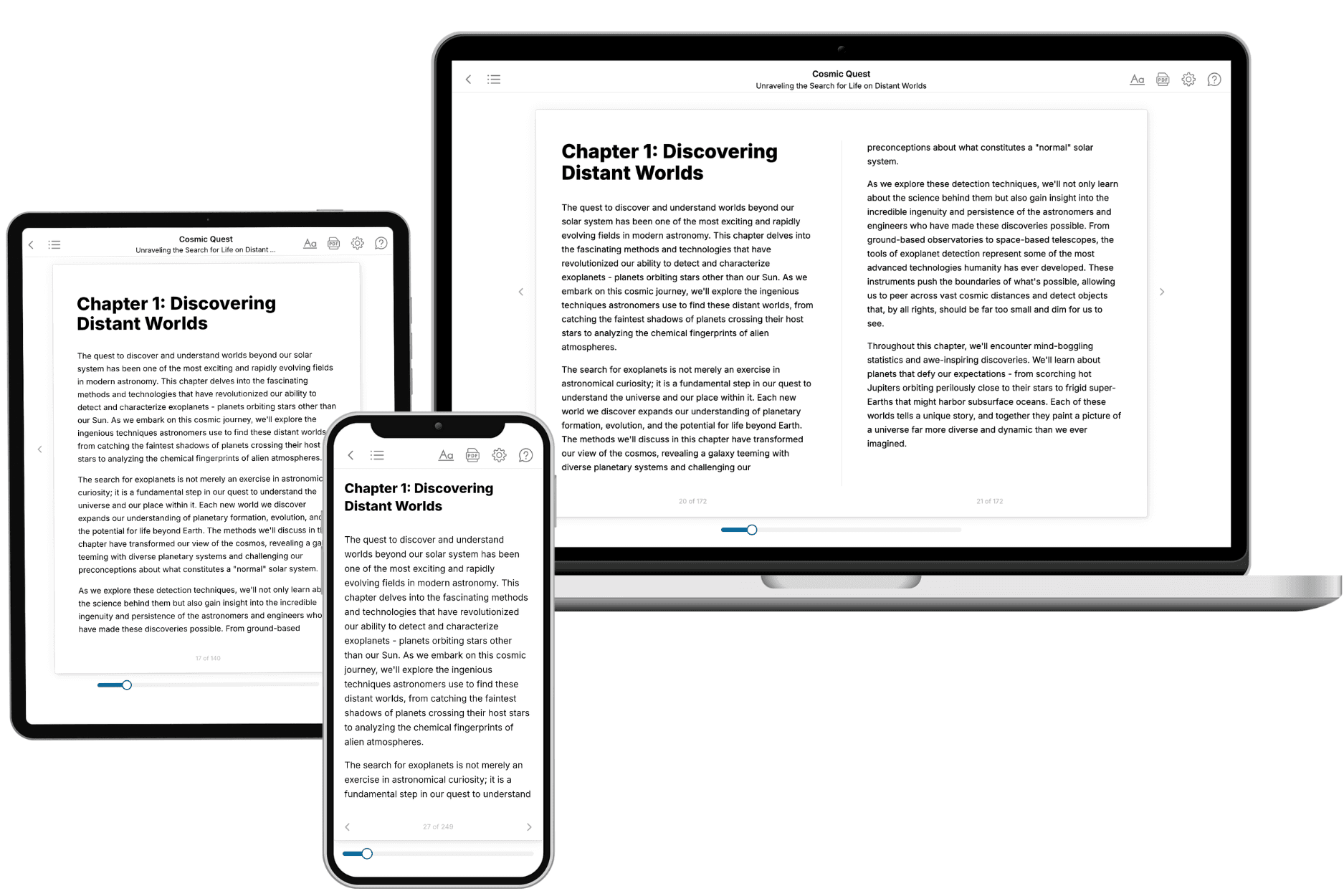
TailoredRead creates complete, full-length nonfiction ebooks, written specifically for you. Tell us what you want to learn and why, and TailoredRead writes you a complete ebook on it, with charts, tables, and diagrams throughout. Read it online, on Kindle, or on any e-reader, or download it as a PDF or EPUB. Every book is written fresh the day you order it.
- How is the book tailored to me?
Before anything is written, you answer a few short questions about your goals, your background, and the topics you care about. Your book is then planned around your answers: written at your level, focused on your goals, and covering the topics you chose, instead of the one-size-fits-all book a store sells everyone.
- Will it read like generic AI content?
No. Your book isn't a chat transcript: it's planned chapter by chapter before a single word is written, told in a clear book voice, and explains ideas visually with charts, tables, and diagrams. After writing, every book goes through an editorial pass that polishes chapters so the book reads consistent from start to finish. Judge for yourself: browse thousands of sample books on our Explore Books page.
- How accurate is the content?
Our AI first checks whether your subject needs live research. Niche and fast-moving subjects are researched before writing, and the book plan and chapters are grounded in what it finds. After writing, every book goes through a quality pass that checks its facts and consistency, and researched books list their sources in a Notes section at the back.
- How long is the book?
You choose the length: Comprehensive (250-300 pages), Detailed (150-200 pages), Essential (70-100 pages), or Short (30-50 pages).
- Does the book include visuals?
Yes. Every book includes charts, tables, and diagrams: timelines, checklists, step-by-step guides, decision trees, comparison tables, matrices, and bar charts. A typical book includes dozens of these visual elements.
- Can I read it on Kindle? What formats can I download?
Yes. Every book can be read in our online reader or downloaded as a PDF or EPUB. The EPUB can be opened with Kindle, Apple Books, Kobo, and any e-reader. The Commercial and Author licenses also include an editable Word (DOCX) and Markdown download.
- How much does it cost?
About the price of a regular ebook. The exact price depends on your book's length and complexity, from $2 for the shortest books to $35 for the most comprehensive, and it's shown when you review your book, before you commit to anything. Each book is a one-time purchase, yours to keep, no subscription. Licenses that let you share, teach, or publish your book range from $35.99 to $49.99.
- Can I preview the book before purchasing?
Before you pay, you'll see what your book will cover: the title, a detailed description, the estimated length, and the complete chapter-by-chapter table of contents, so you know what you're getting before you decide. The full text itself is written after you purchase.
- How long does it take to create a book?
About 10 minutes. You can start reading the opening chapters while the rest is still being written.