Measuring What Matters on the Hospital Tray
A value-based strategy for clinical nutrition and patient care
You will gain a practical, evidence-based way to think about hospital food as a clinical and organizational asset rather than a background service.
207 pages10 chaptersNov 24, 2026Clinical Nutrition
About this book
This book walks you through what value means in hospital foodservice, how to define and measure it across patient nutrition, experience, safety, operational cost, and environmental impact, and how to design metrics you can defend to clinical, administrative, and regulatory audiences. Drawing on CMS requirements, the 2025-2030 Dietary Guidelines, NHS England standards, and recent research on hospital meal interventions, it separates what the evidence supports from what remains uncertain. You will learn how to compare in-house, outsourced, and centralized service models without assuming one is universally best, how to balance cost against quality, and how to lead a menu redesign and procurement review with QAPI as your guide. Written for physicians and clinical leaders who want rigor over slogans, the book offers frameworks, measurement approaches, and honest discussion of limits, so you can build nutrition service policies that serve patients and stand up to scrutiny.
Table of contents
- IntroductionWhy Hospital Food Belongs in Nutrition Care, How to Use This BookRead below
- Chapter 1: Defining Value in Hospital FoodserviceValue as an Outcome-Based Management Approach, Five Domains: Nutrition, Experience, Safety, Cost, Environment, Preferred Terminology and Common Misconceptions
- Chapter 2: The Regulatory and Policy LandscapeCMS Requirements and 42 CFR 482.28, Make Hospital Food Healthier Pledge in Practice, NHS England Standards as a Comparative Reference
- Chapter 3: Dietary Guidelines and Therapeutic Diet ProtocolsApplying the 2025-2030 Dietary Guidelines Thoughtfully, Reviewing Therapeutic Diet Protocols Against Clinical Need, Malnutrition Screening Tools and Their Role in Foodservice
- Chapter 4: Linking Nutrition to Patient OutcomesFood Intake, Plate Waste, and Nutritional Status, Readmission, Length of Stay, and What the Evidence Shows, Where Evidence on Clinical Outcomes Remains Limited
- Chapter 5: Patient Experience and Personalized OrderingMeasuring Patient Food Experience and Satisfaction, Flexible Meal Ordering and Patient-Centered Design, Lessons from Digital Patient-Centered Meal Services
- Chapter 6: Food Safety Systems in HospitalsApplying HACCP Systems in Hospital Kitchens, Safety Metrics, Audits, and Accreditation Expectations
- Chapter 7: Comparing Hospital Foodservice ModelsIn-House, Outsourced, and Centralized Models Compared, Cook-Chill Versus Tray Service Trade-Offs, Procurement Policy and Supplier Contract Decisions
- Chapter 8: Cost Analysis and Clinical Nutrition EconomicsBuilding a Foodservice Cost Analysis Framework, Balancing Cost Against Quality and Safety, Clinical Nutrition Economics and Return on Investment
- Chapter 9: Menu Redesign, Sustainability, and Environmental ImpactLeading a Hospital Menu Redesign Process, Plant-Forward Menus and Sustainable Design, Measuring the Foodservice Carbon Footprint
- Chapter 10: Building Evidence-Based Foodservice Metrics with QAPIDesigning Evidence-Based Foodservice KPIs, Integrating QAPI and Continuous Quality Improvement, Designing Nutrition Service Policies and Oversight
- ConclusionFrom Metrics to Decisions in Your Hospital, Next Steps for Clinical and Administrative Leaders
- Further Reading and Resources
Introduction
A physician reviewing a patient's chart checks vital signs, medication reconciliation, and lab trends without hesitation. The same physician rarely glances at what the patient actually ate that day, or whether the tray arrived warm, matched the ordered therapeutic diet, and was eaten rather than scraped into the trash. That gap is not a minor oversight. Food intake sits on the same causal pathway as many interventions clinicians do track closely, yet it is measured with far less rigor across most hospitals.
This book treats hospital foodservice as a system that deserves the same analytical discipline applied to any other clinical process. That means defining what good
looks like, choosing measures that can be defended to a quality committee, and being honest about where the evidence is thin. Recent attention from the Centers for Medicare & Medicaid Services, including guidance urging hospitals to revisit menus and nutrition policies alongside the latest Dietary Guidelines, has made this a live question for administrators and clinicians alike, not a theoretical exercise reserved for dietitians.
The chapters ahead build a structure for that work, moving from how to define value, through the regulatory floor and aspirational standards that shape practice, into clinical outcomes, patient experience, safety systems, service models, cost, environmental impact, and finally a measurement loop built on QAPI. None of that structure is covered in this introduction. Instead, this introduction explains why the subject deserves a physician's full analytical attention and how to move through the book in a way that matches your role and your hospital's situation.
Readers arriving with a clinical and research background, but little hands-on foodservice experience, often underestimate how many disciplines intersect on a single tray: dietetics, supply chain logistics, food microbiology, labor economics, and increasingly environmental accounting. The book does not assume prior expertise in any of these areas. It assumes instead the habits of mind a physician with a research background already has: comfort with evidence grading, skepticism toward unproven claims, and willingness to hold several competing goals in view at once rather than optimizing for just one.
Why Hospital Food Belongs in Nutrition Care
Consider two patients admitted with the same diagnosis, matched for age and comorbidity. One receives a tray that matches their therapeutic diet order, arrives at an appetizing temperature, and offers enough variety that they eat most of it. The other receives a tray that technically satisfies the diet order on paper but tastes bland, arrives lukewarm, and goes back to the kitchen three-quarters full. Nothing in either chart documents this difference, yet the two patients are on meaningfully different nutritional trajectories. Hospital foodservice generates exactly this kind of invisible variation every day, across thousands of trays, without anyone tracking it as a clinical variable.
Malnutrition on admission and malnutrition acquired during a hospital stay are both common enough to matter at a population level, and both are influenced by whether patients actually eat what is served. A patient who is NPO, nauseated, or simply uninterested in an unappealing meal loses ground nutritionally in ways that complicate wound healing, immune function, and functional recovery. Framing the tray as part of nutrition care, rather than as hospitality dressed up with a diet order, shifts the question from did we serve the right food
to did the patient receive enough nutrition to support recovery.
That shift in framing is the foundation the rest of the book builds on.
Clinical nutrition care already has established tools for this kind of thinking, most visibly the malnutrition screening tool, which is used on admission to flag patients at nutritional risk before complications appear. Foodservice sits downstream of that screening process, because a correctly flagged patient who then receives a mismatched, unappetizing, or poorly timed meal gains little from the screening itself. The screening identifies risk. The foodservice system is what either closes that risk gap or widens it. Treating these as two halves of one pathway, rather than as a clinical step followed by a separate operational function, is the first conceptual move this book asks of you.
A second reason food belongs in nutrition care is that it is one of the few clinical inputs a hospital delivers multiple times a day, every day, to nearly every inpatient. Medication administration is tightly protocolized, documented, and audited. Food delivery, by contrast, often passes through kitchens, trolleys, and ward staff with far less structured oversight, even though it reaches patients with comparable frequency. That volume means small, unmeasured inefficiencies compound quickly across a hospital's census, while small improvements can likewise compound into meaningful aggregate gains in intake, satisfaction, and plate waste reduction.
This is not a claim that better food alone cures malnutrition or shortens hospital stays. The evidence connecting food intake to outcomes such as readmission and length of stay is explored later in the book, and it is more nuanced than advocacy materials often suggest. The claim here is narrower and more defensible: food intake is a measurable clinical input, it varies substantially based on foodservice design choices, and ignoring that variation means ignoring a factor that plausibly affects recovery. A rigorous reader does not need certainty about final outcomes to justify measuring and improving the input itself.
There is also a regulatory dimension that reinforces the clinical one. Hospital foodservice is not purely discretionary; it operates inside a framework set by 42 CFR §482.28 and shaped by voluntary commitments such as the Make Hospital Food Healthier Pledge, with the NHS England National Standards for Healthcare Food and Drink offering an international point of comparison. The regulatory and policy landscape chapter later in the book walks through these instruments in detail. For now, the relevant point is simpler: foodservice already sits inside the compliance and quality infrastructure hospitals maintain for every other clinical process, which means it is already eligible for the kind of rigorous measurement this book proposes, not a candidate for it.
Framing food as clinical also changes who should feel ownership of it. In many hospitals, foodservice decisions are made almost entirely by foodservice management or an outsourced contractor, with clinical leadership engaging only when a complaint escalates or a survey finding demands a response. That division of labor made more sense when foodservice was treated as hospitality. It makes less sense once food intake is understood as a measurable input to nutritional status, alongside medication adherence or mobility protocols. Physicians, dietitians, and foodservice leaders need a shared vocabulary and a shared set of metrics to collaborate on this, rather than operating in separate silos that meet only at the point of a complaint.
None of this implies that clinical judgment should override the operational expertise foodservice managers bring to kitchen workflow, procurement, or labor scheduling. The two domains inform each other. A clinician's job is not to redesign tray-line logistics, but to insist that whatever logistics are chosen get evaluated against outcomes that matter to patients and to the institution. That is a familiar posture for a physician: setting the clinical question, then working with specialists who understand the mechanics of delivery. The five-domain value framework introduced in the next chapter is the tool that makes that collaboration concrete, by giving nutrition, experience, safety, cost, and environmental impact a common structure that both clinical and operational leaders can use.
One final point frames the rest of the book's tone. Hospital foodservice has no shortage of confident claims: that outsourcing always saves money, that centralized production always degrades quality, that plant-forward menus always improve both health and sustainability outcomes simultaneously. Some of these claims have partial support, others very little. A physician trained to read evidence critically will recognize the pattern: strong claims, thin data, and a motivated party behind each one, whether a vendor, a consultancy, or an advocacy group. This book does not pretend the evidence is stronger than it is. Where the research is genuinely limited, later chapters say so explicitly, because an honest account of uncertainty is more useful to a decision-maker than a confident one that cannot survive scrutiny.
How to Use This Book
The book is organized as a sequence, but it is not designed to be read only in order. Chapters build on a shared framework introduced early on, then apply that framework to specific domains: regulation, dietary guidance, clinical outcomes, patient experience, safety, service models, cost, sustainability, and finally measurement and quality improvement. A reader preparing for a specific decision, such as evaluating a contract renewal with an outsourced vendor or redesigning a therapeutic diet protocol, can go directly to the relevant chapter once the early framework chapters are understood, rather than reading the whole book front to back before acting.
The core structural tool, introduced in the chapter on defining value, is the five-domain value framework: nutrition, patient experience, safety, cost, and environmental impact. Every later chapter maps back onto one or more of these five domains, so that a decision about, say, switching from tray service to cook-chill production is evaluated the same way as a decision about menu redesign or procurement policy, using the same five lenses rather than a new ad hoc set of criteria each time. Holding onto this framework as you read is more useful than memorizing any single chapter's details, because the framework is what lets you compare options that otherwise look incommensurable, like comparing a safety improvement against a cost saving.
Each content chapter follows a similar internal logic, moving from definitions and context, through the relevant evidence base, into practical application. The chapter on regulatory and policy context, for instance, separates what is legally binding under 42 CFR §482.28 from what is voluntary and aspirational, such as the pledge or the NHS standards used as a comparator. That distinction matters practically: a compliance floor tells you what you must not fall below, while an aspirational standard tells you where leading institutions are heading, and conflating the two leads either to complacency or to unrealistic expectations placed on every hospital regardless of context.
Where the book discusses evidence, it tries to be explicit about the strength and limits of that evidence rather than presenting a uniform level of confidence throughout. Some claims, such as the mechanics of how HACCP systems control foodborne hazards, rest on well-established food safety science. Others, such as whether a particular service model produces better clinical outcomes than another, rest on a much thinner and more mixed evidence base. The book flags these differences deliberately rather than smoothing them over, because treating weak evidence as strong is itself a source of poor decisions in hospital management, not just in research.
A recurring theme worth anticipating now is that no single foodservice model, dietary approach, or procurement strategy is proven superior across all hospital settings. Chapters comparing in-house foodservice, outsourced foodservice, and centralized foodservice models, or comparing cook-chill against tray service, do not end with a single recommended winner. They end with a structured way to weigh trade-offs given a specific hospital's size, patient population, existing infrastructure, and staffing realities. Readers looking for a universal answer will not find one here, because the evidence does not support giving one, and a book that manufactured false certainty would do readers a disservice.
The book also leans on practical tools rather than abstract discussion alone. Several chapters include structured comparisons, step-by-step processes, or checklists designed to be used directly, whether that means auditing a therapeutic diet protocol against current clinical need, building a cost analysis framework, or leading a menu redesign process. These are meant as starting templates to adapt to local circumstances, not fixed procedures to follow without judgment. A hospital serving a large oncology population will weigh therapeutic diet flexibility differently than one serving mostly short-stay surgical patients, and the tools in this book are built to accommodate that kind of variation rather than erase it.
QAPI appears repeatedly across later chapters, not as a single topic confined to one place, but as the connective structure that turns measurement into action. Quality Assessment and Performance Improvement processes already exist in most hospitals for clinical quality, and the final chapters argue that foodservice metrics belong inside that same structured improvement loop rather than in a separate, less rigorous reporting track. Understanding QAPI's basic logic early, even before reaching the dedicated chapter on it, will make the intervening chapters on cost, safety, and patient experience easier to connect to actual institutional decision-making.
For a physician with a research background but limited hands-on foodservice experience, the most useful habit while reading is to keep translating each new concept back into a question you could ask at your own institution. When a chapter introduces evidence-based foodservice KPIs, the useful exercise is not just understanding the concept abstractly, but asking which KPIs your hospital currently tracks, if any, and which of the five domains those KPIs leave unmeasured. When a chapter discusses malnutrition screening tools, the useful question is whether your hospital's screening results actually feed back into foodservice decisions, or whether the two systems operate in isolation from one another.
The book does not require a background in foodservice management, food science, or supply chain operations to follow. Technical terms are introduced and explained where they first appear, and the canonical terms used throughout, such as plate waste, therapeutic diet protocol, and clinical nutrition economics, are used consistently so that cross-references between chapters stay clear. Where a term carries a precise regulatory or technical meaning, such as the specific provisions of 42 CFR §482.28 or the structure of MSQH standards, the relevant chapter explains that meaning in context rather than assuming prior familiarity.
By the final chapters, the goal is not simply broader knowledge about hospital foodservice as a topic, but a working method: a way to define value for your own institution, choose defensible metrics across all five domains, and feed those metrics into a continuous improvement cycle that clinical and administrative leadership can both stand behind. That method is more durable than any single statistic or recommendation in the book, because hospital policy, vendor contracts, and dietary guidance will continue to change after this book is written, while the underlying discipline of asking the right questions about nutrition, experience, safety, cost, and environmental impact will not go out of date.
This is the end of the free sample. The full book has 10 chapters.
Want this book written for you?
Tell us your goals and background, and get your own version of this book, tailored by AI to you.


Benefits of AI-tailored books
- Read one book, not ten:
- all the Clinical Nutrition knowledge you need, gathered into a single book.
- Save days of learning:
- tell us your goals, choose your topics, and the whole book is built around them.
- Learn effortlessly:
- Clinical Nutrition book written for your specific background and expertise.
- Understand at a glance:
- includes charts, tables, timelines, checklists, decision trees, and more.
- Stay current:
- written the day you order it, not years ago.
- Trust what you read:
- every book is checked for accuracy, with real research when your subject needs it.
Create your unique book in 3 steps
- 1. Select your focus
Select the focus of your Clinical Nutrition book and share your background
- 2. Personalize your book
Specify your goals and choose sub-topics to include
- 3. Get your tailored book
Your book is ready in 10 minutes. Read it online, download as EPUB or PDF, or send to Kindle.


Frequently asked questions
- What is TailoredRead?
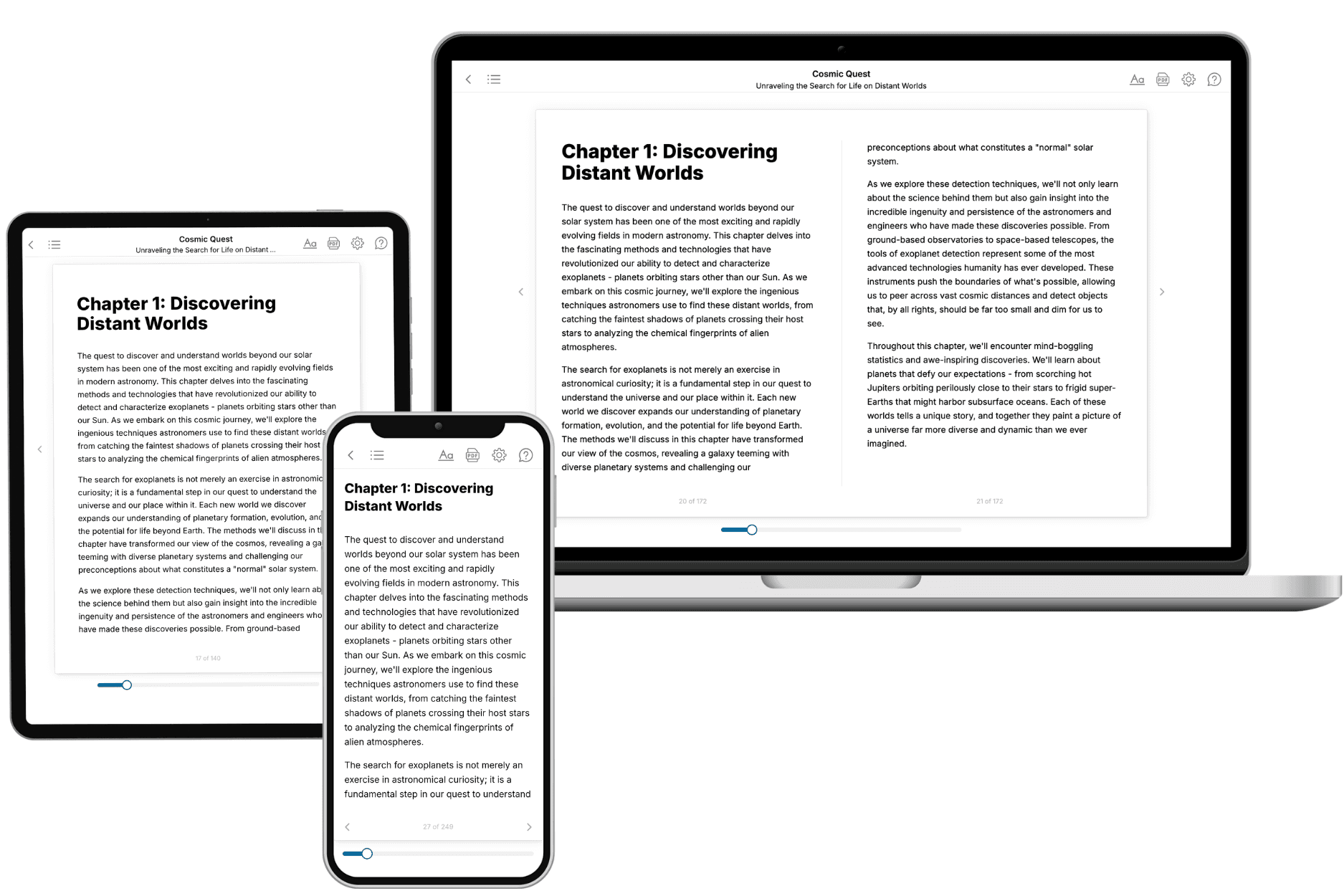
TailoredRead creates complete, full-length nonfiction ebooks, written specifically for you. Tell us what you want to learn and why, and TailoredRead writes you a complete ebook on it, with charts, tables, and diagrams throughout. Read it online, on Kindle, or on any e-reader, or download it as a PDF or EPUB. Every book is written fresh the day you order it.
- How is the book tailored to me?
Before anything is written, you answer a few short questions about your goals, your background, and the topics you care about. Your book is then planned around your answers: written at your level, focused on your goals, and covering the topics you chose, instead of the one-size-fits-all book a store sells everyone.
- Will it read like generic AI content?
No. Your book isn't a chat transcript: it's planned chapter by chapter before a single word is written, told in a clear book voice, and explains ideas visually with charts, tables, and diagrams. After writing, every book goes through an editorial pass that polishes chapters so the book reads consistent from start to finish. Judge for yourself: browse thousands of sample books on our Explore Books page.
- How accurate is the content?
Our AI first checks whether your subject needs live research. Niche and fast-moving subjects are researched before writing, and the book plan and chapters are grounded in what it finds. After writing, every book goes through a quality pass that checks its facts and consistency, and researched books list their sources in a Notes section at the back.
- How long is the book?
You choose the length: Comprehensive (250-300 pages), Detailed (150-200 pages), Essential (70-100 pages), or Short (30-50 pages).
- Does the book include visuals?
Yes. Every book includes visual elements such as timelines, checklists, step-by-step guides, decision trees, comparison tables, and matrices, and many include bar charts. A typical book includes dozens of these visual elements.
- Can I read it on Kindle? What formats can I download?
Yes. Every book can be read in our online reader or downloaded as a PDF or EPUB. The EPUB can be opened with Kindle, Apple Books, Kobo, and any e-reader. The Commercial and Author licenses also include an editable Word (DOCX) and Markdown download.
- How much does it cost?
About the price of a regular ebook. The exact price depends on your book's length and complexity, from $2 for the shortest books to $35 for the most comprehensive, and it's shown when you review your book, before you commit to anything. Each book is a one-time purchase, yours to keep, no subscription. Licenses that let you share, teach, or publish your book range from $35.99 to $49.99.
- Can I preview the book before purchasing?
Before you pay, you'll see what your book will cover: the title, a detailed description, the estimated length, and the complete chapter-by-chapter table of contents, so you know what you're getting before you decide. The full text itself is written after you purchase.
- How long does it take to create a book?
10 minutes. You can start reading the opening chapters while the rest is still being written.