Memory Leaks
Master Code Maintainability Through Effective Memory Management
Memory leaks silently degrade your application's performance and reliability, but their real cost is hidden in maintenance burden and technical debt.
222 pages11 chaptersJul 30, 2026Software Development
About this book
As your codebase grows, undetected memory leaks become increasingly difficult to diagnose and fix, forcing you to spend more time debugging than building new features. This book provides a practical, systematic approach to understanding memory management, identifying leaks before they become critical, and implementing maintainability practices that prevent them from recurring. You'll learn how to use profiling tools effectively, recognize common leak patterns, design architectures that resist memory issues, and establish team practices that catch problems early. Whether you're working with managed or unmanaged languages, this guide equips you with the knowledge and techniques to write code that remains efficient and maintainable throughout its lifecycle.
Table of contents
- IntroductionWhy Memory Management Matters for Code Quality, The Hidden Cost of Memory Leaks, What You'll Learn in This Book, How to Use This GuideRead below
- Chapter 1: Memory FundamentalsHow Memory Allocation Works, Stack vs. Heap: Understanding the Difference, Memory Ownership and Responsibility
- Chapter 2: What Are Memory Leaks?Defining Memory Leaks in Practice, Common Types of Memory Leaks, How Leaks Affect Application Performance and Maintainability
- Chapter 3: Common Leak PatternsCircular References and Object Cycles, Event Listeners and Callbacks Gone Wrong, Global State and Uncontrolled Growth, Unclosed Resources and File Handles
- Chapter 4: Profiling and Detection ToolsGetting Started with Memory Profilers, Analyzing Heap Dumps and Memory Snapshots, Choosing the Right Tools for Your Language
- Chapter 5: Debugging Memory LeaksA Systematic Debugging Methodology, Reproducing and Isolating Leaks, Tracing to Root Cause
- Chapter 6: Language-Specific SolutionsMemory Management in Managed Languages, Manual Memory Management Best Practices, Modern Language Features and Ownership Systems
- Chapter 7: Design Patterns for PreventionResource Acquisition Is Initialization (RAII), Dependency Injection and Lifecycle Management, Using Weak References and Smart Pointers
- Chapter 8: Architecture and Code OrganizationDesigning Modular Systems That Resist Leaks, Managing Memory at System Boundaries, Scaling Without Accumulating Technical Debt
- Chapter 9: Testing for Memory LeaksDesigning Tests That Catch Memory Leaks, Continuous Memory Monitoring in CI/CD, Establishing and Maintaining Performance Baselines
- Chapter 10: Team Practices and Code ReviewMemory-Aware Code Review Practices, Establishing Team Standards and Guidelines, Building a Culture of Memory Awareness
- Chapter 11: Real-World Case StudiesCase Study: Fixing a Production Memory Leak, Case Study: Architectural Refactoring for Maintainability, Lessons and Takeaways from Real Scenarios
- ConclusionKey Takeaways, Your Path Forward
- Appendix: Quick Reference GuideMemory Leak Prevention Checklist, Additional Resources and Tools
Introduction
A Node.js service starts cleanly, handles requests without complaint, and looks perfectly healthy on day one. By day four, response times have doubled. By day ten, the process is consuming three times the memory it started with, and the on-call engineer is restarting it manually every night just to keep the application alive. Nobody changed the business logic. Nobody touched the database layer. The culprit, eventually traced through a heap dump, turns out to be a single event listener registered inside a request handler but never removed. One line of code, repeated thousands of times per hour, quietly filling the heap until the system buckles.
That scenario is not unusual. Memory leaks are among the most common and most misunderstood problems in software development. They appear in every language, every runtime, and every application type, from mobile apps to distributed backend services. What makes them particularly difficult is that they rarely announce themselves. They accumulate gradually, hide behind normal-looking metrics, and only become visible once the damage is significant enough to affect users. By that point, the original cause may be buried under months of subsequent commits.
The deeper problem is that memory leaks are not just a performance issue. They are a code quality issue. A codebase that leaks memory is a codebase where ownership of resources is unclear, where lifecycle boundaries are poorly defined, and where the assumptions one developer makes about an object's lifetime are invisible to the next developer who touches that code. That kind of ambiguity compounds over time. It makes the code harder to read, harder to test, and harder to extend safely. Fixing a memory leak often means untangling a web of responsibilities that should have been clear from the start.
This book treats memory management as a discipline of code maintainability, not just a performance optimization. The goal is to give you a complete, practical toolkit: the conceptual foundation to understand what memory leaks are and why they happen, the diagnostic skills to find them when they do, the design knowledge to prevent them structurally, and the team practices to keep them from coming back. Each chapter builds on the last, moving from fundamentals through detection, prevention, architecture, and finally to the organizational habits that make memory-safe code a team norm rather than an individual heroic effort.
Why Memory Management Matters for Code Quality
Memory management sits at the intersection of correctness and design. When a program allocates memory and fails to release it, that is not just a resource problem. It is a signal that the code's ownership model is broken. Something was created, but nobody was made responsible for cleaning it up. That gap between creation and cleanup is where memory leaks live, and it is also where maintainability problems live. Code that is hard to reason about is code that leaks.
Consider what good memory management actually requires. Every object or resource that gets allocated needs a clear owner: something or someone responsible for deciding when that resource is no longer needed and releasing it. In languages with manual memory management like C or C++, that responsibility falls entirely on the developer. In managed languages like Java, Python, or JavaScript, a garbage collector handles most of it automatically, but the developer still controls whether references are held or released. Mismanaging those references is just as much a leak as forgetting to call free().
The connection to code quality becomes concrete when you look at what causes most leaks in practice. Circular references happen when two objects hold references to each other with no clear owner. Event listener leaks happen when a component registers a callback but the code that should unregister it is never written or never called. Global state growth happens when data is added to a shared collection but the logic for removing stale entries is missing or incorrect. In every case, the leak is a symptom of a design decision that was not fully thought through.
Good memory management forces clarity. When you ask "who owns this object and when should it be released?", you are asking the same question as "what is the lifecycle of this component?" and "what are the boundaries of this module?" Those are exactly the questions that lead to better-designed, more maintainable code. A team that thinks carefully about memory ownership tends to write code with cleaner interfaces, more explicit lifecycles, and fewer hidden dependencies.
This is why memory management belongs in conversations about code review, architecture, and team standards, not just in post-incident debugging sessions. The habits that prevent memory leaks are the same habits that make code easier to read, test, and extend. They are not separate concerns. They are the same concern viewed from different angles.
Languages and runtimes have evolved significantly in how much they automate memory management. Rust's ownership system enforces memory safety at compile time, making entire categories of leaks impossible by construction. Modern C++ smart pointers reduce the risk of manual allocation errors. Java's garbage collector handles most deallocation automatically. But none of these tools eliminate the need for developer judgment. They shift where that judgment is applied, not whether it is needed. Understanding the underlying principles remains essential regardless of which language or runtime you work in.
Memory management is not a low-level concern reserved for systems programmers. It is a design discipline that shapes the quality, reliability, and maintainability of every application, at every level of the stack.
The Hidden Cost of Memory Leaks
The most visible cost of a memory leak is the one that triggers an incident: the server running out of memory, the mobile app crashing after an hour of use, the browser tab becoming sluggish and unresponsive. Those are the moments that get filed as bugs and assigned to engineers. But they represent only the final, visible stage of a much longer and more expensive process that started long before anyone noticed anything wrong.
The hidden costs begin accumulating the moment a leak is introduced. Memory usage climbs slowly, staying within acceptable bounds for days or weeks. During that time, the garbage collector in a managed runtime works harder to reclaim space, consuming CPU cycles that would otherwise serve user requests. Response latency increases slightly. Throughput drops slightly. These changes are small enough to fall within normal variation, so they go unnoticed. The application appears healthy while quietly degrading.
When the leak finally becomes visible, the debugging cost is often disproportionate to the original mistake. The engineer investigating the problem has to work backward from a symptom (high memory usage, slow responses, or an out-of-memory crash) to a cause that may have been introduced weeks earlier by someone who has since moved to a different team. Without good tooling and a systematic debugging methodology, that investigation can take days. The fix itself might be a single line of code. The investigation to find that line is where the real cost lives.
There is also a compounding effect that makes leaks in growing codebases particularly dangerous. A small leak in a low-traffic service is manageable. The same leak in a service that scales to ten times the traffic becomes a critical incident. A leak that only manifests after hours of continuous operation is invisible in short-lived test environments but catastrophic in production. As codebases grow and traffic increases, the tolerance for undetected leaks shrinks. Technical debt that was harmless at small scale becomes a reliability risk at large scale.
The maintenance cost extends beyond the immediate debugging effort. Once a memory leak is found and fixed, the team has to ask why it was not caught earlier. That question often reveals gaps in testing strategy, code review practices, or monitoring infrastructure. Addressing those gaps takes time and organizational effort. A single production memory leak can trigger a cascade of process improvements that consume engineering time for weeks after the original fix.
There is a subtler cost that is harder to quantify but equally real: the erosion of developer confidence. A codebase known to have memory problems becomes a codebase that developers are afraid to change. When nobody is sure which parts of the system are leaking or why, every refactoring carries the risk of making things worse. That fear slows development, discourages cleanup, and leads to the kind of defensive, overly cautious code that accumulates its own technical debt over time.
The economic argument for investing in memory management practices is straightforward. Preventing a memory leak during code review costs minutes. Finding and fixing one in production costs hours or days, plus the reputational and reliability impact of the incident itself. The return on investment for good memory hygiene is not theoretical. It is measurable in reduced incident frequency, faster development cycles, and lower maintenance overhead across the lifetime of the codebase.
What You'll Learn in This Book
This book is organized as a progression from understanding to action. It starts with the foundational concepts that make everything else possible, moves through detection and diagnosis, covers prevention at the code and architecture level, and finishes with the team practices that turn individual knowledge into shared standards. Each section is designed to be practical, with concrete examples, specific techniques, and actionable guidance rather than abstract theory.
The first part of the book builds the conceptual foundation. The chapter on memory fundamentals covers how memory allocation works at the hardware and operating system level, the difference between the stack and the heap, and what memory ownership means in practice. The chapter on what memory leaks are defines the concept precisely, introduces a taxonomy of leak types, and explains how leaks affect both performance and maintainability. These chapters give you the vocabulary and mental models needed to understand everything that follows.
The second part focuses on recognition and diagnosis. The chapter on common leak patterns catalogs the recurring code-level mistakes that cause leaks in real applications, including circular references, event listener leaks, global state growth, and unclosed resources. The chapter on profiling and detection tools covers how to use memory profilers effectively, how to read heap dumps and retention graphs, and how to choose the right tools for your language and runtime. The chapter on debugging methodology provides a repeatable, systematic process for reproducing, isolating, and tracing a memory leak to its root cause.
The third part covers prevention. The chapter on language-specific solutions addresses how memory management works in both managed and unmanaged languages, and how modern language features like ownership systems and smart pointers change the picture. The chapter on design patterns covers RAII, dependency injection lifecycle management, weak references, and smart pointers as structural approaches to preventing leaks. The chapter on architecture and code organization shows how system-level decisions about module boundaries and component lifecycles determine whether memory-safe behavior is easy or hard to achieve.
The fourth part addresses the organizational dimension. The chapter on testing for memory leaks covers how to write tests that catch leaks before they reach production, how to integrate memory monitoring into CI/CD pipelines, and how to establish and maintain performance baselines. The chapter on team practices and code review provides concrete guidance on memory-aware code review, shared standards, and building a culture of memory awareness. The final chapter presents annotated real-world case studies that show the full arc from symptom to fix to prevention, tying together all the concepts from earlier chapters.
Throughout the book, the emphasis is on transferable principles rather than tool-specific recipes. Tools change. Languages evolve. The underlying concepts of ownership, lifecycle, and resource responsibility remain constant. By the end of this book, you will have both the specific techniques to address memory leaks in your current codebase and the conceptual framework to recognize and prevent them in whatever language or environment you work in next.
The case studies in the final chapter are particularly worth noting. They are not simplified toy examples. They are realistic scenarios drawn from the kinds of problems that appear in production systems: a backend service with a slow memory leak traced to an event listener accumulation, and an architectural refactoring that eliminated a class of leaks by clarifying ownership boundaries. Reading those case studies after working through the earlier chapters will show you how the individual concepts connect in practice.
How to Use This Guide
This book is designed to be read sequentially, but it is also structured so that individual chapters stand on their own as references. If you are new to memory management concepts, reading from the beginning is the most effective approach. The foundational chapters on memory fundamentals and leak definitions provide context that makes the later chapters on profiling, debugging, and prevention significantly easier to apply. Skipping ahead without that foundation is possible, but you may find yourself returning to earlier chapters to fill in gaps.
If you are already comfortable with the basics and have a specific problem to solve, the book works well as a targeted reference. The following guide maps common situations to the most relevant chapters:
- You suspect a memory leak in production but do not know where to start: Begin with the chapter on profiling and detection tools, then move to the chapter on debugging methodology.
- You want to understand why your code is leaking: The chapter on common leak patterns is the most direct starting point.
- You want to prevent leaks in new code: The chapters on design patterns and architecture are the most relevant.
- You want to improve your team's practices: Start with the chapter on testing for memory leaks, then the chapter on team practices and code review.
- You want to see how everything fits together in a real scenario: The case studies chapter is designed for exactly that purpose.
The code examples throughout the book are written to illustrate concepts clearly rather than to be copied verbatim into production code. They use simplified scenarios that highlight the specific pattern being discussed. Where language-specific syntax is used, it is chosen to be readable to developers who may not be specialists in that language. The goal is always to make the underlying concept clear, not to demonstrate language mastery.
Each chapter ends with practical takeaways and, where appropriate, checklists or frameworks you can apply immediately. These are not summaries of what the chapter covered. They are tools for putting the chapter's content into practice. The memory-aware code review checklist in the team practices chapter, for example, is designed to be used directly in your next code review session, not just read and forgotten.
The appendix at the end of the book contains a consolidated memory leak prevention checklist and a curated list of additional resources and tools. These are designed as quick references for ongoing use after you have finished reading. The checklist in particular is useful as a starting point for establishing team standards, since it covers the most common leak patterns and prevention techniques in a format that is easy to share and adapt.
One practical suggestion: as you read, keep a specific codebase in mind. The concepts in this book become much more concrete when you are actively thinking about how they apply to code you know well. When the chapter on circular references describes how two objects can hold references to each other indefinitely, ask yourself whether that pattern exists anywhere in your current project. When the chapter on profiling tools describes how to read a retention graph, think about which parts of your application you would want to profile first. That active engagement with the material will make the knowledge stick and make it easier to apply when you need it.
Memory management is a skill that develops with practice. Reading about it builds the conceptual foundation, but the real learning happens when you open a profiler, look at a heap dump, and start tracing references. The goal of this book is to give you enough understanding and enough practical technique that when you sit down with a real memory problem, you know where to start, what to look for, and how to think about what you find. The rest comes from doing the work.
This is the end of the free sample. The full book has 11 chapters.
Want this book written for you?
Tell us your goals and background, and get your own version of this book, tailored by AI to you.


Benefits of AI-tailored books
- Read one book, not ten:
- all the Software Development knowledge you need, gathered into a single book.
- Save days of learning:
- tell us your goals, choose your topics, and the whole book is built around them.
- Learn effortlessly:
- Software Development book written for your specific background and expertise.
- Understand at a glance:
- includes charts, tables, timelines, checklists, decision trees, and more.
- Stay current:
- written the day you order it, not years ago.
- Trust what you read:
- every book is checked for accuracy, with real research when your subject needs it.
Create your unique book in 3 steps
- 1. Select your focus
Select the focus of your Software Development book and share your background
- 2. Personalize your book
Specify your goals and choose sub-topics to include
- 3. Get your tailored book
Your book is ready in 10 minutes. Read it online, download as EPUB or PDF, or send to Kindle.


Frequently asked questions
- What is TailoredRead?
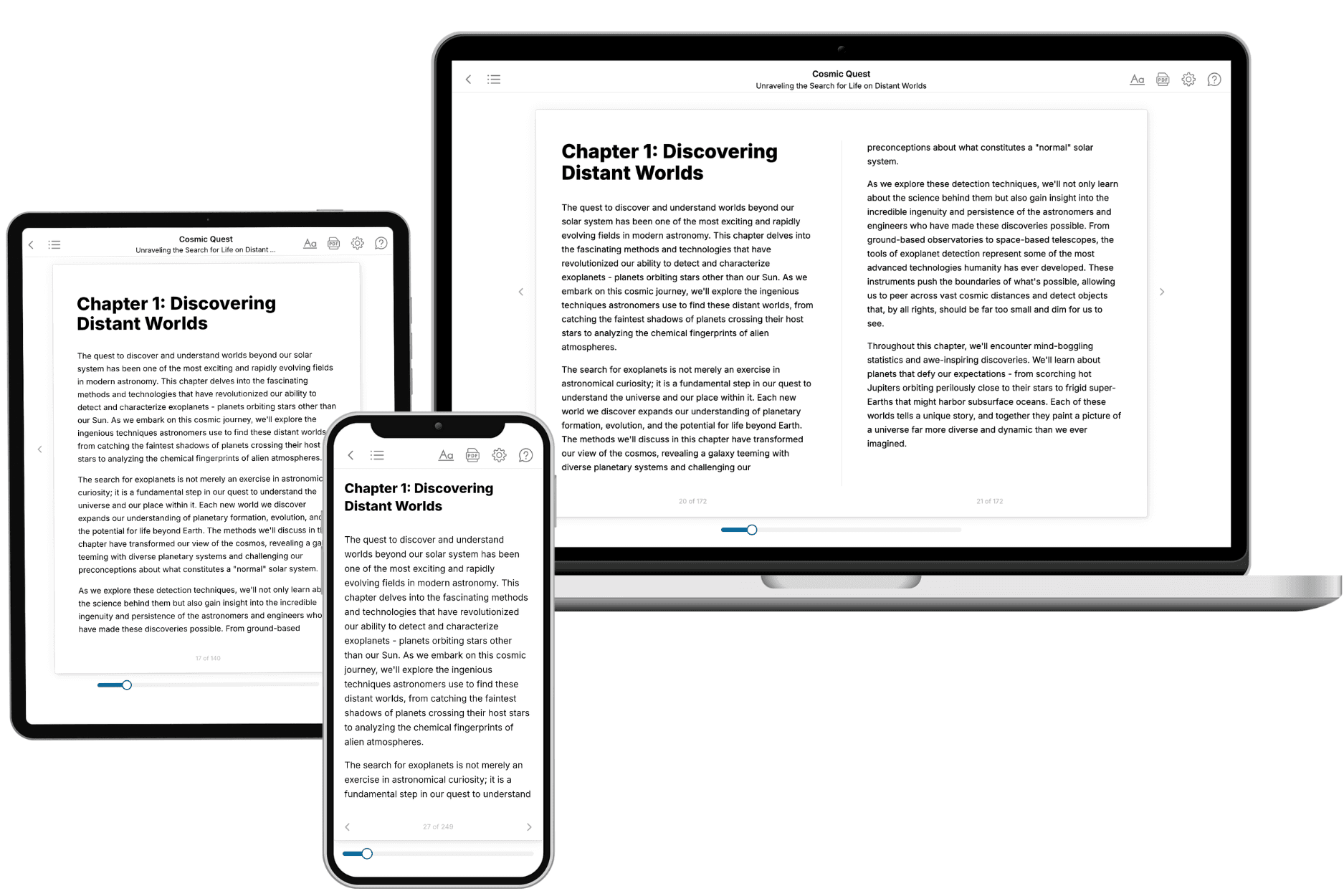
TailoredRead creates complete, full-length nonfiction ebooks, written specifically for you. Tell us what you want to learn and why, and TailoredRead writes you a complete ebook on it, with charts, tables, and diagrams throughout. Read it online, on Kindle, or on any e-reader, or download it as a PDF or EPUB. Every book is written fresh the day you order it.
- How is the book tailored to me?
Before anything is written, you answer a few short questions about your goals, your background, and the topics you care about. Your book is then planned around your answers: written at your level, focused on your goals, and covering the topics you chose, instead of the one-size-fits-all book a store sells everyone.
- Will it read like generic AI content?
No. Your book isn't a chat transcript: it's planned chapter by chapter before a single word is written, told in a clear book voice, and explains ideas visually with charts, tables, and diagrams. After writing, every book goes through an editorial pass that polishes chapters so the book reads consistent from start to finish. Judge for yourself: browse thousands of sample books on our Explore Books page.
- How accurate is the content?
Our AI first checks whether your subject needs live research. Niche and fast-moving subjects are researched before writing, and the book plan and chapters are grounded in what it finds. After writing, every book goes through a quality pass that checks its facts and consistency, and researched books list their sources in a Notes section at the back.
- How long is the book?
You choose the length: Comprehensive (250-300 pages), Detailed (150-200 pages), Essential (70-100 pages), or Short (30-50 pages).
- Does the book include visuals?
Yes. Every book includes charts, tables, and diagrams: timelines, checklists, step-by-step guides, decision trees, comparison tables, matrices, and bar charts. A typical book includes dozens of these visual elements.
- Can I read it on Kindle? What formats can I download?
Yes. Every book can be read in our online reader or downloaded as a PDF or EPUB. The EPUB can be opened with Kindle, Apple Books, Kobo, and any e-reader. The Commercial and Author licenses also include an editable Word (DOCX) and Markdown download.
- How much does it cost?
About the price of a regular ebook. The exact price depends on your book's length and complexity, from $2 for the shortest books to $35 for the most comprehensive, and it's shown when you review your book, before you commit to anything. Each book is a one-time purchase, yours to keep, no subscription. Licenses that let you share, teach, or publish your book range from $35.99 to $49.99.
- Can I preview the book before purchasing?
Before you pay, you'll see what your book will cover: the title, a detailed description, the estimated length, and the complete chapter-by-chapter table of contents, so you know what you're getting before you decide. The full text itself is written after you purchase.
- How long does it take to create a book?
About 10 minutes. You can start reading the opening chapters while the rest is still being written.