Metabolic Pathways Demystified
Understanding How Chemical Reactions Power Life
Discover how your cells convert food into energy and build the molecules needed for life.
253 pages12 chaptersNov 25, 2025Biochemistry
About this book
This book takes you through the fascinating world of metabolic pathways—the chemical reaction sequences that power every living organism. You'll learn how enzymes catalyze reactions with remarkable precision, how ATP captures and transfers energy, and how your body regulates these pathways to maintain balance. Starting with fundamental chemistry concepts, you'll progress through glycolysis, the citric acid cycle, and electron transport, understanding not just what happens, but why it matters. Whether you're studying biochemistry, interested in how your metabolism works, or simply curious about the chemistry of life, this guide makes complex pathways accessible and engaging. Explore real-world applications, from metabolic disorders to biotechnology, and see how understanding these pathways connects to health, disease, and innovation.
Table of contents
- IntroductionWhy Metabolism Matters, What You'll Learn in This Book, How to Use This GuideRead below
- Chapter 1: Foundations of Chemistry and EnergyAtoms, Molecules, and Chemical Bonds, Energy in Chemical Reactions, Thermodynamics Basics: Enthalpy and Entropy, Redox Reactions and Electron Transfer
- Chapter 2: Enzymes: The Catalysts of LifeEnzyme Structure and Function, Enzyme Kinetics and Reaction Rates, Enzyme Regulation and Control, Cofactors and Coenzymes
- Chapter 3: ATP: The Energy CurrencyATP Structure and Synthesis, ATP Hydrolysis and Energy Release, Energy Coupling in Cells, Other High-Energy Molecules
- Chapter 4: Glycolysis: Breaking Down GlucoseGlycolysis Overview and Stages, The Ten Reactions of Glycolysis, Regulation of Glycolysis, The Fate of Pyruvate
- Chapter 5: The Citric Acid Cycle: Energy ExtractionThe Citric Acid Cycle Overview, The Eight Reactions of the Cycle, NADH and FADH2 Production, Regulation of the Citric Acid Cycle
- Chapter 6: Oxidative Phosphorylation: Harvesting EnergyThe Electron Transport Chain, Chemiosmosis and ATP Synthesis, ATP Yield from Glucose, Uncoupling and Thermogenesis
- Chapter 7: Anabolic Pathways: Building MoleculesGluconeogenesis: Making Glucose, Fatty Acid Synthesis and Lipogenesis, Amino Acid Synthesis, Nucleotide Synthesis
- Chapter 8: Metabolic Regulation and IntegrationAllosteric Regulation and Feedback Inhibition, Hormonal Control of Metabolism, Fed and Fasted States, Metabolic Flexibility and Adaptation
- Chapter 9: Alternative Fuel Sources and PathwaysFatty Acid Oxidation and Beta-Oxidation, Ketone Body Metabolism, Amino Acid Catabolism, Alcohol Metabolism
- Chapter 10: Metabolic Disorders and DiseaseGenetic Metabolic Disorders, Diabetes and Metabolic Dysfunction, Mitochondrial Diseases, Diagnostic Approaches and Treatment
- Chapter 11: Metabolic Pathways Across LifeProkaryotic Metabolism and Diversity, Photosynthesis and Light-Dependent Pathways, Comparative Metabolism in Different Organisms
- Chapter 12: Applications and Future DirectionsBiotechnology and Metabolic Engineering, Personalized Nutrition and Metabolism, Emerging Research and Future Directions
- ConclusionKey Takeaways, Continuing Your Learning Journey
- Glossary
- Further Reading and Resources
Introduction
Every moment of your life depends on an intricate dance of chemical reactions happening inside your cells. Right now, as you read these words, millions of molecules are being broken down and rebuilt in carefully orchestrated sequences. Glucose from your last meal is being systematically dismantled to release energy. Amino acids are being assembled into proteins. Fatty acids are being oxidized to fuel your brain. These aren't random events—they're part of metabolic pathways, the organized networks of chemical reactions that power all living things. Understanding these pathways means understanding the fundamental chemistry of life itself.
Metabolism often seems mysterious, hidden away in the microscopic world of cells and molecules. You might hear terms like glycolysis, citric acid cycle, or ATP synthesis and feel overwhelmed by their complexity. Yet these processes follow logical chemical principles that you can grasp with the right foundation. Each pathway is a series of steps, each catalyzed by a specific enzyme, each transforming molecules in predictable ways. When you understand the underlying chemistry—how bonds break and form, how energy is captured and released, how electrons move between molecules—the pathways begin to make sense. They reveal themselves not as arbitrary sequences to memorize, but as elegant solutions to the challenge of extracting and storing energy.
This book bridges the gap between chemistry and biology, showing you how chemical reactions create the phenomenon we call life. You'll discover why cells break down glucose in ten carefully controlled steps rather than burning it all at once. You'll learn how a single molecule of glucose can generate dozens of ATP molecules through a cascade of electron transfers. You'll see how your body switches between burning carbohydrates and fats depending on what fuel is available. Most importantly, you'll develop a framework for thinking about metabolism that goes beyond memorization. By the end, you'll be able to trace the path of a carbon atom from a slice of bread through multiple pathways, understanding the chemistry at each step and why it matters for your health and survival.
Why Metabolism Matters
Metabolism is far more than an academic subject confined to biochemistry textbooks. It's the foundation of every biological process, from the beating of your heart to the firing of neurons in your brain. Every action you take requires energy, and that energy comes from metabolic pathways that convert the food you eat into usable chemical currency. When you exercise, your muscles ramp up glycolysis and oxidative phosphorylation to meet increased energy demands. When you sleep, your metabolism shifts to prioritize repair and synthesis. When you fast, your body activates alternative pathways to maintain blood glucose levels. Understanding metabolism means understanding how your body responds to different conditions and why certain interventions—whether dietary changes, medications, or exercise programs—have the effects they do.
The practical implications of metabolic knowledge extend into nearly every aspect of health and disease. Diabetes, one of the most prevalent chronic conditions worldwide, is fundamentally a metabolic disorder involving disrupted glucose regulation. Cancer cells reprogram their metabolism to support rapid growth, a phenomenon called the Warburg effect that has become a target for new therapies[1]. Obesity, cardiovascular disease, and fatty liver disease all involve metabolic dysfunction at their core. Even aging itself is increasingly understood through the lens of metabolic changes, particularly in mitochondrial function and cellular energy production. When you grasp how metabolic pathways work, you gain insight into these conditions and the logic behind their treatments.
Beyond human health, metabolism connects to broader questions in biology and biotechnology. Why can some bacteria survive in extreme environments where humans would perish? The answer lies in their unique metabolic adaptations. How do plants convert sunlight into chemical energy? Through photosynthetic pathways that share surprising similarities with the energy-harvesting mechanisms in your own cells. Modern biotechnology increasingly harnesses metabolic pathways for practical applications:
- Metabolic engineering modifies microorganisms to produce biofuels, pharmaceuticals, and industrial chemicals
- Synthetic biology designs new metabolic pathways that don't exist in nature
- Personalized medicine uses metabolic profiling to tailor treatments to individual patients
- Agricultural science optimizes crop metabolism to improve yields and nutritional content
Understanding metabolism also provides a unifying framework for thinking about life itself. Despite the incredible diversity of organisms on Earth—from bacteria to blue whales—the core metabolic pathways are remarkably conserved. Glycolysis, the pathway that breaks down glucose, operates in nearly identical fashion in yeast, plants, and humans. This universality reveals something profound: all life shares a common chemical heritage. The same principles of thermodynamics, the same types of chemical reactions, and the same energy currency (ATP) power organisms across all domains of life. When you study metabolism, you're not just learning about human biochemistry—you're discovering the fundamental chemistry that unites all living things.
The relevance of metabolism extends to everyday decisions about diet, exercise, and lifestyle. Popular diets often make claims based on metabolic principles: ketogenic diets aim to shift metabolism toward fat burning, intermittent fasting affects metabolic regulation, and high-intensity exercise triggers specific metabolic adaptations. But without understanding the underlying pathways, it's difficult to evaluate these claims critically or predict how your body might respond. Does eating frequent small meals "boost your metabolism"? What actually happens during "fat burning"? Why do some people lose weight easily while others struggle? The answers lie in the metabolic pathways you'll explore in this book, and understanding them empowers you to make informed decisions rather than following trends blindly.
Perhaps most importantly, metabolism matters because it represents one of humanity's great intellectual achievements—the unraveling of life's chemical machinery. For centuries, the processes that powered living organisms seemed mysterious, almost magical. The gradual discovery of metabolic pathways, from the identification of individual enzymes to the mapping of complete reaction sequences, represents decades of painstaking research by thousands of scientists. Names like Hans Krebs, who elucidated the citric acid cycle, and Peter Mitchell, who proposed the chemiosmotic theory of ATP synthesis, mark milestones in our understanding[2]. When you learn these pathways, you're not just acquiring information—you're connecting with a rich scientific heritage and gaining tools to contribute to ongoing discoveries.
This book approaches metabolism with the conviction that understanding matters more than memorization. You won't find pages of reactions to memorize without context. Instead, you'll discover the chemical logic behind each pathway, the regulatory mechanisms that control them, and the connections between different metabolic routes. You'll learn to think like a biochemist, asking questions about energy flow, molecular transformations, and cellular regulation. This approach takes more effort initially, but it pays dividends in deeper comprehension and the ability to apply your knowledge to new situations. Whether you're a student preparing for advanced coursework, a health professional seeking to understand disease mechanisms, or simply someone curious about how your body works, this foundation in metabolic chemistry will serve you well.
What You'll Learn in This Book
This book takes you on a structured journey through metabolic pathways, building from fundamental chemistry concepts to complex integrated systems. You'll start with the chemical foundations necessary to understand any metabolic pathway: how atoms form bonds, how energy flows through reactions, and how thermodynamics governs what's possible in living systems. These aren't abstract principles—they're the rules that determine whether a reaction can occur spontaneously, how much energy it releases or requires, and how cells can couple unfavorable reactions to favorable ones. You'll explore redox reactions, the electron transfer processes that underlie most energy-harvesting pathways, and learn to track electrons as they move through metabolic sequences.
With chemical foundations in place, you'll dive into enzymes, the remarkable protein catalysts that make metabolism possible. Enzymes don't just speed up reactions—they provide exquisite control over which reactions occur, when they occur, and how fast they proceed. You'll discover how enzyme structure determines function, how cells regulate enzyme activity through multiple mechanisms, and how cofactors and coenzymes expand the chemical repertoire of enzymes. Understanding enzymes is crucial because every step in every metabolic pathway is catalyzed by a specific enzyme, and many diseases result from enzyme deficiencies or malfunctions. You'll learn to think about metabolic pathways not just as sequences of reactions, but as networks of enzyme-catalyzed transformations subject to sophisticated regulation.
The concept of ATP as energy currency forms a central theme throughout the book. You'll explore ATP's structure, why its hydrolysis releases so much energy, and how cells use this energy to drive unfavorable reactions through energy coupling. This isn't just theoretical—you'll see concrete examples of how ATP hydrolysis powers muscle contraction, drives biosynthesis, and fuels active transport across membranes. You'll also learn about other high-energy molecules like GTP, NADH, and FADH₂, understanding how they fit into the broader energy economy of the cell. By the time you finish this section, you'll be able to trace energy flow through metabolic pathways and calculate the net energy yield of different processes.
The heart of the book explores the three major catabolic pathways that extract energy from glucose: glycolysis, the citric acid cycle, and oxidative phosphorylation. For each pathway, you'll learn:
- The overall purpose and location within the cell
- The key reactions and molecular transformations at each step
- How energy is captured in the form of ATP, NADH, and FADH₂
- The regulatory mechanisms that control pathway flux
- How the pathway connects to other metabolic routes
- Clinical relevance and what happens when the pathway malfunctions
You won't just memorize these pathways—you'll understand the chemical logic behind them. Why does glycolysis invest two ATP molecules before generating four? Because the phosphorylation steps trap glucose in the cell and destabilize the molecule for subsequent cleavage. Why does the citric acid cycle regenerate its starting compound? Because this cyclic design allows continuous operation as long as fuel molecules enter. Why is oxidative phosphorylation so efficient? Because it harnesses the energy of electron transfer to create a proton gradient, then uses that gradient to drive ATP synthesis through a molecular turbine. These insights transform pathways from arbitrary sequences into elegant chemical solutions.
Beyond energy extraction, you'll explore anabolic pathways that build complex molecules from simple precursors. Gluconeogenesis synthesizes glucose when dietary sources are unavailable. Fatty acid synthesis creates lipids for membranes and energy storage. Amino acid synthesis and nucleotide synthesis provide building blocks for proteins and nucleic acids. You'll discover how these biosynthetic pathways often mirror catabolic pathways in reverse, but with crucial differences that make them independently regulatable. This balance between breaking down and building up—between catabolism and anabolism—defines the metabolic state of a cell and determines whether you're in a fed, fasted, or starved condition.
The book dedicates substantial attention to metabolic regulation and integration, showing how pathways don't operate in isolation but form an interconnected network. You'll learn about allosteric regulation, where molecules bind to enzymes at sites distinct from the active site to modulate activity. You'll explore feedback inhibition, where the end product of a pathway inhibits its own synthesis, preventing wasteful overproduction. You'll see how hormones like insulin and glucagon coordinate metabolism across different tissues, ensuring that your liver, muscles, and adipose tissue work together to maintain stable blood glucose levels. These regulatory mechanisms reveal metabolism as a dynamic, responsive system rather than a static set of reactions.
Later chapters expand your perspective beyond glucose metabolism to explore alternative fuel sources. When glucose is scarce, your body turns to fatty acids through beta-oxidation, generating acetyl-CoA that feeds into the citric acid cycle. During prolonged fasting or carbohydrate restriction, your liver produces ketone bodies that serve as an alternative fuel for the brain. Amino acids can be catabolized for energy when necessary, though this comes at the cost of breaking down proteins. Even alcohol follows a specific metabolic pathway with important implications for health. Understanding these alternatives shows how metabolically flexible your body is and why different dietary approaches can have such varied effects.
The book also addresses metabolic disorders and diseases, connecting pathway knowledge to clinical reality. Genetic defects in metabolic enzymes cause conditions like phenylketonuria, galactosemia, and glycogen storage diseases. Diabetes involves dysregulation of glucose metabolism at multiple levels. Mitochondrial diseases affect oxidative phosphorylation, causing symptoms in high-energy-demand tissues like muscle and brain. You'll learn how understanding the underlying metabolic defect guides diagnosis and treatment, and why some disorders can be managed through dietary modifications that bypass the defective pathway. These clinical connections make the chemistry tangible and highlight why metabolic knowledge matters for medicine.
Finally, you'll explore metabolic diversity across life and emerging applications. Bacteria exhibit remarkable metabolic versatility, using pathways that extract energy from compounds humans can't metabolize. Photosynthesis in plants captures light energy and converts it to chemical energy through pathways that parallel cellular respiration in reverse. Comparative metabolism reveals both the universality of core pathways and the innovations that allow organisms to thrive in different environments. The book concludes by examining how metabolic engineering, personalized nutrition, and emerging research are translating metabolic knowledge into practical applications, from producing sustainable biofuels to developing targeted therapies for metabolic diseases.
How to Use This Guide
This book is designed to be read sequentially, with each chapter building on concepts introduced in previous ones. The early chapters establish chemical and biochemical foundations that you'll need throughout the book. If you're already comfortable with basic chemistry—chemical bonds, reaction energetics, and redox reactions—you might move through Chapter 1 quickly as a review. However, don't skip it entirely, as it establishes terminology and concepts that appear repeatedly in later chapters. Similarly, the chapter on enzymes provides essential background for understanding how metabolic pathways are catalyzed and regulated. Even if you've studied enzymes before, the focus here on metabolic regulation and control mechanisms will deepen your understanding.
As you progress through the major metabolic pathways in Chapters 4-6, take time to understand each step rather than rushing to memorize the entire sequence. For each reaction, ask yourself:
- What type of chemical transformation is occurring (oxidation, phosphorylation, isomerization, etc.)?
- Why is this step necessary for the overall pathway?
- Where does the energy come from or go to?
- What would happen if this enzyme were defective?
- How might this step be regulated?
The book includes numerous examples, case studies, and clinical connections to illustrate abstract concepts. Pay special attention to these—they show how metabolic knowledge applies to real situations. When you encounter a metabolic disorder, try to predict its symptoms based on the affected pathway before reading the explanation. When you see a regulatory mechanism, think about what would happen if that regulation failed. This active engagement transforms reading into learning and helps you develop the problem-solving skills that characterize expert understanding. You might even keep a notebook to sketch out pathways, work through energy calculations, or note questions that arise as you read.
Don't worry if you don't grasp everything on the first pass through a complex pathway. Metabolic pathways are intricate, and understanding develops through repeated exposure and connection-making. You might read about glycolysis in Chapter 4, then gain new insights when you see how it connects to the citric acid cycle in Chapter 5, and deepen your understanding further when you explore its regulation in Chapter 8. This is normal and expected. The book is designed to revisit key concepts from different angles, building a progressively richer mental model. Consider reading challenging sections twice—once for the overall picture, then again for the details.
The HTML formatting throughout the book serves specific purposes to enhance your learning. Bold text highlights key terms and concepts you should be able to define and explain. Italicized text introduces new terminology or emphasizes important points. Lists break down complex processes into manageable steps. Blockquotes present examples or important statements worth special attention. Code formatting appears when showing chemical formulas or reaction sequences. Use these formatting cues to identify the most important information and to structure your own notes or study materials.
Footnotes provide citations for research findings, historical context, or additional details that would interrupt the main narrative. You don't need to look up every citation as you read, but they're there if you want to explore a topic more deeply or verify a claim. The references span classic papers that established fundamental concepts and recent research showing current applications. If a particular topic captures your interest—perhaps metabolic engineering or a specific disease—the footnotes point you toward primary literature where you can learn more. The "Further Reading and Resources" section at the end of the book provides additional guidance for continued learning.
As you work through the book, try to connect metabolic concepts to your own experiences and observations. When you feel hungry, think about what's happening metabolically—falling blood glucose triggering hormonal responses that activate glycogen breakdown and gluconeogenesis. When you exercise, consider how your muscles shift from oxidative phosphorylation to glycolysis as oxygen becomes limiting. When you read about a metabolic disorder in the news, see if you can identify the affected pathway and predict the consequences. These connections make the material more memorable and more meaningful, transforming abstract biochemistry into a lens for understanding your own biology.
The book includes a comprehensive glossary defining key terms. Use it as a reference when you encounter unfamiliar terminology or need to refresh your memory about a concept introduced earlier. Metabolism has its own vocabulary, and becoming fluent in this language is part of developing expertise. Don't be discouraged if terms like substrate-level phosphorylation or oxidative decarboxylation seem opaque at first—they'll become familiar through repeated exposure and use. The glossary also serves as a useful review tool, allowing you to test your understanding by seeing if you can explain each term without looking at the definition.
Finally, remember that understanding metabolism is a journey, not a destination. Even professional biochemists continue to discover new aspects of pathways they've studied for years. The field itself continues to evolve, with new regulatory mechanisms, pathway connections, and clinical applications emerging regularly. This book provides a solid foundation, but it's just the beginning. As you finish each chapter, reflect on what you've learned and what questions remain. Seek out additional resources, discuss concepts with others, and look for opportunities to apply your knowledge. The goal isn't to memorize every detail, but to develop a robust conceptual framework that allows you to think clearly about metabolic processes, understand new information as you encounter it, and appreciate the elegant chemistry that powers all life.
Now, let's begin our exploration of metabolic pathways by establishing the chemical foundations that make these remarkable processes possible. In Chapter 1, you'll discover how atoms combine to form molecules, how energy flows through chemical reactions, and how the principles of thermodynamics govern what's possible in living systems. These concepts might seem abstract at first, but they're the essential tools you'll need to understand the metabolic pathways that follow. Every reaction you'll encounter, from the simplest phosphorylation to the most complex electron transfer, follows the chemical principles we're about to explore.
This is the end of the free sample. The full book has 12 chapters.
Want this book written for you?
Tell us your goals and background, and get your own version of this book, tailored by AI to you.


Benefits of AI-tailored books
- Read one book, not ten:
- all the Biochemistry knowledge you need, gathered into a single book.
- Save days of learning:
- tell us your goals, choose your topics, and the whole book is built around them.
- Learn effortlessly:
- Biochemistry book written for your specific background and expertise.
- Understand at a glance:
- includes charts, tables, timelines, checklists, decision trees, and more.
- Stay current:
- written the day you order it, not years ago.
- Trust what you read:
- every book is checked for accuracy, with real research when your subject needs it.
Create your unique book in 3 steps
- 1. Select your focus
Select the focus of your Biochemistry book and share your background
- 2. Personalize your book
Specify your goals and choose sub-topics to include
- 3. Get your tailored book
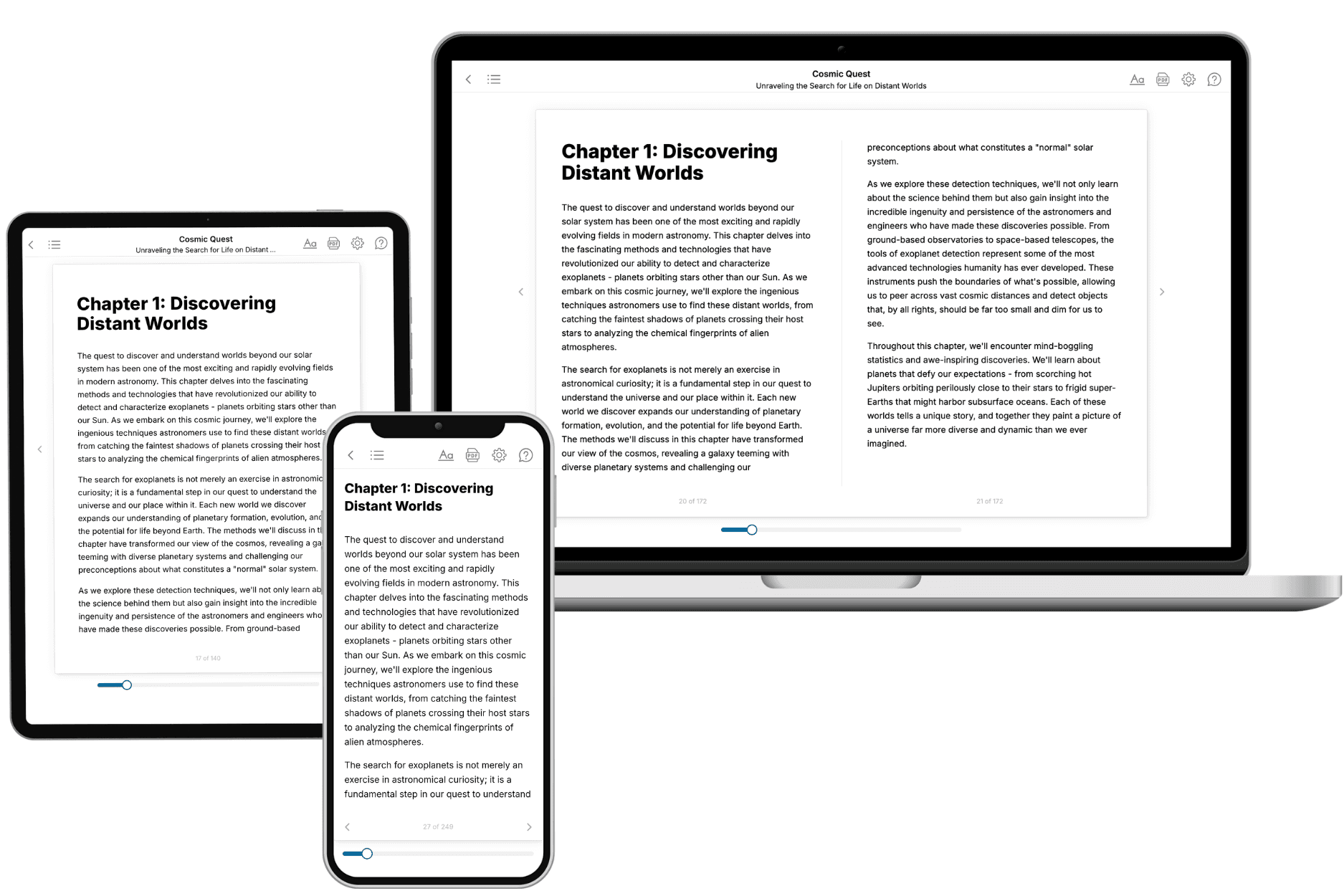
Your book is ready in 10 minutes. Read it online, download as EPUB or PDF, or send to Kindle.

Frequently asked questions
- What is TailoredRead?
TailoredRead creates complete, full-length nonfiction ebooks, written specifically for you. Tell us what you want to learn and why, and TailoredRead writes you a complete ebook on it, with charts, tables, and diagrams throughout. Read it online, on Kindle, or on any e-reader, or download it as a PDF or EPUB. Every book is written fresh the day you order it.
- How is the book tailored to me?
Before anything is written, you answer a few short questions about your goals, your background, and the topics you care about. Your book is then planned around your answers: written at your level, focused on your goals, and covering the topics you chose, instead of the one-size-fits-all book a store sells everyone.
- Will it read like generic AI content?
No. Your book isn't a chat transcript: it's planned chapter by chapter before a single word is written, told in a clear book voice, and explains ideas visually with charts, tables, and diagrams. After writing, every book goes through an editorial pass that polishes chapters so the book reads consistent from start to finish. Judge for yourself: browse thousands of sample books on our Explore Books page.
- How accurate is the content?
Our AI first checks whether your subject needs live research. Niche and fast-moving subjects are researched before writing, and the book plan and chapters are grounded in what it finds. After writing, every book goes through a quality pass that checks its facts and consistency, and researched books list their sources in a Notes section at the back.
- How long is the book?
You choose the length: Comprehensive (250-300 pages), Detailed (150-200 pages), Essential (70-100 pages), or Short (30-50 pages).
- Does the book include visuals?
Yes. Every book includes charts, tables, and diagrams: timelines, checklists, step-by-step guides, decision trees, comparison tables, matrices, and bar charts. A typical book includes dozens of these visual elements.
- Can I read it on Kindle? What formats can I download?
Yes. Every book can be read in our online reader or downloaded as a PDF or EPUB. The EPUB can be opened with Kindle, Apple Books, Kobo, and any e-reader. The Commercial and Author licenses also include an editable Word (DOCX) and Markdown download.
- How much does it cost?
About the price of a regular ebook. The exact price depends on your book's length and complexity, from $2 for the shortest books to $35 for the most comprehensive, and it's shown when you review your book, before you commit to anything. Each book is a one-time purchase, yours to keep, no subscription. Licenses that let you share, teach, or publish your book range from $35.99 to $49.99.
- Can I preview the book before purchasing?
Before you pay, you'll see what your book will cover: the title, a detailed description, the estimated length, and the complete chapter-by-chapter table of contents, so you know what you're getting before you decide. The full text itself is written after you purchase.
- How long does it take to create a book?
About 10 minutes. You can start reading the opening chapters while the rest is still being written.