Microwave Spectroscopy Unveiled
Mastering Molecular Structure Through Advanced Techniques
Contrary to popular belief, microwave spectroscopy isn't just about heating your lunch.
284 pages14 chaptersMar 5, 2025Physics
About this book
It's a powerful tool for unraveling the mysteries of molecular structure and dynamics. In "Microwave Spectroscopy Unveiled," you'll discover how this cutting-edge technique can revolutionize your understanding of molecular physics. This comprehensive guide takes you on a deep dive into the world of microwave spectroscopy, from its fundamental principles to its most advanced applications. You'll learn how to design experiments, interpret complex spectra, and extract valuable information about molecular properties that other methods simply can't reveal. Whether you're a graduate student looking to expand your skillset or a researcher aiming to push the boundaries of molecular physics, this book equips you with the knowledge and tools to become a microwave spectroscopy expert. By the time you finish, you'll be ready to tackle real-world challenges in fields ranging from astrochemistry to materials science.
Table of contents
- IntroductionThe Importance of Microwave Spectroscopy in Molecular Physics, Historical Overview of Microwave Spectroscopy, Structure of the Book, Learning Objectives and How to Use This BookRead below
- Chapter 1: Fundamentals of Microwave SpectroscopyThe Electromagnetic Spectrum and Microwave Region, Molecular Rotations and Energy Levels, Selection Rules for Rotational Transitions, Intensity Distribution in Rotational Spectra
- Chapter 2: Quantum Mechanical FoundationsThe Schrödinger Equation for Rotating Molecules, Angular Momentum in Quantum Mechanics, The Rigid Rotor Model, Non-Rigid Rotor Effects and Centrifugal Distortion
- Chapter 3: Instrumentation for Microwave SpectroscopyMicrowave Sources and Detectors, Waveguides and Resonant Cavities, Sample Preparation and Handling, Vacuum Systems for Microwave Spectroscopy
- Chapter 4: Experimental Techniques in Microwave SpectroscopyAbsorption Spectroscopy, Stark Modulation Techniques, Fourier Transform Microwave Spectroscopy, Chirped-Pulse Fourier Transform Microwave Spectroscopy
- Chapter 5: Spectral Analysis and InterpretationLine Shapes and Widths, Spectral Assignment Techniques, Fitting Procedures and Error Analysis, Software Tools for Spectral Analysis
- Chapter 6: Determining Molecular StructureRotational Constants and Molecular Geometry, Centrifugal Distortion Constants, Dipole Moments from Stark Effect Measurements, Isotopic Substitution and Structure Determination
- Chapter 7: Probing Molecular DynamicsInternal Rotation and Torsional Motion, Inversion and Tunneling Phenomena, Vibrational Effects in Microwave Spectra, Time-Resolved Microwave Spectroscopy
- Chapter 8: Hyperfine Structure in Microwave SpectraNuclear Spin and Magnetic Interactions, Quadrupole Coupling, Spin-Rotation Interaction, Analysis of Hyperfine Structure
- Chapter 9: Symmetry and Selection RulesMolecular Symmetry Groups, Selection Rules Based on Symmetry, Forbidden Transitions and Their Implications, Symmetry in Complex Molecular Spectra
- Chapter 10: Weakly Bound Complexes and ClustersVan der Waals Complexes, Hydrogen-Bonded Systems, Molecular Clusters and Their Spectra, Probing Intermolecular Forces
- Chapter 11: Studying Transient SpeciesReactive Intermediates and Radicals, Discharge and Pyrolysis Techniques, Laser Ablation Sources, Studying Reaction Kinetics with Microwave Spectroscopy
- Chapter 12: Applications in AstrochemistryIdentifying Interstellar Molecules, Laboratory Astrophysics, Isotopic Ratios and Molecular Evolution in Space, Prebiotic Chemistry and the Origins of Life
- Chapter 13: Microwave Spectroscopy in Atmospheric ScienceMeasuring Atmospheric Composition, Remote Sensing Techniques, Studying Climate Change with Microwave Spectroscopy, Pollution Monitoring and Air Quality Assessment
- Chapter 14: Advanced Techniques and Future DirectionsTerahertz Spectroscopy, Cavity Ringdown Spectroscopy, Spectroscopy of Cold and Ultracold Molecules, Microwave Spectroscopy and Quantum Computing, Future Prospects and Emerging Applications
- ConclusionKey Takeaways, Future Challenges and Opportunities
- Glossary
- Further Reading
Introduction
Welcome to the fascinating world of microwave spectroscopy, a powerful and versatile technique that has revolutionized our understanding of molecular structure and dynamics. As you embark on this journey through "Microwave Spectroscopy Unveiled: Mastering Molecular Structure Through Advanced Techniques," you are about to discover how this seemingly specialized field has far-reaching implications across various scientific disciplines. This introduction will set the stage for your exploration, providing you with a solid foundation to build upon as you delve deeper into the intricacies of microwave spectroscopy.
Microwave spectroscopy, at its core, is a method that utilizes electromagnetic radiation in the microwave region to probe the rotational energy levels of molecules. This technique offers unparalleled precision in determining molecular geometries, bond lengths, and dipole moments. As you progress through this book, you will come to appreciate how microwave spectroscopy serves as a bridge between the macroscopic world we observe and the quantum mechanical realm that governs molecular behavior. The insights gained from this technique have profound implications for fields ranging from fundamental physics to astrochemistry and atmospheric science.
Throughout this book, you will encounter a blend of theoretical principles and practical applications, all designed to equip you with the knowledge and skills necessary to conduct and interpret microwave spectroscopy experiments effectively. Whether you are a graduate student looking to expand your experimental repertoire or an early-career researcher aiming to push the boundaries of molecular physics, this book will serve as your comprehensive guide to mastering the art and science of microwave spectroscopy.
The Importance of Microwave Spectroscopy in Molecular Physics
Microwave spectroscopy stands as a cornerstone in the field of molecular physics, offering a unique window into the quantum world of molecules. Its importance cannot be overstated, as it provides researchers with a powerful tool to unravel the mysteries of molecular structure and behavior with unprecedented precision. Unlike other spectroscopic techniques that probe electronic or vibrational states, microwave spectroscopy focuses on the rotational energy levels of molecules, which are exquisitely sensitive to the spatial arrangement of atoms within the molecule.
One of the key strengths of microwave spectroscopy lies in its ability to determine molecular geometries with remarkable accuracy. By analyzing the rotational spectra of molecules, researchers can extract precise information about bond lengths, bond angles, and the overall three-dimensional structure of molecules. This level of detail is crucial for understanding chemical reactivity, intermolecular interactions, and the physical properties of materials. For instance, in the study of pharmaceuticals, knowing the exact molecular structure can provide insights into drug-receptor interactions, potentially leading to more effective medications[1].
Moreover, microwave spectroscopy excels in its ability to measure molecular dipole moments with high precision. The dipole moment of a molecule is a fundamental property that influences its behavior in electric fields and its interactions with other molecules. This information is invaluable in fields such as atmospheric chemistry, where understanding the polarity of molecules helps predict their role in climate processes and atmospheric reactions. For example, the study of water clusters using microwave spectroscopy has provided crucial insights into the behavior of water in the atmosphere and its role in climate change[2].
Another significant advantage of microwave spectroscopy is its sensitivity to isotopic substitution. By comparing the spectra of molecules with different isotopes, researchers can gain detailed information about molecular structure and even probe nuclear properties. This isotopic sensitivity has applications ranging from studying the origins of molecules in interstellar space to tracing the movement of pollutants in the environment. In astrochemistry, for instance, microwave spectroscopy has been instrumental in identifying complex organic molecules in interstellar clouds, providing clues about the chemical processes that occur in space and potentially shedding light on the origins of life[3].
The importance of microwave spectroscopy extends to the study of transient species and reaction intermediates. Due to its high sensitivity and fast time resolution, this technique allows researchers to observe short-lived molecular species that are crucial in understanding reaction mechanisms. This capability has revolutionized our understanding of chemical kinetics and has applications in fields such as combustion science and atmospheric chemistry. For example, microwave spectroscopy has been used to study the formation and destruction of ozone in the upper atmosphere, contributing to our understanding of the ozone layer and its depletion[4].
Furthermore, the advent of advanced techniques such as Fourier transform microwave spectroscopy and chirped-pulse Fourier transform microwave spectroscopy has dramatically expanded the capabilities of this field. These techniques allow for the simultaneous observation of multiple spectral lines over a broad frequency range, significantly increasing the efficiency and information content of spectroscopic measurements. This has opened up new possibilities for studying larger, more complex molecules and has accelerated the pace of discovery in molecular physics.
As you delve deeper into this book, you will discover how microwave spectroscopy intersects with other areas of science, such as quantum mechanics, symmetry theory, and computational chemistry. This interdisciplinary nature makes microwave spectroscopy a versatile tool that continues to find new applications across various scientific domains. From probing the fundamental laws of physics to addressing pressing environmental concerns, microwave spectroscopy remains at the forefront of scientific inquiry, driving innovation and expanding our understanding of the molecular world.
Historical Overview of Microwave Spectroscopy
The history of microwave spectroscopy is a fascinating journey that intertwines technological advancements, theoretical breakthroughs, and serendipitous discoveries. To fully appreciate the current state of the field, it is essential to understand its historical context and the key milestones that have shaped its development. This historical overview will take you through the pivotal moments and influential figures that have contributed to making microwave spectroscopy the powerful analytical tool it is today.
The roots of microwave spectroscopy can be traced back to the early 20th century, with the development of quantum mechanics and the growing understanding of molecular structure. However, the field truly began to take shape in the 1930s and 1940s, driven by advancements in microwave technology during World War II. The war effort led to significant improvements in microwave sources and detectors, originally developed for radar applications. These technological advancements would soon find new purpose in the hands of spectroscopists eager to explore molecular properties[5].
One of the seminal moments in the history of microwave spectroscopy came in 1946 when Charles Townes and his colleagues at Bell Labs observed the first pure rotational spectrum of a molecule using microwave techniques. Their study of ammonia not only demonstrated the feasibility of microwave spectroscopy but also laid the groundwork for future advancements in the field. This breakthrough opened up a new realm of possibilities for studying molecular structure with unprecedented precision[6].
The 1950s and 1960s saw rapid growth in microwave spectroscopy, with researchers around the world applying the technique to a wide variety of molecules. During this period, the theoretical foundations of the field were solidified, and the relationship between molecular structure and rotational spectra was firmly established. Scientists like Walter Gordy, Edward Bright Wilson, and Gerhard Herzberg made significant contributions to the theory and practice of microwave spectroscopy, helping to establish it as a rigorous and quantitative technique for molecular analysis.
A major technological leap came in the 1970s with the introduction of Fourier transform techniques to microwave spectroscopy. This innovation, pioneered by researchers like Richard Schwendeman and William Flygare, dramatically improved the sensitivity and efficiency of spectroscopic measurements. Fourier transform microwave (FTMW) spectroscopy allowed for the simultaneous observation of multiple spectral lines, greatly reducing the time required for experiments and enabling the study of larger, more complex molecules[7].
The 1980s and 1990s saw further refinements in FTMW techniques, including the development of pulsed-beam Fourier transform microwave spectrometers. These instruments combined the high resolution of FTMW spectroscopy with molecular beam techniques, allowing for the study of weakly bound complexes and clusters. This period also saw an increased focus on applying microwave spectroscopy to problems in astrochemistry and atmospheric science, as researchers recognized the technique's potential for identifying and characterizing molecules in space and in the Earth's atmosphere.
The turn of the 21st century brought about another revolutionary advancement in the form of chirped-pulse Fourier transform microwave (CP-FTMW) spectroscopy. Developed by Brooks Pate and his colleagues, this technique uses broadband excitation pulses to capture entire rotational spectra in a single measurement. CP-FTMW spectroscopy has dramatically increased the speed and information content of microwave measurements, enabling the study of complex mixtures and rapid conformational analysis of flexible molecules[8].
In recent years, microwave spectroscopy has continued to evolve, benefiting from advancements in related fields such as quantum computing, terahertz technology, and cold molecule techniques. The integration of microwave spectroscopy with other analytical methods, such as mass spectrometry and computational chemistry, has further expanded its capabilities and applications. Today, microwave spectroscopy stands as a mature yet dynamic field, continually finding new applications in areas ranging from fundamental physics to drug discovery and environmental monitoring.
As you progress through this book, you will encounter many of the concepts and techniques that have emerged from this rich history. Understanding the historical context of microwave spectroscopy will not only deepen your appreciation for the field but also provide you with valuable insights into its current state and future directions. The journey of microwave spectroscopy from a niche technique to a cornerstone of molecular physics is a testament to the power of scientific inquiry and technological innovation, and it continues to inspire new generations of researchers to push the boundaries of what is possible in molecular analysis.
Structure of the Book
"Microwave Spectroscopy Unveiled: Mastering Molecular Structure Through Advanced Techniques" is designed to provide you with a comprehensive and logical progression through the field of microwave spectroscopy. The book's structure is carefully crafted to build your understanding from fundamental principles to advanced applications, ensuring that you develop a solid foundation before tackling more complex topics. This section will outline the organization of the book and explain the rationale behind its structure, helping you navigate the material effectively and get the most out of your learning experience.
The book begins with this introduction, which sets the stage for your journey into microwave spectroscopy. Following this, Chapter 1 delves into the fundamentals of microwave spectroscopy, covering essential concepts such as the electromagnetic spectrum, molecular rotations, and the basic principles of rotational spectroscopy. This chapter serves as a crucial foundation, ensuring that you have a solid grasp of the core ideas before moving on to more advanced topics.
Chapter 2 focuses on the quantum mechanical foundations of microwave spectroscopy. Here, you will explore the Schrödinger equation as it applies to rotating molecules, delve into the concepts of angular momentum in quantum mechanics, and study the rigid and non-rigid rotor models. This chapter is designed to strengthen your theoretical understanding, providing the mathematical and physical basis for interpreting microwave spectra.
With the theoretical groundwork laid, Chapter 3 introduces you to the instrumentation used in microwave spectroscopy. This chapter covers microwave sources and detectors, waveguides and resonant cavities, sample preparation techniques, and vacuum systems. Understanding the experimental setup is crucial for appreciating the capabilities and limitations of microwave spectroscopy, and this chapter will give you a comprehensive overview of the tools of the trade.
Chapter 4 builds on this knowledge by exploring experimental techniques in microwave spectroscopy. You will learn about various methods including absorption spectroscopy, Stark modulation techniques, Fourier transform microwave spectroscopy, and the cutting-edge chirped-pulse Fourier transform microwave spectroscopy. This chapter bridges the gap between theory and practice, showing you how the principles you've learned are applied in real-world experiments.
The next several chapters focus on data analysis and interpretation. Chapter 5 covers spectral analysis, including line shapes and widths, spectral assignment techniques, fitting procedures, and software tools for data analysis. Chapter 6 then shows you how to use this spectral information to determine molecular structure, covering topics such as rotational constants, centrifugal distortion, and the use of isotopic substitution in structure determination.
Chapters 7 and 8 delve into more advanced aspects of molecular spectroscopy. Chapter 7 explores how microwave spectroscopy can be used to probe molecular dynamics, including internal rotation, inversion phenomena, and time-resolved spectroscopy. Chapter 8 focuses on hyperfine structure in microwave spectra, covering nuclear spin interactions, quadrupole coupling, and the analysis of complex hyperfine patterns.
The book then moves on to explore the role of symmetry in microwave spectroscopy. Chapter 9 covers molecular symmetry groups, selection rules based on symmetry, and the implications of symmetry for spectral analysis. This chapter will enhance your ability to predict and interpret spectra for a wide range of molecular systems.
The next two chapters focus on specialized applications of microwave spectroscopy. Chapter 10 covers the study of weakly bound complexes and clusters, an area where microwave spectroscopy has made significant contributions. Chapter 11 explores the use of microwave spectroscopy in studying transient species, including reactive intermediates and radicals, showcasing the technique's power in elucidating reaction mechanisms.
Chapters 12 and 13 highlight two major application areas of microwave spectroscopy: astrochemistry and atmospheric science. These chapters demonstrate how the principles and techniques you've learned are applied to solve real-world scientific problems, from identifying molecules in interstellar space to monitoring atmospheric composition and studying climate change.
The final chapter, Chapter 14, looks to the future of microwave spectroscopy, covering advanced techniques such as terahertz spectroscopy, cavity ringdown spectroscopy, and the spectroscopy of cold and ultracold molecules. This chapter also explores emerging applications and future prospects, giving you a glimpse of where the field is headed.
The book concludes with a summary of key takeaways and a discussion of future challenges and opportunities in microwave spectroscopy. Additionally, a comprehensive glossary and suggestions for further reading are provided to support your continued learning and exploration of the field.
This structure is designed to take you on a logical journey through microwave spectroscopy, from basic principles to cutting-edge applications. By following this progression, you will develop a deep and nuanced understanding of the field, equipping you with the knowledge and skills to conduct your own microwave spectroscopy research and contribute to this exciting area of molecular physics.
Learning Objectives and How to Use This Book
"Microwave Spectroscopy Unveiled" is designed with specific learning objectives in mind, aimed at transforming you from a novice in the field to a competent practitioner capable of designing, conducting, and interpreting microwave spectroscopy experiments. This section will outline these objectives and provide guidance on how to make the most effective use of this book in your studies. By understanding the goals of each chapter and employing effective learning strategies, you will be well-equipped to master the intricacies of microwave spectroscopy.
The primary learning objectives of this book are:
- To develop a comprehensive understanding of the theoretical foundations of microwave spectroscopy, including quantum mechanics and molecular physics.
- To gain practical knowledge of microwave spectroscopy instrumentation and experimental techniques.
- To master the skills necessary for spectral analysis and interpretation, including the ability to extract molecular structural information from rotational spectra.
- To understand the applications of microwave spectroscopy across various scientific disciplines, particularly in astrochemistry and atmospheric science.
- To appreciate the current state of the field and its future directions, including advanced techniques and emerging applications.
To achieve these objectives, each chapter is structured with clear learning goals, key concepts, and practical examples. As you work through the book, you will find that the material builds progressively, with later chapters drawing on concepts introduced earlier. This cumulative approach is designed to reinforce your learning and help you develop a holistic understanding of microwave spectroscopy.
Here are some strategies to help you make the most of this book:
- Active Reading: As you read each chapter, engage actively with the material. Take notes, highlight key points, and try to summarize concepts in your own words. This active engagement will help reinforce your understanding and make the information more memorable.
- Work Through Examples: Each chapter includes worked examples and problem sets. Don't skip these! Working through problems is crucial for developing practical skills and deepening your understanding of theoretical concepts.
- Utilize Additional Resources: The book includes references to primary literature and suggestions for further reading. Take advantage of these to explore topics that particularly interest you in greater depth.
- Apply Concepts to Real-World Scenarios: Throughout the book, you'll find discussions of how microwave spectroscopy is applied in various scientific fields. Try to think about how the concepts you're learning could be applied to other areas or to specific research questions that interest you.
- Engage in Hands-On Learning: If possible, seek opportunities to gain practical experience with microwave spectroscopy equipment. Many universities and research institutions have spectroscopy labs where you might be able to observe or participate in experiments.
- Collaborate and Discuss: If you're studying as part of a course or research group, engage in discussions with your peers and instructors. Explaining concepts to others and hearing different perspectives can significantly enhance your understanding.
- Review and Reflect: At the end of each chapter, take time to review the main points and reflect on how they fit into the broader context of microwave spectroscopy. Try to make connections between different chapters and concepts.
The book is designed to be flexible, allowing you to focus on areas most relevant to your specific interests or research needs. While a linear progression through the chapters is recommended for those new to the field, more experienced readers may choose to focus on specific chapters or use the book as a reference guide.
Remember that mastering microwave spectroscopy is a journey that extends beyond the pages of this book. The field is constantly evolving, with new techniques and applications emerging regularly. Use this book as a foundation to build your expertise, but don't hesitate to explore beyond its contents, engaging with current research literature and attending conferences or workshops when possible.
By the time you complete this book, you should feel confident in your understanding of microwave spectroscopy principles, be able to design and interpret experiments, and have a clear sense of how this powerful technique can be applied to solve real-world scientific problems. Whether your goal is to conduct cutting-edge research, develop new applications, or simply gain a deeper understanding of molecular physics, "Microwave Spectroscopy Unveiled" will provide you with the knowledge and skills you need to succeed in this fascinating field.
Notes
Introduction
- 1. J. M. Hollas, Modern Spectroscopy (4th ed.), John Wiley & Sons, 2004
- 2. C. Pérez and others, "Broadband Fourier transform rotational spectroscopy for structure determination: The water heptamer," Chemical Physics Letters, 2014
- 3. E. Herbst and E. F. van Dishoeck, "Complex organic interstellar molecules," Annual Review of Astronomy and Astrophysics, 2009
- 4. B. J. Drouin and others, "Microwave spectroscopy for atmospheric remote sensing," Journal of Quantitative Spectroscopy and Radiative Transfer, 2017
- 5. W. Gordy and R. L. Cook, Microwave Molecular Spectra (3rd ed.), John Wiley & Sons, 1984
- 6. C. H. Townes and A. L. Schawlow, Microwave Spectroscopy, McGraw-Hill, 1955
- 7. W. H. Flygare, Molecular structure and dynamics, Prentice-Hall, 1974
- 8. G. G. Brown and others, "A broadband Fourier transform microwave spectrometer based on chirped pulse excitation," Review of Scientific Instruments, 2008
This is the end of the free sample. The full book has 14 chapters.
Want this book written for you?
Tell us your goals and background, and get your own version of this book, tailored by AI to you.


Benefits of AI-tailored books
- Read one book, not ten:
- all the Physics knowledge you need, gathered into a single book.
- Save days of learning:
- tell us your goals, choose your topics, and the whole book is built around them.
- Learn effortlessly:
- Physics book written for your specific background and expertise.
- Understand at a glance:
- includes charts, tables, timelines, checklists, decision trees, and more.
- Stay current:
- written the day you order it, not years ago.
- Trust what you read:
- every book is checked for accuracy, with real research when your subject needs it.
Create your unique book in 3 steps
- 1. Select your focus
Select the focus of your Physics book and share your background
- 2. Personalize your book
Specify your goals and choose sub-topics to include
- 3. Get your tailored book
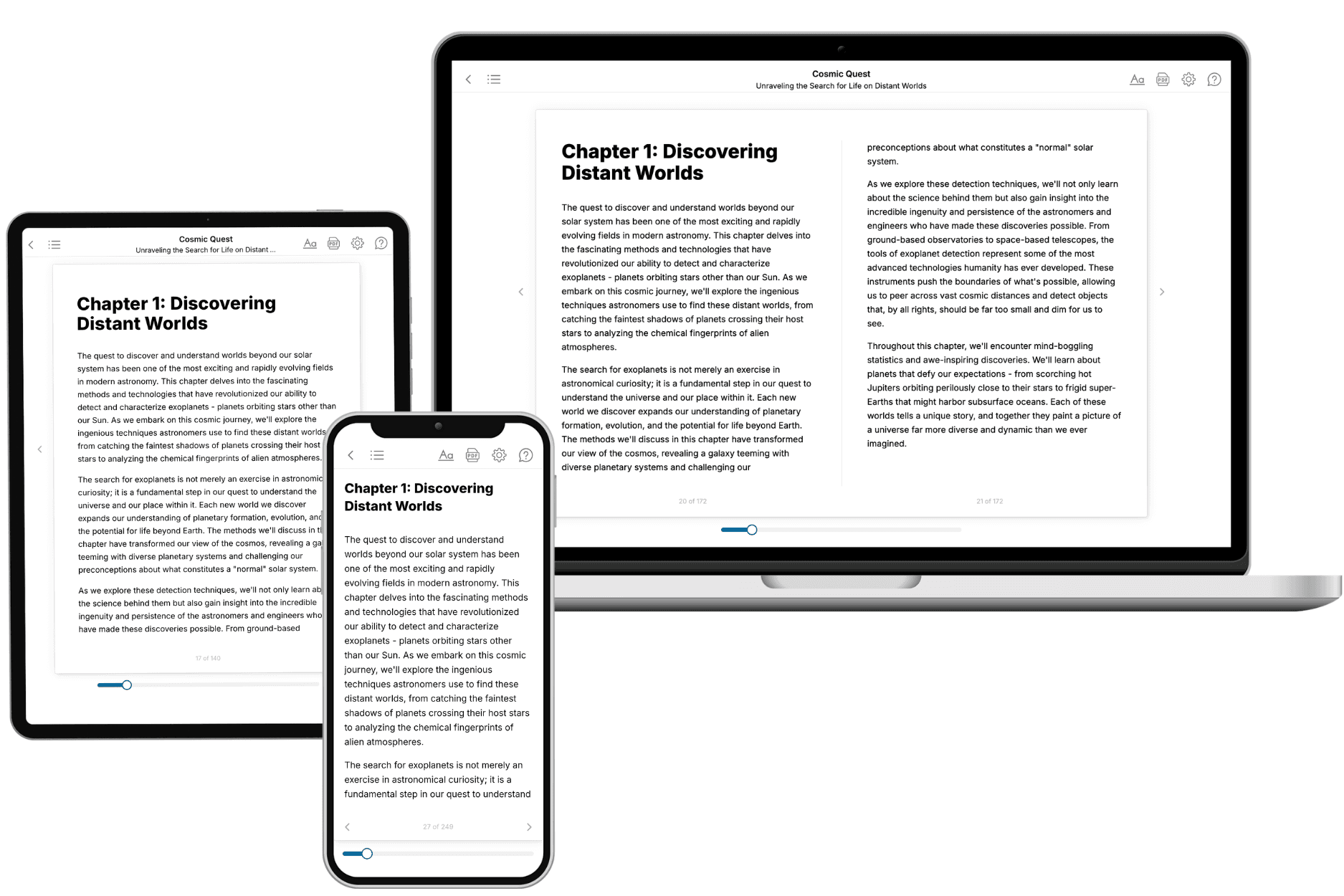
Your book is ready in 10 minutes. Read it online, download as EPUB or PDF, or send to Kindle.

Frequently asked questions
- What is TailoredRead?
TailoredRead creates complete, full-length nonfiction ebooks, written specifically for you. Tell us what you want to learn and why, and TailoredRead writes you a complete ebook on it, with charts, tables, and diagrams throughout. Read it online, on Kindle, or on any e-reader, or download it as a PDF or EPUB. Every book is written fresh the day you order it.
- How is the book tailored to me?
Before anything is written, you answer a few short questions about your goals, your background, and the topics you care about. Your book is then planned around your answers: written at your level, focused on your goals, and covering the topics you chose, instead of the one-size-fits-all book a store sells everyone.
- Will it read like generic AI content?
No. Your book isn't a chat transcript: it's planned chapter by chapter before a single word is written, told in a clear book voice, and explains ideas visually with charts, tables, and diagrams. After writing, every book goes through an editorial pass that polishes chapters so the book reads consistent from start to finish. Judge for yourself: browse thousands of sample books on our Explore Books page.
- How accurate is the content?
Our AI first checks whether your subject needs live research. Niche and fast-moving subjects are researched before writing, and the book plan and chapters are grounded in what it finds. After writing, every book goes through a quality pass that checks its facts and consistency, and researched books list their sources in a Notes section at the back.
- How long is the book?
You choose the length: Comprehensive (250-300 pages), Detailed (150-200 pages), Essential (70-100 pages), or Short (30-50 pages).
- Does the book include visuals?
Yes. Every book includes visual elements such as timelines, checklists, step-by-step guides, decision trees, comparison tables, and matrices, and many include bar charts. A typical book includes dozens of these visual elements.
- Can I read it on Kindle? What formats can I download?
Yes. Every book can be read in our online reader or downloaded as a PDF or EPUB. The EPUB can be opened with Kindle, Apple Books, Kobo, and any e-reader. The Commercial and Author licenses also include an editable Word (DOCX) and Markdown download.
- How much does it cost?
About the price of a regular ebook. The exact price depends on your book's length and complexity, from $2 for the shortest books to $35 for the most comprehensive, and it's shown when you review your book, before you commit to anything. Each book is a one-time purchase, yours to keep, no subscription. Licenses that let you share, teach, or publish your book range from $35.99 to $49.99.
- Can I preview the book before purchasing?
Before you pay, you'll see what your book will cover: the title, a detailed description, the estimated length, and the complete chapter-by-chapter table of contents, so you know what you're getting before you decide. The full text itself is written after you purchase.
- How long does it take to create a book?
About 10 minutes. You can start reading the opening chapters while the rest is still being written.