Middle-earth in New Zealand
Your Complete Guide to Visiting Lord of the Rings Film Locations
Discover how to walk in the footsteps of hobbits, elves, and dwarves across New Zealand's breathtaking landscapes.
222 pages11 chaptersAug 21, 2026New Zealand Travel Guide
About this book
This comprehensive guide takes you beyond the movie screen to the actual locations where Middle-earth came to life, providing detailed directions, insider tips, and practical logistics for visiting each iconic site. Whether you're planning a dedicated film location tour or weaving these destinations into a broader New Zealand adventure, you'll learn which locations are accessible to the public, the best times to visit, and how to capture stunning photographs that rival the films themselves. From the rolling hills of the Shire to the dramatic peaks of Mordor, this guide combines storytelling with actionable travel advice, helping you navigate permits, private land access, seasonal considerations, and transportation options. Explore hidden gems known only to dedicated fans, understand the filmmaking decisions behind location choices, and connect with local communities who were part of this cinematic journey. Your Middle-earth pilgrimage awaits.
Table of contents
- IntroductionWhy Middle-earth in New Zealand Matters, How to Use This Guide, Planning Your Middle-earth AdventureRead below
- Chapter 1: Understanding New Zealand's Geography and RegionsNew Zealand's North and South Islands, Regional Divisions and Film Location Clusters, Climate, Seasons, and Best Times to Visit
- Chapter 2: The Shire and HobbitonHobbiton Movie Set: The Complete Experience, Surrounding Shire Locations and Farmland, Exploring the Matamata Region
- Chapter 3: Rivendell and Elven RealmsRivendell Filming Locations, Wellington Studios and Indoor Sets, Forest and Natural Elven Settings
- Chapter 4: Gondor, Rohan, and the Kingdoms of MenGondor's Majestic Filming Sites, Rohan's Grasslands and Battle Locations, Accessing These Locations Responsibly
- Chapter 5: Mordor and Dark LandsMount Doom and Volcanic Landscapes, Dark Lands and Dramatic Terrain, Safety and Accessibility in Extreme Locations
- Chapter 6: Hidden Gems and Lesser-Known LocationsOff-the-Beaten-Path Filming Sites, Local Secrets and Community Insights, How to Discover and Verify Hidden Locations
- Chapter 7: Practical Travel Logistics and PlanningGetting Around: Rental Cars, Tours, and Public Transport, Where to Stay: Accommodation Options Near Locations, Budgeting Your Middle-earth Journey
- Chapter 8: Access, Permits, and Respectful VisitationUnderstanding Private Land and Access Restrictions, Obtaining Permits and Seeking Permissions, Ethical Tourism and Respecting Local Communities
- Chapter 9: Photography and Creative DocumentationPhotography Techniques and Equipment Recommendations, Capturing the Magic: Composition and Timing, Ethical Photography and Respecting Others
- Chapter 10: Seasonal Variations and Optimal Visiting TimesHow Seasons Transform the Landscape, Weather Patterns and What to Pack, Avoiding Crowds and Finding Solitude
- Chapter 11: Combining Film Locations with Broader New Zealand TourismCreating Integrated Travel Itineraries, Natural Attractions Beyond Middle-earth, Cultural Experiences and Local Communities
- ConclusionYour Middle-earth Journey Awaits, Final Thoughts and Lasting Memories
- Appendix: Quick Reference ResourcesLocation Checklist and Tracking Guide, Useful Contact Information and Websites
Introduction
A sheep paddock outside Matamata sat unremarkable for decades until a location scout flying overhead spotted a single pine tree beside a lake and a rolling hill that matched a sketch from a fantasy novel almost exactly. That paddock became Hobbiton. Nearby, a gravel riverbed in the Canterbury high country became the site of Edoras, and a quiet park just outside Wellington became the woods of Rivendell. None of these places were built from nothing. They were found, transformed, filmed, and in most cases returned to something close to their original state, waiting for the day travelers would come looking for them.
That day has arrived for millions of people, and this book exists to help you find these places without wasting time, money, or goodwill along the way. New Zealand is a small country by population but a large one by land area and terrain variety, and film locations are scattered across both islands in ways that are not obvious from watching the movies alone. A hillside that appears next to a mountain range on screen might sit hundreds of kilometers from that actual mountain in real life, because editing stitched together shots from different regions into a single seamless world. Without a clear map of what is where, a first-time visitor can easily burn a week driving in circles.
This introduction lays the groundwork for everything that follows. It explains why these locations still matter to visitors more than two decades after filming began, how the rest of the book is structured so you can use it efficiently, and what a realistic planning timeline looks like before you book a single flight. None of this requires you to be a lifelong superfan. It only requires enough curiosity to want to stand in a real field and feel the scale of a story that started on a page and ended up shaping how an entire country markets itself to the world.
Treat this book as a working tool rather than a straight read-through. Some readers will want to plan a dedicated two-week film location trip; others will want to fold three or four key stops into a longer New Zealand holiday built around hiking, wine, or Māori cultural experiences. Both approaches are covered, and both are valid. The chapters ahead move from geography and orientation through each major realm of Middle-earth, then into the practical mechanics of permits, transport, budgeting, photography, and seasonal timing that turn a wish list into an itinerary you can actually follow.
Why Middle-earth in New Zealand Matters
Peter Jackson's decision to film The Lord of the Rings trilogy entirely in his home country was not an obvious commercial choice at the time. Studios typically favored established production hubs with deep infrastructure, and New Zealand had neither a large film industry nor a history of hosting productions at this scale. Jackson argued that the country's landscapes could stand in for an entire fictional continent without ever leaving its borders, from subtropical forest in the north to glacier-carved valleys in the south[1]. That bet reshaped both the film industry and the tourism industry in ways still measurable today.
The scale of that transformation is worth sitting with for a moment. Before the trilogy, New Zealand tourism marketing leaned on generic phrases about natural beauty that could describe a dozen other countries. After the films, the country had a specific, ownable identity tied to a beloved story, and tourism bodies moved quickly to formalize that connection through campaigns branding the country as Middle-earth
itself. Visitor numbers to sites like the Hobbiton Movie Set climbed from a curiosity for hardcore fans into a mainstream attraction drawing hundreds of thousands of people annually, proving that film tourism could sustain itself long after a movie left theaters.
What makes these particular locations different from typical film tourism sites elsewhere in the world is durability. Many film sets are dismantled within weeks of production wrapping, leaving nothing behind but a a plaque or a photograph in a museum. Hobbiton is the clearest counterexample: the farmland set was originally built to be temporary and torn down, but the Alexander Farm family and Wingnut Films eventually rebuilt it in permanent materials specifically so it could remain open to visitors indefinitely. That decision alone turned a single farm into one of New Zealand's most visited paid attractions outside its major cities.
Beyond Hobbiton, most locations in this book are not purpose-built attractions at all. They are real mountains, real rivers, and real conservation land that happened to be photogenic enough to catch a scout's eye, which means visiting them is a fundamentally different experience from visiting a theme park. Standing at Mount Sunday looking toward the Southern Alps, you are looking at the same unaltered vista the camera captured for Edoras, with no signage, no gift shop, and often no other visitors in sight. That rawness is part of the appeal, but it also means the responsibility for respectful behavior falls more heavily on you as an individual traveler.
This matters practically because so many of these sites sit on land that is either privately farmed or managed by the Department of Conservation (DOC), not on land set aside purely for tourism. A working sheep station that appeared briefly on screen as Rohan is still, first and foremost, somebody's livelihood. Conservation land that stood in for Ithilien or the approaches to Mordor is still home to native plants and animals that predate the films by millions of years. Understanding this distinction early changes how you approach every location in this book, and later chapters build directly on it when covering permits and ethical tourism in detail.
There is also a cultural layer to this story that deserves acknowledgment from the outset. The landscapes chosen for filming sit within a country whose geography carries deep significance for Māori communities long before any camera arrived, and an integrated itinerary that pairs film locations with Māori cultural experiences offers a fuller picture of the country than film tourism alone can provide. None of this diminishes the excitement of visiting a Middle-earth site. It simply means the excitement sits within a larger, older context that rewards a bit of curiosity beyond the films themselves.
Finally, these locations matter because they offer something increasingly rare in modern travel: a physical, verifiable connection to a shared cultural touchstone. Millions of people around the world know these landscapes intimately from a screen, yet only a fraction have stood on the actual ground. Making that trip yourself closes a gap between imagination and experience that few other travel destinations can offer with this level of precision, since you can often stand in the exact spot a specific shot was framed and see the same skyline the camera saw.
How to Use This Guide
This book is organized to mirror the way most travelers actually plan a trip: understand the country first, then move region by region through the fictional world, then handle the practical mechanics that make any of it possible. The chapter on New Zealand's geography and regions comes first for a reason. Skipping it to jump straight to Hobbiton or Mordor is tempting, but without a mental map of how the North Island and South Island relate to each other, later chapters on specific locations will feel like a list of disconnected place names rather than a coherent route.
After the geography chapter, the book moves through Middle-earth's major realms in roughly the order most itineraries follow geographically rather than the order they appear in the films. The Shire and Hobbiton come first because they sit in the North Island near Auckland, a common entry point for international flights. Rivendell and the Elven realms follow, largely clustered around Wellington. Gondor, Rohan, and Mordor then take you into the South Island and the volcanic center of the North Island, which is why those chapters group together practical guidance on remote and physically demanding terrain that the earlier, gentler chapters do not need.
Each location-focused chapter follows a consistent internal pattern so you can jump directly to what you need without rereading material you already know. Expect an opening section on the flagship site or sites for that realm, a second section widening out to secondary or connected locations nearby, and a third section addressing region-specific practicalities, whether that is farmland etiquette near Matamata or altitude and weather risk near Tongariro National Park. This structure means you can treat the book as a reference you dip into chapter by chapter as your trip approaches, rather than a novel you must finish cover to cover before booking anything.
Three chapters near the end function differently from the rest and deserve special attention regardless of which realms interest you most. The chapter on access, permits, and respectful visitation applies to almost every private-land location described earlier in the book, so treat it as required reading rather than optional background once you have chosen your specific stops. The chapters on photography and on seasonal timing work the same way. They are not tied to one realm but shape decisions across every location you visit, from what lens to pack to whether you should aim for a shoulder season trip to avoid the worst crowds and highest prices.
A practical suggestion: read the geography chapter and this introduction in full before your trip is booked, then treat the realm-specific chapters as a shortlist-building exercise. Go through them with a notebook or a spreadsheet and mark every location that genuinely excites you, without yet worrying about whether it fits neatly into a route. Only after you have that raw list should you move to the logistics chapters on transportation, accommodation, and budgeting, which will help you turn an aspirational wish list into a realistic sequence of days that a self-drive tour or guided Middle-earth tour can actually deliver.
Keep in mind that the appendix at the back of the book is designed to travel with you rather than sit on a shelf at home. It contains a location checklist for tracking which sites you have visited and a set of contact details for tour operators, conservation offices, and permit authorities referenced throughout the earlier chapters. Photocopying or photographing those pages before departure, or simply bookmarking them digitally, saves you from having to flip back through full chapters while standing in a parking lot trying to confirm a booking reference or a DOC office phone number.
One more note on how to read the location-verification guidance that appears in the chapter on hidden gems. That chapter teaches a method for confirming whether a lesser-known site was actually used in filming, since online claims about obscure locations are inconsistent and sometimes simply wrong. Apply that same skeptical habit to any location claim you encounter outside this book too, including from tour guides or fellow travelers, since enthusiasm for the films has produced no shortage of well-meaning but inaccurate location lore over the years.
Planning Your Middle-earth Adventure
Realistic planning starts with an honest accounting of time. A visitor with only three or four days available should not attempt to cover locations spanning both islands, since internal flights, rental car logistics, and the driving distances between clusters will eat most of the trip. A tighter visit is better spent picking one film location cluster, most commonly the North Island grouping around Hobbiton, Rivendell-related sites, and Wellington, and exploring it properly rather than skimming a longer list. Two weeks or more opens the door to covering both islands, including the more remote Gondor and Rohan sites and the volcanic terrain of Mordor, without the trip feeling rushed at every stop.
Budget planning deserves attention early, not as an afterthought once flights are booked. Costs vary enormously depending on whether you choose a self-drive tour, which offers flexibility but requires confidence driving on the left side of the road on sometimes narrow rural roads, or a guided Middle-earth tour, which costs more per day but removes the burden of navigation and permit arrangements in one package. Paid attractions like the Hobbiton Movie Set carry a fixed entry fee, while many other locations, particularly those on public conservation land, cost nothing beyond the fuel and time to reach them. A worked example: a two-week North and South Island trip combining a rental car, mid-range accommodation, and a handful of paid tours or entries commonly lands in the range of a few thousand dollars per person, though costs swing widely with season and travel style.
Season shapes almost every other planning decision, so it deserves consideration before you lock in dates. New Zealand's seasons run opposite to the Northern Hemisphere, meaning December through February is summer with long daylight hours and the busiest crowds, while June through August is winter, quieter but colder and with reduced daylight for photography. Shoulder season months, roughly April to May and September to October, tend to offer a workable balance of manageable crowds, moderate weather, and landscapes still looking close to how they appeared in the films, since much of the trilogy itself was filmed across multiple seasons over more than a year of principal photography.
Booking lead time varies sharply by location type. The Hobbiton Movie Set operates on a fixed tour schedule and can sell out particular time slots during peak summer months, so booking weeks or even months ahead is sensible if your travel dates are fixed. Locations requiring a DOC concession permit or coordination with a private landowner, covered in depth in the chapter on access and permits, often need lead times measured in weeks rather than days, particularly if a guide or transport arrangement is involved. Remote sites like Mount Sunday, reached by unsealed roads through Hakatere Conservation Park, need no advance booking at all but do require you to plan around road conditions and vehicle suitability, since a standard rental car may not be adequately equipped for the final stretch.
A simple three-step framework can anchor your planning process from this point forward.
- Step one: Choose your primary region or realm focus based on available time, using the geography chapter to understand distances honestly.
- Step two: Cross-reference your shortlist against seasonal and permit requirements covered later in the book, eliminating anything that cannot realistically fit your travel window.
- Step three: Build outward from your confirmed film locations into a broader integrated itinerary, adding natural attractions and Māori cultural experiences that sit along your route rather than requiring major detours.
Applying that framework early prevents a common mistake among first-time visitors: building an itinerary purely from a list of favorite on-screen moments, only to discover later that two beloved locations sit a full day's drive apart on opposite coasts. A better approach groups locations by the film location cluster they belong to first, then layers personal priorities on top of that geographic reality. The chapter on New Zealand's regions maps these clusters in detail, and referring back to it while building your route will save far more time than trying to reverse-engineer distances from a film's shot list.
It also helps to decide early how much of the trip will be dedicated purely to film locations versus general New Zealand travel, since that ratio affects almost every downstream choice from accommodation style to daily pacing. A traveler prioritizing depth over breadth might spend an entire day at a single South Island station property discussing its role in the films with a local guide, while a traveler prioritizing breadth might treat several locations as brief photo stops within a longer scenic drive. Neither approach is more legitimate than the other. What matters is naming your priority honestly before you start booking, so the itinerary you build actually matches the experience you are hoping to have.
Finally, hold your plan loosely enough to absorb New Zealand's genuinely unpredictable weather, especially around mountainous and volcanic terrain covered later in the book. A clear forecast for the Tongariro Alpine Crossing can change within hours, and alpine access sometimes closes entirely with little notice. Building at least one flexible, unscheduled day into a longer itinerary gives you room to shift a weather-dependent visit without unraveling the rest of the trip. That single piece of flexibility, more than any gear purchase or advance booking, tends to determine whether a Middle-earth journey through New Zealand ends up feeling smooth or stressful in hindsight.
Notes
Introduction
- 1. Brian Sibley, Peter Jackson, HarperCollins, 2006
This is the end of the free sample. The full book has 11 chapters.
Want this book written for you?
Tell us your goals and background, and get your own version of this book, tailored by AI to you.


Benefits of AI-tailored books
- Read one book, not ten:
- all the New Zealand Travel Guide knowledge you need, gathered into a single book.
- Save days of learning:
- tell us your goals, choose your topics, and the whole book is built around them.
- Learn effortlessly:
- New Zealand Travel Guide book written for your specific background and expertise.
- Understand at a glance:
- includes charts, tables, timelines, checklists, decision trees, and more.
- Stay current:
- written the day you order it, not years ago.
- Trust what you read:
- every book is checked for accuracy, with real research when your subject needs it.
Create your unique book in 3 steps
- 1. Select your focus
Select the focus of your New Zealand Travel Guide book and share your background
- 2. Personalize your book
Specify your goals and choose sub-topics to include
- 3. Get your tailored book
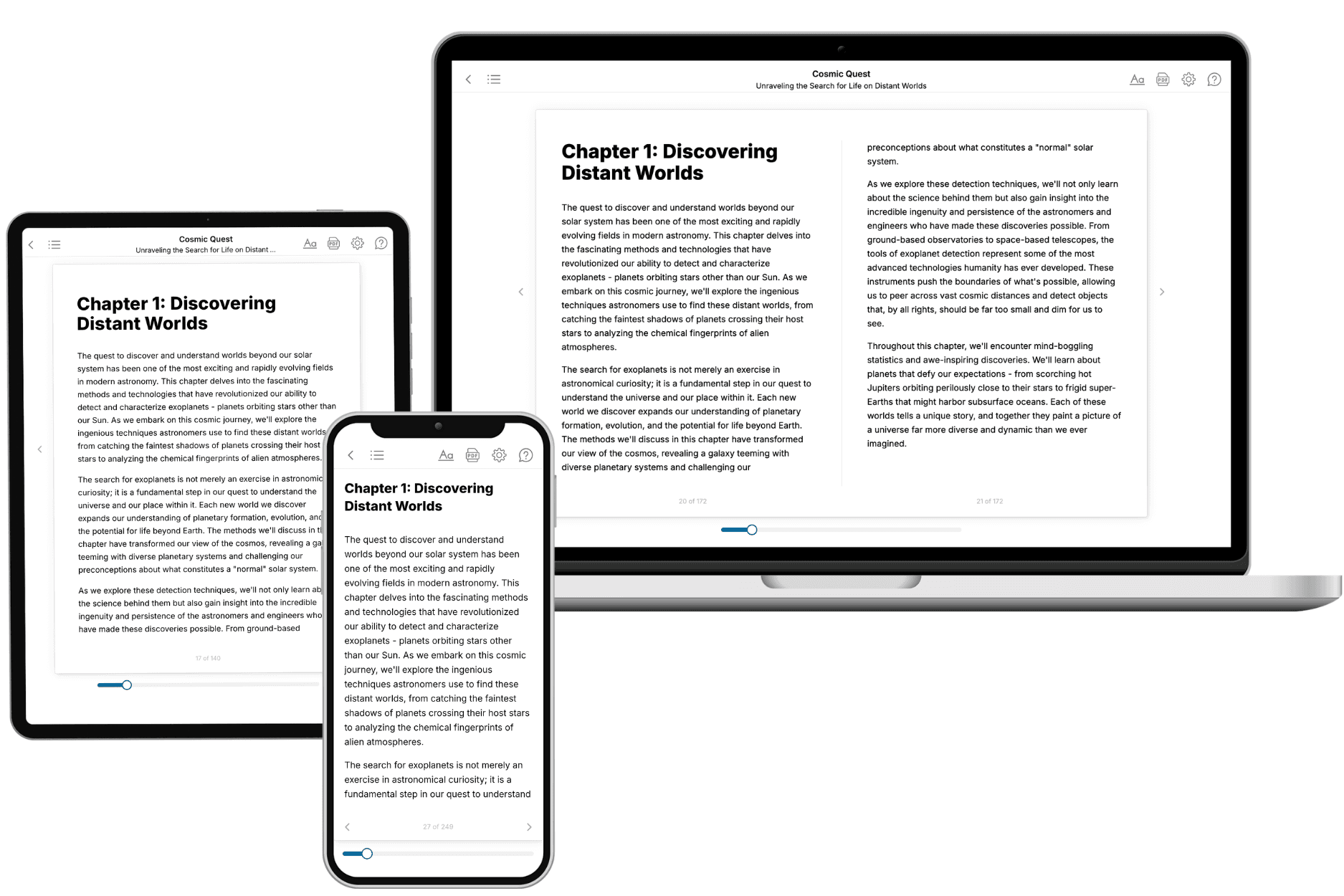
Your book is ready in 10 minutes. Read it online, download as EPUB or PDF, or send to Kindle.
Frequently asked questions
- What is TailoredRead?
TailoredRead creates complete, full-length nonfiction ebooks, written specifically for you. Tell us what you want to learn and why, and TailoredRead writes you a complete ebook on it, with charts, tables, and diagrams throughout. Read it online, on Kindle, or on any e-reader, or download it as a PDF or EPUB. Every book is written fresh the day you order it.
- How is the book tailored to me?
Before anything is written, you answer a few short questions about your goals, your background, and the topics you care about. Your book is then planned around your answers: written at your level, focused on your goals, and covering the topics you chose, instead of the one-size-fits-all book a store sells everyone.
- Will it read like generic AI content?
No. Your book isn't a chat transcript: it's planned chapter by chapter before a single word is written, told in a clear book voice, and explains ideas visually with charts, tables, and diagrams. After writing, every book goes through an editorial pass that polishes chapters so the book reads consistent from start to finish. Judge for yourself: browse thousands of sample books on our Explore Books page.
- How accurate is the content?
Our AI first checks whether your subject needs live research. Niche and fast-moving subjects are researched before writing, and the book plan and chapters are grounded in what it finds. After writing, every book goes through a quality pass that checks its facts and consistency, and researched books list their sources in a Notes section at the back.
- How long is the book?
You choose the length: Comprehensive (250-300 pages), Detailed (150-200 pages), Essential (70-100 pages), or Short (30-50 pages).
- Does the book include visuals?
Yes. Every book includes charts, tables, and diagrams: timelines, checklists, step-by-step guides, decision trees, comparison tables, matrices, and bar charts. A typical book includes dozens of these visual elements.
- Can I read it on Kindle? What formats can I download?
Yes. Every book can be read in our online reader or downloaded as a PDF or EPUB. The EPUB can be opened with Kindle, Apple Books, Kobo, and any e-reader. The Commercial and Author licenses also include an editable Word (DOCX) and Markdown download.
- How much does it cost?
About the price of a regular ebook. The exact price depends on your book's length and complexity, from $2 for the shortest books to $35 for the most comprehensive, and it's shown when you review your book, before you commit to anything. Each book is a one-time purchase, yours to keep, no subscription. Licenses that let you share, teach, or publish your book range from $35.99 to $49.99.
- Can I preview the book before purchasing?
Before you pay, you'll see what your book will cover: the title, a detailed description, the estimated length, and the complete chapter-by-chapter table of contents, so you know what you're getting before you decide. The full text itself is written after you purchase.
- How long does it take to create a book?
About 10 minutes. You can start reading the opening chapters while the rest is still being written.