The Molecular Code
Understanding How Cells Transform DNA Instructions into Living Proteins
Your cells are performing an extraordinary feat right now: converting the static information stored in your DNA into the dynamic proteins that power every aspect of life.
238 pages13 chaptersOct 18, 2025Molecular Biology
About this book
This process—transcription and translation—represents one of biology's most elegant and essential mechanisms, yet it remains mysterious to many who want to understand life at the molecular level. This book guides you through the intricate choreography of molecular events that transform genetic code into functional proteins. You'll discover how RNA polymerase reads DNA sequences, how messenger RNA carries instructions across the cell, and how ribosomes decode these messages to assemble amino acids in precise order. Along the way, you'll explore the regulatory mechanisms that control gene expression, the molecular machinery that ensures accuracy, and the consequences when these processes go awry. Whether you're strengthening your foundation in biochemistry, preparing for advanced studies, or simply fascinated by the molecular basis of life, this book provides clear explanations, practical insights, and a deeper appreciation for the remarkable precision of cellular machinery.
Table of contents
- IntroductionThe Flow of Molecular Information, The Central Dogma of Molecular Biology, Why Understanding These Processes MattersRead below
- Chapter 1: The Foundation: DNA Structure and OrganizationNucleotides: The Building Blocks, The Double Helix Architecture, How DNA Stores Genetic Information, Chromatin Structure and Gene Accessibility
- Chapter 2: RNA: The Versatile MessengerStructural Differences Between RNA and DNA, The Three Major Types of RNA, RNA Stability and Degradation
- Chapter 3: Transcription: Reading the Genetic CodeRNA Polymerase: The Transcription Engine, Promoters and Transcription Start Sites, Assembly of the Transcription Initiation Complex, Transcription Factors and Gene Regulation
- Chapter 4: The Transcription CycleElongation: Synthesizing the RNA Strand, Termination: Ending Transcription, Proofreading and Transcriptional Fidelity
- Chapter 5: RNA Processing and Modification5' Capping: Protecting the Message, Splicing: Removing Introns and Joining Exons, 3' Polyadenylation: Adding the Tail, Alternative Splicing and Protein Diversity
- Chapter 6: Decoding the Genetic LanguageCodons: The Three-Letter Words, Properties of the Genetic Code, Start and Stop Signals
- Chapter 7: Transfer RNA: The Adapter MoleculeThe Cloverleaf Structure of tRNA, Anticodons and Codon Recognition, Aminoacyl-tRNA Synthetases: Charging the tRNA, Wobble Base Pairing and Degeneracy
- Chapter 8: The Ribosome: Protein Synthesis FactoryRibosomal Structure and Subunits, Ribosomal RNA: The Catalytic Core, The A, P, and E Sites
- Chapter 9: Translation Initiation: Starting Protein SynthesisRibosome Assembly on mRNA, Initiation Factors and Their Roles, Positioning the First Amino Acid
- Chapter 10: Translation Elongation: Building the Protein ChainThe Elongation Cycle, Peptide Bond Formation, Translocation and the Ratchet Mechanism, Elongation Factors and GTP Hydrolysis
- Chapter 11: Translation Termination and Protein ReleaseRecognizing Stop Codons, Release Factors and Peptide Release, Ribosome Recycling
- Chapter 12: Regulation and Control MechanismsTranscriptional Control Strategies, Translational Control Mechanisms, Feedback Loops and Cellular Responses
- Chapter 13: Errors, Mutations, and Quality ControlTypes of Mutations and Their Effects, Cellular Quality Control Systems, Nonsense-Mediated Decay
- ConclusionIntegrating the Concepts, Future Directions in Molecular Biology
Introduction
Every second of every day, your cells are performing an extraordinary molecular ballet. Deep within each cell, microscopic machines are reading genetic instructions encoded in DNA, transcribing those instructions into temporary RNA messages, and translating those messages into the proteins that build, maintain, and operate your body. This process—the flow of information from DNA to RNA to protein—represents one of the most fundamental principles of life itself. Without it, cells could not respond to their environment, organisms could not develop, and life as we know it could not exist.
The journey from genetic code to functional protein involves two major processes: transcription and translation. During transcription, specialized enzymes read specific segments of DNA and create complementary RNA copies. These RNA molecules then travel to cellular structures called ribosomes, where translation occurs—the process of decoding the RNA message and assembling amino acids into precise protein sequences. Together, these processes form the molecular foundation for everything from digesting your breakfast to fighting infections, from growing new tissue to thinking your next thought.
Understanding transcription and translation opens a window into the molecular logic of life. These processes reveal how a single genome can produce thousands of different proteins, how cells control which genes are active at any given moment, and how tiny molecular errors can cascade into significant biological consequences. For anyone seeking to comprehend modern biology, biotechnology, or the molecular basis of health and disease, mastering these concepts is essential. This introduction will establish the conceptual framework you need to explore these remarkable processes in depth.
The elegance of these molecular mechanisms lies not just in their complexity, but in their precision and efficiency. RNA polymerase enzymes can transcribe DNA at rates exceeding 50 nucleotides per second while maintaining remarkable accuracy. Ribosomes can synthesize proteins by linking amino acids at speeds of 15-20 per second, reading the genetic code with error rates as low as one mistake per 10,000 amino acids incorporated[1]. This combination of speed and accuracy enables cells to respond rapidly to changing conditions while maintaining the fidelity necessary for life.
The Flow of Molecular Information
Information flow in biological systems follows a directional path that distinguishes living organisms from non-living matter. In your cells, genetic information stored in the stable, long-term archive of DNA must be accessed, copied, and converted into functional molecules that perform cellular work. This flow is not random or bidirectional—it follows specific routes governed by molecular machinery that has been refined over billions of years of evolution. The directionality of this information flow ensures that genetic instructions are preserved in DNA while allowing flexible, temporary expression through RNA and proteins.
The concept of molecular information flow encompasses several key principles that govern how cells use genetic information. First, DNA serves as the permanent repository of genetic instructions, remaining largely unchanged throughout a cell's lifetime except during replication or rare mutation events. Second, RNA acts as a temporary messenger, carrying copies of specific genetic instructions from DNA to the protein synthesis machinery. Third, proteins represent the functional output—the molecules that actually perform cellular work, from catalyzing chemical reactions to providing structural support. This hierarchical organization allows cells to maintain genetic stability while enabling dynamic responses to environmental changes.
Consider what happens when your muscle cells need more energy-producing proteins during exercise. The DNA sequences encoding these proteins remain unchanged in the nucleus, but the cell increases transcription of the relevant genes, producing more RNA copies. These RNA molecules then direct increased protein synthesis at ribosomes. When exercise ends and energy demands decrease, the cell reduces transcription, existing RNA molecules degrade naturally, and protein production returns to baseline levels. This example illustrates how information flow enables cellular adaptation without altering the underlying genetic code.
The molecular machinery that enables information flow operates with remarkable specificity. RNA polymerase enzymes recognize particular DNA sequences called promoters, ensuring that only appropriate genes are transcribed at any given time. Transfer RNA molecules match specific three-letter genetic codes (codons) with their corresponding amino acids, ensuring accurate translation. Ribosomes provide the structural framework where these components come together, coordinating the complex choreography of protein synthesis. Each component plays a distinct role, yet all must work in concert for successful information transfer.
Information flow also involves multiple levels of regulation that fine-tune gene expression. Cells don't simply turn genes fully on or off—they modulate expression levels across a wide spectrum. Transcription factors can enhance or suppress RNA polymerase activity at specific genes. RNA processing mechanisms can generate multiple protein variants from a single gene. Translation can be regulated by factors that control ribosome access to messenger RNA. These regulatory layers allow cells to produce precisely the right amounts of each protein at the right time and place.
The physical separation of transcription and translation in eukaryotic cells adds another dimension to information flow. Transcription occurs in the nucleus, where DNA is housed, while translation happens in the cytoplasm, where ribosomes reside. This spatial separation creates opportunities for additional regulation through RNA processing, transport, and localization. Messenger RNA molecules must be properly modified, exported through nuclear pores, and sometimes directed to specific cellular locations before translation begins. This compartmentalization provides multiple checkpoints for quality control and regulation.
Understanding information flow also requires appreciating the energetic costs involved. Transcription requires energy to break DNA base pairs and form new RNA bonds. RNA processing consumes energy for capping, splicing, and polyadenylation. Translation is particularly energy-intensive, requiring multiple GTP molecules for each amino acid incorporated into a growing protein chain. Cells invest substantial metabolic resources in gene expression, reflecting the critical importance of accurate information transfer. This energy investment also creates opportunities for regulation—cells can control protein production by modulating the availability of energy-rich molecules needed for transcription and translation.
The flow of molecular information is not perfectly linear or error-free. Mutations can alter DNA sequences, transcription errors can produce incorrect RNA copies, and translation mistakes can incorporate wrong amino acids into proteins. However, cells have evolved sophisticated quality control mechanisms to minimize these errors and their consequences. Proofreading activities during transcription and translation reduce error rates. Surveillance systems detect and destroy aberrant RNA molecules. Protein quality control pathways identify and eliminate misfolded proteins. These safeguards ensure that information flow maintains sufficient fidelity for cellular function while tolerating the low error rates that provide raw material for evolution.
Modern molecular biology has revealed that information flow is more complex than initially appreciated. Some RNA molecules function directly without being translated into proteins. Reverse transcription can copy RNA back into DNA in certain contexts. Epigenetic modifications can influence gene expression without changing DNA sequences. These discoveries have expanded our understanding of how genetic information is stored, accessed, and utilized. Nevertheless, the fundamental principle remains: information flows from stable genetic archives through temporary messengers to functional protein products, enabling life's remarkable molecular choreography.
The Central Dogma of Molecular Biology
The central dogma of molecular biology, articulated by Francis Crick in 1958, describes the fundamental pattern of information transfer in biological systems: DNA makes RNA, and RNA makes protein. This principle has proven to be one of biology's most powerful unifying concepts, explaining how genetic information encoded in DNA's four-letter alphabet (A, T, G, C) ultimately specifies the amino acid sequences of proteins. While subsequent discoveries have revealed important exceptions and elaborations, the central dogma remains the foundational framework for understanding gene expression in all domains of life.
The central dogma distinguishes between three types of information transfer. General transfers occur in all cells and include DNA replication (DNA to DNA), transcription (DNA to RNA), and translation (RNA to protein). Special transfers occur in specific circumstances, such as reverse transcription (RNA to DNA) in retroviruses and certain mobile genetic elements. Unknown transfers, which Crick proposed would never be observed, include direct protein-to-DNA or protein-to-RNA information transfer—predictions that have largely held true. This classification helps organize our understanding of how genetic information moves through biological systems.
Transcription represents the first major step in the central dogma's information flow. During this process, RNA polymerase enzymes bind to specific DNA regions called promoters and synthesize complementary RNA copies of gene sequences. The resulting RNA molecules carry the same information as the DNA template, but in a form that can be transported and utilized for protein synthesis. In prokaryotes like bacteria, transcription and translation can occur simultaneously. In eukaryotes like human cells, transcription occurs in the nucleus, and the resulting RNA must be processed and transported to the cytoplasm before translation begins.
Translation converts the nucleotide sequence of messenger RNA into the amino acid sequence of proteins. This process requires the genetic code—a set of rules that maps three-nucleotide codons to specific amino acids. Ribosomes read mRNA sequences in the 5' to 3' direction, matching each codon with the appropriate amino acid delivered by transfer RNA molecules. The ribosome catalyzes peptide bond formation between adjacent amino acids, gradually building a protein chain that folds into its functional three-dimensional structure. This remarkable molecular translation process occurs with high fidelity, ensuring that genetic instructions are accurately converted into functional proteins.
The central dogma's power lies in its universality across life forms. Bacteria, plants, fungi, and animals all use the same basic mechanisms for transcription and translation. The genetic code is nearly universal, with only minor variations in certain organisms and organelles. This conservation across billions of years of evolution suggests that these mechanisms arose early in life's history and proved so effective that they were retained and refined rather than replaced. The universality of the central dogma also enables modern biotechnology—genes from one organism can be expressed in another because the fundamental machinery is shared.
Understanding the central dogma requires recognizing what it does and doesn't claim. It describes the direction of information flow, not the flow of matter or energy. DNA molecules don't physically transform into RNA or proteins—rather, information encoded in DNA sequences is copied into RNA sequences and then decoded into protein sequences. The dogma also doesn't claim that information flow is the only important aspect of molecular biology. Protein structure, enzyme catalysis, metabolic pathways, and cellular organization all matter tremendously. However, the central dogma provides the framework for understanding how genetic information directs cellular activities.
Several important discoveries have elaborated on the central dogma without fundamentally contradicting it. The discovery of reverse transcriptase in retroviruses revealed that RNA can serve as a template for DNA synthesis, adding a special transfer to Crick's framework. The identification of catalytic RNA molecules (ribozymes) showed that RNA can perform enzymatic functions, not just carry information. The discovery of RNA interference and other regulatory RNA molecules demonstrated that not all RNA is translated into protein. These findings have enriched our understanding of RNA's roles while confirming the basic principle that information flows from nucleic acids to proteins, not the reverse.
The central dogma has profound implications for understanding inheritance, development, and evolution. Genetic information passed from parents to offspring is encoded in DNA sequences. During development, differential gene expression—controlled transcription and translation of specific genes in different cells—enables a single genome to produce the diverse cell types of a multicellular organism. Evolutionary change occurs through mutations that alter DNA sequences, which then affect RNA and protein sequences, ultimately influencing organism traits. The central dogma thus connects molecular mechanisms to biological phenomena at every scale.
Modern molecular biology continues to reveal new complexities in gene expression while reinforcing the central dogma's core insights. Epigenetic modifications can influence transcription without changing DNA sequences. Alternative splicing can generate multiple proteins from a single gene. Post-translational modifications can alter protein function after translation. These regulatory mechanisms add layers of control and complexity to gene expression, but they operate within the framework established by the central dogma. Information still flows from DNA through RNA to protein, even as we discover increasingly sophisticated ways that cells regulate and modulate this flow.
The central dogma provides the conceptual foundation for understanding how genotype determines phenotype—how the information in genes ultimately produces the observable characteristics of organisms. Every trait, from eye color to enzyme activity, traces back to proteins whose sequences are specified by genes and synthesized through transcription and translation.
Why Understanding These Processes Matters
Comprehending transcription and translation is not merely an academic exercise—these processes are fundamental to understanding health, disease, biotechnology, and the nature of life itself. Every aspect of cellular function depends on proper gene expression. When transcription or translation goes awry, the consequences can range from subtle metabolic inefficiencies to severe genetic diseases. Conversely, understanding these processes enables powerful applications, from developing new medicines to engineering organisms that produce valuable compounds. For anyone seeking to understand modern biology or its applications, mastering these molecular mechanisms is essential.
The connection between gene expression and human health is direct and profound. Many diseases result from mutations that disrupt transcription or translation. For example, beta-thalassemia results from mutations that reduce or eliminate production of beta-globin, a protein component of hemoglobin. Some mutations affect promoter sequences, reducing transcription. Others create premature stop codons, truncating translation. Still others disrupt RNA splicing, producing non-functional messenger RNA. Understanding these molecular mechanisms explains disease pathology and guides therapeutic strategies. Gene therapy approaches aim to restore normal transcription and translation. Small molecule drugs can modulate gene expression by targeting transcription factors or translation machinery.
Cancer biology is intimately connected to transcription and translation regulation. Cancer cells often have mutations in genes encoding transcription factors, causing inappropriate activation or suppression of gene expression programs. The MYC transcription factor, for instance, is overexpressed in many cancers, driving excessive cell proliferation by activating genes involved in growth and metabolism[2]. Understanding how transcription factors control gene expression has enabled development of targeted cancer therapies. Similarly, some cancer cells become dependent on high rates of protein synthesis, making translation machinery a potential therapeutic target. The more we understand about transcription and translation, the better we can develop strategies to combat cancer.
Biotechnology applications depend fundamentally on manipulating transcription and translation. Recombinant protein production—used to manufacture insulin, growth factors, antibodies, and countless other therapeutic proteins—works by introducing genes into bacteria, yeast, or mammalian cells and inducing their transcription and translation. Researchers must understand promoter sequences to control when genes are expressed, codon usage to optimize translation efficiency, and protein folding to ensure functional products. The entire biotechnology industry rests on the foundation of understanding and controlling gene expression.
Synthetic biology takes manipulation of transcription and translation to new levels. Researchers design artificial genetic circuits that respond to specific signals by activating or repressing gene expression. These circuits can program cells to produce valuable compounds, detect environmental pollutants, or even perform computational operations. Creating such systems requires deep understanding of how promoters, transcription factors, ribosome binding sites, and other regulatory elements control gene expression. As synthetic biology advances, the ability to precisely control transcription and translation becomes increasingly important.
Understanding transcription and translation also illuminates evolutionary processes. Comparing gene sequences across species reveals evolutionary relationships and helps identify functionally important regions. Mutations that alter transcription or translation can provide raw material for natural selection. Gene duplication followed by divergent evolution of transcription patterns enables functional innovation. The evolution of complex traits often involves changes in gene regulation—when and where genes are transcribed—rather than changes in protein sequences themselves. Evolutionary developmental biology (evo-devo) has revealed that differences between species often result from altered transcription factor expression patterns during development.
The COVID-19 pandemic highlighted the practical importance of understanding these molecular processes. The mRNA vaccines developed by Pfizer-BioNTech and Moderna work by introducing synthetic messenger RNA encoding the viral spike protein into human cells. The cells' own translation machinery reads this mRNA and produces spike protein, which triggers an immune response. This approach was possible only because scientists understood how to design stable mRNA molecules, how to optimize codon usage for efficient translation in human cells, and how to deliver mRNA into cells. The rapid development and remarkable efficacy of these vaccines demonstrate the power of applying molecular biology knowledge to real-world challenges.
Antibiotic development and resistance also connect directly to transcription and translation. Many antibiotics work by targeting bacterial ribosomes, disrupting translation and preventing bacterial growth. Streptomycin, tetracycline, and chloramphenicol all interfere with different aspects of bacterial protein synthesis. Understanding the structural and functional differences between bacterial and eukaryotic ribosomes enables development of antibiotics that kill bacteria without harming human cells. Conversely, antibiotic resistance often involves mutations that alter ribosome structure or expression of genes encoding drug efflux pumps. The ongoing challenge of antibiotic resistance requires continued understanding of translation mechanisms.
Agricultural applications benefit from understanding gene expression as well. Genetically modified crops often involve introducing genes with specific promoters that control when and where the gene is expressed. For example, the Bt toxin gene in insect-resistant crops is placed under control of promoters that ensure expression in plant tissues eaten by pests but not in parts consumed by humans. Understanding transcription regulation enables precise control of transgene expression, improving crop performance while addressing safety concerns. As agriculture faces challenges from climate change and growing populations, the ability to engineer crops with desired traits becomes increasingly valuable.
Finally, understanding transcription and translation provides intellectual satisfaction and deeper appreciation for life's molecular basis. These processes represent solutions to fundamental information-processing challenges: how to store information stably, access it selectively, and convert it into functional outputs. The molecular machinery that accomplishes these tasks—RNA polymerases, ribosomes, transfer RNAs, and associated factors—represents some of evolution's most sophisticated inventions. Studying these mechanisms reveals the elegance and efficiency of biological systems, offering insights that transcend specific applications. Whether your interest is theoretical or practical, understanding how cells transform genetic information into proteins enriches your comprehension of biology at every level.
The following chapters will guide you through the intricate details of transcription and translation, from DNA structure through RNA processing to protein synthesis. You'll explore the molecular machinery involved, the regulatory mechanisms that control gene expression, and the consequences when these processes malfunction. Each chapter builds on previous concepts, gradually constructing a comprehensive understanding of how genetic information flows from DNA to RNA to protein. By the end, you'll have the knowledge needed to understand current research, evaluate biotechnology applications, and appreciate the remarkable molecular choreography that makes life possible.
This is the end of the free sample. The full book has 13 chapters.
Want this book written for you?
Tell us your goals and background, and get your own version of this book, tailored by AI to you.


Benefits of AI-tailored books
- Read one book, not ten:
- all the Molecular Biology knowledge you need, gathered into a single book.
- Save days of learning:
- tell us your goals, choose your topics, and the whole book is built around them.
- Learn effortlessly:
- Molecular Biology book written for your specific background and expertise.
- Understand at a glance:
- includes charts, tables, timelines, checklists, decision trees, and more.
- Stay current:
- written the day you order it, not years ago.
- Trust what you read:
- every book is checked for accuracy, with real research when your subject needs it.
Create your unique book in 3 steps
- 1. Select your focus
Select the focus of your Molecular Biology book and share your background
- 2. Personalize your book
Specify your goals and choose sub-topics to include
- 3. Get your tailored book
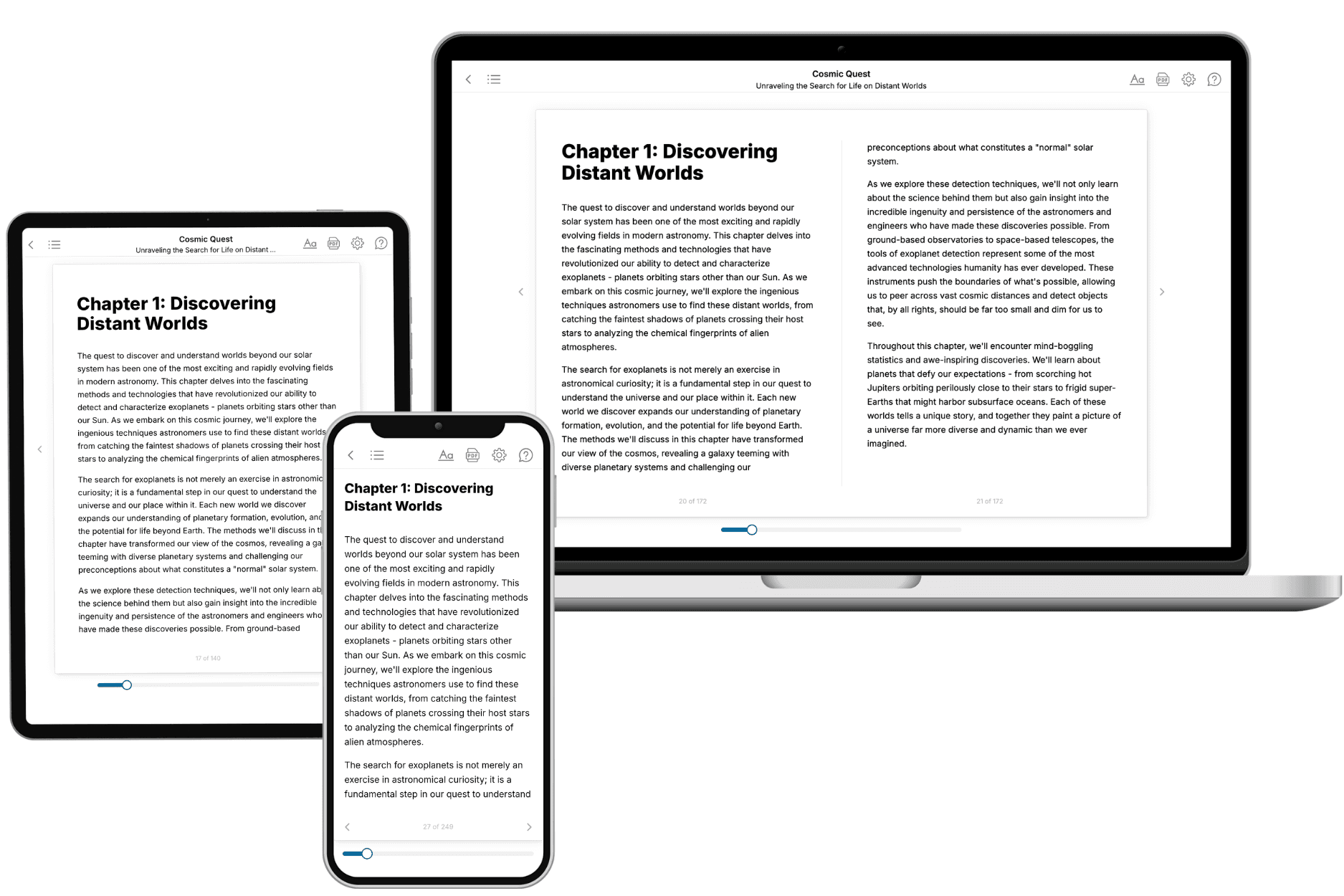
Your book is ready in 10 minutes. Read it online, download as EPUB or PDF, or send to Kindle.
Frequently asked questions
- What is TailoredRead?
TailoredRead creates complete, full-length nonfiction ebooks, written specifically for you. Tell us what you want to learn and why, and TailoredRead writes you a complete ebook on it, with charts, tables, and diagrams throughout. Read it online, on Kindle, or on any e-reader, or download it as a PDF or EPUB. Every book is written fresh the day you order it.
- How is the book tailored to me?
Before anything is written, you answer a few short questions about your goals, your background, and the topics you care about. Your book is then planned around your answers: written at your level, focused on your goals, and covering the topics you chose, instead of the one-size-fits-all book a store sells everyone.
- Will it read like generic AI content?
No. Your book isn't a chat transcript: it's planned chapter by chapter before a single word is written, told in a clear book voice, and explains ideas visually with charts, tables, and diagrams. After writing, every book goes through an editorial pass that polishes chapters so the book reads consistent from start to finish. Judge for yourself: browse thousands of sample books on our Explore Books page.
- How accurate is the content?
Our AI first checks whether your subject needs live research. Niche and fast-moving subjects are researched before writing, and the book plan and chapters are grounded in what it finds. After writing, every book goes through a quality pass that checks its facts and consistency, and researched books list their sources in a Notes section at the back.
- How long is the book?
You choose the length: Comprehensive (250-300 pages), Detailed (150-200 pages), Essential (70-100 pages), or Short (30-50 pages).
- Does the book include visuals?
Yes. Every book includes visual elements such as timelines, checklists, step-by-step guides, decision trees, comparison tables, and matrices, and many include bar charts. A typical book includes dozens of these visual elements.
- Can I read it on Kindle? What formats can I download?
Yes. Every book can be read in our online reader or downloaded as a PDF or EPUB. The EPUB can be opened with Kindle, Apple Books, Kobo, and any e-reader. The Commercial and Author licenses also include an editable Word (DOCX) and Markdown download.
- How much does it cost?
About the price of a regular ebook. The exact price depends on your book's length and complexity, from $2 for the shortest books to $35 for the most comprehensive, and it's shown when you review your book, before you commit to anything. Each book is a one-time purchase, yours to keep, no subscription. Licenses that let you share, teach, or publish your book range from $35.99 to $49.99.
- Can I preview the book before purchasing?
Before you pay, you'll see what your book will cover: the title, a detailed description, the estimated length, and the complete chapter-by-chapter table of contents, so you know what you're getting before you decide. The full text itself is written after you purchase.
- How long does it take to create a book?
About 10 minutes. You can start reading the opening chapters while the rest is still being written.