Multiagent Systems Fundamentals
Building Intelligent Collaborative Systems Through Algorithms and Decision-Making
What if the most complex problems in technology, logistics, and robotics could be solved not by one superintelligent system, but by many simpler agents working together?
222 pages10 chaptersJul 28, 2026Multi-Agent Systems
About this book
Multiagent systems represent a paradigm shift in how we approach distributed problem-solving, and understanding them is increasingly critical in our interconnected world. This book demystifies the core concepts, algorithms, and decision-making frameworks that power multiagent systems. You'll explore how autonomous agents communicate, coordinate, and make decisions in environments where no single entity has complete information. From game-theoretic foundations to practical coordination mechanisms, you'll learn the mathematical principles and algorithmic approaches that enable systems to scale beyond traditional centralized architectures. Whether you're building autonomous systems, optimizing supply chains, or designing collaborative robots, this book provides the conceptual tools and practical insights needed to design systems where distributed intelligence creates emergent solutions greater than the sum of their parts.
Table of contents
- IntroductionWhy Multiagent Systems Matter Today, From Centralized to Distributed Intelligence, What You'll Learn in This BookRead below
- Chapter 1: Foundations of Multiagent SystemsDefining Agents and Agency, Multiagent System Architecture and Components, Types of Agents and Their Characteristics
- Chapter 2: Communication and Information SharingCommunication Protocols and Standards, Message Passing and Information Exchange, Knowledge Representation in Distributed Systems
- Chapter 3: Game Theory and Strategic InteractionGame Theory Fundamentals, Nash Equilibrium and Solution Concepts, Cooperative vs. Non-Cooperative Games
- Chapter 4: Coordination Mechanisms and AlgorithmsCoordination Strategies and Approaches, Consensus and Agreement Algorithms, Task Allocation and Resource Distribution
- Chapter 5: Distributed Decision-MakingLocal Decision-Making and Autonomy, Balancing Local and Global Optimization, Decision-Making Under Uncertainty
- Chapter 6: Learning and Adaptation in Multiagent SystemsReinforcement Learning for Agents, Multi-Agent Learning Dynamics, Adaptation Strategies and Evolution
- Chapter 7: Emergent Behavior and System PropertiesUnderstanding Emergence in Complex Systems, Self-Organization and Pattern Formation, Predicting and Managing Emergent Outcomes
- Chapter 8: Scalability and PerformanceChallenges in Scaling Multiagent Systems, Measuring Efficiency and Performance, Optimization Techniques for Large-Scale Systems
- Chapter 9: Real-World Applications and Case StudiesAutonomous Vehicles and Traffic Management, Supply Chain and Logistics Optimization, Robotic Swarms and Collective Robotics
- Chapter 10: Challenges and Future DirectionsSecurity, Privacy, and Trust in Multiagent Systems, Managing Heterogeneous and Dynamic Environments, Emerging Trends and Future Research Directions
- ConclusionKey Takeaways and Synthesis, Your Next Steps in Multiagent Systems
- Glossary of Key Terms
- Further Reading and Resources
Introduction
A single air traffic controller managing hundreds of flights simultaneously would quickly become overwhelmed. Yet air traffic management systems handle exactly that volume every day, not by making one controller smarter, but by distributing the work across many specialized agents, each handling a defined region of airspace, each communicating with neighbors, and each making local decisions that collectively keep thousands of aircraft safe. That distributed structure is not a workaround for the limits of centralized control. It is a deliberate architectural choice, and it reflects a broader truth about complex systems: some problems are simply better solved by many agents working together than by one agent working alone.
Multiagent Systems (MAS) are computational environments where multiple autonomous agents interact, share information, and coordinate their actions to accomplish tasks. These systems appear across an enormous range of domains. Autonomous vehicles negotiate intersections without a central traffic computer. Supply chain software agents bid on shipping contracts in real time. Robotic swarms map disaster zones without any single robot holding a complete picture of the terrain. In each case, the intelligence of the system emerges from the interactions between agents, not from any single component acting alone.
Understanding how these systems work requires more than knowing how to program a single agent. You need to understand how agents communicate, how they reason about other agents' intentions, how they reach agreement without a central authority, and how their collective behavior can produce outcomes that no individual agent planned or predicted. Those questions sit at the intersection of computer science, mathematics, economics, and cognitive science, and they are what this book is designed to answer. The concepts covered here are not purely academic. They are the foundations of systems being deployed right now in logistics, robotics, finance, and infrastructure management.
This introduction sets the stage for everything that follows. It explains why multiagent approaches have become so relevant, traces the conceptual shift from centralized to distributed intelligence, and maps out the terrain covered across the chapters ahead. If you already have a working knowledge of algorithms and basic software architecture, you have the background needed to engage with the material. The goal is not to overwhelm with formalism but to build genuine understanding, one concept at a time, grounded in concrete examples at every step.
Why Multiagent Systems Matter Today
The problems that matter most in modern technology share a common structure: they are too large, too distributed, or too dynamic for any single system to handle centrally. Consider logistics. A global shipping company might manage millions of packages moving through hundreds of hubs, with conditions changing by the minute due to weather, delays, and demand shifts. No central planner can process all that information fast enough to make optimal decisions in real time. But a network of agents, each managing a local region and communicating with neighbors, can adapt continuously without waiting for instructions from above.
The scale of modern computational infrastructure reinforces this point. Cloud computing platforms now coordinate thousands of servers, each making decisions about load, resource allocation, and fault recovery. Internet-of-Things deployments connect millions of sensors and actuators in smart cities, factories, and hospitals. Financial markets run on algorithmic agents that execute millions of trades per second. In all of these environments, centralized control is not just impractical; it is a single point of failure. Distributed agent architectures provide resilience by design.
There is also a scientific motivation. Multiagent systems provide a formal framework for studying phenomena that appear throughout nature and society. Ant colonies, immune systems, financial markets, and social networks all exhibit complex collective behavior arising from simple local interactions. The study of Swarm Intelligence and Complex Adaptive Systems draws directly on multiagent modeling to understand how these phenomena work and how they can be engineered or influenced. That connection between computational models and natural systems gives MAS research an unusually broad reach.
From a practical engineering standpoint, multiagent architectures offer specific advantages that are difficult to replicate with monolithic designs. These advantages include:
- Modularity: agents can be developed, tested, and updated independently without rebuilding the entire system.
- Fault Tolerance: if one agent fails, others can compensate, preventing system-wide collapse.
- Scalability: new agents can be added to handle increased load without redesigning the architecture.
- Parallelism: agents work simultaneously, reducing the time needed to solve large problems.
- Adaptability: agents can adjust their behavior in response to changing conditions without central reprogramming.
These properties are not free. They come with real costs in coordination complexity, communication overhead, and the difficulty of predicting system-level behavior. A multiagent system that is poorly designed can produce chaotic, inefficient, or even harmful outcomes. Understanding both the benefits and the pitfalls is what separates a practitioner who can build effective MAS from one who simply knows the terminology.
The growing importance of artificial intelligence has also pushed multiagent systems to the forefront of research and industry. As AI systems become more capable and more numerous, the question of how multiple AI agents interact, compete, and cooperate becomes increasingly urgent. Whether the context is autonomous vehicles sharing roads, AI assistants negotiating on behalf of users, or robotic systems collaborating in warehouses, the principles of multiagent coordination are directly relevant. The field is no longer a niche academic specialty. It is infrastructure for the next generation of intelligent systems.[1]
One concrete example illustrates the stakes clearly. In 2010, a sequence of automated trading agents interacting on U.S. stock markets triggered what became known as the Flash Crash, briefly erasing nearly a trillion dollars in market value before prices recovered within minutes. No single agent caused the crash. The outcome emerged from the interactions between many agents, each behaving rationally according to its own rules, but collectively producing a catastrophic feedback loop. That event demonstrated that understanding multiagent dynamics is not just an academic exercise. The consequences of getting it wrong can be measured in real economic damage.[2]
From Centralized to Distributed Intelligence
Early computing was built around a simple model: one processor, one program, one stream of instructions. Even as hardware grew more powerful, the dominant design pattern remained centralized. A single system received inputs, processed them, and produced outputs. This model works well for problems that fit neatly within the memory and processing capacity of one machine. But as problems grew in scale and complexity, its limitations became increasingly apparent.
The shift toward distributed computing began as an engineering necessity. Networks of machines could share workloads that no single machine could handle. But distributing computation introduced new challenges: how do separate machines coordinate? How do they agree on shared state? How do they handle failures in one part of the network without corrupting the whole? These questions drove the development of distributed systems theory, which laid important groundwork for multiagent systems research.
The conceptual leap from distributed computing to multiagent systems involves adding Agency to the picture. In a standard distributed system, components follow fixed protocols and do not have goals of their own. An Agent, by contrast, is an autonomous entity with its own objectives, beliefs about the world, and capacity to act on its environment. When you populate a distributed system with agents rather than passive components, the system's behavior becomes far richer and far harder to predict. Agents can cooperate, compete, negotiate, and adapt in ways that passive components cannot.
A useful way to understand this shift is to compare two approaches to managing a city's traffic flow. A centralized approach uses a single control system that receives data from all traffic sensors, computes optimal signal timings, and sends commands to every traffic light. This works well when the system is functioning and the data is complete. But it creates a single point of failure, requires enormous communication bandwidth, and struggles to adapt quickly to local incidents. A multiagent approach instead gives each intersection its own agent that monitors local conditions, communicates with neighboring intersections, and adjusts its own timing based on both local data and messages from nearby agents. The system is more resilient, more responsive, and scales naturally as the city grows.
The tradeoffs between these two approaches are not always obvious. Centralized systems can achieve globally optimal solutions more easily because they have access to all information. Distributed multiagent systems often settle for solutions that are locally good but globally suboptimal, because no single agent has the full picture. This tension between local rationality and global efficiency runs through almost every topic in this book. It appears in game theory, in coordination algorithms, in learning dynamics, and in the design of real-world applications.
Three architectural patterns have emerged as the main ways to organize multiagent systems, each representing a different point on the centralized-to-distributed spectrum:
- Hierarchical architectures: agents are organized in layers, with higher-level agents coordinating lower-level ones. This preserves some centralized oversight while distributing execution.
- Market-based architectures: agents interact through economic mechanisms like auctions and contracts, using price signals to coordinate without explicit central control.
- Peer-to-peer architectures: agents interact directly with neighbors, with no hierarchy and no central coordinator. Coordination emerges from local interactions alone.
Each pattern has domains where it excels and domains where it struggles. Hierarchical architectures work well when there is a natural decomposition of tasks and a need for accountability. Market-based architectures handle resource allocation efficiently when agents have well-defined preferences. Peer-to-peer architectures are most resilient and scalable but hardest to design for predictable global behavior. Real systems often combine elements of all three.
The intellectual history of this shift is worth noting briefly. Researchers in artificial intelligence, distributed computing, economics, and biology all contributed to the foundations of multiagent systems, often independently. The convergence of these fields in the 1980s and 1990s produced a distinct research community with its own conferences, journals, and canonical problems. That interdisciplinary heritage is still visible in the field today, which is one reason MAS draws on such a diverse toolkit of mathematical and computational methods.[3]
Understanding where multiagent systems sit relative to other paradigms helps clarify what they are good for and what they are not. They are not a replacement for centralized systems in every context. When a problem is small enough to fit within one system, when global optimality is critical, or when coordination costs are prohibitive, a centralized approach may be better. The skill lies in recognizing which problems genuinely benefit from distributed agent architectures and designing those architectures with the right coordination mechanisms for the task at hand.
What You'll Learn in This Book
This book is organized as a progressive journey through the core concepts of multiagent systems, starting with foundational definitions and building toward advanced topics in learning, emergence, and real-world deployment. Each chapter introduces new concepts while connecting them to what came before, so the material accumulates into a coherent picture rather than a collection of isolated topics. The sequence is deliberate: later chapters assume familiarity with earlier ones, so working through them in order will give you the strongest foundation.
The first chapter establishes the definitional bedrock. It answers the question that every other chapter assumes you can answer: what exactly is an agent, and what makes a collection of agents a system? You will encounter the key properties that distinguish agents from ordinary software components, including autonomy, reactivity, proactivity, and social ability. You will also see the main architectural patterns used to build agents, from simple Reactive Agents that respond directly to stimuli, to Deliberative Agents that reason about goals and plans, to Hybrid Agents that combine both approaches. The BDI Model, which represents agents in terms of Beliefs, Desires, and Intentions, receives particular attention because it provides a clean conceptual framework that reappears throughout the book.
The second chapter turns to communication. Agents that cannot exchange information cannot coordinate, so understanding how agents talk to each other is fundamental. The chapter covers the major Communication Protocols and standards, including FIPA ACL and KQML, and explains the concept of Speech Acts, which treats messages not just as data transfers but as actions with social meaning. Message Passing architectures, shared memory models, and the role of Ontology in ensuring that agents interpret messages consistently are all examined in practical terms.
The third chapter introduces Game Theory, the mathematical framework for analyzing strategic interaction between self-interested agents. You will work through Payoff Matrices, the Prisoner's Dilemma, and the concept of Nash Equilibrium, which describes stable outcomes where no agent can improve its situation by changing strategy alone. The distinction between Cooperative Games and non-cooperative games, and the concept of Pareto Optimality, provide tools for evaluating whether a system's outcomes are collectively good or merely individually stable. Mechanism Design, the engineering counterpart to game theory, shows how to structure incentives so that agents' self-interested behavior produces desirable collective outcomes.
The fourth chapter covers coordination. Even agents that communicate well and understand each other's incentives still need mechanisms to align their actions. The chapter examines a range of Coordination Mechanisms, from Consensus Algorithms that help agents agree on shared facts, to the Contract Net Protocol for task assignment, to Auction Mechanisms for resource allocation. Distributed Constraint Optimization provides a formal framework for problems where agents must satisfy constraints while optimizing a shared objective. The chapter also covers Stigmergy, the indirect coordination mechanism used by ant colonies and other biological systems, which has inspired a family of powerful algorithms for distributed optimization.
The fifth chapter examines decision-making. Individual agents must make choices under uncertainty, often with incomplete information about the world and about other agents' intentions. The Markov Decision Process and its partially observable variant, the Partially Observable MDP, provide the formal machinery for modeling sequential decision problems. Utility Functions capture agent preferences, while Bounded Rationality acknowledges that real agents cannot compute optimal solutions to every problem they face. The chapter explores how local decisions aggregate into global outcomes, and when that aggregation goes well or badly.
The sixth chapter addresses learning and adaptation. Static agents that follow fixed rules cannot handle environments that change over time. Reinforcement Learning gives agents a mechanism for improving their behavior through experience, and Q-Learning is examined as a concrete algorithm for doing so. Multi-Agent Reinforcement Learning extends these ideas to settings where multiple agents are learning simultaneously, introducing the challenge of Non-Stationarity: each agent's environment changes as other agents learn, making the learning problem fundamentally harder than the single-agent case. The tension between Exploration vs. Exploitation appears here in a new light, shaped by the presence of other learning agents.
The seventh chapter examines emergence and self-organization. Some of the most striking behaviors in multiagent systems are not programmed into any individual agent but arise from the interactions between agents. Emergence and Self-Organization are examined through concrete examples, from the formation of traffic jams to the collective intelligence of Robotic Swarms. Feedback Loops are identified as the key mechanism driving emergent behavior, and the chapter provides practical guidance on how to anticipate, harness, or suppress emergent outcomes in system design.
The eighth chapter tackles scalability. A multiagent system that works well with ten agents may fail completely with ten thousand. Scalability challenges are examined systematically, covering communication bottlenecks, coordination overhead, and the difficulty of maintaining Fault Tolerance at scale. Performance metrics including Throughput and Load Balancing are defined and connected to specific optimization techniques. The chapter provides a practical toolkit for diagnosing and addressing performance problems in large-scale deployments.
The ninth chapter grounds all of this theory in three concrete application domains. Autonomous Vehicle Coordination shows how agents negotiate right-of-way, share sensor data, and optimize traffic flow without central control. Supply Chain Optimization demonstrates how agent-based approaches handle the complexity of global logistics networks with dynamic demand and disruptions. Robotic Swarm applications illustrate how simple agents following local rules can accomplish sophisticated collective tasks like search and rescue or environmental monitoring. Each case study connects back to the theoretical concepts from earlier chapters, showing how abstract ideas translate into deployed systems.
The tenth and final chapter looks ahead. Open problems in security, trust, and the management of Heterogeneous Agents are examined alongside emerging research directions. Adversarial Agents and Byzantine Fault tolerance raise questions about how systems can remain robust when some agents behave maliciously or unpredictably. Trust Models provide mechanisms for agents to reason about the reliability of information from other agents. The chapter closes by identifying the trajectories most likely to shape the field over the coming decade, from the integration of deep learning with multiagent coordination to the governance challenges posed by large-scale autonomous systems.
Throughout all of this, the emphasis is on building genuine understanding rather than surface familiarity. Each concept is introduced with a concrete example, connected to related concepts, and examined from both a theoretical and a practical angle. The goal is that by the time you finish, you will not just know what a Nash Equilibrium is or how a Consensus Algorithm works. You will understand why these concepts matter, when to apply them, and what can go wrong when they are misapplied. That kind of understanding is what makes the difference between knowing about multiagent systems and actually being able to build them.
Notes
Introduction
- 1. Michael Wooldridge, An Introduction to MultiAgent Systems, John Wiley and Sons, 2009
- 2. Andrei Kirilenko and others, "The Flash Crash: High-Frequency Trading in an Electronic Market," The Journal of Finance, 2017
- 3. Victor Lesser, "Reflections on the Nature of Multi-Agent Coordination and Its Implications for an Agent Architecture," Autonomous Agents and Multi-Agent Systems, 1998
This is the end of the free sample. The full book has 10 chapters.
Want this book written for you?
Tell us your goals and background, and get your own version of this book, tailored by AI to you.


Benefits of AI-tailored books
- Read one book, not ten:
- all the Multi-Agent Systems knowledge you need, gathered into a single book.
- Save days of learning:
- tell us your goals, choose your topics, and the whole book is built around them.
- Learn effortlessly:
- Multi-Agent Systems book written for your specific background and expertise.
- Understand at a glance:
- includes charts, tables, timelines, checklists, decision trees, and more.
- Stay current:
- written the day you order it, not years ago.
- Trust what you read:
- every book is checked for accuracy, with real research when your subject needs it.
Create your unique book in 3 steps
- 1. Select your focus
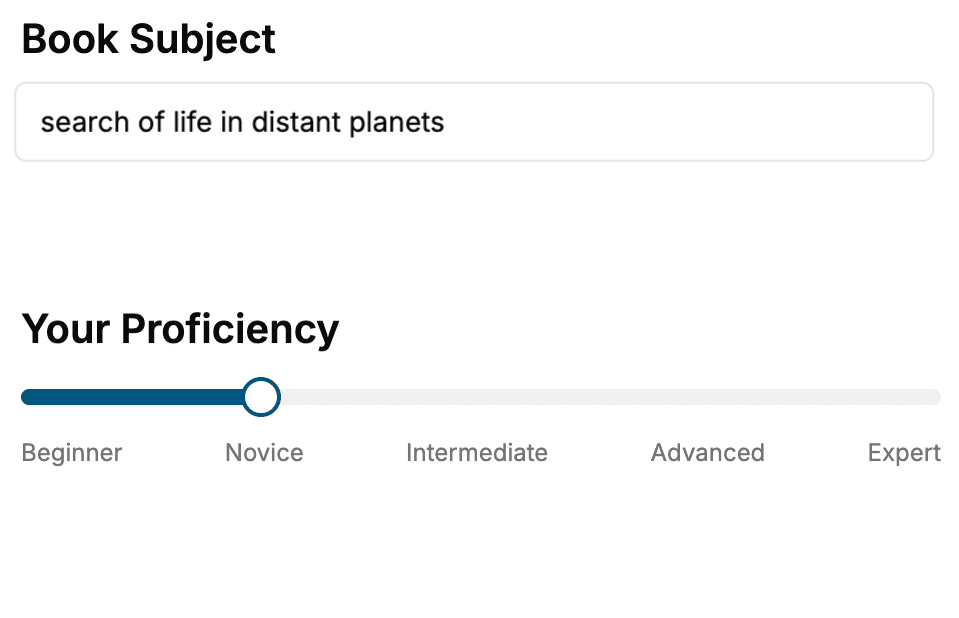
Select the focus of your Multi-Agent Systems book and share your background
- 2. Personalize your book
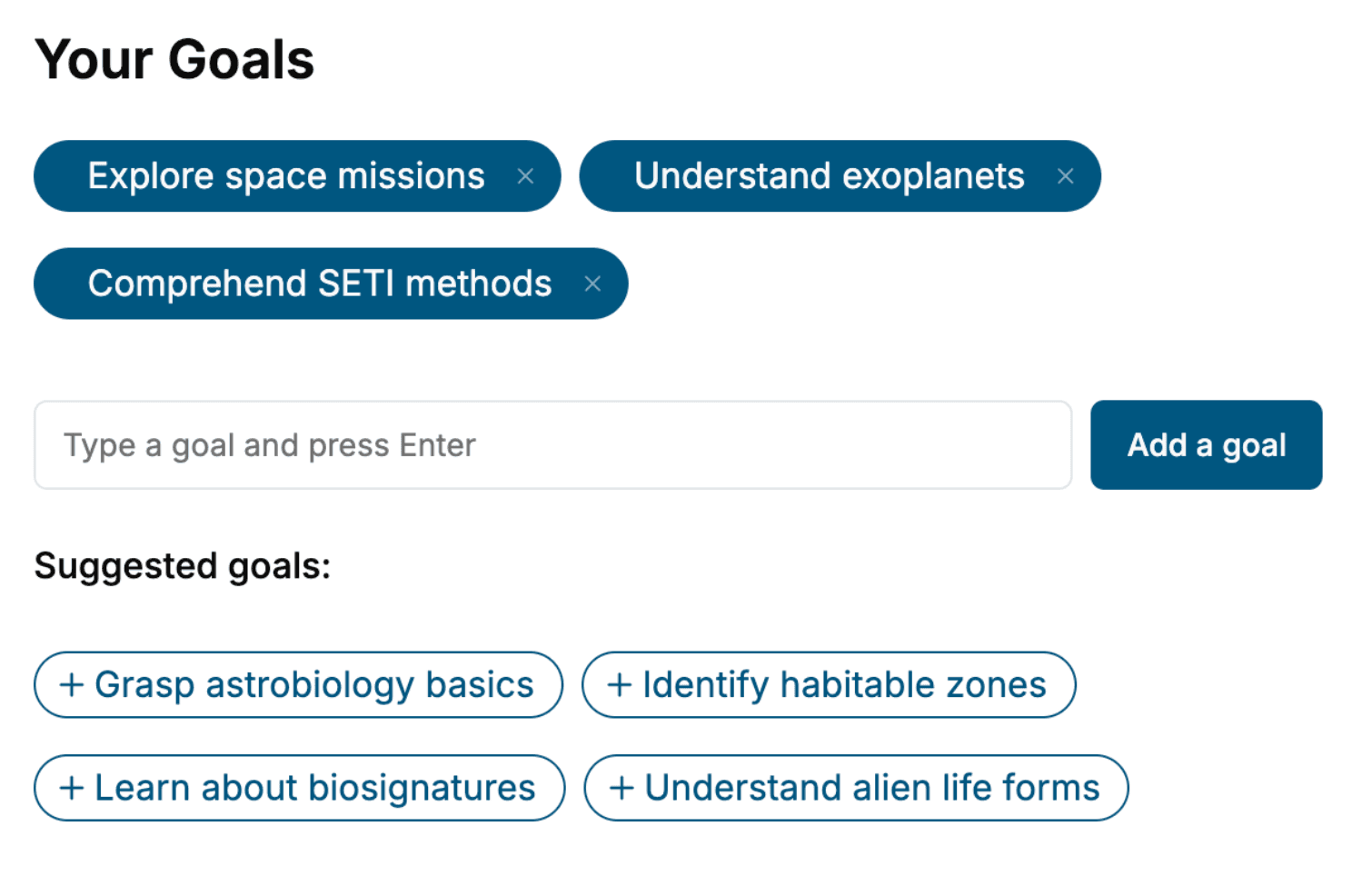
Specify your goals and choose sub-topics to include
- 3. Get your tailored book
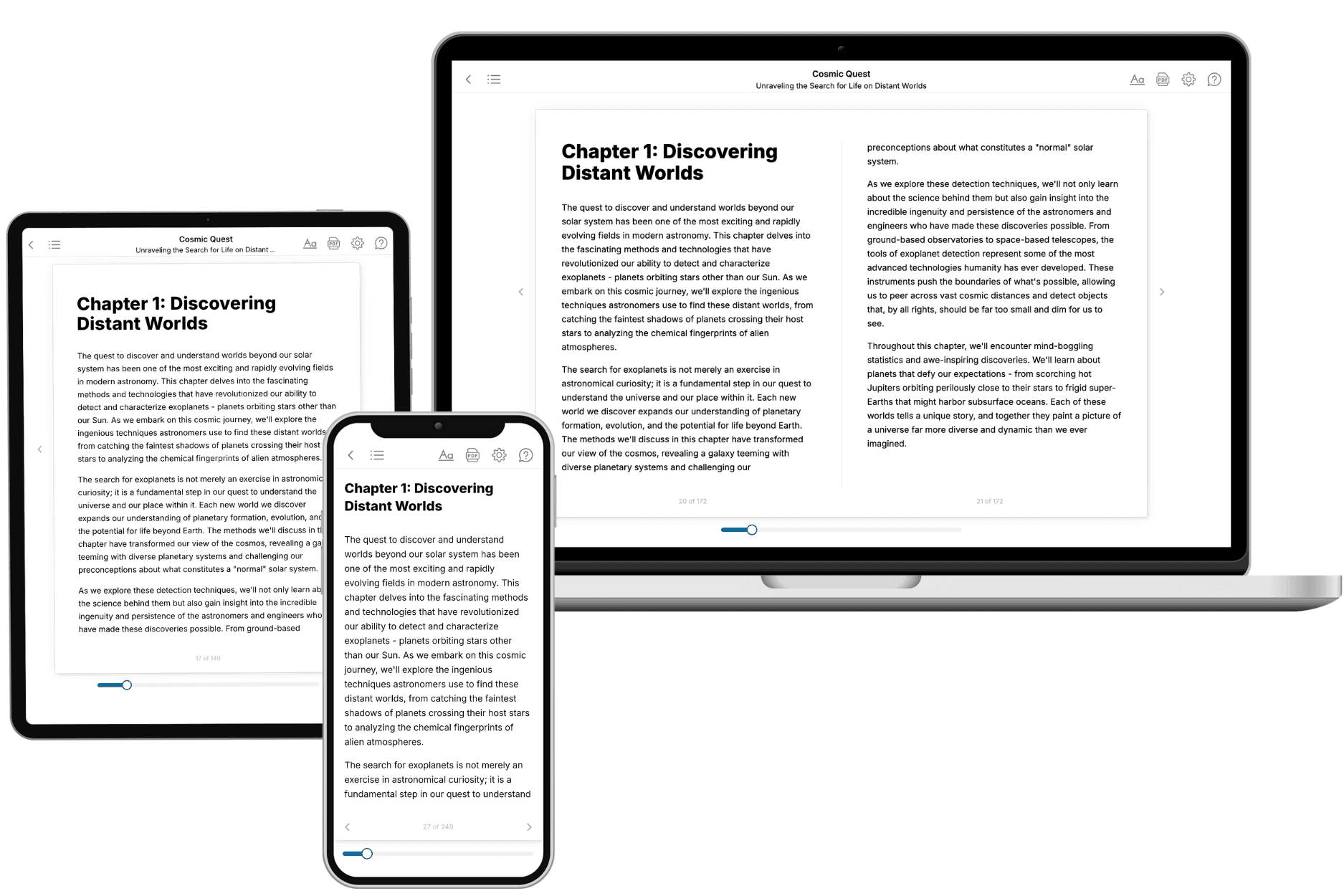
Your book is ready in 10 minutes. Read it online, download as EPUB or PDF, or send to Kindle.
Frequently asked questions
- What is TailoredRead?
TailoredRead creates complete, full-length nonfiction ebooks, written specifically for you. Tell us what you want to learn and why, and TailoredRead writes you a complete ebook on it, with charts, tables, and diagrams throughout. Read it online, on Kindle, or on any e-reader, or download it as a PDF or EPUB. Every book is written fresh the day you order it.
- How is the book tailored to me?
Before anything is written, you answer a few short questions about your goals, your background, and the topics you care about. Your book is then planned around your answers: written at your level, focused on your goals, and covering the topics you chose, instead of the one-size-fits-all book a store sells everyone.
- Will it read like generic AI content?
No. Your book isn't a chat transcript: it's planned chapter by chapter before a single word is written, told in a clear book voice, and explains ideas visually with charts, tables, and diagrams. After writing, every book goes through an editorial pass that polishes chapters so the book reads consistent from start to finish. Judge for yourself: browse thousands of sample books on our Explore Books page.
- How accurate is the content?
Our AI first checks whether your subject needs live research. Niche and fast-moving subjects are researched before writing, and the book plan and chapters are grounded in what it finds. After writing, every book goes through a quality pass that checks its facts and consistency, and researched books list their sources in a Notes section at the back.
- How long is the book?
You choose the length: Comprehensive (250-300 pages), Detailed (150-200 pages), Essential (70-100 pages), or Short (30-50 pages).
- Does the book include visuals?
Yes. Every book includes charts, tables, and diagrams: timelines, checklists, step-by-step guides, decision trees, comparison tables, matrices, and bar charts. A typical book includes dozens of these visual elements.
- Can I read it on Kindle? What formats can I download?
Yes. Every book can be read in our online reader or downloaded as a PDF or EPUB. The EPUB can be opened with Kindle, Apple Books, Kobo, and any e-reader. The Commercial and Author licenses also include an editable Word (DOCX) and Markdown download.
- How much does it cost?
About the price of a regular ebook. The exact price depends on your book's length and complexity, from $2 for the shortest books to $35 for the most comprehensive, and it's shown when you review your book, before you commit to anything. Each book is a one-time purchase, yours to keep, no subscription. Licenses that let you share, teach, or publish your book range from $35.99 to $49.99.
- Can I preview the book before purchasing?
Before you pay, you'll see what your book will cover: the title, a detailed description, the estimated length, and the complete chapter-by-chapter table of contents, so you know what you're getting before you decide. The full text itself is written after you purchase.
- How long does it take to create a book?
About 10 minutes. You can start reading the opening chapters while the rest is still being written.